Stanza · Audio guide
Pałac Kultury i Nauki Audio Guide
A place to remember. A story to take with you.
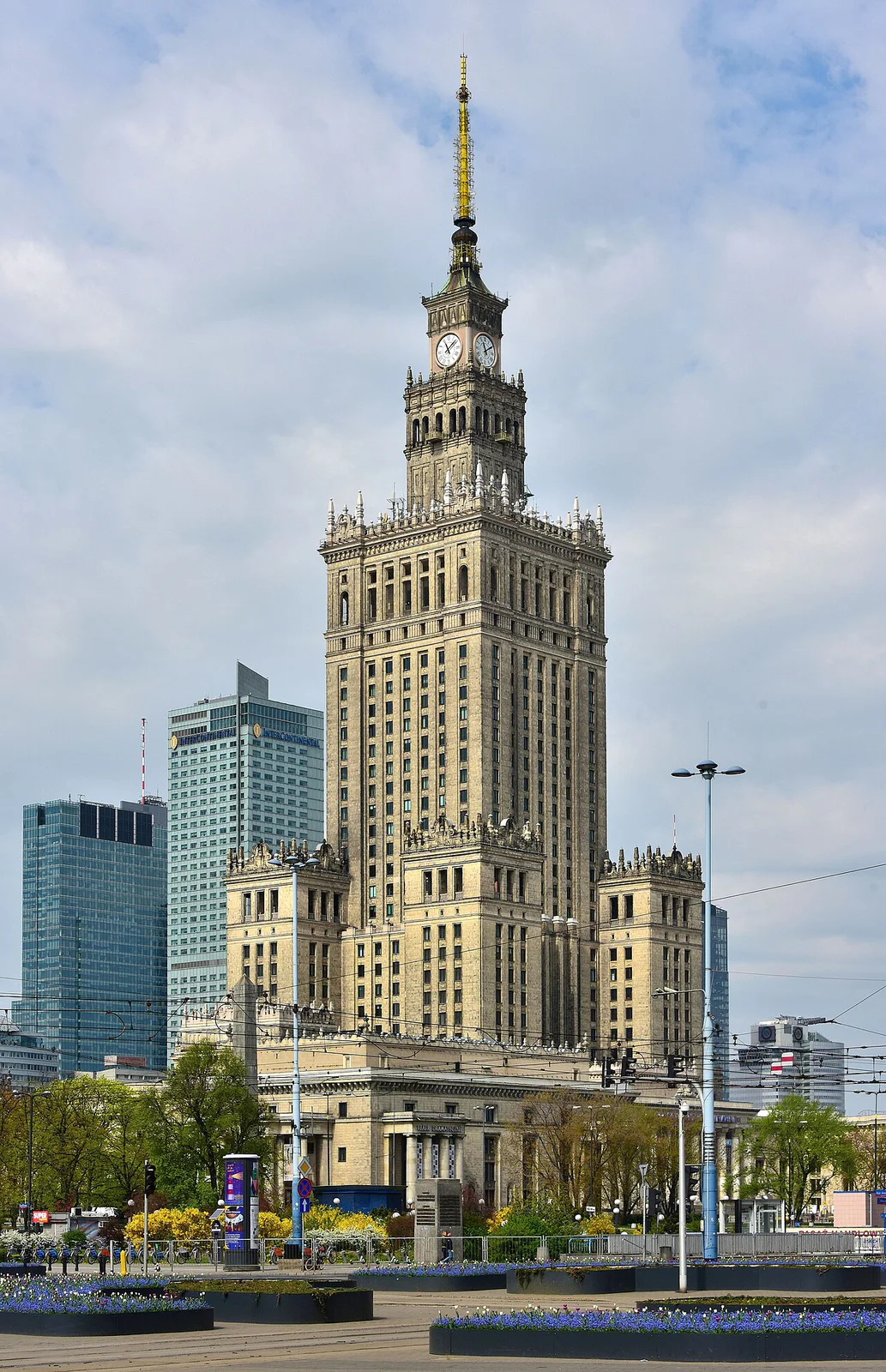
The Palace of Culture and Science is a notable high-rise building in central Warsaw, Poland. It is the second tallest building in both Warsaw and Poland.
Download Stanza, then search for “Pałac Kultury i Nauki”.
About the tour
One guide. Your kind of visit.
The Palace of Culture and Science is a notable high-rise building in central Warsaw, Poland. It is the second tallest building in both Warsaw and Poland.
Ready when you are.
- 01Get the free Stanza app.
iOS & Android
- 02Find your guide.
“Pałac Kultury i Nauki”
- 03Download before you go.
Works offline
Audio guide / 13 narrated stops
Inside the guide
Get to know a few of the stories before you go. Open a stop to read more.
01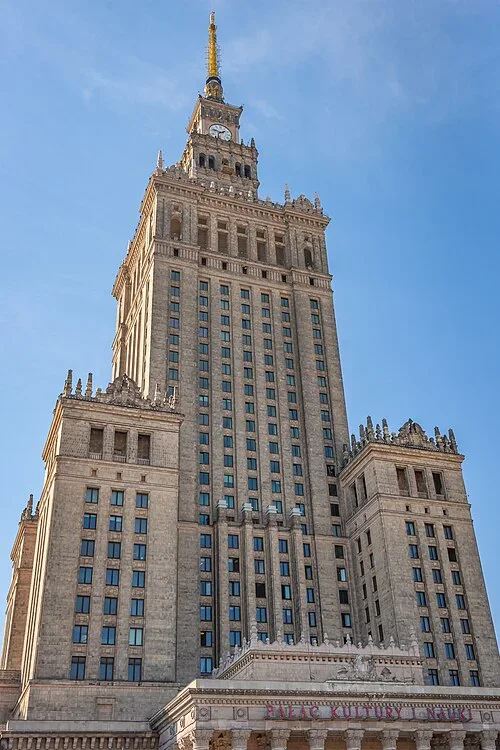 Plac Defilad and the Monumental Facade
The Palace from Plac Defilad
Welcome to the Palace of Culture and Science, the vast tower at the heart of Warsaw, and the subject of this tour. The Soviet Union offered it to the people of Poland as a gift, and the two governments signed the agreement in April 1952. Its height was fixed in an unusual way. Soviet and Polish architects gathered near the eastern approach of the Silesian-Dąbrowa Bridge. A small airplane flew over the building site, towing a balloon on a long line. The first pass came at a hundred metres, and the plane climbed higher with each circle. Lev Rudnev, who led the Soviet architects, judged a hundred and twenty metres enough for the tallest building in the city. Józef Sigalin, Warsaw's chief architect, thought otherwise. After every pass, the Polish side shouted a single word: higher. In the end the tower rose to two hundred and thirty-seven metres. The main structure takes the first hundred and twenty metres. A turret and a slender spire carry the rest. When it opened in July 1955 it ranked among the tallest buildings in the world, and it still dominates Plac Defilad.
Photo: Fotodruk · CC BY 4.0
02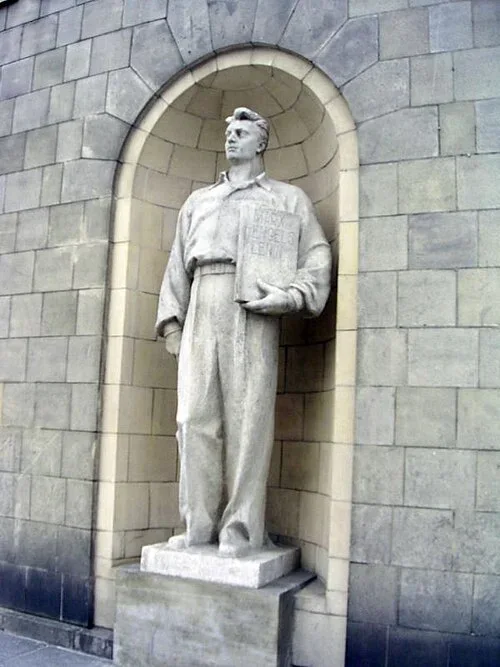 Plac Defilad and the Monumental Facade
The Worker Statue in the Facade Niche
A young man in work clothes stands in one of the facade niches, holding a heavy volume against his chest. The spine reads Marx, Engels, Lenin. Figures like this one fill the palace's outer walls, standing for the fields of culture and science that gave the building its name. At the opening it carried a heavier name still: the Joseph Stalin Palace of Culture and Science. A bronze statue of Stalin himself was planned for the main portico. Then the political thaw came, and the dedication to Stalin was revoked. His name was chiselled off the colonnade, removed from the interior lobby, and cut out of one of the building's sculptures. On this facade the place where the word Stalin stood is still visible as a trace beside the book. The worker with his volume stayed where he was.
Ireneusz S. Wierzejski · CC BY-SA 3.0
03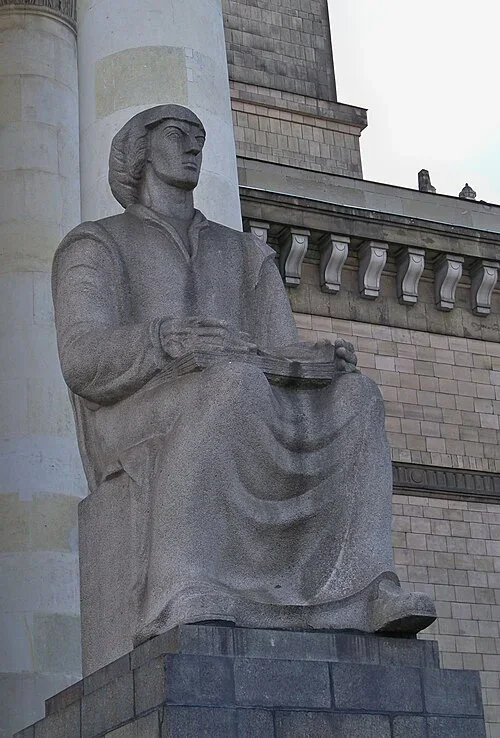 The Grand Portico: Copernicus and Mickiewicz Statues
Nicolaus Copernicus by Ludwika Nitschowa
Seated with a book open on his knees sits Nicolaus Copernicus, the astronomer. Ludwika Nitschowa, a Polish sculptor, carved this granite figure in the nineteen-fifties. He represents the science half of the palace's name. The Soviet architect Lev Rudnev wanted the tower to feel Polish, and he went to see the country for himself. He travelled to Kraków, Chełmno and Zamość to study Polish architecture at first hand. The evidence sits high on the walls around this statue. The carved parapets edging the roofline copy the Renaissance attics of townhouses and palaces in Kraków and Zamość. Rudnev and his team drew up five designs before one was chosen. The Polish side added its own requests to the winning plan, including theatres and exhibition halls inside the building.
Listen in the appPhoto: Panek · CC BY-SA 4.0
04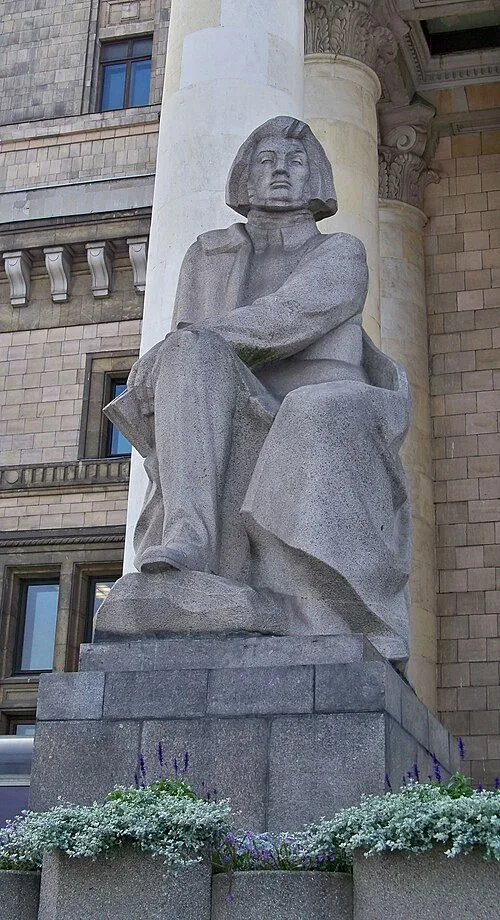 The Grand Portico: Copernicus and Mickiewicz Statues
Adam Mickiewicz by Stanisław Horno-Popławski
Across the portico from Copernicus sits Adam Mickiewicz, Poland's national poet. Stanisław Horno-Popławski carved him from granite in the same years, seated and wrapped in a heavy coat, a book resting in his lap. He carries the culture half of the palace's name, as the astronomer carries its science. Together the two make a pointed pair. Poland's own heroes, by Polish sculptors, guard the entrance of a monument built under Soviet direction. Whatever the building was meant to say when it opened, the figures at its door have always spoken for Poland.
Listen in the appPhoto: Panek · CC BY-SA 4.0
05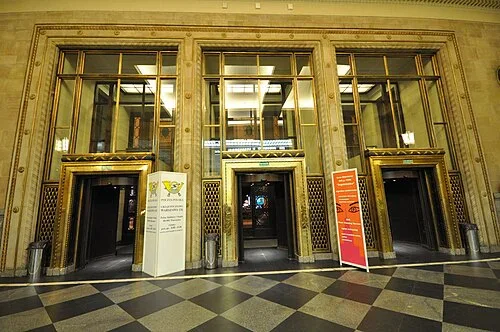 The Grand Vestibule and the Marble Hall
The Grand Vestibule
Inside the main entrance, the hall opens up with brass-framed glass doors and polished stone. A vast workforce built all of this. Somewhere between three and a half and five thousand Soviet guest workers came to Warsaw for the job. Around four thousand Polish workers laboured beside them. War-damaged Warsaw had almost no housing to spare, so a neighbourhood was built for the newcomers in Bemowo, called Osiedle Przyjaźń, the Friendship Neighbourhood. It had wooden houses, a cinema, a food hall, a community centre and a swimming pool. Sixteen workers died in accidents during construction. They were buried together at the Orthodox cemetery in Wola. The scale of what they raised is hard to grasp: three thousand two hundred and eighty-eight rooms, with lifts behind brass doors like these to carry people up through them.
Listen in the appJorge Láscar from Australia · CC BY 2.0
06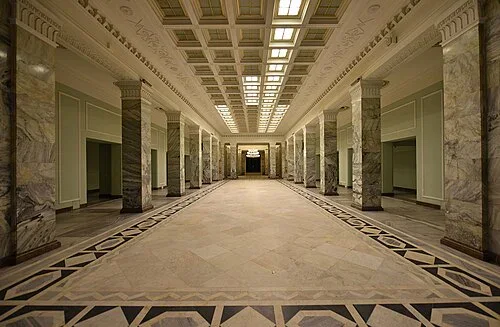 The Grand Vestibule and the Marble Hall
The Marble Hall (Sala Marmurowa)
The Marble Hall is the palace at its most luxurious. A long avenue of grey-veined marble columns runs down the middle, and the coffered ceiling glows with light from above. The floor spreads out in geometric patterns of pale and dark stone. Polish craftsmen produced this work in the nineteen-fifties, carving and polishing by hand. Professor Irena Huml of the Institute of Art put it plainly. There are no interiors from the fifties in Poland preserved like these, she said, made by the best artists and craftsmen in wood, stone and metal, and destroying them would be terrible. In 2007 the palace entered the Registry of Objects of Cultural Heritage. Workmanship like this hall's was the decisive argument.
Listen in the appAdrian Grycuk · CC BY-SA 3.0 pl
07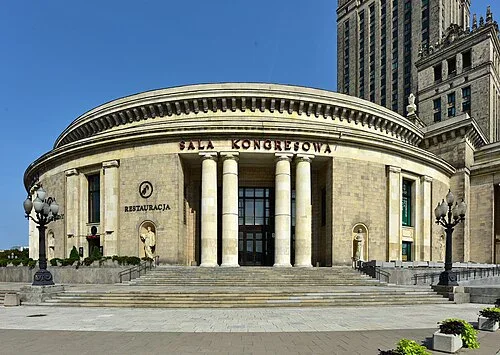 Congress Hall (Sala Kongresowa)
The Congress Hall Rotunda
The round building beside the tower is the Congress Hall, the palace's great arena of assembly. Its rotunda holds an amphitheatre of three thousand seats. In the decades after the palace opened, this was where the ruling party held its congresses and the state staged its official conventions. The hall was conceived as an ideological stage, and for years it played that part. It has stood closed since 2014.
Listen in the appAdrian Grycuk · CC BY-SA 3.0 pl
08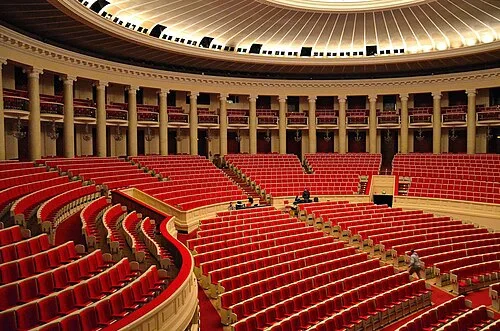 Congress Hall (Sala Kongresowa)
Inside the Congress Hall
Inside, the auditorium is a wide bowl of red seats beneath a ring of columns. In 1967 the Rolling Stones played here, the first major western rock group to hold a concert behind the Iron Curtain. Leonard Cohen followed in 1985. His concert fell during the period of martial law in Poland, and intense expectations surrounded it. The audience waited to hear whether he would say something about the growing Solidarity movement.
Listen in the appAdrian Grycuk · CC BY-SA 3.0 pl
09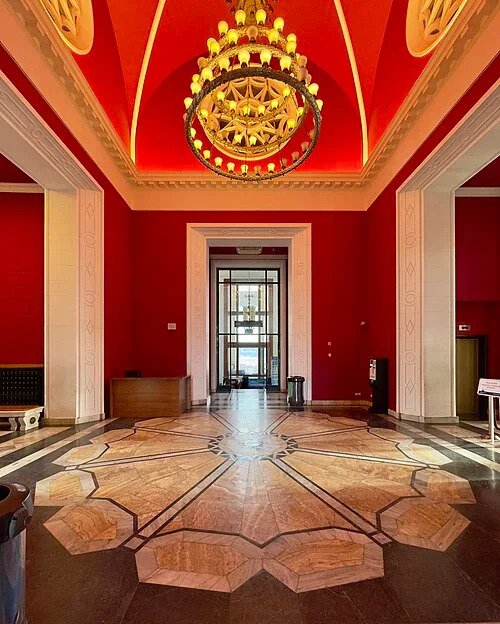 The 30th-Floor Observation Terrace
The 30th-Floor Red Hall
The lift ride to the thirtieth floor ends in a hall of deep red. A vaulted ceiling burns scarlet above a star-shaped chandelier, and the marble floor spreads out in a pattern of pale petals. This room is the threshold between the lift and the open air. Beyond its far doorway lies the observation terrace, a hundred and fourteen metres above the city, open to visitors since the palace began.
Listen in the appChris Olszewski · CC BY-SA 4.0
10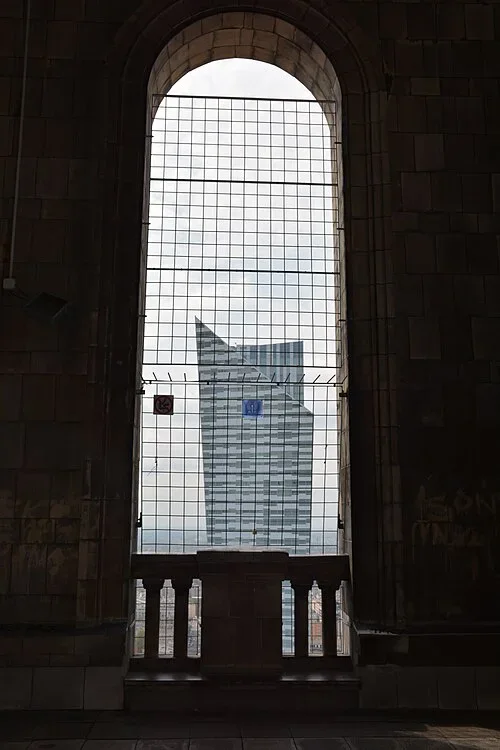 The 30th-Floor Observation Terrace
The Barred Observation Window
The arches around the observation deck are framed in heavy steel mesh, and there is a painful reason why. In 1956, the palace's first full year, a young Frenchman jumped from the observation deck. Seven Polish nationals followed him that year, one after another. After those deaths the deck was enclosed in steel bars. The mesh across the glass is that decision, still in place.
Listen in the appRoman Eugeniusz · CC BY-SA 3.0
- 11
The Panorama from the Terrace
The classic view over Warsaw, now shared with glass towers and a family of peregrine falcons.
- 12
The Clock Tower and Spire
Four six-metre clock faces, among the highest-set tower clocks in the world, above decades of broadcasting.
- 13
Teatr Dramatyczny and the Palace Today
A working cultural city in one building, and the demolition debate that has never gone away.
Pałac Kultury i Nauki
Frequently asked questions
How much does the guide cost?
Free app download. Listed guide price: $0.99. Guide price shown in the app. Audio guide only. Venue admission is separate.
Can I listen without internet?
Yes. Download the guide’s audio, images, and maps in the app before your visit. Your downloaded content is then available offline.
Can I listen in my language?
This audio guide is available in 15 languages, including English.
Do I need to follow a schedule?
No. This is a self-guided experience. Choose your stops, pause whenever you like, and return to a story at your own pace.
At your own pace
Explore Pałac Kultury i Nauki.
Download Stanza, then search for “Pałac Kultury i Nauki”.
Free app download · Guide price shown in the app
Keep exploring
Audio guides — Poland
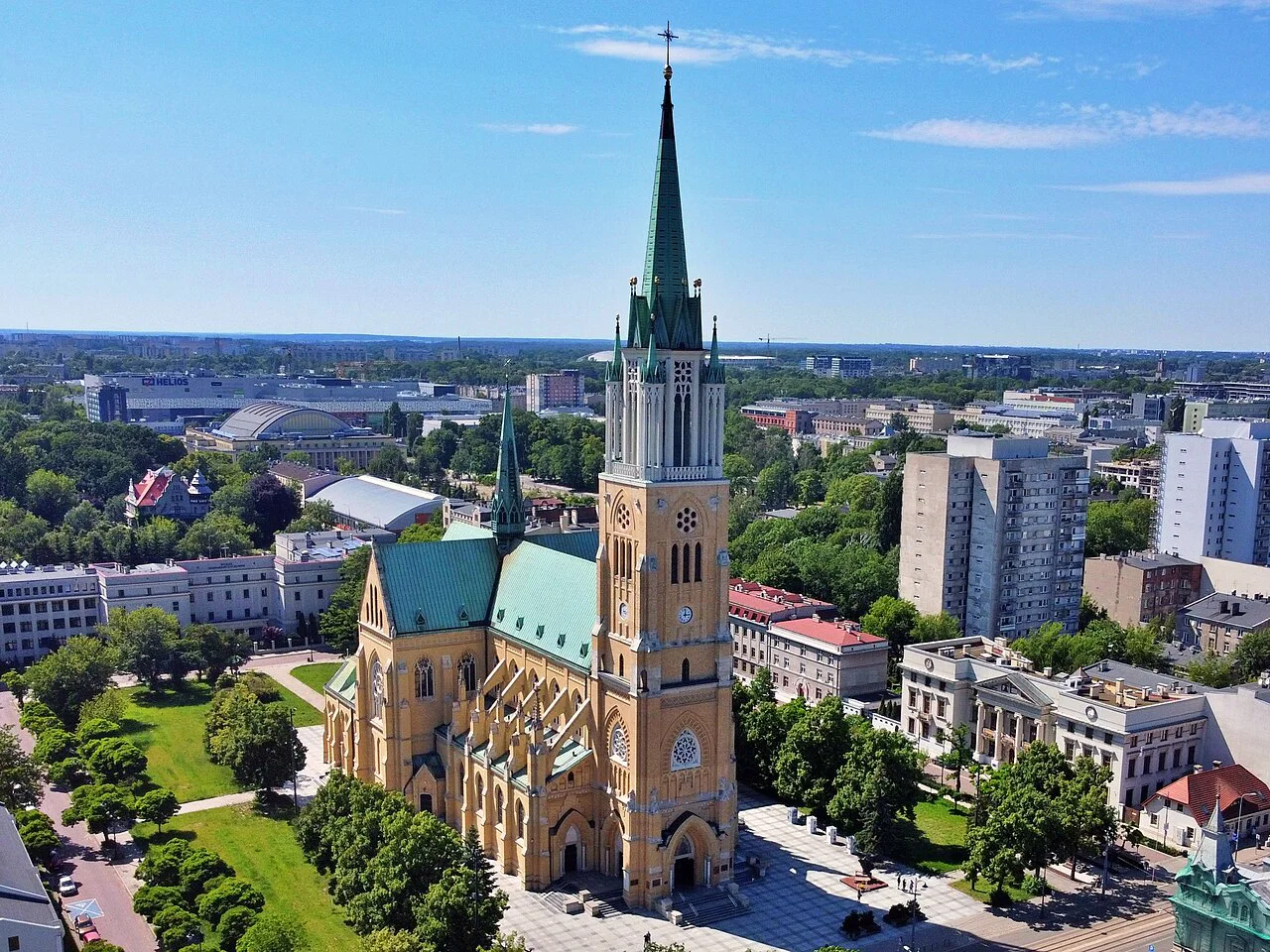
Łódź · 119 km
Bazylika Archikatedralna św. Stanisława Kostki w Łodzi
Content & sources
Photo: Kapitel · CC BY-SA 4.0
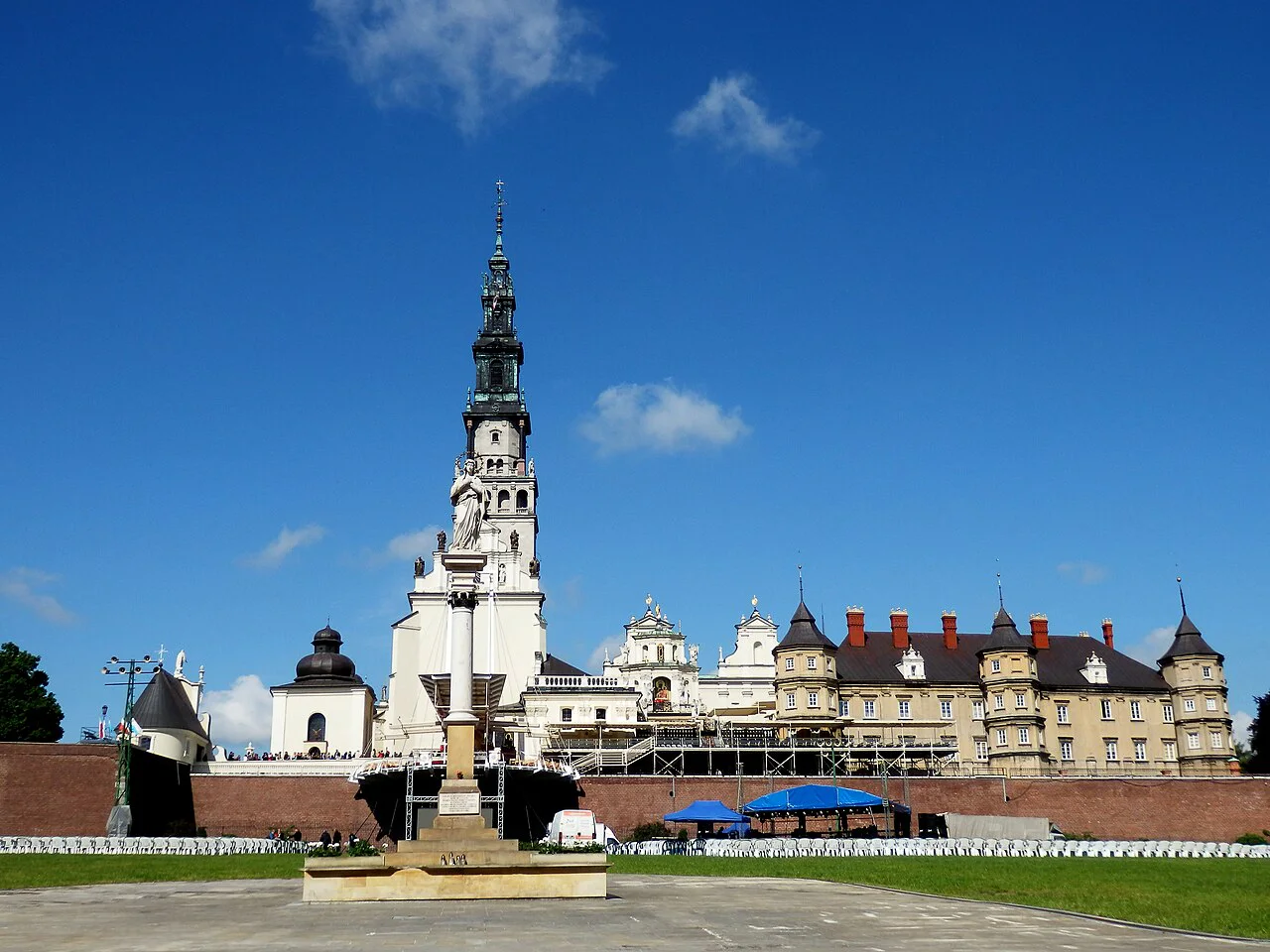
Częstochowa
Jasna Góra
Content & sources
Photo: Ebielmaj · CC BY-SA 3.0 pl
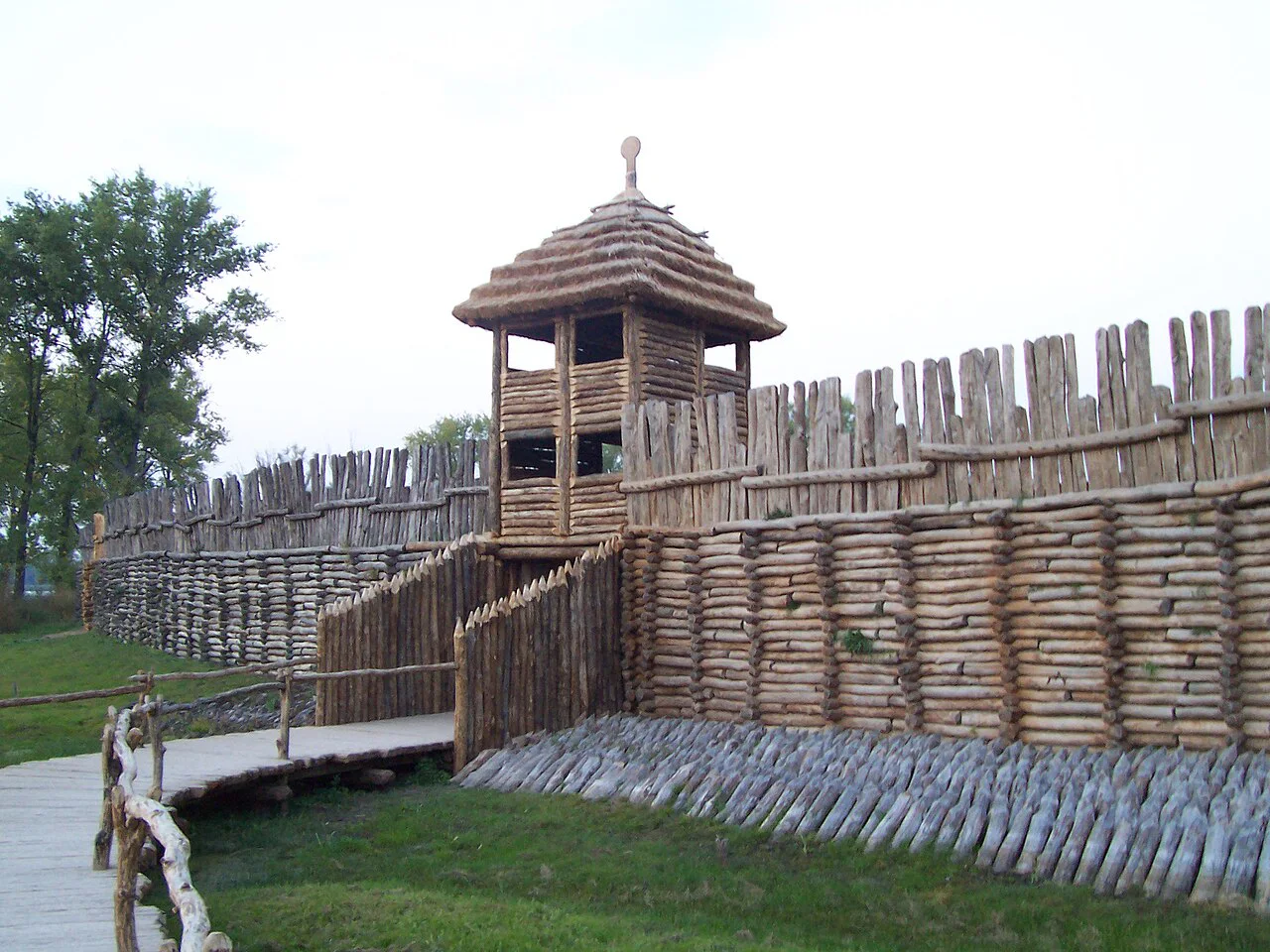
Biskupin
Biskupin
Content & sources
User:Fazer · CC BY-SA 2.5
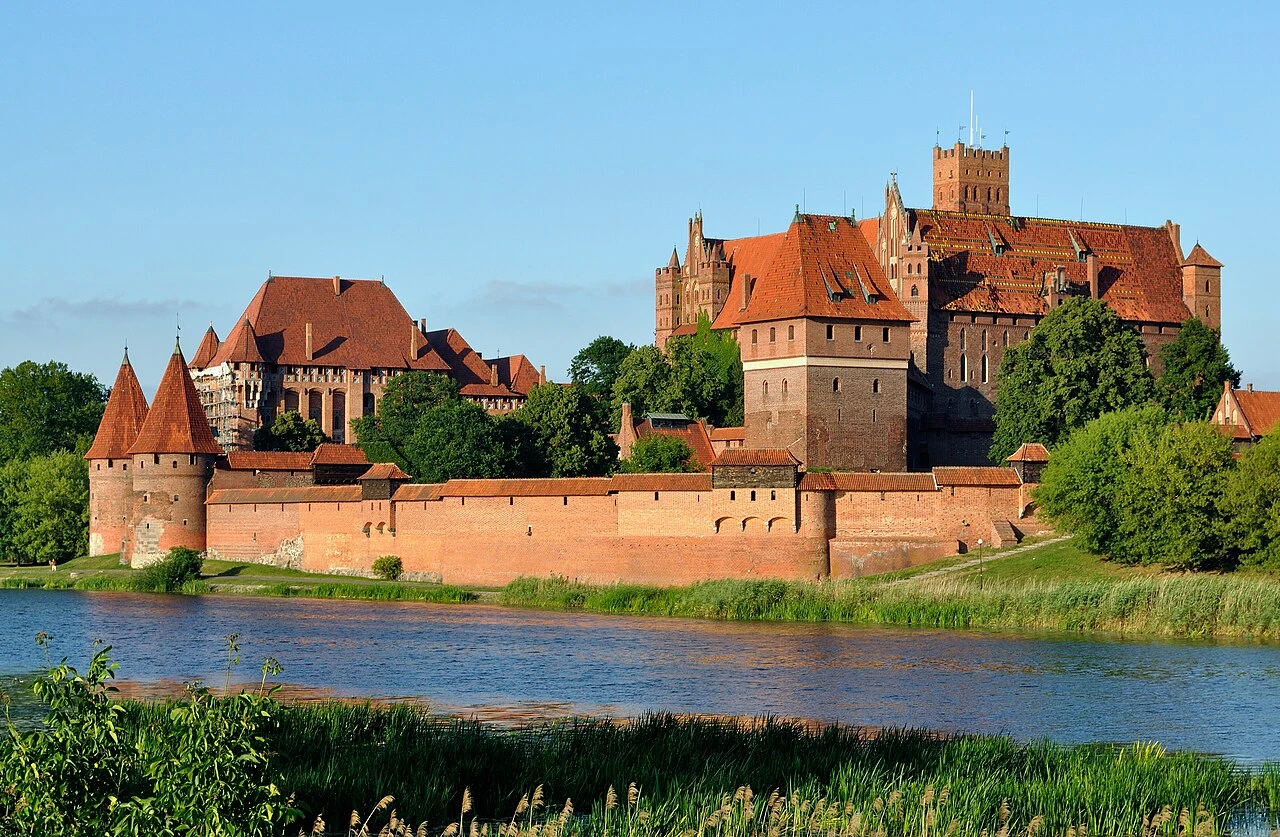
Malbork
Malbork Castle
Content & sources
DerHexer; derivate work: Carschten · CC BY-SA 3.0