Languages
15Cetatea Histria Audio Guide
Cetatea Histria is an archaeological site in Istria, Romania. Explore it with Stanza's guided offline audio tour — narrated in 15 languages.
Quick Facts
19
Stops
15
Languages
100%
Offline
📍 Istria, Romania · 44.5475°N, 28.7747°E
About Cetatea Histria
Histria is the oldest urban settlement on Romanian territory, established as a Greek colony on the western coast of the Black Sea. The site contains extensive ruins reflecting its history from the 7th century BC through the Roman and Byzantine periods.
Cetatea Histria is also known as Istron, Situl arheologic „Cetatea Histria”.
This self-guided audio tour features 19 narrated stops organized across 7 sections. As a archaeological site, Cetatea Histria offers a unique cultural experience in the heart of Istria, Romania.
The Stanza audio guide is available in 15 languages and works entirely offline — download the complete tour including audio narration, maps, and images before your visit. As you walk through Cetatea Histria, GPS-triggered narration plays automatically at each point of interest.
Last updated:
What you will hear
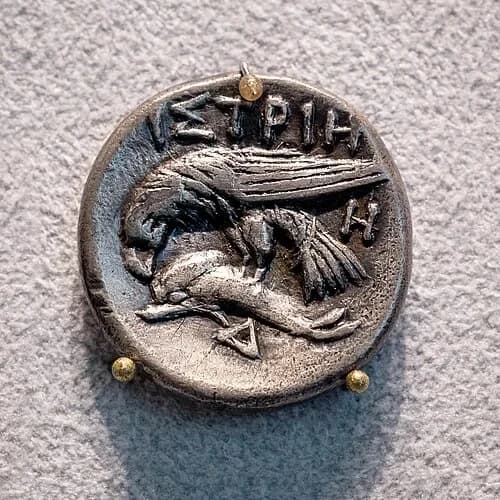
The Currency of Istros
This stop focuses on the silver drachma, the earliest documented currency minted on Romanian territory around 480 BC. It features the unique design of two youthful heads and an eagle clutching a dolphin, the emblem of the city.
The First Currency
This silver drachma, dating back to approximately 480 BC, is a milestone in the economic history of the region. As the earliest documented currency minted on Romanian territory, it represents the city’s transition from a bartering colony to an independent economic power. The design is both striking and symbolic of the city's identity. On one side, an eagle is depicted clutching a dolphin in its talons—a motif commonly known as the 'eagle-dolphin' emblem. This imagery was a clear declaration of Histria’s dominance over both the air and the sea, reflecting its status as a significant naval power in the western Black Sea. The opposite side features two youthful heads, placed one beside the other. Some historians suggest these represent the Dioscuri or perhaps a personification of the local trade winds. Beyond its artistic merit, the production of these silver coins required sophisticated metallurgical knowledge and a steady supply of precious metals, likely sourced from the nearby Balkan mountains. The use of a unified currency allowed Histria to conduct business with distant Greek city-states more efficiently, further cementing its position as a commercial leader. These tiny silver discs facilitated everything from large-scale grain shipments to the daily transactions of the local marketplace.
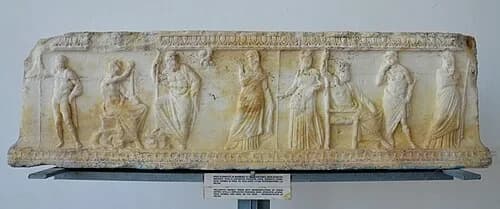
The Hellenistic Pantheon
Examine the Hellenistic marble frieze, a masterpiece showing a procession of Greek deities. This artifact underscores the religious importance of the city and its direct cultural links to Miletus.
The Greek Pantheon
This high-relief carving depicts a solemn procession of Greek deities, including Apollo, Zeus, Athena, and Hermes. Such artworks provided the visual backdrop for the religious life of the city, emphasizing the deep cultural and spiritual ties between Histria and its mother-city, Miletus, on the coast of modern-day Turkey. The quality of the craftsmanship, seen in the fluid draping of the figures' garments and their dignified postures, is evidence of the prosperity Histria enjoyed during the Hellenistic period. During this era, the city was not just a trading post but a center of sophisticated culture and artistic production. Each figure carries traditional attributes that identified them to the ancient viewer: Zeus with his authority, Athena with her wisdom, and Hermes, the protector of travelers and merchants, who would have been particularly significant to a port city like Histria. The relief likely adorned a public building or a significant temple in the sacred district. Its survival provides a rare glimpse into the aesthetic preferences of the citizens and the scale of the monumental architecture that once dominated the skyline. The depth of the carving creates shadows that bring the figures to life, reflecting the skill of the artisans who lived and worked here over two thousand years ago.
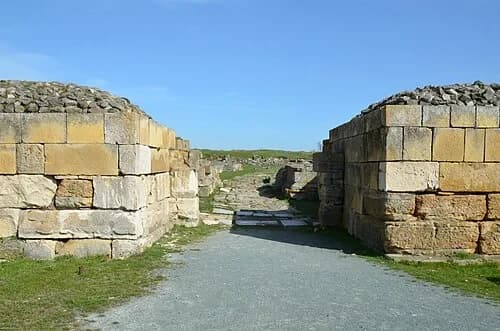
The Big Gate
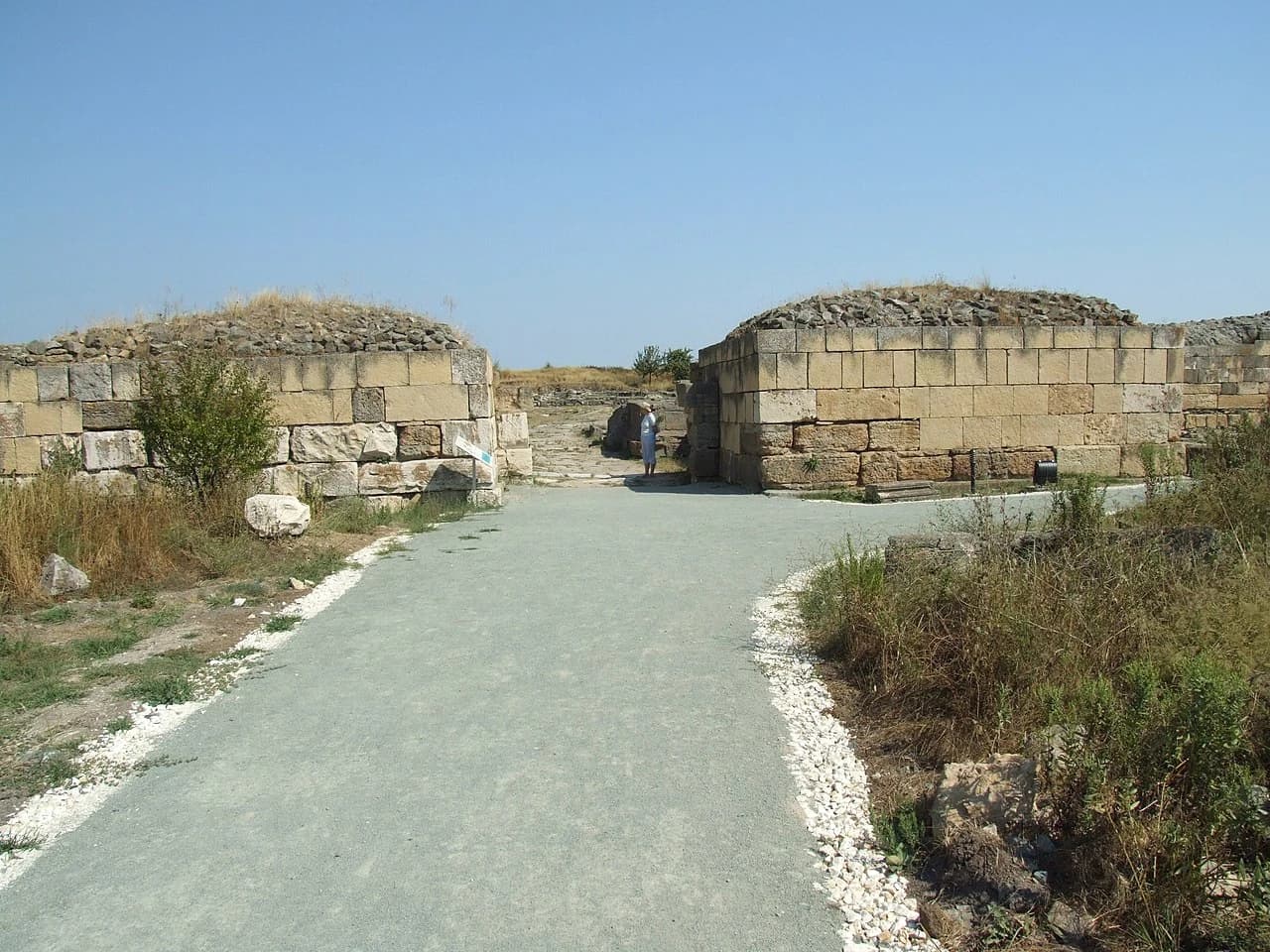
Leaving the museum, you arrive at the main entrance to the fortress. This massive gateway with its defensive towers was the primary point of entry and a critical part of the city's survival against invasions.
The Great Fortress Gate
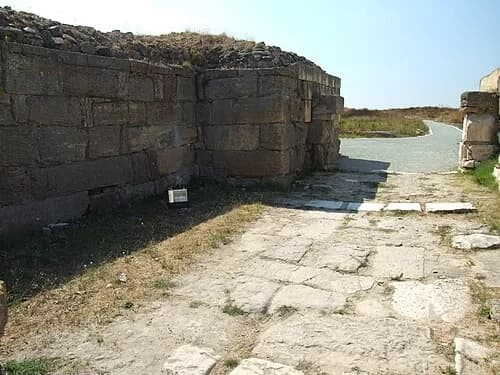
Stepping outdoors, we find ourselves at the Great Fortress Gate, the primary entrance on the western side of the city’s precinct wall. The sheer scale of the limestone blocks used in its construction reveals the defensive priorities of the inhabitants. This was the first line of defense against terrestrial threats from the hinterland. Originally, the city's fortification system was far more complex than the ruins suggest today, featuring four strategically placed towers that allowed defenders to rain projectiles down on any approaching attackers. The thickness of the walls near the gate indicates that this was a high-profile target during times of siege. Throughout the centuries, as different groups threatened the city's stability, these walls were repeatedly reinforced, patched, and sometimes entirely rebuilt. You can see how the stones were fitted together without mortar in some sections, relying on their massive weight for stability. This gate was the threshold where merchants, soldiers, and citizens passed daily, a transition point between the safety of the urban environment and the unpredictable world outside. It stands as a physical record of the engineering effort required to maintain a Greek and later Roman presence in this frontier territory. Small grooves in the threshold suggest where heavy wooden doors once pivoted on their iron hinges.
Path of the Conquerors
As you move through the fortress gate, notice how the stone paving beneath you seems to narrow. This was not an accident of construction but a deliberate tactical choice. By constricting the width of the roadway at the entrance, the city's architects created a bottleneck. This forced any invading force to break their ranks and limited the number of attackers who could enter the city at once, making them easier for the defenders to manage from the walls above. The stone slabs themselves tell a story of longevity and constant change. Look closely at the ground; you will see a patchwork of mismatched stone sizes and shapes. These variations are the result of over a millennium of repairs. As sections of the road wore down from the heavy wheels of carts or were damaged during conflict, new stones were brought in to fill the gaps. These layers of history are literally laid out beneath your feet, representing the transition from early Greek paving to later Roman and Byzantine maintenance. The ruts worn into some of the larger stones are the physical echoes of centuries of traffic, from the delivery of grain to the movement of troops. This path has been trodden by every person who entered or left Histria for nearly 1,200 years.
The Main Square and Paved Road
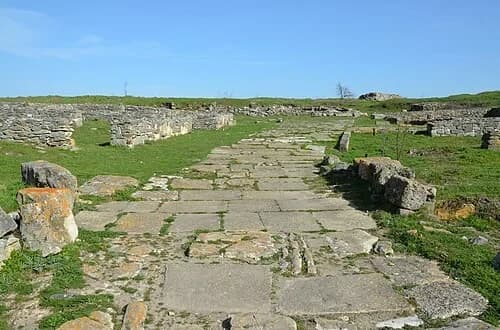
Step onto the ancient paved street of the late Roman settlement. This area illustrates the city's sophisticated urban planning, which remained structured and organized for over a millennium.
The Roman Agora
Histria was meticulously planned following the traditional Greek 'polis' structure, a design that was later adapted and expanded by the Romans. This paved square, known as the Agora in Greek or the Forum in Latin, functioned as the civic heart of the late city. It was here that the community gathered for everything from public announcements and political debates to legal trials and social socializing. The orderly layout of the surrounding foundations demonstrates the importance of structured urban planning in the classical world. In this square, the local government functioned, and the city’s laws were displayed for all to see. During the Roman period, the square was often embellished with statues of emperors or prominent local citizens, reinforcing the social hierarchy of the province. The paving stones provided a clean, durable surface for the thousands of people who passed through here every day. Imagine the sounds of lively debate, the footsteps of magistrates, and the calls of people conducting business. While the bustling crowds are long gone, the scale of the square still conveys the importance of this space as the nerve center of Histria’s public life. Even the drain outlets along the edges show the sophisticated level of infrastructure that supported this crowded public area.
The Sacred Area
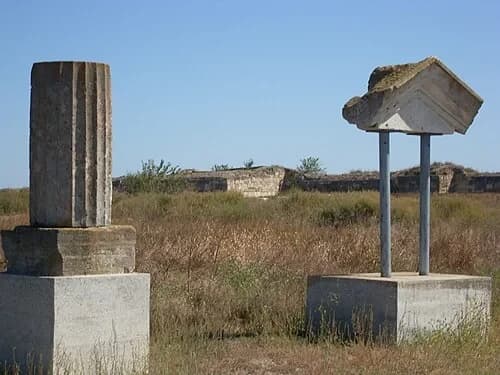
This is the most ancient part of the city, where temples dedicated to Apollo Ietros and Zeus once stood. The foundations and architectural fragments here are the oldest urban remains in Romania, dating back to the 7th century BC.
The Sacred Area
This portion of the city is known as the Sacred Area, representing the most ancient layer of Histria’s urban development. Excavations here have uncovered foundations dating back to the 7th century BC, making these the oldest urban remains in Romania. This district was the spiritual center of the colony, dominated by temples dedicated to the most important deities of the Greek pantheon. Among them stood the Temple of Apollo Ietros, the patron god of the Milesian colonists, and a temple to Zeus. The fluted column segments and fragments of decorated pediments scattered around give a sense of the architectural grandeur that once defined this space. Unlike the commercial or residential districts, the Sacred Area was designed to inspire awe and demonstrate the community's piety. These structures were built with the finest materials available, often imported from great distances. The orientation of the temples and the careful placement of altars reflected a complex understanding of religious ritual. Even after the city adopted Christianity centuries later, this area remained significant as a reminder of Histria's deep-rooted Greek heritage. The worn limestone steps of these temples were once climbed by the city’s founders as they sought divine favor for their new settlement on the edge of the Black Sea.
Thermae I: The Roman Baths
The Roman influence is most visible in the extensive bath complexes. Thermae I was a sophisticated facility for communal bathing and social gathering, featuring multi-room layouts and open courtyards.
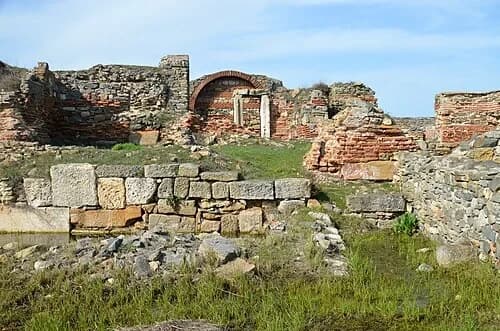
The Great Baths
With the arrival of Roman influence in the 1st century AD, the urban landscape of Histria changed significantly. One of the most prominent additions was the introduction of large-scale public bath complexes, such as 'Thermae I.' The walls here, composed of alternating layers of stone and characteristic Roman red brick, were built to withstand the humidity and heat of the bathing process. In Roman society, the baths were far more than just a place to wash; they were a central social club. Citizens would come here to meet friends, discuss business, and catch up on the latest news from the capital. The use of red brick courses was a standard Roman building technique that provided structural stability, particularly in multi-story or vaulted structures. These baths required a massive commitment of resources, from a steady supply of fresh water to the enormous quantities of wood needed to fuel the heating furnaces. The transition from the simpler Greek way of life to this more elaborate Roman standard of living is clearly visible in the scale and complexity of these ruins. The thick walls served as insulation, keeping the heat in and the coastal winds out, creating a controlled environment of relaxation and social interaction that was a hallmark of life in a Roman province.
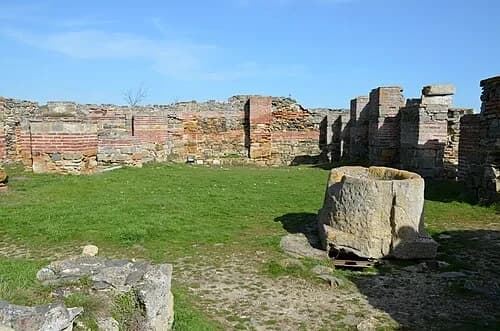
The Exercise Yard
Inside the perimeter of the Great Baths lies an open area that once served as the palestra, or exercise yard. Before entering the heated rooms of the bath complex, citizens would gather here to participate in physical activities, such as wrestling, running, or ball games. This space was essential to the classical ideal of a healthy mind in a healthy body. As the city’s population grew and Roman influence deepened, the baths were expanded in the 2nd century AD to accommodate more visitors. The palestra was a site of high energy and social competition, where young men demonstrated their physical prowess and older citizens observed and debated. The floor would have been covered in sand to provide a safe surface for wrestlers. While only the foundational outlines and patches of grass remain today, the location of the palestra highlights the integrated nature of Roman leisure. Physical exertion was followed by a sequence of baths in rooms of varying temperatures, making the visit to the thermae a several-hour process. This expansion of the facilities reflects the zenith of Histria's population and prosperity under the Roman Empire, when the city was a thriving administrative and cultural center for the region of Moesia Inferior.
Roman Engineering: Hypocausts and Aqueducts
This stop looks at the hidden technology of the city. You can see the remains of the hypocaust heating system and the stone water conduits that supplied the baths with fresh water.
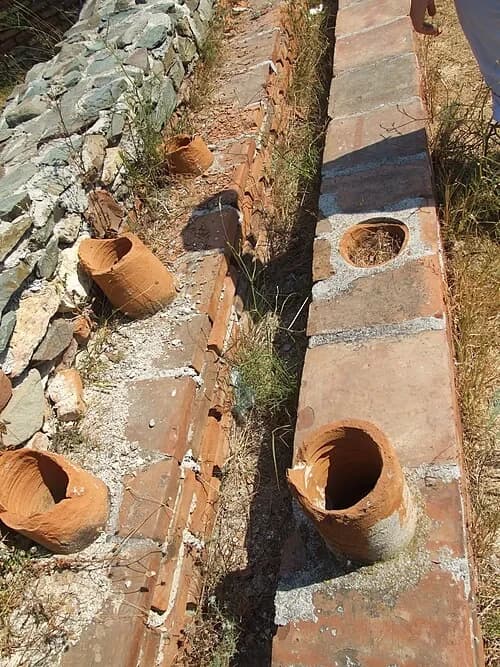
The Heating System
The Roman bath experience relied on an invisible but highly sophisticated engineering feat known as the hypocaust system. Look closely at the walls, and you can see hollow terracotta pipes, called 'tubuli,' embedded within the masonry. These pipes were part of a complex network designed to distribute heat throughout the building. The process began in the 'praefurnium,' or furnace room, where fires were kept burning constantly. The hot air and smoke from these fires didn't just escape; they were channeled under the raised floors and then up through these wall pipes. This created a radiant heating effect that warmed both the floors and the walls of the most exclusive rooms. This system represents a peak of luxury and technological advancement for the period, allowing the inhabitants to enjoy a tropical climate even during the harsh winters of the Black Sea coast. The use of terracotta was ideal because it could withstand high temperatures and distribute heat evenly. This level of comfort was reserved for the most important public buildings, highlighting the importance the Roman state placed on the well-being of its citizens. The surviving pipes offer a rare, internal view of the hidden infrastructure that made Roman urban life so remarkably advanced for its time.
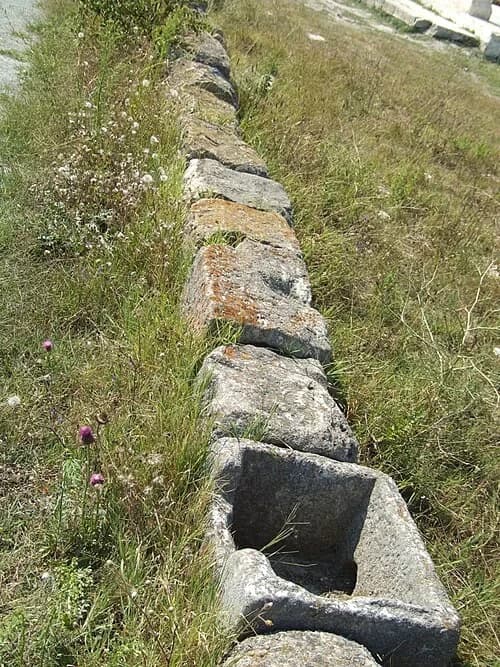
The Stone Aqueduct
Maintaining a large urban population required a consistent supply of fresh water, a challenge Histria met with a sophisticated system of aqueducts and drains. You can see examples of this here in the hollowed-out stone blocks that were once part of the city's water infrastructure. These blocks were meticulously carved so they could be fitted together, forming a continuous conduit to transport water from distant inland springs. The precision required for such a project was immense, as the entire system relied on gravity to keep the water flowing at a steady rate. Alongside the supply lines, Histria also featured an advanced drainage and sewage network. This effective management of water is one of the primary reasons why large sections of the city’s foundations have survived for two thousand years. By preventing standing water from eroding the building bases and managing the runoff from heavy rains, these ancient engineers ensured the longevity of their city. This stone channel is more than just a pipe; it is a piece of a larger puzzle that supported public health, the operation of the great baths, and the needs of thousands of households. The durability of the stone explains why these fragments remain long after more modern metal pipes would have rusted away.
Want to hear the rest?
Download the Stanza app to unlock all 19 stops and the complete guided audio tour.
Frequently Asked Questions
How long does the Cetatea Histria audio tour take?
The Cetatea Histria audio guide includes 19 narrated stops. Most visitors spend 45 minutes to 1.5 hours exploring the complete tour, though you can listen at your own pace and skip or revisit any stop.
Is the Cetatea Histria audio guide available in my language?
Stanza supports 15 languages: English, Spanish, French, German, Italian, Portuguese, Russian, Japanese, Chinese, Korean, Arabic, Hindi, Polish, Dutch, Hebrew. Check the guide in the app to confirm the languages currently available for this tour.
Can I use the audio guide offline at Cetatea Histria?
Yes! Download the complete Cetatea Histria tour — including all audio, maps, and images — before your visit. The Stanza app works completely offline, so you don't need WiFi or mobile data at the venue.
How much does the Cetatea Histria audio guide cost?
The Stanza app is free to download. Free and paid audio guides are available; current prices are shown in the app.
How do I use the Stanza audio guide at Cetatea Histria?
Download the free Stanza app, search for "Cetatea Histria", and download the tour. When you arrive at the venue, the app uses GPS to detect your location and automatically plays the relevant narration as you move between points of interest — completely hands-free.
What makes the Stanza audio guide different from other Cetatea Histria tours?
Stanza offers GPS-triggered narration that plays automatically as you walk through Cetatea Histria — no need to manually select stops. The tour is available in 15 languages, works fully offline, and includes 19 expertly narrated stops with images and historical context.
What other audio guides are available near Cetatea Histria?
Stanza offers multiple audio guides in Istria, Romania and nearby areas. After downloading the app, browse the map to discover all available tours near Cetatea Histria. Each guide can be downloaded for offline use.