Stanza · Audio guide
Sterkfontein Audio Guide
A place to remember. A story to take with you.
Sterkfontein is a set of limestone caves located in the Gauteng province of South Africa. It is a site of special interest in paleoanthropology and is part of the Cradle of Humankind World Heritage Site.
Download Stanza, then search for “Sterkfontein”.
About the tour
One guide. Your kind of visit.
Sterkfontein is a set of limestone caves located in the Gauteng province of South Africa. It is a site of special interest in paleoanthropology and is part of the Cradle of Humankind World Heritage Site.
Ready when you are.
- 01Get the free Stanza app.
iOS & Android
- 02Find your guide.
“Sterkfontein”
- 03Download before you go.
Works offline
Audio guide / 12 narrated stops
Inside the guide
Get to know a few of the stories before you go. Open a stop to read more.
01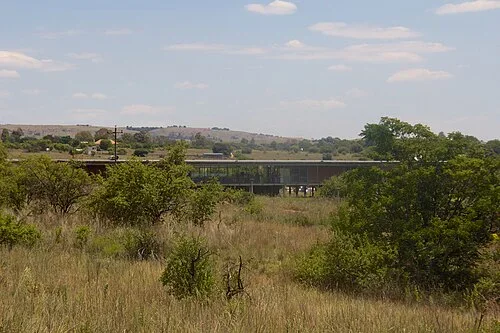 Visitor Centre Exhibition and Fossil Hall
Sterkfontein Visitor Centre in the Cradle of Humankind
Welcome to Sterkfontein, a set of limestone caves about forty kilometres northwest of Johannesburg. From the road, it looks like quiet grassland with a low visitor centre. Under that hill lies one of the richest early-human fossil sites in the world. Since scientific digging began here in 1936, finds have totalled some five hundred hominid individuals. The surrounding area is called the Cradle of Humankind, and the caves were declared a World Heritage Site in 1999. The name Sterkfontein is Afrikaans for strong spring. This tour asks one question: why did this particular hill preserve our origins? The route leads into the caves, past the two great discoveries, down to an underground lake, and back out to the live excavations. Along the way, you will meet the miners, scientists and divers who have entered this hill, and the ancestors their work brought back to light.
Photograph by Mike Peel (www.mikepeel.net). · CC BY-SA 4.0
02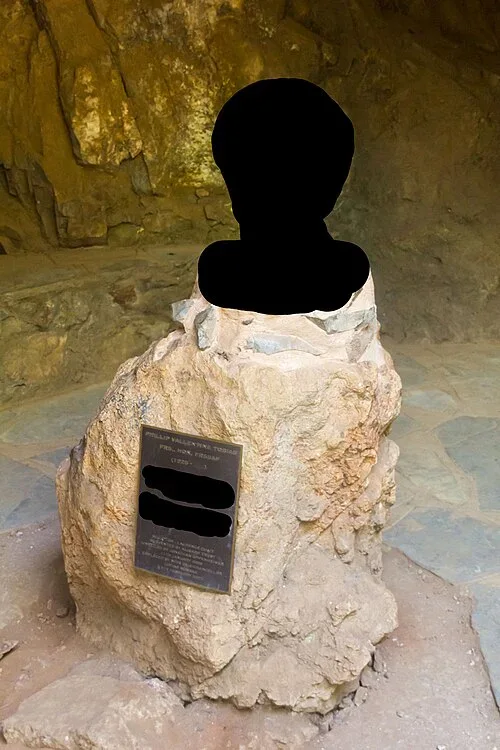 Visitor Centre Exhibition and Fossil Hall
Bust of Phillip V. Tobias
Inside the exhibition stands a bronze bust of Phillip Tobias, made in 2006 by the sculptor Laurence Chait. It marks something easy to miss about this place. The science here has never been the work of one person or one lifetime. From the pioneers of the 1930s to their successors at the University of the Witwatersrand, the excavation has been a relay across generations. Each team handed its questions, its methods and its half-finished layers to the next. The site honours those scientists here, in bronze, alongside the fossils they recovered. Tobias's own role belongs to that continuing line of researchers who made Sterkfontein their life's work.
Photograph by Mike Peel (www.mikepeel.net). · CC BY-SA 4.0
03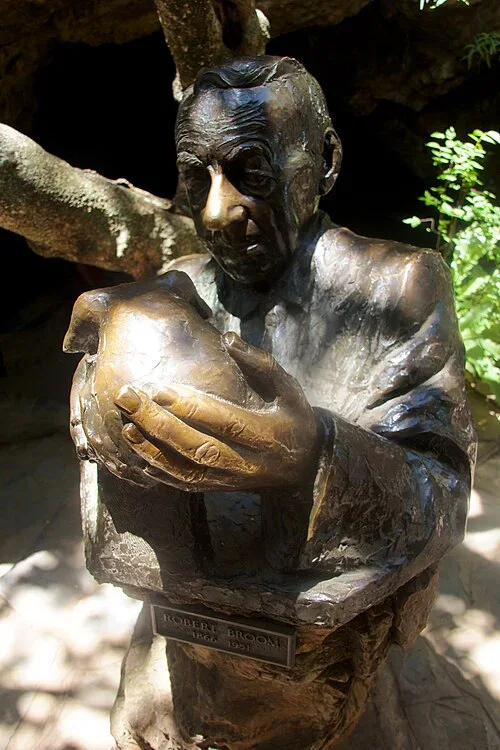 Visitor Centre Exhibition and Fossil Hall
Bust of Robert Broom
The bronze figure shows a heavy-browed man cradling a skull in his hands. This is Robert Broom, the pioneer who turned Sterkfontein into a scientific excavation. His story starts with a colleague's claim. Professor Raymond Dart had argued that a small skull from Taung, known as the Taung Child, belonged to a human ancestor. Many scientists doubted him. In 1936, students of Dart and Broom from the University of the Witwatersrand began concerted excavations here at Sterkfontein. The caves soon yielded the first adult Australopithecine ever found. That find substantially strengthened Dart's claim about the Taung Child. The work paused during the Second World War, as so much did. But after the war, Broom came back and took up his pick again.
Listen in the appPhotograph by Mike Peel (www.mikepeel.net). · CC BY-SA 4.0
04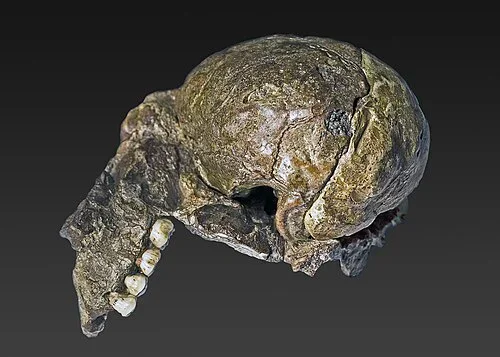 Visitor Centre Exhibition and Fossil Hall
Mrs. Ples (STS 5)
In 1947, Robert Broom, working with John T. Robinson, recovered a nearly complete skull of an adult from these caves. It carries the catalogue number STS 5. Broom named it Plesianthropus transvaalensis, meaning near-man from Transvaal. That scientific name gave the fossil its affectionate nickname: Mrs. Ples. Today it is classed as Australopithecus africanus, the same species as the Taung Child. The original skull is kept in the Ditsong National Museum of Natural History in Pretoria. The skull substantially strengthened the argument that human origins lie in Africa. Science keeps revising the details, though. Some researchers have suggested the skull may belong to an adolescent male rather than an adult female. Its age is debated too. One line of dating work puts Mrs. Ples at just over two million years old, while recent studies of the surrounding layer, Member 4, have placed much of it in the mid-Pliocene, around three and a half million years back. The fossil stays the same; the clock keeps being argued over.
Listen in the appJosé Braga;Didier Descouens · CC BY-SA 4.0
05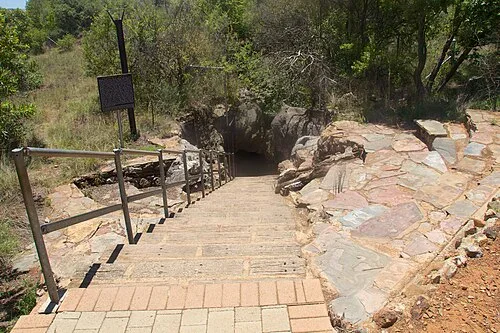 Cave Entrance and Descent Stairway
The Descent Path to the Cave Entrance
The path down to the caves is stone and steps, winding through trees toward a dark opening in the rock. A standard guided tour runs sixty to ninety minutes. The chambers are humid, the staircases steep in places, and some passages are tight. In 2024, the cave's owner closed it to visitors because of flooding. The water that carved these chambers in the first place had simply carried on working. The caves reopened to the public on the fifteenth of April, 2025. The hill keeps its own schedule; visitors fit in around it.
Listen in the appPhotograph by Mike Peel (www.mikepeel.net). · CC BY-SA 4.0
06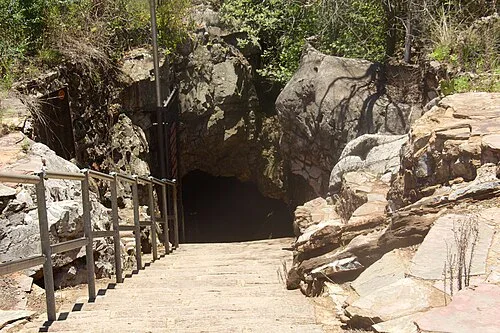 Cave Entrance and Descent Stairway
The Cave Entrance
The dark mouth of the cave was opened by people looking for lime, not knowledge. In the late 1890s, limestone miners worked this hill, blasting rock for commercial lime. Modern excavation of the caves began with them. As they hacked out the deposit, they noticed fossils in the rock. Rather than ignoring them, they brought the bones to the attention of scientists. That small decision opened the door to everything that followed. The doorway used today stands in that same tradition of entering the hill. First people came for lime. Then they came for the story the lime had uncovered.
Listen in the appPhotograph by Mike Peel (www.mikepeel.net). · CC BY-SA 4.0
07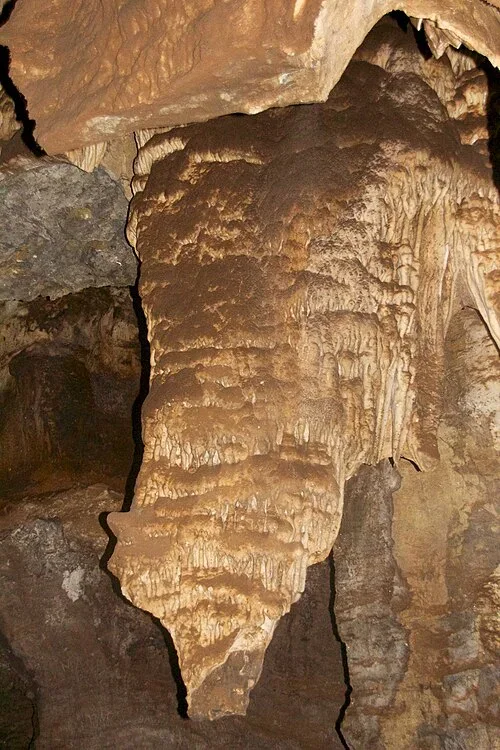 Main Hall and Limestone Geology
Flowstone Formations of the Main Hall
The great draperies and flowstone in the main hall look like water caught mid-pour. In a sense, they are. Rainwater seeping down through the ground slowly dissolved the ancient dolomite below, hollowing out these chambers over millions of years. The same percolating water built what it had carved. Drip by drip, it left the stalactites hanging from the ceiling, the stalagmites rising to meet them, and the flowing sheets of stone between. Those dissolved voids did something else as well. Openings in the cave roof formed shafts and chambers that acted as natural traps. Animals and hominins fell in, and their bones were sealed in hard breccia, a rock of bone and sediment cemented together. That is why a cave is a fossil vault. The same water that hollowed the hill also buried its treasures, and kept them safe.
Listen in the appPhotograph by Mike Peel (www.mikepeel.net). · CC BY-SA 4.0
08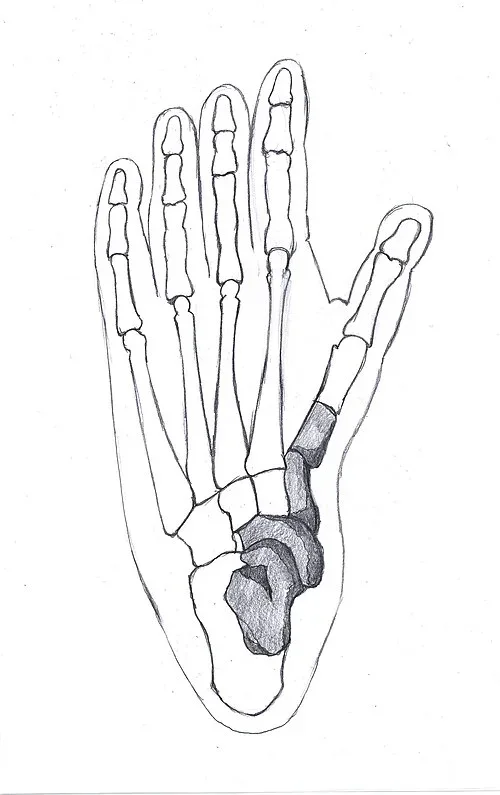 Silberberg Grotto and the Little Foot Excavation
Little Foot: The Bones First Found in Storage
The story of Little Foot begins not in the caves but in storage. In the mid-1990s, the palaeoanthropologist Ronald J. Clarke was going through museum material from Sterkfontein when he recognised fossilised hominin bones among the stored fragments. The first parts found were the bones of a foot. Small bones, from a single individual. From those few pieces, Clarke deduced that an entire skeleton might still lie in the rock of the caves. It was an audacious leap: a whole ancestor inferred from a handful of fragments in a box. The foot bones gave the skeleton its name, Little Foot. The search for the rest was about to move underground.
Listen in the appPhoto: Tobias Fluegel · CC BY-SA 3.0
09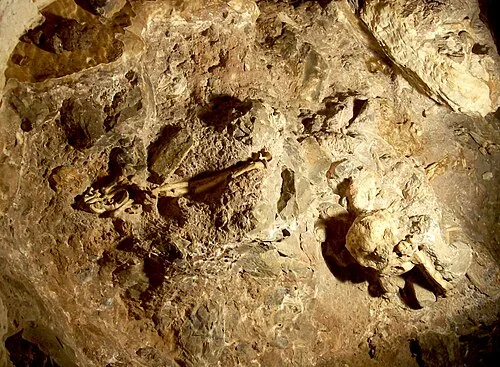 Silberberg Grotto and the Little Foot Excavation
Little Foot in the Silberberg Grotto
Deep in the Silberberg Grotto, the bones lay embedded in the rock of the cave. Following Clarke's lead into the chamber, his field assistants found bones whose breaks matched the stored fragments. What emerged was StW 573, a skeleton of a second species of Australopithecus, called Australopithecus prometheus. It is by far the most complete early hominin skeleton known, more than ninety percent intact. Freeing it from the surrounding breccia, concrete-hard after millions of years, took some twenty years of meticulous work. In December 2017 the cleaned and reconstructed skeleton was unveiled at the University of the Witwatersrand in Johannesburg, where it is now kept. Even its age is argued over. One combination of dating methods puts it at roughly two and a half million years old, while another approach suggests closer to four million. Either way, the grotto that held it for millions of years is still here.
Listen in the app120 / V. Mourre · CC BY-SA 3.0
10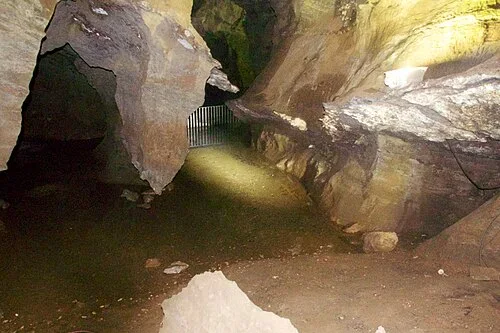 Subterranean Lake Viewpoint
The Underground Lake
The water here is so still and so clear it reads like glass. This lake fills the flooded lower reaches of the cave system, and it holds life found almost nowhere else. Tiny white shrimp inhabit the clear water, creatures shaped by a world without light. The flooded passages also hold a sober memory. In 1984, Peter Verhulsel, a member of a cave diving expedition researching one of the caves, was lost in the underwater network. Rescue groups could not find him. He starved to death after three weeks in the cave. His loss says something about the scale of this place. Much of the flooded system has never been mapped, and the water keeps its passages to itself.
Listen in the appPhotograph by Mike Peel (www.mikepeel.net). · CC BY-SA 4.0
- 11
Surface Excavations: The Work Continues
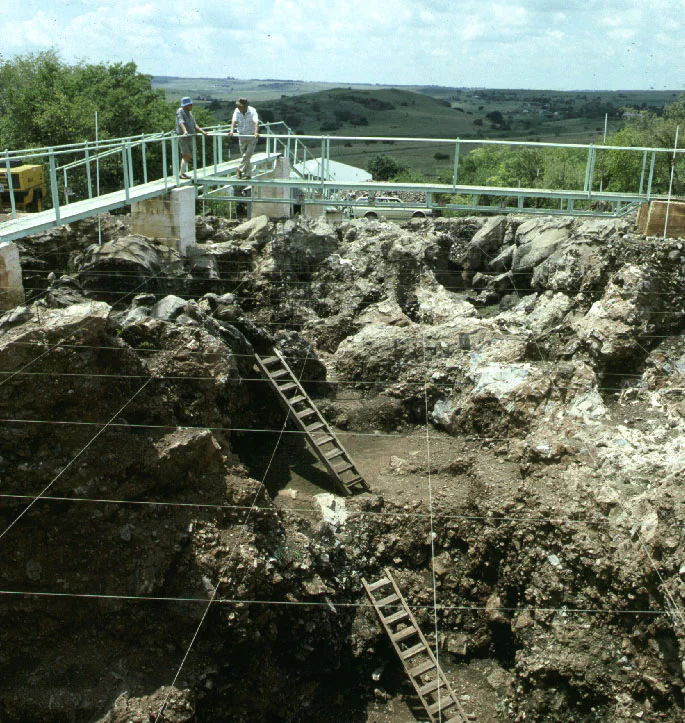
The open excavation pits where digging has continued almost without interruption, and the stone tools of a later world.
- 12
Broom at the Exit: What Sterkfontein Means
The bronze figure at the exit, hands around a skull, holding the whole site's meaning.
Sterkfontein
Frequently asked questions
How much does the guide cost?
Free app download. Listed guide price: $0.99. Guide price shown in the app. Audio guide only. Venue admission is separate.
Can I listen without internet?
Yes. Download the guide’s audio, images, and maps in the app before your visit. Your downloaded content is then available offline.
Can I listen in my language?
This audio guide is available in 15 languages, including English.
Do I need to follow a schedule?
No. This is a self-guided experience. Choose your stops, pause whenever you like, and return to a story at your own pace.
At your own pace
Explore Sterkfontein.
Download Stanza, then search for “Sterkfontein”.
Free app download · Guide price shown in the app
Keep exploring
Audio guides — South Africa
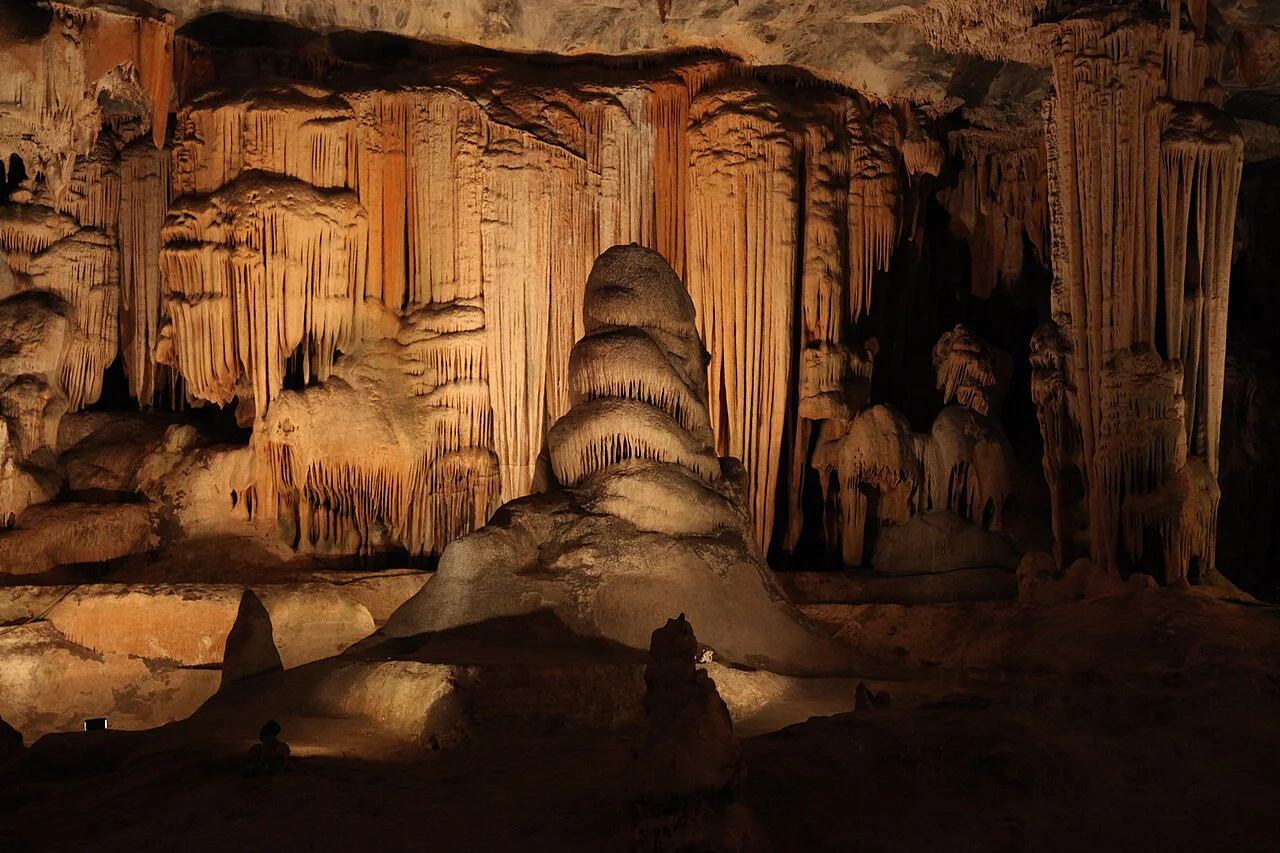
Oudtshoorn
Cango Caves
Content & sources
Rute Martins of Leoa's Photography (www.leoa.co.za) · CC BY-SA 3.0
Nemanwa Growth Point
Great Zimbabwe
Content & sources
Photo: Atamari · CC BY-SA 3.0
Kunene Region
Twyfelfontein
Content & sources
Thomas Schoch · CC BY-SA 3.0