 Stanza / Audio guide
Content & sources
Stanza · Audio guide
Cango Caves Audio Guide
A place to remember. A story to take with you.
The Cango Caves are a system of limestone tunnels and chambers located near the town of Oudtshoorn in South Africa. It is one of the country's most popular tourist caves and features a guided tour of its…
Download Stanza, then search for “Cango Caves”.
About the tour
One guide. Your kind of visit.
The Cango Caves are a system of limestone tunnels and chambers located near the town of Oudtshoorn in South Africa. It is one of the country's most popular tourist caves and features a guided tour of its accessible sections.
Ready when you are.
- 01Get the free Stanza app.
iOS & Android
- 02Find your guide.
“Cango Caves”
- 03Download before you go.
Works offline
Audio guide / 8 narrated stops
Inside the guide
Get to know a few of the stories before you go. Open a stop to read more.
01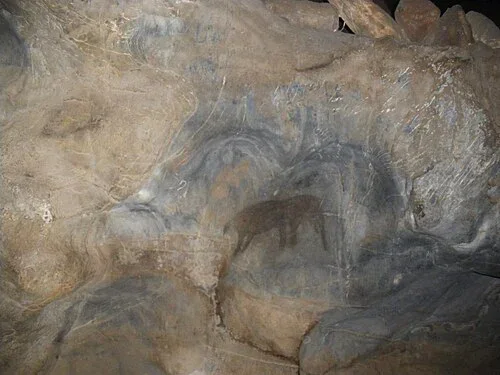 The Entrance Cavern and Stone Age Heritage
The Cave Paintings
Welcome to the Cango Caves, a limestone system in the foothills of the Swartberg range, near the town of Oudtshoorn in the Western Cape. The human story begins with the faint painting on this wall. Animals were drawn onto the rock here, and the pigment has faded with the ages. Paintings and artefacts together show that people sheltered in these caves over a long stretch of prehistory, through the Middle and Later Stone Ages. The caves gave shelter from weather and predators, and the entrance zone held firelight and company. In 1930 the archaeologist A. J. H. Goodwin, from the University of Cape Town, dug a test pit here. He found stone artefacts and other cultural material left behind by those long-ago occupants. That quiet dig turned a scenic cave into a place with a written record of its Stone Age past.
Vberger · Public domain
02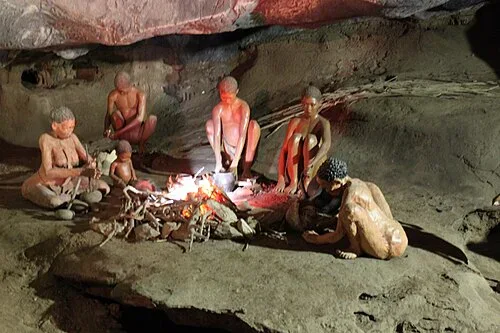 The Entrance Cavern and Stone Age Heritage
The Stone Age Shelter Reconstruction
These figures around a fire are a modern reconstruction, made to show how a night in the cave may have looked. The faces, the tools, the arrangement of the flames are all an artist's interpretation, not a scene preserved from the past. Displays like this one help visitors picture what the evidence alone cannot: people gathered at a cave mouth, firelight on the rock, work and rest shared in the warm glow. The real proof of that life lies in the cave's paintings and stone tools. Here, the reconstruction does the imaginative work. It gives the Stone Age occupants of Cango a visible presence, standing in for the people who left so little behind.
Photo: Anagoria · CC BY 3.0
03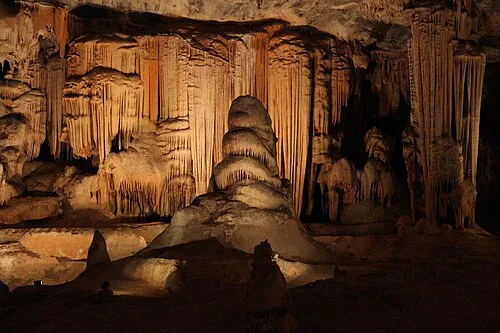 Van Zyl's Hall
In 1780 a local farmer named Jacobus Van Zyl was lowered down into the darkness here, the first modern rediscovery of the caves. What waited below him was a chamber as long as a football field, carved entirely by natural water. The hall now carries his name, Van Zyl's Hall. Twelve years later, in 1792, a second chamber was found, and exploration continued from there. Word of the caverns spread quickly, and the caves soon became a popular place to visit. Travellers made their way to this farm country to see what Van Zyl had stumbled upon. In 1829 Dr Andrew Smith came to the caves, and found much here to tempt his scientific curiosity. A farmer's descent into the dark had opened one of the country's great natural wonders to the world.
Listen in the appRute Martins of Leoa's Photography (www.leoa.co.za) · CC BY-SA 3.0
04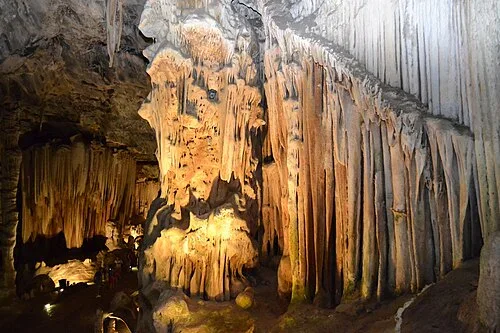 Van Zyl's Hall
The Great Columns
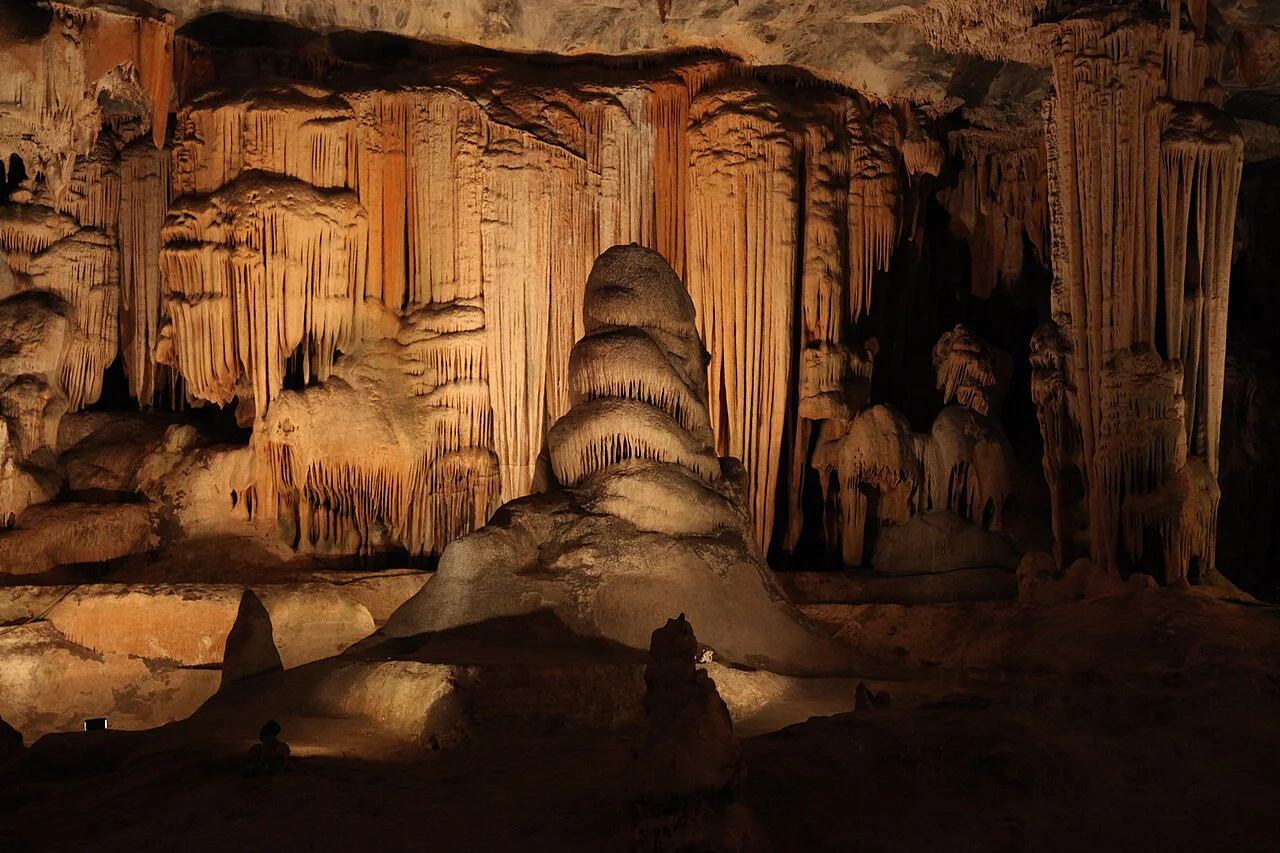
This pillar began as two separate formations, a stalactite growing down from the roof and a stalagmite rising from the floor. Where they finally met, a single column formed, and it stands here as a record of patient work. Every drop of water entering the cave carries dissolved minerals from the rock above. Each drop leaves a thin film of calcite behind as it falls. One deposit at a time, over thousands of years, the stone builds into curtains, pillars and cascades like these. The rock holding all of this is far older than the formations themselves. It is Precambrian limestone, hundreds of millions of years old, and water working through it hollowed out these caverns long before any formation began to grow. Every chamber on this tour, and every pillar within it, is the product of that slow chemistry.
Listen in the appPhoto: PHParsons · CC BY-SA 3.0
05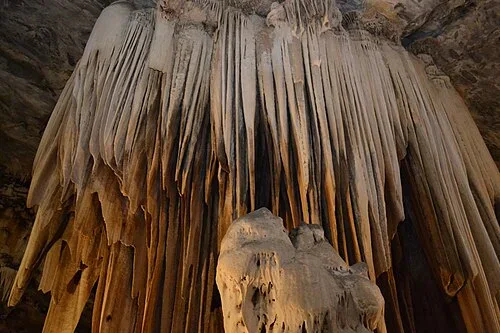 The Grand Dripstone Chambers
The Draperies
This curtain of folded stone pours down the wall like a frozen cascade, and it marks the moment the caves became a destination. The Cango Caves are counted among the finest and best-known tourist caves in South Africa, drawing many visitors from overseas. The system of tunnels and chambers runs to more than four kilometres in total. Only about a quarter of that is open to visitors. Beyond the lit route, the greater part of the cave lies dark and closed. Entry is allowed only in groups, each one led by a guide, a rule that protects both the formations and the people moving among them. Here, the stone itself is the draw, and the careful management of it is what keeps the show going.
Listen in the appPhoto: PHParsons · CC BY-SA 3.0
06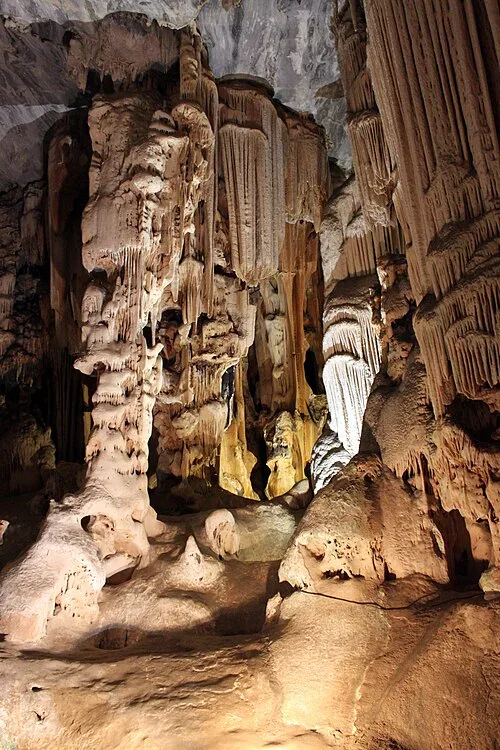 The Grand Dripstone Chambers
The Formation Chambers
Among these tiers and canopies hangs the tour's best story, told as a legend rather than a record. Johnny van Wassenaer, the cave's first official guide, is purported to have walked for twenty-nine hours in 1898 to find the end of the caves. When he got there, he is said to have calculated that he was twenty-five kilometres from the entrance, and two hundred and seventy-five metres underground. His route, the story goes, followed an underground river. Explorers keep finding more caves beyond the known sections, and each new discovery lends the tale a little more support. One fact does anchor the era: the first rough survey was done in 1897, mapping out the first twenty-six chambers. Whether Van Wassenaer truly walked those twenty-nine hours, no one can now say. The story has travelled with the caves ever since.
Listen in the appPhoto: Anagoria · CC BY 3.0
07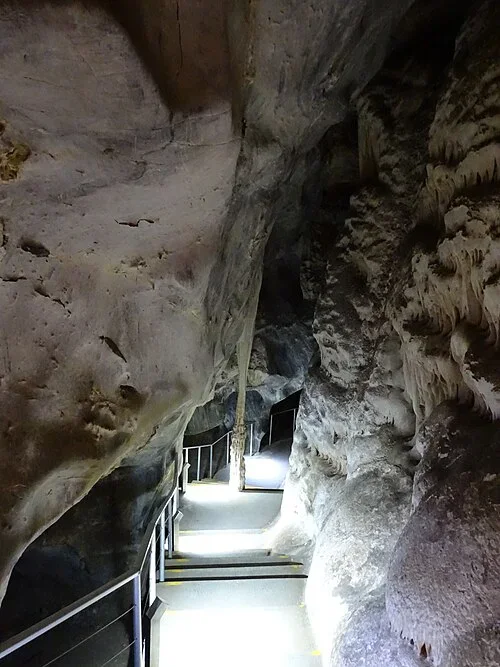 The Devil's Kitchen and Adventure Passages
The Devil's Kitchen
For as long as the caves had been visited, this constricted barrier marked their practical end. Beyond it the passage narrowed and blocked, and the show cave stopped. In 1972 three men changed that. James Craig-Smith, Luther Terblanche and Dart Ruiters widened an obstructed passage here and pushed through into new ground. What they found is now called Cango II, and it stretches two hundred and seventy metres beyond the end of the Devil's Kitchen. This spot holds another distinction. The top of the shaft here is the nearest point to the surface anywhere in the caves, fifty-two point six metres above the floor. That makes this cramped corner the cave's closest link with the world outside. At the end of Cango II, a shaft descends into a chamber filled with water, and the water flows back in the direction of Cango I. The frontier, once breached, kept inviting explorers onward.
Listen in the appPhoto: PHParsons · CC BY-SA 3.0
08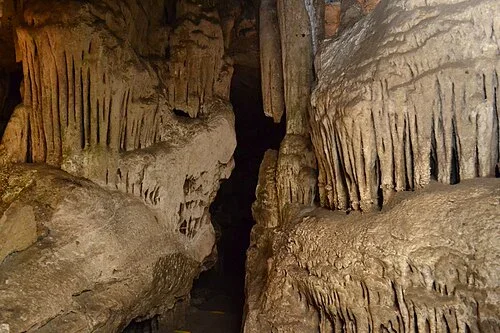 The Devil's Kitchen and Adventure Passages
The Adventure Tour Squeeze
The narrow dark gaps of the deeper cave are the challenge the Cango Caves are famous for. On the Adventure Tour, visitors crawl through constricted passages and climb steep rock formations, guided only by small lights. The tour takes an hour and a half, against the hour of the Standard Tour. The smallest gap that tourists must pass through to exit is just under fifteen centimetres high. Squeezing through it is the price of seeing what most visitors never do. This is also where the map kept growing. In August 1975, during a symposium on cave biology, an exploration team drained the water-filled chamber at the end of Cango II and crawled through a passage that had been underwater. It led to Cango III, about a thousand metres of new caves, with its biggest chamber stretching some three hundred metres. Digby Ellis and Dave Land later added nearly three hundred metres more to it, with further extensions in 1978. From Stone Age shelter-seekers to modern crawlers, everyone who has entered this cave has been drawn the same way, onward through the dark.
Listen in the appPhoto: PHParsons · CC BY-SA 3.0
Cango Caves
Frequently asked questions
How much does the guide cost?
Free app download. Listed guide price: $0.99. Guide price shown in the app. Audio guide only. Venue admission is separate.
Can I listen without internet?
Yes. Download the guide’s audio, images, and maps in the app before your visit. Your downloaded content is then available offline.
Can I listen in my language?
This audio guide is available in 15 languages, including English.
Do I need to follow a schedule?
No. This is a self-guided experience. Choose your stops, pause whenever you like, and return to a story at your own pace.
At your own pace
Explore Cango Caves.
Download Stanza, then search for “Cango Caves”.
Free app download · Guide price shown in the app
Keep exploring
Audio guides — South Africa
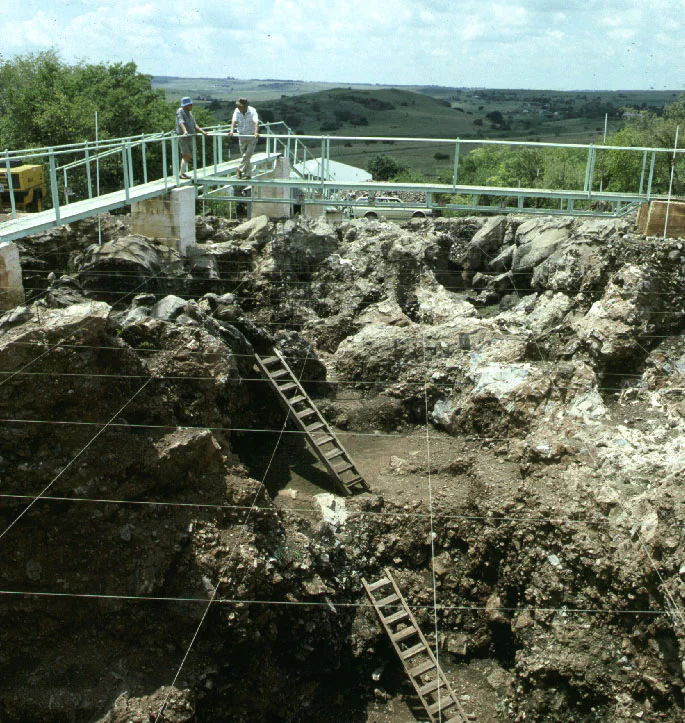
Krugersdorp
Sterkfontein
Content & sources
english Wikipedia user · CC BY-SA 3.0
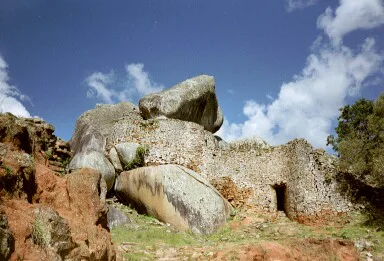
Nemanwa Growth Point
Great Zimbabwe
Content & sources
Photo: Atamari · CC BY-SA 3.0
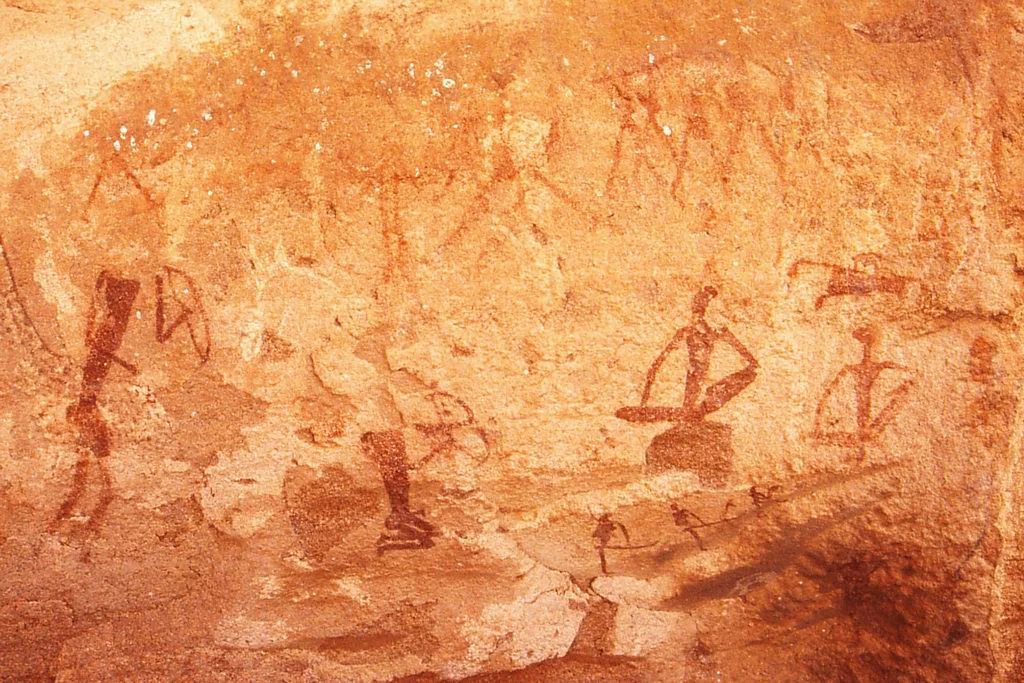
Kunene Region
Twyfelfontein
Content & sources
Thomas Schoch · CC BY-SA 3.0