Stanza · Audio guide
Seokguram Audio Guide
A place to remember. A story to take with you.
Seokguram is a hermitage and part of the Bulguksa temple complex located in Gyeongju, South Korea. It is a UNESCO World Heritage site that exemplifies some of the best Buddhist sculptures in the world.
Download Stanza, then search for “Seokguram”.
About the tour
One guide. Your kind of visit.
Seokguram is a hermitage and part of the Bulguksa temple complex located in Gyeongju, South Korea. It is a UNESCO World Heritage site that exemplifies some of the best Buddhist sculptures in the world.
Ready when you are.
- 01Get the free Stanza app.
iOS & Android
- 02Find your guide.
“Seokguram”
- 03Download before you go.
Works offline
Audio guide / 8 narrated stops
Inside the guide
Get to know a few of the stories before you go. Open a stop to read more.
01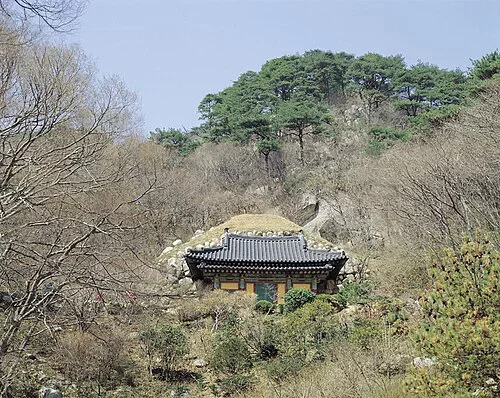 Mount Tohamsan Approach and Grotto Pavilion
Seokguram on the Slope of Mount Tohamsan
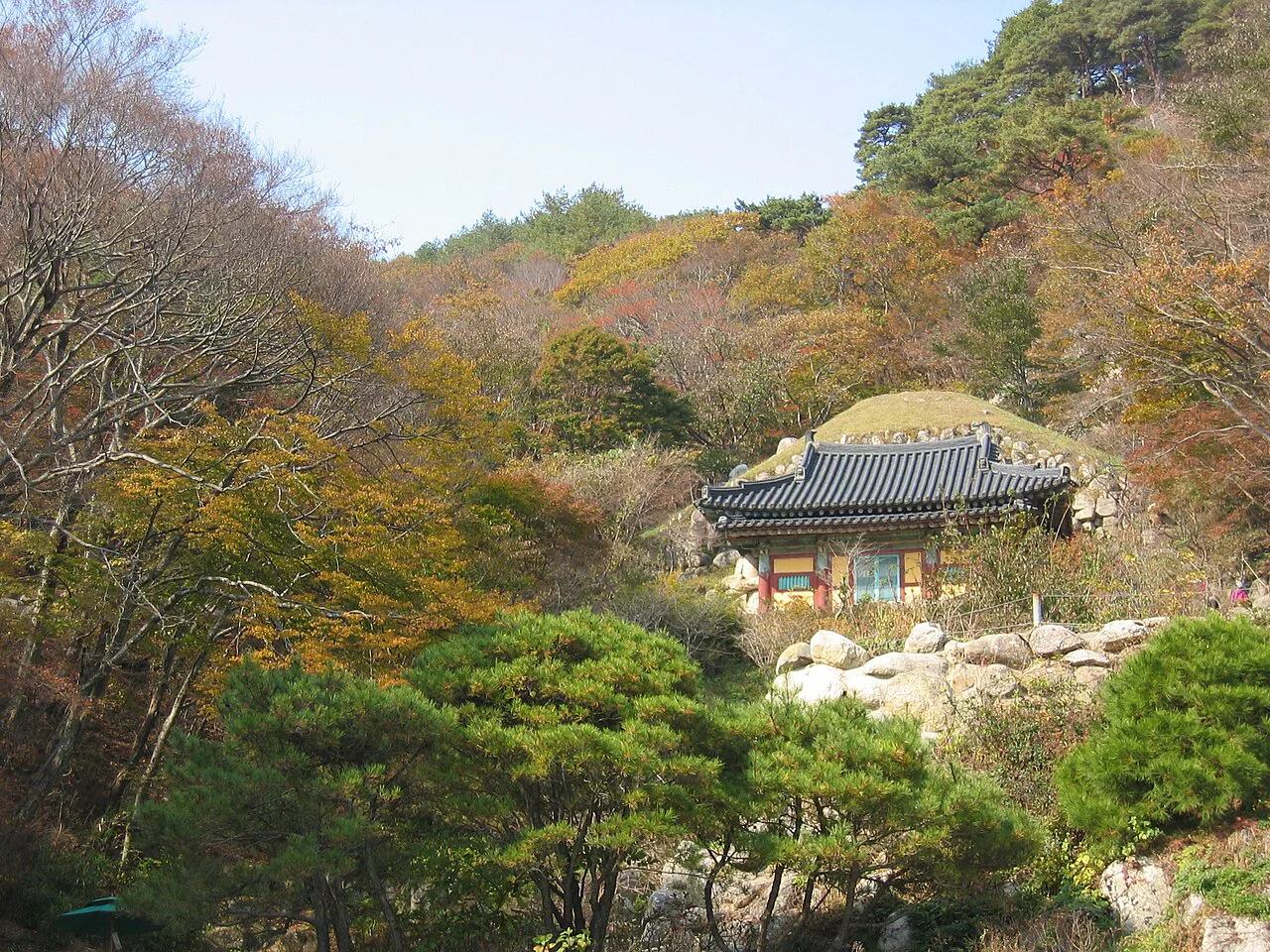
You're standing on the slope of Mount Tohamsan, about 750 meters above sea level, and this earth-covered building with its tiled roof is Seokguram, a Buddhist hermitage looking out toward the East Sea. It belongs with Bulguksa temple, about three kilometers below on the same mountain. Work began here in 751, at the height of the Unified Silla kingdom, started by the prime minister Kim Daeseong. The old chronicle Samguk Yusa tells it as a story of double devotion: Kim built Bulguksa for his present-life parents, and this stone sanctuary for the parents of his former life. He died before it was finished, and the Silla court completed the work in 774. Now, here's the remarkable part. Korea's granite is far too hard to carve caves into, so the builders didn't dig this grotto out of the rock. They assembled it, from hundreds of shaped granite blocks, held together by stone rivets with no mortar at all. That engineering, and the sculpture inside, earned it National Treasure status in 1962 and a place on the UNESCO World Heritage List alongside Bulguksa in 1995. Let's go up to the entrance.
Unknown author · KOGL Type 1
02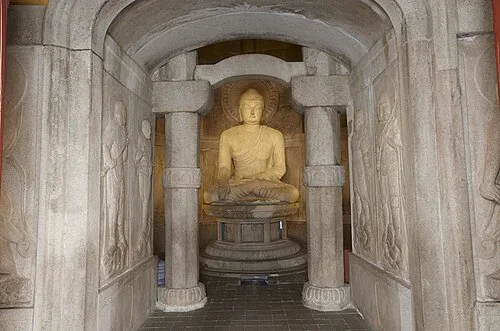 The Antechamber and Corridor Guardians
The Entrance: Antechamber, Corridor, Rotunda
Look straight down the axis and you can read the whole plan: an arched entrance into a rectangular antechamber, then a narrow corridor lined with carved reliefs, and finally the round main chamber with its dome. Silla architects made it symmetrical, and the idea is a journey: the pilgrim walks from the earthly, rectangular world into the circular, sacred one, toward the Buddha at the center. Traditionally you'd begin that walk at Bulguksa, or at the foot of this holy mountain. The stone around you also carries a harder story. After centuries of decline under Confucian-leaning Joseon rulers, who suppressed Buddhism, the grotto was patched in 1703 and 1758 but badly damaged by 1900. From 1913 to 1915, during the Japanese colonial period, it was almost completely taken apart and reassembled, without proper study, and then encased in concrete, the most advanced technology of the day. The grotto could no longer breathe. Humidity built up, water leaked, and the sculptures began to erode. Drainage pipes, then asphalt, only made things worse. In the 1960s, President Park Chung Hee ordered a major restoration with mechanical climate control, and added the wooden pavilion you saw outside. Many historians believe the original design had no such structure, which would have kept the sunrise over the sea in view and the air flowing.
Unknown author · KOGL Type 1
03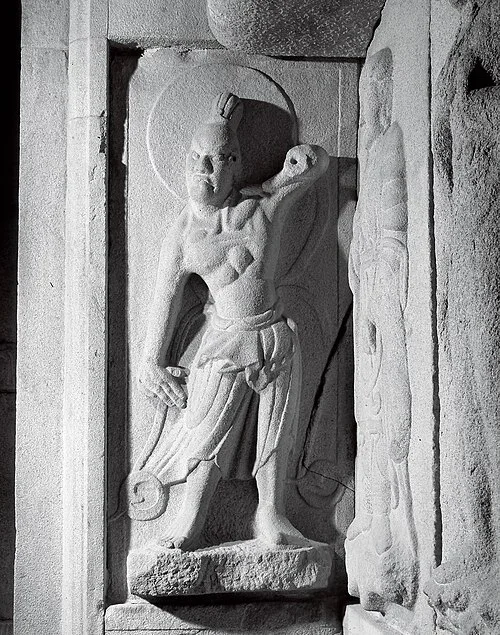 The Antechamber and Corridor Guardians
The Vajrapani Guardian
Here at the entrance to the corridor stands one of the grotto's guardians, a Vajrapani warrior carved in granite relief. Look at the body: muscles taut, one arm raised, weight shifting as if he's about to spring. That fierce face and the halo behind his head are pure 8th-century Silla carving, and he holds the club that gives his type its name. He isn't alone. His counterpart stands on the other side of the threshold, the Four Heavenly Kings guard the corridor itself, and eight more guardian deities adorn the antechamber walls. So before the pilgrim ever reaches the Buddha, she passes through ranks of protectors, each one marking the transition from the ordinary world into sacred ground. Notice how the sculptor got so much energy out of a flat wall: the pose twists, the cloth swirls, the figure seems to push forward out of the stone. It's a fitting sentry for what lies ahead.
Listen in the app한석홍 · KOGL Type 1
04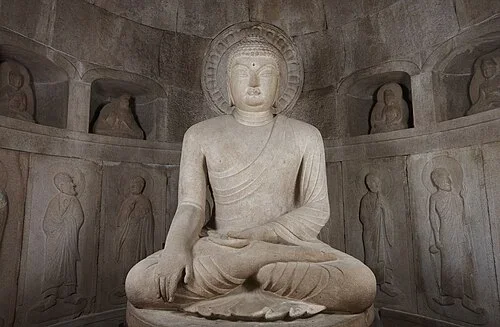 The Main Rotunda, Shakyamuni Buddha, and Dome
The Seated Buddha
This is the heart of the grotto, and many consider it among the finest Buddhist sculptures anywhere. The seated figure is about three and a half meters tall, on a lotus pedestal roughly 1.34 meters high. That pedestal is built in three parts: lotus petals carved above and below, and between them a shaft of eight pillars. The legs are crossed, the small raised bump on the head, called an usnisa, stands for wisdom, and the fan-shaped folds of cloth over the legs show how Korean sculptors reinterpreted Indian models. The position of the hands symbolizes the moment of enlightenment. Scholars generally identify this as Shakyamuni, the historical Buddha, but the identity is still debated, so hold it loosely. Now the cleverest detail: the halo. Most Buddhas have a halo fixed to the back of the head. Here, it's a granite roundel carved with lotus petals, set into the back wall, and it's deliberately off-center. Everything in this grotto is symmetrical except that halo. It was placed so that from a viewing height of about 160 centimeters, the estimated average height of a Silla man, it reads as a perfect circle behind the head. When you go in, try it.
Listen in the appCultural Heritage Administration · KOGL Type 1
05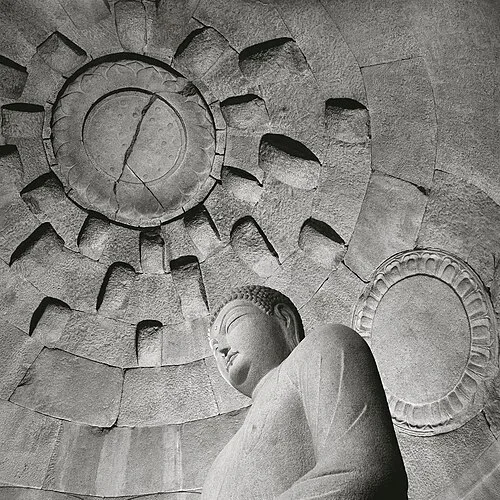 The Main Rotunda, Shakyamuni Buddha, and Dome
The Dome and the Cracked Capstone
Now look up. The ceiling above the Buddha is a dome of individually shaped granite blocks, each one cut and fitted, rising course by course to a carved lotus flower at the very top. The round room below is not quite a perfect circle, either: it measures about 6.8 meters across at its widest and 6.58 at its narrowest. The builders seem to have accepted that small irregularity and worked with it. And the crown of the dome carries one of the best-loved legends about this place, recorded in the Samguk Yusa. As Kim Daeseong prepared the great circular capstone, the story goes, the stone cracked into three pieces. He wept in despair and fell asleep, and that night celestial gods came down and fitted the broken stone back together. Look closely at the top today and you can still see the cracks dividing the capstone into three segments. Whether heaven intervened or Silla masons solved a very hard problem, the stone has held for well over a thousand years.
Listen in the app한석홍 · KOGL Type 1
06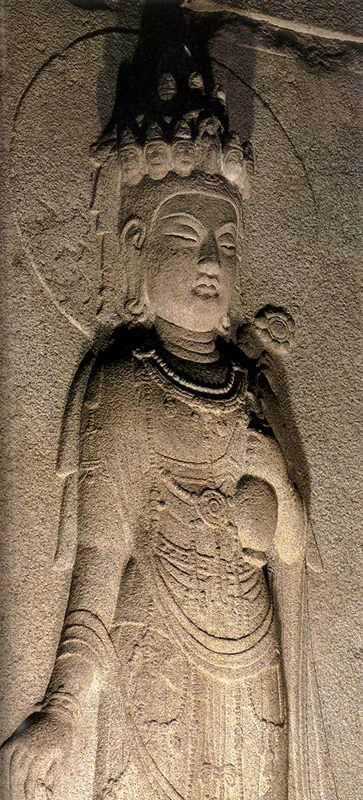 The Rear Sanctuary: Avalokitesvara and Wall Niches
The Eleven-faced Avalokitesvara
Directly behind the Buddha, on the back wall of the rotunda, stands the Eleven-faced Avalokitesvara, the Bodhisattva of Compassion, and it's well worth circling behind for a proper look. The figure is 2.18 meters tall, crowned, dressed in rich robes and jewelry, holding a vase that contains a lotus blossom. Look at the head: the eleven faces are there, a crown of small faces above the serene main face, each one symbolizing the bodhisattva's watch over the world. Here's the compositional detail that makes it special. Every other relief in the rotunda faces sideways, turned toward the Buddha. This is the only one facing straight out, toward you. That forward gaze gives it a depth and presence the others don't have. And think about where it stands in the journey: you've passed the guardians at the threshold, crossed the corridor, and arrived in the presence of the enlightened one, and there, directly behind him, stands compassion itself.
Listen in the appUnknown author · KOGL Type 1
07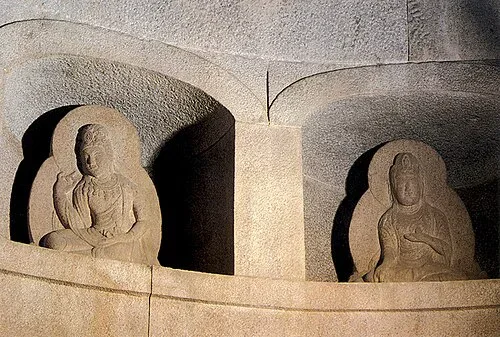 The Rear Sanctuary: Avalokitesvara and Wall Niches
The Niches of the Rotunda Wall
Look at the wall around the room, above the reliefs: these arched niches hold seated figures, and there are ten of them, bodhisattvas, saints, and the faithful. Below them runs a band of carved panels. Three bodhisattvas stand here, including Manjusri and Samantabhadra. Then come ten disciples of Shakyamuni, five on each side of the Avalokitesvara. And finally two Hindu gods, Brahma and Indra. Add it up and the grotto holds about forty figures representing Buddhist teachings, though only thirty-eight remain today. One detail worth noticing on the disciples: their features suggest a Greek influence, a trace of how far Buddhist art had traveled from India. And in a sense, the whole building exists for these figures. The grotto was constructed around them, to shield them from the weather. The Buddha here even reached modern banknotes. In 1972 the Bank of Korea planned a 10,000 won note with this grotto's Buddha on the front. Christian groups protested that the state bank was favoring one religion, and Buddhist groups objected that putting a sacred image on money cheapened it. The design was changed to King Sejong. But hold a note up to the light: a watermark of the Samantabhadra bodhisattva is still hidden there, a quiet trace of the plan that was set aside.
Listen in the appUnknown author · KOGL Type 1
08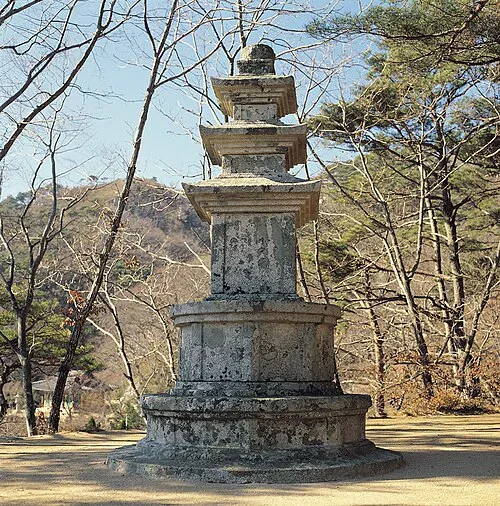 Mount Tohamsan Grounds and the Three-Story Pagoda
The Three-Story Stone Pagoda
Let's step outside and finish here, with this weathered three-story granite pagoda on the grounds. It's thought to date from the late 8th century, the same Unified Silla world that built the grotto, and it is said to face the direction where the sun rises on the winter solstice. Think about what that means. Everything you've seen today was oriented toward light. The mountain path, the guardians, the walk from the rectangular world into the round chamber, the halo trick you tried, the dome opening upward like a sky, and now a pagoda turned to catch the year's earliest dawn. This was a state project, and its builders joined exact engineering to deep devotion. Watching the sunrise over the East Sea from near the grotto remains a beloved tradition here, a quiet continuity with what the Silla builders intended. The granite blocks, the off-center halo, this solstice-facing stone: together they tell you how much skill, and how much belief, went into one mountainside over twenty years. Thank you for walking up the mountain with me.
Listen in the app문화재청 (공공누리 제1유형) · CC BY-SA 4.0
Seokguram
Frequently asked questions
How much does the guide cost?
Free app download. Listed guide price: $0.99. Guide price shown in the app. Audio guide only. Venue admission is separate.
Can I listen without internet?
Yes. Download the guide’s audio, images, and maps in the app before your visit. Your downloaded content is then available offline.
Can I listen in my language?
This audio guide is available in 15 languages, including English.
Do I need to follow a schedule?
No. This is a self-guided experience. Choose your stops, pause whenever you like, and return to a story at your own pace.
At your own pace
Explore Seokguram.
Download Stanza, then search for “Seokguram”.
Free app download · Guide price shown in the app
Keep exploring
Audio guides — South Korea
Gyeongju-si · 2 km
Bulguksa Temple
Content & sources
Bernard Gagnon · CC0
Yeongju · 146 km
Buseoksa
Content & sources
ko:Excretion · CC BY-SA 2.0 kr
Suwon
Hwaseong Fortress
Content & sources
Lance Vanlewen · CC BY-SA 4.0
Seoul
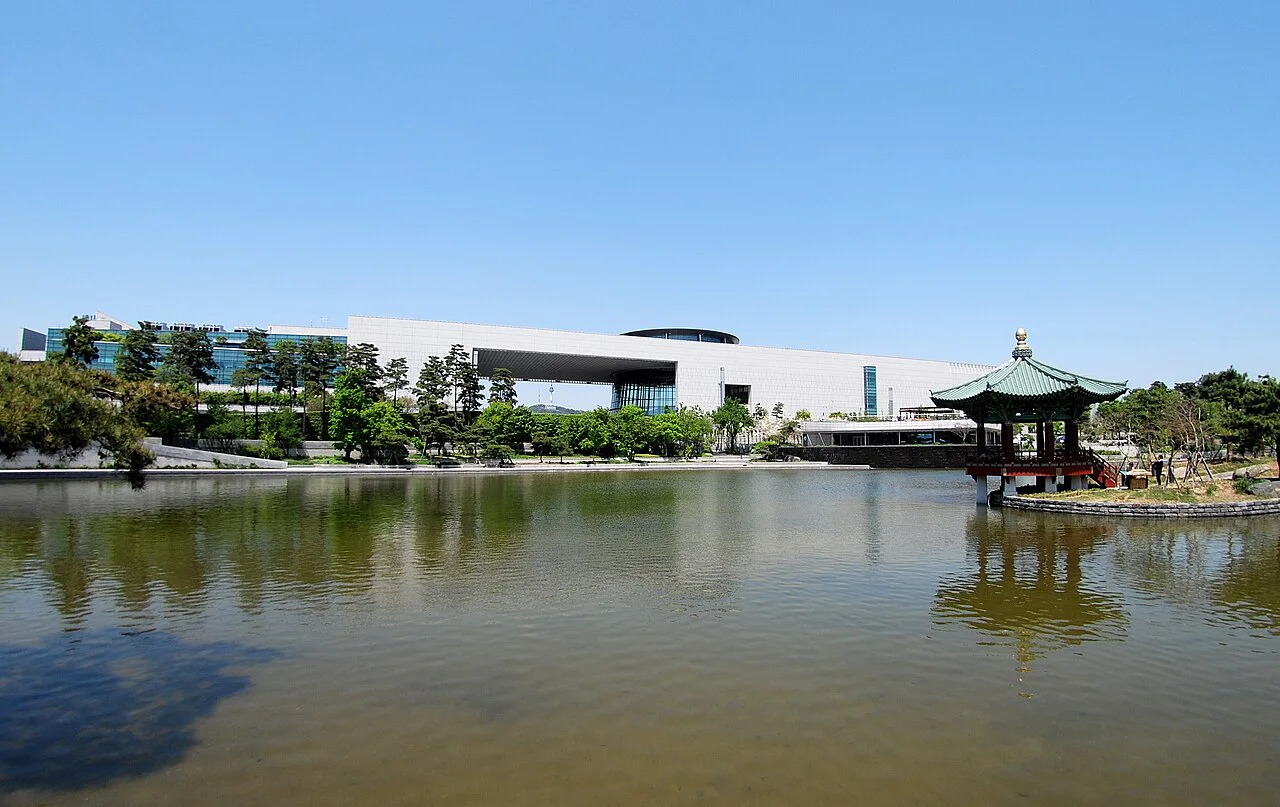
National Museum of Korea
Content & sources
Photo: Jinah78 · CC BY-SA 3.0