Stanza · Audio guide
Buseoksa Audio Guide
A place to remember. A story to take with you.
Buseoksa is a Buddhist temple located near the mountain Bonghwangsan in Yeongju, South Korea. It was founded by the prominent scholar-monk Uisang in 676.
Download Stanza, then search for “Buseoksa”.
About the tour
One guide. Your kind of visit.
Buseoksa is a Buddhist temple located near the mountain Bonghwangsan in Yeongju, South Korea. It was founded by the prominent scholar-monk Uisang in 676.
Ready when you are.
- 01Get the free Stanza app.
iOS & Android
- 02Find your guide.
“Buseoksa”
- 03Download before you go.
Works offline
Audio guide / 13 narrated stops
Inside the guide
Get to know a few of the stories before you go. Open a stop to read more.
01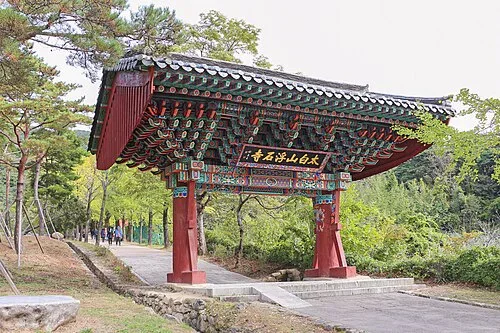 The Gateway and Flagpole Supports
Iljumun, the One-Pillar Gate
Welcome to Buseoksa, a mountain temple at Yeongju in South Korea, founded in the year 676. The story begins with a monk named Uisang. He had spent ten years in Tang China studying the Hwaeom school of Buddhism, and he sailed home in 670. Six years later, the old chronicle Samguk Sagi says, he founded this temple on the orders of King Munmu. The timing mattered. Silla had just ended a long war with Tang China, and the kingdom was unsettled. Temples like this one were meant to harmonize a fractured society, and in time each central region held a Hwaeom temple of its own. The gate here is an Iljumun, the one-pillar gate. Its pillars stand in a single line, which is where the name comes from. Passing through it marks the line between the ordinary world and the sacred mountain. From here, everything climbs.
Bernard Gagnon · CC0
02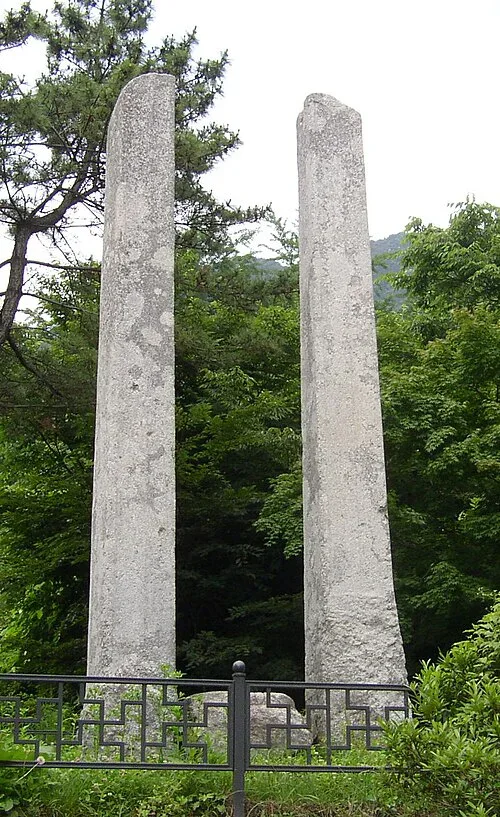 The Gateway and Flagpole Supports
Dangganjiju, the Flagpole Supports
Two weathered stone pillars stand on the approach, taller than a person and leaning a little with age. They are the Dangganjiju, the supports that once bracketed a tall wooden flagpole. At temples across Korea, such poles flew banners announcing festival days and ceremonies, so the approach itself became part of the ritual. Lichen has claimed much of the stone, and the surface has gone soft-edged with weather. The pillars are a designated Treasure, protected for what they say about the temple's ceremonial life. Even here, the ground announced that something sacred lay up the mountain.
Photo: Nichetas · Public domain
03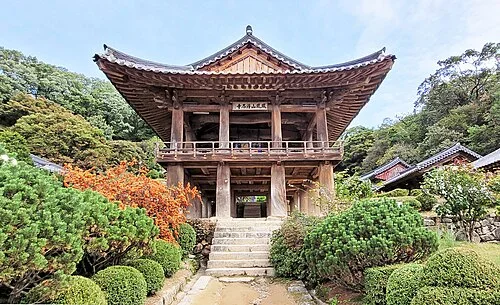 The Nine Terraces and Beomjongnu Pavilion
Beomjongnu Pavilion
Korean builders on steep mountainsides rarely cut the slope flat. At Buseoksa they did something more patient: nine stone retaining walls rise along the mountainside, and the buildings sit on the terraces between them. Nine staircases link the tiers. In temple tradition, those nine steps stand for the nine stages a mind climbs toward Nirvana, so the whole ascent becomes a teaching. The pavilion called Beomjongnu sits partway up this sequence, its upper floor raised on pillars over the path. Its roof sweeps wide, with painted eaves and layered brackets in the old style. Each terrace gained is a stage passed, and by the time the upper court appears, the climb has said what the stones were built to say.
Listen in the appBernard Gagnon · CC0
04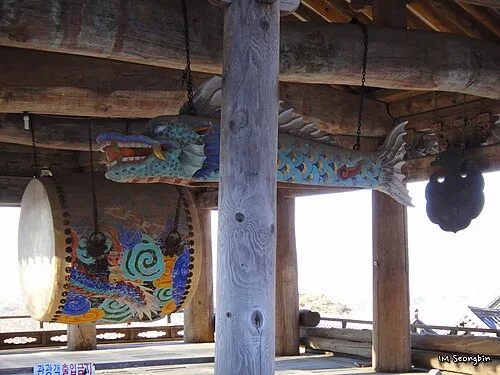 The Nine Terraces and Beomjongnu Pavilion
Inside Beomjongnu: Drum and Wooden Fish
Despite its name, which means Bell Pavilion, Beomjongnu holds no metal bell. Instead a great ceremonial drum hangs inside, painted with swirling dragons, beside a carved wooden fish suspended from the beams. In Korean temples, the drum's beat is said to carry the teaching to all living beings, while the fish, an animal that never closes its eyes, stands for wakefulness. Both instruments are common to temples of this kind rather than particular to Buseoksa. When the pavilion was repaired in 1957, workers found a roof-beam record hidden in the structure. It dates an earlier restoration to 1843. The building named for a bell keeps its rhythm now with hide and wood.
Listen in the app골뱅이 · CC BY-SA 3.0
05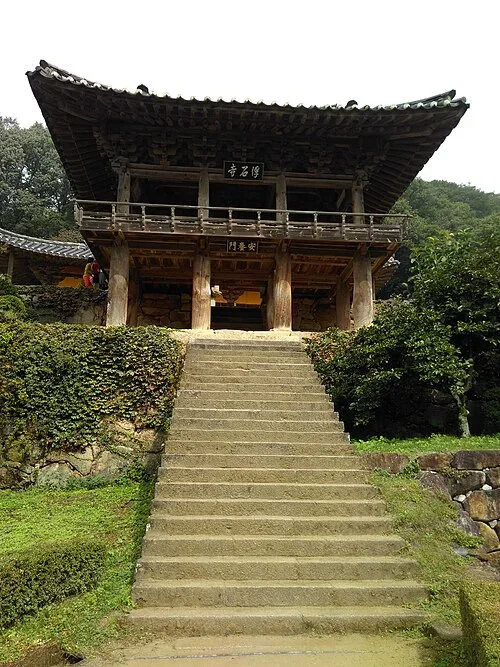 Anyanglu Pavilion - Threshold to Paradise
Anyanglu Pavilion
A steep flight of stone steps ends at a two-story pavilion, the final gate before the upper court. Its name, Anyanglu, points to Anyang, the Pure Land, the paradise of Amitabha Buddha. Read that way, the nine terraces of the climb finish at the doorway of paradise itself. The plaque above the entrance carries a surprise. Its calligraphy was written by Syngman Rhee, the first president of South Korea. A modern hand, on a threshold built to be crossed on the way to eternity. Beyond it, the courtyard of the main hall opens.
Listen in the appPhoto: G41rn8 · CC BY-SA 4.0
06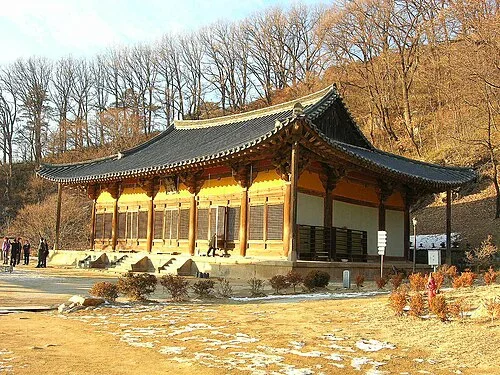 Muryangsujeon Hall and the Stone Lantern
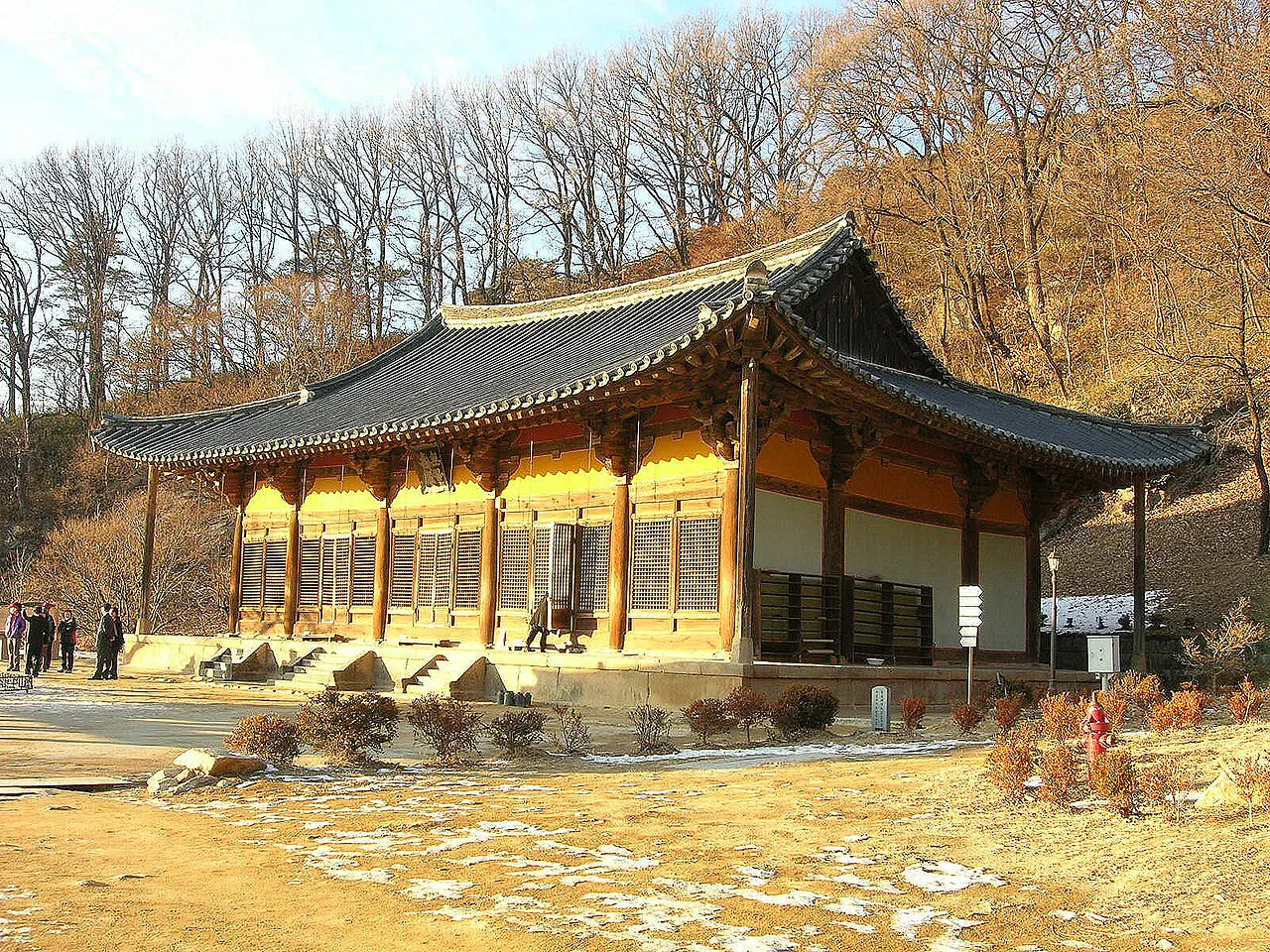
Muryangsujeon Hall
The main hall, Muryangsujeon, is the second oldest standing wooden building in South Korea. It is also one of the few wooden structures of the Goryeo dynasty to survive at all, and it holds the designation of National Treasure No. 18. Its story includes a fire. In 1358 Japanese raiders burned much of the temple, and this hall was among the losses. The monk Won-eung directed the great reconstruction under King Gongmin, and the hall rose again in 1376. Centuries later, during repairs in 1916, ink inscriptions came to light that confirm that early rebuilding. The hall's grace lies in its balance with the mountain: the sweeping roofline follows the slope rather than fighting it, in the Korean ideal of building and nature as one. Amitabha is enshrined within, on the highest terrace of the temple.
Listen in the appko:Excretion · CC BY-SA 2.0 kr
07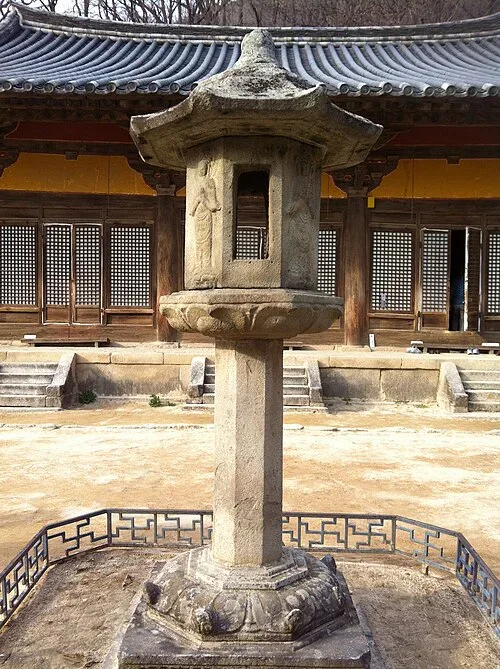 Muryangsujeon Hall and the Stone Lantern
Stone Lantern before Muryangsujeon
Directly before the main hall stands a stone lantern, designated National Treasure No. 17. It belongs among the oldest layers of this courtyard, carved in the Silla period. The panels of its firebox bear carved figures, and they reward a long look: a roof of curved stone above, a lotus base below. The lantern is old enough to have watched the wooden hall beside it burn and rise again. It has kept its post through every rebuilding around it.
Listen in the appPhoto: Jjw · CC BY-SA 3.0
08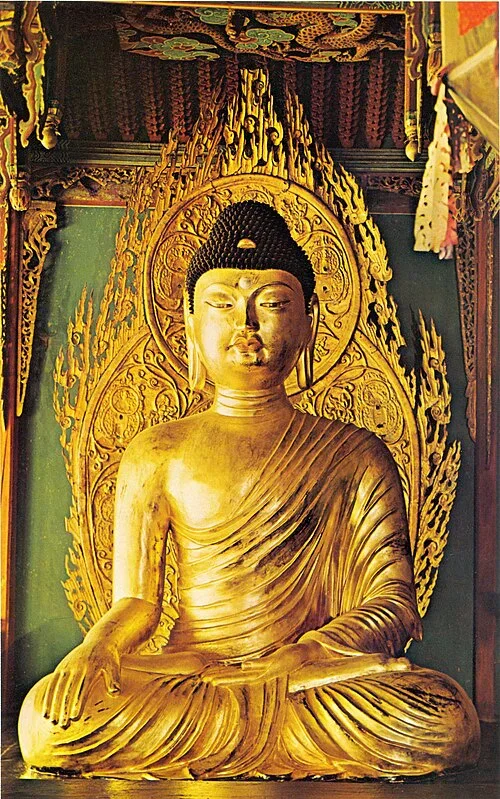 The Clay Amitabha Buddha
Seated Clay Amitabha Buddha
Inside the hall sits the temple's most remarkable survivor: a seated Amitabha Buddha formed of clay, National Treasure No. 45. Clay rarely outlives a fire, which makes the old account the stranger. Inscriptions found during the 1916 repairs say that when the flames swept through, the statue's face and head were carried out through the smoke and came to rest on a stone at the west corner of the hall. In 1376 the monk Won-eung remade the statue and covered it in gold. The gilded figure now sits in the earth-toned hall, the focus of the Amitabha devotion that Anyanglu announced on the way up.
Listen in the appUnknown author · Public domain
09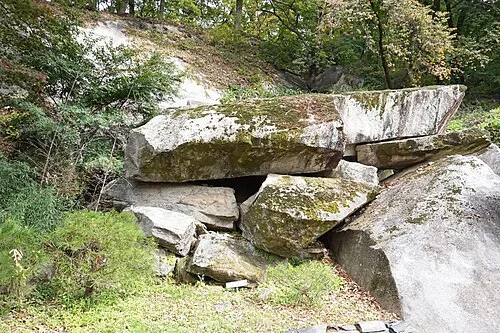 The Floating Stone and Seonmyogak Shrine
The Floating Stone
The temple's name comes from a boulder. Buseok means floating stone, and the great moss-covered rock beside the main hall is that stone. The legend, told in the Samguk Yusa, runs so: when Uisang began to build, a hostile crowd of some five hundred people rose against him. Lady Seonmyo, in her dragon form, lifted a giant stone high above their heads, and the crowd scattered. The way for the temple was clear. Tradition adds a physical test. The eighteenth-century geographer Yi Jung-hwan wrote in his Taekriji that a thread pulled through the gap beneath the rocks passes without snagging, proof, the story goes, that the stone truly floats.
Listen in the appBernard Gagnon · CC0
10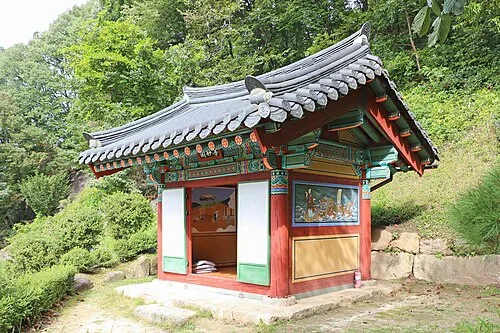 The Floating Stone and Seonmyogak Shrine
Seonmyogak Shrine
Behind the floating stone stands a woman, and a small shrine on the hillside honors her. The Samguk Yusa tells of Lady Seonmyo, a Chinese woman who admired Uisang through his long years of study in Tang China. When he sailed home to Silla, her devotion ran so deep that she transformed herself into a dragon. In that form she guided his ship through the perils of the voyage. Later, as the floating stone recalls, she drove off those who opposed his building on this mountain. A temple keeping a shrine to a laywoman is unusual, and Seonmyogak is hers. Its doors stand open onto the green slope.
Listen in the appBernard Gagnon · CC0
- 11
Seonmyogak Interior Painting
Lady Seonmyo in paint, riding her dragon through the clouds above the altar.
- 12
Three-story Stone Pagoda
A compact three-story stone pagoda holding its own quiet corner of the temple grounds.
- 13
Josadang Hall and the Sacred Shrub
The founder's own shrine, and the walking stick that sprouted into a shrub thirteen centuries old.
Buseoksa
Frequently asked questions
How much does the guide cost?
Free app download. Listed guide price: $0.99. Guide price shown in the app. Audio guide only. Venue admission is separate.
Can I listen without internet?
Yes. Download the guide’s audio, images, and maps in the app before your visit. Your downloaded content is then available offline.
Can I listen in my language?
This audio guide is available in 15 languages, including English.
Do I need to follow a schedule?
No. This is a self-guided experience. Choose your stops, pause whenever you like, and return to a story at your own pace.
At your own pace
Explore Buseoksa.
Download Stanza, then search for “Buseoksa”.
Free app download · Guide price shown in the app
Keep exploring
Audio guides — South Korea
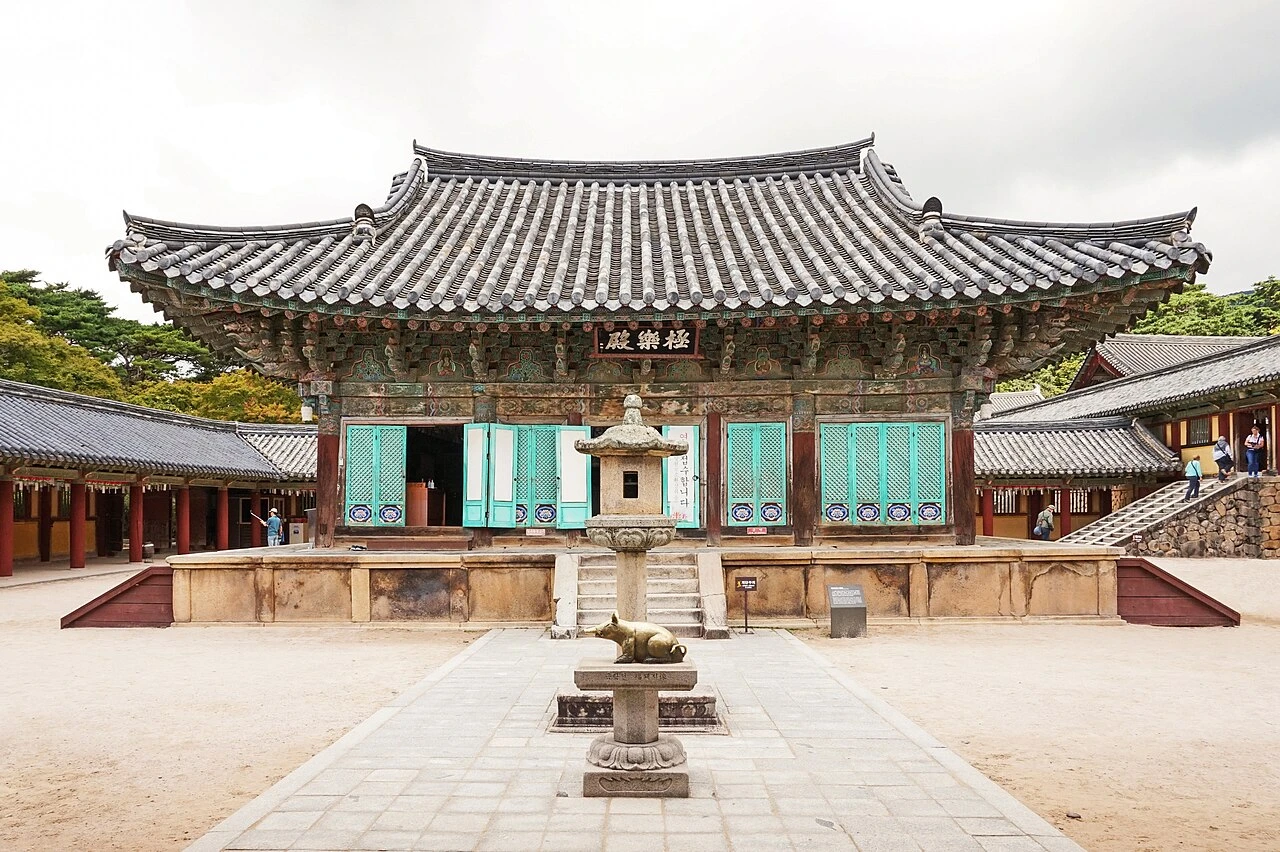
Gyeongju-si · 146 km
Bulguksa Temple
Content & sources
Bernard Gagnon · CC0
Gyeongju-si · 146 km
Seokguram
Content & sources
by eimoberg · CC BY 2.0
Suwon
Hwaseong Fortress
Content & sources
Lance Vanlewen · CC BY-SA 4.0
Seoul
Changgyeonggung Palace
Content & sources
d'n'c (a flickr user) · CC BY-SA 2.0