Stanza · Audio guide
Torre de Hércules Audio Guide
A place to remember. A story to take with you.
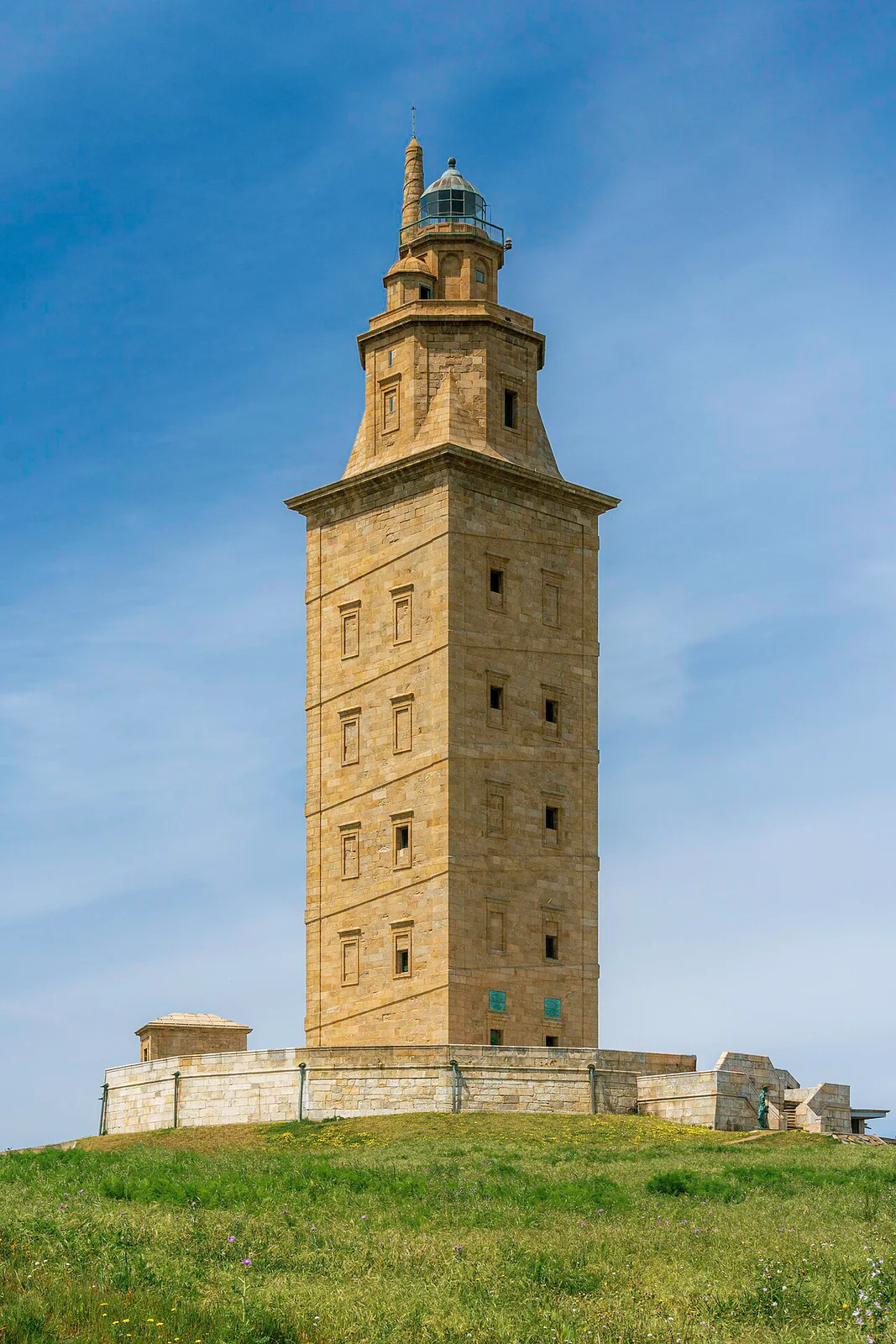
The Tower of Hercules is an ancient Roman lighthouse located in A Coruña, Spain. It is the only fully preserved Roman lighthouse that is still used for maritime signalling.
Download Stanza, then search for “Torre de Hércules”.
About the tour
One guide. Your kind of visit.
The Tower of Hercules is an ancient Roman lighthouse located in A Coruña, Spain. It is the only fully preserved Roman lighthouse that is still used for maritime signalling.
Ready when you are.
- 01Get the free Stanza app.
iOS & Android
- 02Find your guide.
“Torre de Hércules”
- 03Download before you go.
Works offline
Audio guide / 9 narrated stops
Inside the guide
Get to know a few of the stories before you go. Open a stop to read more.
01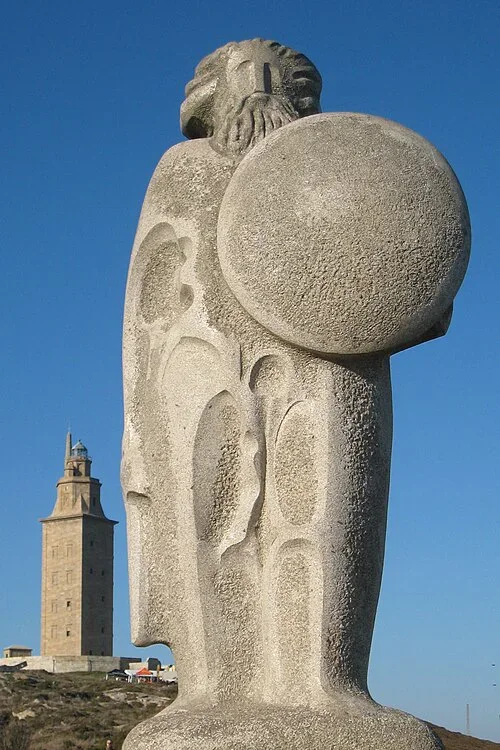 The Park Approach and Statue of King Breogán
Statue of King Breogán
Welcome to the Tower of Hercules, where the stories begin before the stones do. The stone figure here, a great round shield slung over his shoulder, is Breogán, the legendary founding father of the Galician nation. His story comes from an eleventh-century Irish book, the Book of Invasions. Breogán, it says, built a tower so tall that from its top his son Ith could make out a distant green shore. That glimpse of green land drew Ith to sail north to Ireland. His descendants, the legend continues, became the ancestors of the Irish people. The Irish book never names this coast, but in Galicia the tradition grew that Breogán's tower stood on this very headland. Some even hear an echo of Breogán in the tower's ancient name, Brigantium, though no one knows for sure. The statue was raised near the lighthouse to mark that claim.
Xosé Calvo (gl:User:Xosé) · CC BY-SA 3.0
02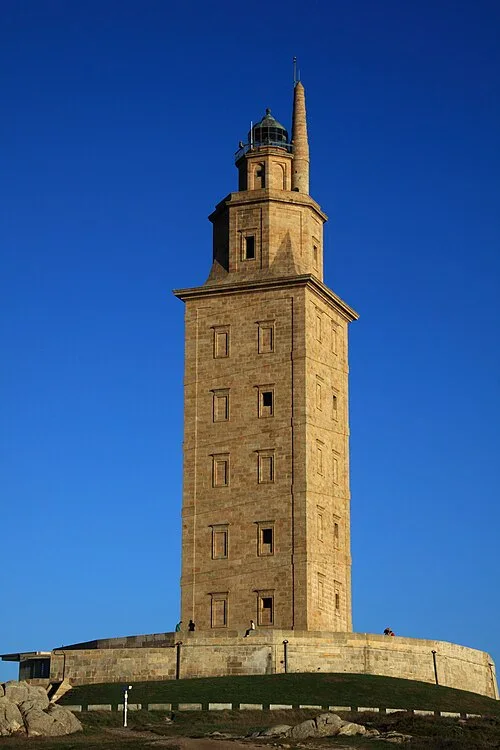 The Tower Plaza and Roman Cornerstone
The Tower of Hercules from the Plaza
The tower rising from this headland is the only Roman lighthouse anywhere that survives fully intact and still works for maritime signalling. The Romans built it in the late first century, on a peninsula a couple of kilometres from the centre of A Coruña. Until the twentieth century it was known as the Farum Brigantium. Farum is Latin, borrowed from Pharos, the Greek name for the great lighthouse of Alexandria, so the Romans were quoting the most famous beacon of the ancient world. The tower stands about fifty-five metres tall, and it is really two buildings in one. The lower thirty-four metres are original Roman masonry. The upper twenty-one metres were added much later, when the tower received its new lantern. In June 2009, UNESCO inscribed the tower on the World Heritage List, and crowds in A Coruña waited hours in the square to hear the decision announced.
Photo: FirkinCat · CC BY-SA 3.0 es
03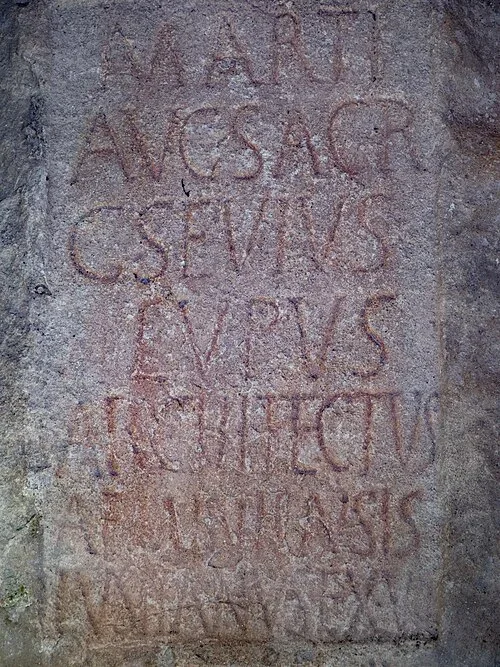 The Tower Plaza and Roman Cornerstone
Roman Cornerstone Inscription
At the base of the tower, a weathered stone keeps the oldest signature in this whole story. Its carved Latin begins MARTI AVG SACR, sacred to Mars Augustus, the Roman god of war. Then it names the maker: C SEVIVS LVPVS ARCHITECTVS, Gaius Sevius Lupus, architect. He came from Aeminium, the Roman town that is now Coimbra in Portugal, in the old province of Lusitania. The closing words, EX VO, mark the stone as a vow fulfilled, an offering promised to the god and paid. So the one person we can name from the Roman building is not an emperor or a governor, but an architect from Lusitania, signing his work to Mars. Centuries later, it is said, medieval readers misread inscriptions like this one, and from that confusion grew the tale that Julius Caesar himself had built the tower.
Listen in the appPhoto: C messier · CC BY-SA 4.0
04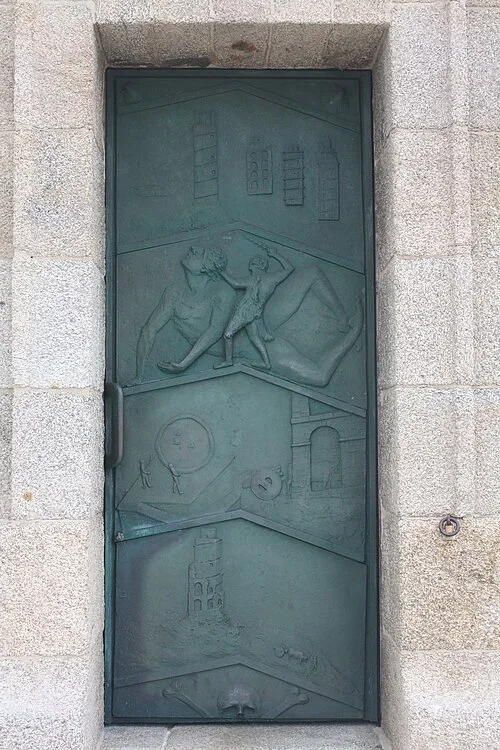 The Monumental Portal and Hercules Legend
Bronze Portal Reliefs: Hercules and Geryon
The green bronze door into the tower carries the legend that gave the lighthouse its modern name. In its relief panels, the hero Hercules wrestles the giant tyrant Geryon, a battle that raged for three days and three nights. When Geryon finally fell, Hercules buried his head together with his weapons, in the old Celtic manner, and ordered a city built on the spot. The lowest panel of the door shows what lies beneath the ground there: a skull and crossbones, the buried head of the slain giant. A lighthouse standing over a buried skull is the image that carried into the coat of arms of A Coruña, which shows a skull and crossbones beneath the tower. And because Hercules won his battle here, the lighthouse bears his name to this day.
Listen in the appPhoto: P.Lameiro · CC BY-SA 4.0
05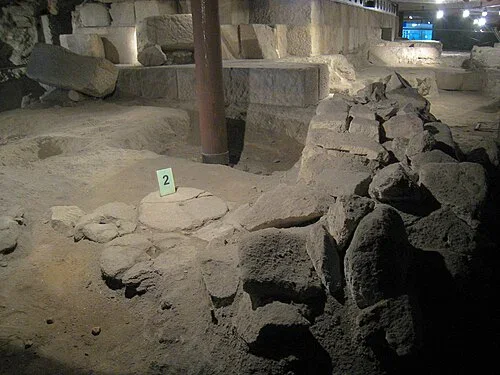 The Roman Core and Spiral Ascent
Excavated Roman Foundations
Inside the base, the ground opens onto the tower's Roman bones: excavated rubble and cut stone from the first-century foundations. The walls around record the tower's whole biography at once, Roman work, medieval patching and later repairs, all left visible within the newer shell. The Middle Ages were the low point of the story. The tower probably lost its maritime role in that period and served instead as a fortification. In 1682 the Duke of Uceda commissioned an architectural restoration, and a wooden staircase was built up through the vaults to the top, where two small towers held the lights. That rescue stopped the decline; the complete rebuilding came a century later, under Charles the Third.
Listen in the appXosé Calvo (gl:User:Xosé) · CC BY-SA 3.0
06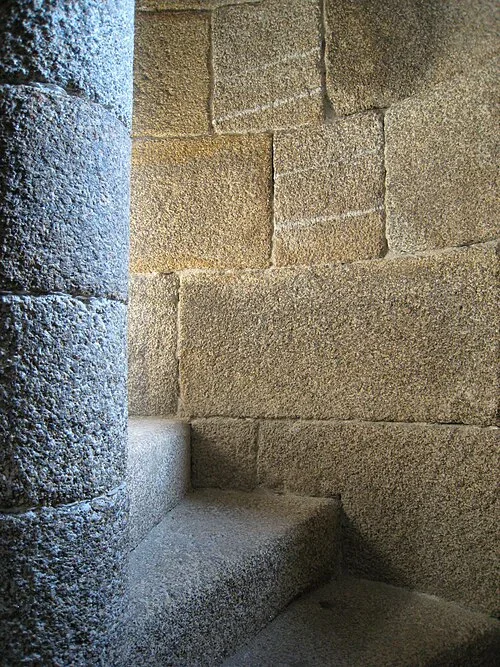 The Roman Core and Spiral Ascent
The Spiral Staircase Ascent
The climb to the top runs to two hundred and thirty-nine steps of granite, winding through the old masonry. The stair is not the Roman way up, though. In the original tower, the surviving core was ringed on the outside by a spiral ramp, and its diagonal outline can still be traced across the restored facade. At Roman lighthouses generally, ramps like that were how workers hauled fuel up to the lamp, wood and whatever else fed the flame. Centuries later the climb moved inside. Outside, the ghost of the ramp keeps circling the stone.
Listen in the appXosé Calvo (gl:User:Xosé) · CC BY-SA 3.0
07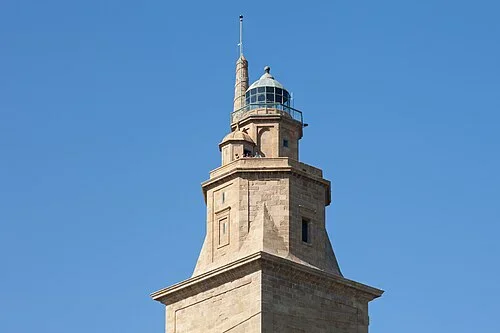 The Summit Beacon and Ocean Lookout
The 18th-Century Lantern
The glazed lantern at the top is the visible result of the tower's great rescue. Under Charles the Third, the naval engineer Eustaquio Giannini directed a Neoclassical restoration, completed in 1791. His design clothed the old tower in a new facade and added a fourth storey, twenty-one metres of stone, to carry the light. The Roman core below was kept and protected rather than swept away. UNESCO later judged the whole operation exemplary, praising a restoration that preserved the central core of the original Roman monument while returning it to working condition. Overhead, the lantern still does what Giannini rebuilt it to do.
Listen in the appLuis Miguel Bugallo Sánchez (Lmbuga) · CC BY-SA 3.0
08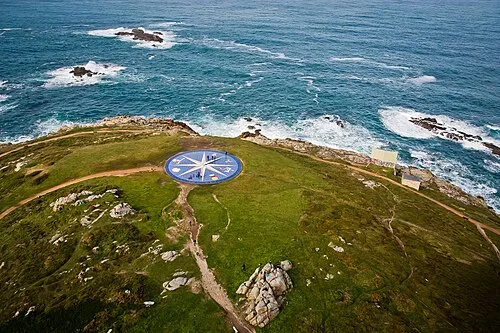 The Summit Beacon and Ocean Lookout
Summit View over the Atlantic
The view from the summit runs out over the Atlantic headland, and on the grass far below spreads a great mosaic wind rose. This is the outlook the tower was built for. The oldest written mention of the lighthouse comes from around 415 AD, from Paulus Orosius, a priest writing his History Against the Pagans. Of Brigantia, the city here, he wrote that a very tall lighthouse was erected, among the few works worth remembering, for looking towards Britannia. That was the purpose of the whole building: a beacon aimed along the Atlantic route toward the island at the edge of the Roman world. The wind rose set into the headland points its directions out to the same sea.
Listen in the appPhoto: D.Rovchak · CC BY-SA 4.0
09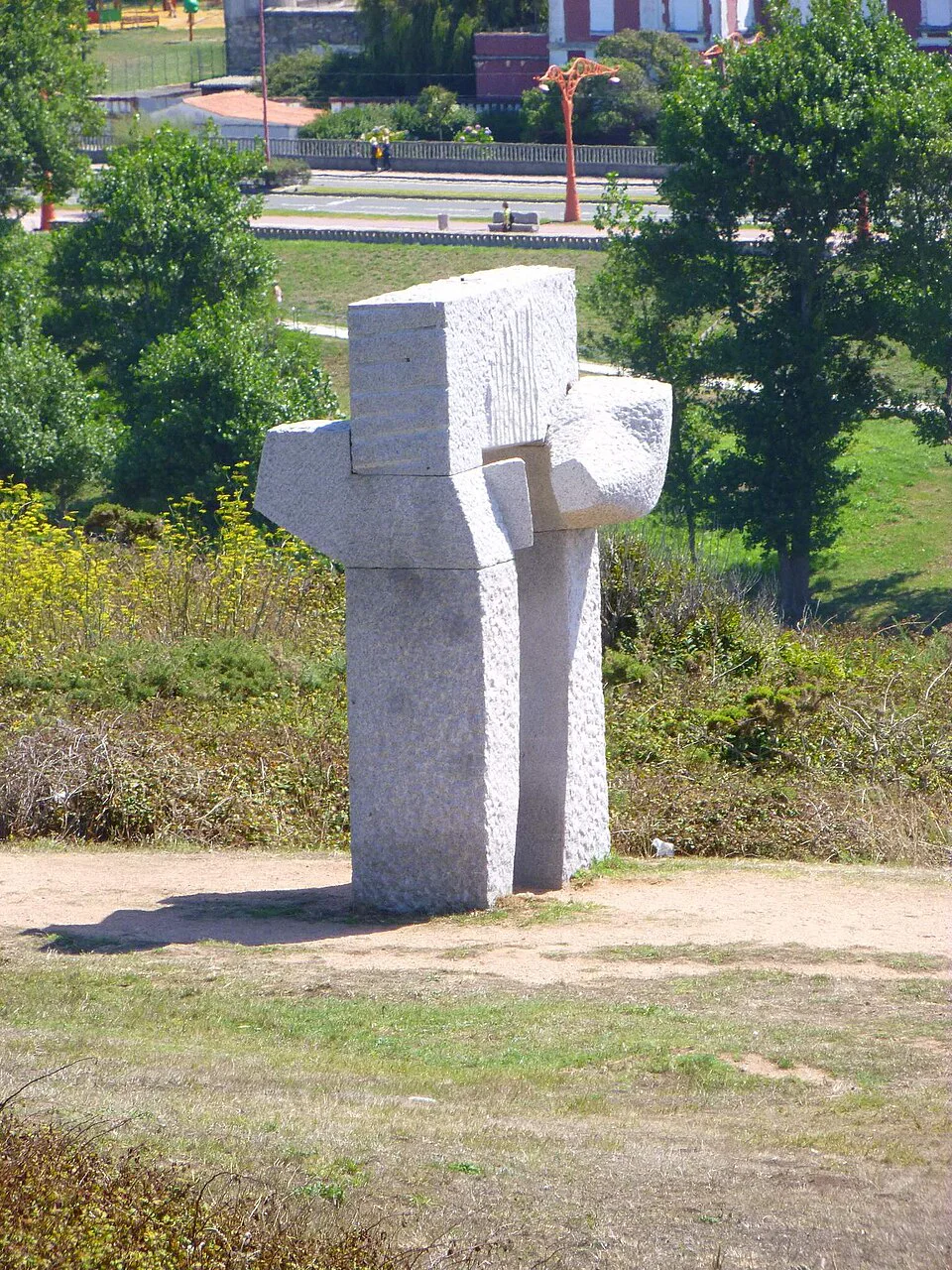 The Coastal Sculpture Park: Ara Solis
The Coastal Sculpture Park
The headland around the tower is an open-air museum. More than fifteen sculptures by twentieth-century artists stand along the coastal paths, among them works by Francisco Leiro and Manolo Paz, set into a wide natural landscape of grass, rock and ocean wind. Granite is the favoured stone here, the same grey stone the tower itself wears. A Coruña has kept marking this coast, with a Roman beacon, with a legend, and now with sculpture, each generation adding its own sign to the edge of the Atlantic. The tower remains the oldest of them all.
Listen in the appPhoto: Zarateman · CC0
Torre de Hércules
Frequently asked questions
How much does the guide cost?
Free app download. Listed guide price: $0.99. Guide price shown in the app. Audio guide only. Venue admission is separate.
Can I listen without internet?
Yes. Download the guide’s audio, images, and maps in the app before your visit. Your downloaded content is then available offline.
Can I listen in my language?
This audio guide is available in 15 languages, including English.
Do I need to follow a schedule?
No. This is a self-guided experience. Choose your stops, pause whenever you like, and return to a story at your own pace.
At your own pace
Explore Torre de Hércules.
Download Stanza, then search for “Torre de Hércules”.
Free app download · Guide price shown in the app
Keep exploring
Audio guides — Spain
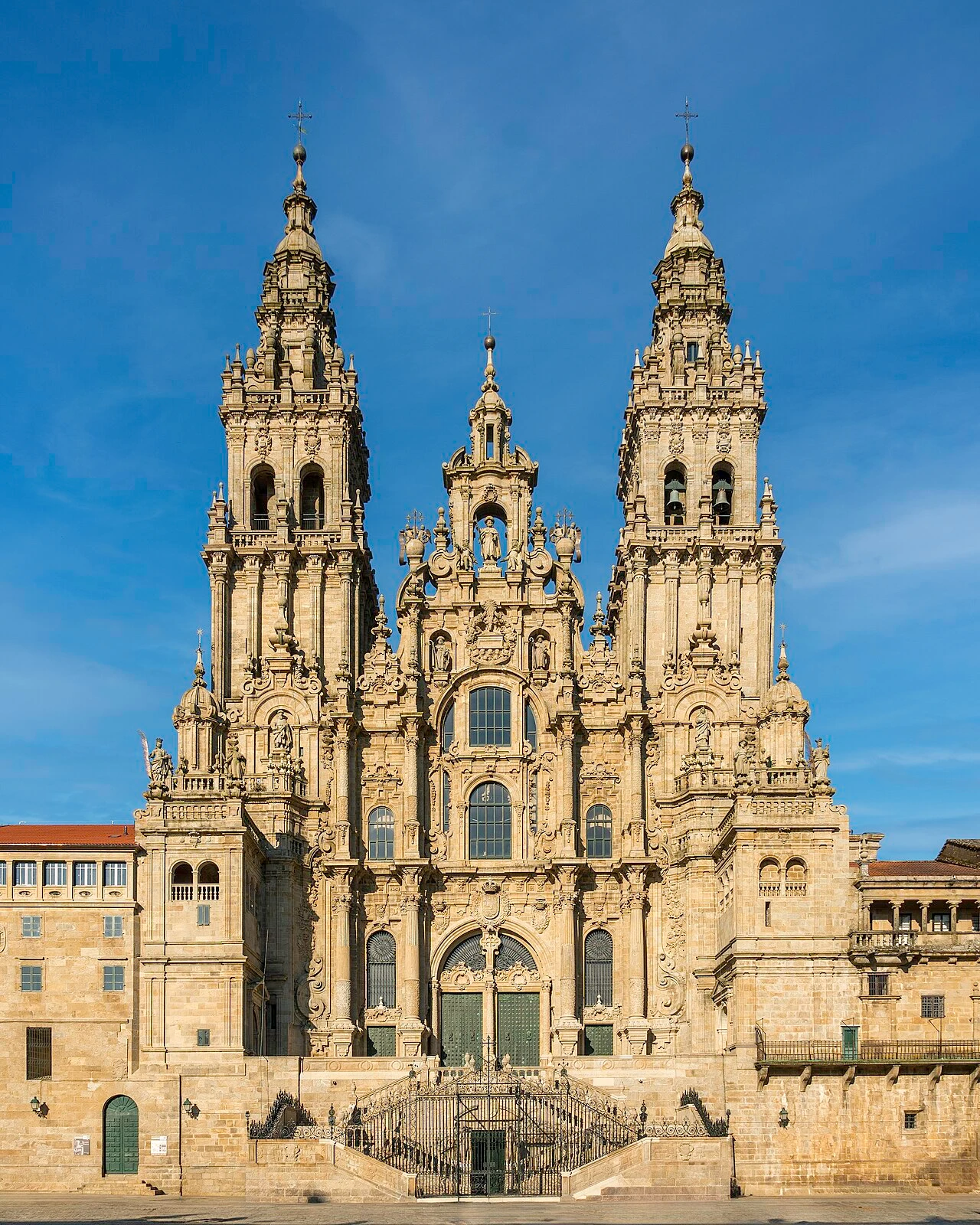
Santiago de Compostela · 57 km
Santiago de Compostela Cathedral
Content & sources
Photo: Fernando · CC BY-SA 4.0
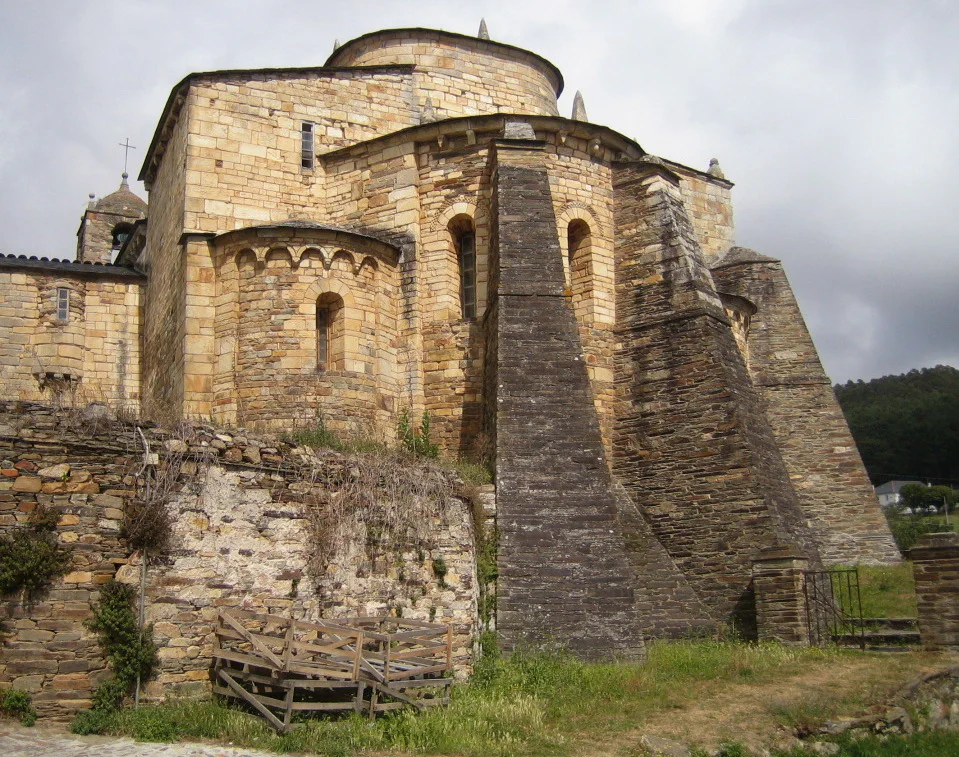
Foz · 91 km
Basílica de San Martín
Content & sources
Photo: Yeza · CC BY-SA 4.0
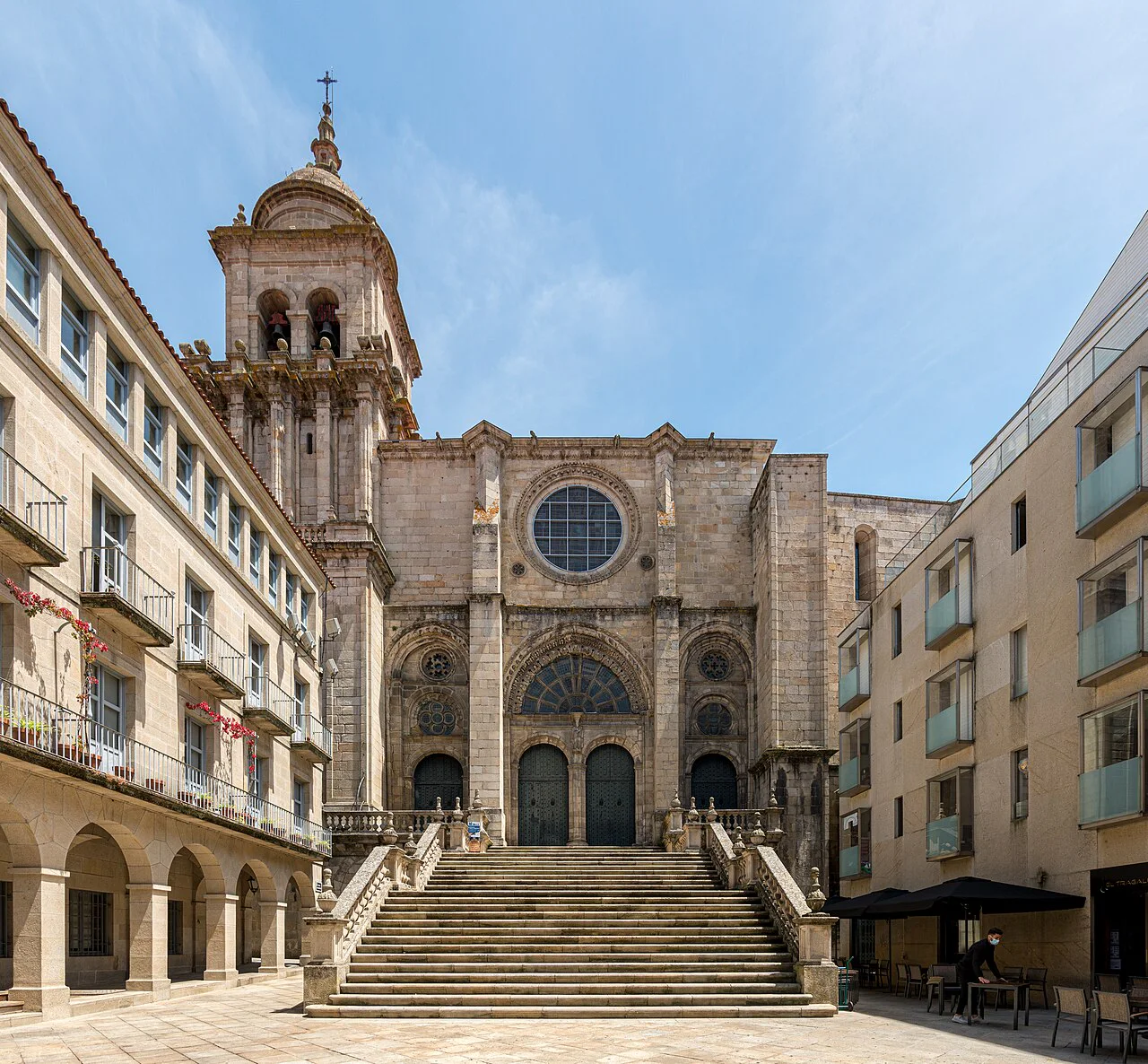
Ourense · 125 km
Catedral de Orense
Content & sources
Photo: Fernando · CC BY-SA 4.0
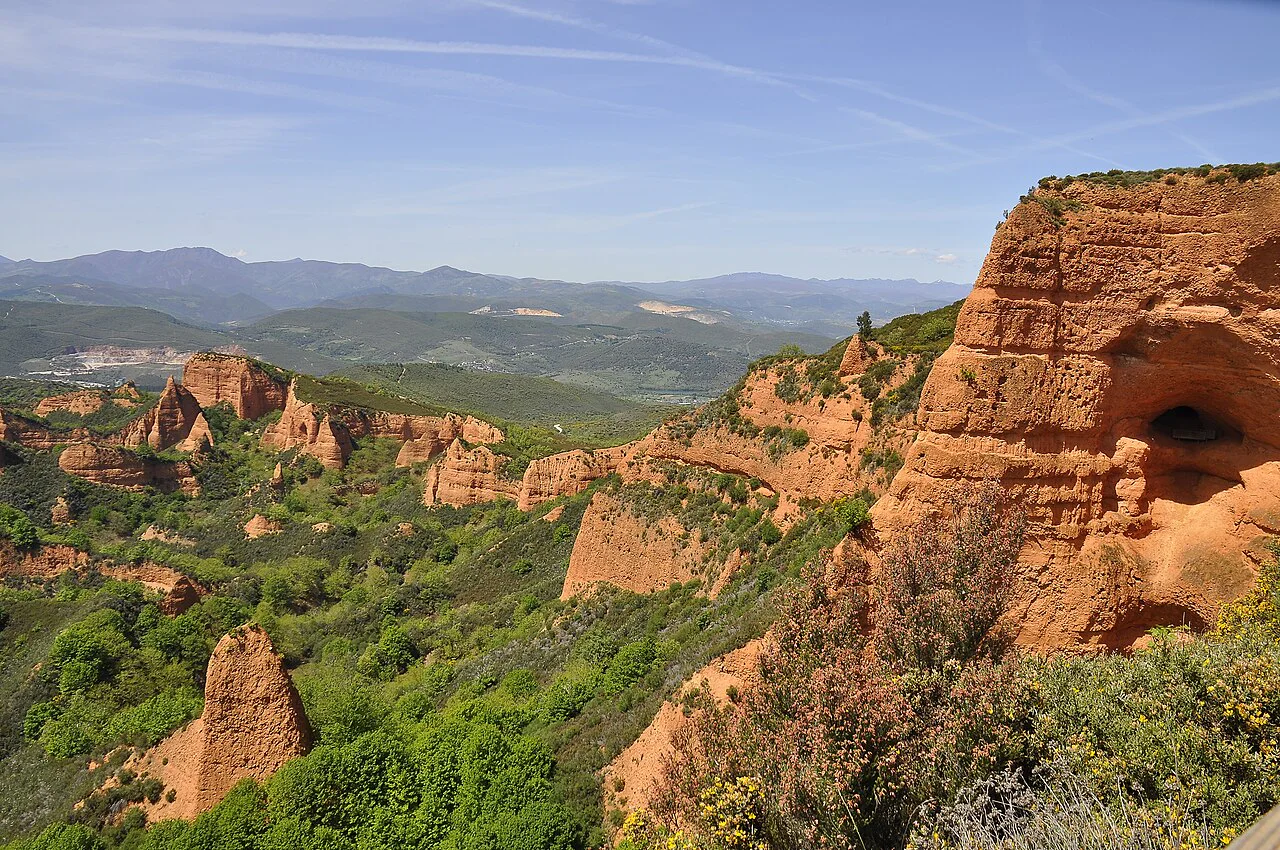
Carucedo
Las Médulas
Content & sources
Frayle from Salamanca, España · Public domain