Stanza · Audio guide
Catedral de la Santa Cruz y Santa Eulalia Audio Guide
A place to remember. A story to take with you.
The Cathedral of the Holy Cross and Saint Eulalia is the seat of the archbishop of Barcelona in Catalonia, Spain. It was constructed from the thirteenth to fifteenth centuries, with the principal work…
Download Stanza, then search for “Catedral de la Santa Cruz y Santa Eulalia”.
About the tour
One guide. Your kind of visit.
The Cathedral of the Holy Cross and Saint Eulalia is the seat of the archbishop of Barcelona in Catalonia, Spain. It was constructed from the thirteenth to fifteenth centuries, with the principal work completed in the fourteenth century.
Ready when you are.
- 01Get the free Stanza app.
iOS & Android
- 02Find your guide.
“Catedral de la Santa Cruz y Santa Eulalia”
- 03Download before you go.
Works offline
Audio guide / 14 narrated stops
Inside the guide
Get to know a few of the stories before you go. Open a stop to read more.
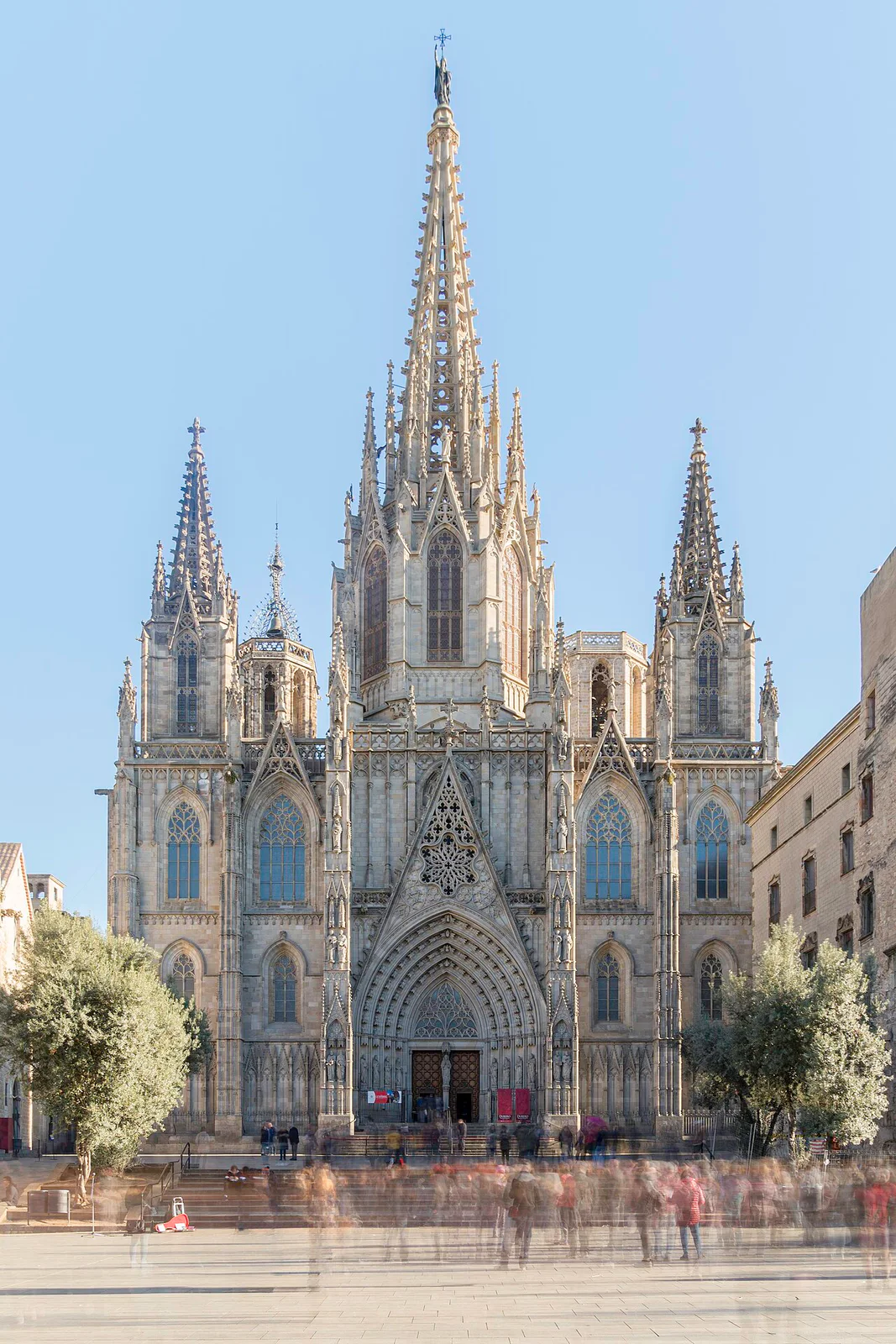
01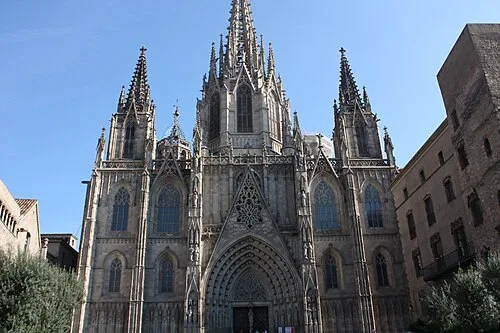 Pla de la Seu and the Neo-Gothic Façade
The Neo-Gothic Façade on Pla de la Seu
Welcome to the Cathedral of the Holy Cross and Saint Eulalia, the seat of the archbishop of Barcelona. The Gothic church behind this ornament was begun on the first of May, 1298, under King James the Second and Bishop Bernat Pelegrí. Yet the west front is the youngest part of the whole building. Catalan Gothic churches traditionally left their west walls plain, so for centuries the cathedral showed a bare face to the square. Ahead of the Universal Exposition of 1888, a competition was called to give it a Gothic façade at last. The commission went to Josep Oriol Mestres, the cathedral's architect since 1855. He drew on tracings prepared in the early fifteenth century by Carles Galtés de Ruan. Manuel Girona i Agrafel paid for the work, and his children saw it finished in 1913.
Pierre_Gronau from de.wikipedia.org · CC BY-SA 3.0
02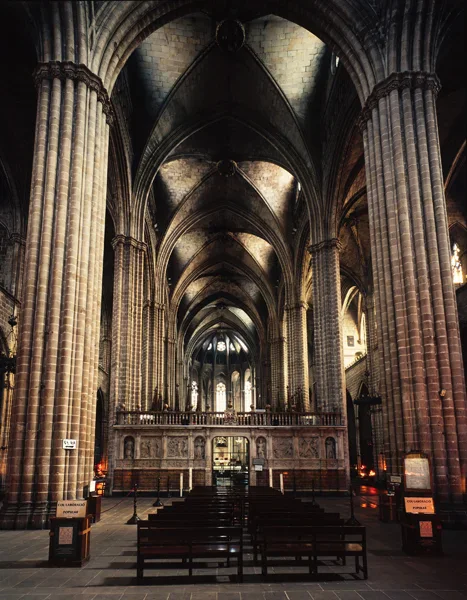 The Grand Nave and Catalan Gothic Vaults
The Gothic Nave and Catalan Vaults
Inside, the cathedral opens into a wide, luminous space. It is vaulted over five aisles, with the two outer ones divided into chapels. The transept is truncated, and the east end is a chevet of nine chapels around an ambulatory. This is Catalan Gothic, a style that prefers breadth and balance to towering height. The central nave rises about twenty-eight metres, and the unusually tall side aisles help carry its weight. The vaults carry a scheme of two hundred and fifteen keystones, sculpted and painted in colour. The biggest, in the main nave, span two metres across. Each weighs about five tons. Windows opening onto the cloister throw light as far as the choir.
Photo: PMRMaeyaert · CC BY-SA 4.0
03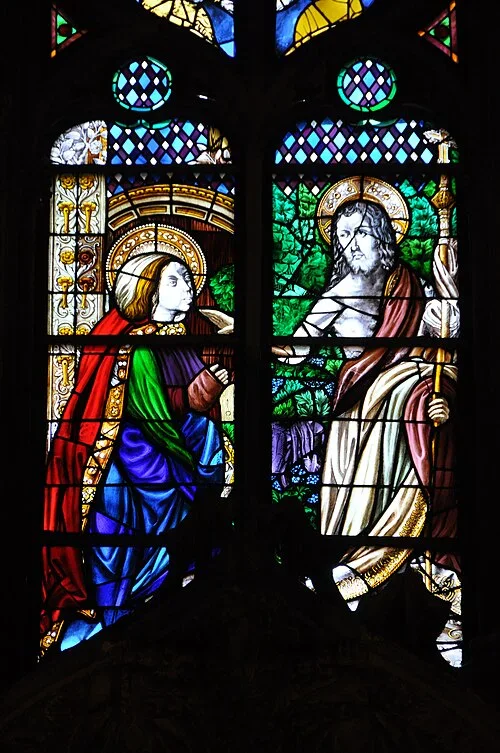 The Grand Nave and Catalan Gothic Vaults
The Noli me tangere Window
Stained glass fills the high windows, and one panel in the baptistery chapel tells a whole story on its own. It shows the Risen Christ in a garden, meeting Mary Magdalene, who kneels before him in blue and red. The Latin words Noli me tangere, do not touch me, run along its lower band. The glassmaker Gil Fontanet made the window in 1495, working from a cartoon drawn by the painter Bartolomé Bermejo. Pairing a leading painter with a master glazier shows how the arts worked together here at the end of the Middle Ages. The window belongs to the cathedral's fifteenth-century phase of glazing, when the long building campaign finally turned to its decoration.
Listen in the appBartolomé Bermejo · CC BY-SA 2.0
04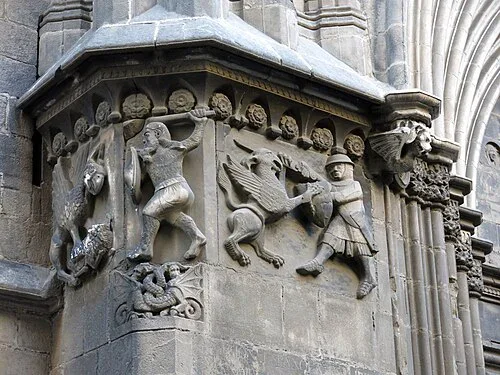 The Portal of Saint Ivo and the Renaissance Organ
The Portal of Saint Ivo
Warriors carved in stone fight griffins and other monsters on this corner of the cathedral. It is the Portal of Saint Ivo, the oldest Gothic entrance in the building. For some five hundred years it served as the main way in. It takes its name from the building opposite, which long housed the city's lawyers, whose patron was Saint Ivo. The portal is one of the first attempts at the pointed arch in Catalan Gothic, begun in 1298, in marble and stone from Montjuïc. Above the pillars, carved musicians lean out of the arch. The reliefs at the sides are believed to have come from the old Romanesque cathedral. Nearby, under the bell tower by this door, stands the Renaissance organ of 1538. Its case was once closed by great painted doors, taken down in 1950 and kept in the cathedral museum.
Listen in the appPhoto: Enfo · CC BY-SA 3.0
05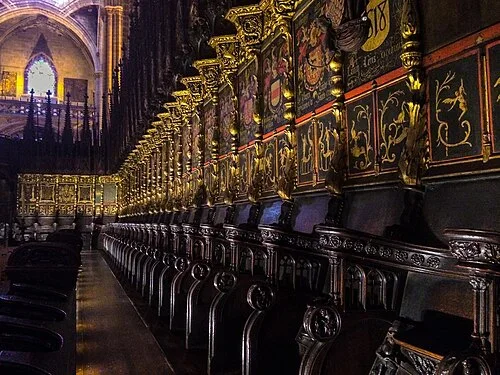 The Imperial Choir of the Golden Fleece
The Choir Stalls of the Golden Fleece
A long row of painted shields runs along the oak stalls of this choir, and they mark a great state occasion. In 1519 Charles, King of Spain and soon Emperor, chose Barcelona for a chapter of the Order of the Golden Fleece. He had come for his investiture as Count of Barcelona. The port gave his scattered Habsburg lands their best Mediterranean link, and the cathedral was large enough for the required ceremonies. From 1518 the order's herald, Thomas Isaac, and its treasurer, Jean Micault, prepared the sanctuary. Joan de Burgunya painted the heraldry on sixty-four panels of the stalls, for the monarchs and knights of the chapter. The shields are still in place. Work on the choir itself had begun much earlier, in 1390, under Bishop Ramon d'Escales.
Listen in the appAndrew Moore from Johannesburg, South Africa · CC BY-SA 2.0
06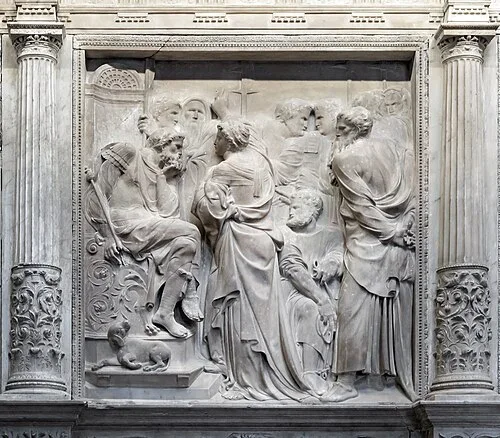 The Imperial Choir of the Golden Fleece
The Judgment of Saint Eulalia
A young woman is brought before the Roman governor Dacian in this marble relief. She is Eulalia, co-patron of Barcelona, and the story the cathedral keeps is one of tradition rather than record. According to it, she was thirteen years old when she spoke out about the persecution of Christians. The governor punished her instead of helping her. Tradition counts thirteen tortures, one for each year of her age. She was stripped and exposed in the forum, until a miraculous snowfall in mid-spring covered her. Then she was shut into a barrel studded with knives and broken glass, and rolled down a street still called the Baixada de Santa Eulàlia. At the end she was crucified on an X-shaped cross, which became the emblem of the cathedral and the diocese. The relief was carved in 1519, the same year the Golden Fleece chapter filled this choir.
Listen in the appDidier Descouens · Public domain
07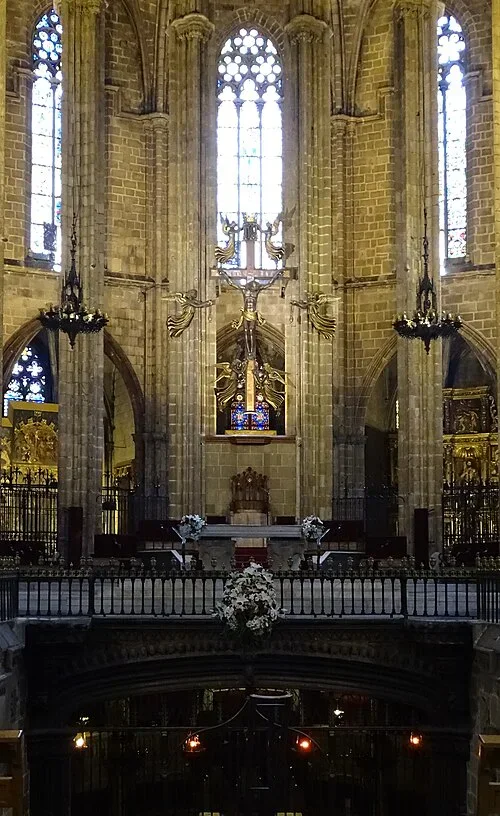 The High Altar and Royal Tombs
The High Altar
The high altar stands raised on a platform, and the design is deliberate. From the church above, worshippers have a clear view down into the crypt beneath it, where Saint Eulalia rests. Architecture here serves devotion, joining the church above to the saint's tomb below. Above the altar stands Frederic Marès's image of the Exaltation of the Cross, surrounded by six angels, and flowers stand at the altar rail.
Listen in the appAd Meskens You are free to use this picture for any purpose as long as you credit its author, Ad Meskens. Example: © Ad Meskens / Wikimedia Commons If you use this work outside of the Wikimedia projects, a message or a copy is very much appreciated. This image is not in the public domain. A statement such as "From Wikimedia Commons" or similar is not by itself sufficient. If you do not provide clear attribution to the author you do not comply with the terms of the file's license and you may not use this file. If you are unable or unwilling to provide attribution you should contact Ad Meskens to negotiate a different license. · CC BY-SA 4.0
08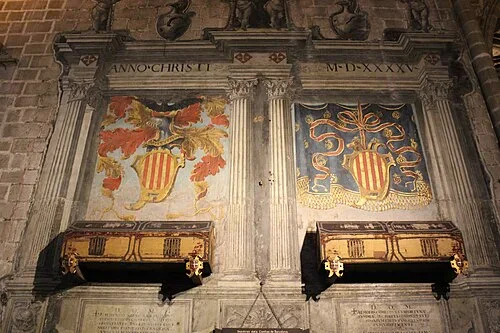 The High Altar and Royal Tombs
The Tombs of Ramon Berenguer I and Almodis
Before the Gothic church, there was a Romanesque cathedral on this spot. In 1046 Count Ramon Berenguer the First and his wife Almodis de la Marche, together with Bishop Guislabert, began building it. It was consecrated in November 1058, and the Gothic church later rose on its foundations. The count and his wife are buried here still, in wall tombs set with painted heraldic panels. Other rulers and bishops of the see rest nearby, in the church they helped to found.
Listen in the appPhoto: Tulumnes · CC BY-SA 4.0
09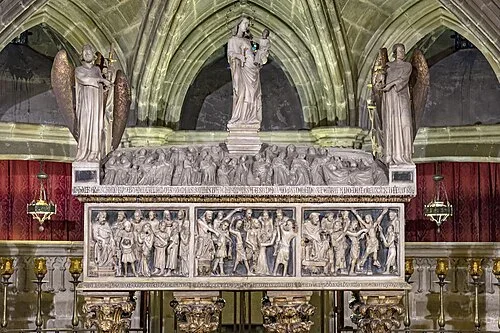 The Crypt of Saint Eulalia
Below the presbytery lies the crypt built for Saint Eulalia. Jaume Fabre, the cathedral's first known architect, began it in the early fourteenth century, and it was finished in 1326. Its flattened vault divides into twelve arcs that converge on one central keystone. The keystone shows the Virgin with the Child Jesus placing the martyr's diadem on Eulalia's head. The relics were not moved here until 1339. At the centre of the crypt, behind the altar table, stands her alabaster sarcophagus, held up by eight columns with gilded capitals. A sculptor from Pisa, Lupo di Francesco, carved it. Its lid and sides carry scenes of the martyrdom told in the choir relief above. Against the back wall is a far older ninth-century tomb, with an inscription from 877 recording that Bishop Frodoí and his clergy found the relics in the church of Santa María. It reads: here rests Saint Eulalia, martyr of Christ, who suffered in the city of Barcelona under Dacian.
Listen in the appDidier Descouens · CC BY-SA 4.0
10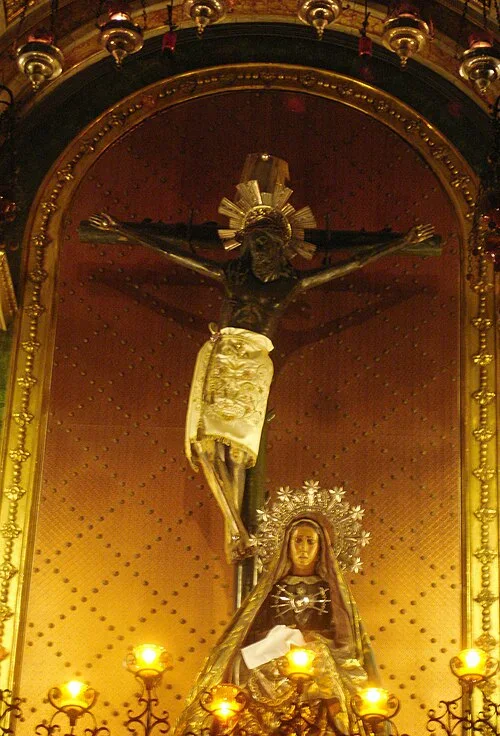 The Chapel of the Holy Christ of Lepanto
The Holy Christ of Lepanto
This crucifix is one of the cathedral's most revered images, the Holy Christ of Lepanto. It is said to date from the time of the battle of 1571, and to have been carried on the galley of Don Juan of Austria, half-brother of King Philip the Second. The Catalan legend the cathedral keeps tells that a cannonball flew straight at the cross. The figure leaned aside to dodge it, and has hung inclined ever since. A second version says the cross was stowed in the hold, and moved to cover a hole that would have sunk the ship. The Habsburgs were said to read the twist as an encouraging omen. Both are legends gathered around a venerable sixteenth-century crucifix.
Listen in the appMutari 12:15, 23 September 2007 (UTC) · Public domain
- 11
The Tomb of Saint Olegarius
A medieval chapterhouse rebuilt as the shrine of a bishop who became an archbishop and a saint.
- 12
The Cloister Geese
Thirteen white geese in a palm-filled cloister, one for every year of Saint Eulalia's life.
- 13
The Fountain of Saint George
The dancing egg of Corpus Christi, and the witches turned to stone on the cathedral roof.
- 14
The Chapel of Santa Llúcia
The rough-stone Romanesque chapel that survived beside the Gothic church, and the bishop buried there.
Catedral de la Santa Cruz y Santa Eulalia
Frequently asked questions
How much does the guide cost?
Free app download. Listed guide price: $0.99. Guide price shown in the app. Audio guide only. Venue admission is separate.
Can I listen without internet?
Yes. Download the guide’s audio, images, and maps in the app before your visit. Your downloaded content is then available offline.
Can I listen in my language?
This audio guide is available in 15 languages, including English.
Do I need to follow a schedule?
No. This is a self-guided experience. Choose your stops, pause whenever you like, and return to a story at your own pace.
At your own pace
Explore Catedral de la Santa Cruz y Santa Eulalia.
Download Stanza, then search for “Catedral de la Santa Cruz y Santa Eulalia”.
Free app download · Guide price shown in the app
Keep exploring
Audio guides — Spain
Barcelona · 1 km
Basílica de Santa María del Mar
Content & sources
Photo: Kent Wang · CC BY-SA 4.0
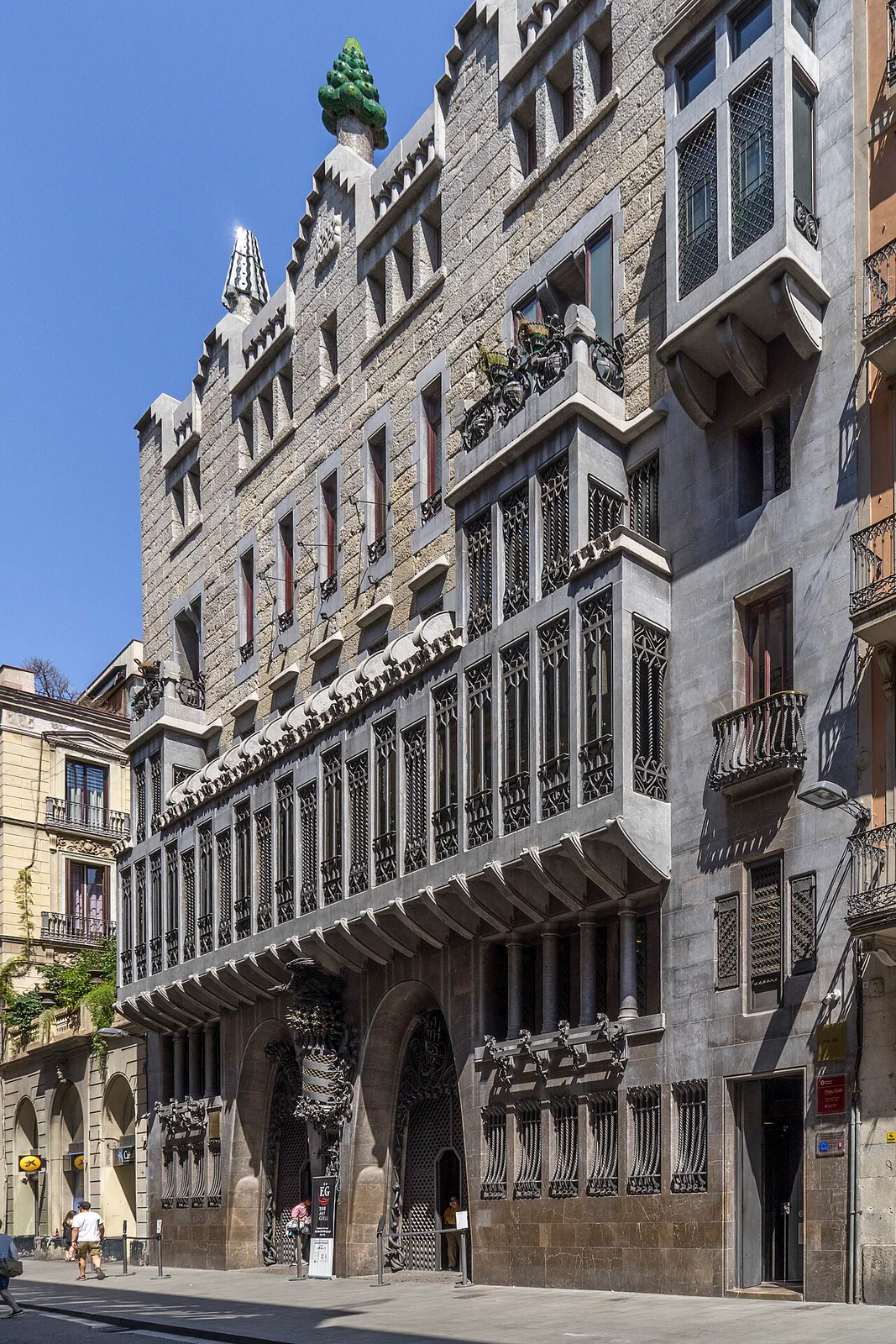
Barcelona · 1 km
Palacio Güell
Content & sources
Thomas Ledl · CC BY-SA 4.0
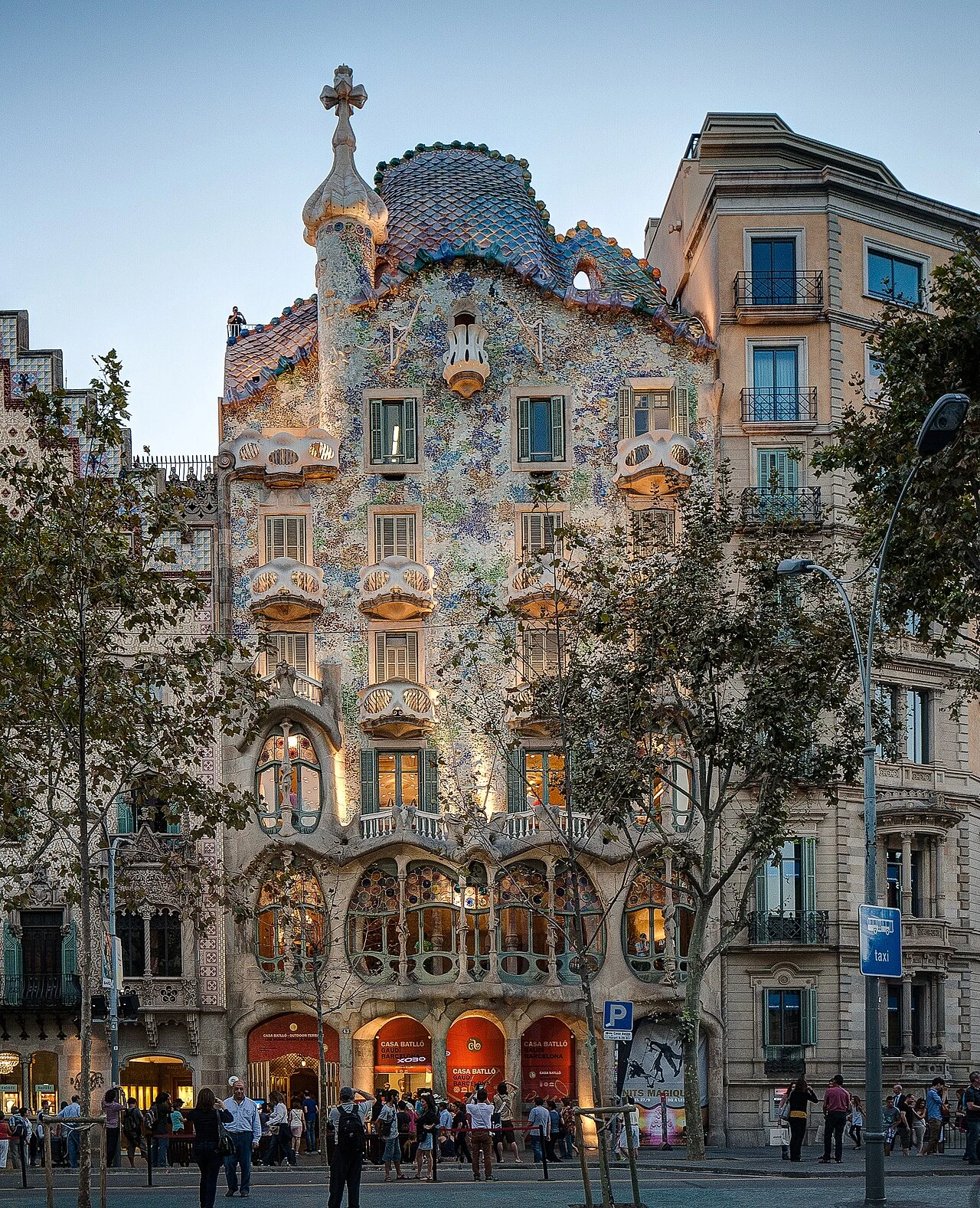
Barcelona · 1 km
Casa Batlló
Content & sources
ChristianSchd · CC BY-SA 3.0
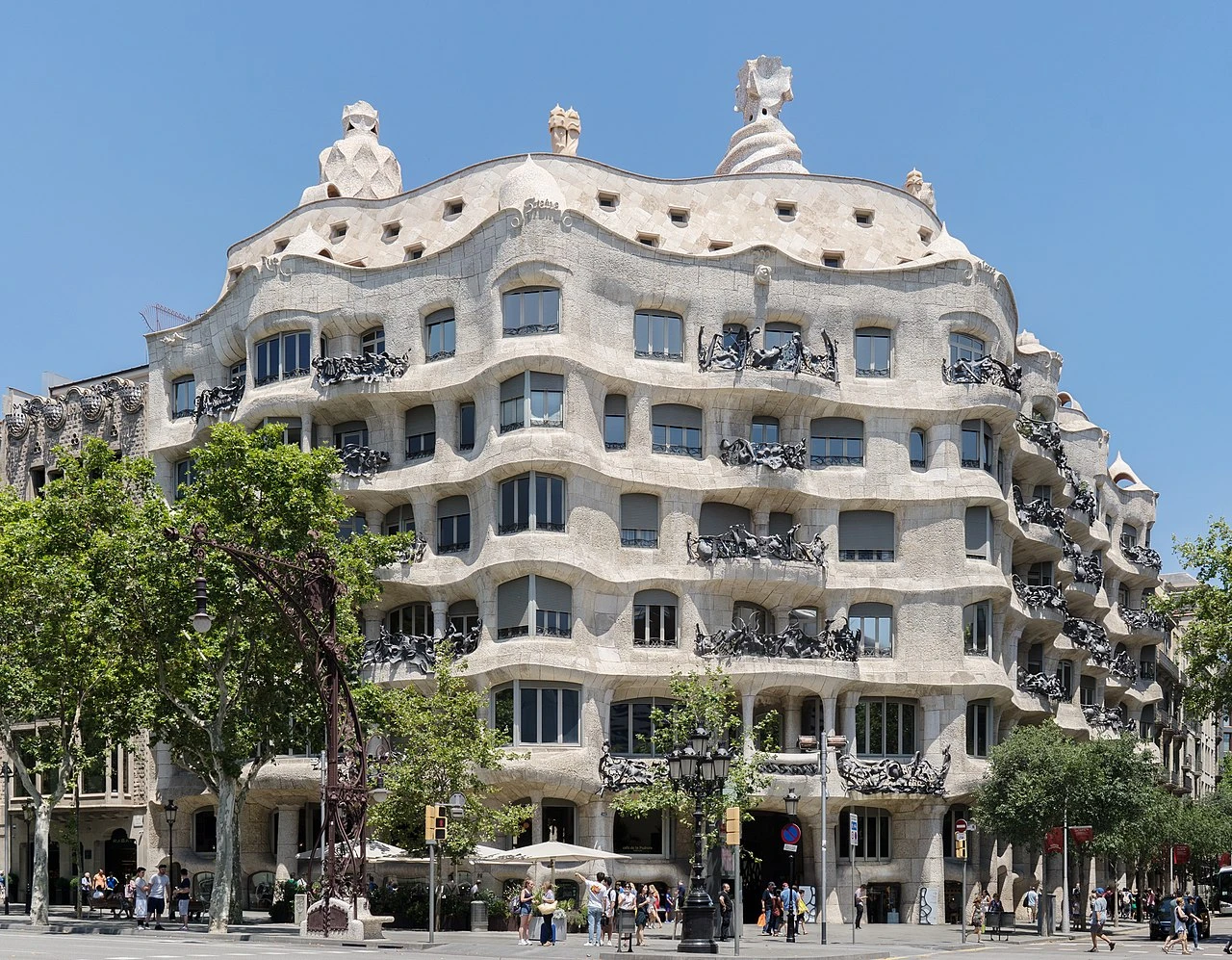
Barcelona · 2 km
Casa Milà
Content & sources
Thomas Ledl · CC BY-SA 4.0
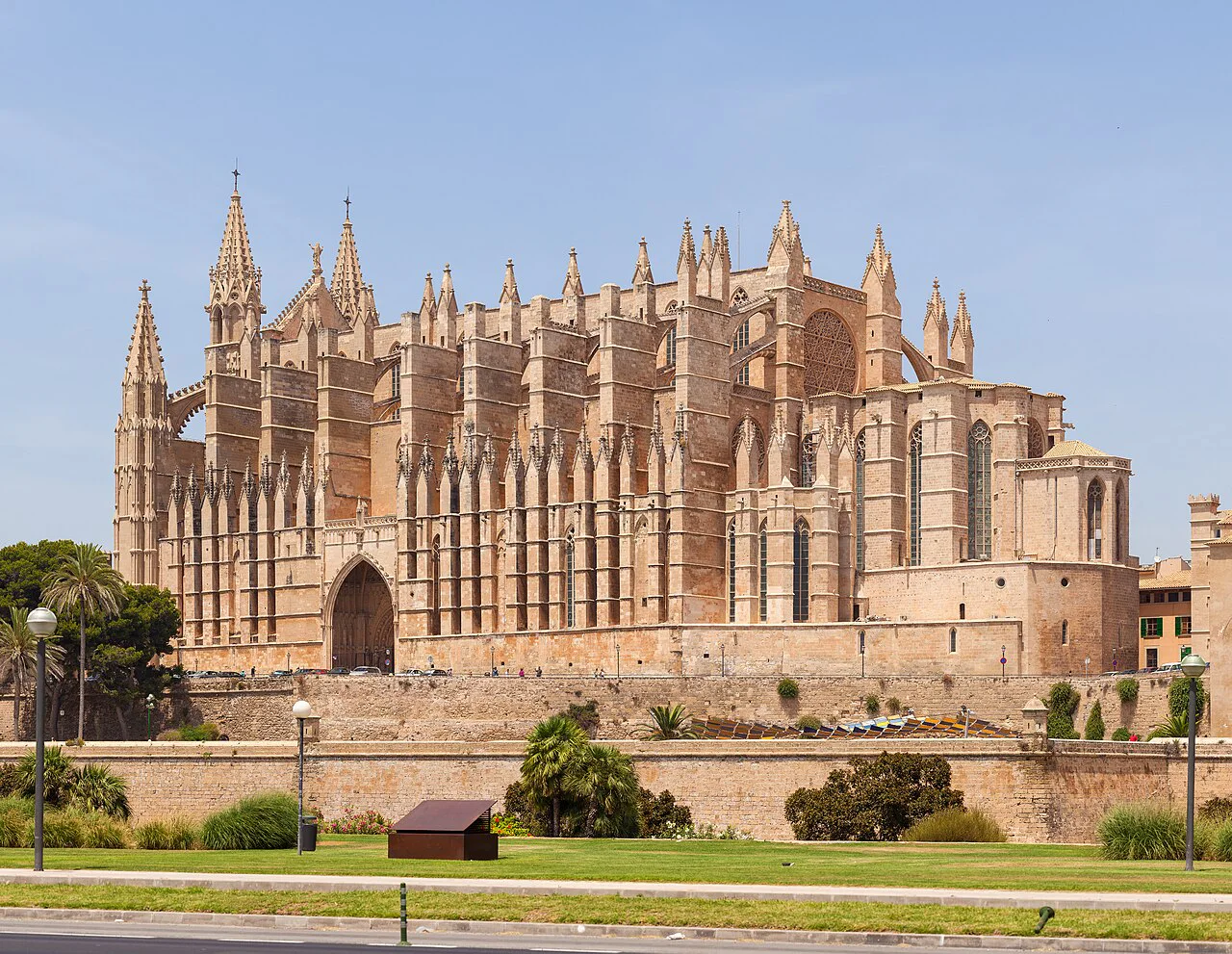
Palma
Catedral de Palma de Mallorca
Content & sources
Thomas Wolf, www.foto-tw.de · CC BY-SA 3.0 de