Stanza · Audio guide
Catedral de Palma de Mallorca Audio Guide
A place to remember. A story to take with you.
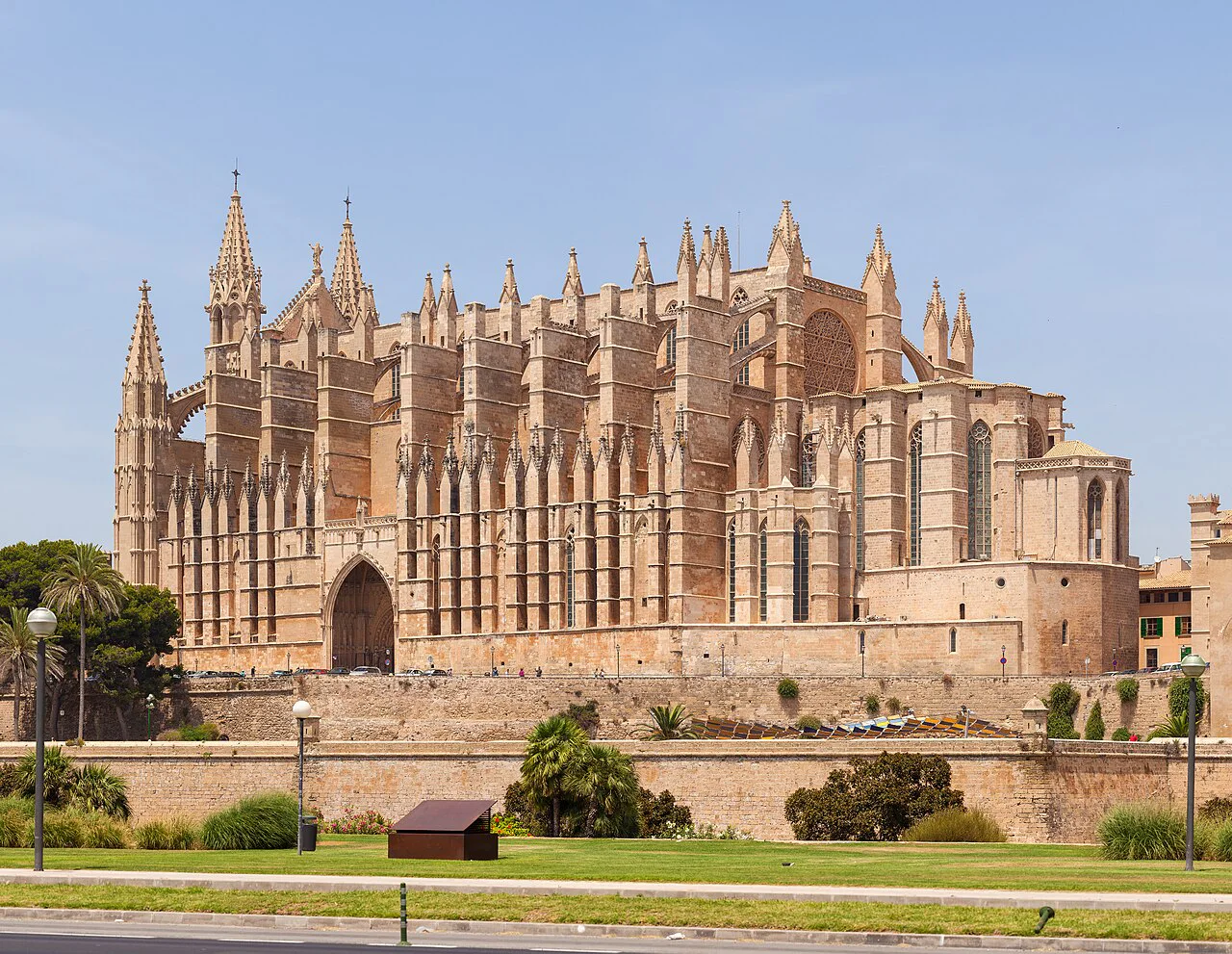
The Cathedral of Santa Maria of Palma is a Gothic Roman Catholic cathedral located in Palma, Mallorca. It features a rose window with a diameter of nearly 14 meters and a 44-meter high nave.
Download Stanza, then search for “Catedral de Palma de Mallorca”.
About the tour
One guide. Your kind of visit.
The Cathedral of Santa Maria of Palma is a Gothic Roman Catholic cathedral located in Palma, Mallorca. It features a rose window with a diameter of nearly 14 meters and a 44-meter high nave.
Ready when you are.
- 01Get the free Stanza app.
iOS & Android
- 02Find your guide.
“Catedral de Palma de Mallorca”
- 03Download before you go.
Works offline
Audio guide / 16 narrated stops
Inside the guide
Get to know a few of the stories before you go. Open a stop to read more.
01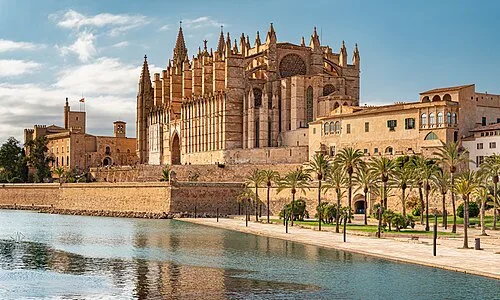 The Seafront Citadel and Western Façade
La Seu Above the Sea
Welcome to La Seu, the great Gothic cathedral of Palma de Mallorca. From the water it looks less like a church than a fortress, rising straight off the old city ramparts. It stands between the Royal Palace of La Almudaina on one side and the Episcopal Palace on the other, with the sea at its feet. The story begins in 1229, when King James the First sailed from Aragon to conquer the island. A fierce storm broke over his fleet during the crossing. The story goes that he vowed to the Virgin Mary that if they were spared, he would build her a cathedral. They reached shore, and he kept his word. The city, then called Madina Mayurqa, had been ruled by its Muslim Almohad governors. James ordered the city's largest mosque torn down, and raised the new church in its place. He reestablished the diocese of Mallorca at the same time, and the site was consecrated the following year. The building that grew from that vow took roughly three and a half centuries to finish. What you see from the harbor is the result of all that patient work.
Jorge Franganillo · CC BY 2.0
02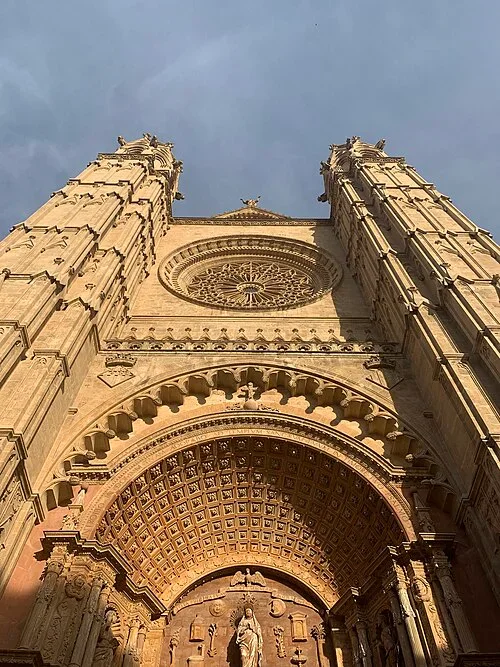 The Seafront Citadel and Western Façade
The Neo-Gothic West Façade
The west front of La Seu wears the face most visitors know: twin towers, a pointed gable, pinnacles at every corner. Most of it, though, is younger than it looks. The original façade rose to a flat top, without the gable. Over the centuries some of the cathedral's vaults gave trouble, and by the nineteenth century the west front needed serious repair. In 1854 the architect Juan Bautista Peyronnet began remodeling it. He gave the façade the triangular gable and pinnacles it carries now, in a style inspired by French Gothic cathedrals. Only the main portal at its base survives largely from the Middle Ages. So the grand face of La Seu is really a nineteenth-century interpretation of the medieval building behind it.
Photo: Unforgettable editor · CC BY-SA 4.0
03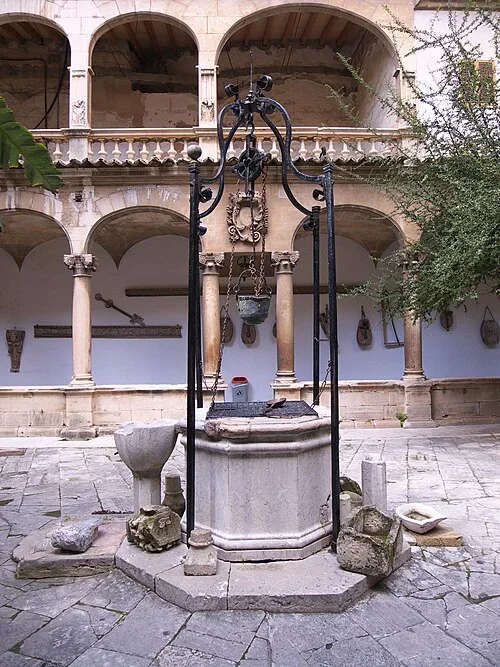 The Cloister Courtyard and Chapterhouse Treasury
The Cloister Patio
This courtyard belongs to the cathedral's working side, reached through the Portal de l'Almoina, finished in 1498. The cloister was built in the early eighteenth century, around the same time as the chapterhouse beside it. Its iron well stands at the center, with an ornate wrought-iron crane to raise the bucket. Strictly speaking, this is more patio than cloister. A true cloister has walks wide enough for processions, and walls ready to open into chapels and funerary monuments. These proportions allow neither. It is a compact service yard rather than a monk's gallery, a reminder that a cathedral's household worked differently from a monastery's.
Listen in the appJosé Luis Filpo Cabana · CC BY 3.0
04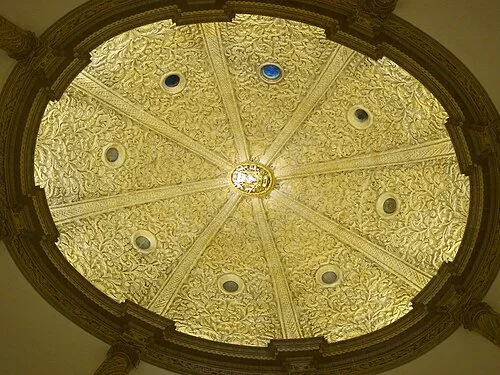 The Cloister Courtyard and Chapterhouse Treasury
The Chapterhouse
The room with the golden dome is the chapterhouse. Its ceiling is a richly molded oval vault, ringed with small windows that let in points of light. The building had a practical reason: after the Council of Trent, the cathedral's chapter of canons was growing. The chapter was the governing body of La Seu, the group of priests who ran its worship, its lands and its accounts. This was their meeting room, where decisions about the cathedral were argued out. The wing continues on toward the cathedral museum and its treasury.
Listen in the appJosé Luis Filpo Cabana · CC BY 3.0
05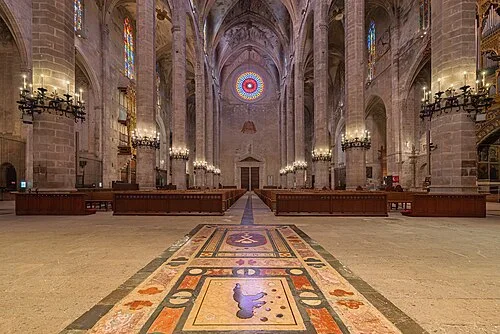 The Soaring Nave and Slender Columns
The Central Nave
Down the center of the building runs the central nave, flanked by two side naves, each ending in its own apse. The whole interior stretches about 121 meters. There is no transept and no ambulatory, so the plan never forms the shape of a cross. Most scholars link that layout to contemporary Catalan churches, above all the cathedral of Barcelona and Santa Maria del Mar. There is a twist in the story, though. Evidence in the stonework suggests the plan changed partway through construction. The architect Guillem Forteza argued in the twentieth century that the first design called for a single enormous nave. Around the middle of the fourteenth century the builders switched to three naves instead, and later raised all of them. That change fell around the time the Kingdom of Mallorca was rejoined to the Crown of Aragon in 1343.
Listen in the appPhoto: T meltzer · CC BY-SA 4.0
06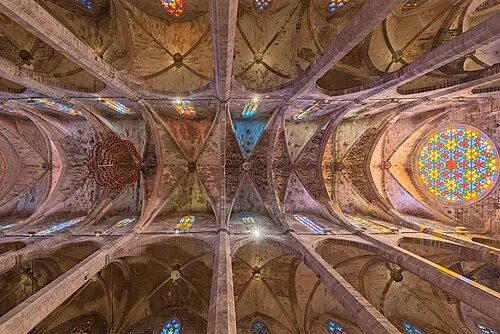 The Soaring Nave and Slender Columns
Vaults and Slender Pillars
Tilt your attention upward, to the forest of ribs spreading across the vaults. The nave reaches about 44 meters, the eighth-highest in the world. What makes it remarkable is what carries that height. The octagonal pillars are the narrowest in Gothic architecture relative to the vaults they support. Each one measures about one twelfth the width of its span. At the cathedral of Reims in France, by comparison, the ratio is about one sixth. The builders were chasing open space and light for the congregation, pushing the stone to its limits. The daring had a cost. Some vaults collapsed in the seventeenth and eighteenth centuries, undone by those slender columns. Yet the cathedral held, and the pillars still stand at their audacious width.
Listen in the appPhoto: T meltzer · CC BY-SA 4.0
07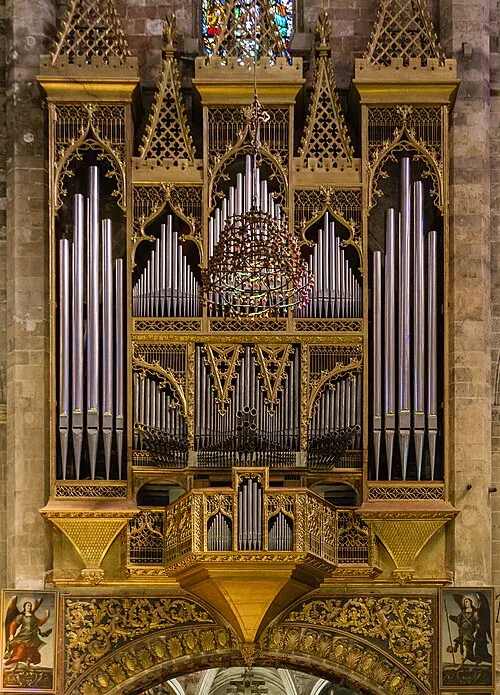 The Monumental Organ and Side Chapels
The Grand Organ
High on the side of the nave hangs a gilded casing crowned with Gothic spires and pinnacles. The case itself dates to 1477, carved by Pablo Rosell. Two Mallorcan organbuilders, Gabriel Tomàs and Josep Bosch, set a new instrument inside it in the years 1795 to 1797. The instrument has been modernized and restored since, most recently in the 1990s. Today it speaks through 54 registers, played from four manual keyboards and a pedalboard. It is centuries of Mallorcan craftsmanship, still sounding over the services of the cathedral.
Listen in the appFriedrich Haag · CC BY-SA 4.0
08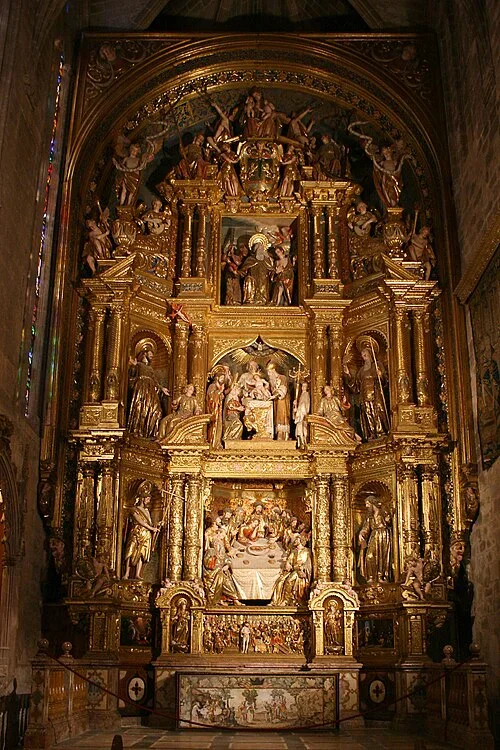 The Monumental Organ and Side Chapels
Corpus Christi Retable
This wall of gold is the Corpus Christi retable, carved and gilded by Jaume Blanquer in 1641. Its tiers of twisted columns and crowded figures show the baroque at full voice, and at its base sits a carved scene of the Last Supper. The Council of Trent had called for churches to be richly decorated, and La Seu answered with baroque murals and altarpieces like this one. It also opens the door to the sixteen chapels that line the nave. Between them they represent nearly every architectural style practiced in Mallorca since the cathedral began. There is the Plateresque Chapel of Sant Jeroni at one end of the story, and the ornate Churrigueresque Chapel of Our Lady of the Crown at the other. Each chapel was a family or a guild claiming its own piece of the cathedral.
Listen in the appMike Lehmann, Mike Switzerland 15:58, 15 October 2006 (UTC) · CC BY-SA 3.0
09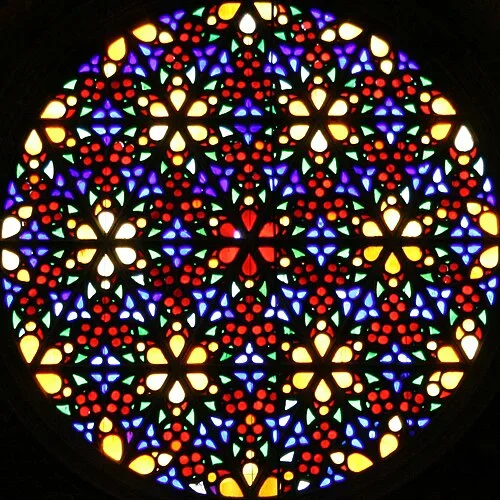 The Great Eastern Rose Window
The Eye of the Gothic
Medieval glassmakers rarely worked bigger than this. The great rose window of La Seu, known as the eye of the Gothic, measures nearly fourteen meters across. Its stone and glass cover close to one hundred and fifty square meters. Among Gothic rose windows still standing, only Strasbourg's is larger. What makes it unusual is where it sits. Most rose windows crown the west entrance. This one hangs above the high altar at the east end, so it greets the morning light instead. Set into its pattern is a large six-pointed star, the star of David. Some say the designers meant it as a deliberate nod to the Jewish heritage of the island. That reading is a legend told about the window, not something the builders explained themselves. Either way, the wheel of glass has become the emblem of Palma, reproduced on souvenirs all over Mallorca.
Listen in the appMike Lehmann, Mike Switzerland 15:57, 15 October 2006 (UTC) · CC BY-SA 3.0
10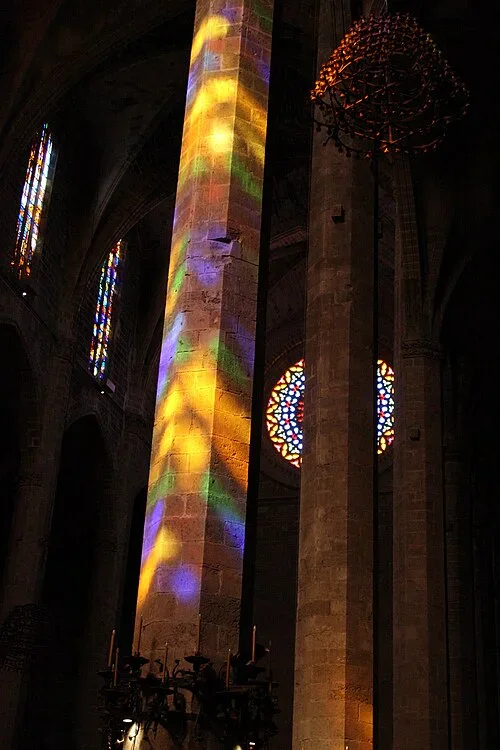 The Great Eastern Rose Window
Light on Stone
On clear mornings the Mediterranean sun rises almost directly behind the altar. Its light passes through the great rose window and falls into the church in patches of red, blue and gold. The stone pillars catch those colors, so a single column can glow with a dozen hues at once. The effect changes hour by hour as the sun climbs. Much of this brightness is younger than the Middle Ages. When Antoni Gaudí began his work here in the early twentieth century, several windows had been bricked up for years. His campaign opened them again, deliberately, to let more natural light into the nave. The color moving across the stone is part of what his changes left behind.
Listen in the appMike Lehmann, Mike Switzerland 15:59, 15 October 2006 (UTC) · CC BY-SA 3.0
- 11
Royal Chapel and Royal Pantheon
The kings of Mallorca buried at the highest point of their own cathedral.
- 12
Gaudí's Baldachin
Gaudí's canopy on cables, and the reform that emptied the nave.
- 13
Chapel of the Most Blessed Sacrament
A Mallorcan artist covered a Gothic chapel with three hundred square meters of ceramic sea.
- 14
Barceló's Ceramic Sea
Moray eels, octopuses and the risen Christ, molded in cracked ceramic.
- 15
Portal del Mirador
The great Gothic door faces the sea, and its Last Supper carries an old story.
- 16
Buttresses over the Ramparts
Reading the whole cathedral at once from the sea ramparts.
Catedral de Palma de Mallorca
Frequently asked questions
How much does the guide cost?
Free app download. Listed guide price: $0.99. Guide price shown in the app. Audio guide only. Venue admission is separate.
Can I listen without internet?
Yes. Download the guide’s audio, images, and maps in the app before your visit. Your downloaded content is then available offline.
Can I listen in my language?
This audio guide is available in 15 languages, including English.
Do I need to follow a schedule?
No. This is a self-guided experience. Choose your stops, pause whenever you like, and return to a story at your own pace.
At your own pace
Explore Catedral de Palma de Mallorca.
Download Stanza, then search for “Catedral de Palma de Mallorca”.
Free app download · Guide price shown in the app
Keep exploring
Audio guides — Spain
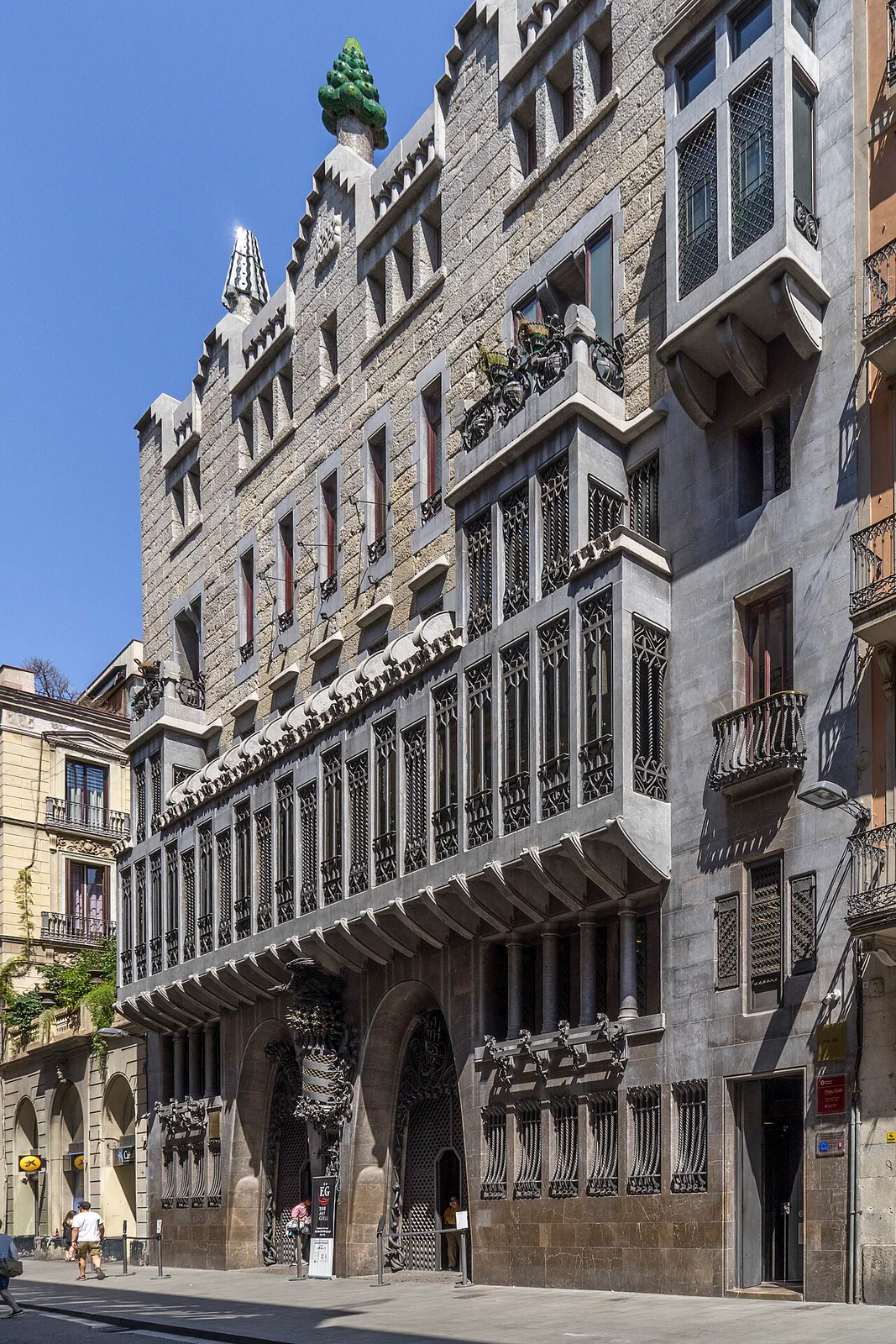
Barcelona
Palacio Güell
Content & sources
Thomas Ledl · CC BY-SA 4.0
Barcelona
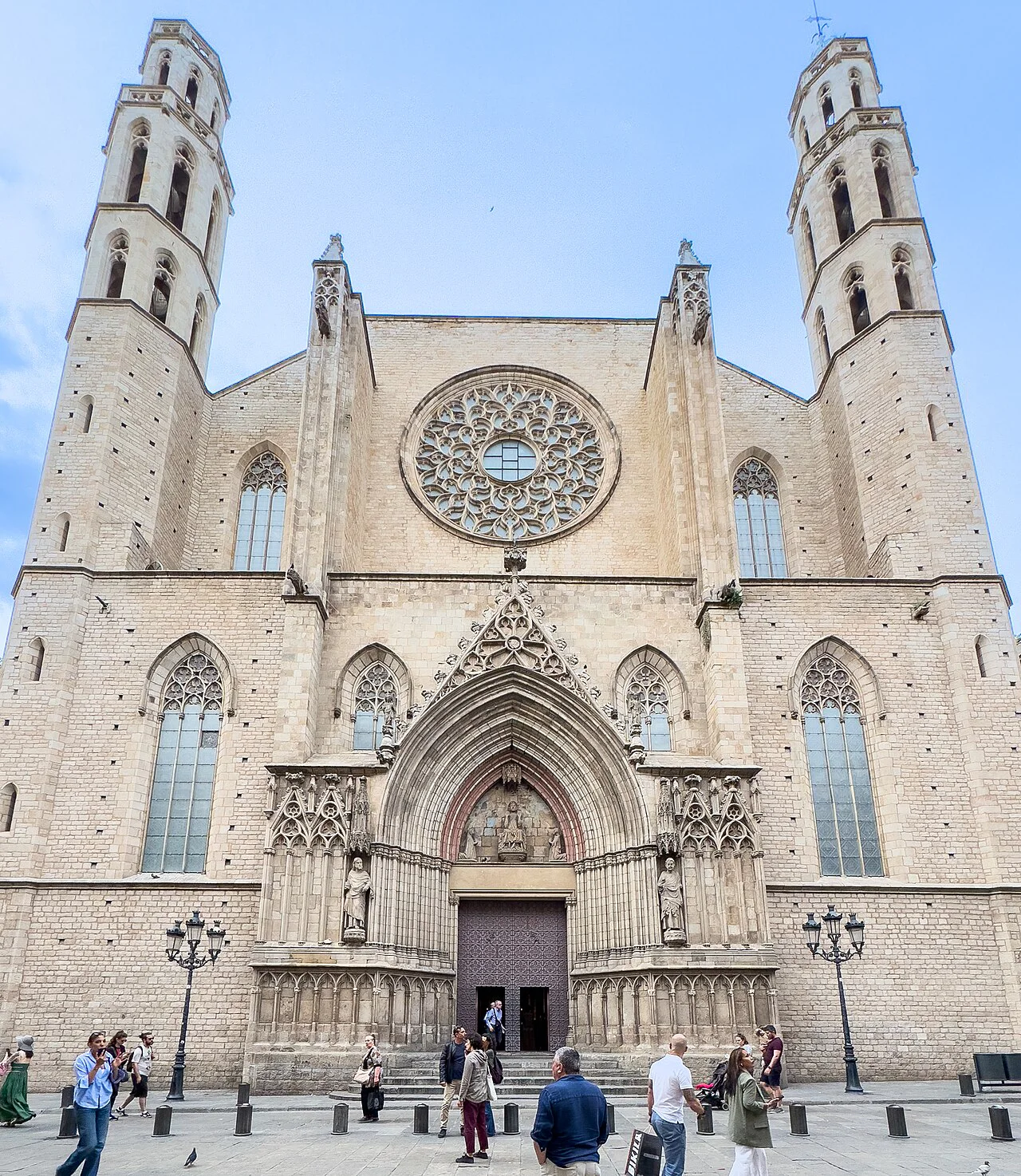
Basílica de Santa María del Mar
Content & sources
Photo: Kent Wang · CC BY-SA 4.0
Barcelona
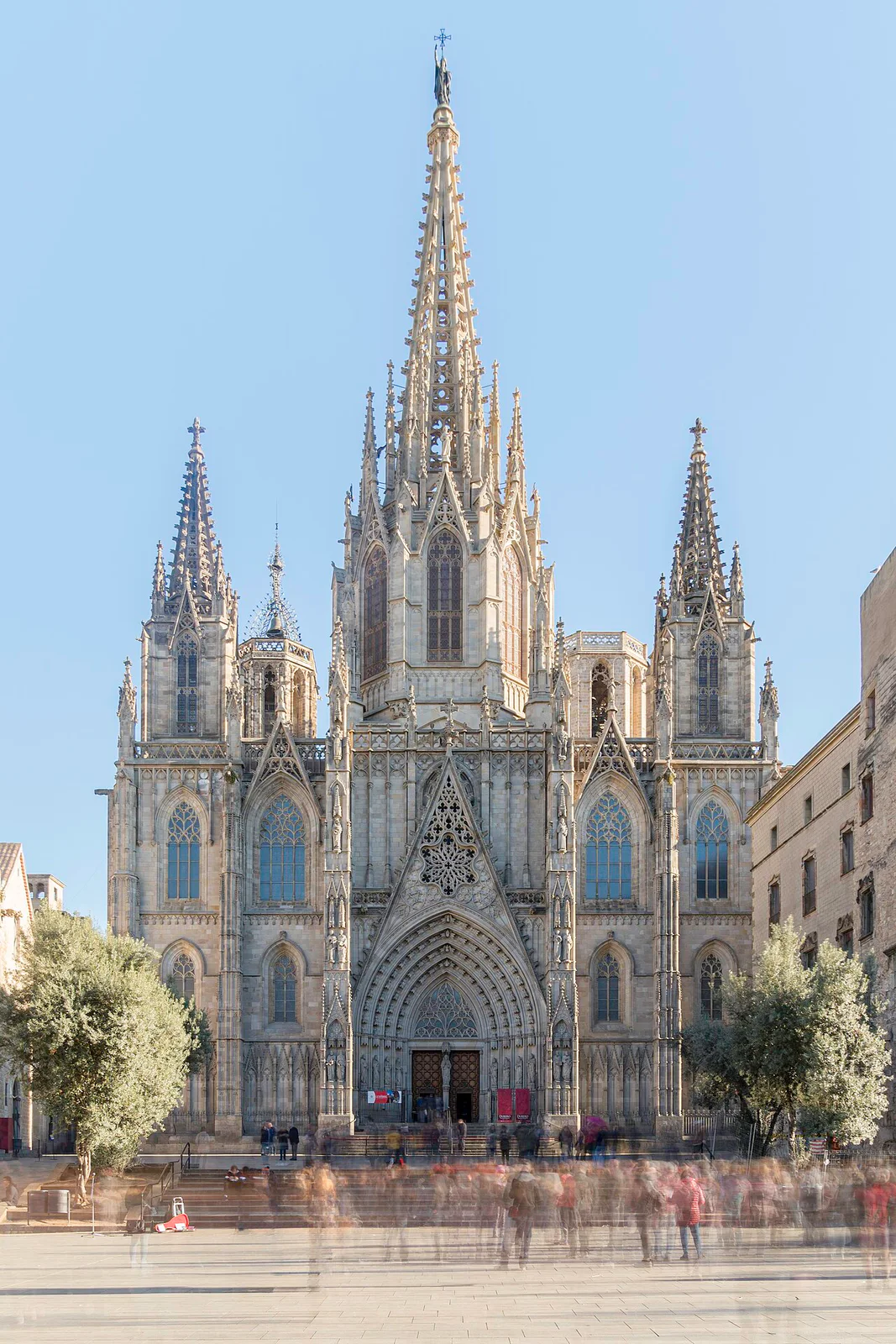
Catedral de la Santa Cruz y Santa Eulalia
Content & sources
Photo: Fernando · CC BY-SA 4.0
Barcelona
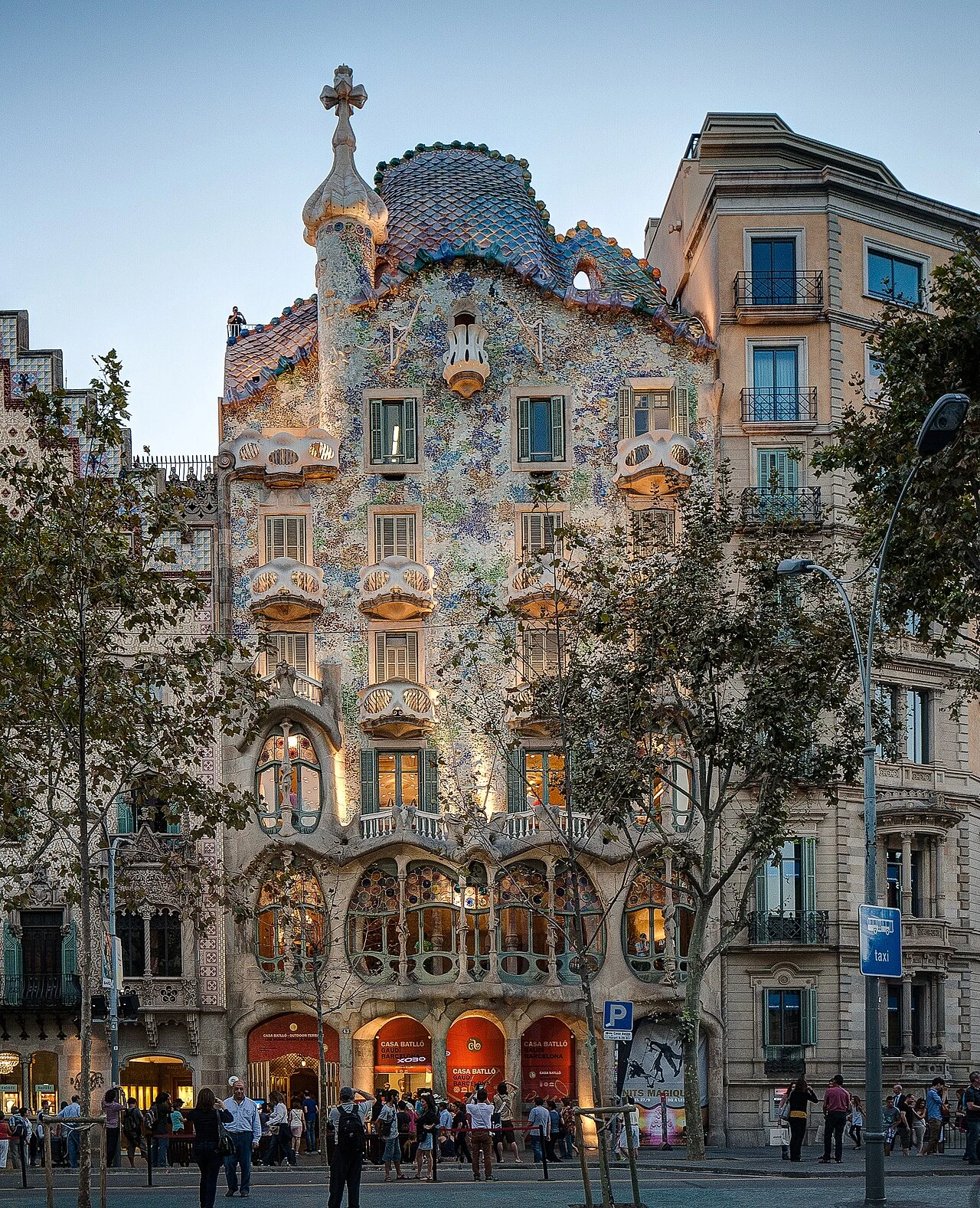
Casa Batlló
Content & sources
ChristianSchd · CC BY-SA 3.0
Casbah
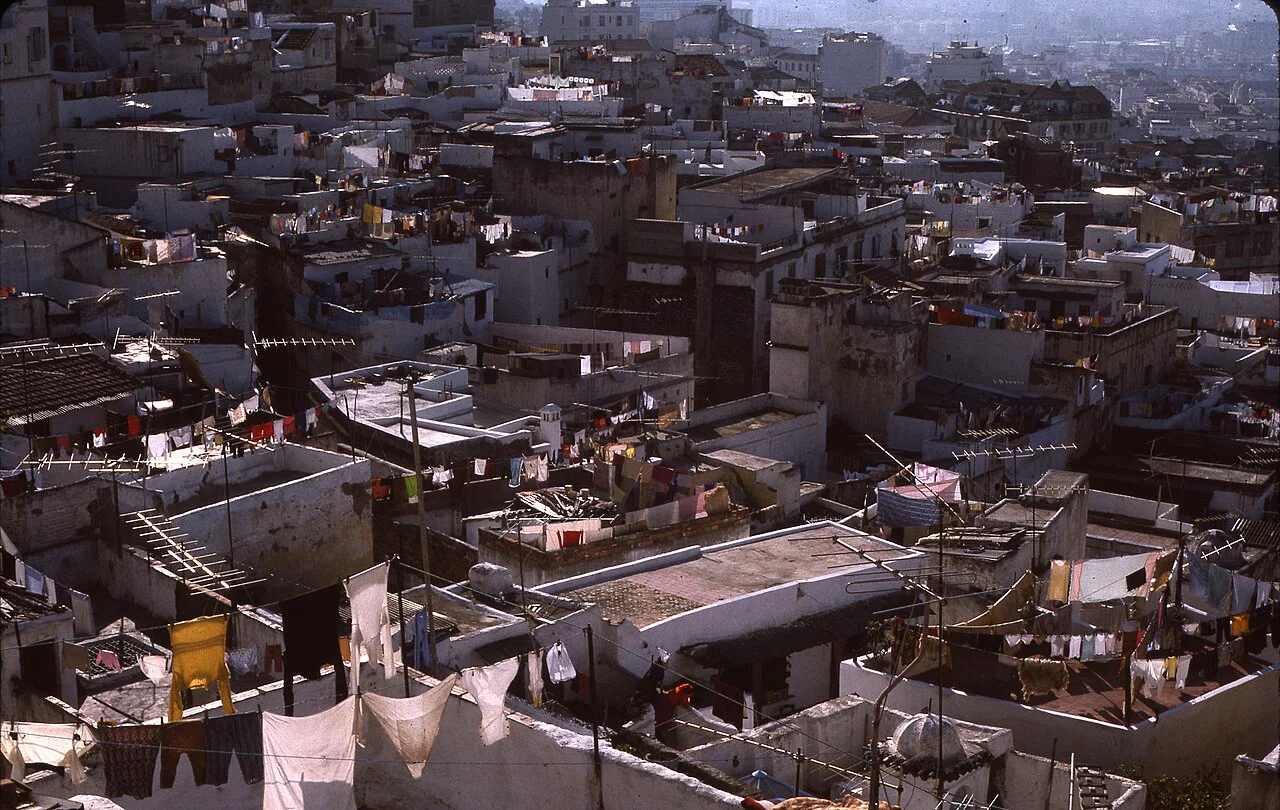
Casbah of Algiers
Content & sources
Maison Méditerranéenne Des Sciences de l'Homme Phonothèque, André Raymond · Licence Ouverte