Stanza · Audio guide
Palacio Real de El Pardo Audio Guide
A place to remember. A story to take with you.
The Royal Palace of El Pardo is an official residence of the Spanish royal family and one of the oldest in the country. It has been used by Spanish monarchs since the 15th century and currently serves as a…
Download Stanza, then search for “Palacio Real de El Pardo”.
About the tour
One guide. Your kind of visit.
The Royal Palace of El Pardo is an official residence of the Spanish royal family and one of the oldest in the country. It has been used by Spanish monarchs since the 15th century and currently serves as a state guest house.
Ready when you are.
- 01Get the free Stanza app.
iOS & Android
- 02Find your guide.
“Palacio Real de El Pardo”
- 03Download before you go.
Works offline
Audio guide / 13 narrated stops
Inside the guide
Get to know a few of the stories before you go. Open a stop to read more.
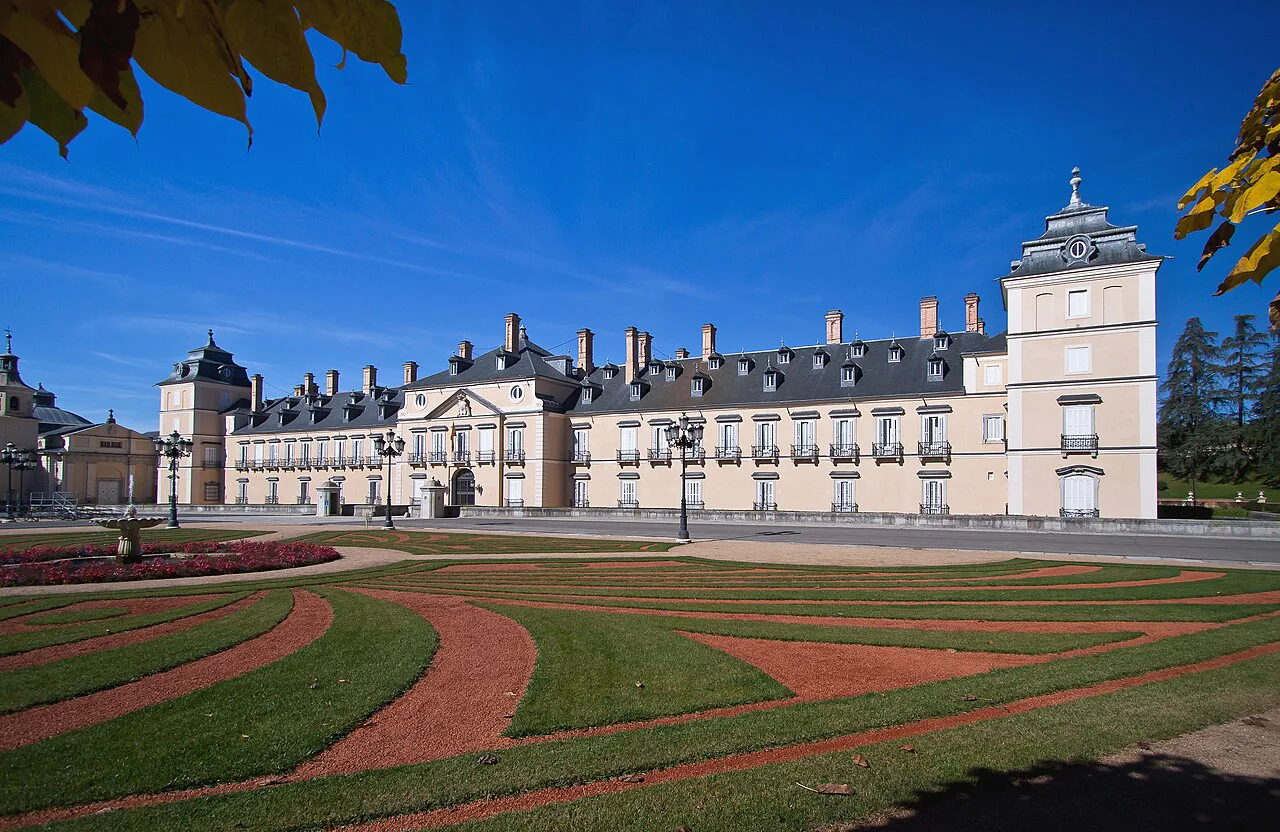
01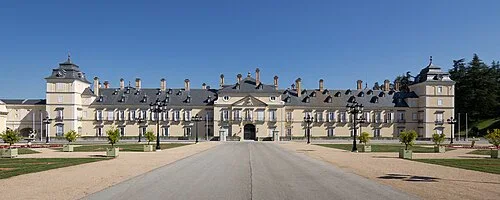 Main South Facade and Historic Moat
The Main South Facade: A Palace Twice Built
Welcome to the Royal Palace of El Pardo, a royal retreat on a wooded hill just outside Madrid. Spanish monarchs have kept a footing here since the fifteenth century. The long, low facade in front of you tells the whole story in one glance, because this palace was built twice. The right-hand half is the old sixteenth-century alcázar of the Habsburgs. In the 1770s, Charles the Third found the palace too small for his whole family, so he sent his architect Francesco Sabatini to enlarge it. Sabatini built a new wing to the east, identical to the old building, and joined the two with a central pavilion. That pavilion held the entrance hall below and the King's antechambers and dining room above. The new courtyard took the name Patio de los Borbones, set against the older Patio de los Austrias next door. With its balanced wings, corner towers and slate mansard roofs, the palace now resembled a late French baroque château. Inside wait the Goya tapestries, a rare court theater, and five centuries of political history. Today the building belongs to the Spanish state and serves as a guest house for visiting heads of state.
Carlos Delgado · CC BY-SA 3.0
02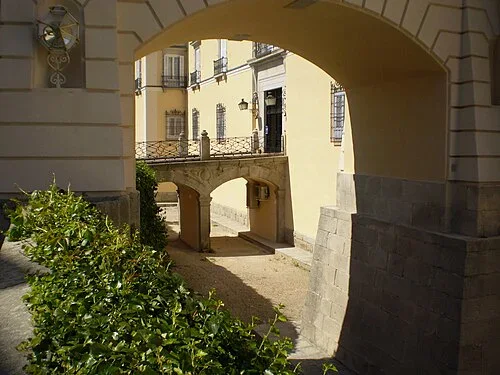 Main South Facade and Historic Moat
The Dry Moat and the Hunting Alcázar
The story of El Pardo begins with animals, not architecture. Mount El Pardo teemed with game, and in 1406 Henry the Third of Castile ordered a small castle built here to reach it. What began as a hunting lodge grew into something more serious. In the 1540s, Emperor Charles the Fifth had the architect Luis de Vega transform it into a true alcázar, a fortified palace with a defensive moat. That moat is the sunken stone channel around the building, crossed by the bridge through this arch. Philip the Second finished the work his father had begun, and gave the palace its most distinctive feature: steep Flemish-style roofs of dark slate. The result was a strange and deliberate hybrid, a fortified castle raised for the chase rather than for ceremony. Kings came here to ride and to hunt, and slept behind walls and a moat while they did it. Crossing this bridge, you pass from the open hunting ground into a lodge dressed up as a fortress.
Photo: Esetena · CC BY-SA 3.0
03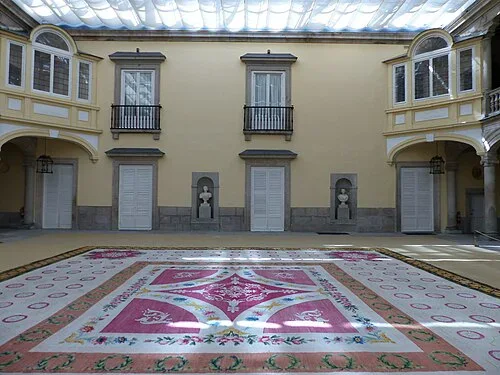 Patio de los Austrias (Habsburg Courtyard)
The Habsburg Courtyard (Patio de los Austrias)
This courtyard is the original heart of the Renaissance palace, built under Charles the Fifth and Philip the Second. Under the Habsburgs, life here moved to the rhythm of the hunt. The court paid a brief visit on Saint Andrew's Day, the thirtieth of November, then went away and came back after Christmas. The real stay ran from early January into February, about a month in the frozen countryside. Monarchs also arrived unannounced, for a day or two of eating and hunting, and vanished again. Then the Bourbons changed the building. From 1739 to 1743 the architect François Carlier reworked the old palace to house the whole royal family. He walled up two of its three galleries, the Queen's Gallery and the Portrait Room among them. At the angles of this courtyard he added octagonal viewpoints to ease the flow of people. The Flemish spires on the towers came down, replaced by mansard roofs. The habit of retreat here lasted long after: in 1847 the king consort Francisco de Asís came to El Pardo for dawn hunts and quiet, while the court holidayed elsewhere.
Listen in the appPhoto: Benjamín Núñez González · CC BY-SA 4.0
04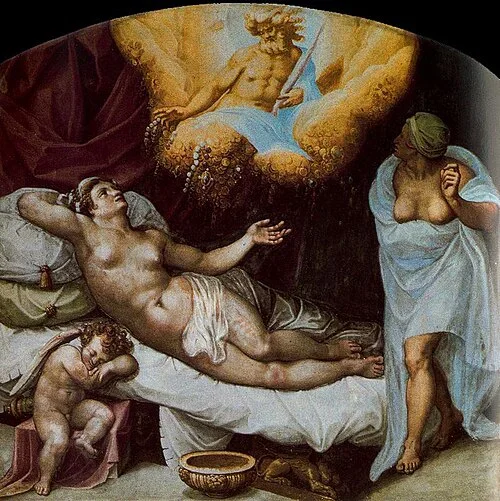 Gaspar Becerra Tower and Habsburg State Rooms
Becerra's Story of Perseus Frescoes
On the thirteenth of March 1604, fire tore through the palace. It destroyed much of the building and most of the paintings gathered there, masterpieces among them. Almost the only decoration to survive hangs in the apartments of the Queen's Chief Chamberlain, the tower known as the Torreón de Becerra. There Gaspar Becerra had painted a ceiling cycle of the Story of Perseus. One panel shows Danaë on her bed, with Jupiter descending in a shower of gold, a small boy asleep at the foot of the bed and a startled maid at the side. The fire's best-known aftermath is a single sentence. When they told Philip the Third of the blaze, he asked only about Titian's Venus of El Pardo. Told it had been rescued, he answered: if that painting was saved, nothing else matters. The rescued Venus eventually left Spain, and hangs today in the Louvre.
Listen in the appGaspar Becerra · Public domain
05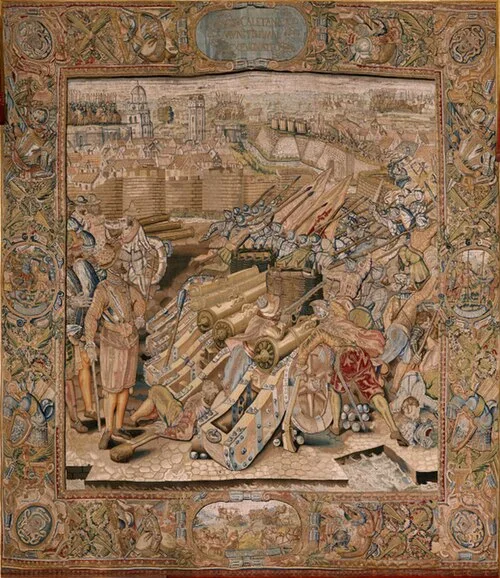 Gaspar Becerra Tower and Habsburg State Rooms
The Assault on the Town of Calais Tapestry
This tapestry shows an army assaulting the walled town of Calais in 1597, cannons dragged to the siege lines, encampments stretching to the horizon. It was woven by Martin Reymbouts in wool and silk, with threads of gold and silver worked into the field. This is what the Habsburgs collected: vast martial and courtly cycles of tapestry, the kind Charles the Fifth and Philip the Second amassed to clothe their walls. When Philip the Fifth first came here in 1701, the palace held 222 paintings, genre scenes and Flemish landscapes, portraits of the Habsburgs, and several copies after Titian. Most of that was sent away to other royal sites, so the collection on view now is largely a later reconstruction. Cannons, ramparts and a dynasty's world of war, all rendered in wool and silk, show what the dynasty wanted its rooms to say.
Listen in the appPhoto: PMRMaeyaert · CC BY-SA 4.0
06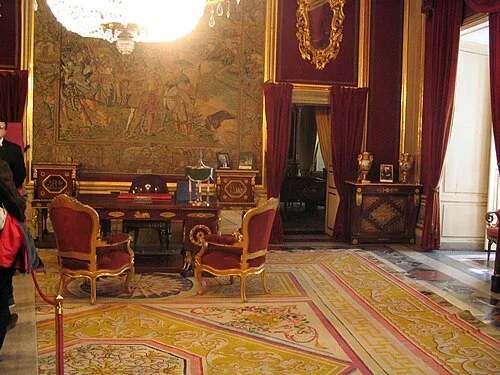 Franco's Office and Cabinet Room
The Dictator's Office
After the Spanish Civil War, this palace became the residence and headquarters of General Francisco Franco. Works adapted the building for the head of state, and Charles the Third's old dining room was converted into the official office. From this room, from 1939 until his death in November 1975, Franco ran Spain. He worked here, held the councils of ministers, received audiences, and welcomed visiting heads of state. The role of the place ran so deep that El Pardo became a byword for the office of head of state itself. A barracks was built nearby for his Moorish Guard escort. The room itself carries the layers openly: royal gilding and tapestry-lined walls, repurposed as the working desk of an authoritarian regime. Power in Spain was exercised for a generation under these painted ceilings, in a palace built for kings who came to shoot deer.
Listen in the appPhoto: Jordiferrer · CC BY-SA 3.0
07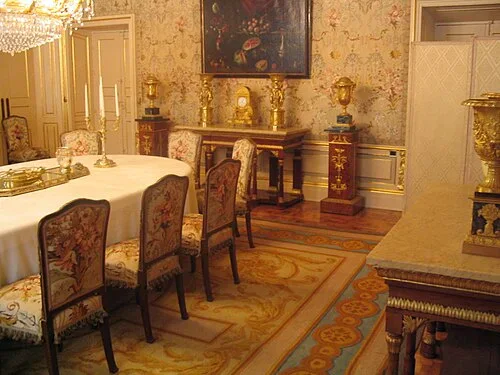 Franco's Office and Cabinet Room
The State Reception and Dining Room
This is the state reception and dining room, in a palace that has long been a place for negotiation. In 1739 El Pardo hosted talks between the governments of Great Britain and Spain, trying to settle their disputes before they turned to war. The result was the Convention of Pardo, an agreement meant to avert the conflict. It failed. The War of Jenkins' Ear broke out shortly afterwards, and the peace signed in these halls lasted barely a season. The palace's diplomatic life, though, kept growing. After Franco's death, the works finished in 1982 made it the official residence for visiting heads of state. The first guests arrived in March 1983: King Carl the Sixteenth Gustaf and Queen Silvia of Sweden. The laid table and gilded service of this dining room carry that continuing role. Where government decisions were once taken under this roof, foreign presidents and monarchs now sleep as guests of the Spanish state.
Listen in the appPhoto: Jordiferrer · CC BY-SA 3.0
08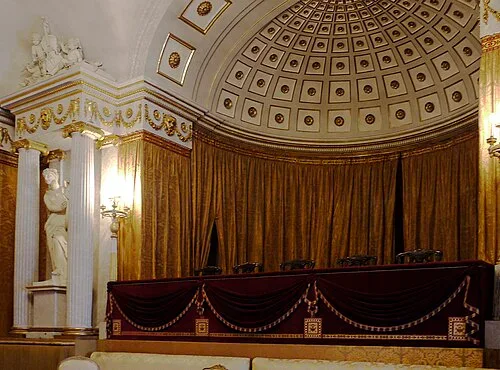 El Coliseo: The Royal Court Theater
El Coliseo: The Court Theater
El Pardo holds something no other Spanish palace can claim: El Coliseo, said to be the only preserved court theater in the country. It was created under Charles the Third, a private stage where the court itself was the audience. The gilded columns frame the line of the royal box, and the coffered dome closes over the stage. A court theater was performance woven into royal daily life, steps from the royal apartments rather than a night out in town. The delicate neoclassical decoration, with its painted illusions of architecture, was redecorated in the nineteenth century by Isidro González Velázquez. His work is what survives here, over the curtain line and along the walls. The velvet drapes and the box seats record a world where the king watched plays in his own house, between dinner and bed.
Listen in the appXauxa Håkan Svensson · CC BY-SA 3.0
09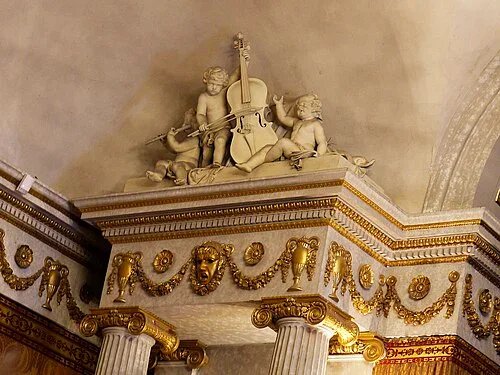 El Coliseo: The Royal Court Theater
Musicians in Plaster: The Coliseo's Hidden Years
Above the cornice, three plaster children make music: one with a cello, one with a flute, one lounging with a tambourine. This sculptural group is a nod to the performances the room was built for. Under Franco, the theater took a second life no eighteenth-century architect could have predicted. It became his private cinema. The elaborate trompe-l'œil neoclassical decoration was hidden under fabric coverings, wrapped out of sight while films were screened for the dictator and his circle, week after week, with his guard close by. When the palace opened to the public, the coverings came off and the putti reappeared. The uncovered plaster now stands for the whole palace's habit of changing costumes: theater, cinema, museum.
Listen in the appXauxa Håkan Svensson · CC BY-SA 3.0
10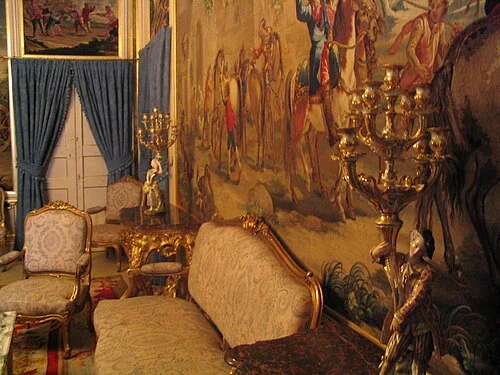 The Goya Tapestry Rooms and Bourbon Wing
The Goya Tapestry Salon
In the salon called the Salón Francisco Goya, once the King's First Antechamber, hang tapestries designed by Goya himself. Among them are The Snowstorm, with figures fighting through the wind; The Stilts, with boys towering over a village crowd; and The Picnic on the Banks of the Manzanares, an afternoon of wine and music by the river. The commission came from the crown's wish to decorate the new Bourbon wing and warm its stone rooms. The Royal Santa Bárbara Factory in Madrid wove the tapestries, from cartoon series supervised by Mengs and Francisco Bayeu. Goya, his brother-in-law Ramón Bayeu and José del Castillo painted the cartoons themselves. The subjects were chosen deliberately: playful, rural, contemporary Madrid, picnics and street games instead of gods and heroes. Five of Goya's seven famous cartoon series were destined for this palace. None of the series now hangs in its original place, but this room keeps the name of the painter who filled it.
Listen in the appPhoto: Jordiferrer · CC BY-SA 3.0
- 11
Queen María Luisa of Parma
A young queen in silk and lace: María Luisa of Parma, and the pleasure palace built for her husband.
- 12
The Bedchamber of Alfonso XII
The quiet room where Alfonso the Twelfth died in 1885, and his widow's conversion of it into an oratory.
- 13
The Gardens and the Monte de El Pardo
The walled forest that explains everything: the Monte de El Pardo, its hundred-kilometer wall, and five centuries of return.
Palacio Real de El Pardo
Frequently asked questions
How much does the guide cost?
Free app download. Listed guide price: $0.99. Guide price shown in the app. Audio guide only. Venue admission is separate.
Can I listen without internet?
Yes. Download the guide’s audio, images, and maps in the app before your visit. Your downloaded content is then available offline.
Can I listen in my language?
This audio guide is available in 15 languages, including English.
Do I need to follow a schedule?
No. This is a self-guided experience. Choose your stops, pause whenever you like, and return to a story at your own pace.
At your own pace
Explore Palacio Real de El Pardo.
Download Stanza, then search for “Palacio Real de El Pardo”.
Free app download · Guide price shown in the app
Keep exploring
Nearby audio guides
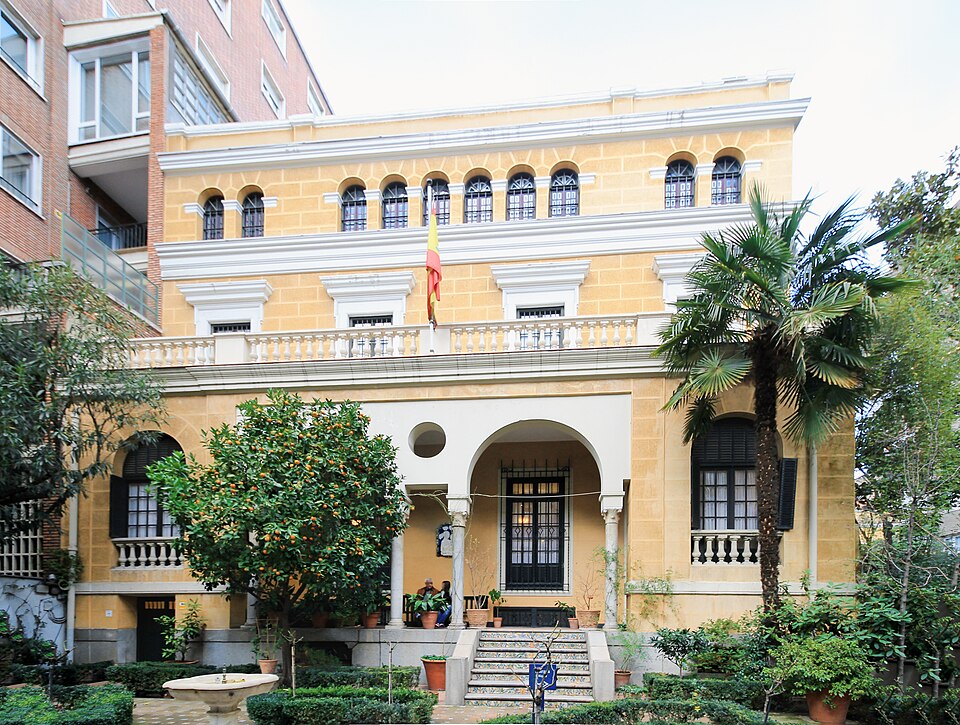
Madrid · 12 km
Sorolla Museum
Content & sources
Luis García (Zaqarbal) · CC BY-SA 3.0 es
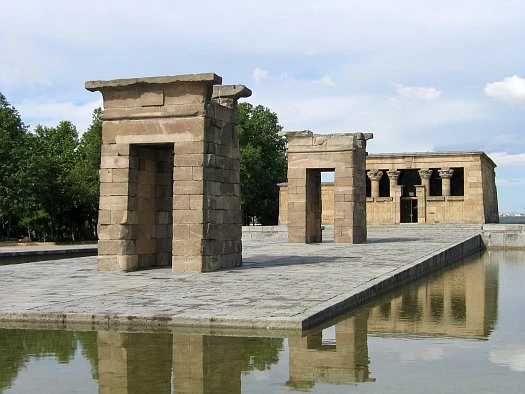
Madrid · 12 km
Temple of Debod
Content & sources
Photo: OsvaldoGago · CC BY-SA 2.0
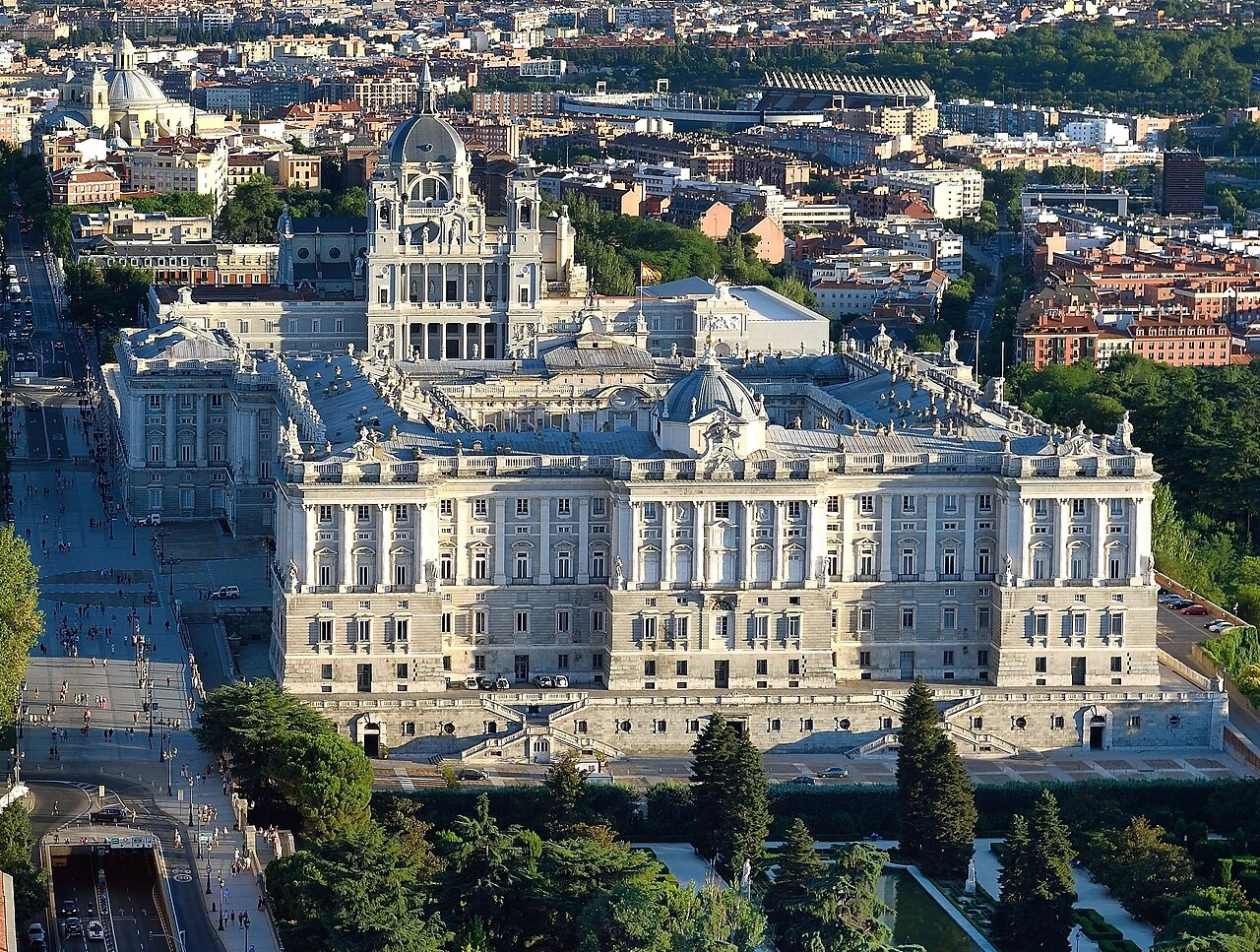
Madrid · 13 km
Royal Palace of Madrid
Content & sources
Tim Adams · CC BY-SA 4.0
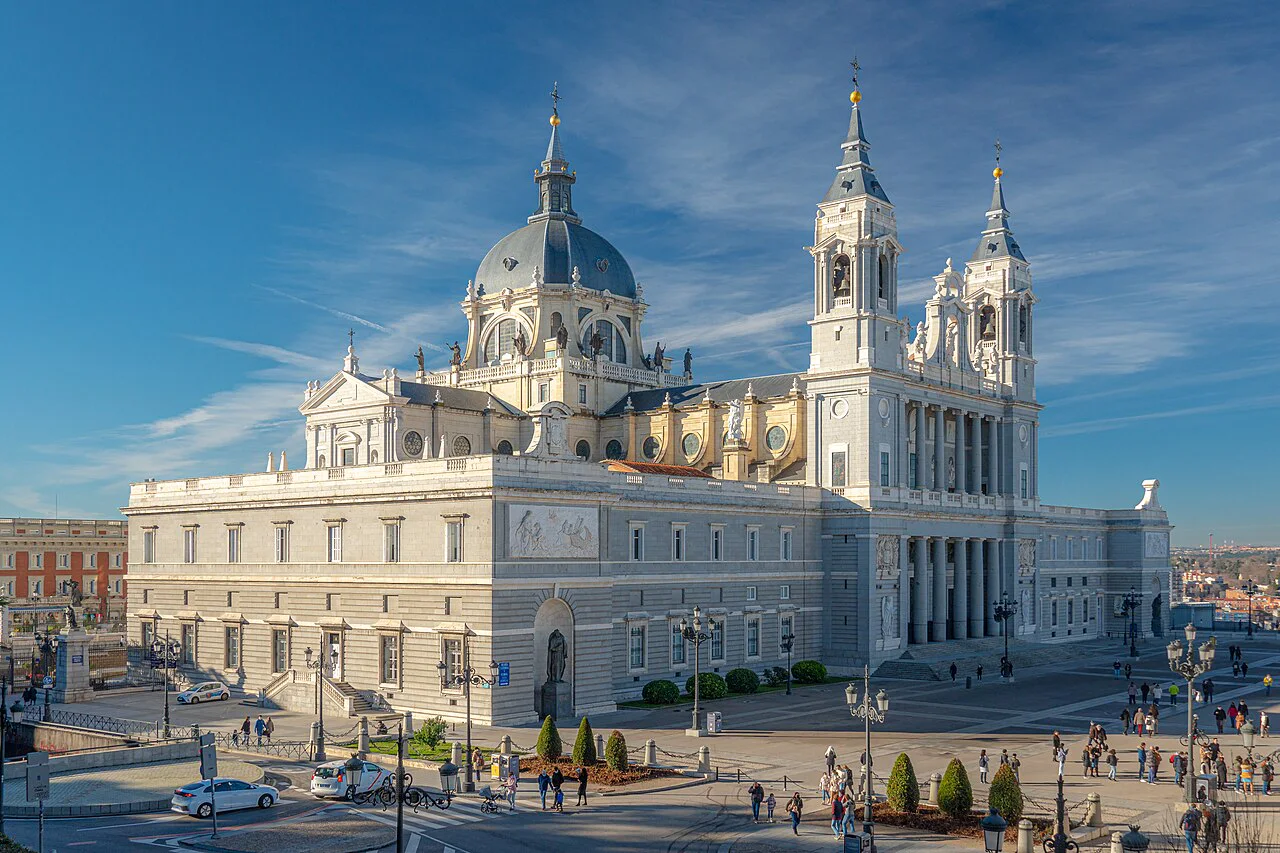
Madrid · 13 km
Catedral de la Almudena
Content & sources
Photo: Fernando · CC BY-SA 4.0