Stanza · Audio guide
Vasa Museum Audio Guide
A place to remember. A story to take with you.
The Vasa Museum in Stockholm, Sweden, showcases the remarkably preserved 17th-century warship Vasa, which sank on its maiden voyage in 1628. It is the only intact 17th-century ship in the world.
Download Stanza, then search for “Vasa Museum”.
About the tour
One guide. Your kind of visit.
The Vasa Museum in Stockholm, Sweden, showcases the remarkably preserved 17th-century warship Vasa, which sank on its maiden voyage in 1628. It is the only intact 17th-century ship in the world.
Ready when you are.
- 01Get the free Stanza app.
iOS & Android
- 02Find your guide.
“Vasa Museum”
- 03Download before you go.
Works offline
Audio guide / 14 narrated stops
Inside the guide
Get to know a few of the stories before you go. Open a stop to read more.
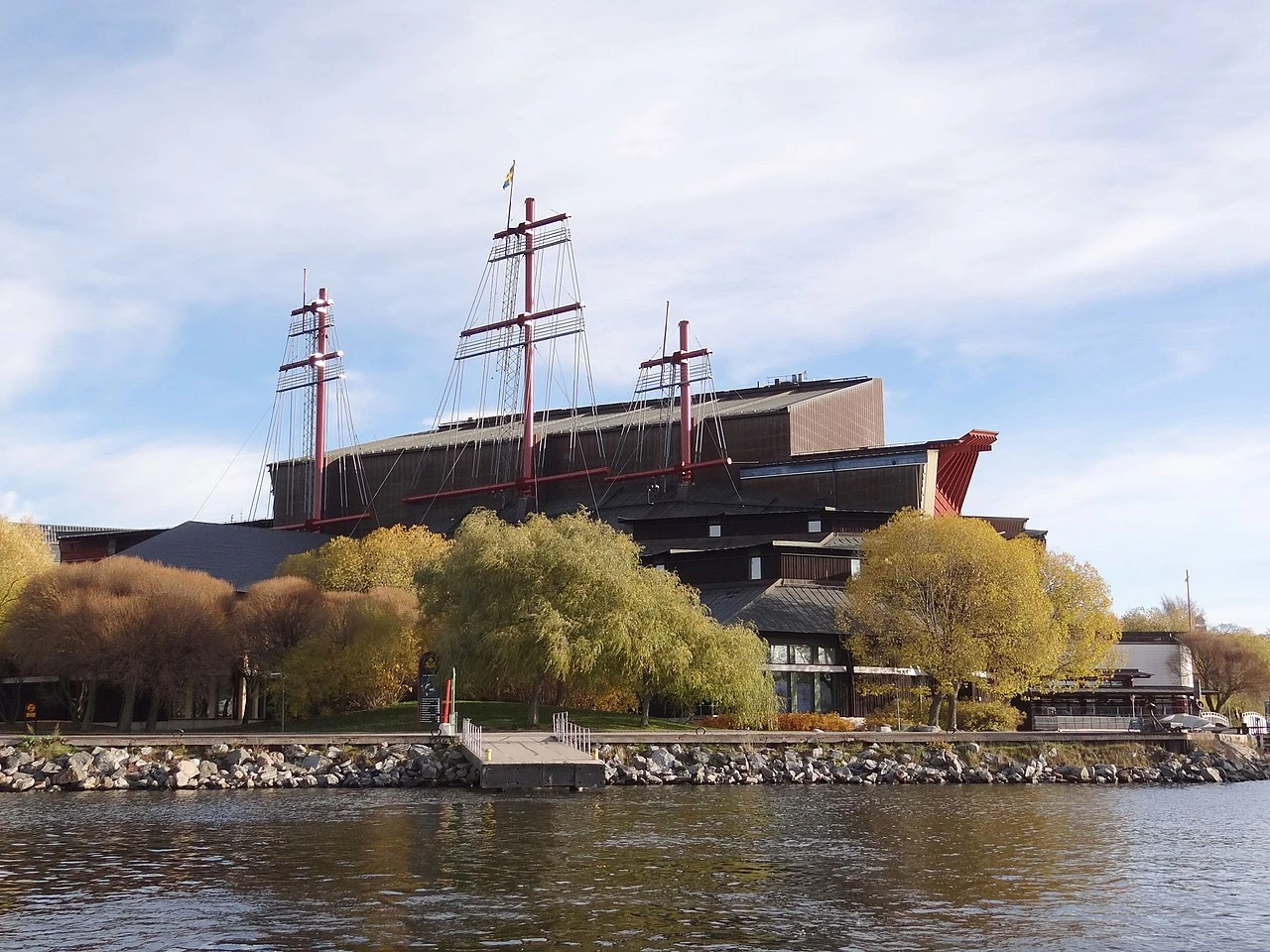
01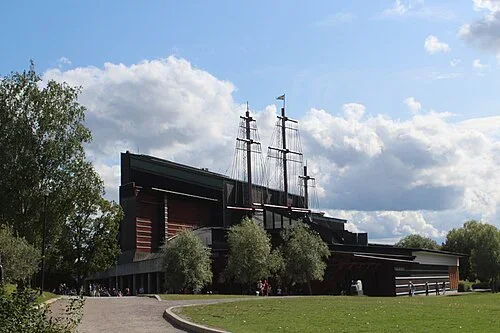 Museum Arrival and Architectural Masts
The Museum Built Around a Ship
The Vasa Museum stretches across an old dry dock, and the warship it protects still lies in that dock. The dock was part of the Stockholm naval yard and dates from 1878. In 1981 the Swedish government decided on a permanent museum for Vasa, and a Nordic architecture competition followed. Marianne Dahlbäck and Göran Månsson won, sharing first prize with a Danish design. Their winning entry was called Ask, which means box. The copper roof carries a set of stylised masts. The tallest one reaches the height Vasa's main mast would have reached above her keel, fifty-two and a half metres. King Carl the Sixteenth Gustaf officially opened the museum on the fifteenth of June, 1990.
Photo: Deror avi · CC BY-SA 4.0
02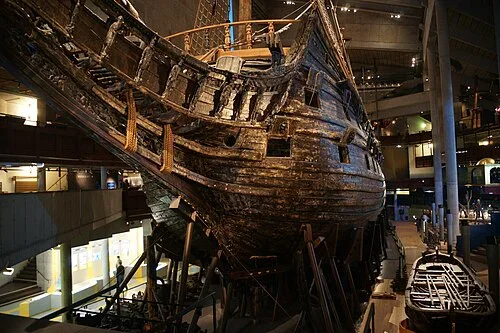 Main Ship Hall: The Warship Vasa
Vasa: The Intact Hull
Three centuries under water darkened the timber of this hull. Most of the dark wood is the ship's own, aged by the sea. Some parts were missing or badly damaged, and those have been replaced. The new pieces were left untreated and unpainted, so they stand out against the old wood. Among the replacements are the lower sections of all three masts and a new bowsprit. Props hold her up from below, and the bow rises high above them. Vasa is the only almost fully intact seventeenth-century ship ever salvaged. The hall shows her from six levels, from the bottom of the hull up to the top of the sterncastle.
Photo: JavierKohen · CC BY-SA 3.0
03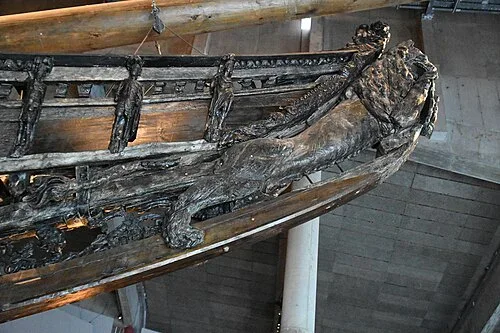 Main Ship Hall: The Warship Vasa
The Bow and the Maiden Voyage of 1628
The lion at the bow is three metres long. It was carved by the sculptor Mårten Redtmer, in several parts bolted together. On the tenth of August, 1628, Vasa left Stockholm for the first time. Her gun ports were open and her guns run out, ready to fire a salute as she went. Hundreds of Stockholmers, perhaps thousands, had come to watch. The day was calm, with only a light breeze from the southwest. Then a gust pushed the ship over and forced the open lower gun ports under the surface. Water rushed onto the lower gun deck. Vasa sank swiftly, after sailing about thirteen hundred metres, in water thirty-two metres deep and only a hundred and twenty metres from shore. About thirty people are said to have died. Captain Söfring Hansson survived and was taken at once for questioning. On the fifth of September a full inquest met at the Royal Palace, before members of the Privy Council and Admiralty. No one was punished.
Listen in the appRichard Mortel from Riyadh, Saudi Arabia · CC BY 2.0
04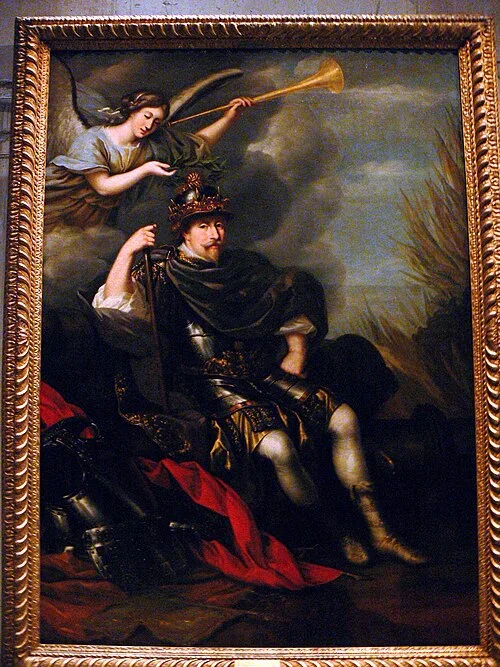 Royal Ambition and the Gun Decks
King Gustav II Adolf and Swedish Ambition
An angel blows a trumpet above the king in this painting and holds a laurel wreath over his head. He sits in polished armour, with a red cloth spread beneath him. The painting honours him; it did not come off the ship. Gustav the Second Adolf became king in 1611, at sixteen. He fought a war with Poland, whose king, Sigismund, was his cousin, and from 1626 that war needed a strong navy in the Baltic. The fleet was losing ships: ten were wrecked in a storm in the Bay of Riga in 1625, and two large ships were lost at the Battle of Oliwa in 1627. The king was a keen artillerist. He began a series of warships with two full gun decks and heavier guns, and Vasa was the first of them. He visited the shipyard in January 1628, probably the only time he was aboard her. He was killed at the Battle of Lützen on the sixth of November, 1632, aged thirty-seven.
Listen in the appWolfgang Sauber · CC BY-SA 3.0
05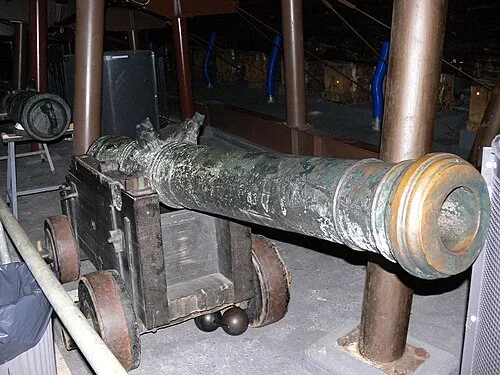 Royal Ambition and the Gun Decks
The Guns of Vasa
The gun in this display, on its wooden carriage, is the kind of bronze weapon Vasa carried. Forty-six of her main guns were cast to one new, standard, lightweight design. That design, together with the sheer number of guns, gave the ship great firepower. The main guns were called twenty-four-pounders, after the weight of the shot they fired. They were cast in one series at the state gun foundry in Stockholm, under a Swiss-born founder named Medardus Gessus. Cannons of that era were each cast in a single-use mould. Vasa's guns were so uniform that their main dimensions varied by only a few millimetres. Heavy guns set high in a sailing ship made balance a serious worry. The foundry could not cast guns as fast as the navy yard built ships, so Vasa waited nearly a year after her construction was finished for her armament.
Listen in the appWolfgang Sauber · CC BY-SA 3.0
06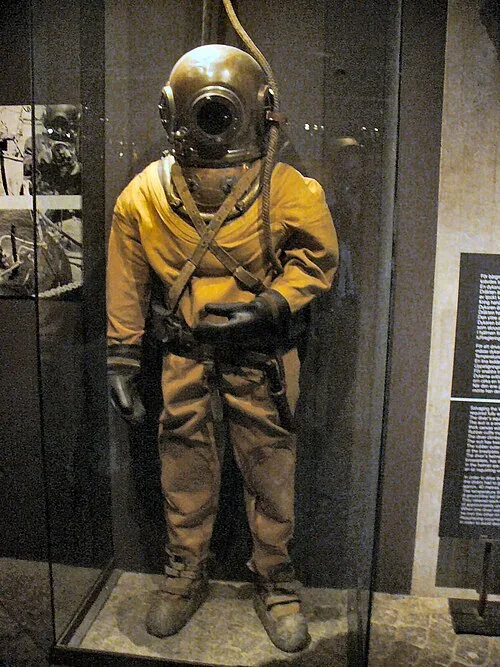 The 1961 Salvage and Preservation Operation
Finding Vasa: Anders Franzén's Search
Divers of the twentieth century worked in a suit like the one in this case, with a heavy metal helmet and air sent down by hose from the surface. It was Anders Franzén who found Vasa. He was born in Stockholm in 1918 and worked for the oil company BP, and then for the Swedish Naval Administration, as an expert on oil and fuels. He also did extensive archive research on old warships. From 1954 he concentrated on Vasa. He built a coring probe of his own, which could cut a sample out of timber. On the twenty-fifth of August, 1956, he found the wreck off the Beckholmen dock. Finding her was only half the task. Franzén lobbied hard for the whole ship to be raised, and sent material about Vasa to the king, among others. The Swedish navy and the city of Stockholm took an interest, and the navy provided the diving resources.
Listen in the appThe original uploader was CsTom at Hungarian Wikipedia. · CC BY-SA 2.5
07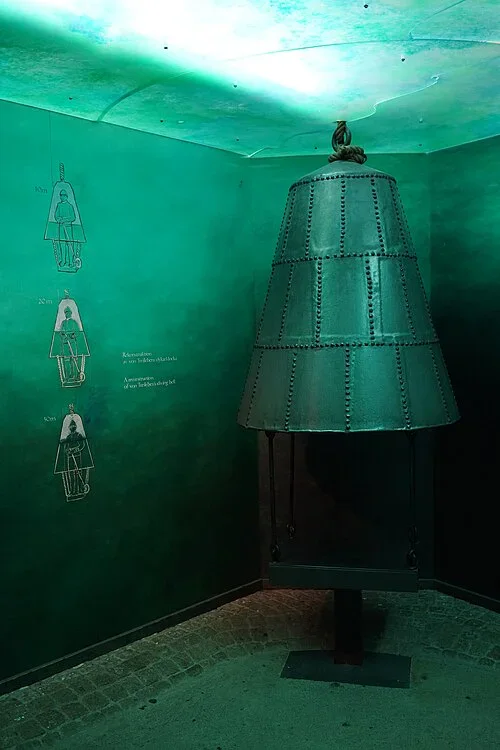 The 1961 Salvage and Preservation Operation
Raising the Ship and Keeping Her Alive
In 1961, Vasa came up from the seabed. Waterlogged oak that dries in air tends to crack, so the real challenge came next. From that year on, her timbers were treated with polyethylene glycol, a chemical that took the place of water in the wood. A diving bell in this green-lit room shows the kind of equipment used for underwater work. The treatment took place at Wasavarvet, the Vasa Shipyard, a temporary museum that opened the same year. The building was cramped, and visitors could see her from only two levels.
Listen in the appRay Swi-hymn from Sijhih-Taipei, Taiwan · CC BY-SA 2.0
08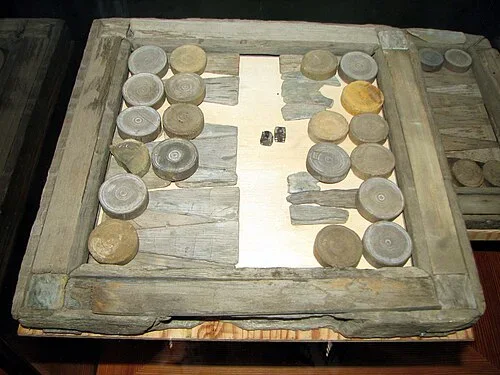 Life Onboard: Recovered Personal Artifacts
Games from the Sea Chests
A backgammon set was found on Vasa, complete with its dice and markers. Two small dice still rest in the middle of the board. When the ship sank, most of the sailors' personal possessions were stored on the gun decks, in chests and casks. These held spare tools, materials for mending, and money in the form of low-denomination copper coins. Another compartment held the possessions of the ship's carpenter, including a large tool chest. Vasa was meant to carry a crew of one hundred and forty-five sailors and three hundred soldiers, and chests like these belonged to the men of that company.
Listen in the appUser:Chris 73 · CC BY-SA 3.0
09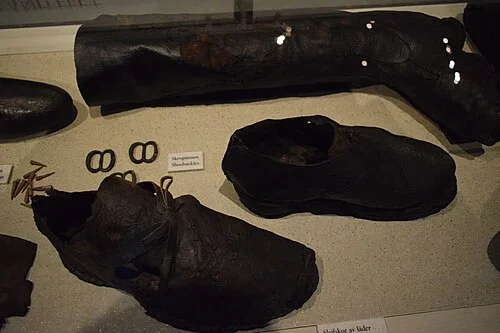 Life Onboard: Recovered Personal Artifacts
What the Mud Preserved: Boots and Shoes
These leather shoes and boots lay in the seabed mud for three hundred and thirty-three years. Part of the reason is the water. The Baltic is cold and brackish, and Franzén had reasoned that it would be free of shipworm, which usually destroys submerged wood rapidly in warmer, saltier seas. Mud shut out oxygen as well, and in those conditions organic materials fare better, so wood, cloth and leather are often in very good condition. The shoes came from the sailors' chests and casks, where spare clothing and shoes were packed. The display holds a tall boot, a lace-up shoe and a plain shoe, with a pair of metal buckles nearby.
Listen in the appPhoto: Chinmayee Mishra · CC BY-SA 4.0
10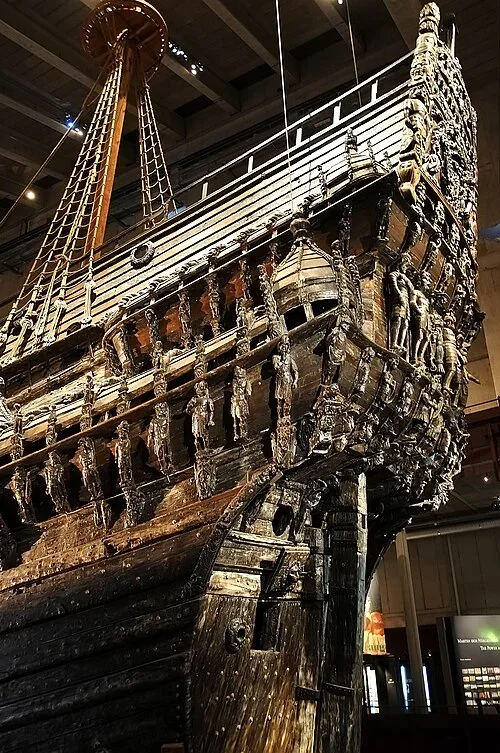 Upper Decks, Sterncastle, and the Great Cabin
The Sterncastle and Its Sculptures
Close to five hundred sculptures cover Vasa, and most are crowded onto the high stern, its galleries and the beakhead at the bow. A team of at least six expert sculptors worked on them for a minimum of two years. Redtmer, who carved the lion at the bow, also made the figure of the king at the very top of the stern. His style was powerful, lively and naturalistic. The carving was meant to glorify the authority, wisdom and martial prowess of the monarch, and almost all its heroic imagery points, directly or indirectly, to the king. After the sinking, the sterncastle slowly collapsed into the seabed mud, carvings and all. Copies of some of the sculptures stand in a leafy walk in the museum garden.
Listen in the appDennis G. Jarvis · CC BY-SA 2.0
- 11
The Sheaf That Names the Ship
Cherubs, a crowned shield, and the bright colours that once covered the ship's carvings.
- 12
The Officers and the Stability Test
The officers' Great Cabin, rebuilt as a reproduction, and the rooms where senior officers lived and worked.
- 13
The Museum's Renaissance Garden
A garden of hops, flax and woad, where some of the plants were also used aboard Vasa.
- 14
Finngrundet and the Museum Harbour
A red lightvessel and three other historic ships moored in the harbour outside the museum.
Vasa Museum
Frequently asked questions
How much does the guide cost?
Free app download. Listed guide price: $2.99. Guide price shown in the app. Audio guide only. Venue admission is separate.
Can I listen without internet?
Yes. Download the guide’s audio, images, and maps in the app before your visit. Your downloaded content is then available offline.
Can I listen in my language?
This audio guide is available in 15 languages, including English.
Do I need to follow a schedule?
No. This is a self-guided experience. Choose your stops, pause whenever you like, and return to a story at your own pace.
At your own pace
Explore Vasa Museum.
Download Stanza, then search for “Vasa Museum”.
Free app download · Guide price shown in the app
Keep exploring
Nearby audio guides

Stockholm · 2 km
Klara Church
Content & sources
Arild Vågen · CC BY-SA 3.0
Ekerö kommun · 31 km
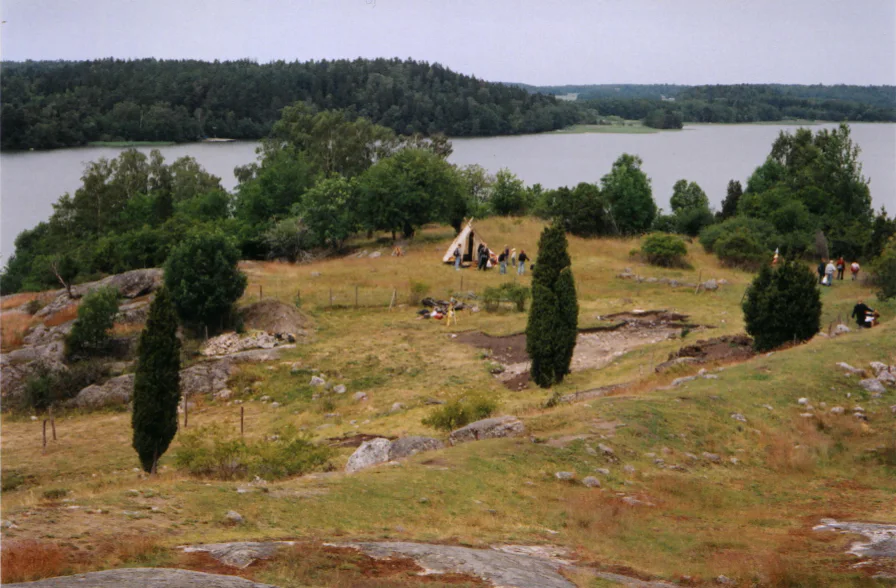
Birka
Content & sources
Alex Peterson · CC BY-SA 3.0
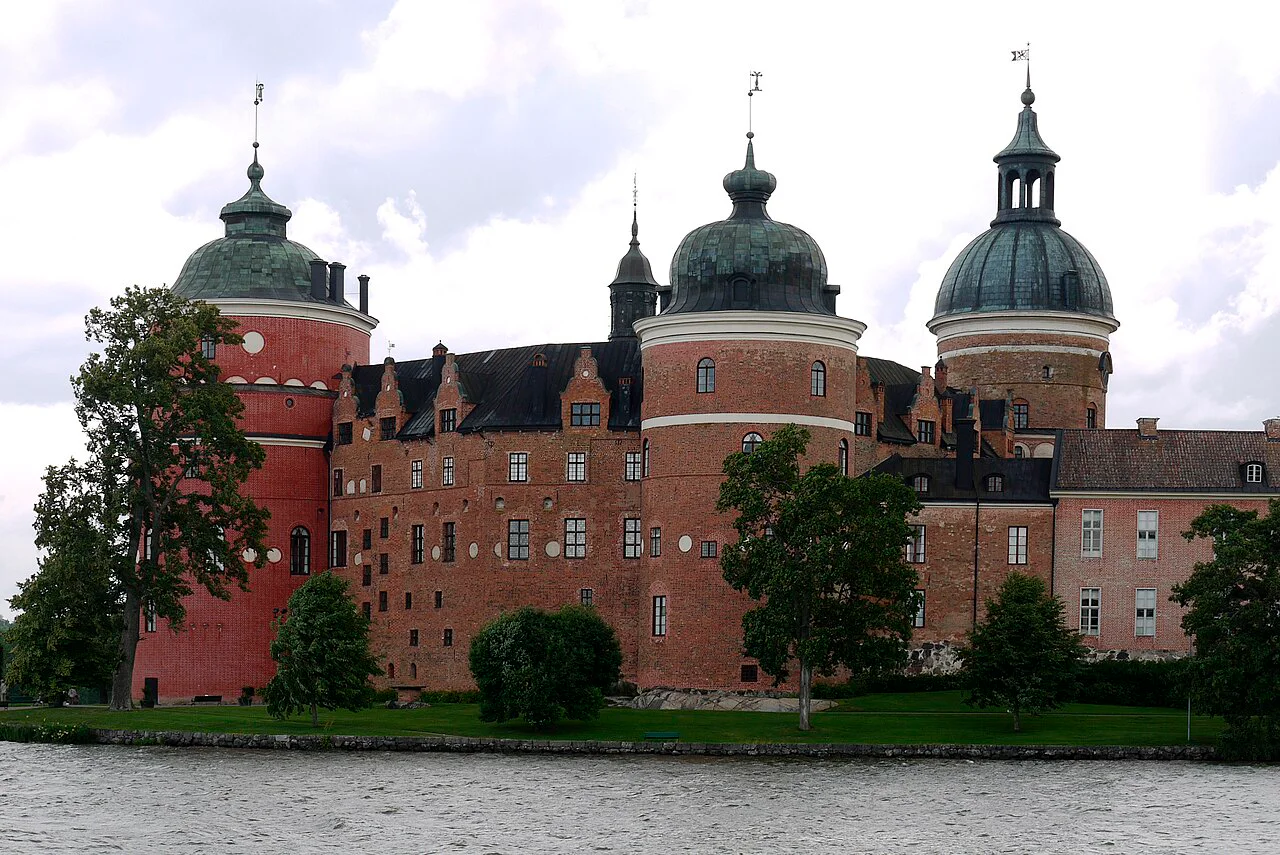
Mariefred · 50 km
Gripsholm Castle
Content & sources
Xauxa Håkan Svensson · CC BY-SA 3.0
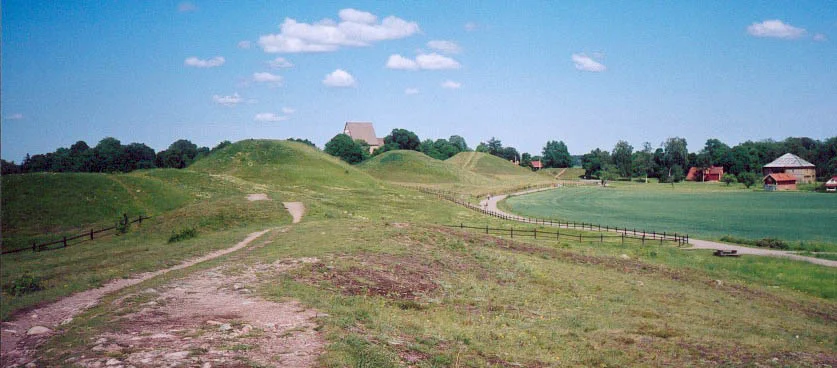
Uppsala · 68 km
Gamla Uppsala
Content & sources
OlofE · CC BY-SA 3.0