Stanza · Audio guide
Schloss Kyburg Audio Guide
A place to remember. A story to take with you.
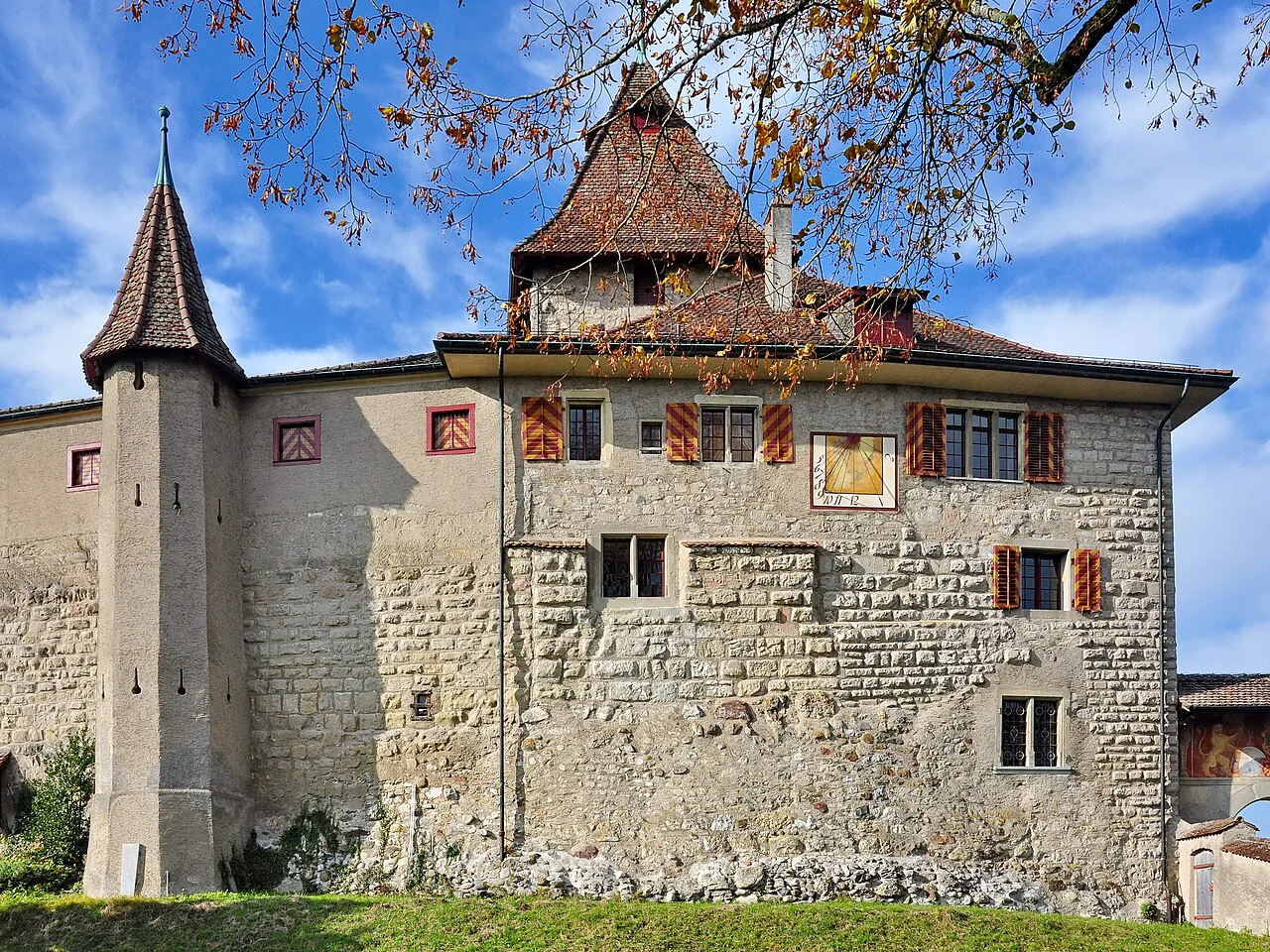
Kyburg Castle is a castle in Switzerland located near Winterthur. It is a Swiss heritage site of national significance.
Download Stanza, then search for “Schloss Kyburg”.
About the tour
One guide. Your kind of visit.
Kyburg Castle is a castle in Switzerland located near Winterthur. It is a Swiss heritage site of national significance.
Ready when you are.
- 01Get the free Stanza app.
iOS & Android
- 02Find your guide.
“Schloss Kyburg”
- 03Download before you go.
Works offline
Audio guide / 13 narrated stops
Inside the guide
Get to know a few of the stories before you go. Open a stop to read more.
01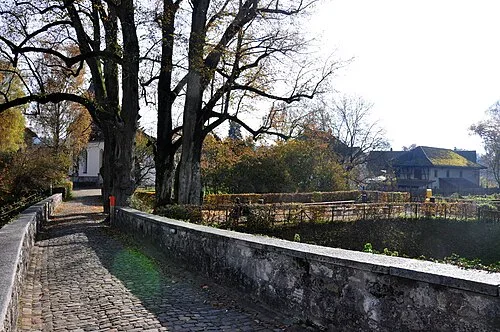 Outer Gatehouse and Neck Ditch
The Castle Approach over the Neck Ditch
Welcome to Schloss Kyburg, on its steep hill above the Töss valley, a few kilometres from Winterthur. It is one of the largest castle complexes to survive from the Middle Ages anywhere in Switzerland. The name goes back a long way, and it is an odd one. In 1027 the place was first written down as Chuigeburg, which means cows-fort. The likeliest reading is that this began as a refuge castle, a walled retreat where people driving their cattle could shelter in dangerous times. From that humble start, the cow-fort became the seat of one of the region's great noble families, a keeper of the Empire's crown jewels, an administrative castle for the city of Zürich, and finally a museum. The bridge ahead of the gate crosses one of the old defensive ditches, cut deep into the hill so attackers would have to cross in the open. That is the way in.
Photo: Roland zh · CC BY-SA 3.0
02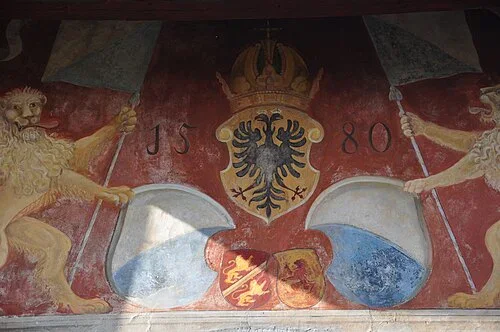 Outer Gatehouse and Neck Ditch
The Gatehouse Painted Coats of Arms
Above the gate, two lions hold up a crowned eagle with two heads, and the date 1580 sits between its wings. The gatehouse had just been rebuilt, in 1579 and 1580, and the coats of arms were painted by Christoph and Josias Murer, a father and son who worked as painters and designers in Zürich. The double-headed eagle was the emblem of the Holy Roman Empire, and it hangs here over a castle that once guarded that Empire's most precious possessions. The painted panels below the eagle carry smaller shields, and their exact meaning is uncertain. What is certain is the message of the whole composition: whoever passed under this gate in 1580 walked beneath the Empire and its power, on the way into a castle now ruled from Zürich.
Photo: Roland zh · CC BY-SA 3.0
03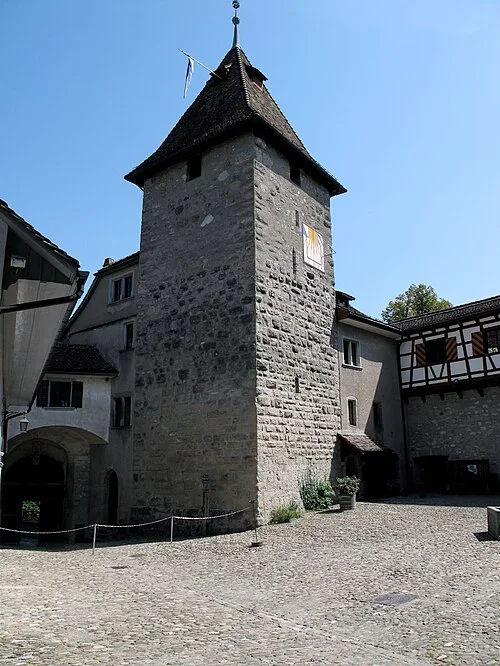 Castle Courtyard and Bergfried Keep
The Bergfried and Courtyard
The great tower in the courtyard is the bergfried, the keep, and it holds the oldest story in the stonework. Its lower walls go back to the castle's medieval core, while the upper section was rebuilt in pale tuffstone from 1424, after Zürich took over. When the masons rebuilt it, they set the entrance eleven metres above the ground. There is no door at street level, because there was never meant to be one. The only way in was by removable ladder or raised access, so even if attackers reached the courtyard, the tower stayed shut against them. Behind the tower stands the shield wall, the Schildmauer, between the keep and the great hall. It is two and a half metres thick, and it was built in the thirteenth century as a solid barrier against attack from that side. A ring wall ties everything together around the large courtyard, enclosing the hall, the chapel, the living and working buildings. From below, with the hill steep on every side, this was a fortress that could not simply be stormed.
Listen in the appPhoto: Archipat · CC BY-SA 3.0
04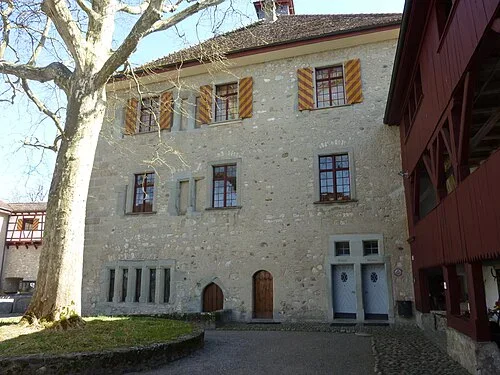 Castle Courtyard and Bergfried Keep
The Ritterhaus (Knights' Hall)
The Ritterhaus, the Knights' Hall, carries the heaviest event in this castle's history. In 1349, during the plague years, persecution of Jews swept through the region, and here it turned lethal. The records tell that 330 Jews were burned within this fortress. It counts as one of the deadliest such attacks recorded in the Swiss lands. The burnings most likely took place somewhere in the castle grounds as a whole, not at any single spot in it, so no stone here marks the exact place. The building itself speaks of something else as well: the endless work of keeping a castle standing. Its south façade had to be rebuilt in 1472, because the ground beneath it would not hold. Walls like these were never finished; they were patched, propped and rebuilt by generation after generation.
Listen in the appAdrian Michael · CC BY-SA 1.0
05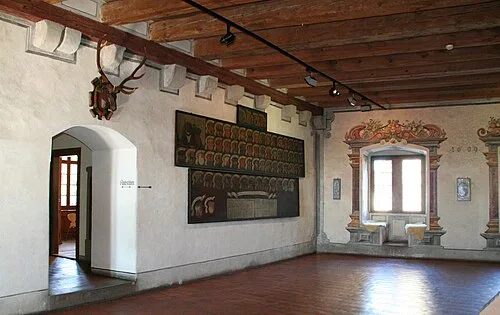 The Palas and Living Quarters
The Palas Great Hall
The great hall of the Palas was built to impress. It stood complete by about 1370 at the latest, after the Habsburgs had taken over the castle, with roughly 290 square metres of living space on every floor. That made it one of the largest halls of its kind in the entire German-speaking world. The castle's rise had begun with the counts of Kyburg, who grew powerful through inheritance. When the Lenzburger line died out in 1173, and the Zähringer in 1218, their lands and rights passed to the house of Kyburg. With them, the counts rose to stand beside the Habsburgs and the house of Savoy as one of the most powerful noble families between the Rhine and the Alps. A hall like this was where a lord's power was put on show. Assemblies were held here, guests were received here, and the timber ceiling overhead, spanning that width without support, was itself a statement of wealth and command.
Listen in the appAdrian Michael · CC BY-SA 3.0
06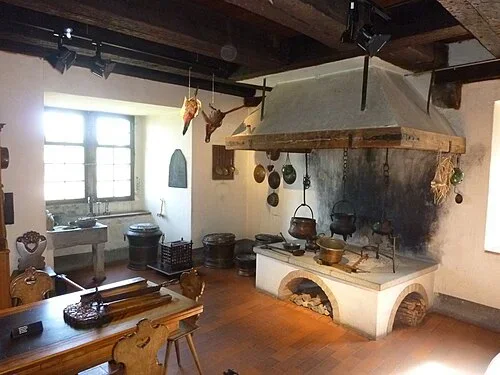 The Palas and Living Quarters
The Castle Kitchen
Power at this scale had to be fed, and this room shows the working side of the castle. The great hooded hearth is blackened by decades of smoke, with cauldrons set into the fire and vessels hanging above it from chains. A seat of this rank ran a large household, and the castle combined residential buildings with economic ones, the barns and stores and kitchens that kept the whole establishment going. Everything on the grand table upstairs began with work like this, over fire and cast iron. One thing to keep in mind: the way the room is arranged today reflects the later museum, not an exact picture of the medieval kitchen.
Listen in the appAdrian Michael · CC BY-SA 1.0
07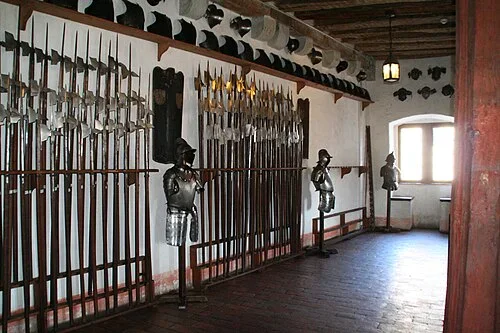 The Palas and Living Quarters
The Armory
The rows of halberds and the armours standing here belong to the long era of Zürich's rule. In 1424 the city of Zürich bought the county of Kyburg and made this castle the seat of its reeve. The first of them, Johannes Schwend the Elder, found the castle run down and had it put back in order. From then until 1798, fifty-nine landvögte resided here, one after another, each a patrician of Zürich serving a six-year term. They held court in the castle and collected the dues of the county, and for many the post was a stepping stone towards the mayor's office back in the city. The weapons on display are the museum's furnishing of that armed administration, not equipment proven to have belonged to the reeves themselves. The era ended abruptly in March 1798, at the start of the Helvetian Republic. Farmers occupied the castle and plundered it, though they let the last reeve, Hans Caspar Ulrich, walk out free.
Listen in the appAdrian Michael · CC BY-SA 3.0
08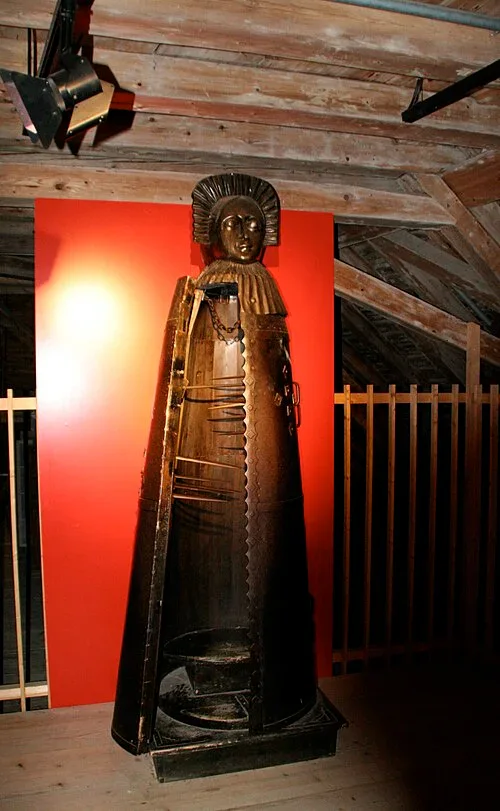 Justice Chamber and the Iron Maiden
The Iron Maiden
The Iron Maiden is probably the best-known exhibit in the castle, and its story is not what the label suggests. The figure is two metres and thirty-seven centimetres tall, but it is a thin wooden construction covered with iron sheet, not a solid medieval instrument. In 1876 the castle's owner at the time, Matthäus Pfau, bought it from a castle in Carinthia and set it up here for one purpose: to lure paying visitors. Pfau was a showman of the romantic age. He had opened the castle as a Castle and Art Museum in 1865, and a fearsome maiden in a torture chamber was exactly the kind of exhibit the public of his day wanted to see. And it worked, for generations. Until 1999 the figure stood in the so-called torture chamber, playing its part in a story of medieval cruelty that it never lived through. Today it stands in the Ritterhaus, a piece of nineteenth-century theatre rather than a relic of the Middle Ages.
Listen in the appAdrian Michael · CC BY-SA 3.0
09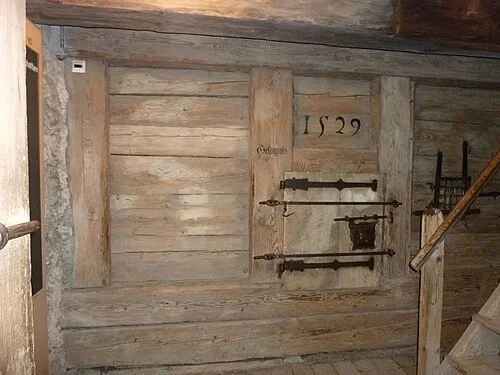 Justice Chamber and the Iron Maiden
The Lock-Up Cell of 1529
Beside the invented torture chamber stands the real thing, in plain timber and iron. This heavy door, with its iron fittings and its timbers carved with the year 1529, belongs to the castle's documented penal side. Under Zürich's reeves, the castle was a seat of jurisdiction, and a seat of justice needed somewhere to hold people. Castles that held courts commonly had lock-ups like this, secure cells where a prisoner could be kept until the reeve's court sat. The carved date and the heavy ironwork are what can be said with confidence about this room. What it shows is the difference between evidence and theatre: this cell needed no legend, only bolts, timber and the plain business of holding court.
Listen in the appAdrian Michael · CC BY-SA 1.0
10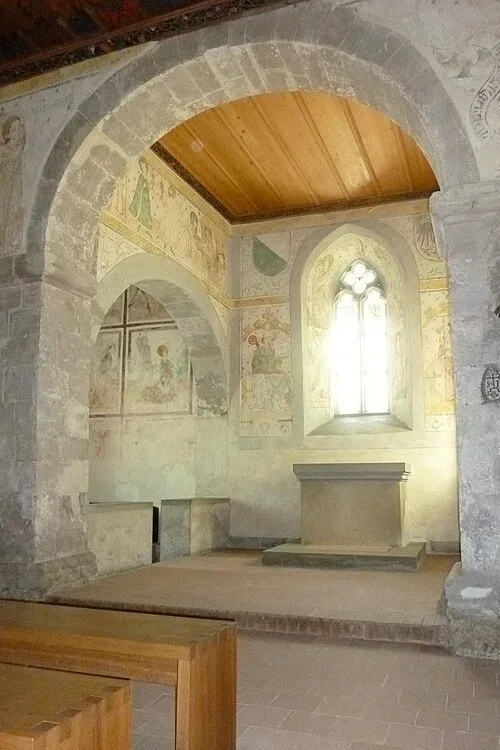 Castle Chapel of Saint Ulrich and Saint Regula
The Castle Chapel
This small chapel, with its round Romanesque arches among the oldest stonework in the castle, holds the peak of Kyburg's political importance. The last count of Kyburg died in 1264, leaving no heir. Rudolf of Habsburg claimed the inheritance for his family, and the castle passed with it. Then came something remarkable: with one interruption, the Imperial Regalia of the Holy Roman Empire, the crown and insignia of the Empire itself, were kept here between 1273 and 1322. Local tradition adds a detail to that, and it should stay a tradition: the story goes that the insignia lay in an iron-bound chest here in the castle chapel. Whether or not that is exactly where they rested, the fact remains that for close to fifty years, the symbols of the Empire's authority were kept on this hill above the Töss, in a castle that had begun, by its name, as a refuge for cows.
Listen in the appAdrian Michael · CC BY-SA 1.0
- 11
The Saint Regula Frescoes
Frescoes of Zürich's martyr saint, plastered over in the Reformation and found again in 1865.
- 12
The French Formal Garden
Between the old defensive ditches, a baroque garden where the fortress learned to be comfortable.
- 13
The Castle on the Hill Spur
How a castle meant for the quarry was saved by a Polish count, and how it lives today.
Schloss Kyburg
Frequently asked questions
How much does the guide cost?
Free app download. Listed guide price: $0.99. Guide price shown in the app. Audio guide only. Venue admission is separate.
Can I listen without internet?
Yes. Download the guide’s audio, images, and maps in the app before your visit. Your downloaded content is then available offline.
Can I listen in my language?
This audio guide is available in 15 languages, including English.
Do I need to follow a schedule?
No. This is a self-guided experience. Choose your stops, pause whenever you like, and return to a story at your own pace.
At your own pace
Explore Schloss Kyburg.
Download Stanza, then search for “Schloss Kyburg”.
Free app download · Guide price shown in the app
Keep exploring
Nearby audio guides
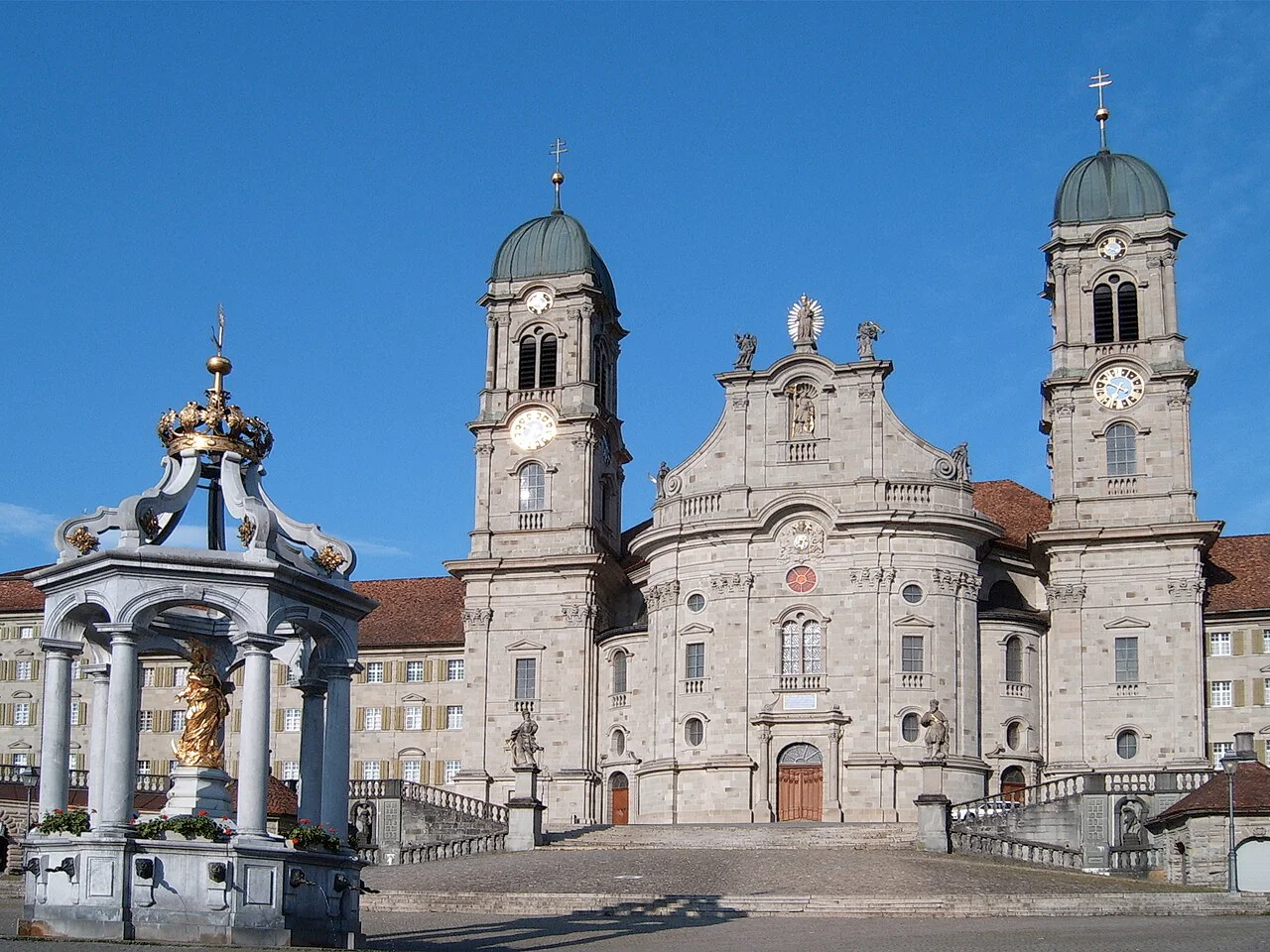
Einsiedeln · 37 km
Kloster Einsiedeln
Content & sources
Markus Bernet · CC BY-SA 2.5
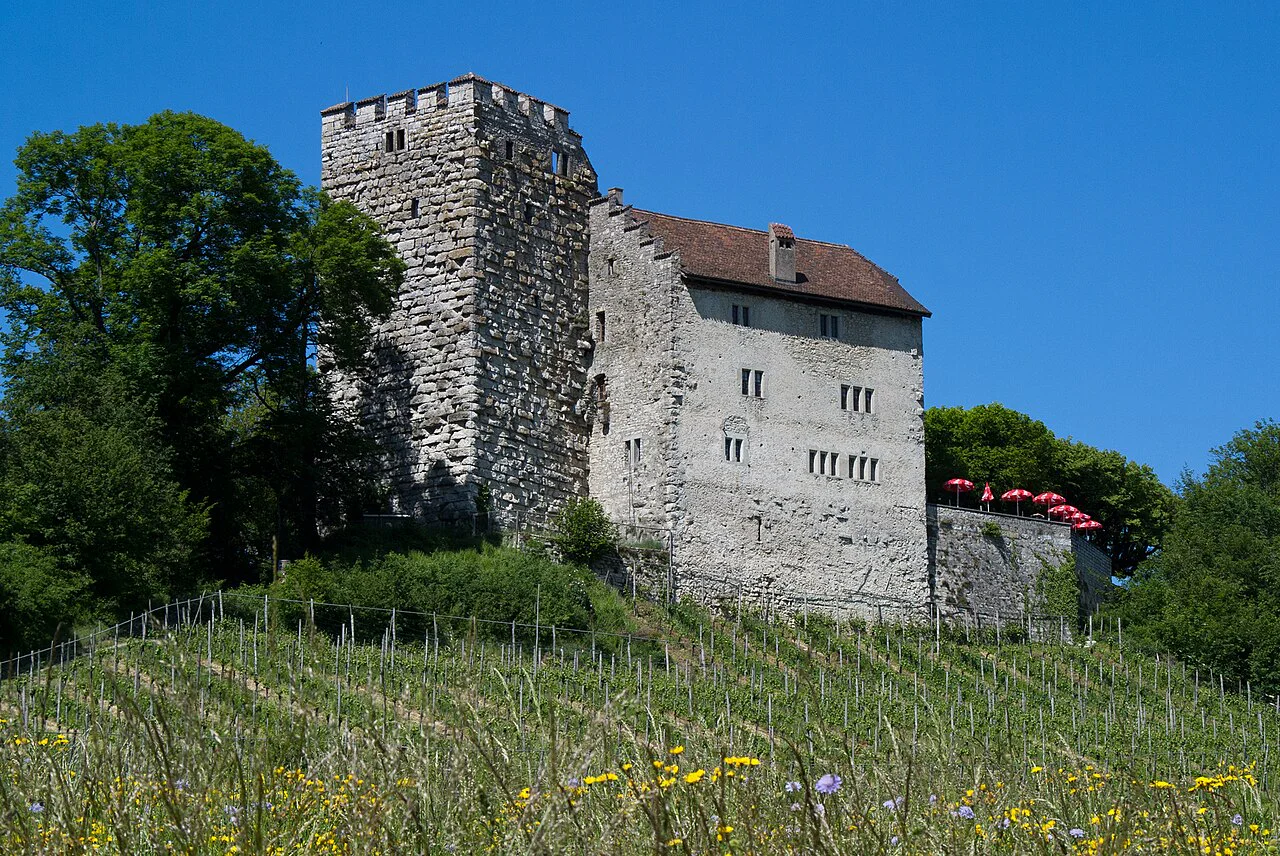
Habsburg · 42 km
Habsburg
Content & sources
Photo: Roland Zumbuehl · CC BY-SA 3.0
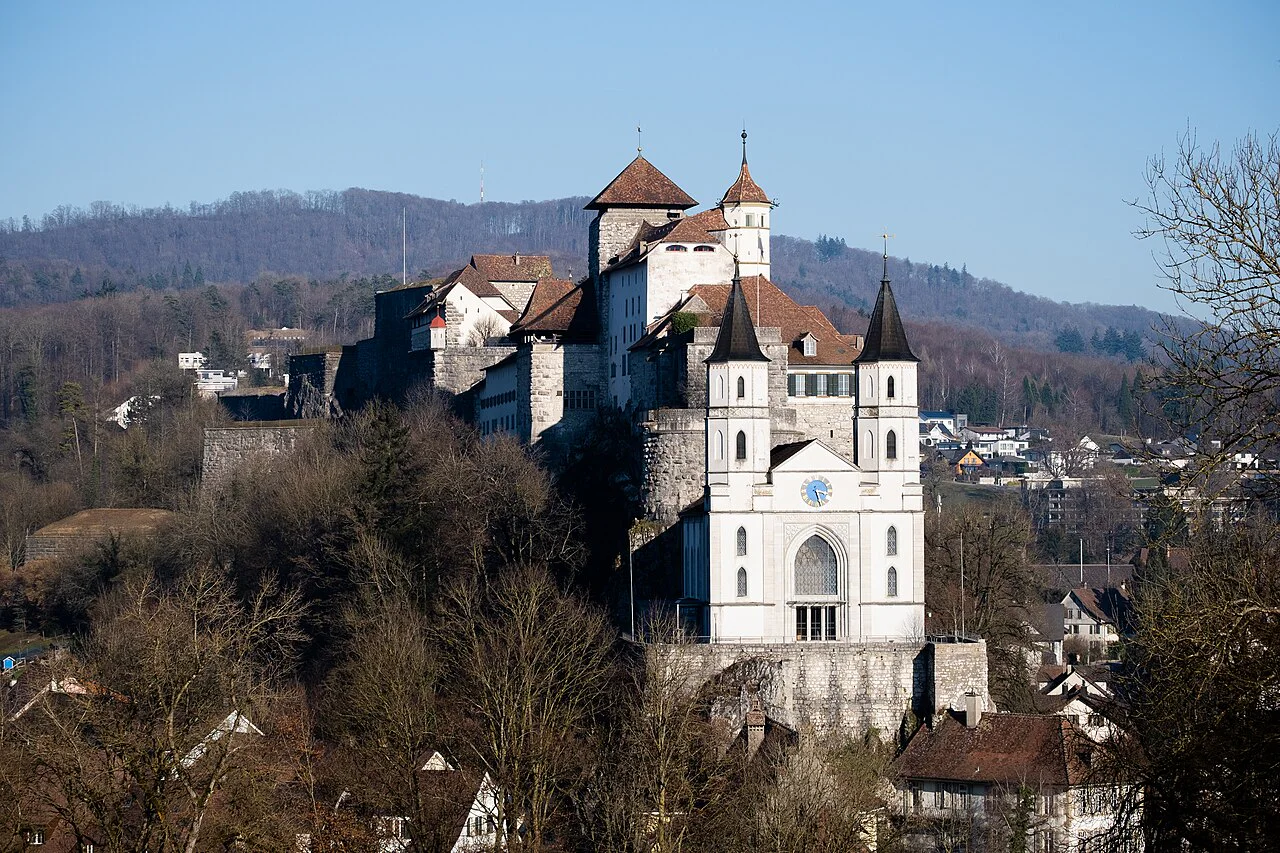
Aarburg · 65 km
Festung Aarburg
Content & sources
Christian David · CC BY-SA 4.0
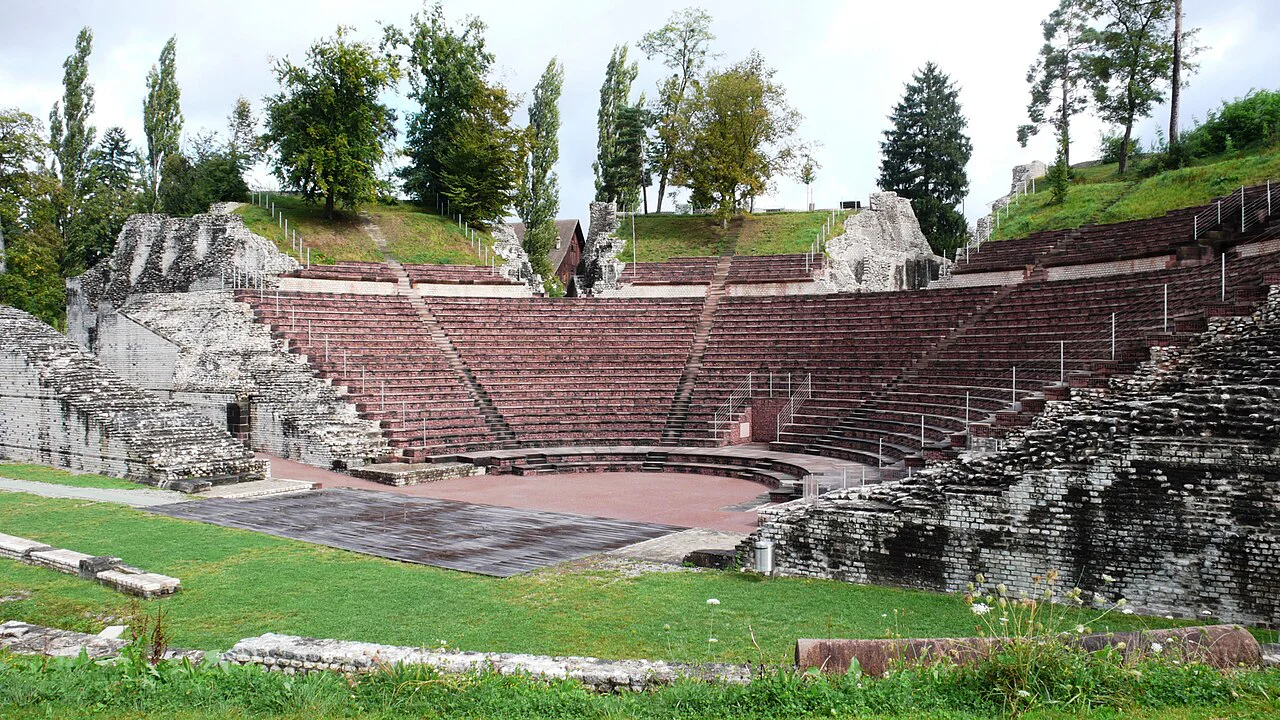
Augst · 77 km
Augusta Raurica
Content & sources
Guido Radig · CC BY-SA 3.0