Stanza · Audio guide
Selimiye Camii Audio Guide
A place to remember. A story to take with you.
The Selimiye Mosque is an Ottoman imperial mosque located in Edirne, Turkey, that was built by Mimar Sinan between 1568 and 1575. It is considered Sinan's masterpiece and is recognized as one of the highest…
Download Stanza, then search for “Selimiye Camii”.
About the tour
One guide. Your kind of visit.
The Selimiye Mosque is an Ottoman imperial mosque located in Edirne, Turkey, that was built by Mimar Sinan between 1568 and 1575. It is considered Sinan's masterpiece and is recognized as one of the highest achievements of Islamic and Ottoman architecture.
Ready when you are.
- 01Get the free Stanza app.
iOS & Android
- 02Find your guide.
“Selimiye Camii”
- 03Download before you go.
Works offline
Audio guide / 13 narrated stops
Inside the guide
Get to know a few of the stories before you go. Open a stop to read more.
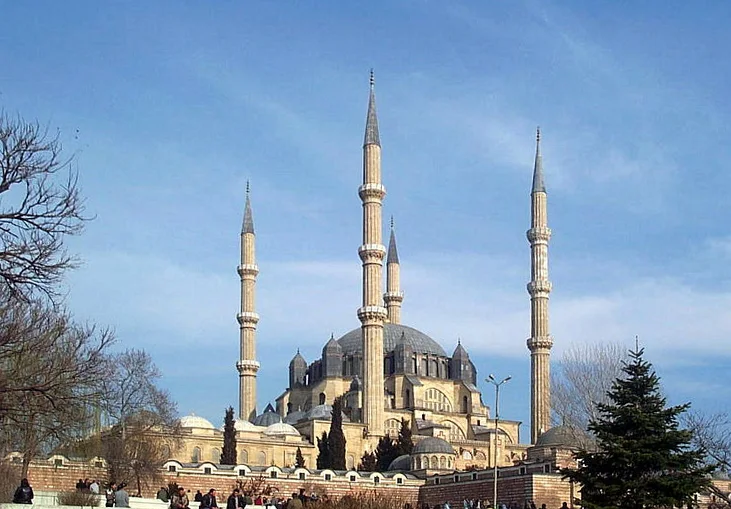
01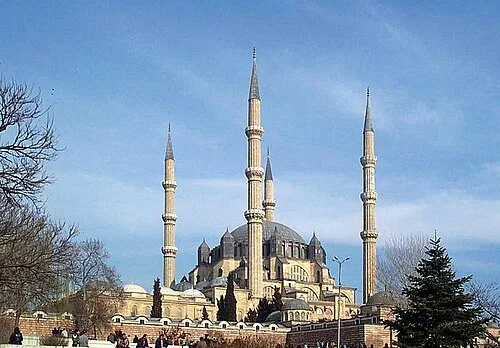 Arrival and the Monumental Silhouette
Selimiye Mosque on Its Hill: An Imperial Commission
Welcome to the Selimiye Mosque in Edirne, and to the story of an old architect's proudest work. Mimar Sinan, the sultans' chief architect, was about eighty when he began this. In March 1568, Sultan Selim II first asked him only to renovate the city's Old Mosque. Instead, plans grew for a new imperial mosque on the hilltop above it. Why Edirne rather than Istanbul, the capital? Selim had served as the city's governor in his youth, and he kept coming back. Historians still debate his other reasons. Perhaps Istanbul had no free hilltop left for an imperial mosque. Perhaps, without a victorious campaign to his name, Selim could not yet claim a sultanic mosque in the capital. Work began in 1568 or 1569 and was finished in 1574 or 1575. The sultan's share of the spoils from the conquest of Cyprus helped pay for it. Selim died in December 1574, before the mosque stood fully complete. Sinan called it his ustalik eserim, his masterwork. In 2011, UNESCO listed the mosque and its social complex as World Heritage.
Nevit Dilmen · CC BY-SA 3.0
02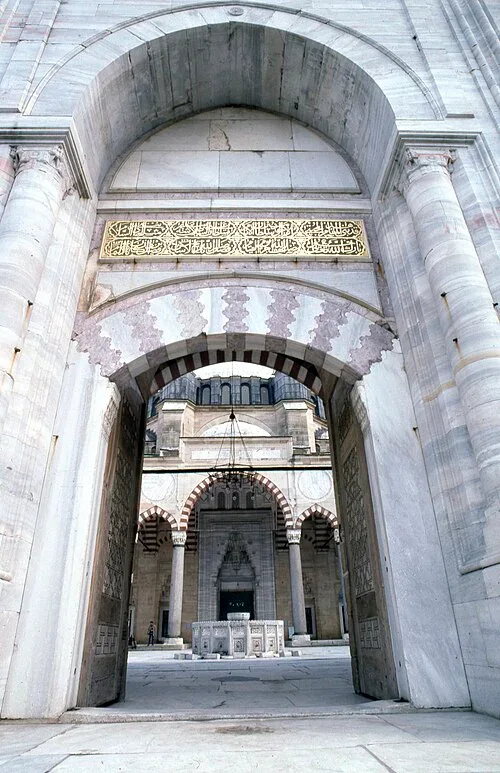 Arrival and the Monumental Silhouette
Through the Outer Gate: The Külliye
A royal mosque in the Ottoman world was never meant to stand alone. The Selimiye is the heart of a kulliye, a charitable religious and social complex behind an outer wall. Its precinct covers roughly 130 by 190 metres of elevated ground. Inside it, prayer shared the ground with teaching, study and trade. There are two madrasas, one for reciting the Qur'an and one for the sayings of the Prophet. There is an elementary school for young children, and a covered market street along the southern edge. The main gate frames all of this with care. Through it, the courtyard fountain and the mosque beyond line up on one axis. That view is composed on purpose, not left to chance.
Photo: Dosseman · CC BY-SA 4.0
03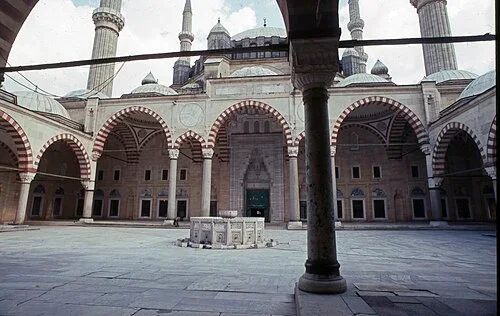 The Arcaded Courtyard and Marble Fountain
The Courtyard and the Four Minarets
Four minarets rise from the corners of the prayer hall, and they are twins, all four of them. Ottoman tradition placed minarets of different sizes around a mosque's corners. Sinan abandoned that here, setting four identical shafts at the corners of the prayer hall instead. The point was the dome. The matched minarets frame it and pull the eye to the centre. Each stands just over seventy metres, among the tallest Ottoman minarets ever built. The two nearest the main entrance hide a piece of engineering. Each contains three separate internal staircases, so three muezzins could climb to the balconies without ever meeting on the way. Around the courtyard, four porticos of arches and domes enclose the open square.
Listen in the appPhoto: Dosseman · CC BY-SA 4.0
04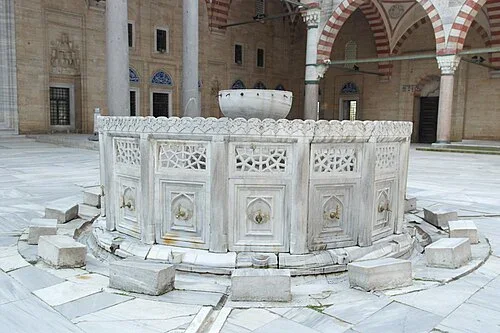 The Arcaded Courtyard and Marble Fountain
The Marble Shadirvan
At the centre of the courtyard stands a marble fountain, carved and pierced like lace. This is the shadirvan, where worshippers washed before prayer and drew their water. Its basin and panels make it one of the finest examples of its kind from the period. Yet something is missing. The usual roof and canopy are not there. The historian Dogan Kuban reads that as a sign the fountain was never finished. Gülru Necipoglu sees it differently, as a deliberate choice that keeps the view of the main dome open above. Two careful scholars, one fountain, two readings. The question is still open.
Listen in the appKLMircea · CC BY-SA 2.0
05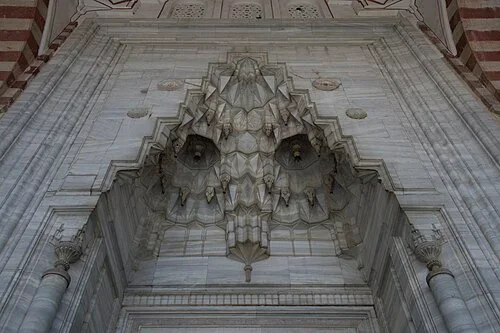 The Portico of Late Comers and Entrance Portal
The Entrance Portal
The portico before the entrance is taller than its three siblings around the courtyard. Sinan raised this southeastern one to meet the great height of the mosque itself. Three wide arches carry it, with two very small arches tucked between, a rhythm that faintly recalls a Roman triumphal arch. Above them, two marble circles carry inscriptions from the Qur'an. The portal itself wears a canopy of muqarnas, the honeycomb carving that dissolves a ceiling into small hanging cells. As for the wooden doors, the story goes that they were brought from the Ulu Cami, the Great Mosque of Birgi.
Listen in the appPhoto: Dosseman · CC BY-SA 4.0
06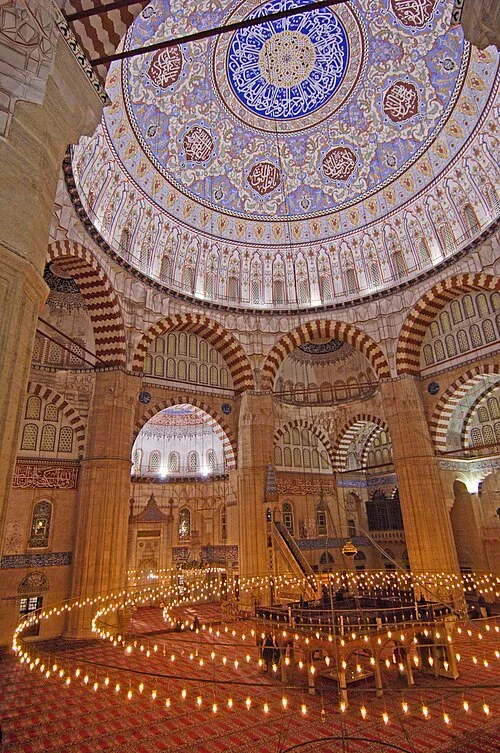 The Grand Dome and Unified Interior
One Room Under One Dome
Eight enormous pillars do the work here, set into the rectangular shell of the walls. Together they form what architects call an octagonal baldaquin, a design Sinan had been refining for years. Extra buttresses hide inside the outer shell, so the walls between them could be opened up with window after window. The leftover bays between the pillars became raised galleries, using up the last corners of floor space. The result is that the dome rules the view from wherever a person stands, with no half-domes crowding in front of it. The hall also holds a quieter chapter. Baha'u'llah, founder of the Baha'i Faith, was exiled to Edirne as a prisoner of the Ottoman Empire at the end of 1863. From 1865 he lived in a house near this mosque, and he visited it often until 1868. It was here, the account says, that he was meant to hold an open debate with Mirza Yahya, a contest bound up with the split of Babism into two faiths.
Listen in the appPhoto: Dosseman · CC BY-SA 4.0
07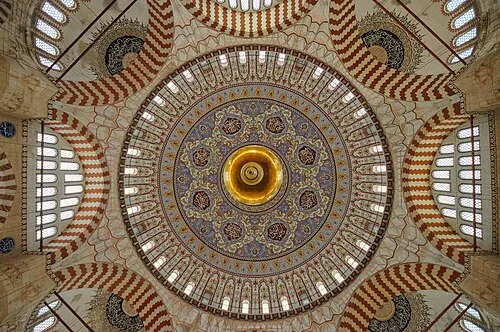 The Grand Dome and Unified Interior
The Dome and Hagia Sophia
The dome overhead was built to settle an old argument. Christian architects, so the story goes, claimed Muslims could not match the dome of Hagia Sophia. Sinan's biographer, Sa'i Mustafa Celebi, recorded his master's answer in the Tezkiratü'l-Bünyan. In this mosque, Sinan declared, I have erected a dome six cubits higher and four cubits wider than the dome of Hagia Sophia. The dome measures just over thirty-one metres across, matched to Hagia Sophia's scale for the first time in Ottoman building. Its painted decoration, though, is largely not Sinan's. Most of it dates from a nineteenth-century restoration under Sultan Abdülmecid I, and from later campaigns. And the dome carries a wound. Bulgarian artillery struck it during the siege of Edirne in 1913. Atatürk ordered the traces left unrestored, as a warning to future generations.
Listen in the appPhoto: Tarikkaanmuslu · CC BY-SA 4.0
08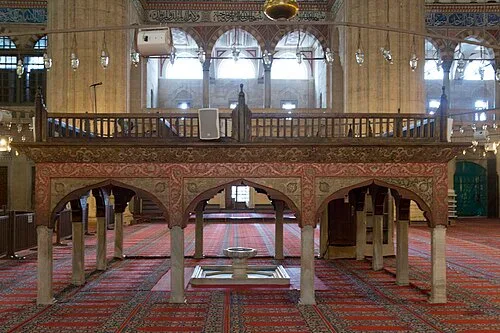 The Müezzin Mahfili and Inverted Tulip
The Müezzin Mahfili Under the Dome
Directly under the centre of the dome stands a wooden platform raised on arches. This is the müezzin mahfili, the place from which the muezzin repeats the call to prayer and chants through the service. Its position is the strange part. Ottoman mosques nearly always kept this platform to one side. Here it sits dead centre, blocking the view of the mihrab from the entrance. Sinan never repeated the arrangement anywhere else. The likeliest reason, scholars suggest, is that it underlines the dome's centrality, gathering everything beneath its crown. The platform is finely painted wood carried on twelve low arches with multifoil curves, arches drawn with many small lobes. Underneath it hides a marble fountain for ablutions and drinking water.
Listen in the appPhoto: Dosseman · CC BY-SA 4.0
09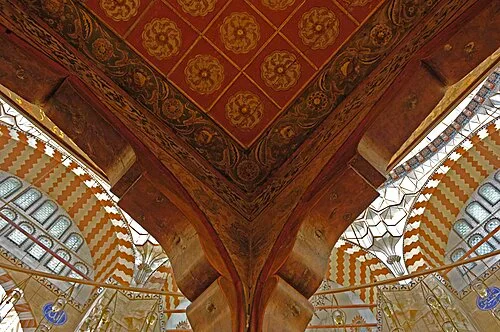 The Müezzin Mahfili and Inverted Tulip
Painted Wood and the Inverted Tulip
The paint on this wood is older than almost any other colour in the mosque. During a restoration in the 1980s, conservators uncovered painted decoration on the platform's wooden surfaces. It ranks among the best-preserved of the Classical period, the sixteenth and seventeenth centuries. Unlike the dome's painting, largely redone later, this is the mosque's own early decoration surviving. Then there is the tulip. The local legend, the rivayet, tells of a tulip garden covering the building site, and an owner who long refused to sell. In the end she gave up the land on one condition, that a tulip be carved into the mosque. Sinan obliged, and set the flower upside down under one of the platform's marble supports. The tulip stands for her garden. The upside-down position stands for her stubbornness.
Listen in the appPhoto: Dosseman · CC BY-SA 4.0
10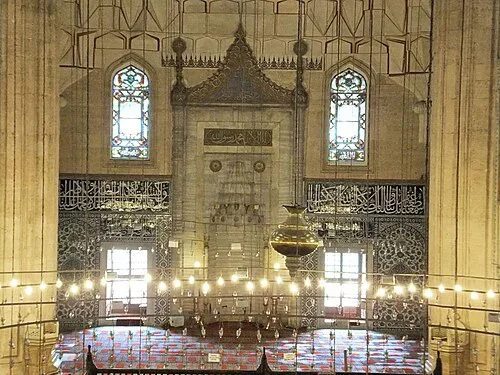 The Mihrab Niche and Stone Minbar
The Mihrab and Its Light
Light was part of the design of the mihrab. The marble prayer niche marks the direction of Mecca, and it sits set back in an apse-like recess. That recess is deep enough for windows on three sides. Daylight pours in and makes the tile panels on the lower walls sparkle. The tiles flanking the mihrab count among the finest Iznik ceramic work in the building. The niche itself is carved marble, a strong example of Ottoman stone-cutting of the period, with a muqarnas hood and a band of inscription. Above it all rises a curved triangle, set between two alems, the finials that crown flagpoles.
Listen in the appPhoto: R Prazeres · CC BY-SA 4.0
- 11
The Stone Minbar
The pulpit for the Friday sermon, carved from stone as if it were lace.
- 12
The Sultan's Loge and Its Stolen Tiles
Where the sultan prayed apart from his subjects, and the tiles that were carried off to Moscow.
- 13
Gravestones and Schools: The Complex Endures
Gravestones under a pergola, and two old schools that never stopped serving the city.
Selimiye Camii
Frequently asked questions
How much does the guide cost?
Free app download. Listed guide price: $0.99. Guide price shown in the app. Audio guide only. Venue admission is separate.
Can I listen without internet?
Yes. Download the guide’s audio, images, and maps in the app before your visit. Your downloaded content is then available offline.
Can I listen in my language?
This audio guide is available in 15 languages, including English.
Do I need to follow a schedule?
No. This is a self-guided experience. Choose your stops, pause whenever you like, and return to a story at your own pace.
At your own pace
Explore Selimiye Camii.
Download Stanza, then search for “Selimiye Camii”.
Free app download · Guide price shown in the app
Keep exploring
Nearby audio guides
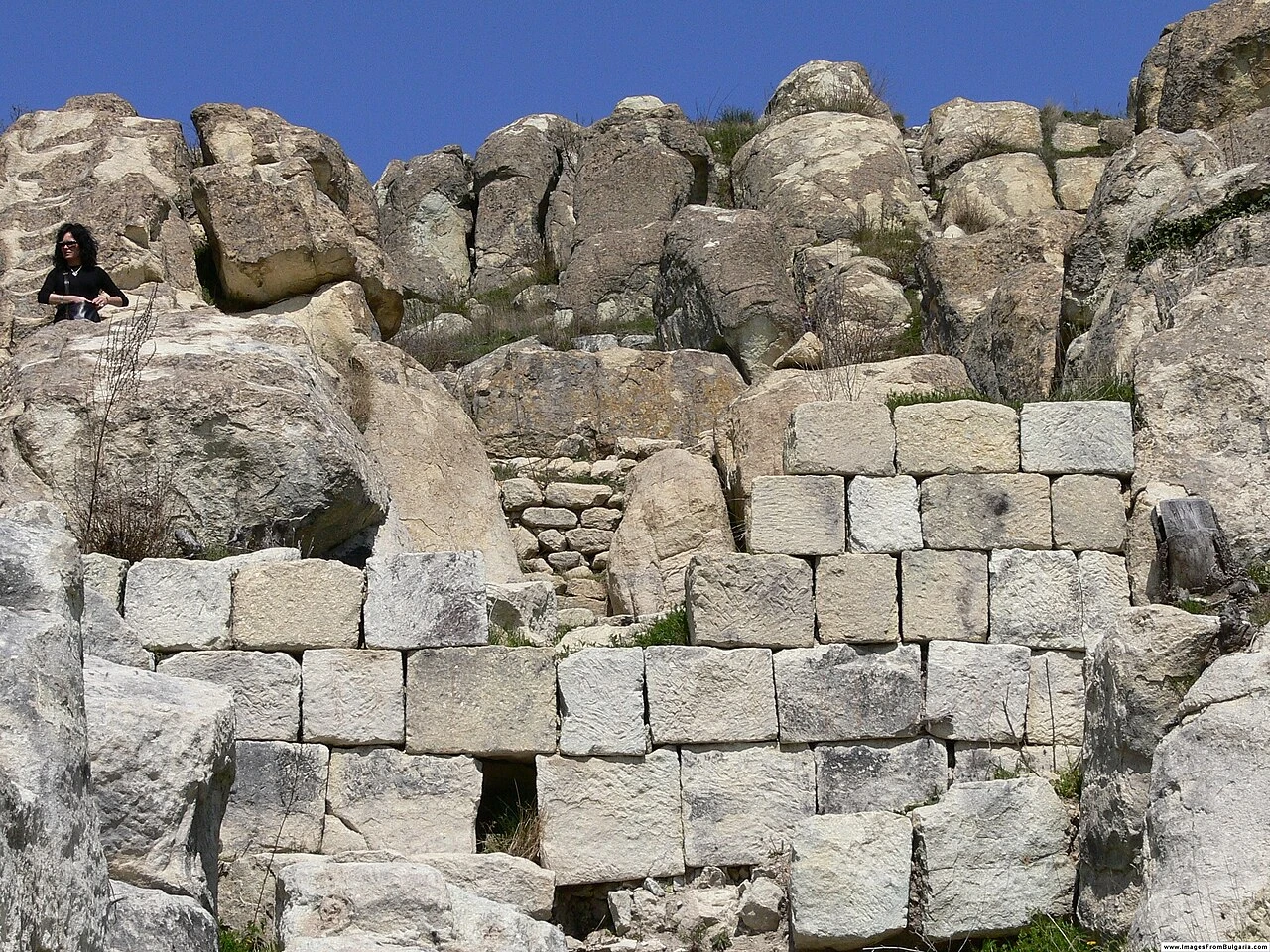
Gorna Krepost · 91 km
Perperikon
Content & sources
Nenko Lazarov · CC BY 2.5
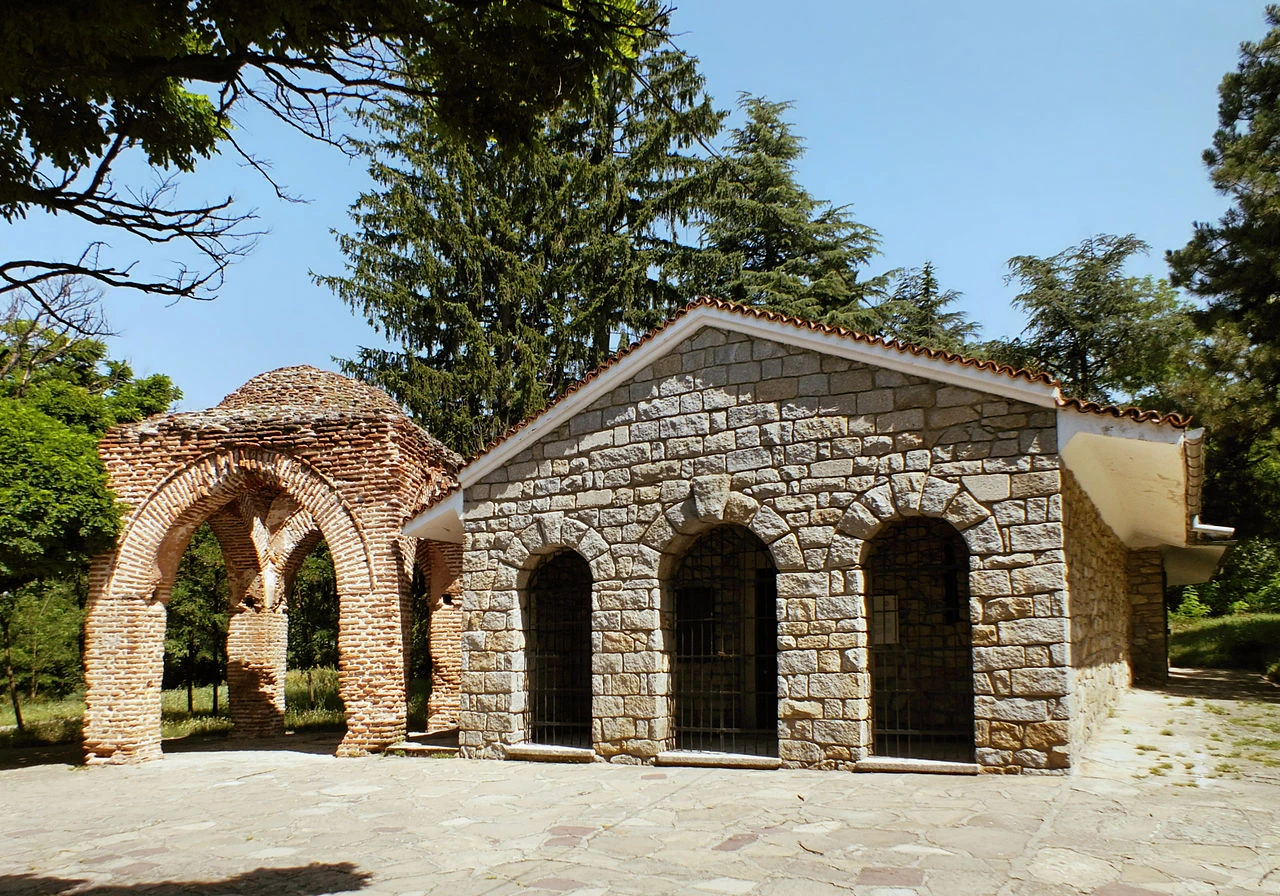
Kazanlak · 142 km
Thracian Tomb of Kazanlak
Content & sources
Photo: Roweromaniak · CC BY-SA 3.0
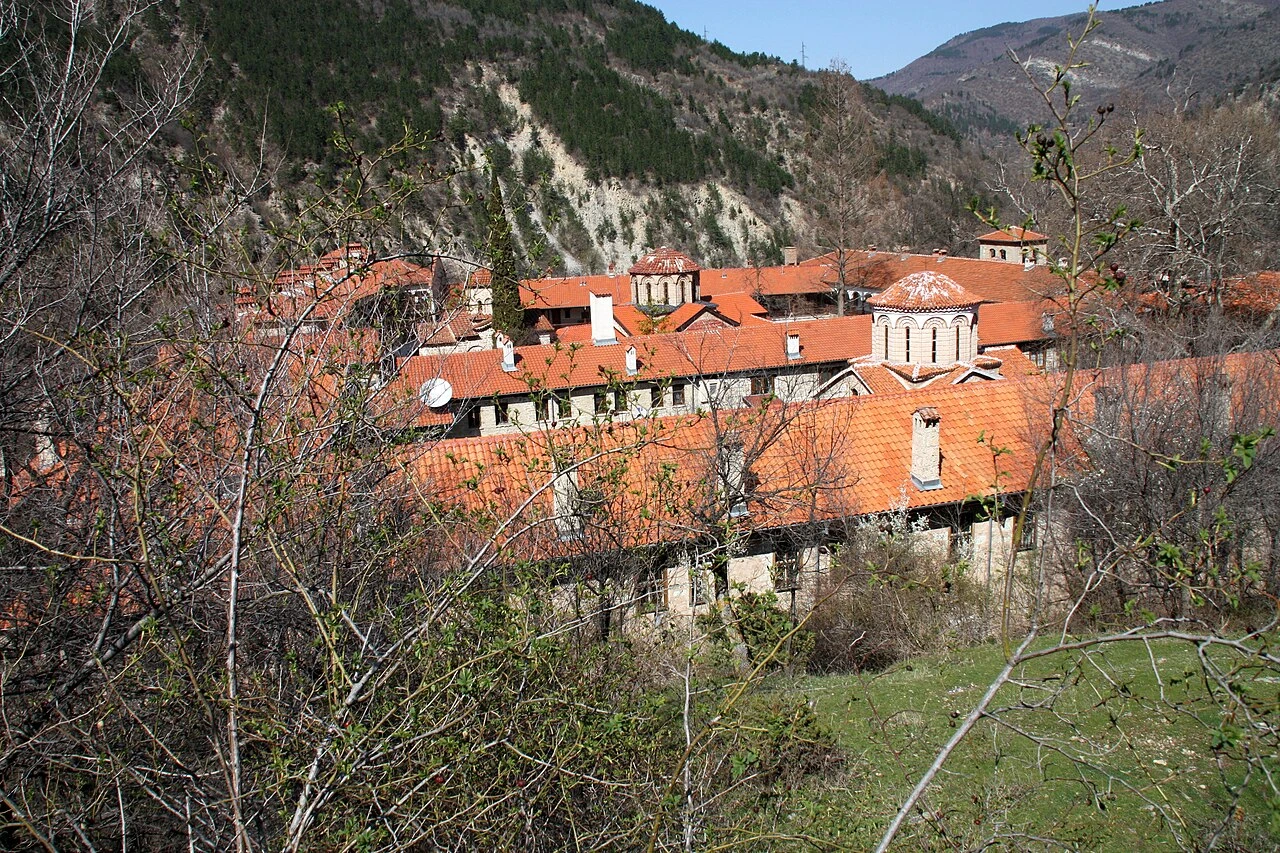
Bachkovo · 145 km
Bachkovo Monastery
Content & sources
Photo: Reneman · CC BY 2.0 de
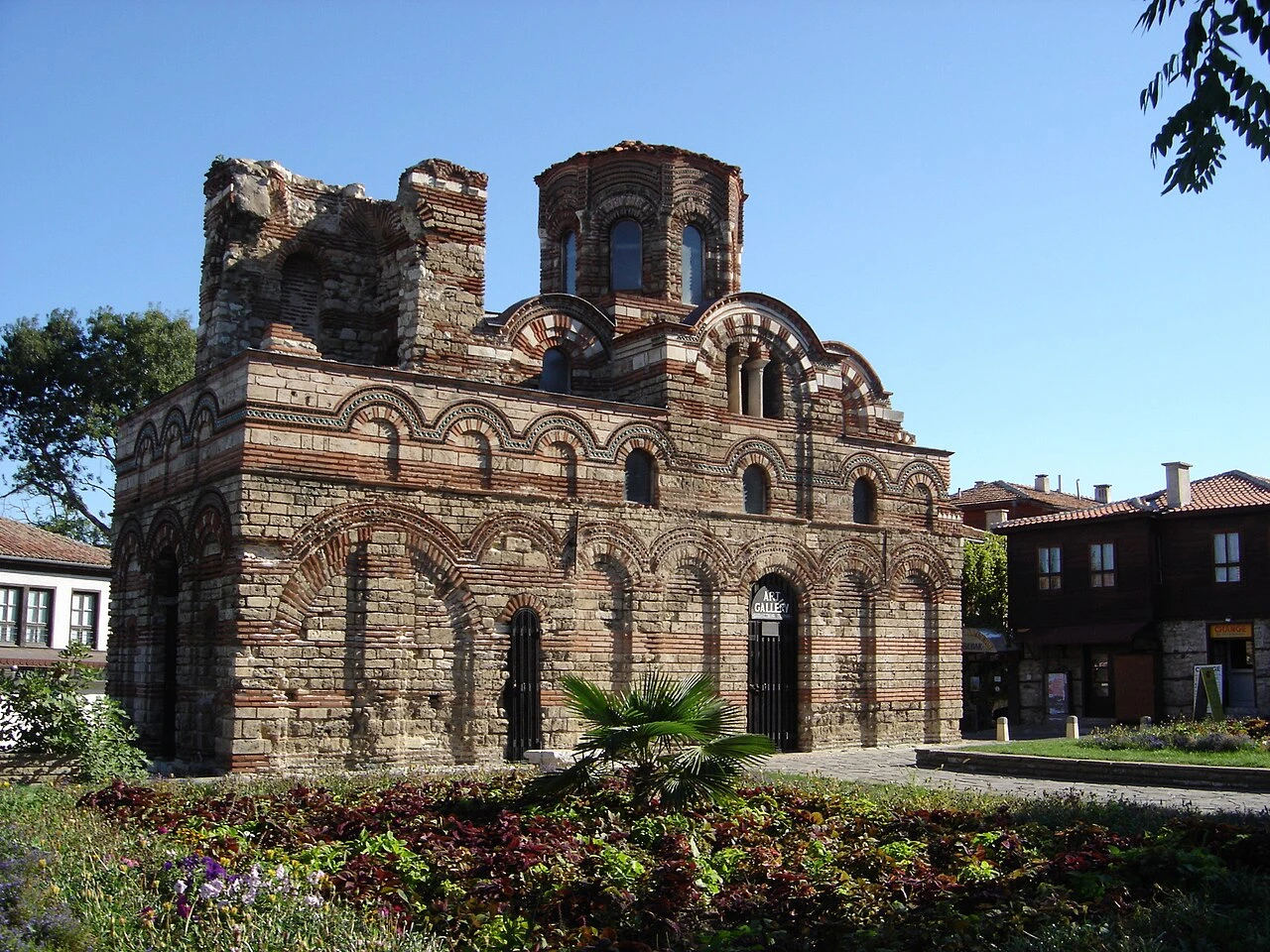
Nesebar · 145 km
Ancient City of Nessebar
Content & sources
Photo: Gérard Janot · CC BY-SA 3.0