Languages
15Ancient City of Nessebar Audio Guide
Ancient City of Nessebar is an archaeological site in Nesebar, Bulgaria. Explore it with Stanza's guided offline audio tour — narrated in 15 languages.
Quick Facts
35
Stops
15
Languages
100%
Offline
📍 Nesebar, Bulgaria · 42.6561°N, 27.7300°E
About Ancient City of Nessebar
The Ancient City of Nessebar is a historic peninsula town located on the Black Sea coast of Bulgaria. A UNESCO World Heritage site, it is celebrated for its rich archaeological remains, ancient fortifications, and numerous medieval churches.
This self-guided audio tour features 35 narrated stops organized across 7 sections. As a historic district, Ancient City of Nessebar offers a unique cultural experience in the heart of Nesebar, Bulgaria.
The Stanza audio guide is available in 15 languages and works entirely offline — download the complete tour including audio narration, maps, and images before your visit. As you walk through Ancient City of Nessebar, GPS-triggered narration plays automatically at each point of interest.
Last updated:
What you will hear
Mesembria Fortifications and City Gate
The massive stone walls and gate mark the entrance to the ancient city, showcasing layers of Thracian, Greek, and Byzantine engineering.
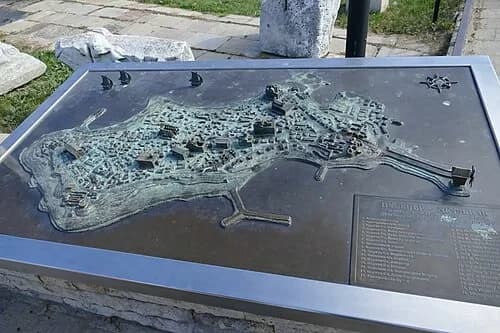
Tactile Map of the Peninsula
This bronze relief map provides a clear perspective on Nessebar’s unique geography, revealing its distinct 'butterfly' shape. Originally, the city was an island separated from the mainland by the sea. It was only later that a narrow man-made isthmus was constructed to provide a permanent land link. As you trace the layout of the old town, notice the incredible density of the structures. This small peninsula once housed as many as 40 churches, a concentration so high that the city became known as 'The Bulgarian Jerusalem.' This scale model also serves a somber purpose; it helps us visualize how much of the ancient territory has been surrendered to the rising Black Sea waters over thousands of years. Foundations and streets that were once bustling with life now lie submerged beneath the waves surrounding the port. The map serves as a vital guide for understanding the compact, sacred landscape you are about to explore, where every corner holds a piece of a sunken past. It captures the fragile balance between the city and the surrounding sea.
Nessebar Archaeological Museum
A vital first stop to see the 'Town of 40 Churches' in context, featuring artifacts from the Chalcolithic era to the Middle Ages.
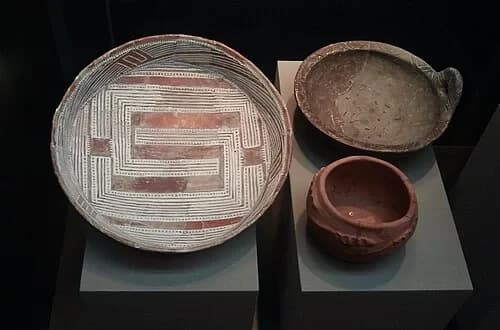
Prehistoric Pottery Finds
Long before the Greeks or Romans established their colonies, people were already living and creating art on this peninsula. These vessels date back to the Copper Age, or Chalcolithic period, making them more than 6,000 years old. The level of artistic sophistication found in such a pre-literate society is truly impressive. Focus on the largest bowl, which features white-painted designs that form a complex, maze-like pattern. These geometric motifs suggest that these were not merely everyday kitchen pots but were likely ritual objects used in significant community ceremonies. The precision of the lines and the balance of the patterns indicate a culture with a deep appreciation for aesthetics and symbolic representation. Finding such well-preserved examples of prehistoric pottery confirms that the peninsula has been a sought-after location for settlement since the dawn of human civilization. These pieces provide a silent record of the earliest residents of Nessebar, who worked the clay of the Black Sea coast millennia before the first stone walls of Mesembria were ever laid. Their presence demonstrates that the spirit of craftsmanship and artistic expression has been part of this landscape for six millennia.
Church of Saint Stephen
Known as the 'New Bishopric,' this church is world-famous for its over 1,000 mural figures dating from the 16th to 18th centuries.
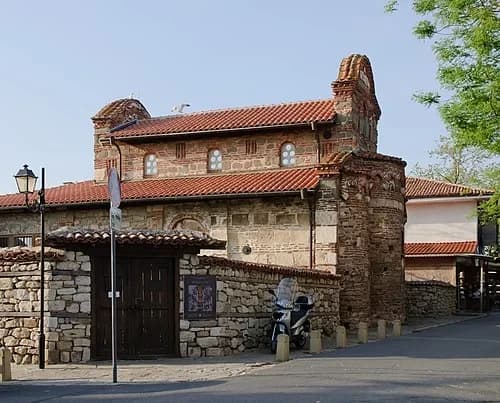
Church of Saint Stephen
Although its exterior may appear relatively humble compared to its neighbors, the Church of Saint Stephen holds a place of great importance as the former 'New Bishopric' of the city. One reason the building survived the Ottoman period relatively intact is its unusual construction; it was built partially into the ground to maintain a low profile, a common tactic for Christian structures at the time. Over the course of several centuries, from the 11th to the 16th, the church was repeatedly expanded and refined. You can see evidence of this long history in the masonry of the apse, where rough, unhewn stones transition into more sophisticated and decorative brickwork. This evolutionary style tells a story of a community that persisted in improving its most sacred space despite changing political tides. Inside, the church is a masterclass in storytelling, containing over 1,000 individual painted figures. These frescoes cover almost every square inch of the walls, making it one of the most significant monuments of post-Byzantine art in the Balkans and a vital record of medieval fashion, theology, and artistic expression. The gradual growth of the structure illustrates the resilience of local traditions across centuries of foreign rule.
Church of Christ Pantocrator
One of the best-preserved medieval churches in Bulgaria, famous for its rich exterior decoration and ceramic ornamentation.
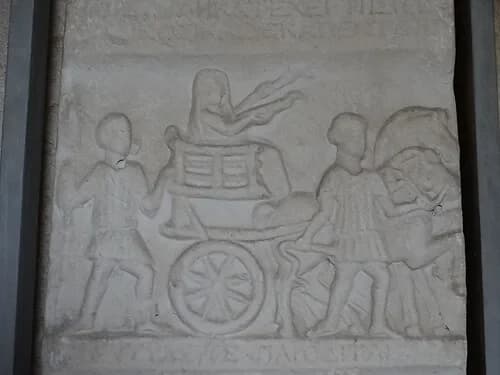
Greek Funeral Relief
This ancient stone slab is a funerary stele, a grave marker that dates back to the Greek era of the city. The carved relief prominently features a chariot and a team of horses, images that held deep symbolic meaning for the citizens of Mesembria. In Greek culture, the chariot often represented the status and wealth of the deceased during their lifetime, while also serving as a metaphor for the final journey of the soul into the afterlife. The detail in the carving reveals much about the artistic standards of the time, from the musculature of the horses to the posture of the driver. Interestingly, this piece was not found in its original cemetery. Like many ancient artifacts in Nessebar, it was eventually rediscovered within the foundations of much later buildings. For centuries, the residents of the peninsula practiced a form of large-scale recycling, using the sturdy stones of the past to construct the churches and homes of the present. This survival of a Greek citizen's memorial within a medieval wall perfectly encapsulates the overlapping layers of history that define the city, where every generation built literally upon the foundations of those who came before.
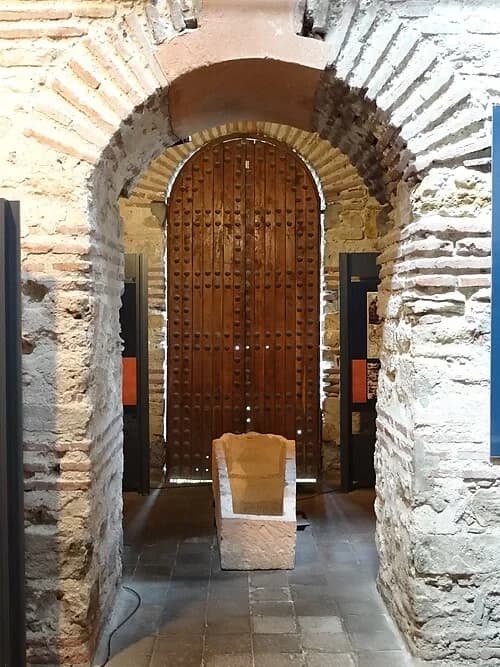
The Threshold of the Past
The entrance to this sacred space is marked by heavy, iron-studded wooden doors and a massive stone threshold, both designed to withstand the test of time and the harsh coastal climate. As you look just inside the entrance, you will notice a stone sarcophagus. This placement is significant; it illustrates how churches in Nessebar functioned not only as centers for daily worship but also as final resting places for their most prominent benefactors and community leaders. Being buried within or near the church was a sign of great honor and social standing. The architecture itself was highly functional as well as symbolic. The exceptionally thick stone walls served a dual purpose: they kept the interior sanctuary comfortably cool during the sweltering Black Sea summers and provided a crucial barrier against the humid, salt-laden sea mist. This environment was essential for the long-term preservation of the valuable icons and intricate frescoes that once filled the interior. Crossing this threshold meant leaving the busy streets behind to enter a cool, quiet world dedicated to faith and the memory of the city's ancestors. The worn stones of the entrance show the passage of countless feet across centuries of prayer and pilgrimage.
Church of the Holy Saviour
Built in 1609 during the Ottoman period, this church was partially buried to comply with height restrictions of the time.
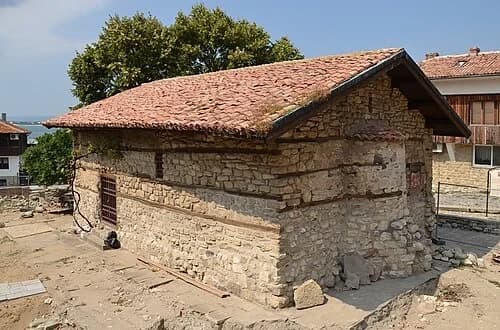
Church of the Holy Saviour
Notice how this church seems to sit unusually low compared to the surrounding streets. Built in 1609 during the period of Ottoman rule, the structure was governed by a strict regulation: Christian buildings were forbidden from standing taller than a Turkish soldier on horseback. To circumvent this without sacrificing the internal height needed for a traditional sanctuary, the local community dug deep into the earth. This clever bit of architectural rebellion allowed for a spacious interior while maintaining a humble, barn-like profile from the outside. Seen from the street, the building's rough stone walls and simple roofline were designed to be as inconspicuous as possible, avoiding unwanted attention from authorities. However, once you cross the threshold and descend the steps, the space opens up into a surprisingly grand, single-nave interior. This contrast between the plain exterior and the hidden complexity inside is a common feature of post-medieval churches in the Balkans. It was a space built by a community that valued its traditions enough to hide them in plain sight. The heavy timber roof and thick masonry created a cool, quiet refuge that has protected the delicate artwork inside from the harsh Black Sea winters for over four hundred years.
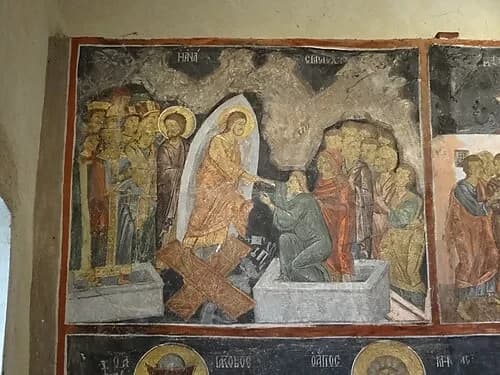
Resurrection of the Dead
This dynamic scene depicts one of the most significant themes in Eastern Orthodox theology: the 'Harrowing of Hell,' or the Resurrection. The mural shows Christ standing triumphantly over the broken gates of the underworld, reaching out to pull Adam and Eve from their sarcophagi. This specific artwork is notable for its use of high-contrast colors; bright orange and white highlights were applied to the robes and faces to make the figures 'pop' in the low-light environment of the sunken church. These pigments were carefully chosen to ensure that even a single candle could bring the story to life for worshippers. If you look at the faces of Adam and Eve, you will see a level of expressiveness that was quite advanced for the early seventeenth century, capturing a mix of awe and relief. The artist has captured the movement of the drapery as Christ leans down, adding a sense of physical urgency to the spiritual event. Below Christ’s feet, you can see the shattered locks and chains of the abyss, rendered in dark, stark tones. This composition was intended to be the ultimate message of hope for the local population, placed where it would be most visible during the Easter liturgy. It remains a powerful example of how art was used to provide light and drama in a restricted space.
Church of the Holy Archangels Michael and Gabriel
A 13th-century masterpiece known for its single nave and characteristic decorative arches.
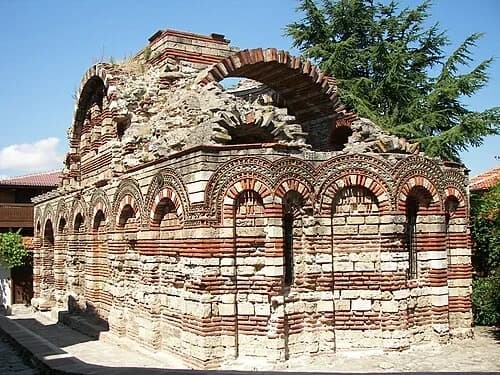
Church of the Holy Archangels Michael and Gabriel
The striking, jagged silhouette of this thirteenth-century church highlights a period of immense prosperity for the Bulgarian Empire. During this time, Nessebar served as the primary port for the Tsar in Veliko Tarnovo, and wealth from maritime trade was funneled directly into these ambitious religious projects. Notice the unique double-vaulted roof system; this wasn't just for style, but was engineered to support a massive bell tower that once rose above the structure. Although the upper sections of the tower are now gone, the strength of the remaining masonry speaks to the high level of craftsmanship available in the city. The exterior is a masterclass in decorative brickwork, featuring intricate 'meander' patterns that wrap around the building like a stone ribbon. Rows of green glazed ceramic tubes trace the arches, adding a touch of color to the red brick and white stone. This building was designed to be seen from the harbor, signaling to approaching ships that they were entering a city of power and piety. The complexity of the design suggests that the patrons were not merely building a parish church, but a monument that could compete with the grandest structures of Constantinople. Today, even as a ruin, the church retains an air of elegance that reflects the heights of medieval Bulgarian culture.
Church of Saint Paraskevi
Dating from the 13th-14th century, this church features some of the most elaborate ceramic decorations in the city.
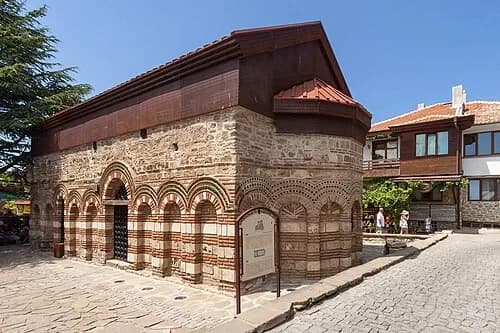
Church of Saint Paraskevi
This thirteenth-century church is widely considered to have the most elaborate and refined brickwork in the entire old town. As you examine the exterior, you will notice a series of arches that appear to be windows but are actually solid walls. These are 'blind arches,' a purely decorative feature used by medieval architects to break up the flat surfaces of the stone and create a sense of rhythmic height. This design makes the building appear much taller and more slender than it actually is. The church was dedicated to Saint Paraskevi, a martyr who became a beloved figure across the Balkans. She was particularly venerated as the protector of women and traditional crafts, making her church a central point for the town’s social and domestic life. The masonry here uses a sophisticated 'Late Byzantine' style, with alternating layers of white limestone and red brick that create a vibrant, striped effect. This was not just a structural choice; it was an artistic one, designed to make the building stand out in the crowded urban landscape of the peninsula. Even without its original roof and dome, the precision of the surviving walls demonstrates why this period is considered a peak of Bulgarian architectural history. The church stands as a fine example of how decorative masonry could be used to express both cultural identity and religious devotion.
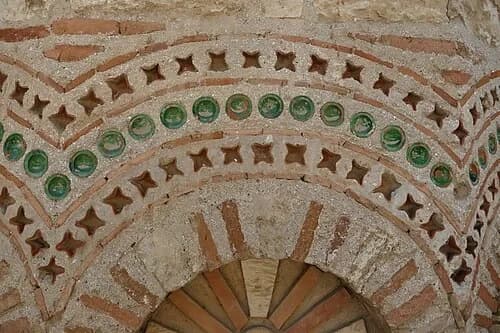
Ceramic Quatrefoil Details
The intricate details on these walls are composed of thousands of tiny, hand-pressed clay inserts in the shapes of stars and quatrefoils. Before they were placed into the wet mortar, medieval potters fired and glazed these pieces, often in a vivid green hue. This specific decorative technique is almost entirely unique to the Black Sea coast and reaches its peak here in Nessebar. Rather than treating a wall as a flat surface for plaster, the masons here acted more like mosaic artists, considering every square inch as a space for ornament. The stars and quatrefoils are arranged in precise rows, creating a texture that changes depending on where the sun is in the sky. This level of detail required a high degree of coordination between the potters and the masons, showing that church construction was a massive community endeavor involving many specialized guilds. These tiny inserts were more than just decoration; they were a way of making the building feel alive and vibrant, even from a distance. The consistency of the shapes suggests the use of wooden molds, while the slight variations in the green glaze show the hand of the individual craftsman. It is this combination of industrial repetition and artistic flair that gives the city's ruins their distinctive, tactile character, surviving centuries of weathering with their colors still intact.
Want to hear the rest?
Download the Stanza app to unlock all 35 stops and the complete guided audio tour.
Frequently Asked Questions
How long does the Ancient City of Nessebar audio tour take?
The Ancient City of Nessebar audio guide includes 35 narrated stops. Most visitors spend 45 minutes to 1.5 hours exploring the complete tour, though you can listen at your own pace and skip or revisit any stop.
Is the Ancient City of Nessebar audio guide available in my language?
Stanza supports 15 languages: English, Spanish, French, German, Italian, Portuguese, Russian, Japanese, Chinese, Korean, Arabic, Hindi, Polish, Dutch, Hebrew. Check the guide in the app to confirm the languages currently available for this tour.
Can I use the audio guide offline at Ancient City of Nessebar?
Yes! Download the complete Ancient City of Nessebar tour — including all audio, maps, and images — before your visit. The Stanza app works completely offline, so you don't need WiFi or mobile data at the venue.
How much does the Ancient City of Nessebar audio guide cost?
The Stanza app is free to download. The current listed price for the Ancient City of Nessebar audio guide is $3.99; app-store region and currency may affect the final price.
How do I use the Stanza audio guide at Ancient City of Nessebar?
Download the free Stanza app, search for "Ancient City of Nessebar", and download the tour. When you arrive at the venue, the app uses GPS to detect your location and automatically plays the relevant narration as you move between points of interest — completely hands-free.
What makes the Stanza audio guide different from other Ancient City of Nessebar tours?
Stanza offers GPS-triggered narration that plays automatically as you walk through Ancient City of Nessebar — no need to manually select stops. The tour is available in 15 languages, works fully offline, and includes 35 expertly narrated stops with images and historical context.
What other audio guides are available near Ancient City of Nessebar?
Stanza offers multiple audio guides in Nesebar, Bulgaria and nearby areas. After downloading the app, browse the map to discover all available tours near Ancient City of Nessebar. Each guide can be downloaded for offline use.