Stanza · Audio guide
Karahantepe Audio Guide
A place to remember. A story to take with you.
Karahan Tepe is a Pre-Pottery Neolithic archaeological site located in Turkey. It is considered a significant site that may be the earliest known human village, dating back to between 10,000 and 9500 BC.
Download Stanza, then search for “Karahantepe”.
About the tour
One guide. Your kind of visit.
Karahan Tepe is a Pre-Pottery Neolithic archaeological site located in Turkey. It is considered a significant site that may be the earliest known human village, dating back to between 10,000 and 9500 BC.
Ready when you are.
- 01Get the free Stanza app.
iOS & Android
- 02Find your guide.
“Karahantepe”
- 03Download before you go.
Works offline
Audio guide / 10 narrated stops
Inside the guide
Get to know a few of the stories before you go. Open a stop to read more.
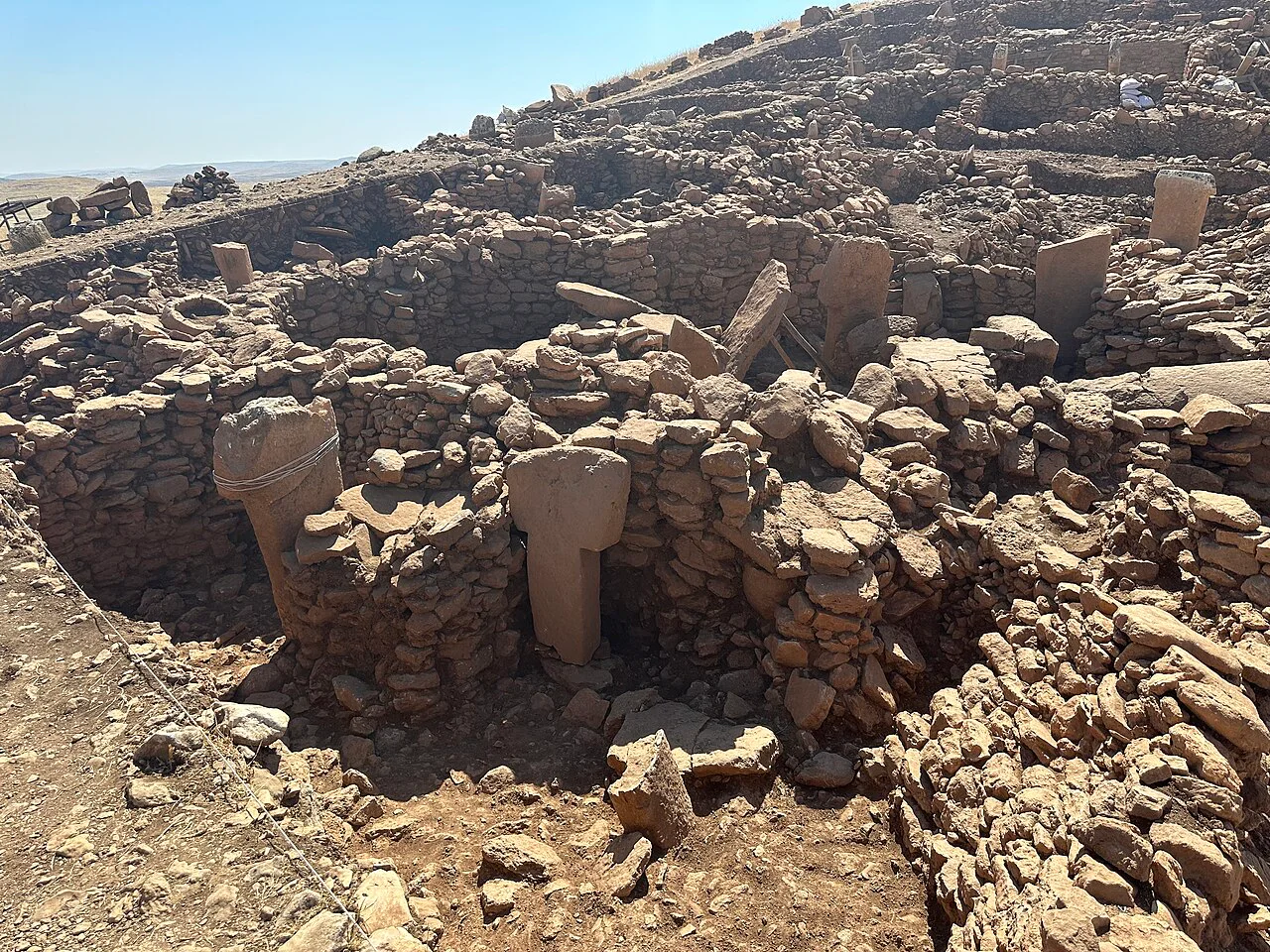
01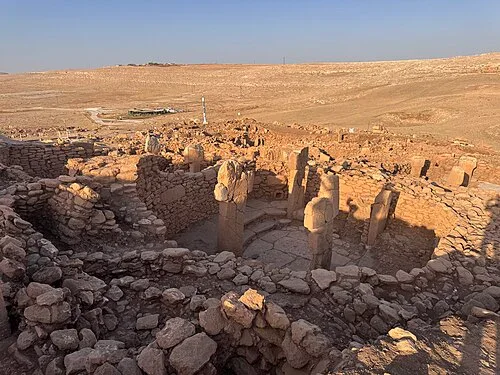 Hilltop Arrival and the Central Megalithic Enclosure
Karahantepe: Arrival on the Hilltop
Welcome to Karahantepe, a stone hilltop in the Tek Tek Mountains of southern Turkey. Local people have long known this rise as Keçilitepe. Its story begins almost twelve thousand years ago, when people with no pottery and no farming built a great sanctuary here. They started around 9750 BCE, and left a few centuries later. What they made was a settlement of enclosures, standing pillars and carved sculptures, raised by communities who still lived by hunting and gathering. The archaeologist Bahattin Çelik identified the site in 1997. It lies east of Göbekli Tepe, and the two are often called sister sites. Karahantepe belongs to a wider group of about a dozen similar places, known as Taş Tepeler, the Stone Hills. The site covers nearly ten hectares, and only a small part of it has been dug so far. Most of what these people built still waits under the ground.
tobeytravels · CC BY-SA 4.0
02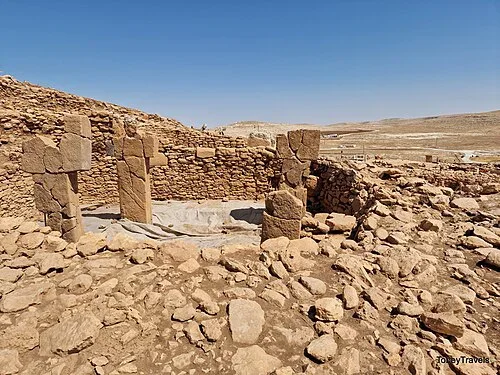 Hilltop Arrival and the Central Megalithic Enclosure
The Enclosure of T-Shaped Pillars
The signature of Karahantepe is the T-shaped pillar. More than 266 of these monoliths had been counted across the site by the year 2000. The same form appears at Göbekli Tepe and at other sanctuaries of the region, one reason archaeologists treat them as related. Each pillar was quarried from the local rock, shaped, and raised upright. The builders had no metal tools, no draught animals and no wheel. Moving a pillar of many tonnes meant muscle, ropes and levers, and a workforce that had to be fed and organised. Researchers are still studying how that work was arranged. Systematic excavation of these special structures only began in 2019, so much of the answer is still in the ground.
tobeytravels · CC BY-SA 4.0
03 Structure AB: The Subterranean Ritual Sanctuary
Structure AB: The Subterranean Pillar Shrine
Cut into the living bedrock here is Structure AB, the most enigmatic space at Karahantepe. It was not built up from stones, but hollowed out of the hill itself. Upright pillars rise from the chamber floor, carved in a phallic form. A human head projects from the rock wall, and a porthole-like opening leads through toward Structure AD. Archaeologists read the place as a space for ritual, though what happened inside is unknown. What is known is how it survived. At some point, the people who used these chambers filled them with dirt and rubble. That ancient backfilling packed the carved walls and pillars in place, keeping them intact for eleven thousand years until the excavators reached them.
Listen in the apptobeytravels · CC BY-SA 4.0
04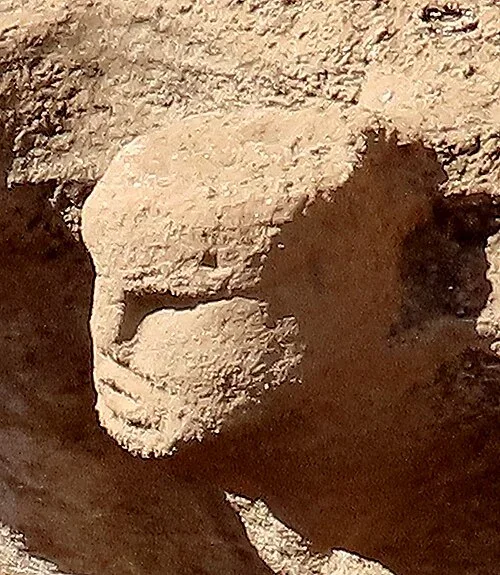 Structure AB: The Subterranean Ritual Sanctuary
The Face in the Bedrock
A human face looks out from the wall of the chamber. The brows, nose and mouth are strongly modelled, and the features are unmistakably those of a person. What makes it remarkable is the material. This head was not carved separately and set in place. It is the bedrock itself, shaped where it stood, so the face and the chamber are one stone. It emerges from the wall, facing the pillars. The head is that of a man, but after more than eleven thousand years no one can say why it was placed here. The makers left no explanation, and the carving keeps its secret.
Listen in the appTobey Travel · CC BY-SA 4.0
05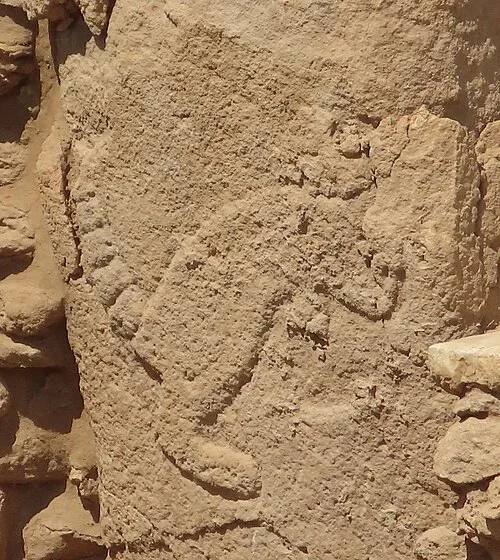 Structure AD: Symbolism and Animal Reliefs
Animal Carvings of Structure AD
Carved in low relief on this pillar is an animal, moving low to the ground with a long tail behind it. The identification is not certain, but it looks much like a fox. Animals dominate the carved imagery of these early sanctuaries. Foxes, vultures, snakes and other creatures appear again and again, at Karahantepe and at Göbekli Tepe and related sites. Humans are rare in this repertoire, at least in the reliefs. The people who made these images lived alongside wild animals, hunted them, and gave them a central place in their art. What each creature meant to them is hard to recover now. Karahantepe stands out from its neighbours in one way, its human figures.
Listen in the appTobey Travel · CC BY-SA 4.0
06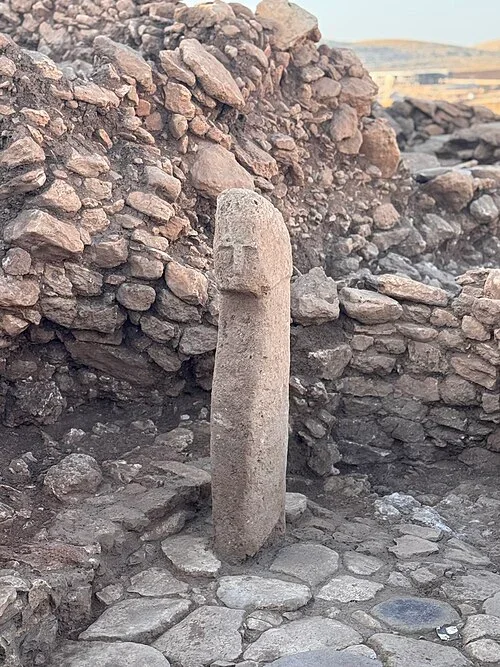 Structure AD: Symbolism and Animal Reliefs
A Pillar with a Face
Some pillars at Karahantepe carry a face. This small T-shaped carving has stylised features at its head, and it points to an idea archaeologists discuss widely. The T-shape itself may not be abstract. In this reading, the two arms of the T are shoulders, and the stone below is a body, so every great pillar in the enclosures is a being of some kind. The face markings at the top support the thought. It would fit a world where the boundary between stone, person and animal was drawn differently than today.
Listen in the appPhoto: Campels · CC BY-SA 4.0
07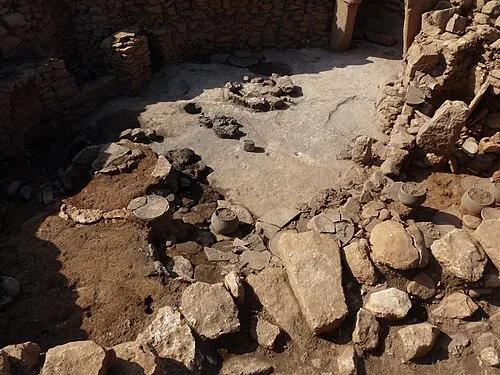 Domestic Quarters and Daily Prehistoric Life
Inside the Ongoing Excavation
Karahantepe is not only a sanctuary. It is a settlement, and it is still being dug. By 2023, around five percent of the site's surface had been investigated. The quarries where pillars were cut add another five hectares. So the hilltop holds years of work ahead. The surfaces in this open trench are ordinary ones, beaten floors and settings of stone rather than monuments. They show that everyday life went on beside the great enclosures. This is the edge of the change archaeologists call the transition to village life, when people who had moved with the seasons began to stay. The monuments and the houses belong to the same moment.
Listen in the appFrantisek Trampota · Public domain
08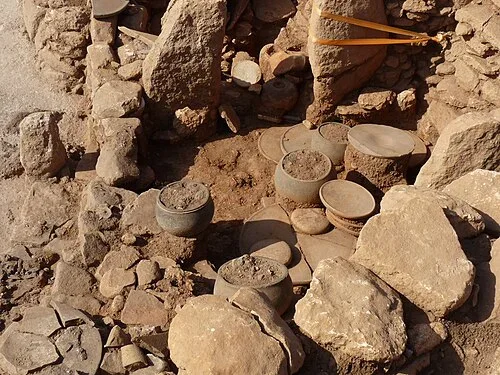 Domestic Quarters and Daily Prehistoric Life
Stone Vessels and the Table of the First Villagers
These bowls and plates were found where they had been left, on the floors of the settlement. They are stone, because the people of Karahantepe lived before pottery existed. Containers had to be chipped and ground out of stone, and that is what these are. They served whatever daily life required, food prepared, stored, and eaten. The remains recovered from the site point to a clear diet. Gazelles provided the meat, and legumes supplied much of the rest.
Listen in the appFrantisek Trampota · Public domain
09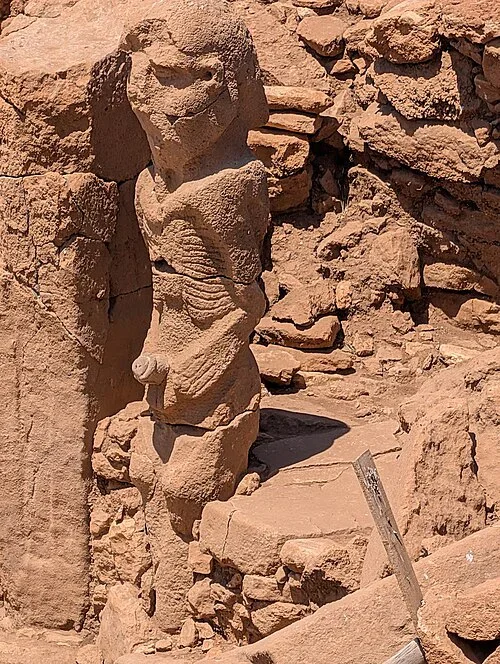 The Master Sculptures and Legacy
The Seated Man: A Monumental Human Figure
In September 2023, Turkish and German experts uncovered a giant human figure. The figure is a naked man, about 2.3 metres tall, and he is probably depicted as sitting, holding his phallus with both hands. A V-shaped collar marks his neck, and deep incised lines pick out his ribs and fingers. The pose and details are broadly similar to Urfa Man, a statue found near the city of Şanlıurfa in 1993, during construction work. That figure stands about 1.8 metres tall. Two sites, two statues, one shared convention. The agreement across the region shows these communities were not isolated. They exchanged ideas, or drew on a common tradition, in the art of the human body.
Listen in the appKarahan Tepe anthropomorphic seated statue in situ · Public domain
10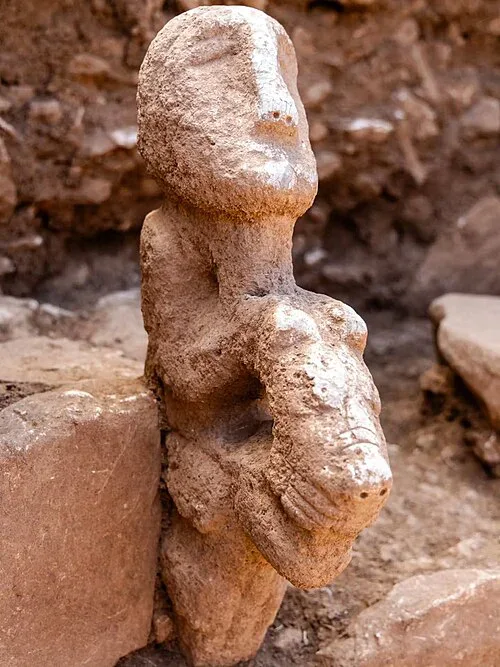 The Master Sculptures and Legacy
Carrying the Leopard: What Karahantepe Leaves Us
One of the most astonishing sculptures from Karahantepe shows a human with a leopard on their back. The figure holds or carries the animal, and the two are carved as one composition. Images of such direct contact between a person and a wild animal are very rare from the Pre-Pottery Neolithic, which is why this piece caused such interest. It came to light during the recent excavations, and it is now displayed at the Şanlıurfa Museum, together with other finds from the site. A leopard on a human back resists easy reading. It might mean protection, danger tamed, or a bond of some other kind, and the makers did not explain. Karahantepe still keeps most of itself underground. What has come to light already shows symbolic culture, cooperation and art fully formed at the very beginning of settled life.
Listen in the appUnknown author · Public domain
Karahantepe
Frequently asked questions
How much does the guide cost?
Free app download. Listed guide price: $0.99. Guide price shown in the app. Audio guide only. Venue admission is separate.
Can I listen without internet?
Yes. Download the guide’s audio, images, and maps in the app before your visit. Your downloaded content is then available offline.
Can I listen in my language?
This audio guide is available in 15 languages, including English.
Do I need to follow a schedule?
No. This is a self-guided experience. Choose your stops, pause whenever you like, and return to a story at your own pace.
At your own pace
Explore Karahantepe.
Download Stanza, then search for “Karahantepe”.
Free app download · Guide price shown in the app
Keep exploring
Audio guides — Turkey
Haliliye · 37 km
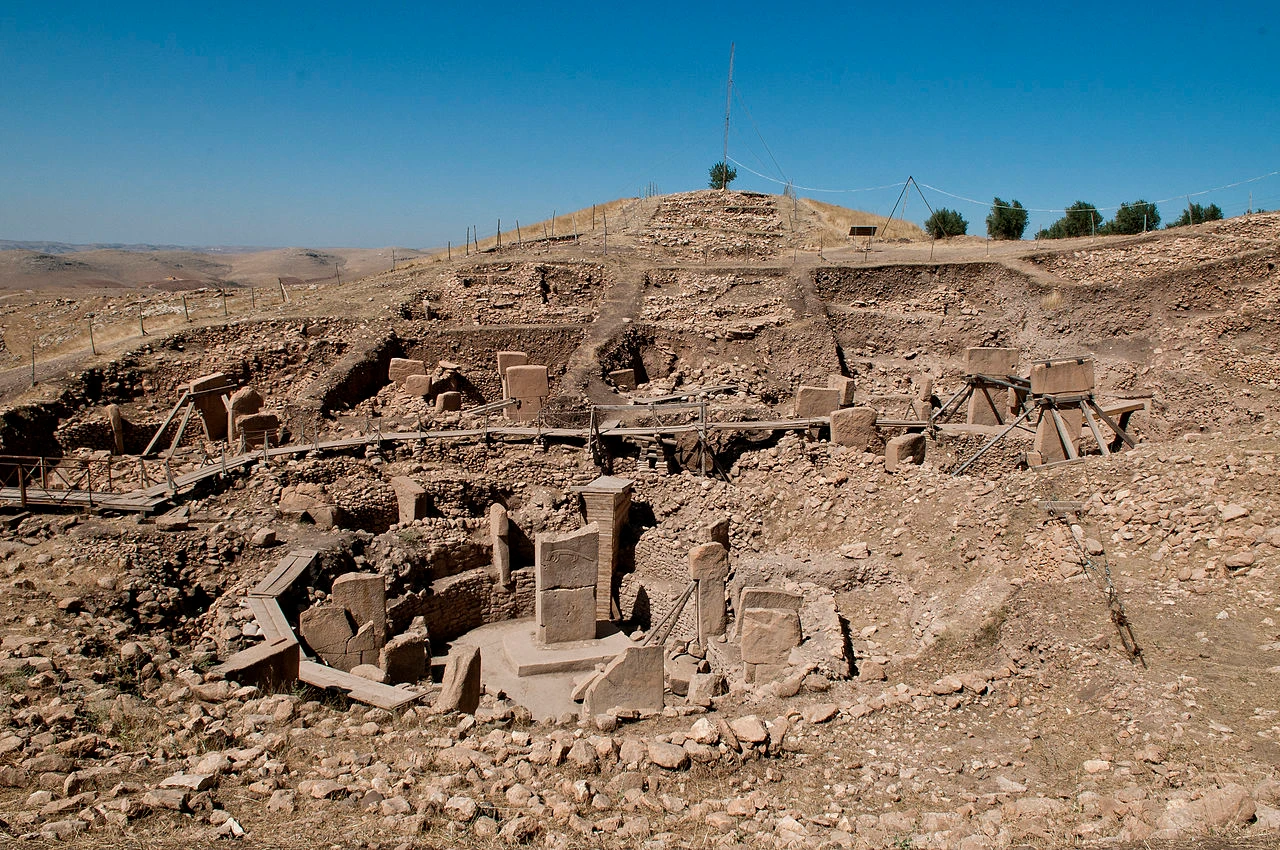
Göbekli Tepe
Content & sources
Photo: Teomancimit · CC BY-SA 3.0
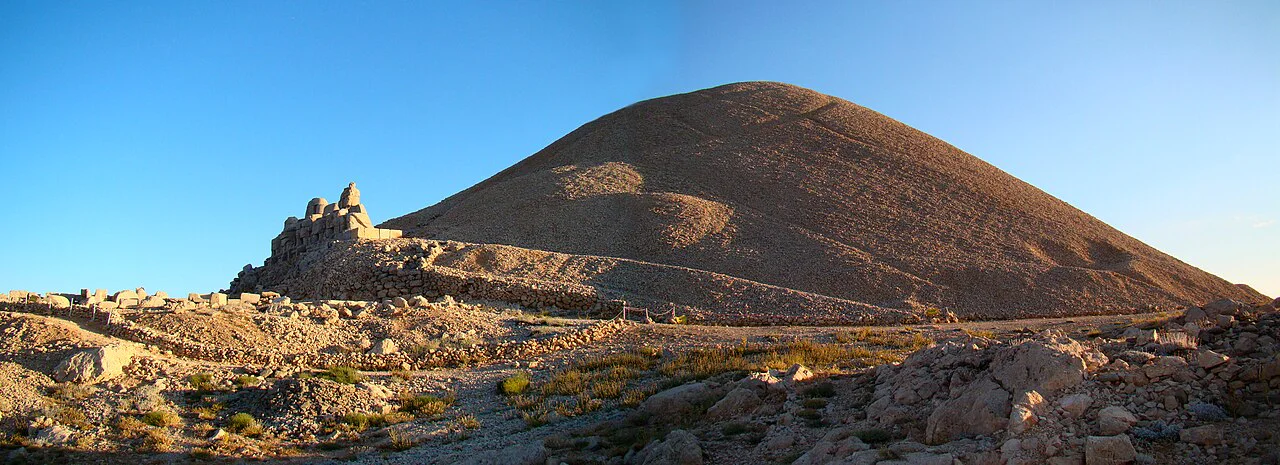
Kâhta · 111 km
Nemrut Dağı
Content & sources
Bjørn Christian Tørrissen · CC BY-SA 3.0
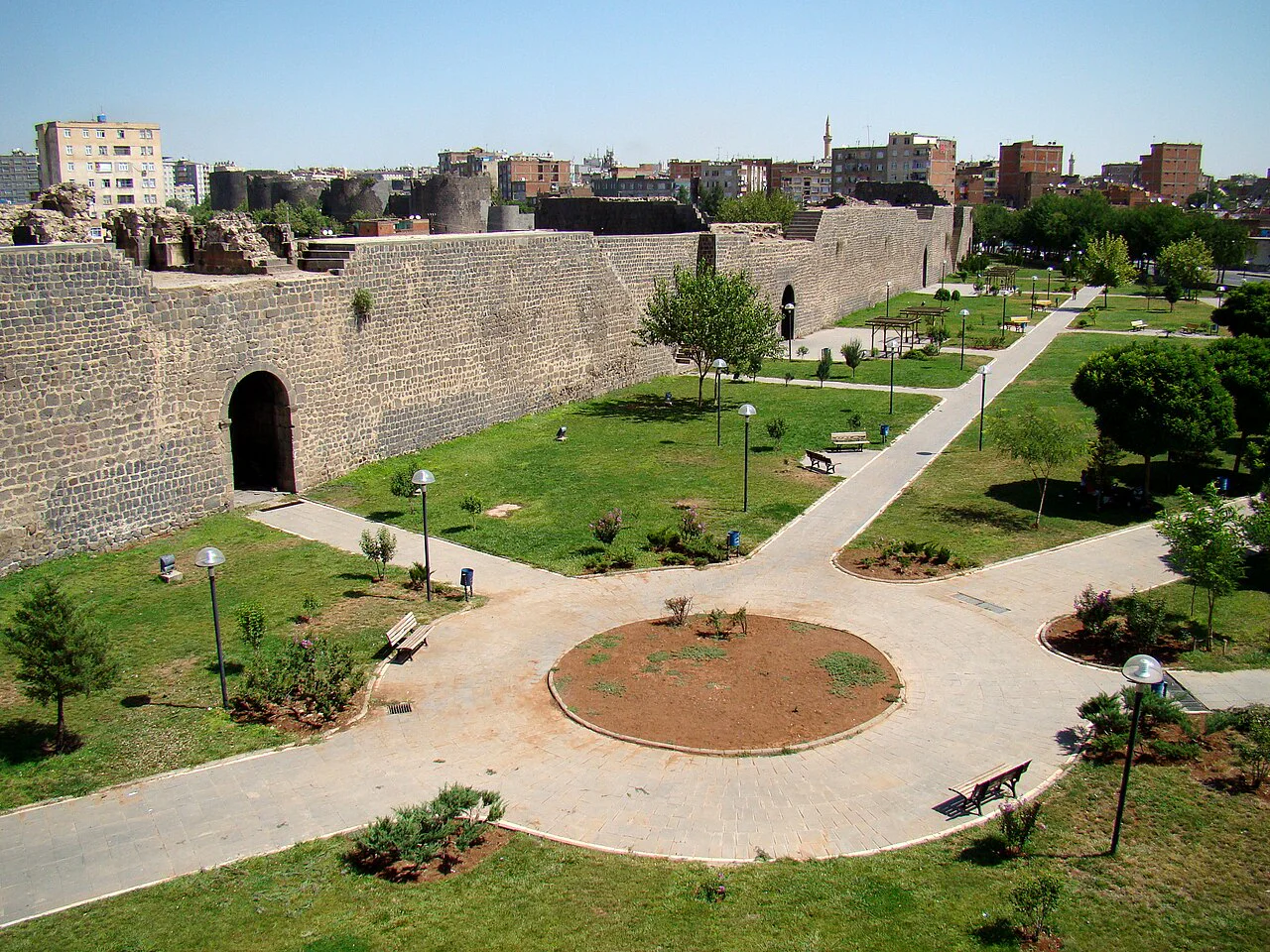
Diyarbakır · 122 km
Diyarbakır Kalesi
Content & sources
Bjørn Christian Tørrissen · CC BY-SA 3.0
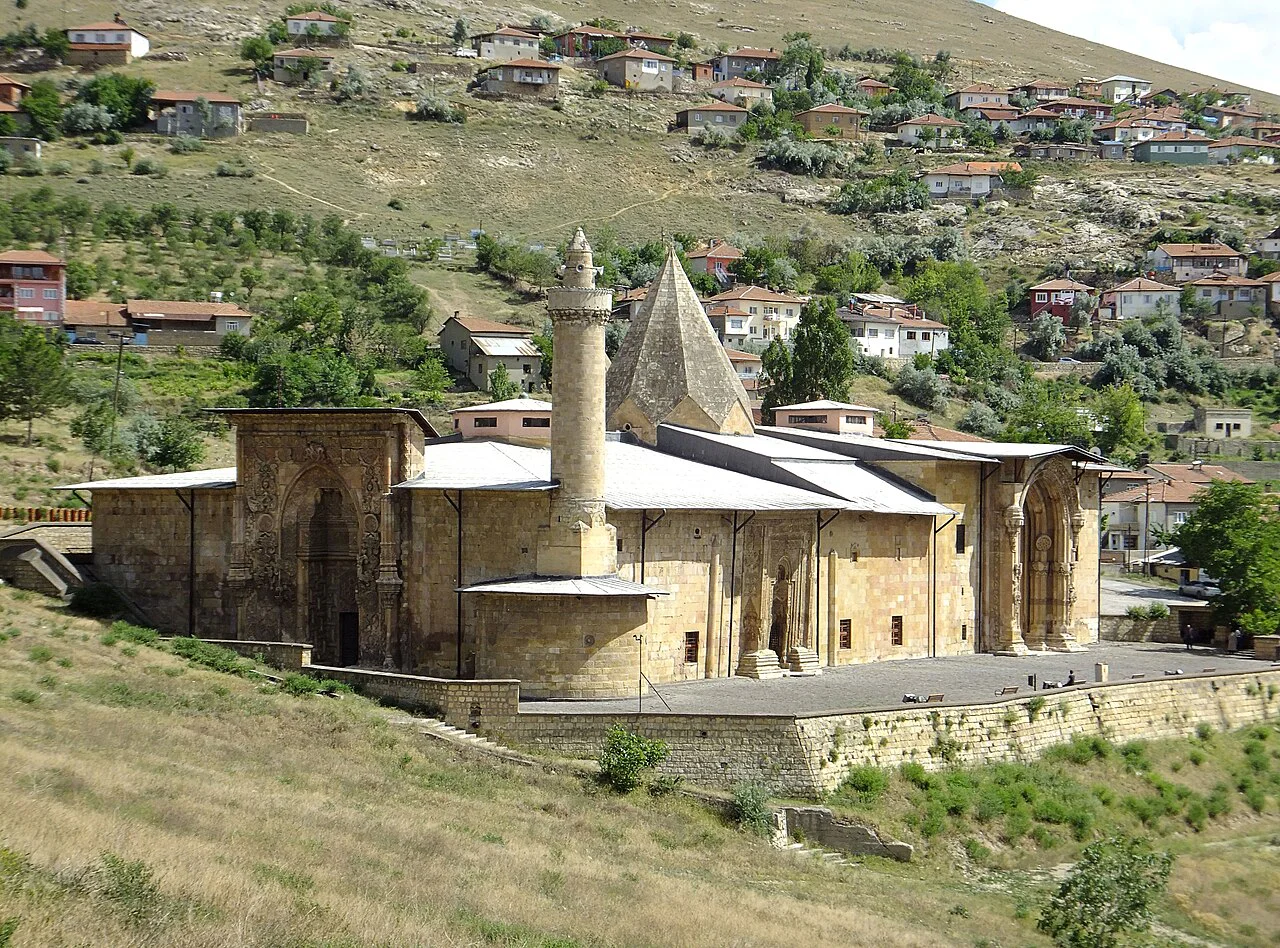
Divriği
Divriği Ulu Camii ve Darüşşifası
Content & sources
Photo: R Prazeres · CC BY-SA 4.0