Stanza · Audio guide
Sümela Manastırı Audio Guide
A place to remember. A story to take with you.
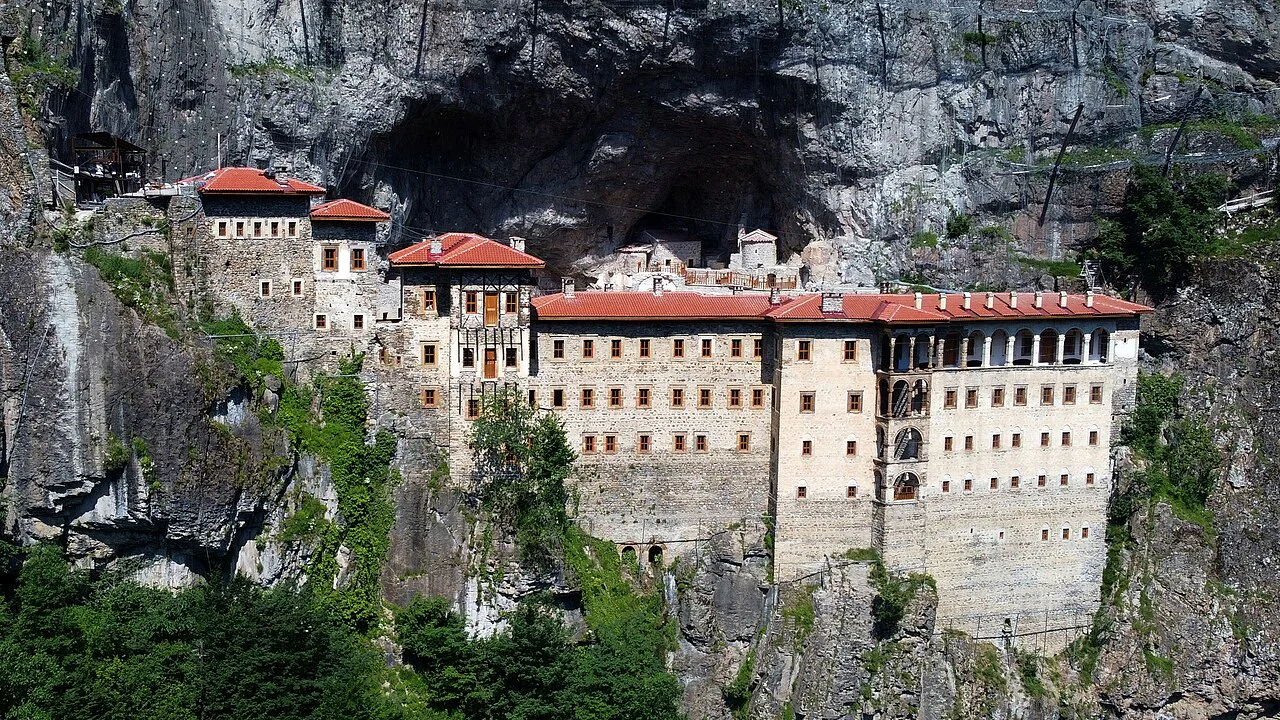
Sumela Monastery is a museum and former Greek Orthodox monastery located in the Pontic Mountains of Turkey. It dates back to ancient times and remained in use until the Greco-Turkish population exchange in…
Download Stanza, then search for “Sümela Manastırı”.
About the tour
One guide. Your kind of visit.
Sumela Monastery is a museum and former Greek Orthodox monastery located in the Pontic Mountains of Turkey. It dates back to ancient times and remained in use until the Greco-Turkish population exchange in 1923.
Ready when you are.
- 01Get the free Stanza app.
iOS & Android
- 02Find your guide.
“Sümela Manastırı”
- 03Download before you go.
Works offline
Audio guide / 13 narrated stops
Inside the guide
Get to know a few of the stories before you go. Open a stop to read more.
01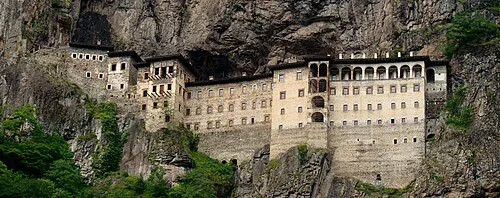 Cliffside Approach and the Aqueduct
Sumela Monastery from the Altindere Valley
Welcome to Sumela, one of the most improbably placed monasteries in the world. It hangs on a ledge of Mount Mela, about three hundred metres above the floor of the Altindere valley, at roughly twelve hundred metres above the sea. The buildings in this view are a Greek Orthodox monastery complex, in use from late antiquity until 1923, in the Pontic Mountains of northern Turkey. Monks chose a perch like this for two reasons. It offered the isolation an ascetic life demanded, and it was almost impossible to attack. Over some fifteen centuries the community kept adding to it, until the whole thing became a fortified monastic village of chapels, kitchens, guest rooms and a library, all balanced on one shelf of rock. Even the name has two explanations. In Pontic Greek it may mean simply on Melas, on this dark mountain. Or it may come from a Laz word for the Trinity. Keep this view in mind. Everything ahead, the gate, the courtyard, the cave church, the spring, is stacked on that single ledge.
Photo: Jaba1977 · Attribution
02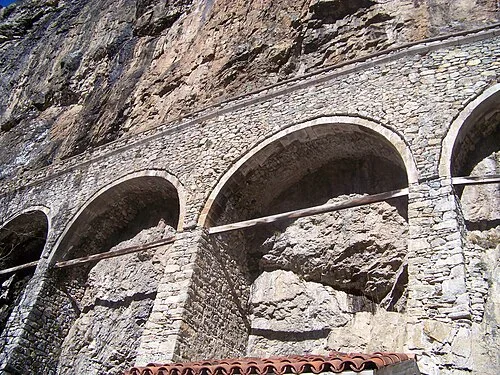 Cliffside Approach and the Aqueduct
The Cliffside Aqueduct
Water was the hardest problem on this cliff. A monastery perched three hundred metres above the valley could not simply send someone down with buckets every day, and in a siege the supply had to hold. The answer runs right against the rock here, a large aqueduct built into the face of the cliff, carrying water to the entrance of the monastery. Its line of tall stone arches is the first great piece of engineering a visitor meets. Most of the arches have been restored over the years, so what stands now is a careful patching of old and new masonry. The path to the monastery passes directly beneath these arches before the final climb, which is no accident. Think of it as the lifeline of the whole ledge, built to keep a hidden community alive in peace and under attack alike.
Listen in the appPhoto: Jaba1977 · Attribution
03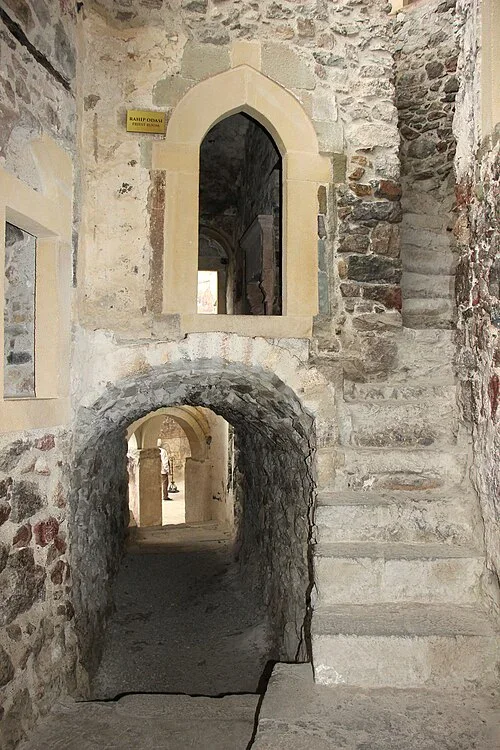 Fortified Gatehouse and Entrance Passage
Entrance Passage and Stairway
A refuge is only as good as its door. The monastery was reached by a long and narrow stairway climbing to the entrance, and this vaulted passage with its arched openings was part of that single gateway. Beside the entrance stood a guard-room, where watch could be kept on everyone coming up. From there, stairs lead down into the inner courtyard, so even the arrival route folded visitors through a choke point. The logic is simple and severe. One way in, easily watched, easily held. The masonry tells its own story too. Arches of different stone and different ages sit patched against each other, the work of centuries of rebuilding. Whoever wanted to reach the church above had to climb, queue, and pass the guard.
Listen in the appFrancesco Bini · CC BY-SA 4.0
04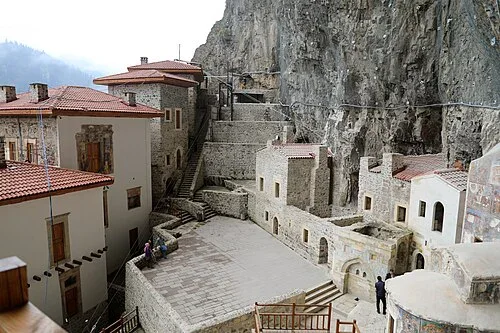 The Inner Central Courtyard
This courtyard terrace is where the monastery's golden age shows itself. Sumela rose to prominence under the Empire of Trebizond, the Greek state that ruled this Black Sea coast after Constantinople fell to the Crusaders. Emperors Basil and John the Second had already endowed it richly. But the decisive patron was Alexios the Third, who reigned from 1349 to 1390. The story goes that the young Alexios was saved from a storm at sea by the Mother of God, and that she told him to restore her monastery on Mount Mela. Whatever happened in the storm, the reward is on record. A chrysobull, an imperial charter, dated to 1365 confirms the monastery's freedom and autonomy with all its hereditary lands. It exempted the monastery from every tax except one due twice a year, and even the serfs who settled on its land were freed of dues, forty of them listed by name. The monastery also received an annual grant from imperial funds, and later emperors kept the money flowing. This courtyard, framed by the rock overhang and stacked with buildings, is what centuries of imperial generosity look like.
Listen in the appFrancesco Bini · CC BY-SA 4.0
05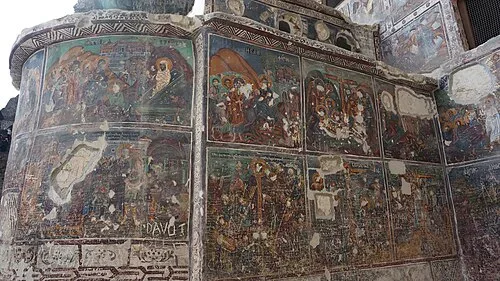 The Exterior Murals of the Rock Church
Exterior Frescoes of the Rock Church
The Rock Church wears its story on the outside. Its inner and outer walls, and the walls of the adjacent chapel, are covered in frescoes, and the main subjects are biblical scenes telling the story of Jesus and the Virgin Mary. For pilgrims arriving in the courtyard, these exterior panels worked like an open-air book, the sacred narrative readable before anyone stepped inside. The painting here spans multiple centuries, laid on in different campaigns, which is why some panels still glow with strong colour while others have faded to ghosts. And the damage is part of the honest picture. The frescoes of the monastery have been seriously damaged by vandalism over the years, with graffiti, smoke and losses scarring figures that were once vivid. One panel nearby deserves a closer reading, an assembly of haloed figures that turns out to be a famous council of the early Church.
Listen in the appBen Bender · CC BY-SA 3.0
06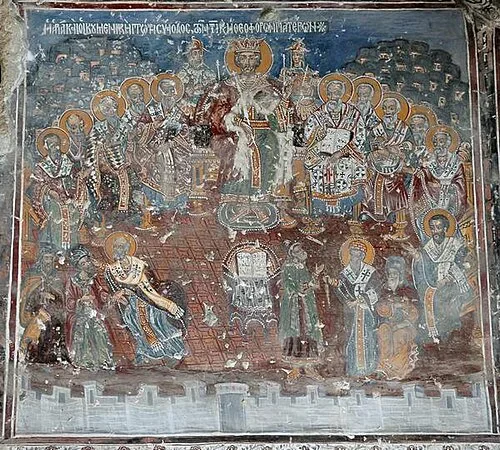 The Exterior Murals of the Rock Church
Fresco of the Council of Nicaea
Here is how to read a Sumela fresco. This panel shows a great assembly of haloed bishops, arranged in ranks around a central figure, with an emperor among them. It depicts the First Council of Nicaea, the gathering that defined core Christian doctrine in the early fourth century. A Greek inscription runs across the top of the panel, naming the scene for those who could read it. Painting church councils on monastery walls was a statement. It proclaimed that this community stood with orthodoxy, and that learning mattered here as much as prayer. The panel is weathered now, its colours dulled and its surface worn, but the composition still reads clearly, bishop after bishop in procession around the throne. No date or painter is recorded for this specific panel, so it simply joins the long conversation of images covering these walls.
Listen in the appUnknown author · Public domain
07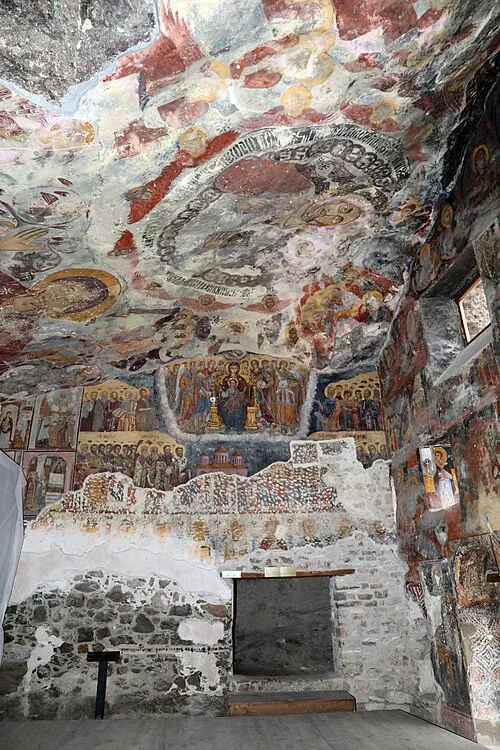 Inside the Rock Church Cave Sanctuary
Everything at Sumela grew around this cave. A natural cavity in the cliff, converted into a church, it is the centre of the whole monastery. The oldest architecture here is the rock itself, blackened by centuries of lamps and smoke. The Turkish Ministry of Culture and Tourism dates the founding to around the year 386, in the reign of the emperor Theodosius the First. How it began is told as legend. Two Athenian monks, Barnabas and Sophronios, each dreamed the same dream, of an icon of the Virgin Mary holding the infant Christ, hidden in a cave on this mountain. The icon was said to have been painted by the Apostle Luke himself. Travelling independently, the two monks met at Trabzon, compared their dreams, climbed the cliff and founded the first sanctuary here. The icon was known as the Panagia Gorgoepekoos and made the monastery famous. Inside the cave, frescoes from the era of Alexios the Third line the inner wall facing the courtyard, imperial painting wrapped around the humble hollow where the story started.
Listen in the appFrancesco Bini · CC BY-SA 4.0
08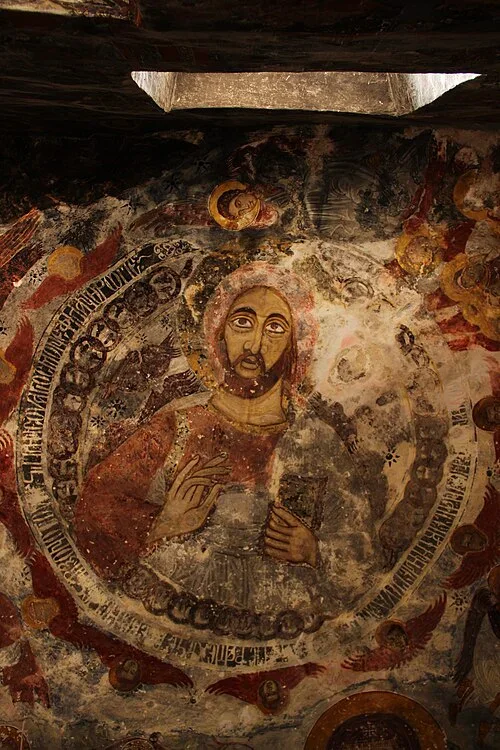 Inside the Rock Church Cave Sanctuary
Christ Pantocrator Fresco
These walls were painted more than once. Scholars have identified three distinct layers of frescoes here, one laid over another as the centuries passed, and the visible top layer dates mainly from the eighteenth century. This fresco shows what the final layer produced, Christ as Pantocrator, the almighty ruler of all, set within a great medallion ringed with writing and angelic wings. It is a commanding image, the classic figure of Orthodox church decoration, one hand raised in blessing, the other holding the book. Smoke and age darken the rock around it, so the face emerges out of blackness, which gives it a power the original painters could not have planned. Underneath this Christ lie two older paintings, hidden but still there, the monastery repainting its own soul every few centuries.
Listen in the appHamdigumus · CC0
09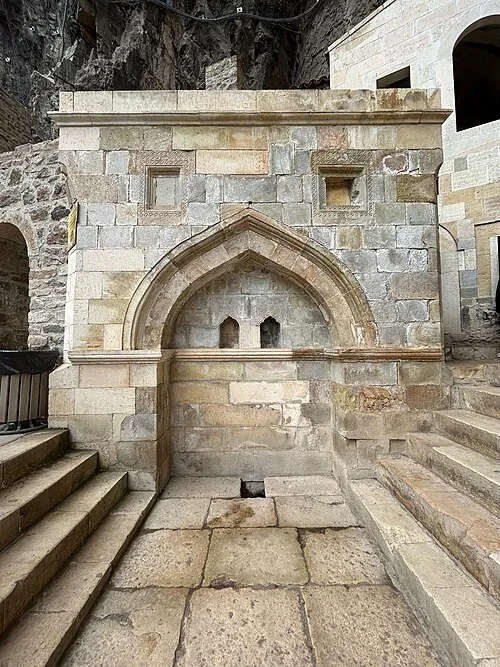 The Sacred Spring Cistern
The Sacred Spring (Ayazma)
Water made this monastery holy as well as alive. Within the complex is a sacred spring, revered by Eastern Orthodox Christians, its water dripping from the cave and gathered in a stone basin. For centuries it was honoured as holy and curative by Christian and Muslim pilgrims alike, and that shared devotion says a great deal about this place. That shared devotion was protected from above. When Sultan Mehmed the Second conquered Trebizond in 1461, he granted the monastery his protection and renewed its rights and privileges, and later sultans confirmed them in their own firmans. Selim the First had a special bond with this coast, having spent his youth as prince-governor of Trabzon, and he presented two large candelabras to the Rock Church. So the monastery passed from one empire to the next without losing its standing, a Christian sanctuary honoured under Ottoman rule.
Listen in the appPhoto: Rəcəb Yaxşı · CC BY-SA 4.0
10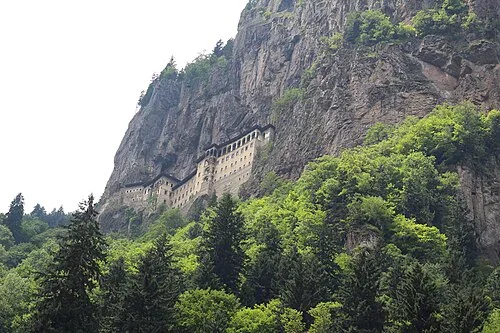 Monks' Cells and 1840 Residential Wing
The 1840 Residential Wing from the Cliffside
The long facade you see here is the monastery's most prominent frontage, and it is surprisingly late. This large multi-storey building, with its wooden balconies projecting over the cliff edge, dates from 1840. It housed the monks' cells and accommodation for guests, which tells you the community was still flourishing in the nineteenth century, long after the Byzantine emperors who first enriched it had vanished. Pilgrims kept climbing, and the monastery kept hosting them. In the great Orthodox monasteries of the tradition, a guest wing like this was standard practice, because hospitality to travellers and pilgrims was part of the monastic vocation itself. Picture the balconies on a feast day, crowded with visitors who had walked up from the valley, sleeping under the same roof as the brotherhood. The building was raised nearly fifteen centuries after the founding tradition, proof that the ledge was still worth building on.
Listen in the appPhoto: Valen1988 · CC BY-SA 4.0
- 11
Monks' Cells
Inside a monk's room: whitewashed stone, wall niches and iron lamps.
- 12
The Library Chamber
The library chamber and the famous Greek school that met here from 1682.
- 13
Aya Varvara Chapel and the Farewell View
The end of the story in 1923, a daughter monastery in Greece, and Sumela's return to life.
Sümela Manastırı
Frequently asked questions
How much does the guide cost?
Free app download. Listed guide price: $0.99. Guide price shown in the app. Audio guide only. Venue admission is separate.
Can I listen without internet?
Yes. Download the guide’s audio, images, and maps in the app before your visit. Your downloaded content is then available offline.
Can I listen in my language?
This audio guide is available in 15 languages, including English.
Do I need to follow a schedule?
No. This is a self-guided experience. Choose your stops, pause whenever you like, and return to a story at your own pace.
At your own pace
Explore Sümela Manastırı.
Download Stanza, then search for “Sümela Manastırı”.
Free app download · Guide price shown in the app
Keep exploring
Audio guides — Turkey
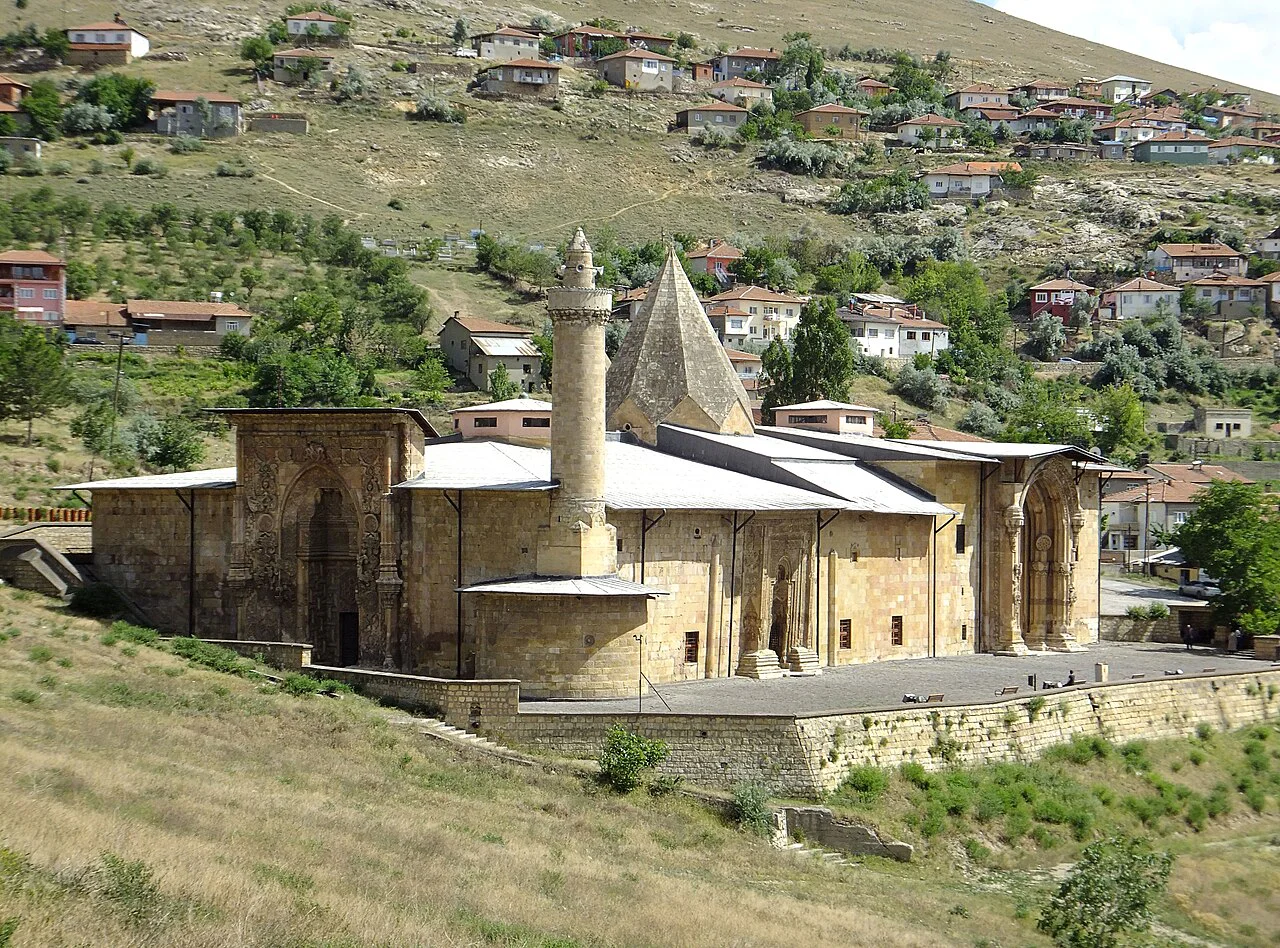
Divriği
Divriği Ulu Camii ve Darüşşifası
Content & sources
Photo: R Prazeres · CC BY-SA 4.0
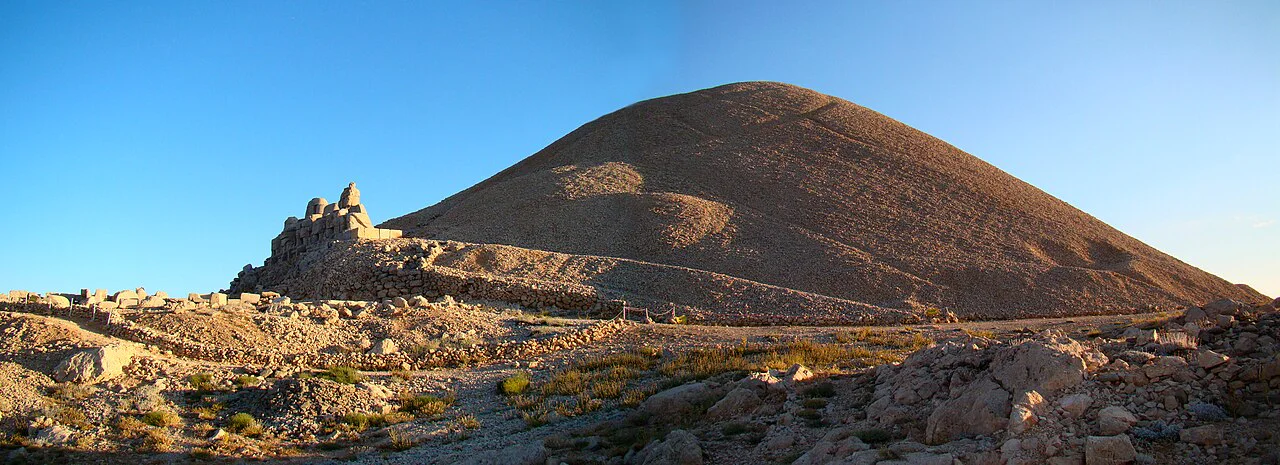
Kâhta
Nemrut Dağı
Content & sources
Bjørn Christian Tørrissen · CC BY-SA 3.0
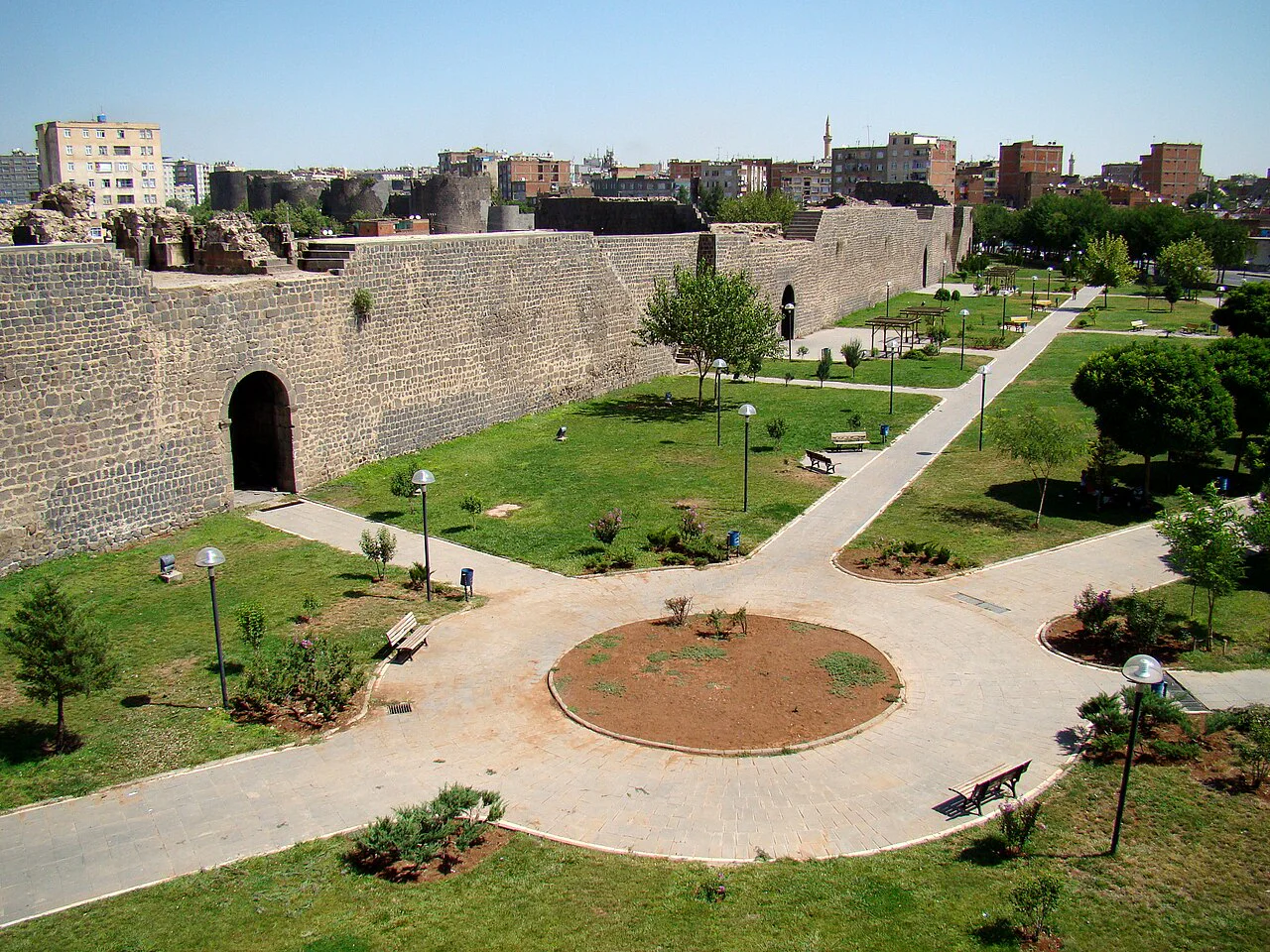
Diyarbakır
Diyarbakır Kalesi
Content & sources
Bjørn Christian Tørrissen · CC BY-SA 3.0
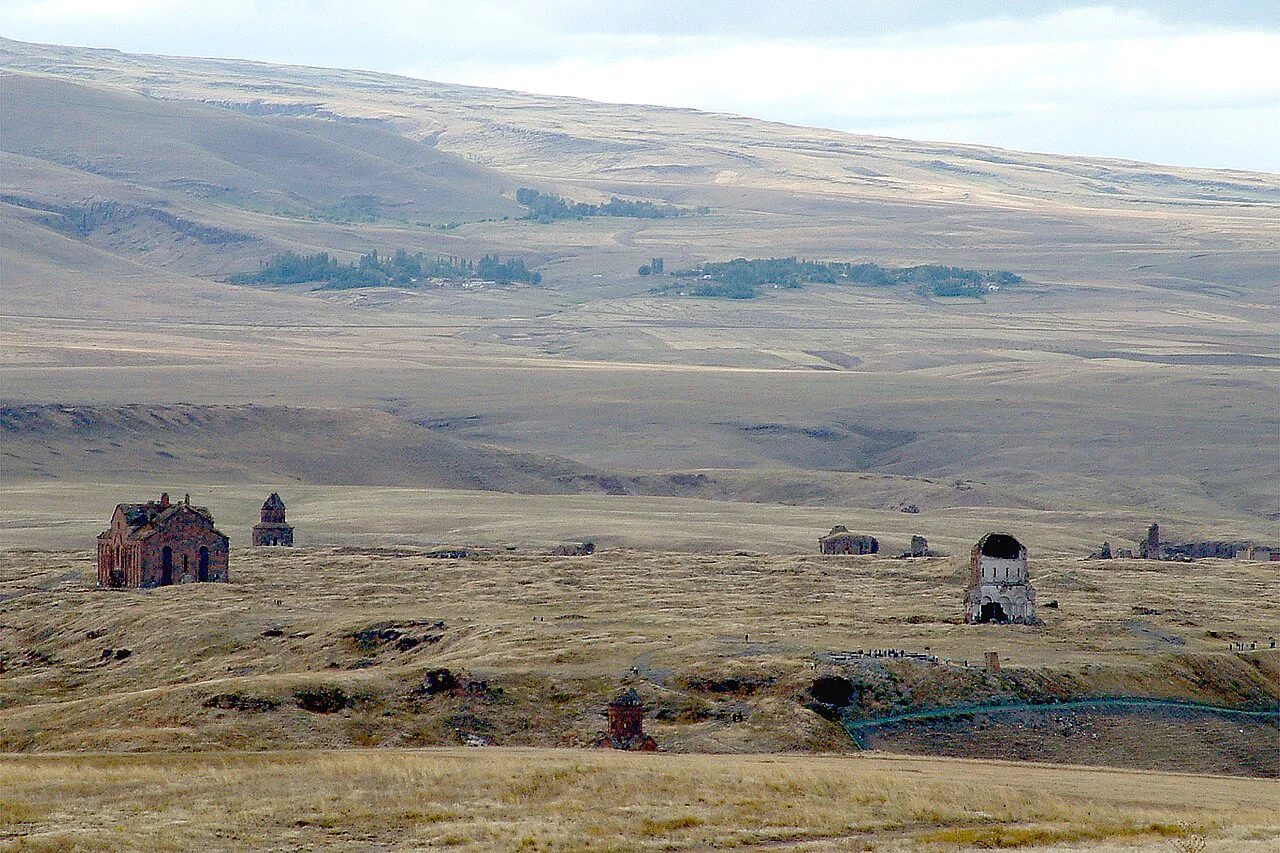
Kars
Ani
Content & sources
haigoes · CC BY-SA 3.0