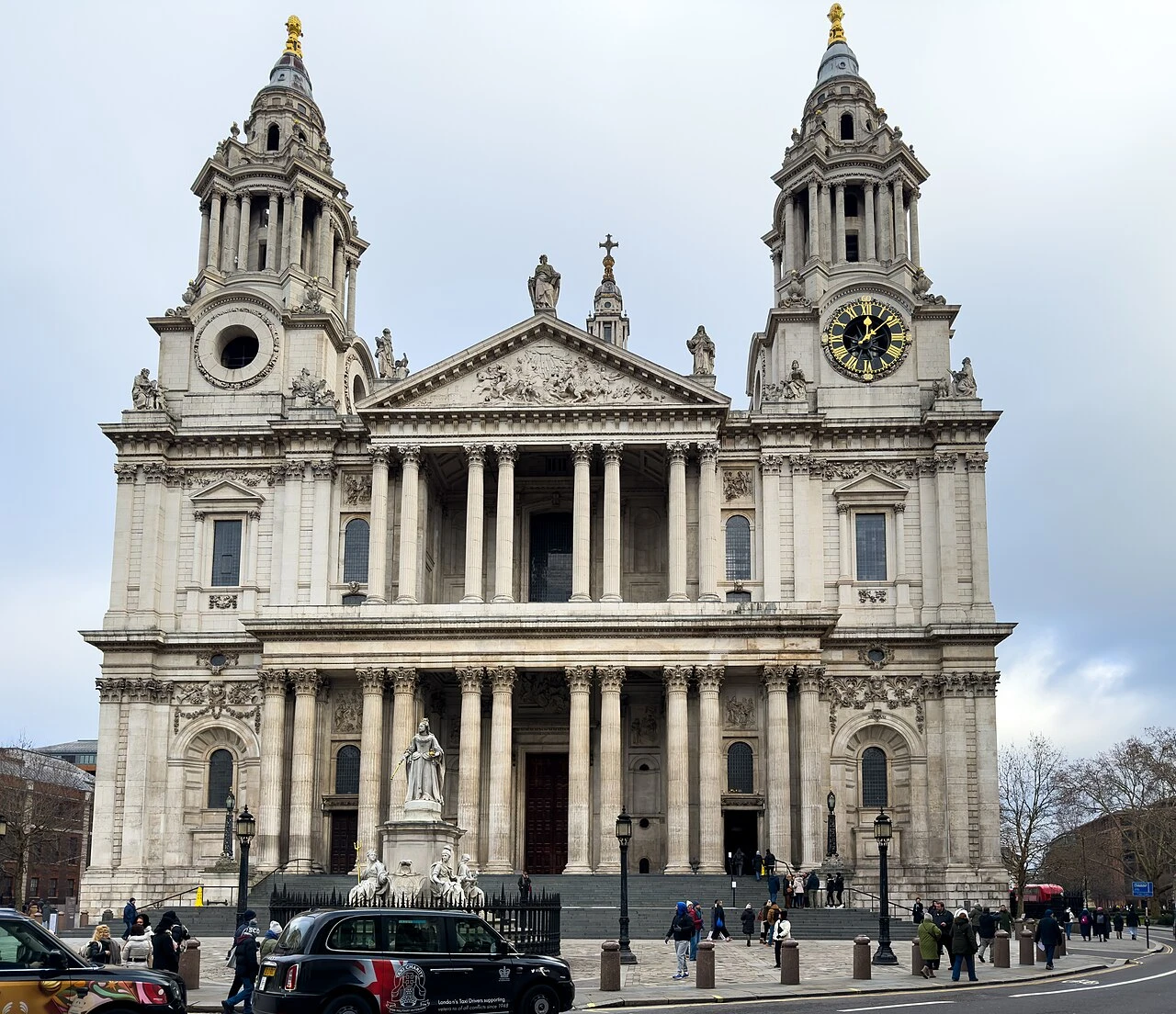
 Stanza / Audio guide
Content & sources
Stanza · Audio guide
St Paul's Cathedral Audio Guide
A place to remember. A story to take with you.
St Paul's Cathedral is an iconic Anglican cathedral in London, England. Designed by Sir Christopher Wren, it is a significant architectural masterpiece and a major tourist attraction.
Download Stanza, then search for “St Paul's Cathedral”.
About the tour
One guide. Your kind of visit.
St Paul's Cathedral is an iconic Anglican cathedral in London, England. Designed by Sir Christopher Wren, it is a significant architectural masterpiece and a major tourist attraction.
Ready when you are.
- 01Get the free Stanza app.
iOS & Android
- 02Find your guide.
“St Paul's Cathedral”
- 03Download before you go.
Works offline
Audio guide / 28 narrated stops
Inside the guide
Get to know a few of the stories before you go. Open a stop to read more.
01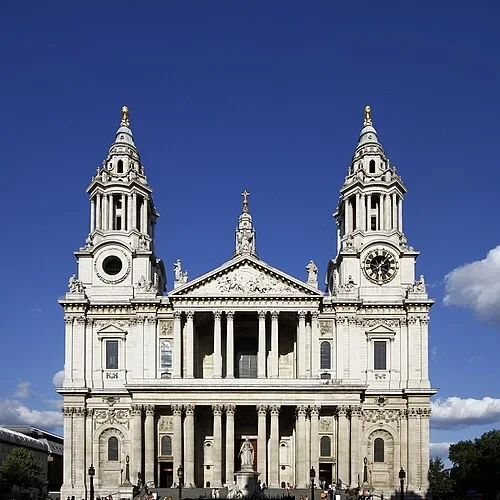 The West Front and Twin Towers
The West Front
Welcome to St Paul's Cathedral, an enduring icon of the London skyline and the crowning achievement of the architect Sir Christopher Wren. This site has been a center of worship for centuries, but the building you see today is the product of a massive reconstruction following the Great Fire of London. Built between 1675 and 1711, it represents the first cathedral built in England for the Anglican faith. As you look at the West Front, notice the grand Baroque facade. It features a magnificent double-story portico, which was a departure from the more traditional single-story entrances of the time. High above in the triangular pediment, you can see a detailed relief depicting the 'Conversion of St Paul,' the cathedral's namesake. One of the most remarkable facts about this structure is its height. From the pavement to the top of the cross, the cathedral stands exactly 365 feet tall. Wren chose this specific dimension to represent one foot for every day of the calendar year. This massive structure survived the aerial bombardments of the twentieth century, becoming a symbol of resilience for the city and the nation alike, standing firm while much of the surrounding neighborhood was leveled.
Photo: PierreSelim · CC0
02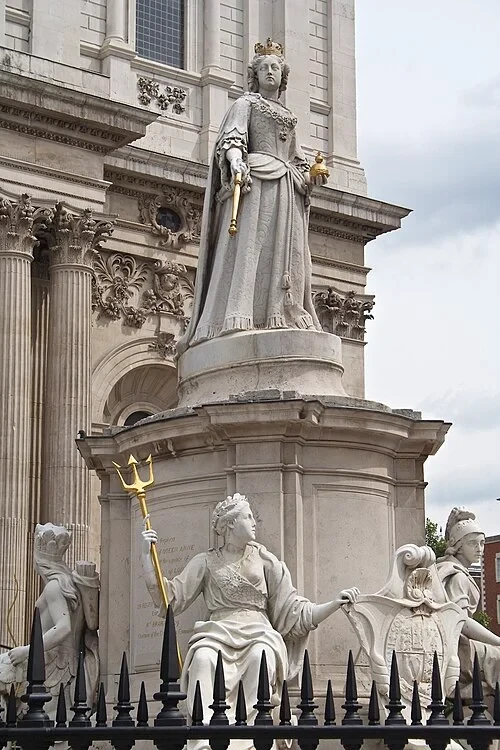 The West Front and Twin Towers
Statue of Queen Anne
Standing prominently before the entrance is the figure of Queen Anne, the monarch who reigned when this massive project was finally declared complete. While Sir Christopher Wren designed the cathedral, it was under Anne's sovereignty in 1711 that the building was officially finished. The figure you see today is actually a nineteenth-century marble replica of the original 1712 statue, which had fallen into disrepair over the decades. Queen Anne is depicted in her royal robes, holding the orb and scepter, symbols of her authority and the church. Take a moment to look at the four allegorical figures seated at the base of the pedestal. These represent the various realms over which the British crown claimed influence or dominion during her reign: Britain, Ireland, France, and North America. Her placement here is a permanent reminder of the close historical ties between the British Monarchy and the Established Church during the early eighteenth century, an era of significant expansion and architectural ambition. The statue anchors the cathedral to its royal history and the specific political landscape of the time it was built.
Elias Gayles · CC BY 2.0
03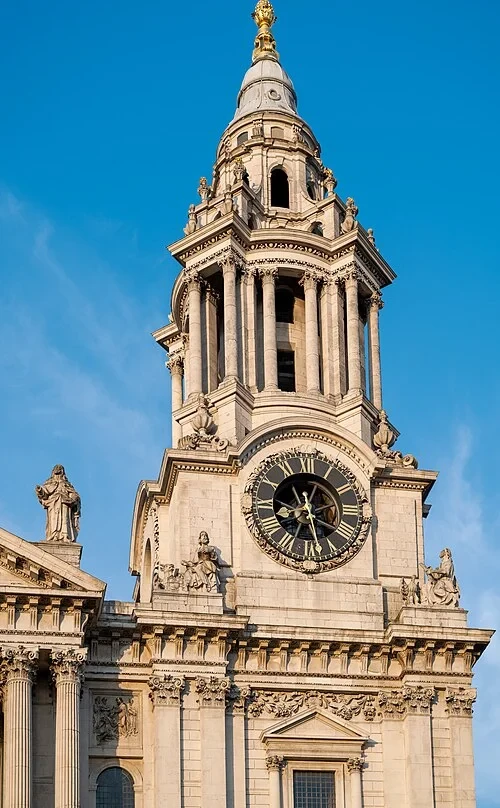 The West Front and Twin Towers
The Southwest Tower
Looking up at the Southwest Tower, you are seeing the home of 'Great Paul,' once the most massive bell in the entire British Isles. Cast in the late nineteenth century, this behemoth weighs an astounding 16.5 tons. For many years, its deep, resonant toll was a familiar sound across the city, though today it is rung only on special occasions. The tower also serves as the cathedral's timekeeper. The large clock face visible on this tower has been a landmark for Londoners for generations, helping to regulate the pulse of the surrounding city.
Listen in the appPhoto: Tilman2007 · CC BY-SA 4.0
04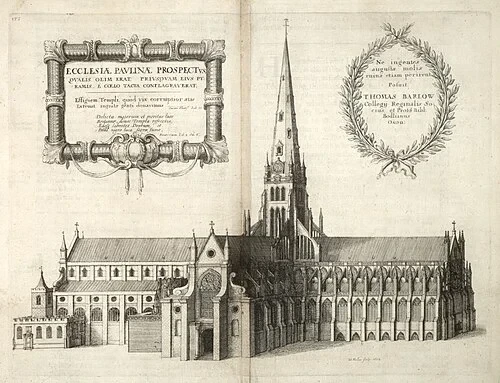 The Great Fire and Rebirth
The Old St Paul's
The engraving on your screen, made by Wenceslaus Hollar in the 1650s, offers a glimpse into a lost world, showing the medieval Gothic cathedral that dominated the city before the catastrophic Great Fire of 1666. Known today as 'Old St Paul's,' this building was a masterpiece of the Gothic style, characterized by pointed arches and a massive central spire that was once one of the tallest in the world. The scale of the old cathedral was truly immense, rivaling even the current building in length and height. It served as more than just a place of worship; for centuries, the nave was used as a public meeting space, a marketplace, and even a thoroughfare for the people of London. However, by the seventeenth century, the building was in a state of serious decay. The Great Fire provided the final, tragic blow, leaving only scorched stone walls behind. Christopher Wren was tasked with clearing the ruins to make way for the Baroque structure we see today. Studying this image helps us appreciate the radical transition London underwent, from a medieval city of timber and narrow lanes to the grand, stone-built capital that emerged from the ashes of the fire.
Listen in the appWenceslas_Hollar_-_St._Paul's_from_the_south_showing_the_spire_(State_1).jpg: Original upload by User:Dcoetzee, revision by User:Bob Castle derivative work: Bob Castle (talk) · Public domain
05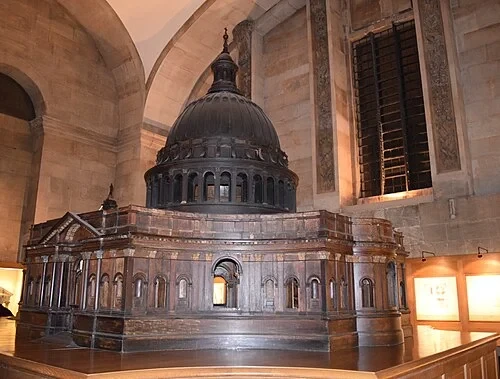 The Great Fire and Rebirth
The Great Model
Imagine a cathedral that looks quite different from the one you see today; this oak model, about twenty feet long, preserves Sir Christopher Wren's preferred design for St Paul's. Known as the 'Great Model,' it represents a building shaped like a Greek Cross, with four equal arms radiating from a central dome. Wren poured his creative energy into this design, believing it to be the most perfect architectural expression for the new cathedral. However, when he presented it, the cathedral authorities rejected it. They found the design 'too modern' and insufficiently traditional for a cathedral of the Anglican faith. They preferred a more conventional Latin Cross layout with a long nave, which is what was eventually built. While Wren was disappointed, he didn't discard his vision entirely. You can see many elements of the Great Model, especially the proportions of the dome, reflected in the final structure. This model remains one of the most important architectural artifacts in the world, offering a rare look at the 'cathedral that almost was' and the compromises an architect must sometimes make between artistic vision and institutional tradition.
Listen in the appThe National Churches Trust · CC BY 2.0
06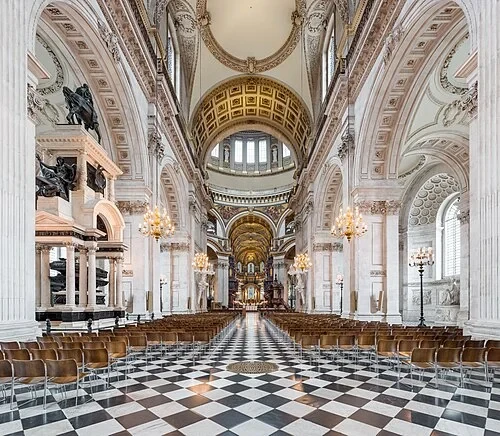 The Nave and Great Organ
The Nave
Stepping into the nave, the sheer scale of the interior reveals itself. Stretching far ahead of you toward the dome, this long central aisle was designed to create a sense of awe and spiritual progression. Notice the striking black and white checkerboard marble floor, which adds to the grand, orderly feel of the space. One of Christopher Wren's most radical decisions was the use of large, clear glass windows. In medieval Gothic cathedrals, the interiors were often dark and mysterious, lit by colorful stained glass. Wren, influenced by the Enlightenment and the 'Age of Reason,' wanted the cathedral to be filled with natural light. He believed that light reflected the clarity of the faith and the reason of the human mind. As you look up, the series of shallow domes and arches draw your eye forward toward the choir and the main altar. This vast, bright space was designed not just for large processions, but to make every visitor feel both small in the face of the divine and elevated by the beauty of the architecture. It remains one of the most celebrated interior spaces in European architecture.
Listen in the appPhoto: Diliff · CC BY-SA 3.0
07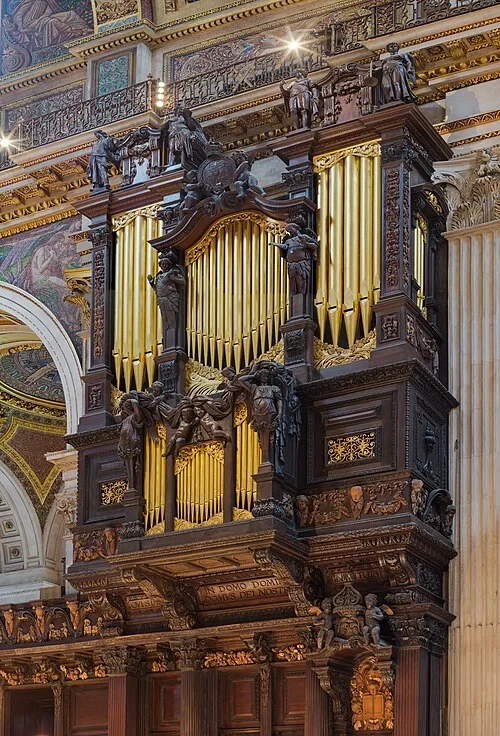 The Nave and Great Organ
The Grand Organ
The magnificent organ case you see here is not just a musical instrument, but a masterpiece of Baroque wood carving. The intricate case features incredibly detailed woodwork by the master carver Grinling Gibbons, who was the most celebrated artisan of his kind during the late seventeenth century. Beyond its visual beauty, the organ itself is a musical giant. It is one of the largest instruments in the United Kingdom, housing an incredible 7,256 pipes. Over the centuries, its powerful voice has been shaped by various builders and organists to meet the changing needs of cathedral music. The instrument's history is linked to some of the greatest names in music. For example, the famous composer Felix Mendelssohn is known to have played this organ during his visits to London in the nineteenth century. Whether standing silent or filling the vast space with sound, the Grand Organ serves as a bridge between the architectural splendor of the building and the centuries of choral and instrumental tradition that are the heartbeat of St Paul's. It stands as a testament to the fact that in a cathedral, the art of the eye and the art of the ear are meant to work in perfect harmony.
Listen in the appPhoto: Diliff · CC BY-SA 3.0
08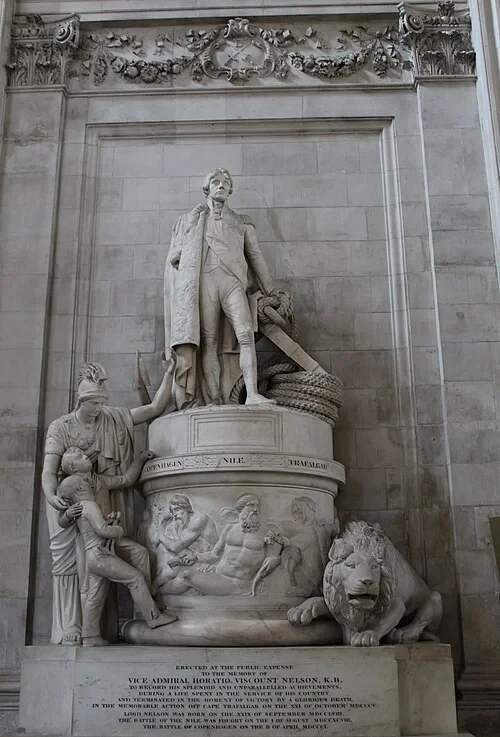 The Nave and Great Organ
Monument to Admiral Nelson
While the great Admiral Nelson rests in the crypt below, this grand monument in the south transept serves as a public tribute to the victor of the Battle of Trafalgar. Nelson was a national hero, and his death in 1805 led to one of the most significant state funerals in British history. Because the public could not easily visit his tomb in the crypt, this monument was placed here on the 'Floor of Heroes' to allow for national celebration. The sculpture depicts Nelson in a heroic pose, leaning against an anchor which symbolizes his naval career and his status as a savior of the nation. He is surrounded by figures that underscore his significance to Britain. On one side, you can see the figure of Britannia, the personification of the nation, and on the other, the British Lion, representing strength and courage. The base of the monument is decorated with reliefs depicting his most famous naval victories. This monument is one of many throughout the nave that transformed the cathedral into a national 'hall of fame,' where the military and political giants of the British Empire were immortalized in stone for the public to admire and remember.
Listen in the appPhoto: 14GTR · CC BY-SA 4.0
09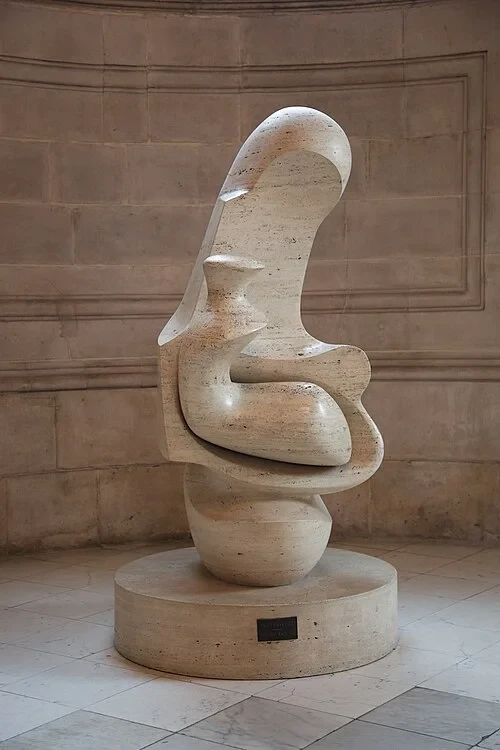 The Nave and Great Organ
Mother and Child
This abstract sculpture by Henry Moore represents a modern layer of the cathedral's history, where contemporary art meets centuries-old Baroque architecture. Carved from travertine stone, this work, titled 'Mother and Child,' was one of the last major sculptures completed by Moore before his death. The smooth, flowing lines of the sculpture contrast sharply with the rigid stone columns and ornate decorations of Wren's cathedral. However, the subject matter—a mother cradling her child—is a universal and deeply spiritual theme that resonates with the Christian environment of the space. The presence of this piece highlights the cathedral's ongoing commitment to commissioning and displaying modern art. Rather than being a static museum of the past, St Paul's continues to engage with living artists, allowing their contemporary perspectives to sit alongside the masterworks of the seventeenth and eighteenth centuries. As you look at the sculpture, notice how the natural light from Wren's windows catches the texture of the stone, bringing a soft, organic feel to this modern interpretation of a timeless maternal bond.
Listen in the appJames O'Gorman · CC BY-SA 2.0
10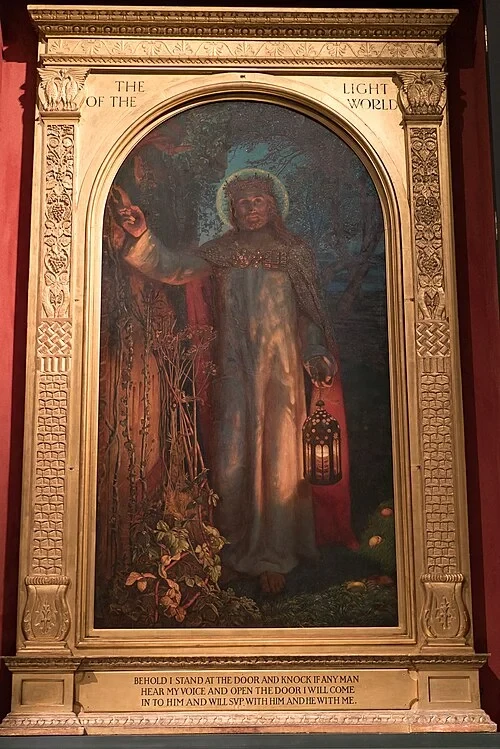 The Nave and Great Organ
The Light of the World
Among the cathedral's artistic treasures is this globally famous painting, 'The Light of the World,' by the Pre-Raphaelite artist William Holman Hunt. This is the third and largest version of the subject painted by Hunt, and it is arguably one of the most recognizable religious images in the world. The painting depicts Christ in a moonlit garden, holding a lantern and knocking on a door that is overgrown with weeds and vines. A key detail to notice is that the door has no handle on the outside; it can only be opened from within. This symbolizes the human heart, suggesting that faith is a personal choice that must be made from the inside. Before finding its permanent home here, this specific painting traveled across the globe on a world tour, where it was seen by millions of people in various countries. It was eventually gifted to the cathedral in the early twentieth century. The painting's rich symbolism and meticulously detailed style are hallmarks of the Pre-Raphaelite movement, which sought to bring deep spiritual meaning and naturalistic detail back to the art of the nineteenth century. It continues to draw visitors who find in its glowing colors a profound message of hope and patience.
Listen in the appPaul Hudson from United Kingdom · CC BY 2.0
- 11
Under the Dome
Reaching the center of the cathedral, you stand directly beneath the architectural climax: the massive triple-shell dome.
- 12
The Spandrel Mosaics
The vibrant scenes in the triangular spaces beneath the dome represent a Victorian-era effort to bring color to the interior.
- 13
The Choir
Moving into the choir, the space becomes even more ornate, with ceiling vaults glittering with mosaics designed in the late 1890s.
- 14
The High Altar
The golden canopy of the High Altar is a modern addition, created to fulfill a vision the original architect never saw realized.
- 15
The Choir Stalls
Look closely at the woodwork here to see the incredible skill of Grinling Gibbons, who carved these details over three centuries ago.
- 16
The American Memorial Chapel
Located behind the High Altar, this chapel serves as a poignant tribute to the 28,000 Americans who lost their lives while based in the UK during the Second World War.
- 17
Geometric Staircase
This breathtaking helical stone staircase seems to defy gravity, with each step cantilevered from the wall to create a graceful spiral that has even appeared on the silver screen.
- 18
Tomb of the Duke of Wellington
Resting within the vast expanse of the crypt, this massive sarcophagus commemorates the Duke of Wellington, the famed commander who led the Allied victory at the Battle of Waterloo.
- 19
Tomb of Lord Nelson
This striking black marble sarcophagus holds the remains of Admiral Lord Nelson, though it was originally commissioned centuries earlier for a powerful Tudor cardinal.
- 20
The Tomb of Christopher Wren
In a quiet corner of the crypt, the cathedral's architect, Sir Christopher Wren, is buried beneath a modest slab, accompanied by one of the most famous epitaphs in history.
- 21
The OBE Chapel
Dedicated to the Order of the British Empire, this vibrant chapel is filled with heraldic flags and stained glass, honoring individuals from diverse backgrounds for their service to society.
- 22
St Paul's Survives
During the darkest days of the Second World War, St Paul's Cathedral became a powerful symbol of national resilience as it stood defiant against the smoke and flames of the Blitz.
- 23
The St Paul's Watch
The survival of this cathedral during the air raids of World War II was thanks in large part to the 'St Paul's Watch,' a brave group of volunteers who patrolled the rooftops.
- 24
The Whispering Gallery
High above the cathedral floor, the Whispering Gallery offers a world-famous acoustic experience where even a faint whisper can be heard clearly on the opposite side of the dome.
- 25
View from the Stone Gallery
Stepping out onto the Stone Gallery, you are rewarded with a stunning panoramic view of the London skyline and a close-up look at the architecture of the outer dome.
- 26
The Golden Cross
Reaching the very top of the cathedral, the Golden Gallery sits beneath the massive cross and orb, marking the highest point of Sir Christopher Wren's architectural masterpiece.
- 27
St Paul's Cross
This monument in the cathedral churchyard marks the historic site of St Paul's Cross, an outdoor pulpit that served as the beating heart of London's public and political life for centuries.
- 28
Temple Bar
We conclude our journey at Temple Bar, a historic stone gateway designed by Sir Christopher Wren that once stood as the formal entrance to the City of London.
St Paul's Cathedral
Frequently asked questions
How much does the guide cost?
Free app download. Listed guide price: $2.99. Guide price shown in the app. Audio guide only. Venue admission is separate.
Can I listen without internet?
Yes. Download the guide’s audio, images, and maps in the app before your visit. Your downloaded content is then available offline.
Can I listen in my language?
This audio guide is available in 15 languages, including English.
Do I need to follow a schedule?
No. This is a self-guided experience. Choose your stops, pause whenever you like, and return to a story at your own pace.
At your own pace
Explore St Paul's Cathedral.
Download Stanza, then search for “St Paul's Cathedral”.
Free app download · Guide price shown in the app
Keep exploring
Nearby audio guides
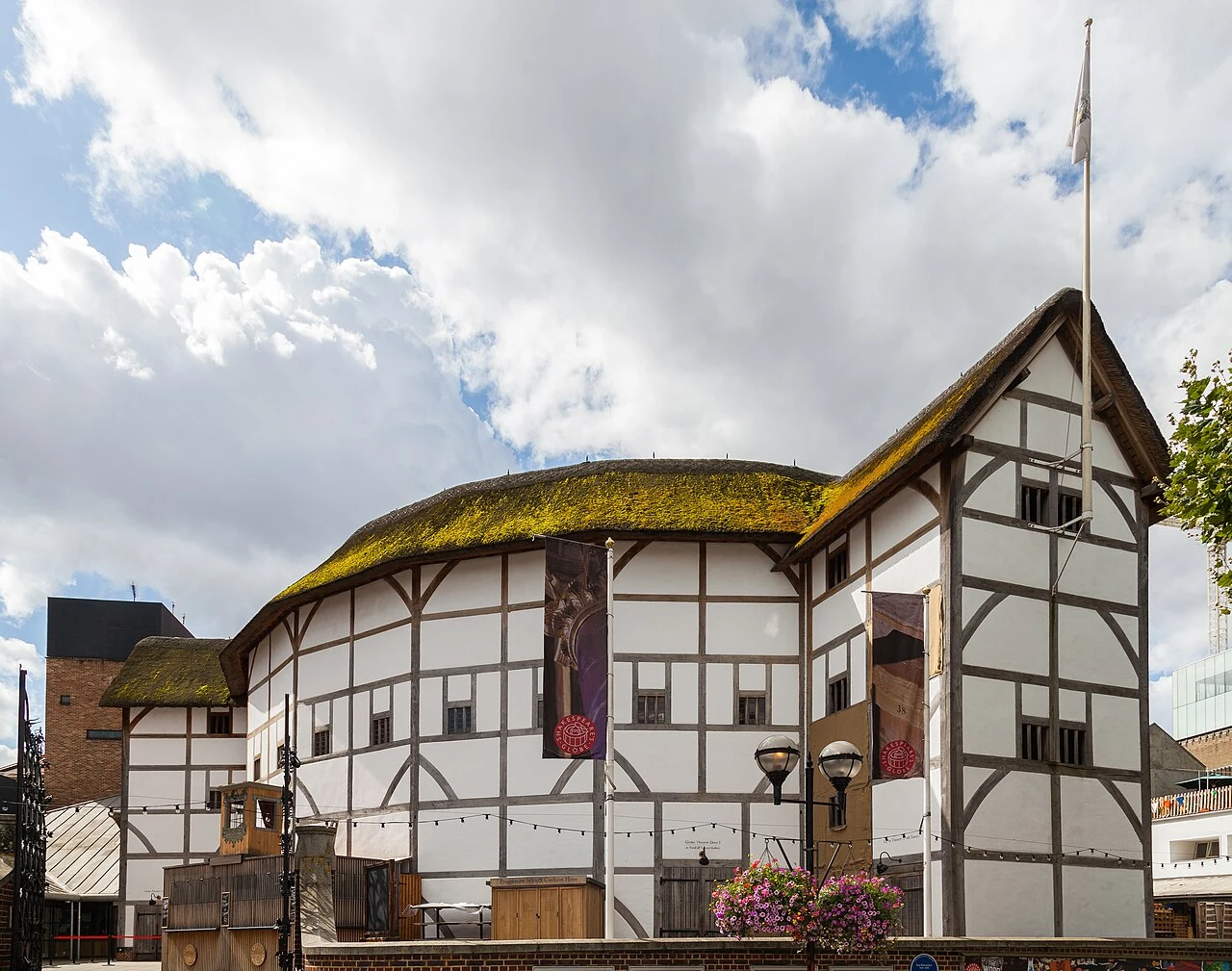
Greater London · 1 km
Shakespeare's Globe
Content & sources
Diego Delso · CC BY-SA 4.0
London · 1 km
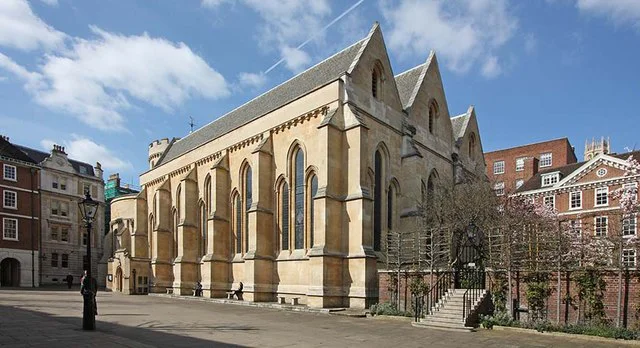
Temple Church
Content & sources
John Salmon · CC BY-SA 2.0
London · 1 km
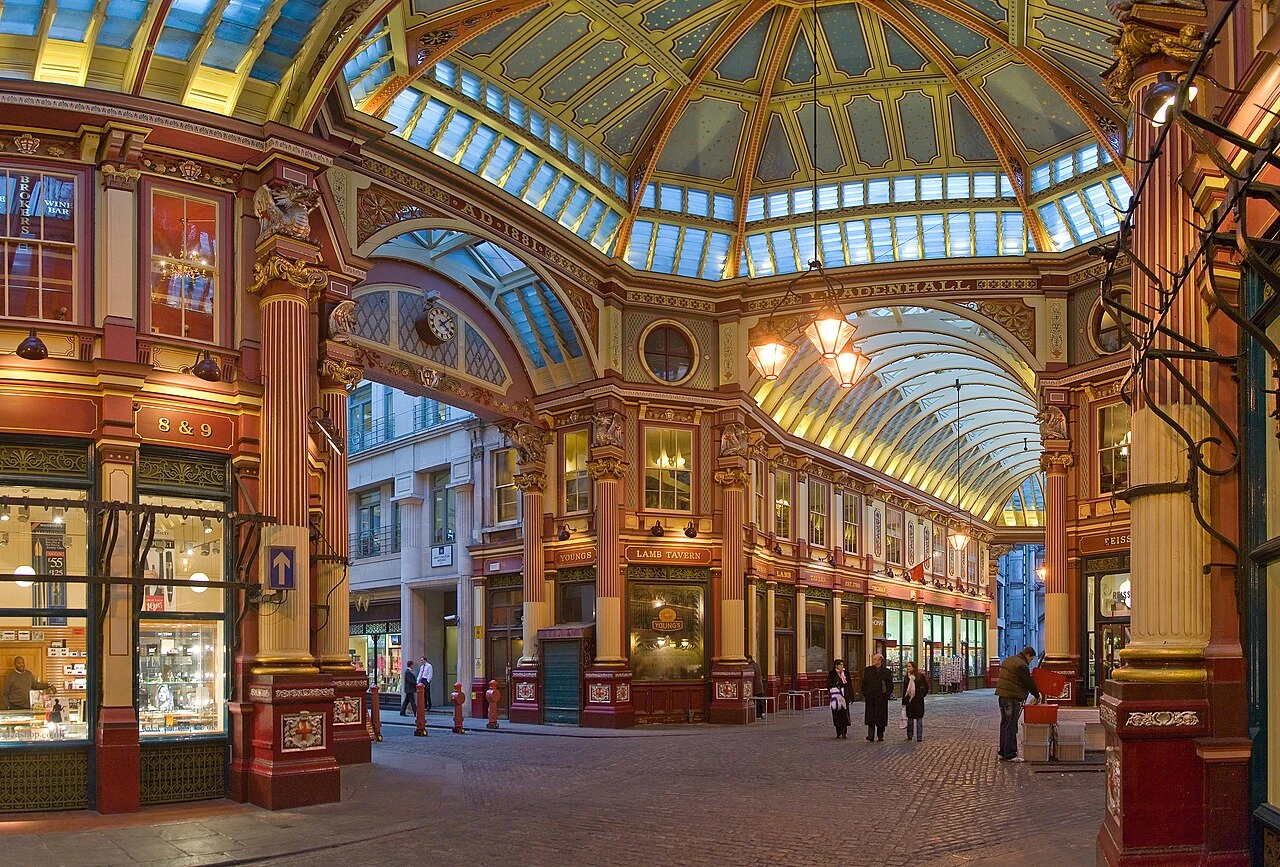
Leadenhall Market
Content & sources
Diliff · CC BY 2.5
Greater London · 1 km
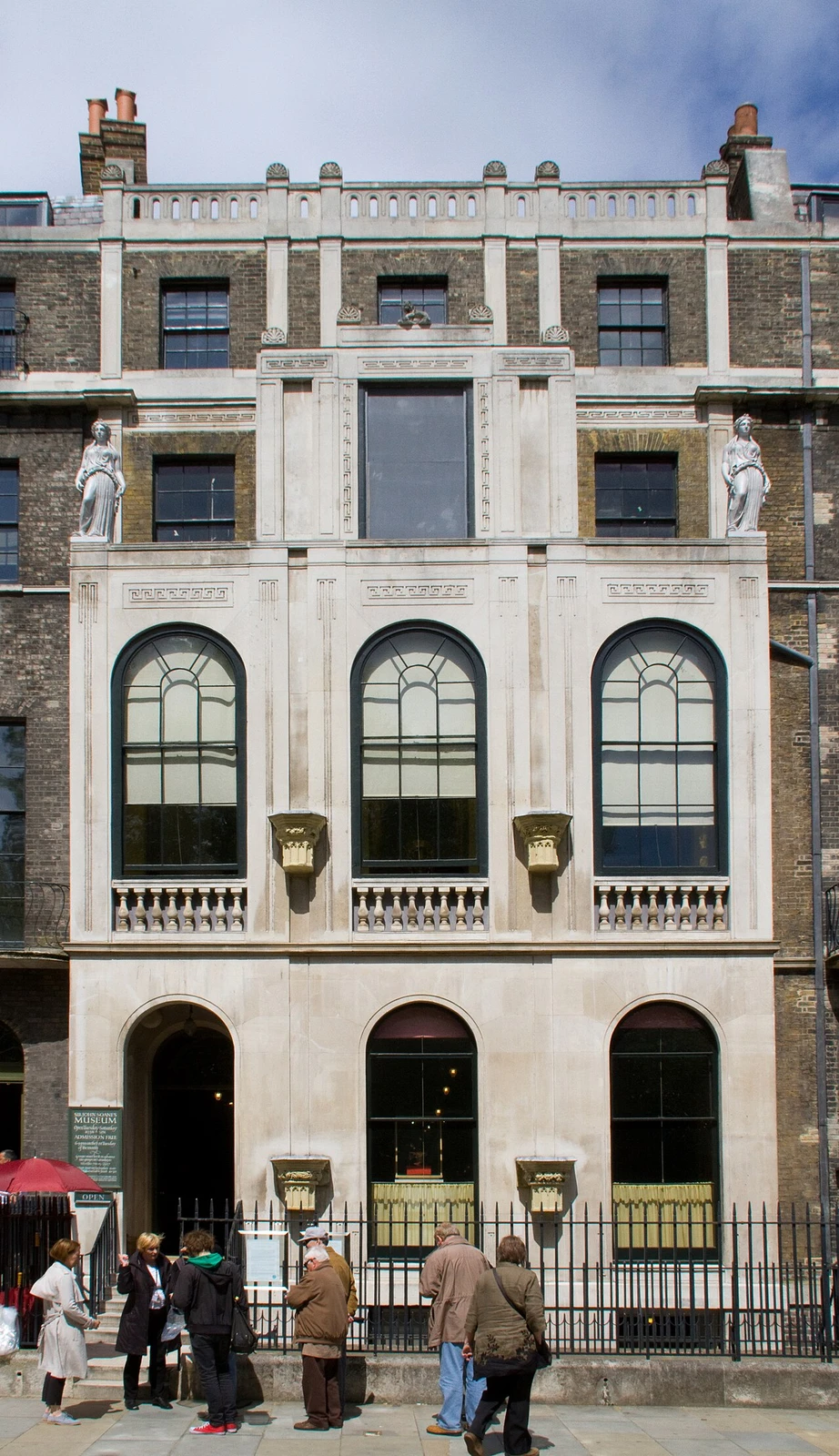
Sir John Soane's Museum
Content & sources
Tony Hisgett from Birmingham, UK · CC BY 2.0