Stanza · Audio guide
Hatfield House Audio Guide
A place to remember. A story to take with you.
Hatfield House is a Grade I listed country house located in Hatfield, Hertfordshire. It is set within a large park known as the Great Park.
Download Stanza, then search for “Hatfield House”.
About the tour
One guide. Your kind of visit.
Hatfield House is a Grade I listed country house located in Hatfield, Hertfordshire. It is set within a large park known as the Great Park.
Ready when you are.
- 01Get the free Stanza app.
iOS & Android
- 02Find your guide.
“Hatfield House”
- 03Download before you go.
Works offline
Audio guide / 15 narrated stops
Inside the guide
Get to know a few of the stories before you go. Open a stop to read more.
01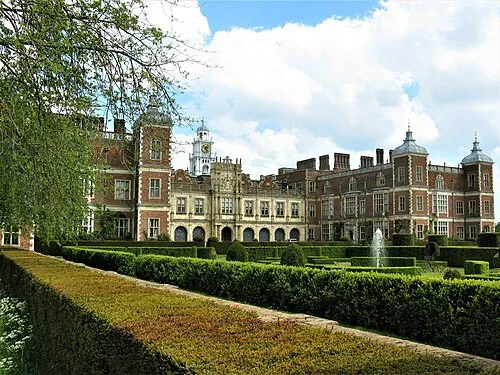 Parkland Approach and South Façade
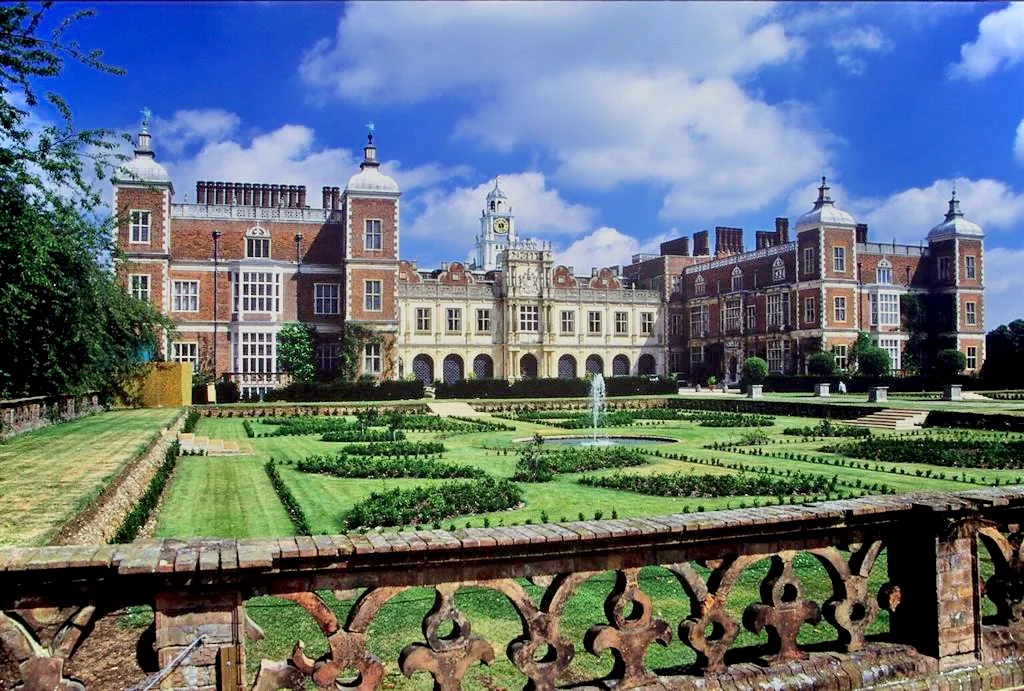
Hatfield House: The South Façade
Welcome to Hatfield House, and to a story that runs from Tudor princes to the family who still live here. The red-brick face in front of you belongs to the Jacobean age. Robert Cecil, first Earl of Salisbury, built it between 1607 and 1612. He was chief minister to King James the First, and he liked building. In 1607 the king gave him Hatfield, because James had taken a dislike to the old royal palace on this site. In exchange, the king took Theobalds, the Cecil family's own grand house nearby. Cecil then pulled down three wings of the royal palace and used their bricks for his new one. Robert Lemynge supervised the work, with advice from the royal surveyor Simon Basil. The architect Inigo Jones also came here, in October 1609. How far he shaped the design is not certain; his visit is what the record keeps. What the stone archways and carved crests announce is simpler. This was a prodigy house, built to impress a king's court.
G Laird · CC BY-SA 2.0
02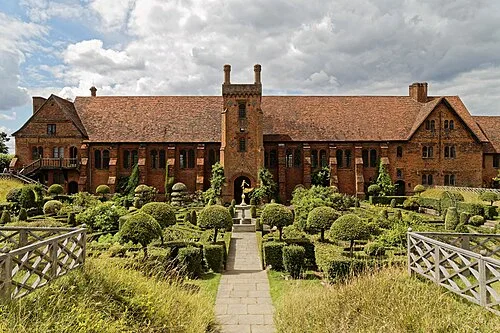 The Surviving Tudor Old Palace
The Old Palace
Long before the great house, there was a palace here, and this red-brick range is what survives of it. Cardinal John Morton, Henry the Seventh's minister, built it in the late fourteen hundreds, four wings around a courtyard. Henry the Eighth later seized it, along with other church properties. It became a nursery for his children. The young Edward and the future Elizabeth spent their youth at Hatfield. Their elder sister Mary lived here too, sent to wait on the little princess as punishment for refusing to accept her father's marriage to Anne Boleyn. For Elizabeth, the palace became a favourite residence. She was here in November 1558, when her sister Queen Mary died. In the Great Hall of this building she held her first Council of State as queen. The formal beds of the parterre now fill the old courtyard space, laid out low and neat against the Tudor brick.
Photo: Acabashi · CC BY-SA 4.0
03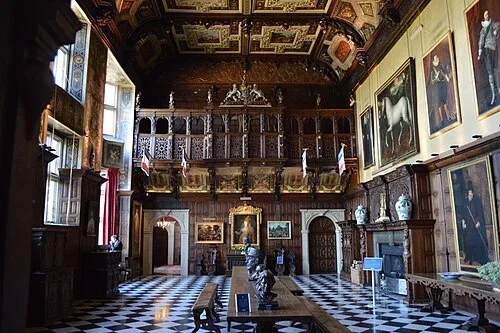 The Marble Hall
Inside Cecil's new house, this was the room built for showing off. The Marble Hall was the ceremonial and dining centre of the Jacobean mansion. A carved oak screen stands across one end, and above it the ceiling runs with rich ornament. Portraits crowd the walls, generations of faces looking down on the long floor. A hall like this was made for hospitality, for feasts and ceremony, when the whole room filled with the household and its guests. Even quiet, it keeps the shape of that ambition. Cecil meant Hatfield to stand comparison with any court house in England. Hanging here among the portraits is the painting this house is most famous for, a portrait of Elizabeth the First with a rainbow in her hand.
Listen in the appMatt Brown · CC BY 2.0
04 The Marble Hall
The Rainbow Portrait of Elizabeth I
Every part of this painting says something. Elizabeth stands with a rainbow in her hand, and beneath it a motto: non sine sole iris, no rainbow without sun. The meaning is plain. As the sun makes the rainbow, so the monarch makes peace and calm. Her cloak is stitched all over with eyes and ears, the eyes and ears of a sovereign who sees and hears everything in her kingdom. On her sleeve coils a serpent, the old emblem of wisdom. The painting was made in the early sixteen hundreds, nearly half a century into her reign. By then her image was a piece of statecraft, worked out in symbols rather than in wrinkles. Who painted it is not known; no artist's name has stayed attached to it. What is certain is the message. Vigilance, wisdom, and a queen who needed no heir to rule alone.
Listen in the appFormerly attributed to Marcus Gheeraerts the Younger / Formerly attributed to Isaac Oliver · Public domain
05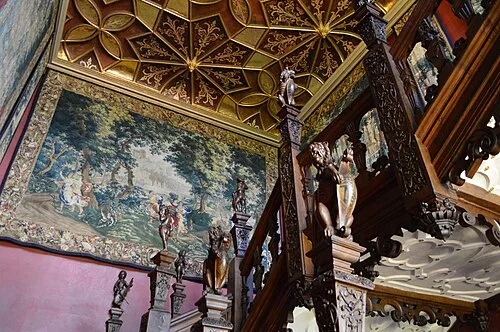 The Grand Staircase
The staircase is one of the house's original Jacobean features, worked when the building was new in 1611. Every figure, every panel of the balustrade, is carved from wood, and the ceiling above glows with gilding. This was never just a way upstairs. It is the spine of the house, the route from the ground floor up into the State Rooms, and guests climbed it in procession. The carvers gave it their best work, because every visitor saw it. Alongside the chapel glass, it is one of the original Jacobean features from Cecil's day that remain in the building. Four centuries of hands on the rail, and the wood still holds its sharp detail.
Listen in the appMatt Brown · CC BY 2.0
06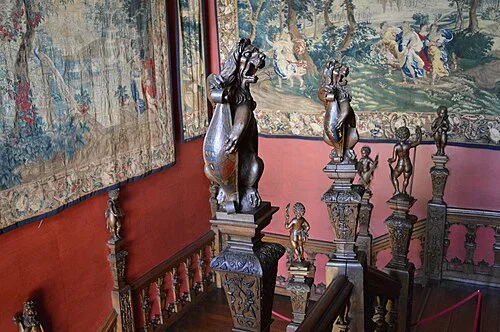 The Grand Staircase
Carved Beasts of the Staircase
This is the carver's own work, up close. On the newel posts stand animals and little figures, each one cut by hand from the solid wood. A lion grips its prey under its paws. Smaller carved children hold their own tiny posts along the balustrade. Behind them hang great tapestries, so the beasts stand out dark against woven hunting scenes. Look at the lion's mane and the ripple of its body. Someone spent days on that one post, with chisels and no second piece of timber. The staircase as a whole was the showpiece; these are the details that reward the slow climb.
Listen in the appMatt Brown · CC BY 2.0
07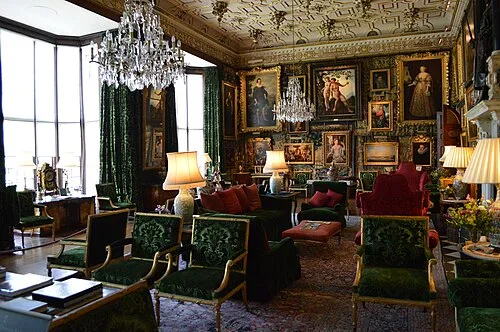 King James Drawing Room and State Apartments
The King James Drawing Room
The Cecils have held Hatfield since Robert Cecil received it from King James, and this room shows what that means. The King James Drawing Room is not a museum set frozen in 1611. Portraits have gathered on the walls over the centuries, layer upon layer of family faces and royal ones. The furniture is arranged for living, chairs grouped for conversation, lamps and books in use. Today the house is the home of Robert Gascoyne-Cecil, the seventh Marquess of Salisbury, the latest of a line that runs straight back to the first Earl. It is also open to visitors, which is how the State Rooms can be seen at all. Few great houses can say their owners never left.
Listen in the appMatt Brown · CC BY 2.0
08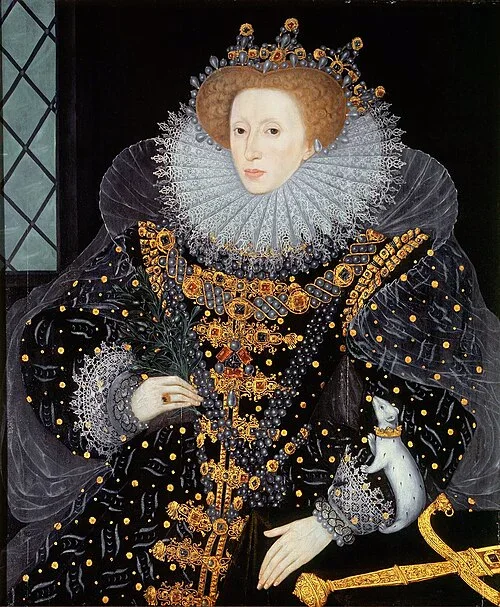 King James Drawing Room and State Apartments
The Ermine Portrait of Elizabeth I
Here is Elizabeth again, but a different Elizabeth from the rainbow painting. This one was painted in 1585, probably by William Segar, while the queen was very much alive and in the middle of her reign. An ermine sits beside her, a small white animal that legend said would rather die than soil its coat, so it stood for purity. She holds an olive branch, the emblem of peace. At her side rests the sword of state, the sign of her authority. Where the Rainbow Portrait turns the queen into an allegory, this is a portrait of a ruler in her own lifetime, painted for people who knew her face. Together the two pictures bracket her: the living monarch of the fifteen eighties, and the symbol she became.
Listen in the appAttributed to William Segar / Attributed to George Gower / Formerly attributed to Nicholas Hilliard · Public domain
09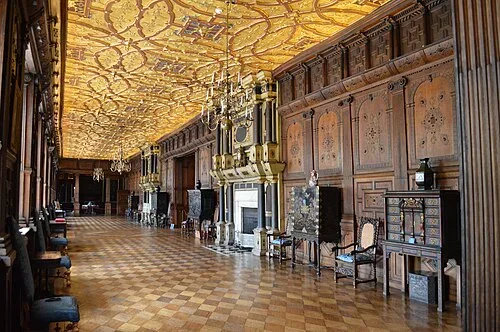 The Long Gallery
Hatfield draws visitors for its Elizabethan relics, and many of them are kept along this gallery. The ceiling overhead is covered in gold leaf, running the whole length of the panelled room. Among the treasures are gloves belonging to Queen Elizabeth, and a pair of silk stockings believed to have been the first ever worn in England. In the library hangs a parchment roll more than twenty feet long, illuminated by hand. It traces the queen's pedigree all the way back to Adam and Eve. A family tree like that was a political argument in paint and gold, a claim of ancient right. Together with the portraits downstairs, these objects make the house a place rich in Elizabethan memory.
Listen in the appMatt Brown · CC BY 2.0
10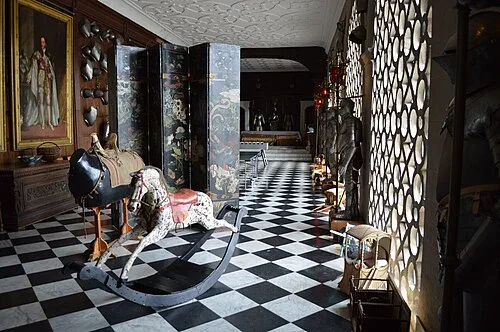 The Armoury
This long room was once an open loggia, later enclosed to hold the family's armour and weapons. Suits of plate stand along the walls, with screens and portraits filling the spaces between. There is even a rocking horse among the martial display, a reminder that children played here too. The military story does not stop at the armour. During the First World War, the park outside was dug into a mock Western Front, with trenches, craters and barbed wire, to test the first British tanks. After the war the only surviving Mark I tank was placed at Hatfield, where it stood from 1919 until 1970, before moving to the tank museum at Bovington. A quiet room of old armour, guarding ground where modern war machines were born.
Listen in the appMatt Brown · CC BY 2.0
- 11
The Private Chapel Window
Robert Cecil's private chapel and its rare stained glass, an original survival from 1611.
- 12
Inside the Private Chapel
Inside the chapel: the full glow of the glazing above the gilded woodwork.
- 13
The West Garden and Tradescant's Planting
John Tradescant's gardens: plants new to England, neglect, and a restoration still under way.
- 14
'Renaissance' by Angela Conner
Angela Conner's 'Renaissance', a water-driven sculpture proving the gardens still innovate.
- 15
Queen Elizabeth's Oak
The oak where Elizabeth is said to have learned she was queen, and what Hatfield holds together.
Hatfield House
Frequently asked questions
How much does the guide cost?
Free app download. Listed guide price: $0.99. Guide price shown in the app. Audio guide only. Venue admission is separate.
Can I listen without internet?
Yes. Download the guide’s audio, images, and maps in the app before your visit. Your downloaded content is then available offline.
Can I listen in my language?
This audio guide is available in 15 languages, including English.
Do I need to follow a schedule?
No. This is a self-guided experience. Choose your stops, pause whenever you like, and return to a story at your own pace.
At your own pace
Explore Hatfield House.
Download Stanza, then search for “Hatfield House”.
Free app download · Guide price shown in the app
Keep exploring
Nearby audio guides
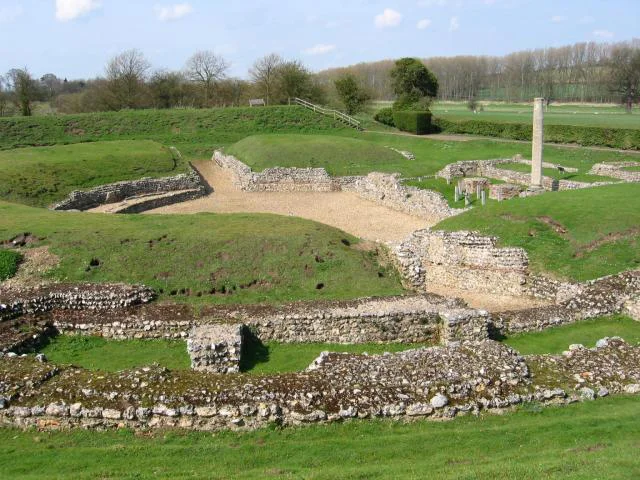
St Albans · 10 km
Verulamium
Content & sources
Rob Hinkley · CC BY-SA 2.0
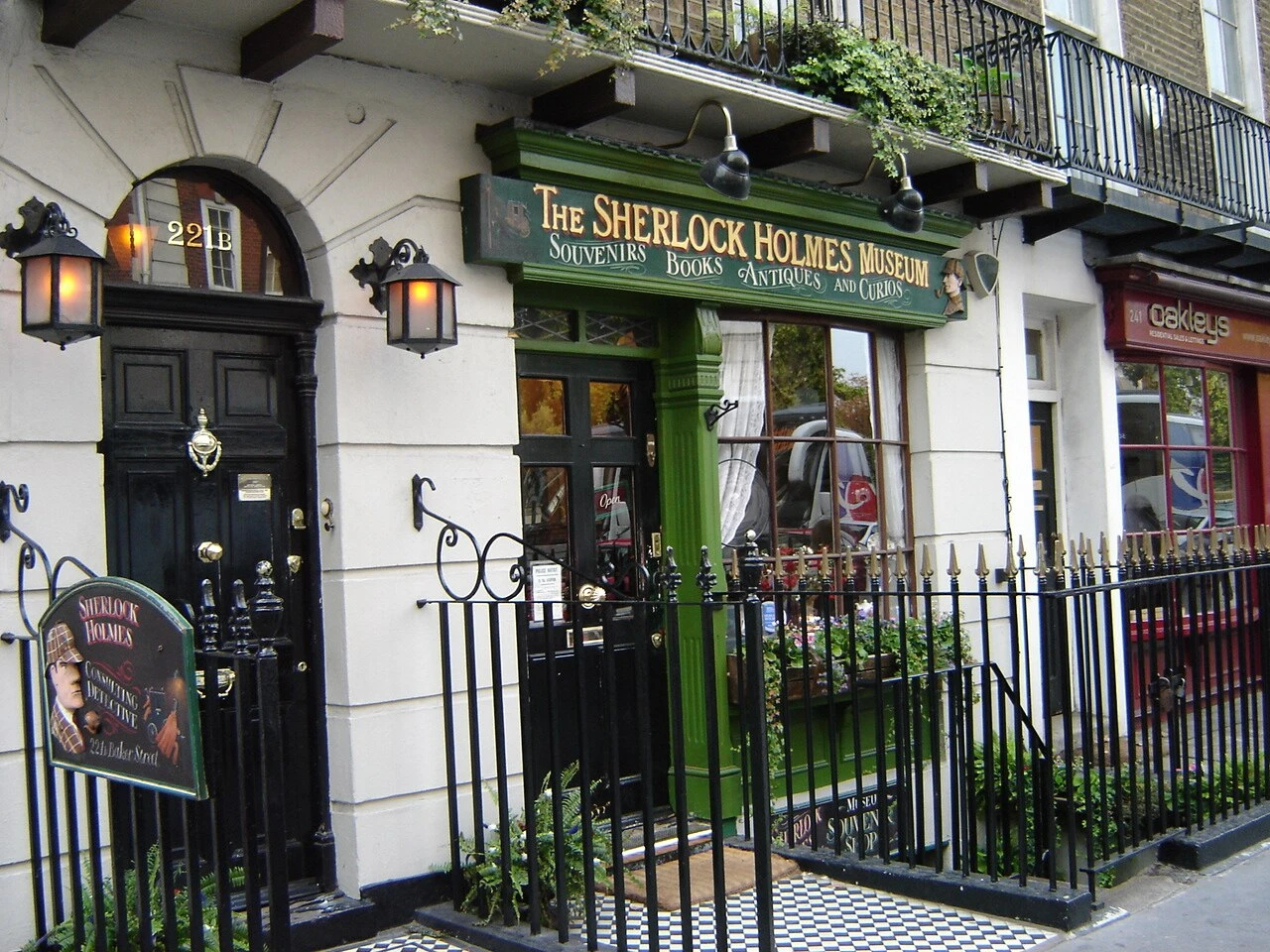
London · 27 km
Sherlock Holmes Museum
Content & sources
Jordan 1972 (talk) · Public domain

London Borough of Camden · 27 km
British Museum
Content & sources
Ham · CC BY-SA 3.0
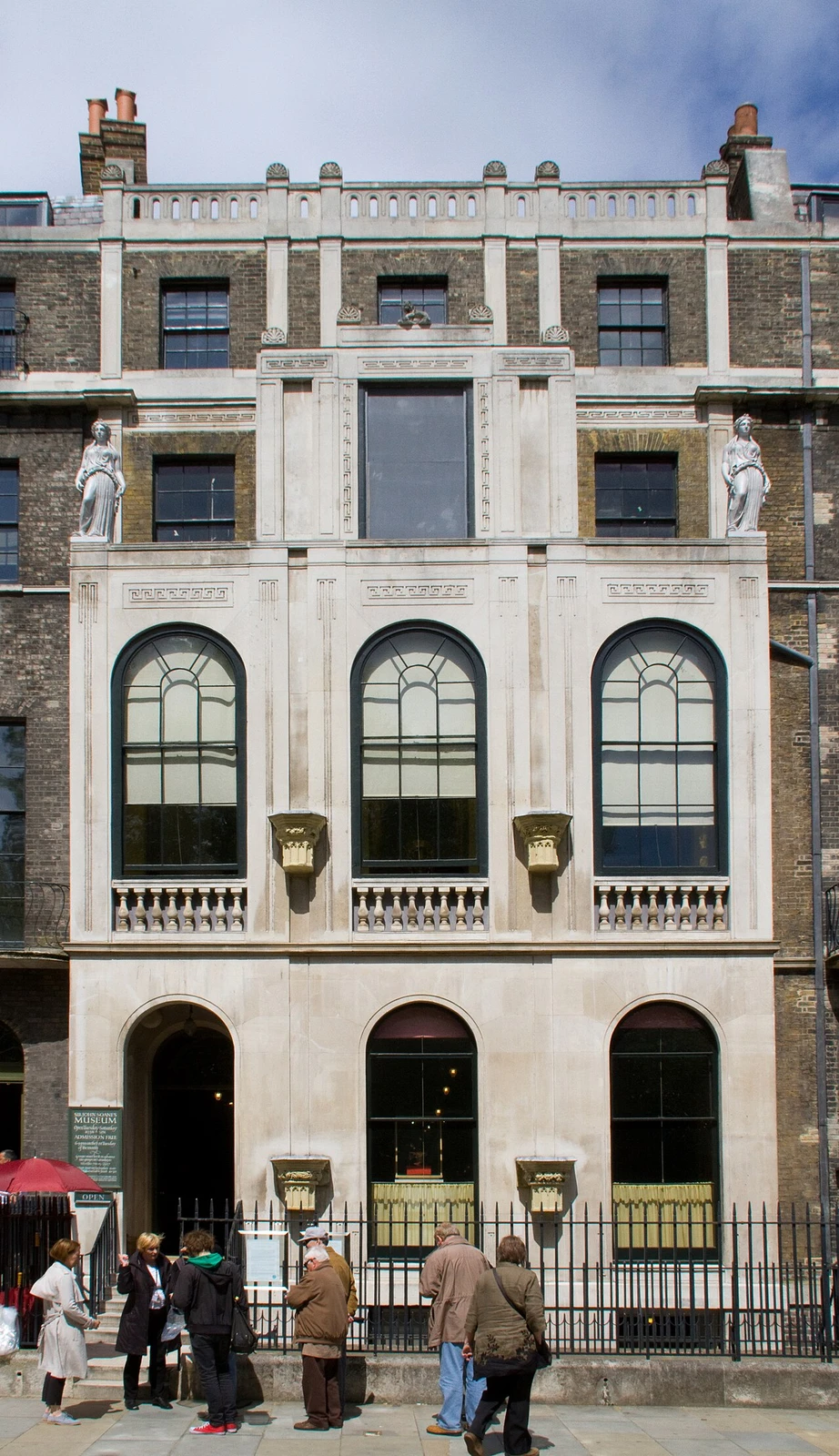
Greater London · 28 km
Sir John Soane's Museum
Content & sources
Tony Hisgett from Birmingham, UK · CC BY 2.0