Stanza · Audio guide
British Museum Audio Guide
A place to remember. A story to take with you.
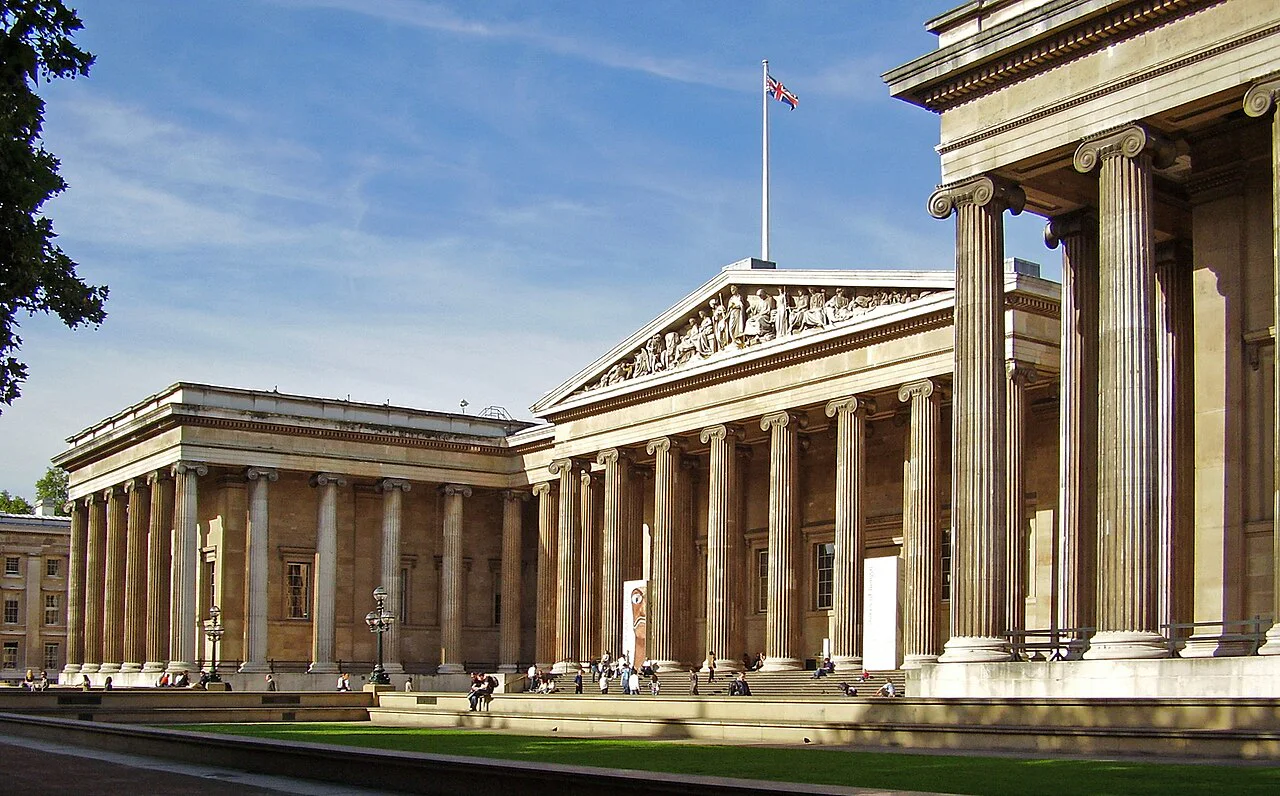
The British Museum is a public museum located in the Bloomsbury area of London that is dedicated to human history, art and culture. Established in 1753, it was the world's first public national museum and…
Download Stanza, then search for “British Museum”.
About the tour
One guide. Your kind of visit.
The British Museum is a public museum located in the Bloomsbury area of London that is dedicated to human history, art and culture. Established in 1753, it was the world's first public national museum and houses a permanent collection of eight million artefacts.
The British Museum guide tells the stories of 403 artworks, including The Great Wave off Kanagawa (Katsushika Hokusai), Rosetta Stone (Unknown Artist), Cyrus cylinder (Unknown Artist), The Rhinoceros (Albrecht Durer), Melencolia I (Albrecht Durer), Babylonian Map of the World (Unknown Artist), Fine Wind, Clear Morning (Katsushika Hokusai), and Standard of Ur (Unknown Artist). 9 of the most famous are longer stories that move across the picture detail by detail, set to music. Every artwork is free to hear in the Stanza app until 1 January.
Ready when you are.
- 01Get the free Stanza app.
iOS & Android
- 02Find your guide.
“British Museum”
- 03Download before you go.
Works offline
Audio guide / 403 artworks
Inside the guide
Get to know a few of the stories before you go. Open a stop to read more.
01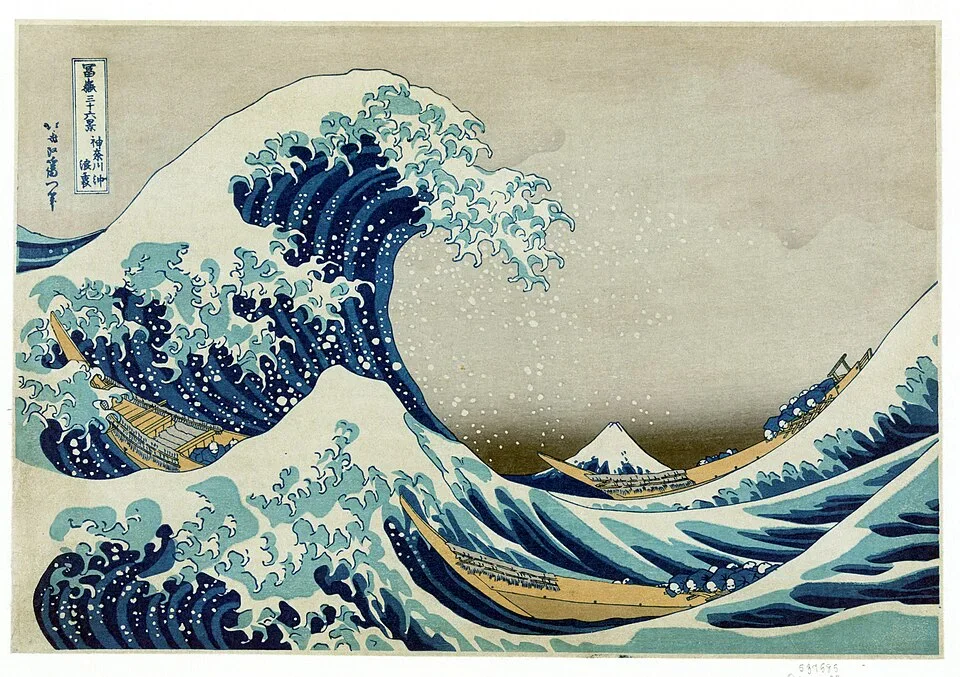
The Great Wave off Kanagawa
It feels like the sea is about to fall on you. All that weight, hanging in the air. And the foam at the top is reaching down. Katsushika Hokusai made this print between 1830 and 1833. We call it The Great Wave. Go up to the crest. Every bit of foam ends in a hooked, curling finger. Claws, almost. Grabbing at the air, at the boats, at you. Now the wave's body. Deep blue, in bands, with white dots scattered through it. That blue had only just become affordable, and he used it freely. He was seventy when he began this series. He once said that at one hundred and ten, every dot and every line would have a life of its own. Now go down, into the trough. Men crouch low in a long boat, heads bowed, white faces turned to the planks. Eight rowers on each boat, all gripping their oars. These are not soldiers. They are fishermen. Fast boats, used to carry live fish to the markets of Edo. Here they are likely heading out for a cargo. Another boat climbs a slope of water. Same bowed heads. Same bodies pressed forward. And a third is almost lost inside the blue and the foam. Three crews, doing their work, in the worst water you can imagine. Now find the stillness. Under the curl of the wave, a small white mountain. Fuji. The sky around it is dark, as if morning is only starting. And no rain falls there. It is painted in blue with white highlights, just like the wave. Fuji is the hero of every print in this series. Here he is tiny, tucked under the crest. So the wave is not only a threat. Its curl is a spiral, and the middle of that spiral is open. It is holding a window open, so we can see Fuji.
Listen in the appKatsushika, Hokusai, 1760-1849, artist · Public domain
02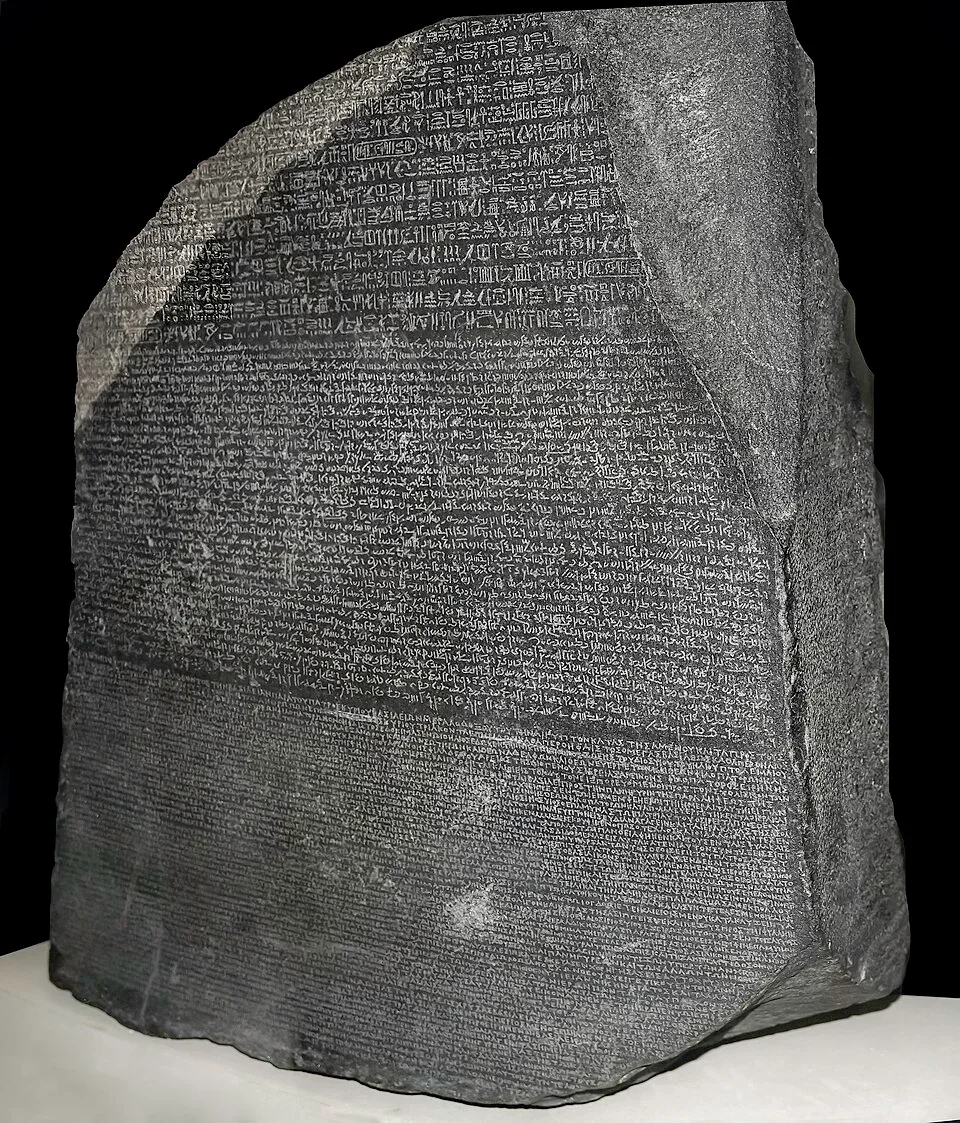
Rosetta Stone
Dark stone, and not an empty inch on it. A wall of marks that seems to say nothing. For a long while, nobody could read it. This is the Rosetta Stone, and its decree was issued in 196 BC. Start at the top, with the pictures. Tiny figures and symbols, set in tight rows. Hieroglyphs. Only fourteen lines of them survive, and every one is cut off on the right. Beyond that edge, the rough stone is blank. Now drop lower, to a different script. Smaller, flowing, joined-up marks. That is Demotic, much closer to the Egyptian that people really spoke in those days. And at the bottom, letters you may know. Greek. The first complete translation of the Greek came out in 1803. All three texts carry the same decree. One decree, three times, with only small differences. Priests gathered at Memphis to issue it, to strengthen the rule of the Ptolemaic kings. Ptolemy the Fifth had come to the throne at five. Egypt had lost land abroad and was shaken by a revolt at home. Look at the lower right, where the Greek lines run into a diagonal break. The lines fade away there. The stone is only a fragment of a larger one. Then, in 1799, a French officer found it at a fort near Rosetta. It had been used as building material. Scholars saw that the flowing script spelled foreign names with sounds. Signs began to speak. By 1822 the code was broken. Not a wall of marks after all. A voice, waiting under them.
Listen in the appPhoto: Awikimate · CC BY-SA 4.0
03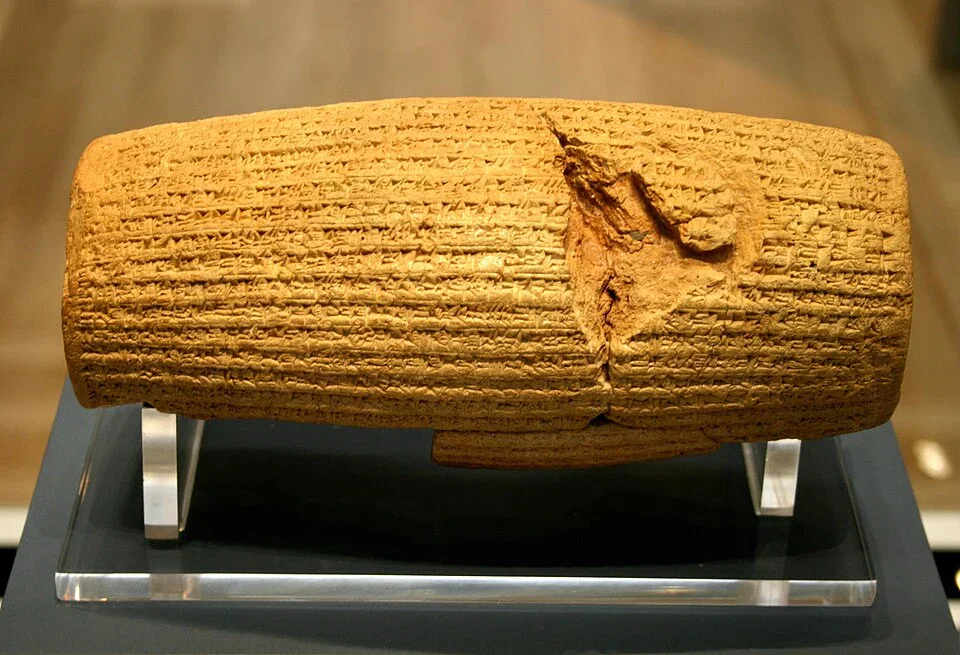
Cyrus cylinder
It looks like nothing much. A rough clay barrel, baked the colour of old bread, and scratched all over. Come closer. Those scratches are lines. Row after row of tiny wedges, lined up like writing on a page. Forty five lines of them, in the old script of Babylonia. Cyrus the Great, the Persian king, took Babylon in 539 before Christ, and this clay cylinder was made after that. And here is the oddity. A Persian king's words, in the old script of Babylon. Read on, and the lines say Babylon's own chief god, Marduk, chose Cyrus. The old king, Nabonidus, is painted as an oppressor of his people. And Cyrus walks into the city in peace, welcomed by the crowds. And all of it praises Cyrus. It also praises him for sending displaced people home and restoring temples. Now the break. A crack runs down the middle, around a rough patch. It perhaps broke apart long ago, in ancient times. In 1961 it was fired again, and the gaps were filled with plaster. A number of lines at the start and end are too damaged to read more than a few words. It was buried in the foundations of Babylon's main temple. It ends with Cyrus mending the city wall, and finding words there from a king long before him. All of that, in a lump of clay less than a quarter of a metre long. Nothing much, you thought. A conquest, told as a welcome.
Listen in the appPhotograph by Mike Peel (www.mikepeel.net). Modifications by مانفی · CC BY-SA 4.0
04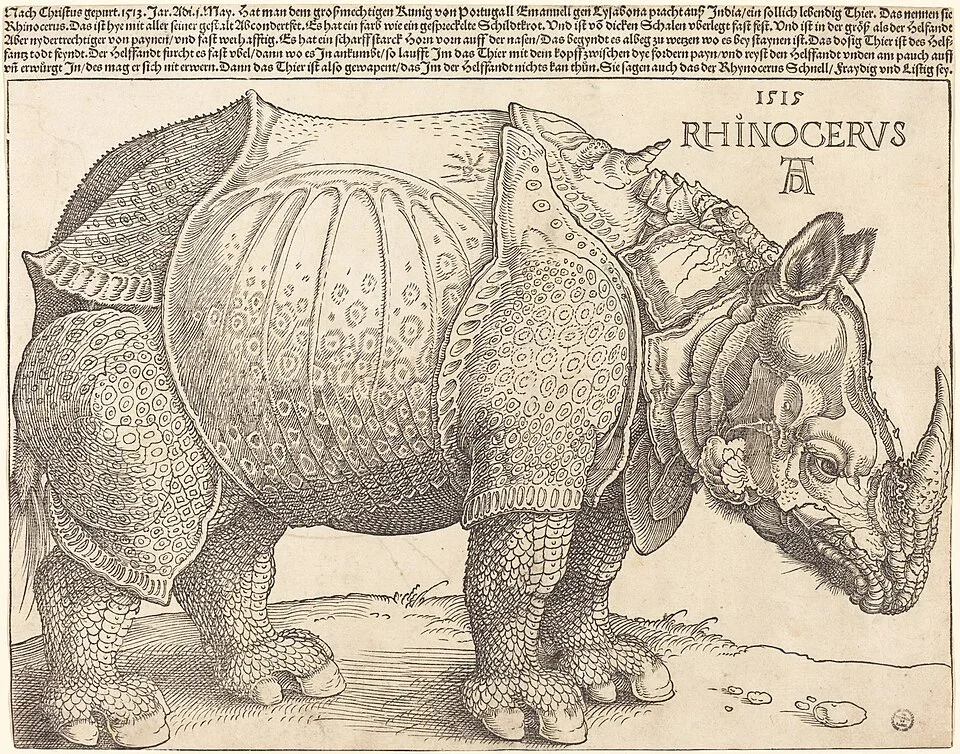
The Rhinoceros
Plates and rivets, armour hammered tight over a heavy body. A knight, surely. Then your eye reaches the head, and it is an animal after all, gazing down and a little sideways. Albrecht Dürer made this, and he never saw a rhinoceros. In 1515 a living rhinoceros stepped off a ship in Lisbon. The first Europe had seen since Roman times. Dürer was far away in Nuremberg. All he had was a letter, and a small sketch by someone else. Follow the body. The skin is cut into hard plates, studded with rivets along the seams, like a suit of armour. A real rhinoceros has deep folds in its skin. Perhaps Dürer's armour is his way of drawing them. And up on its back, a small twisted horn. No rhinoceros has that. The rear quarters are edged like a saw. The legs are covered in scales. Above it all, printed words promise a true picture. The real animal did not get far. The King of Portugal sent it on as a gift for the Pope, and the ship was wrecked in a storm. The rhinoceros was chained to the deck. It drowned. But Dürer's print sailed on. It was copied for three centuries, and people trusted it as the real rhinoceros until the late eighteenth century.
Listen in the appAlbrecht Dürer · CC0
05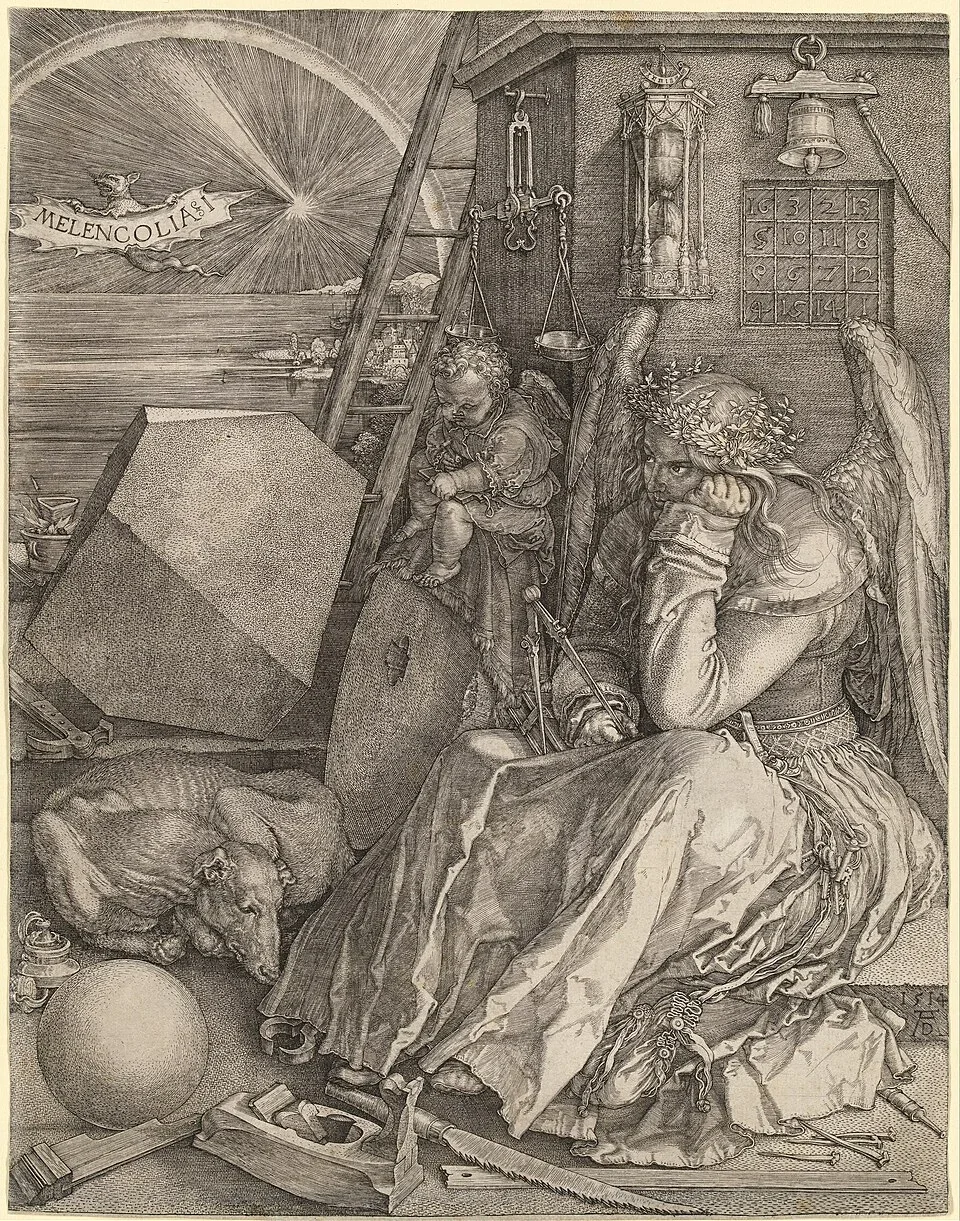
Melencolia I
Everything in this picture is stuck still, and almost nothing is happening. A woman with wings sits with her cheek on her fist, staring past you. It could be quiet thinking. It feels heavier than that. Dürer engraved her in fifteen fourteen, and the banner in the sky names her Melencolia. Her face lies in shadow, and her eyes are wide open, fixed on something far away. A wreath of leaves crowns her, yet she props her head on a closed fist, the old pose for sadness. In her other hand, a compass. She holds it loosely and pays it no mind. On the floor, a plane lies on its side. A saw lies beside it. Tools lie scattered about, and none is in use. Dürer pictured the sadness that can visit creative minds, and here it leaves her unable to use her tools. Behind her, one small figure works. A winged child sits on a millstone, head bowed, scratching at a tablet. He is almost the only one doing anything. At her feet a dog sleeps, thin and curled up tight. Even the dog has stopped. Above her hangs an hourglass, a sign of time. Time passes, even when she does not. Beside it, set into the wall, is a square of numbers. Every row and every column adds up to thirty four. And in the bottom row, the year of the print. Fifteen fourteen. That year Dürer lost his mother, after friends had died before her. Perhaps some of that grief sits in her. Keys hang at her belt, an old sign of power. She has the tools, the numbers and the time. And still she sits. Dürer once warned young artists that too much striving can drop you under the hand of melancholy. Her stillness does not look like rest. It looks like a mind weighed down, unable to use what lies around it. Everything is here, and almost nothing moves.
Listen in the appAlbrecht Dürer · Public domain
06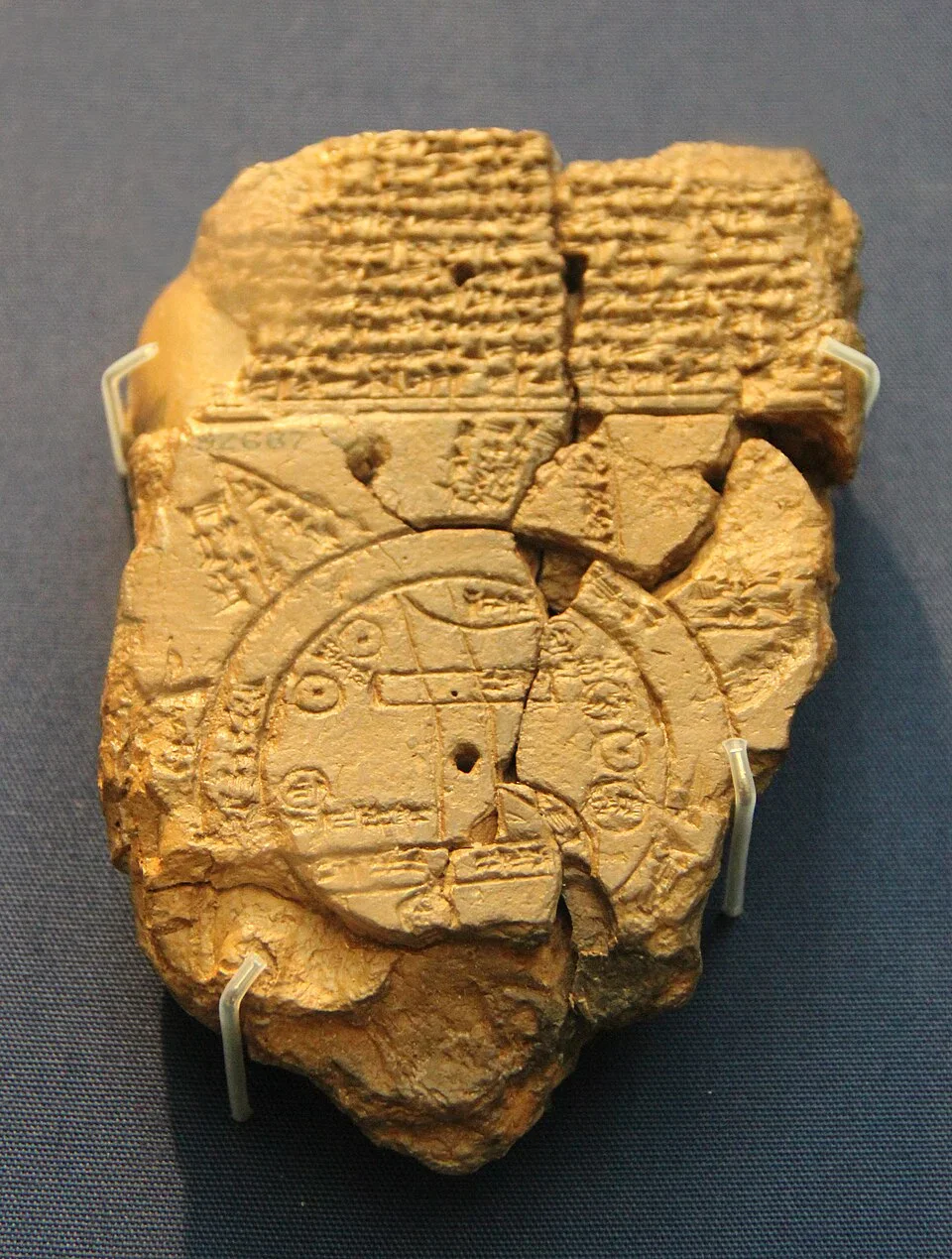
Babylonian Map of the World
A broken piece of clay. A scrap. Cracked, chipped, the edges crumbling. But look at the circle pressed into it. The Babylonian Map of the World dates to the sixth century BC, made by someone whose name we do not know. Two rings, one inside the other. That band is the bitter river. Salt water running all the way round the world. And inside it, the world as it was then known. Down the middle runs the Euphrates, from north to south. Babylon sits on that river, north of the middle. Small circles dot the land around it. Seven of them, perhaps cities. Now go outside the ring. Triangles, spreading out beyond the water. Seven or eight distant regions, beyond the ocean. Perhaps mountains. Above the map, the writing is tiny. Line after line, pressed into the clay. It tells of the god Marduk making the world. He parted the primeval salt sea, and so made land and sea. Then it names some of the beasts he made. Lion, wolf, ostrich, monkey. Creatures of faraway lands. Picture the land itself as a giant raft floating on the sea. On the back, the writing goes on, region after region. Of one far region it says a winged bird cannot safely finish the journey. And the map itself is a view from above, a bird's-eye view of the world. The tablet speaks of four quarters that no one can comprehend. So not a broken scrap. A whole world, held in your hand.
Listen in the appGary Todd · CC0
07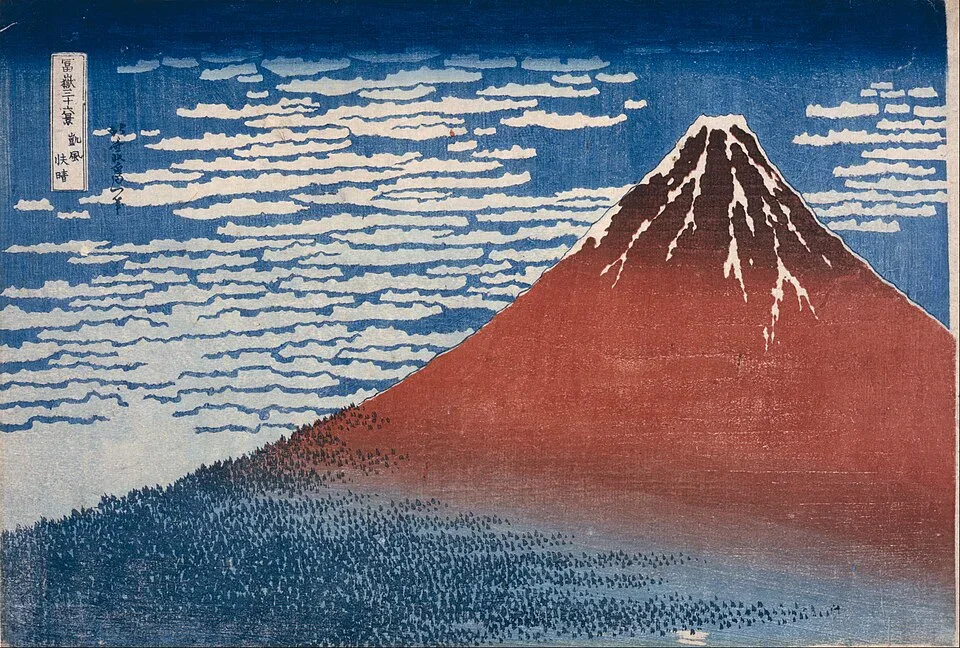
Fine Wind, Clear Morning
A very calm mountain. Solid. Symmetrical. Red as a coal. But this picture holds more than a first look gives away. Hokusai made this woodblock print, Fine Wind, Clear Morning, as one of his thirty-six views of Mount Fuji. The sky first. White clouds in neat rows, cut out of deep blue. The title gives you the weather. A south wind, and a clear sky. Now the blue itself. It darkens as it climbs, step by step, until it is almost night at the top. The mountain has its own steps of colour, and sky and slope seem to answer each other. And the red is not flat. It glows in the middle, then thins and cools toward the foot. That may be the rising sun. In early autumn, with a south wind and clear sky, it can turn the mountain red. Then the peak. Thin white threads of snow, running down dark ridges. The last of the snow still clings there. At the bottom, the forest. Thousands of tiny dark shapes, packed into one blue black mass. Dark shadows lie over it. Snow, shadow and weather all pin this down to one precise moment. And there is no village, no road, no name of a place. No one knows where he stood. He caught a moment more than a place. This calm mountain is one particular morning.
Listen in the appKatsushika Hokusai · Public domain
08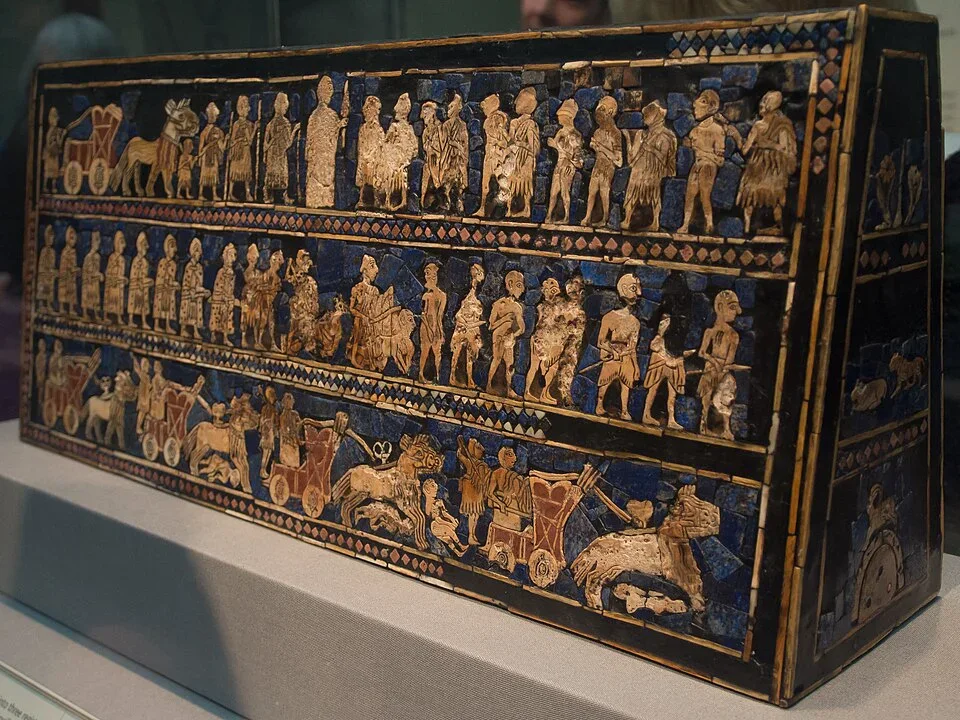
Standard of Ur
Small figures, in neat lines, all walking one way. Calm as a parade, cut from shell and set in deep blue stone. It is the Standard of Ur, made by hands no one remembers, about four thousand six hundred years ago. And it is a picture of war. Start at the top, with the tallest man. His head rises above everyone else, right up to the edge of the frame. Nothing else marks him out. Just height. Here, size is rank. Below him, the soldiers. Leather cloaks, helmets on every head, all marching alike. Real helmets of that kind lay in the same tomb. Now the prisoners, back in the top band. Naked. Arms bound. Wounds across chest and thigh. That is how defeat is drawn here, with no clothes and no dignity. In the middle band, more of them are marched away, with guards behind. Now drop to the bottom band. This is where the calm breaks. The first wagon rolls on solid wheels. Its team walks. The next one canters. Then a gallop. And under the hooves, a man on the ground. The last team rears up over a fallen enemy. Walk, canter, gallop, rear. One charge, in four steps. Those bodies under the hooves stand for the power of a wagon attack. It was found in a royal tomb, lying close to a man who may have held it on a pole. The earth crushed it, and what we see today is a careful rebuilding. And the tallest man? Below him, men are bound, bleeding and trampled. He stands taller than all of them, his head at the frame. It never was calm. It was war, told in blue.
Listen in the appDenis Bourez from France · CC BY 2.0
09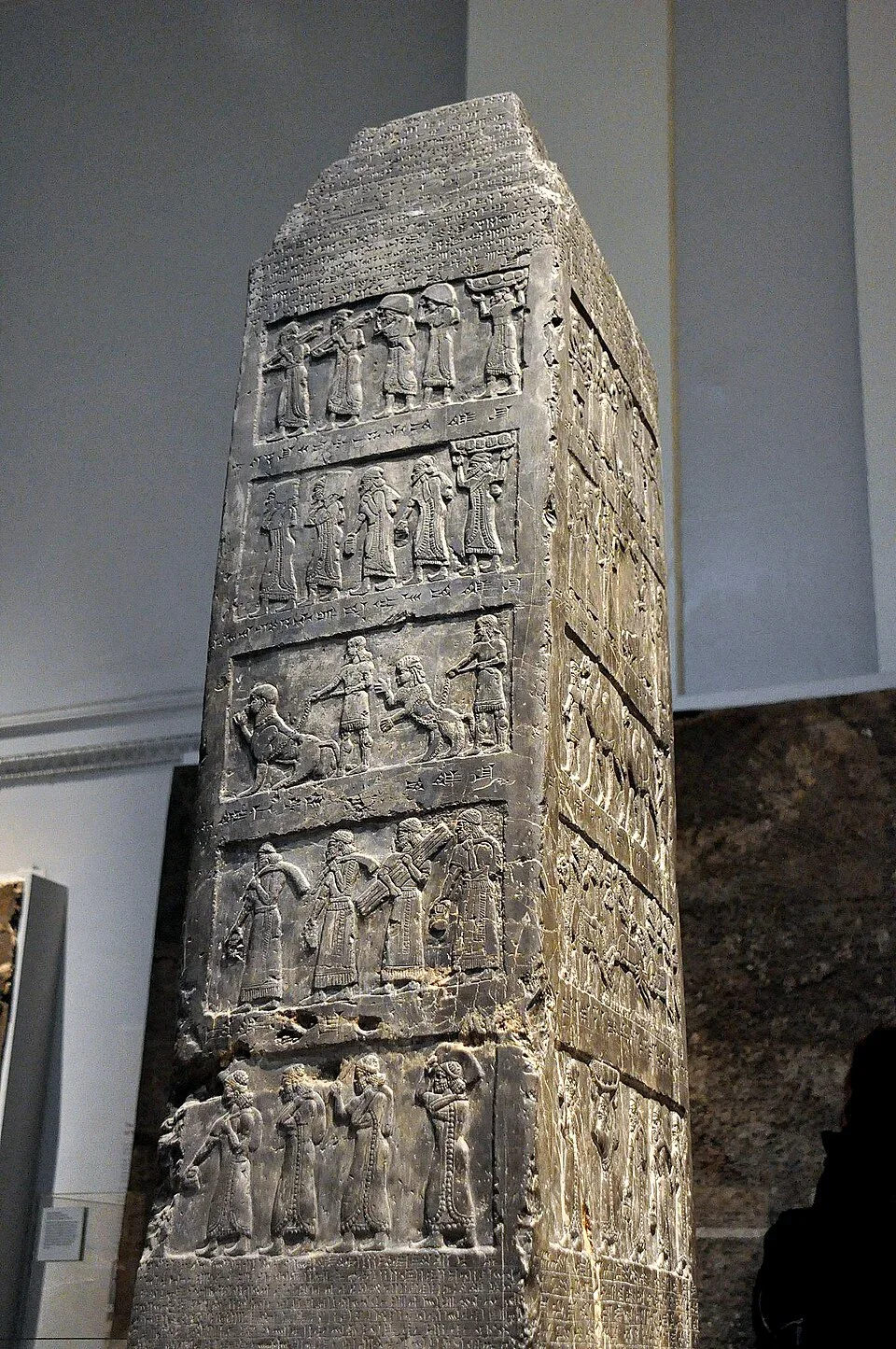
Black Obelisk of Shalmaneser III
Men in long fringed robes, one behind the other, never hurrying. Row after row, five rows high. Nothing here is shouted. Carved from black stone, this is the Black Obelisk of Shalmaneser the Third. Start with the top row. The men walk in step, and the last one lifts a heavy load on his head, both arms raised to hold it. These are not guests. They are kings, bringing gifts to a ruler who has beaten them. Five scenes, five different kings. Look at the second row, the same slow walk. And each king's scene does not stop at the edge. It runs round all four sides. Lower down, men lead animals on leads. One crouches low. Another rears up, paws reaching. Above, wedges of writing pressed into the stone, line after line. They list the king's campaigns, year by year, up to his thirty-first. Go round to the other sides. In a second row there, a king of Israel perhaps appears. Jehu. The writing above that scene lists silver, gold, a golden bowl. The obelisk went up in 825 BC, in the central square of Nimrud, at a time of civil war. A calm line of walkers, in a country that was not calm. Every step is a payment.
Listen in the appOsama Shukir Muhammed Amin FRCP(Glasg) · CC BY-SA 4.0
10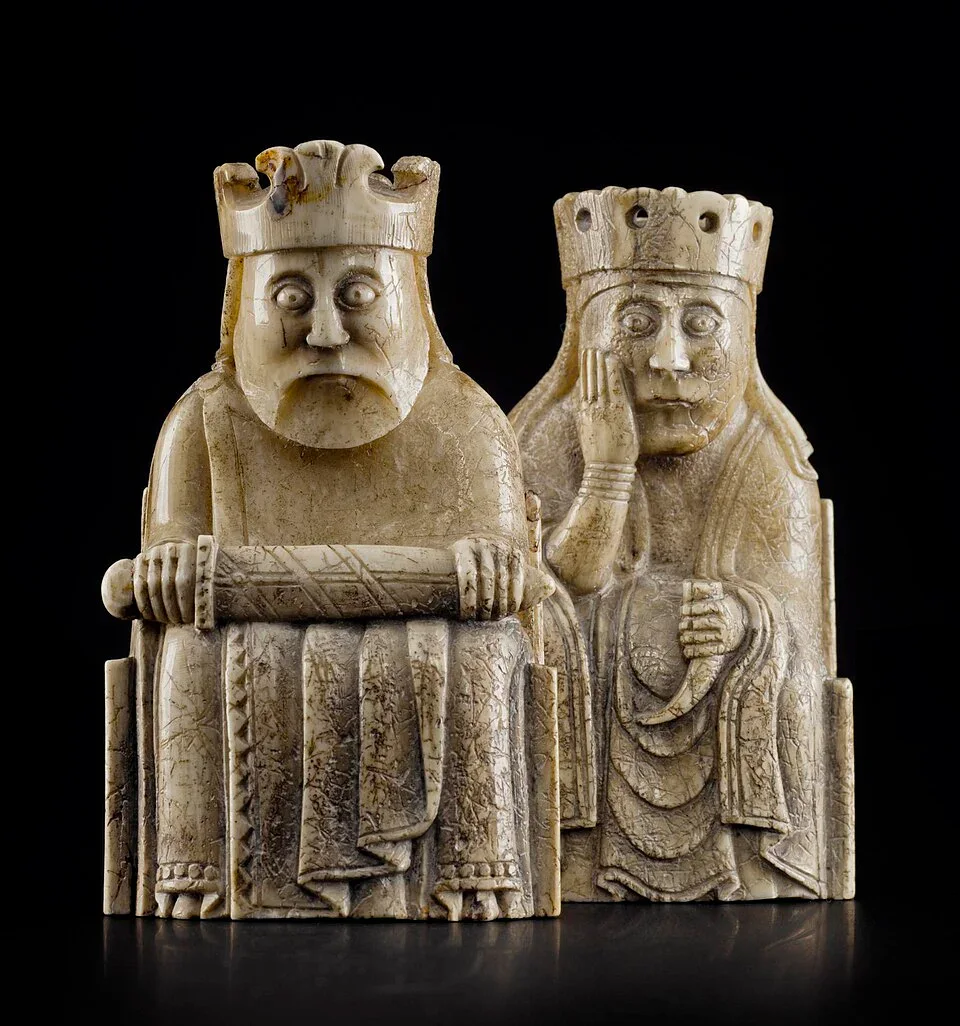
Lewis chessmen
A queen sits on her throne, her hand pressed to her face. To us she looks fed up, or heartbroken. She was never meant to. The people who carved her read that pose as contemplation, repose, maybe wisdom. The same goes for the wild-eyed soldiers who bite their own shields. That is battle fury, not a joke. These pieces were carved from walrus ivory, probably in Trondheim in Norway, sometime between 1150 and 1200. They turned up buried on the Isle of Lewis in 1831, and most of them ended up in this room. We smile at their bulging eyes and glum little faces. Their makers would not have laughed.
Listen in the appNational Museums Scotland · CC BY-SA 4.0
- 11
Benin Bronzes
Unknown Artist
- 12
Crystal skull
Unknown Artist · c. 1881
- 13
Taylor and Sennacherib Prisms
Unknown Artist · -689
- 14
Portland Vase
Unknown Artist · 100
- 15
Burney Relief
Unknown Artist · 1800–1750 BC
- 16
Oxus Treasure
Unknown Artist · -549
- 17
Oxyrhynchus Papyri
Unknown Artist
- 18
Franks Casket
Unknown Artist · 8th century
- 19
Lycurgus Cup
Unknown Artist · 350
- 20
Crouching Venus
Doidalsa · -250
- 21
Knight, Death, and the Devil
Albrecht Durer · 1513
- 22
Vindolanda tablets
Unknown Artist
- 23
complaint tablet to Ea-nāṣir
Unknown Artist · -1749
- 24
Parthenon Frieze
Phidias · -443
- 25
Nimrud lens
Unknown Artist · 749 BC
- 26
Sudden Shower over Shin-Ōhashi Bridge and Atake
Utagawa Hiroshige · 1857
- 27
The Three Crosses
Rembrandt · 1653
- 28
The Ancient of Days
William Blake · 1794
- 29
Epifania
Michelangelo · 1550–1553
- 30
Kurkh Monoliths
Yuber
- 31
Libyco-Punic Mausoleum of Dougga
Warsakan, Tamôn, Schafot, Masidil, Managai, Papai, Atban, Ankan, Abdarisch, Zimer, Zazai · -200
- 32
I Modi
Marcantonio Raimondi · 1600
- 33
Lothair Crystal
Ashley Van Haeften · 855–869
- 34
Venus tablet of Ammisaduqa
Unknown Artist
- 35
Ram in a Thicket
Unknown Artist · -2600
- 36
Bronze Head from Ife
Unknown Artist · 1300
- 37
Swimming Reindeer
Unknown Artist · -11000-01-01T00:00:00Z
- 38
Cylinder of Nabonidus
Unknown Artist · 6th century BC
- 39
Vale of York Hoard
Unknown Artist
- 40
Hoxne treasure
Unknown Artist · 400
- 41
MacGregor plaque
Unknown Artist · c. 2985 BC
- 42
Sutton Hoo helmet
Unknown Artist
- 43
Papyrus of Ani
Unknown Artist · -1249
- 44
Tablet of Shamash
Unknown Artist
- 45
Statue of Tara
Unknown Artist · 800
- 46
Adam and Eve
Albrecht Durer · 1504
- 47
Gayer-Anderson cat
Unknown Artist · -663
- 48
Gebelein predynastic mummies
Unknown Artist · c. 3350 BC
- 49
Nereid Monument
Unknown Artist
- 50
Shabaka Stone
Unknown Artist
- 51
British Museum Reading Room
Unknown Artist · 1854–1857
- 52
Aubin Codex
Unknown Artist · 1576–1607
- 53
Royal Gold Cup
Unknown Artist · 1350
- 54
Lachish letters
Unknown Artist
- 55
Ain Sakhri lovers
Unknown Artist · -9000
- 56
Sphinx of Taharqo
Unknown Artist
- 57
Lely Venus
Doidalsa · 2nd century
- 58
Ziwiye
Unknown Artist
- 59
White Obelisk
Unknown Artist
- 60
Mold gold cape
Mark Ramsay · 1900–1600 BC
- 61
Pediments of the Parthenon
Phidias · 439–432 BC
- 62
Aegina Treasure
Unknown Artist · 1850–1550 BC
- 63
Guilden Morden boar
Herbert George Fordham · http://www.wikidata.org/.well-known/genid/3b3f4309e631d13ccd47c8d11d9ef92a
- 64
Colossal red granite statue of Amenhotep III
Jon Bodsworth · c. 1370 BC
- 65
Hunters Palette
Unknown Artist · -3249
- 66
Lion of Knidos
Unknown Artist · -199
- 67
Admonitions Scroll
Gu Kaizhi · 700
- 68
Adam and Eve cylinder seal
George Smith (1840 - 1876) · c. 2200–2100 BC
- 69
Tang dynasty tomb figures of Liu Tingxun
Margaret
- 70
Kakiemon elephants
Unknown Artist · 1660–1690
- 71
Battersea Shield
Unknown Artist · -400
- 72
Holy Thorn Reliquary
Unknown Artist · c. 1390–1397
- 73
Statue of Idrimi
Unknown Artist · -1500
- 74
Uruk Trough
Gary Todd · 3300–3000 BC
- 75
Younger Memnon
Unknown Artist
- 76
Burgon vase
Burgon Group · c. 560 BC
- 77
Esquiline Treasure
Unknown Artist
- 78
Farnese Diadumenos
After Polykleitos · 1st century AD
- 79
Wandsworth Shield
Unknown Artist · 2nd century BC
- 80
Waterloo Helmet
Unknown Artist · c. 150–50 BC
- 81
metopes of the Parthenon
Unknown Artist
- 82
Meroë Head
Unknown Artist · -26
- 83
Seax of Beagnoth
Unknown Artist · 10th century
- 84
Double-headed serpent
Unknown Artist
- 85
Prudhoe Lions
Jon Bodsworth · -1369
- 86
Nimrud ivories
Unknown Artist · -900
- 87
Mogao Christian painting
Unknown Artist · 9th century
- 88
Jar of Xerxes I
Marco Prins · 486–465 BC
- 89
The Men’s Bath
Albrecht Durer · 1496–1497
- 90
Bimaran casket
Unknown Artist
- 91
Gilgamesh flood myth
Unknown Artist
- 92
Euphorbos plate
Unknown Artist · 600–599 BC
- 93
Percival David Foundation of Chinese Art
Unknown Artist
- 94
Thetford Hoard
Unknown Artist
- 95
Paracas textile
Unknown Artist
- 96
Shorwell helmet
Unknown Artist
- 97
Azekah Inscription
Henry Rawlinson
- 98
Lachish relief
Unknown Artist · 700–681 BC
- 99
Statues of Amun in the form of a ram protecting King Taharqa
Unknown Artist
- 100
Mildenhall Treasure
Unknown Artist · 4th century AD
- 101
Idalion bilingual
George M. Groutas · 388 BC
- 102
Great Mongol Shahnameh
Unknown Artist · c. 1330s
- 103
Tomb of Payava
Unknown Artist · -359
- 104
Mathura lion capital
Unknown Artist · 5
- 105
Minoan Bull-leaper
Unknown Artist · -1600
- 106
Ambika Statue from Dhar
Unknown Artist
- 107
Assyrian lion weights
Unknown Artist · 8th century BC
- 108
Chatsworth Apollo
Unknown Artist · c. 460 BC
- 109
Jennings Dog
Unknown Artist · 2nd century AD
- 110
Campo Iemini Venus
Variant/copy of a type by Praxiteles
- 111
Study for the Madonna of the Cat
Leonardo da Vinci · c. 1480
- 112
Statue of Ashurnasirpal II
Unknown Artist · -871
- 113
Battlefield Palette
Unknown Artist
- 114
Apapa Hoard
Unknown Artist · early 16th century
- 115
Braganza Brooch
Unknown Artist · 3rd century BC
- 116
florin
Unknown Artist · 1344
- 117
Isabella Brant
Peter Paul Rubens · c. 1621
- 118
Statue of Horemheb and Amenia
Unknown Artist
- 119
Portrait of a Young Woman
Rogier van der Weyden · 1430–1445
- 120
Strangford Apollo
Unknown Artist · 500–490 BC
- 121
Obelisks of Nectanebo II
Unknown Artist · 4th century BC
- 122
Basse Yutz Flagons
Unknown Artist · 5th century BC
- 123
Allegory of Abundance
Sandro Botticelli · c. 1480–1485
- 124
Strickland Brooch
Unknown Artist · mid-9th century
- 125
Ribchester Helmet
James Basire
- 126
Fuller Brooch
Unknown Artist · late 9th century
- 127
El-Amra clay model of cattle
Unknown Artist · c. 3500 BC
- 128
Empress pepper pot
Unknown Artist
- 129
Kanishka casket
Unknown Artist · 127
- 130
Carthage Treasure
Unknown Artist
- 131
Punic-Libyan bilinguals
Jean Emile Humbert · 2nd century BC
- 132
Oscan Tablet
Unknown Artist · 3rd century BC
- 133
Mechanical Galleon
Hans Schlottheim · c. 1585
- 134
Colossal quartzite statue of Amenhotep III
Jon Bodsworth · c. 1350 BC
- 135
Greenfield papyrus
Unknown Artist
- 136
Strolling Actresses Dressing in a Barn
William Hogarth · 1738
- 137
Stela of Shamshi-Adad V
Unknown Artist · 824–811 BC
- 138
Tell al-'Ubaid Copper Lintel
Unknown Artist
- 139
Hari-shigoto
Kitagawa Utamaro · c. 1794–1795
- 140
Papyrus of Hunefer
Hunefer · 1310–1275 BC
- 141
Dramatic Ramesseum Papyrus
Unknown Artist
- 142
The Fall of Phaeton
Michelangelo · c. 1533
- 143
Anahit statue
Unknown Artist · -200
- 144
The Bad Taste of the Town
William Hogarth · 1723–1724
- 145
A Poison Tree
William Blake · 1794–1795
- 146
Esarhaddon's Treaty with Ba'al of Tyre
w:Hugo Winckler · 681–669 BC
- 147
Ringlemere Cup
The Portable Antiquities Scheme, Daniel Pett, 2003-07-29 16:01:39 · c. 1700–1500 BC
- 148
Blau Monuments
King, L. W. (Leonard William), 1869-1919
- 149
Emblematical Print on the South Sea Scheme
William Hogarth · 1721
- 150
Land grant to Ḫasardu kudurru
L. W. King
- 151
Ship's chronometer from HMS Beagle
Thomas Earnshaw · c. 1800
- 152
Seated Woman with a Spider's Web
Joachim Christian Adolf Friedrich · c. 1803
- 153
Balawat Gates
Unknown Artist · -850
- 154
Little Passion
Albrecht Durer · 1511
- 155
Witham Shield
Unknown Artist · c. 4th century BC
- 156
Bassae Frieze
Unknown Artist · 420–400 BC
- 157
La Ghorfa stelae
Unknown Artist
- 158
Assyrian statue
Unknown Artist · 1080–1056 BC
- 159
Apollo of Cyrene
Unknown Artist · 2nd century AD
- 160
Demeter of Knidos
Unknown Artist · c. 350 BC
- 161
Hoa Hakananai'a
Unknown Artist
- 162
Choiseul-Gouffier Apollo
Unknown Artist · 1st century AD
- 163
Copper Bull
Unknown Artist · c. 2600 BC
- 164
Antiochus cylinder
Unknown Artist · c. 250 BC
- 165
Townley Antinous
Unknown Artist · 130
- 166
Son of Baalshillek marble base
Nathan Davis
- 167
Star Carr Frontlets
Unknown Artist
- 168
God on the Winged Wheel coin
Unknown Artist · 4th century BC
- 169
The Lyte Jewel
Nicholas Hilliard · 1610
- 170
Rongorongo text K
Unknown Artist
- 171
Taino Ritual Seat
Arahuacos (Arawak)
- 172
statue of A'a from Rurutu
Unknown Artist · c. 1591–1647
- 173
Icon of the Triumph of Orthodoxy
Unknown Artist · c. 1400
- 174
Tudor Heart Pendant
Unknown Artist · early 16th century
- 175
The Penance of St. John Chrysostom
Albrecht Durer · 1496–1497
- 176
Nemesis
Albrecht Durer · 1501–1503
- 177
Sir Joseph Banks (1743–1820), President of the Royal Society, Trustee of the British Museum
Thomas Lawrence · 1806
- 178
Piranesi Vase
Giovanni Battista Piranesi
- 179
Seated Luohan from Yixian
Unknown Artist
- 180
Shebna Inscription
Unknown Artist · 7th century BC
- 181
Guisborough Helmet
Unknown Artist · 3rd century AD
- 182
Yaxchilan Lintel 24
Unknown Artist
- 183
Shrewsbury Hoard
Unknown Artist · 335
- 184
Miniature altarpiece
Unknown Artist · 1511
- 185
Arcisate Treasure
Unknown Artist · c. 100–75 BC
- 186
Bell Shrine of St. Cuileáin
Unknown Artist
- 187
Petelia Gold Tablet
Unknown Artist · 300–200 BC
- 188
Folkton Drums
Unknown Artist
- 189
Head of a Walrus
Albrecht Durer · 1521
- 190
Water Newton Treasure
Unknown Artist · 4th century AD
- 191
Waddesdon Bequest
Unknown Artist
- 192
Tourdan Situla
Unknown Artist · 2nd century AD
- 193
Little Thetford flesh-hook
Dr Peter Hoare of pgh@ventifact.co.uk
- 194
Milton Keynes Hoard
Unknown Artist · c. 1150–800 BC
- 195
Penrith Hoard
Unknown Artist · 10th century
- 196
Robin Hood Cave Horse
Unknown Artist
- 197
Unlucky Mummy
Unknown Artist · 950–899 BC
- 198
Hinton St Mary Mosaic
Unknown Artist · 4th century AD
- 199
Amarna Akkadian letter
Unknown Artist · -1350
- 200
Vaison Diadumenos
Copy after Polykleitos
- 201
Wardak Vase
Unknown Artist
- 202
Watlington Hoard
Anon
- 203
Witcham Gravel helmet
Unknown Artist
- 204
Pentney Hoard
Unknown Artist · 800
- 205
Carthaginian slaughterhouse inscription
Corpus Inscriptionum Semiticarum
- 206
Bronze Head of Queen Idia
Unknown Artist · early 16th century
- 207
David Vases
Unknown Artist · 1351
- 208
Amaravati sculptures in the British Museum
Unknown Artist
- 209
Amarna letter EA 9
Unknown Artist
- 210
The Spanish Bullfight
James Gillray · 1808
- 211
Carthage Tariff
C J Ball · 3rd century BC
- 212
Woman with Dead Child
Käthe Kollwitz · 1903
- 213
Londesborough Brooch
Unknown Artist
- 214
Armento Rider
Unknown Artist · c. 560–550 BC
- 215
Sedgeford Torc
Unknown Artist
- 216
Archangel ivory
Unknown Artist · 520
- 217
Saint-Denis Crystal
Unknown Artist
- 218
Borradaile Triptych
Unknown Artist · 900
- 219
Breadalbane Brooch
Unknown Artist · c. 8th century
- 220
Lacock Cup
Unknown Artist · mid-15th century
- 221
Asclepius of Milos
Unknown Artist
- 222
Great Torc from Snettisham
Unknown Artist · c. 75 BC
- 223
John Grandisson Triptych
Unknown Artist · 1330–1340
- 224
Klang Bell
Unknown Artist
- 225
Lingwell Gate coin moulds
Unknown Artist
- 226
Kendrick's Cave Decorated Horse Jaw
Unknown Artist · -8000
- 227
Meyrick Helmet
Unknown Artist
- 228
Rongorongo text J
Unknown Artist
- 229
Rongorongo text L
Unknown Artist
- 230
Townley Caryatid
Unknown Artist · 140
- 231
Townley Vase
Unknown Artist · 2nd century AD
- 232
Wolverine pendant of Les Eyzies
Unknown Artist · -10500-01-01T00:00:00Z
- 233
Arundel Head
Unknown Artist
- 234
Ædwen's brooch
Unknown Artist · early 11th century
- 235
Sant'Angelo Muxaro Patera
Unknown Artist · c. 599 BC
- 236
Palmer Cup
Unknown Artist · 1200–1225
- 237
Bossall-Flaxton hoard
Unknown Artist · early 10th century AD
- 238
The Large Horse
Albrecht Durer · 1505
- 239
Frederick the Wise, Elector of Saxony
Albrecht Durer · 1524
- 240
Willibald Pirkheimer
Albrecht Durer · 1524
- 241
Philipp of Melanchthon
Albrecht Durer · 1526
- 242
The Little Fortune
Albrecht Durer · 1495–1496
- 243
An Oriental Family
Albrecht Durer · c. 1496
- 244
Witch riding backwards on a goat
Albrecht Durer · c. 1500
- 245
Warrior with Helmet and Breastplate in Profile
Leonardo da Vinci · 1472–1480
- 246
Hercules
Albrecht Durer · 1496–1497
- 247
Head of a woman
Andrea del Verrocchio · 1475
- 248
Aleppo Treaty
Unknown Artist · 13th century BC
- 249
Kells Crozier
Unknown Artist
- 250
Mâcon Treasure
Unknown Artist
- 251
Kang Hou Gui
Unknown Artist
- 252
First Cyprus Treasure
Unknown Artist
- 253
Dowris Hoard
Unknown Artist · 900–600 BC
- 254
silver finds from the Sutton Hoo ship burial
amandabhslater
- 255
Mainz Gladius
Unknown Artist
- 256
Townley Venus
Unknown Artist
- 257
Oxborough Dirk
Unknown Artist
- 258
Domagnano Treasure
Unknown Artist
- 259
Priene Inscription
Unknown Artist · 334–330 BC
- 260
Cordoba Treasure
Unknown Artist
- 261
Amitābha Buddha
Unknown Artist
- 262
Amran Tablets
Unknown Artist
- 263
Kulu Vase
Unknown Artist
- 264
Lochar Moss Torc
Unknown Artist
- 265
Paramythia Hoard
Unknown Artist
- 266
Sambas Treasure
Unknown Artist
- 267
Lampsacus Treasure
Unknown Artist
- 268
Amarna Letter EA 5
Amenhotep III · 14th century BC
- 269
Rondanini Faun
François Duquesnoy · 1625–1630
- 270
Hephthalite silver bowl
Unknown Artist
- 271
Oscott Psalter
Unknown Artist · 1265–1270
- 272
Moel Hebog shield
Unknown Artist · 1300–1000 BC
- 273
Blacas ewer
Unknown Artist · 1232
- 274
Bell Shrine of Conall Cael
Unknown Artist · early 12th century
- 275
Gray's Inn Lane Hand Axe
Unknown Artist
- 276
Ipswich Hoard
Unknown Artist
- 277
Mammoth spear thrower
Unknown Artist · -10500-01-01T00:00:00Z
- 278
Taxila copper plate
Unknown Artist
- 279
Stela of Ashurnasirpal II
Unknown Artist · 883–859 BC
- 280
Codex Waecker-Gotter
Unknown Artist
- 281
Sanchi Yakshi Figure
Unknown Artist · 1st century AD
- 282
Sutri Treasure
Unknown Artist
- 283
Uerdingen Hoard
Unknown Artist
- 284
Xanten Horse-Phalerae
Unknown Artist
- 285
Tromsø Burial
Unknown Artist
- 286
Buddhapad Hoard
Unknown Artist
- 287
Jade terrapin
Unknown Artist
- 288
Teotihuacan Ocelot
Unknown Artist
- 289
Thanjavur Shiva
Unknown Artist
- 290
Beaurains Treasure
Unknown Artist
- 291
Asyut Treasure
Unknown Artist
- 292
Corbridge Lanx
Unknown Artist · 4th century AD
- 293
Pontormo - Study for Deposition Capponi Chapel 001
Pontormo · 1520s
- 294
Elgin Amphora
Unknown Artist · 760–749 BC
- 295
Peter Behrens for his 150th Birthday-8607
Peter Behrens · 1900–1901
- 296
hydria
Unknown Artist
- 297
Orense Torcs
Unknown Artist · 3rd century BC
- 298
Wernher Triptych
Unknown Artist
- 299
Crucifixion
Michelangelo · c. 1545
- 300
Sarcophagi of Seianti women
Unknown Artist · 2nd century BC
- 301
Bronze Head of Hypnos from Civitella d'Arna
Unknown Artist
- 302
Deepdale Hoard
Unknown Artist · c. 337
- 303
The Small Horse
Albrecht Durer · 1505
- 304
The Lady Riding and the Landsknecht
Albrecht Durer · c. 1497
- 305
BM-13901
François Thureau-Dangin · -1800
- 306
Characters and Caricaturas
William Hogarth · 1743
- 307
The Allied Bakers
George Cruikshank · 1814
- 308
Cracked Ice screen
Maruyama Ōkyo · late 18th century
- 309
Landscape with a View of the Sea at Sunset
Joos de Momper the Younger · 1610
- 310
Fools' kitchen
Hieronymus Bosch · 1477
- 311
Pictorum aliquot celebrium Germaniae inferioris effigies
Johannes Wierix
- 312
Musicians plate
Unknown Artist
- 313
Pleasure District at Senju
Katsushika Hokusai · 1830–1832
- 314
Chaourse Treasure
Unknown Artist
- 315
Isis Tomb, Vulci
Unknown Artist · 625–550 BC
- 316
Gaochang Jili
Unknown Artist
- 317
Crystal Goose
Kushan Empire · 900
- 318
Statue ivory king Petrie
W. M. Flinders Petrie (1853-1942) · -2950
- 319
Jacob's Ladder
William Blake · 1805
- 320
Tejaprabhā Buddha and the Five Planets
Chang Huai-hsing · 897
- 321
Westmacott athlete
Polykleitos · c. 450 BC
- 322
Bursa Treasure
Unknown Artist · 1st century AD
- 323
Capheaton Treasure
Unknown Artist
- 324
Caubiac Treasure
Unknown Artist
- 325
Artres Treasure
Unknown Artist
- 326
Belluno Treasure
Unknown Artist
- 327
Bergamo Treasure
Unknown Artist · 6th century AD
- 328
Lamentation for the Dead Christ
Albrecht Durer · 1495–1498
- 329
Codex Kingsborough
Unknown Artist · c. 1550s
- 330
Dunaverney flesh-hook
Unknown Artist · 1050–900 BC
- 331
Dunstable Swan Jewel
Unknown Artist · c. 1400
- 332
Shropshire bulla
Unknown Artist
- 333
Stele of Ushumgal and Shara-igizi-Abzu
Unknown Artist
- 334
Townley Hadrian
Unknown Artist · 2nd century AD
- 335
Granite bust of Ramses II
Unknown Artist · -1249
- 336
Adam and Eve in paradise
Lucas Cranach the Elder · 1506–1509
- 337
Portrait of Leendert van der Cooghen with a Large Hat (Cornelis Pietersz. Bega) c. 1653-54
Cornelis Pietersz Bega · c. 1653–1654
- 338
Amarna Tablet
Unknown Artist · c. 1350 BC
- 339
Hamadab Stela
Unknown Artist
- 340
Chatuzange Treasure
Unknown Artist
- 341
Reliquary of St. Eustace
Unknown Artist · 1200
- 342
Huixian Bronze Hu
Unknown Artist
- 343
Townley Discobolus
Copy of Myron · 2nd century AD
- 344
Fragmentary Cameo: Head of Claudius crowned with laurel
Unknown Artist · 45
- 345
Inlaid and gilded panel
Unknown Artist
- 346
Relief of Jason the Physician
Unknown Artist · 2nd century AD
- 347
Papyrus BM 10808
Unknown Artist · 2nd century AD
- 348
Appels dragonhead
Unknown Artist
- 349
Stone (basalt?) seated figure of Xochipilli, with arms crossed over the knees
Unknown Artist · 1435
- 350
Mithras sacrificing a bull
Unknown Artist · 2nd century AD
- 351
British Museum Xiuhtecuhtli
Unknown Artist · 1423
- 352
Bust of Homer BM
Unknown Artist · 2nd century
- 353
British Museum Egypt 093
Unknown Artist · c. 1324 BC
- 354
Bronze stand 3
Unknown Artist · -1150
- 355
Ptolemy
Unknown Artist
- 356
British Museum Egypt 047
Unknown Artist · c. 369 BC
- 357
box with scenes from the Joseph story
Unknown Artist
- 358
Head of an Old Woman
Hans Baldung Grien · 15th century
- 359
Quetzalcoatl 801
Unknown Artist · 1423
- 360
Harp from the New Kingdom
Jon Bodsworth · 1550–1069 BC
- 361
Statue of Nenkheftka
Jon Bodsworth · -2399
- 362
Khaemwaset
Markh · -1249
- 363
The Disasters of War (unframed)
Francisco Goya · 1810–1814
- 364
My Lady Greensleeves
Dante Gabriel Rossetti · 1859
- 365
Arthur's Tomb; Alternative title: The last meeting of Launcelot and Guenevere
Dante Gabriel Rossetti · 1854
- 366
Fragmentary Bust of Ahmes Merytamun-August 19-08
Unknown Artist
- 367
Tlazolteotl
Unknown Artist
- 368
Statue Kurlil BM WA114207
Unknown Artist · -2499
- 369
Xiuhcoatl British Museum
Unknown Artist · 1425
- 370
BM; RM6 - ANE, Assyrian Sculpture 13 West Wall (M + N) ~ Assyrian Empire + -Lamassu, Gates at Balawat, Relief Panel's) & Full Projection.2
Unknown Artist · -882
- 371
Mictlantecuhtli
Unknown Artist · 1423
- 372
Whalebone plaque
Unknown Artist
- 373
Sphinx of Taharqa in the British Museum
Unknown Artist · 680 BC
- 374
The Last Judgment
After Hieronymus Bosch · 1550–1570
- 375
Tang-4
Unknown Artist
- 376
Ammenemes IV (Side)-British Museum-August 19-08
Unknown Artist
- 377
The Nativity
Albrecht Durer · 1504
- 378
Saint George on Horseback
Albrecht Durer · 1505–1508
- 379
The Crucifixion
Albrecht Durer · 1508
- 380
The Virgin with a Starry Crown
Albrecht Durer · 1508
- 381
Sudarium Displayed by Two Angels
Albrecht Durer · 1513
- 382
Peasant Couple Dancing
Albrecht Durer · 1514
- 383
The Bagpiper
Albrecht Durer · 1514
- 384
Cardinal Albrecht of Brandenburg - The Small Plate
Albrecht Durer · 1519
- 385
Cardinal Albrecht of Brandenburg - the Large Plate
Albrecht Durer · 1523
- 386
Saint Bartholomew
Albrecht Durer · 1523
- 387
Saint Simon
Albrecht Durer · 1523
- 388
Saint Philip
Albrecht Durer · 1523–1526
- 389
Man of Sorrows, Seated
Albrecht Durer · 1515
- 390
The Angel with the Sudarium
Albrecht Durer · 1516
- 391
Saint John's vision of the seven candlesticks
Albrecht Durer · 1497–1498
- 392
Martyrdom of St Sebastian
Albrecht Durer · c. 1495
- 393
The Eight Saints of Austria
Albrecht Durer · 1515–1517
- 394
Studies of The Virgin and Child with Saint Anne and Saint John the Baptist
Leonardo da Vinci · 1503–1510
- 395
Crucifixion
Albrecht Durer · 1495–1498
- 396
The First Knot
Albrecht Durer · 1505–1507
- 397
The Small Triumphal Car or the Burgundian Marriage (left part)
Albrecht Durer · c. 1518
- 398
The Small Triumphal Car or the Burgundian Marriage (right part)
Albrecht Durer · c. 1518
- 399
Landscape with a Woodland Pool
Albrecht Durer · c. 1496
- 400
St. Bridget and the Virgin interceding for the Damned (leaf 11)
Albrecht Durer · 1500
- 401
Leda and the Swan
Cornelis Bos · 1540s
- 402
Rhinoceros (preparatory study)
Albrecht Durer · 1515
- 403
Tomb of Nebamun
Unknown Artist · 1400–1350 BC
British Museum
Frequently asked questions
How much does the guide cost?
Free app download. Free until 1 January. Listed guide price: $4.99. Audio guide only. Venue admission is separate.
Can I listen without internet?
Yes. Download the guide’s audio, images, and maps in the app before your visit. Your downloaded content is then available offline.
Can I listen in my language?
In English for now. More languages soon.
Do I need to follow a schedule?
No. This is a self-guided experience. Choose your stops, pause whenever you like, and return to a story at your own pace.
Which artworks are in the British Museum audio guide?
403 artworks, including The Great Wave off Kanagawa (Katsushika Hokusai), Rosetta Stone (Unknown Artist), Cyrus cylinder (Unknown Artist), The Rhinoceros (Albrecht Durer), Melencolia I (Albrecht Durer), Babylonian Map of the World (Unknown Artist), Fine Wind, Clear Morning (Katsushika Hokusai), and Standard of Ur (Unknown Artist). The full list is on this page.
Is this the museum’s official audio guide?
No. Stanza is an independent audio guide app and is not affiliated with British Museum. Museum admission is separate.
At your own pace
Explore British Museum.
Download Stanza, then search for “British Museum”.
Free app download · Guide price shown in the app
Keep exploring
Nearby audio guides
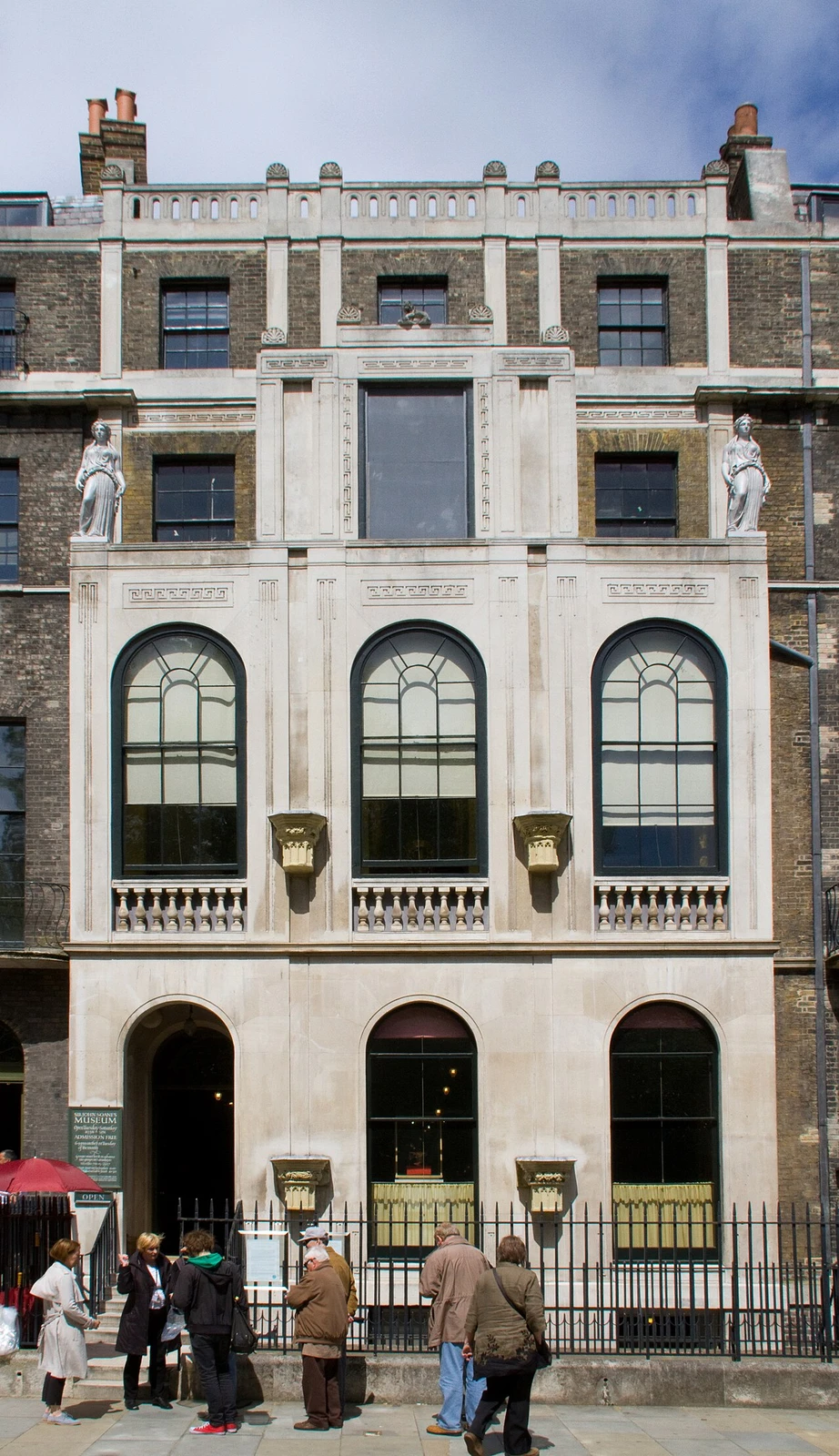
Greater London · 1 km
Sir John Soane's Museum
Content & sources
Tony Hisgett from Birmingham, UK · CC BY 2.0
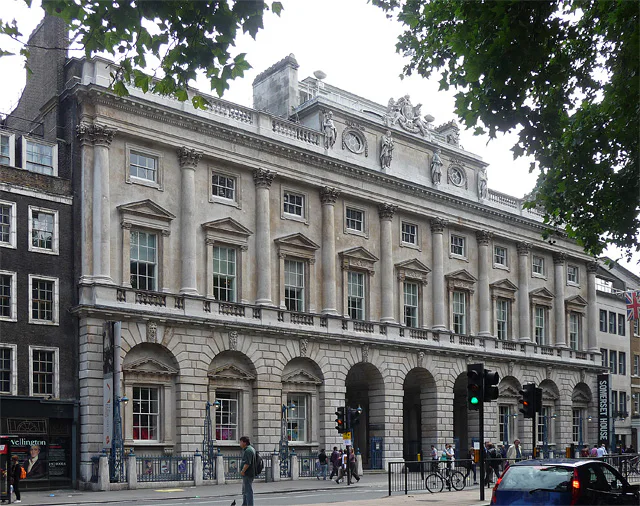
City of Westminster · 1 km
Courtauld Gallery
Content & sources
Stephen Richards · CC BY-SA 2.0
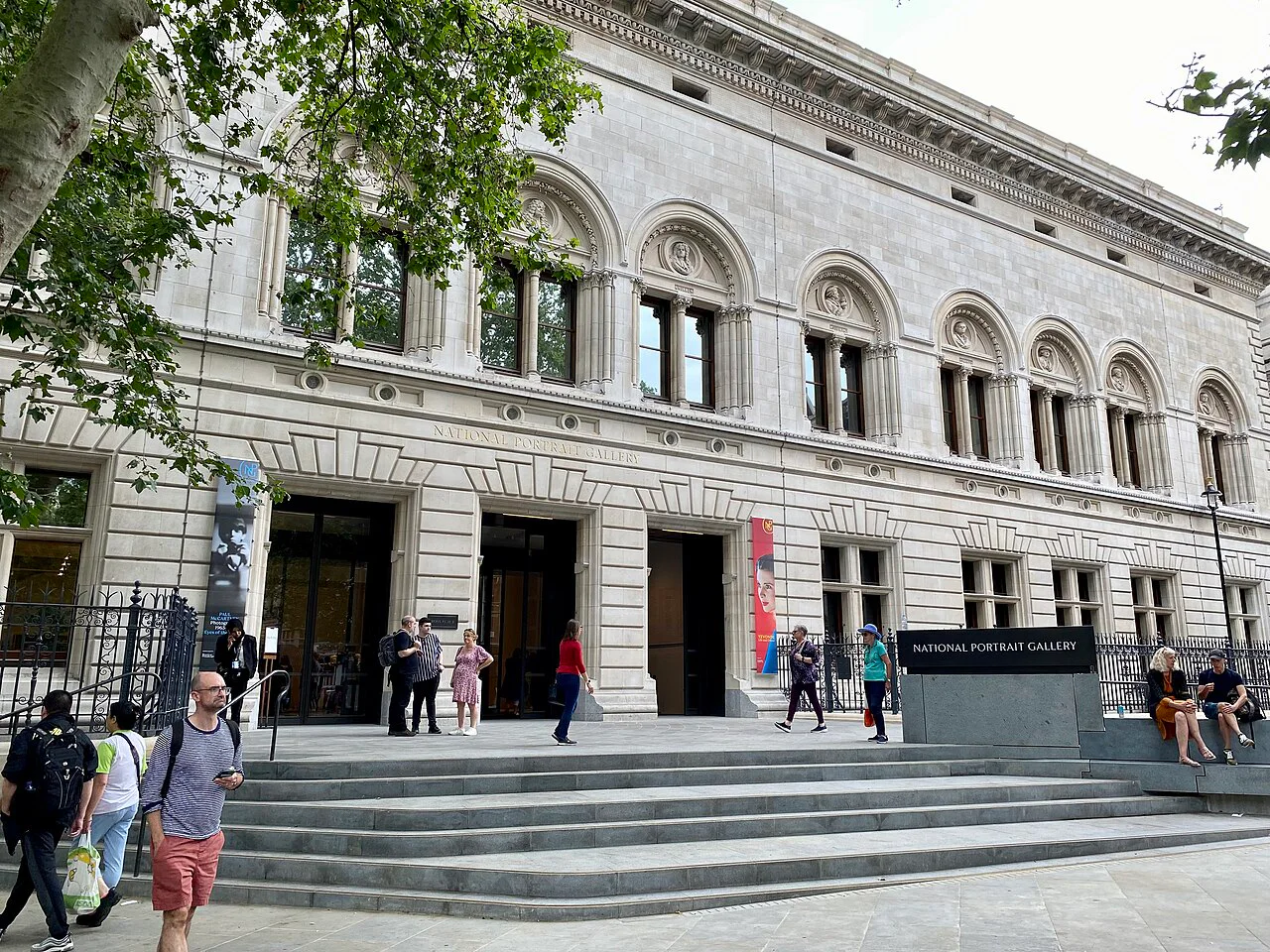
City of Westminster · 1 km
National Portrait Gallery, London
Content & sources
Photo: No Swan So Fine · CC BY-SA 4.0
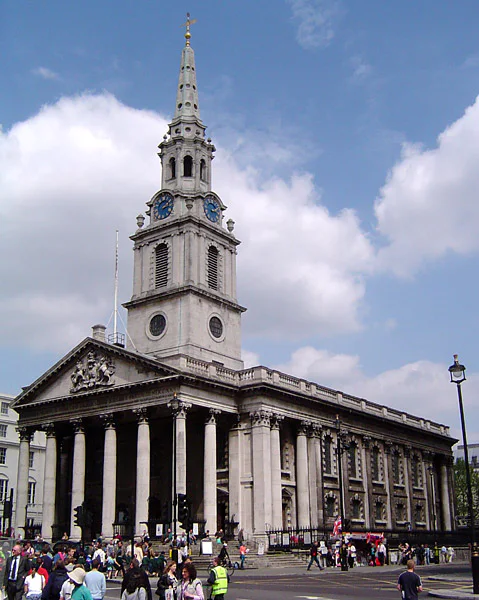
London · 1 km
St Martin-in-the-Fields
Content & sources
Photo: Yopohari~commonswiki · CC BY-SA 3.0
Art museums
More art museum audio guides
London · 8 artworks
Sir John Soane's Museum
Content & sources
Tony Hisgett from Birmingham, UK · CC BY 2.0
London · 33 artworks
Courtauld Gallery
Content & sources
Stephen Richards · CC BY-SA 2.0
London · 164 artworks
National Portrait Gallery, London
Content & sources
Photo: No Swan So Fine · CC BY-SA 4.0
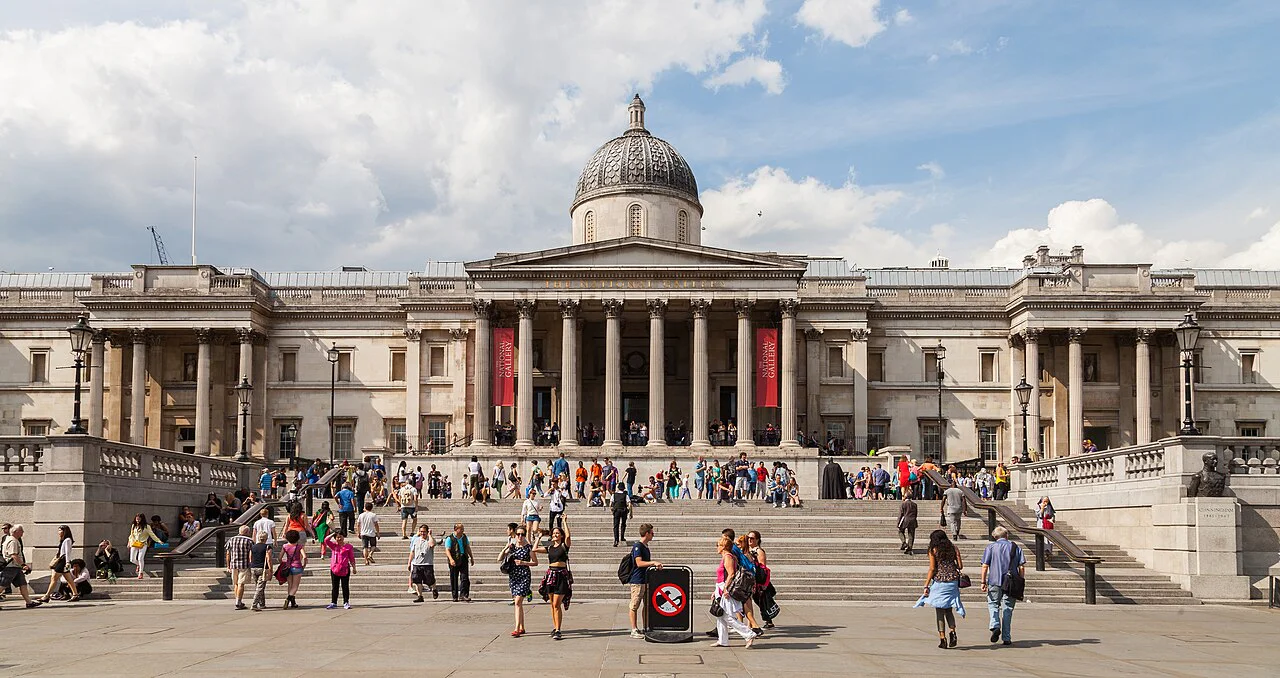
London · 617 artworks
National Gallery, London
Content & sources
Diego Delso · CC BY-SA 4.0
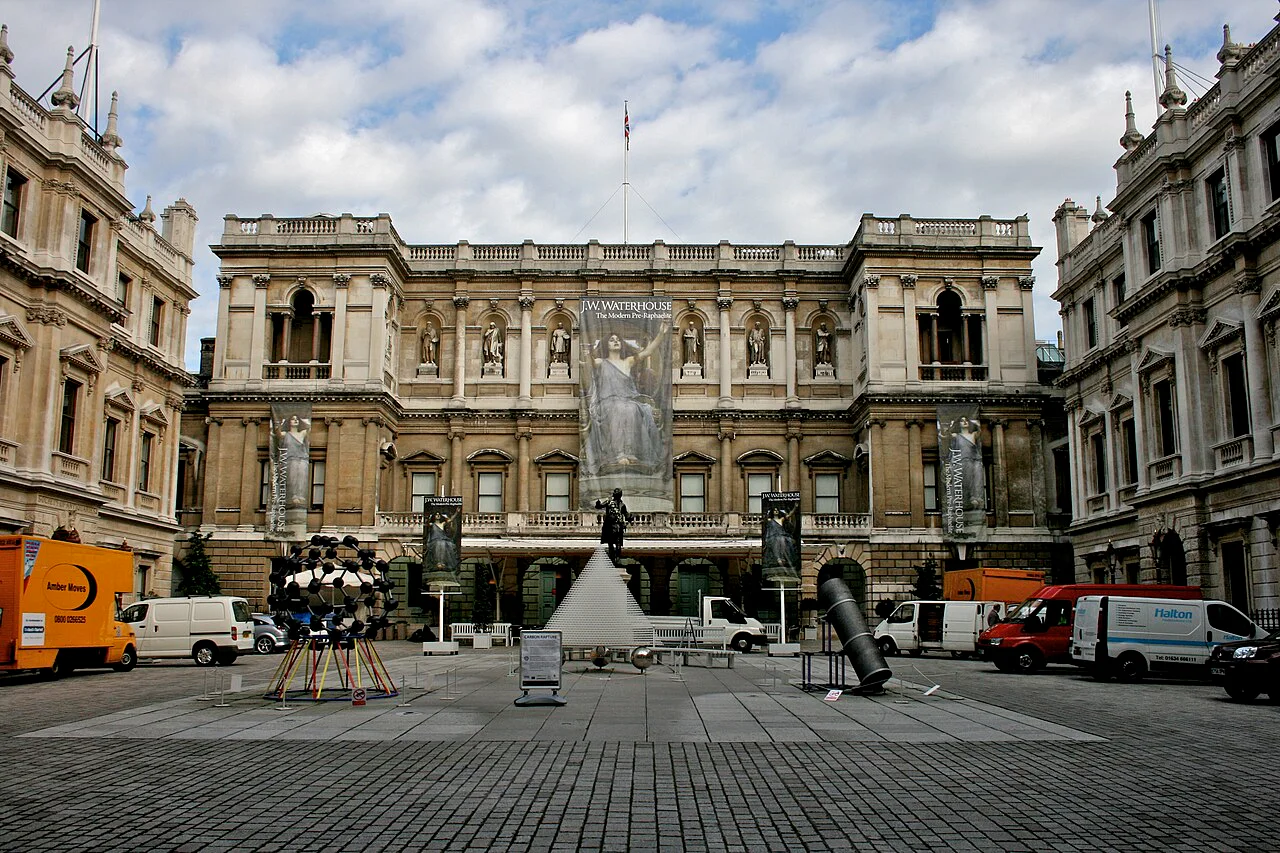
London · 50 artworks
Royal Academy of Arts
Content & sources
Photograph by Mike Peel (www.mikepeel.net). · CC BY-SA 4.0
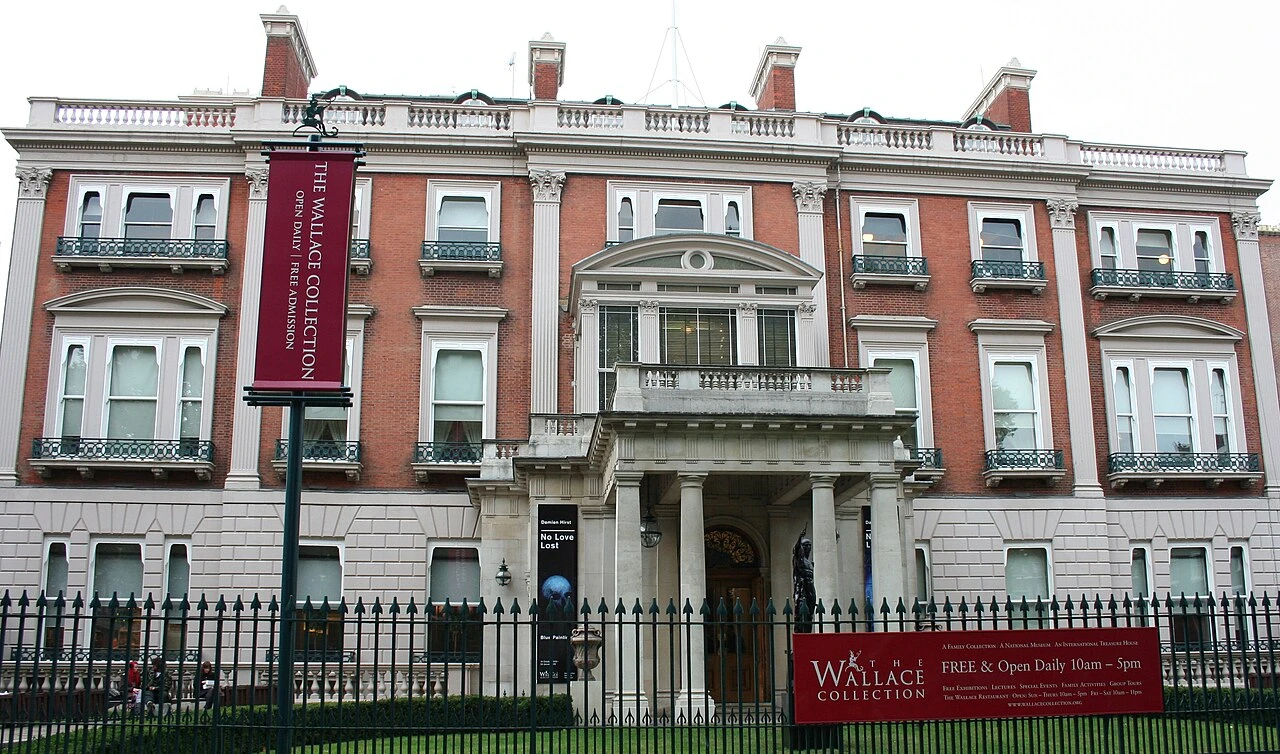
London · 605 artworks
Wallace Collection
Content & sources
Photo: Peter Clarke · CC BY-SA 3.0