Stanza · Audio guide
Buckingham Palace Audio Guide
A place to remember. A story to take with you.
Buckingham Palace is the official residence and administrative headquarters of the monarch of the United Kingdom in London. It is often at the centre of state occasions and royal hospitality.
Download Stanza, then search for “Buckingham Palace”.
About the tour
One guide. Your kind of visit.
Buckingham Palace is the official residence and administrative headquarters of the monarch of the United Kingdom in London. It is often at the centre of state occasions and royal hospitality.
Ready when you are.
- 01Get the free Stanza app.
iOS & Android
- 02Find your guide.
“Buckingham Palace”
- 03Download before you go.
Works offline
Audio guide / 17 narrated stops
Inside the guide
Get to know a few of the stories before you go. Open a stop to read more.
01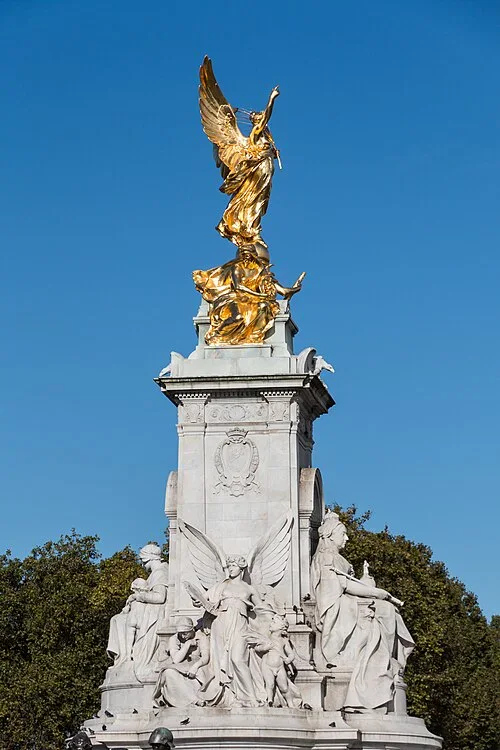 The Victoria Memorial & The Mall Approach
The Victoria Memorial
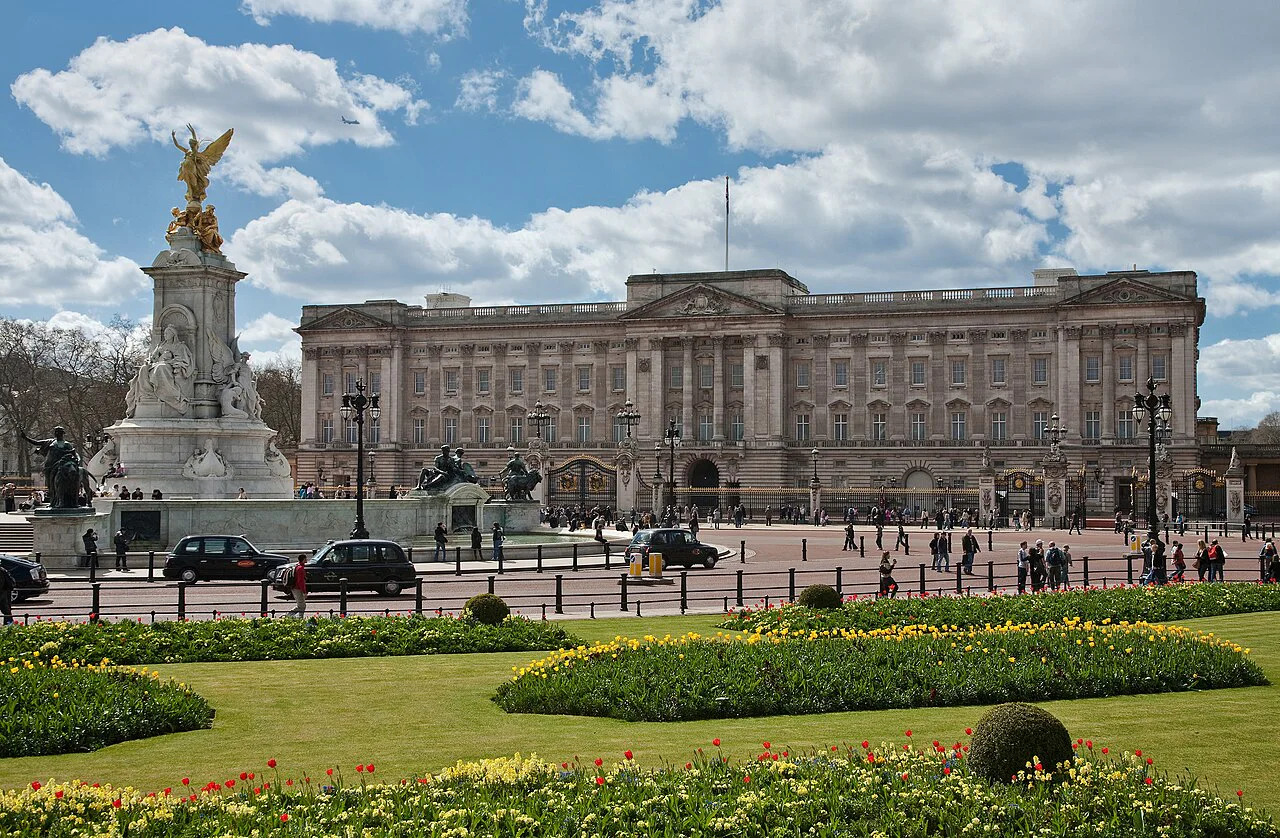
Welcome to Buckingham Palace. The gilded winged figure crowning the white marble monument is part of the memorial to Queen Victoria, and it now stands between the palace gates and the world beyond them. Victoria was the first monarch to live here. She arrived as queen in June 1837, and every monarch after her occupied the palace until the present King, who works here but lives at nearby Clarence House. The palace is the official residence and administrative headquarters of the British monarch. It is a working building too: about 775 rooms, and more than 700 people come here to work. Every year some 50,000 invited guests are entertained at garden parties, receptions and banquets. Through all of it, the palace has been a focal point for the British people at times of national rejoicing and mourning.
Dietmar Rabich · CC BY-SA 4.0
02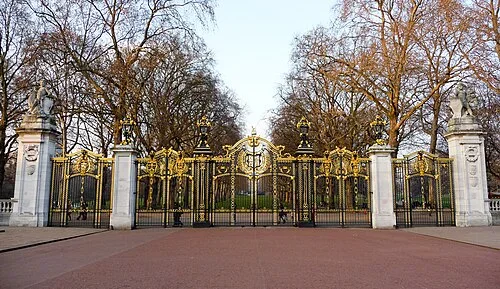 The Victoria Memorial & The Mall Approach
Gates on the Mall Approach
The broad tree-lined avenue running towards the palace is The Mall, and it was laid out as an approach rather than an ordinary street. Aston Webb designed it, and it was completed in 1911 as part of a grand memorial to Queen Victoria. It runs from Admiralty Arch, across St James's Park, to the Victoria Memorial, and ends at the gates into the palace forecourt. Road, monument and gates were meant to be read as one composition, with the palace closing the view. This is the route taken by the cavalcades of visiting heads of state, and the royal family use it on state occasions, including the annual Trooping the Colour. The gilded gate here belongs to that same memorial setting around the monument.
Ian Dick · CC BY 2.0
03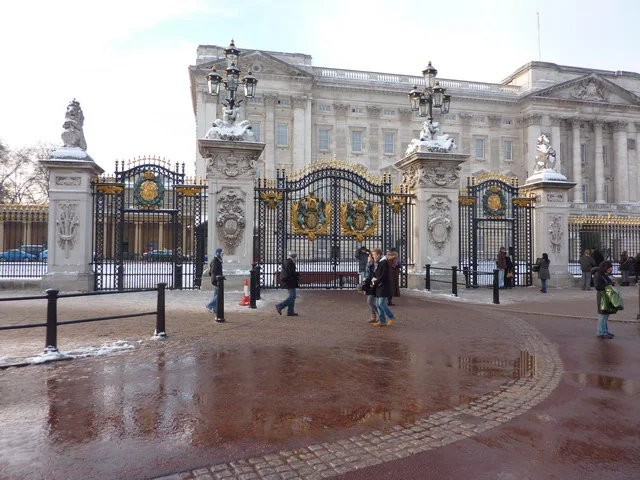 The Forecourt Gates & Changing of the Guard
The Palace Gates and Forecourt
The gilded railings and gates around the palace were completed in 1911 by the Bromsgrove Guild, a firm of metalworkers. Beyond them lies the forecourt, the palace's public threshold. It very nearly became a target. On 15 September 1940, known as Battle of Britain Day, an RAF pilot named Ray Holmes met a German Dornier bomber over London. He believed it was heading to bomb the palace, and he had run out of ammunition. So he made a quick decision: he rammed it with his own aircraft. Holmes bailed out and survived. The bomber crashed into the forecourt of London Victoria station. Its engine was later put on display at the Imperial War Museum in London. Holmes became a King's Messenger after the war, and died in 2005 at the age of 90.
Listen in the appAlexander P Kapp · CC BY-SA 2.0
04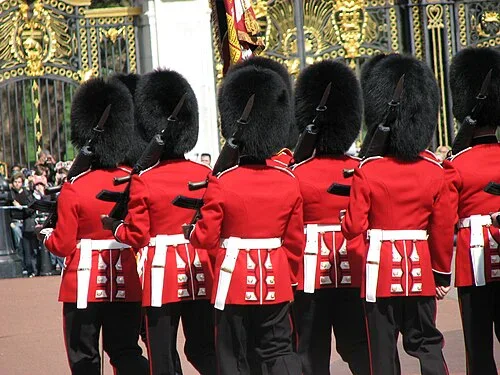 The Forecourt Gates & Changing of the Guard
Changing of the Guard
Red coats and tall black bearskins: the Changing of the Guard in the palace forecourt is its best-known living ceremony. The Band of the Grenadier Guards provides the musical accompaniment, so the old guard hands over to the new to the sound of a military band. The ceremony runs daily from April to July, and every other day in the other months. It is a major ceremony and a considerable tourist attraction, played out on the very forecourt inside the gilded gates.
Listen in the appbortescristian · CC BY 2.0
05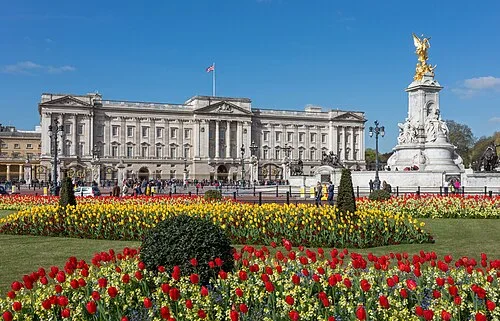 The East Front & The Royal Balcony
The East Front
By 1847, Queen Victoria and Prince Albert found the palace too small for court life and their growing family. Edward Blore designed a new wing, and the builder Thomas Cubitt raised it between 1847 and 1849, enclosing the central quadrangle. The bill was settled by the sale of the Brighton Pavilion in 1850. The large East Front facing The Mall became the palace's public face. In 1940 the palace became a target. During the Second World War the palace was bombed nine times. One bomb fell in the quadrangle while George VI and Queen Elizabeth were in residence, blowing in many windows. The most serious incident, in 1940, destroyed the palace chapel. The King and Queen were filmed inspecting their bombed home, and the newsreels played in cinemas across the country to show that rich and poor suffered alike. As the Queen put it: "I'm glad we have been bombed. Now I can look the East End in the face."
Listen in the appPhoto: Ibex73 · CC BY-SA 4.0
06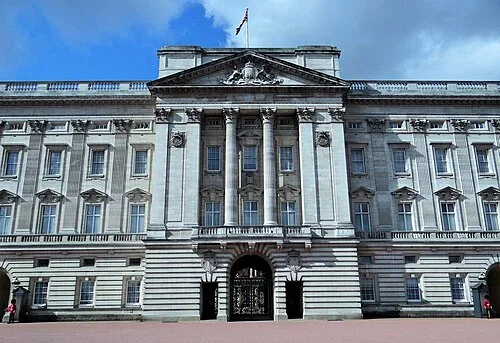 The East Front & The Royal Balcony
The Royal Balcony
At the centre of the East Front is the famous balcony, set behind the glass doors of the Centre Room. On momentous occasions, and after the annual Trooping the Colour, the royal family appear here to acknowledge the crowds gathered along The Mall. It is the palace's symbolic public stage, the moment when the building's formal front turns into a platform for celebration. That role has made this modest stretch of stonework one of the most recognised faces in Britain.
Listen in the appPhoto: Ibex73 · CC BY-SA 4.0
07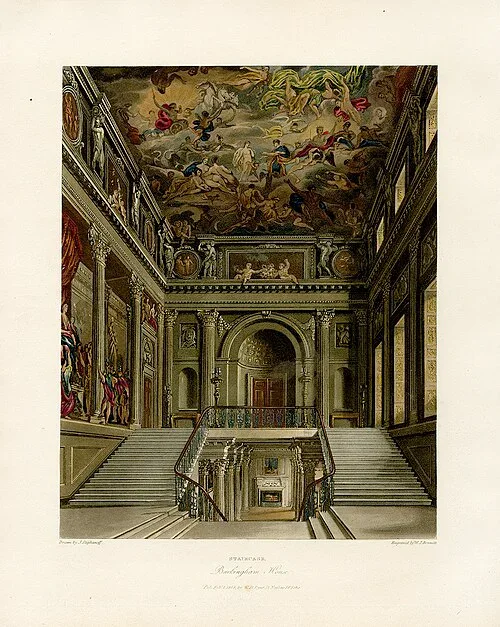 The Grand Staircase Hall
From Buckingham House to Palace: the Grand Staircase
This hand-coloured print shows the grand staircase of the older house on this site, Buckingham House, a large townhouse built in 1703 for the Duke of Buckingham and Normanby. George III bought it in 1761 as a private residence for Queen Charlotte, and it became known as The Queen's House; all but one of her fifteen children were born there. Her son George IV took the next step. After his accession in 1820 he continued the renovation, intending a small, comfortable home. Then in 1826, with the work already under way, he decided to turn the house into a palace, with John Nash as his architect. The costs grew dramatically, and by 1829 Nash's extravagance cost him the job. On George IV's death in 1830, his brother William IV hired Edward Blore to finish the work. William never moved in, preferring Clarence House. After the Palace of Westminster burned down in 1834, he even offered Buckingham Palace as a new Houses of Parliament; the offer was declined. The staircase remained the formal entrance route up to the State Rooms, and the print preserves the interior of the earlier house, before the rebuilding transformed it.
Listen in the appWilliam James Bennett / James Stephanoff · Public domain
08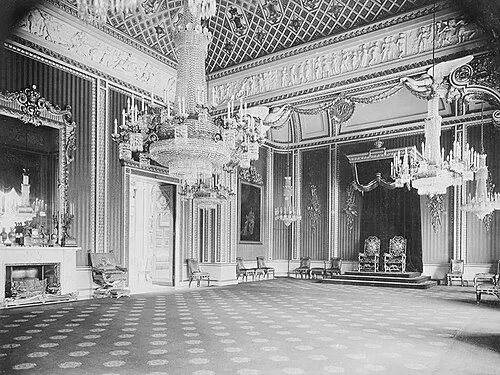 The Throne Room & Drawing Rooms
The Throne Room
The Throne Room is the palace's working ceremonial hall. Investitures for the awarding of honours usually take place here, conducted by the King or another senior member of the royal family. Knighthoods are conferred the old way, by dubbing with a sword. A military band plays in the musicians' gallery while the recipients receive their honours, watched by their families and friends. The route to the throne is itself ceremonial: it runs from the Guard Room at the top of the Grand Staircase, through the Green Drawing Room, which serves as a huge anteroom. That Guard Room holds white marble statues of Queen Victoria and Prince Albert in Roman costume, set in a tribune lined with tapestries. These very formal rooms are used only for ceremonial and official entertaining, though they open to the public every summer. The room was arranged like this by 1914, with its chandeliers and the thrones waiting at the far end.
Listen in the appAlexander Hood, 5th Duke of Bronté · Public domain
09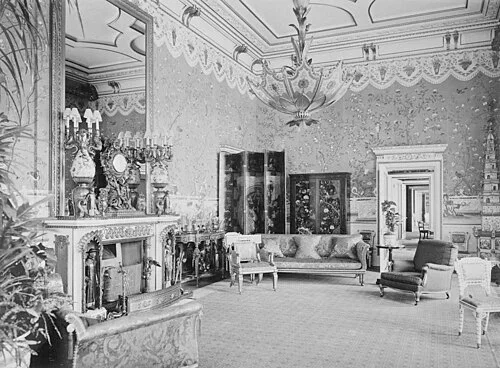 The Throne Room & Drawing Rooms
The Yellow Drawing Room
Many of the palace's smaller reception rooms are furnished in the Chinese regency style, with furniture and fittings brought from the Royal Pavilion at Brighton and from Carlton House. The Yellow Drawing Room belongs to that family. Its hand-painted Chinese wallpaper was supplied in 1817, originally for the Brighton Saloon. Its chimneypiece is a European vision of a Chinese one, complete with nodding mandarins in the niches and fearsome winged dragons, designed by Robert Jones. When the new east wing was being built at the end of the 1840s, the Brighton Pavilion was plundered of its fittings yet again, so the rooms of the new wing took on a distinctly oriental atmosphere. In a sense, the Pavilion survives inside the palace in portable form. The older interiors had their own palette: the early-19th-century designs, many still surviving, made widespread use of brightly coloured scagliola and blue and pink lapis, on the advice of Charles Long.
Listen in the appSir Alexander Nelson Hood (1854-1937) · Public domain
10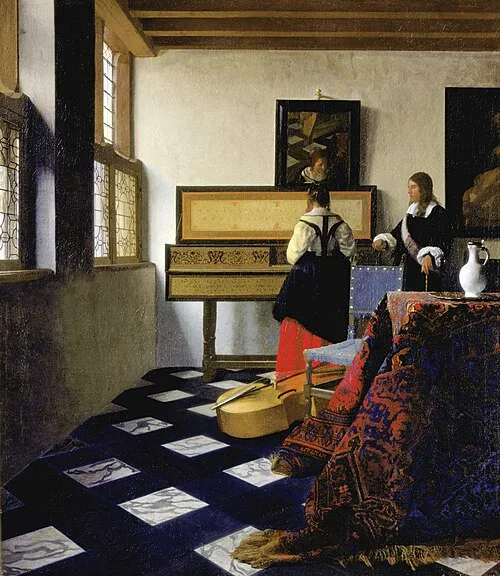 The Picture Gallery Masterpieces
The Picture Gallery and Vermeer's 'The Music Lesson'
Vermeer painted The Music Lesson in 1662: a young woman at a keyboard, a gentleman standing by, light falling from a leaded window across the checkered floor. It hangs in the Picture Gallery, the corridor at the centre of the state rooms. The gallery runs fifty metres and is top-lit, so daylight falls evenly along the walls. Rembrandt, van Dyck and Rubens hang here too, and the gallery does more than display them. It links the whole suite: the Throne Room and the Green Drawing Room open from it. On the grandest evening of the palace year, in November, the King entertains the diplomatic corps and every state room comes into use. The royal party begins its progress at the great north doors of this gallery. As Nash intended, the double-mirrored doors stand open all the way, reflecting chandeliers and sconces, so the rooms seem to multiply into space and light.
Listen in the appJohannes Vermeer · Public domain
- 11
The Royal Collection: Rembrandt's Agatha Bas
A Rembrandt portrait, and the story of the Royal Collection it belongs to.
- 12
The Ballroom
The palace's largest room, built in 1854, laid for state banquets with a silver-gilt service made for George IV.
- 13
The White Drawing Room
Edwardian cream and gold in the drawing rooms, and the christenings held next door in the Music Room.
- 14
The Royal Mews Riding School
The working yard beside the palace, where the monarchy keeps its horses, carriages and cars.
- 15
The Gold State Coach
The gilded Rococo coach that has carried the monarch at every coronation since William IV.
- 16
The Palace Garden
Sixteen hectares of park behind the façade, where the palace's largest hospitality takes place each summer.
- 17
The Waterloo Vase
A monumental marble vase by Richard Westmacott on the garden lawn, and what the palace has become.
Buckingham Palace
Frequently asked questions
How much does the guide cost?
Free app download. Listed guide price: $1.99. Guide price shown in the app. Audio guide only. Venue admission is separate.
Can I listen without internet?
Yes. Download the guide’s audio, images, and maps in the app before your visit. Your downloaded content is then available offline.
Can I listen in my language?
This audio guide is available in 15 languages, including English.
Do I need to follow a schedule?
No. This is a self-guided experience. Choose your stops, pause whenever you like, and return to a story at your own pace.
At your own pace
Explore Buckingham Palace.
Download Stanza, then search for “Buckingham Palace”.
Free app download · Guide price shown in the app
Keep exploring
Nearby audio guides
London · 1 km
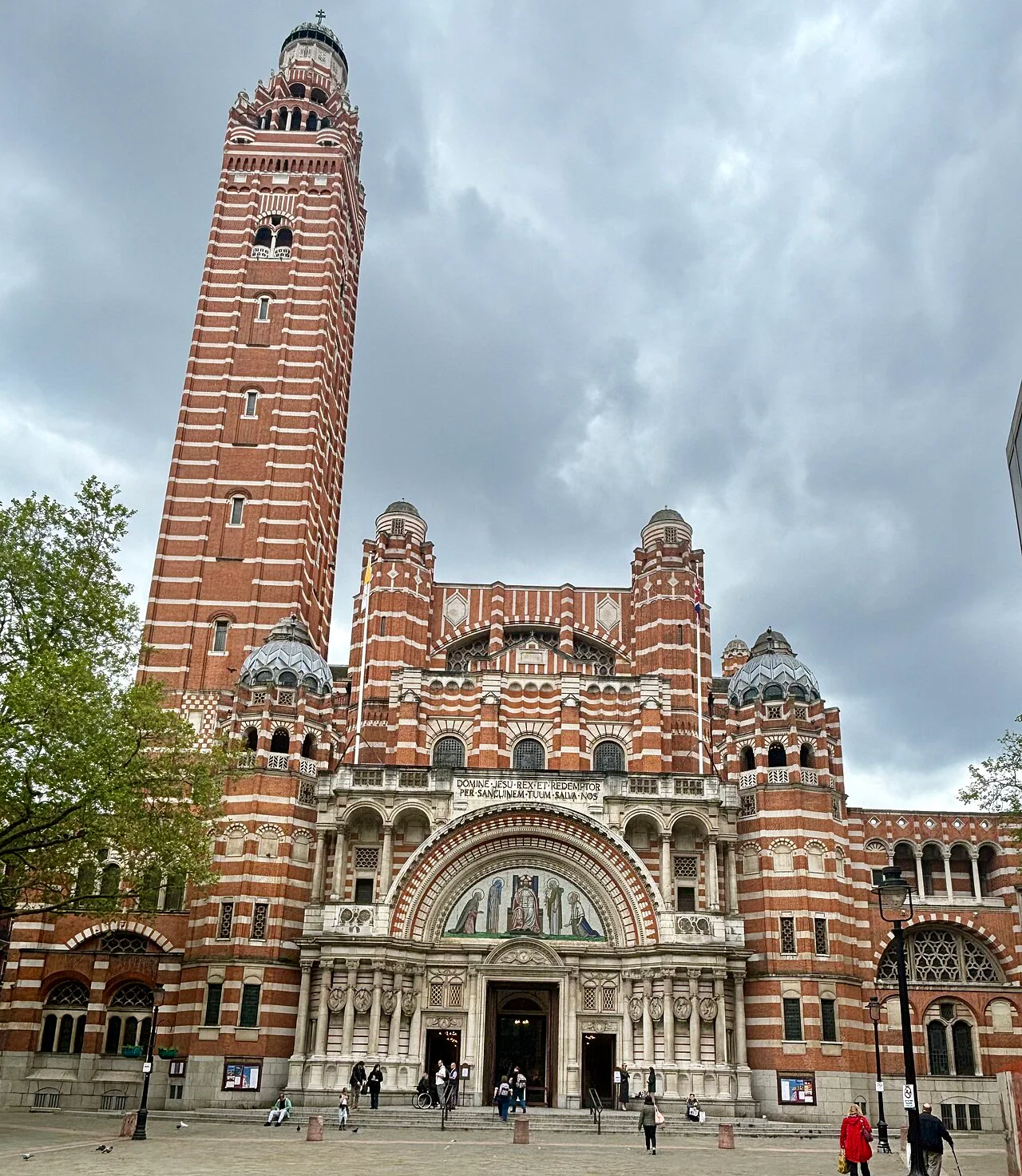
Westminster Cathedral
Content & sources
Frank Kovalchek · CC BY 2.0
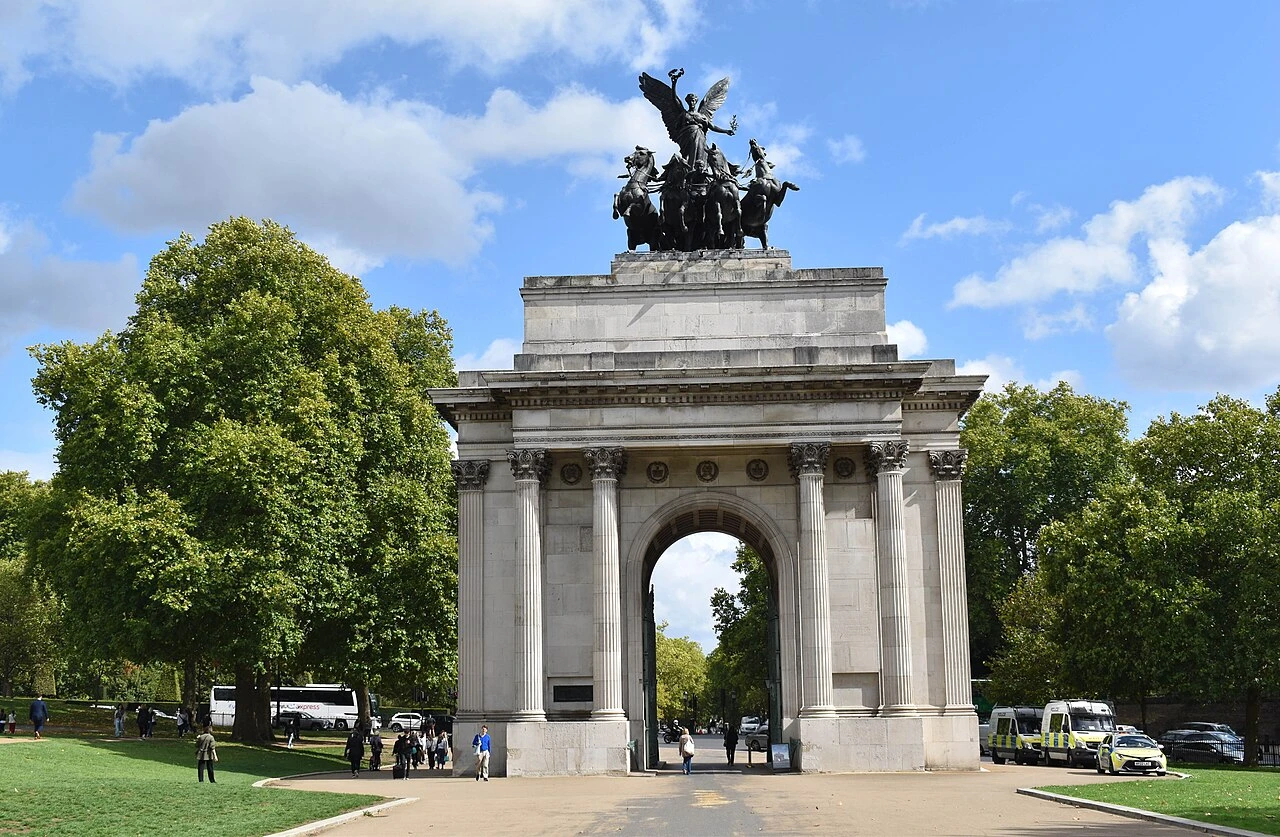
London · 1 km
Wellington Arch
Content & sources
Photo: Canaan · CC BY-SA 4.0
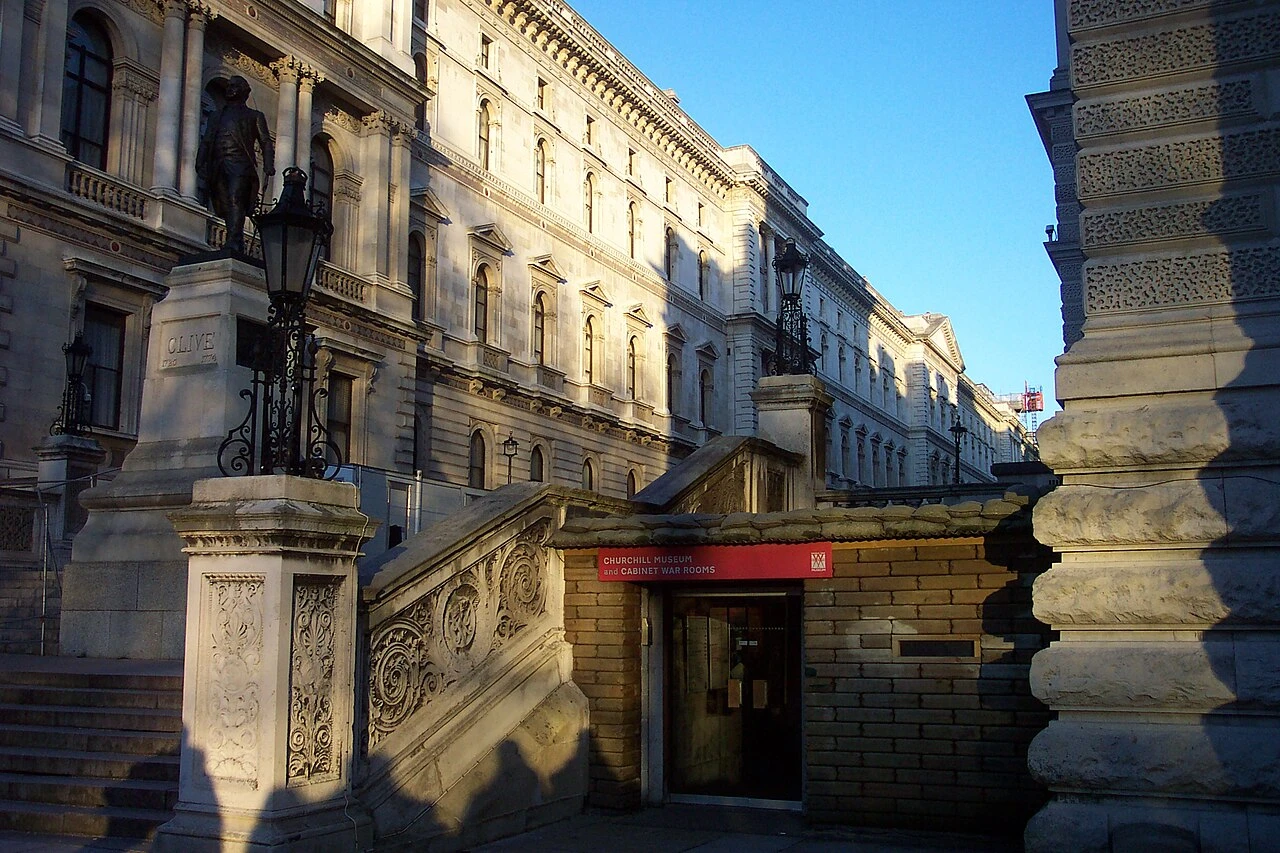
London · 1 km
Churchill War Rooms
Content & sources
en:User:Jdhowens90 · CC BY-SA 3.0
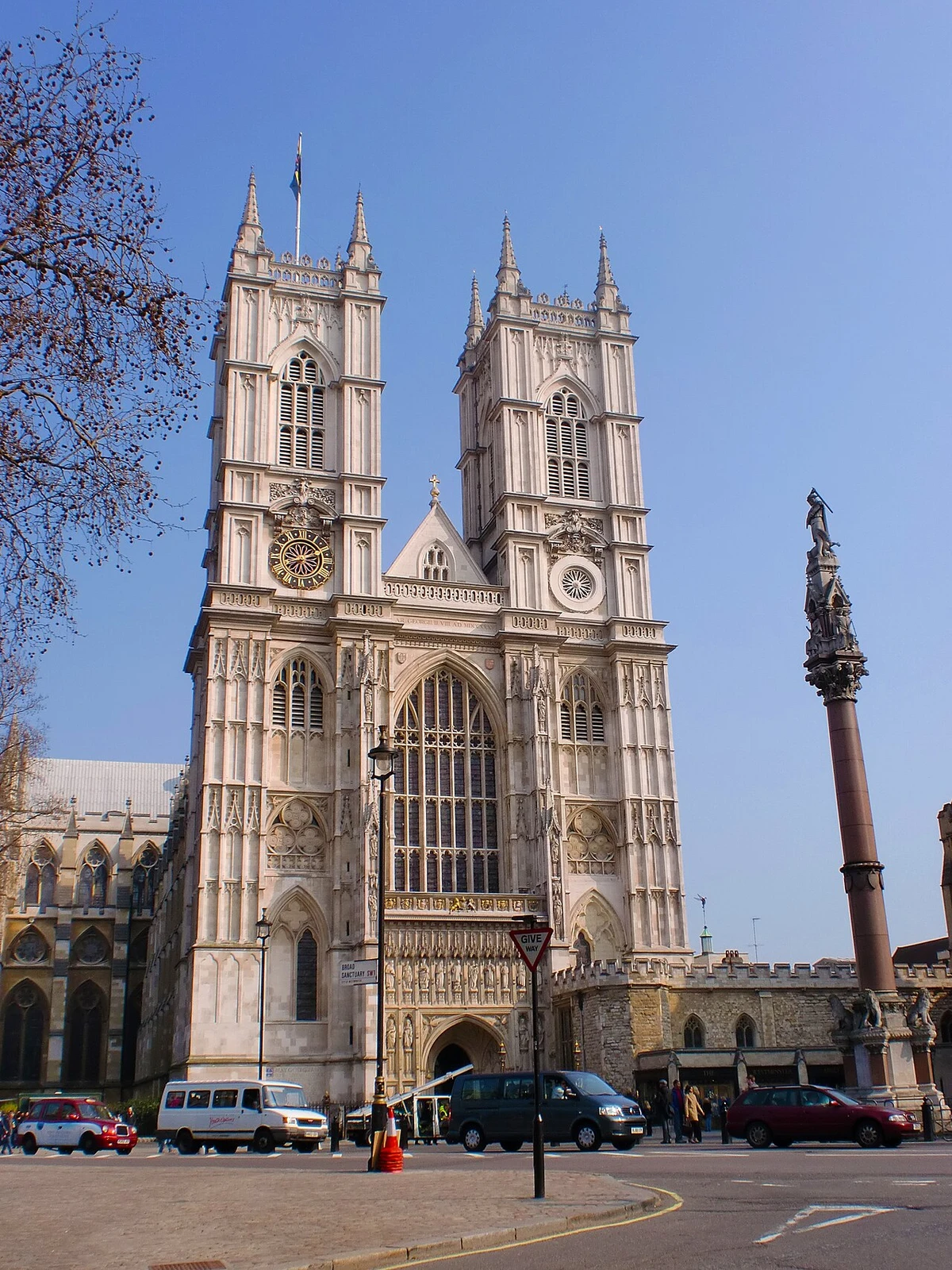
London · 1 km
Westminster Abbey
Content & sources
Σπάρτακος · CC BY-SA 3.0