Stanza · Audio guide
Westminster AbbeyAudio guide
A place to remember. A story to take with you.
Westminster Abbey is a large, Gothic abbey church in London, England. It serves as the traditional place of coronation and burial site for English and later British monarchs.
Download Stanza, then search for “Westminster Abbey”.
About the tour
One guide. Your kind of visit.
Westminster Abbey is a large, Gothic abbey church in London, England. It serves as the traditional place of coronation and burial site for English and later British monarchs.
Ready when you are.
- 01Get the free Stanza app.
iOS & Android
- 02Find your guide.
“Westminster Abbey”
- 03Download before you go.
Works offline
Audio guide / 33 narrated stops
Inside the guide
Get to know a few of the stories before you go. Open a stop to read more.
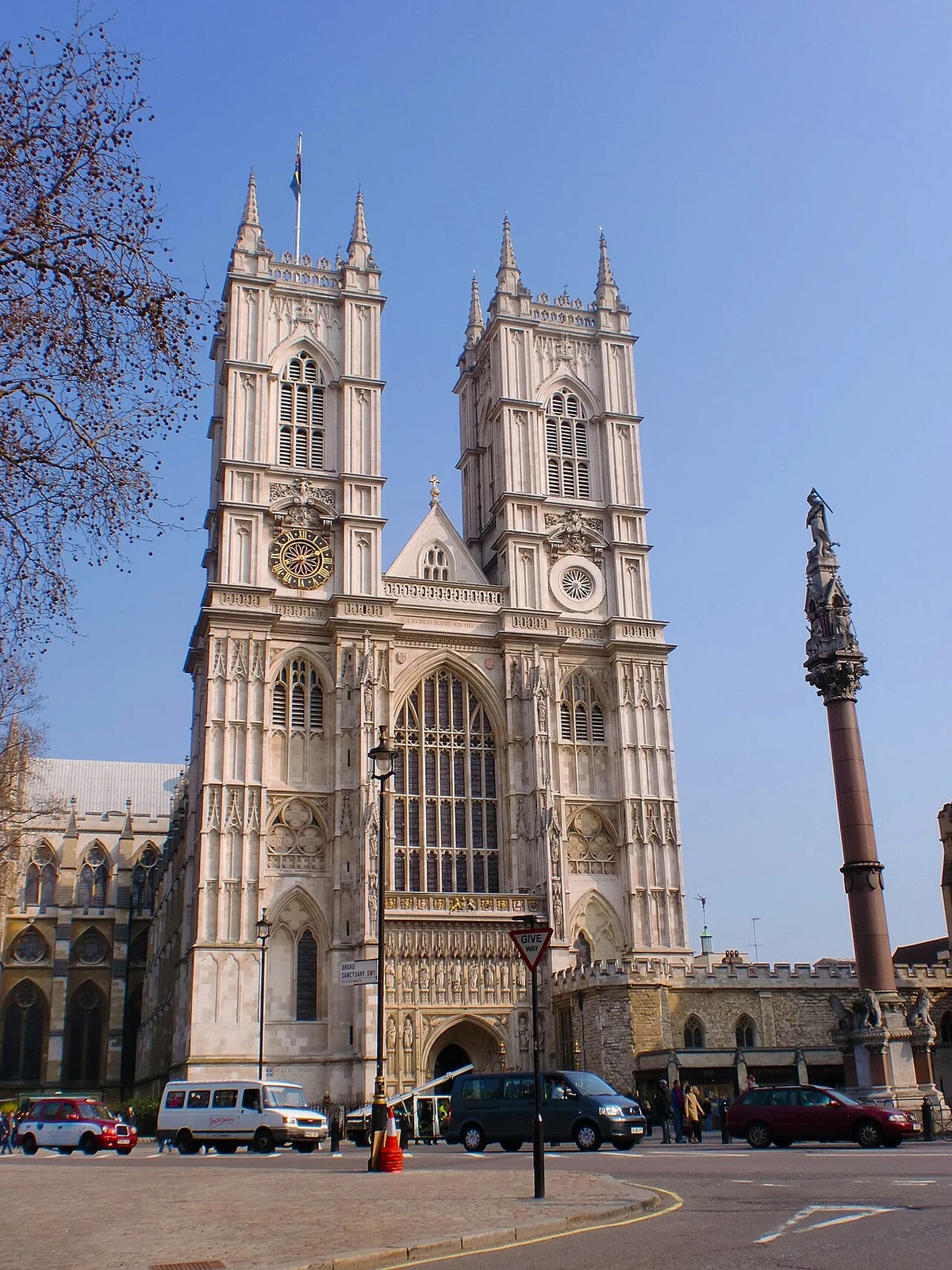
01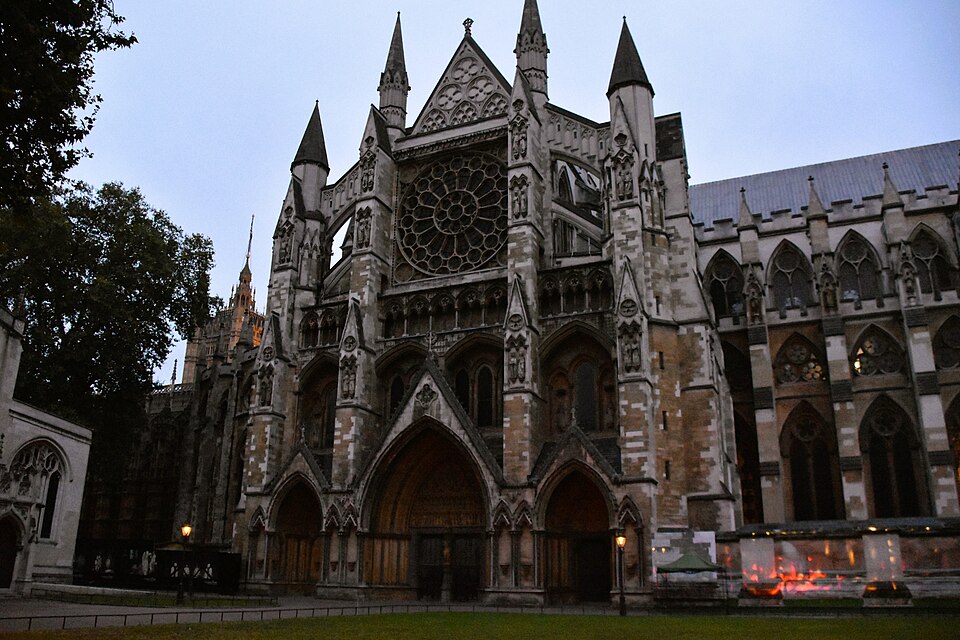 The North Transept EntranceSolomon's Porch Entrance
Welcome to one of the most significant architectural statements in the Abbey. As you stand before the North Transept entrance, you are looking at a facade traditionally known as Solomon's Porch. This grand gateway serves as a testament to the ambitious vision of King Henry III, who began a massive Gothic rebuild of the Abbey in 1245. Henry drew heavy inspiration from the majestic French cathedrals he admired, particularly the coronation church at Reims, aiming to create a structure that could rival the greatest religious buildings in Europe. While the foundations of this sacred site reach back to the 11th century and the reign of Edward the Confessor, the Gothic facade you see today represents the Abbey's unique status as a 'Royal Peculiar.' Unlike most churches that fall under the jurisdiction of a bishop or archbishop, a Royal Peculiar is accountable only to the Sovereign. This direct link between the monarch and the Abbey is palpable in the scale and grandeur of the North Porch, which was designed to overwhelm visitors with a sense of both royal and religious power as they entered the heart of England's spiritual life. It serves as a reminder that this is not just a place of worship, but a royal church built to the glory of the crown.
Photo: Jps3 · CC BY-SA 4.0
02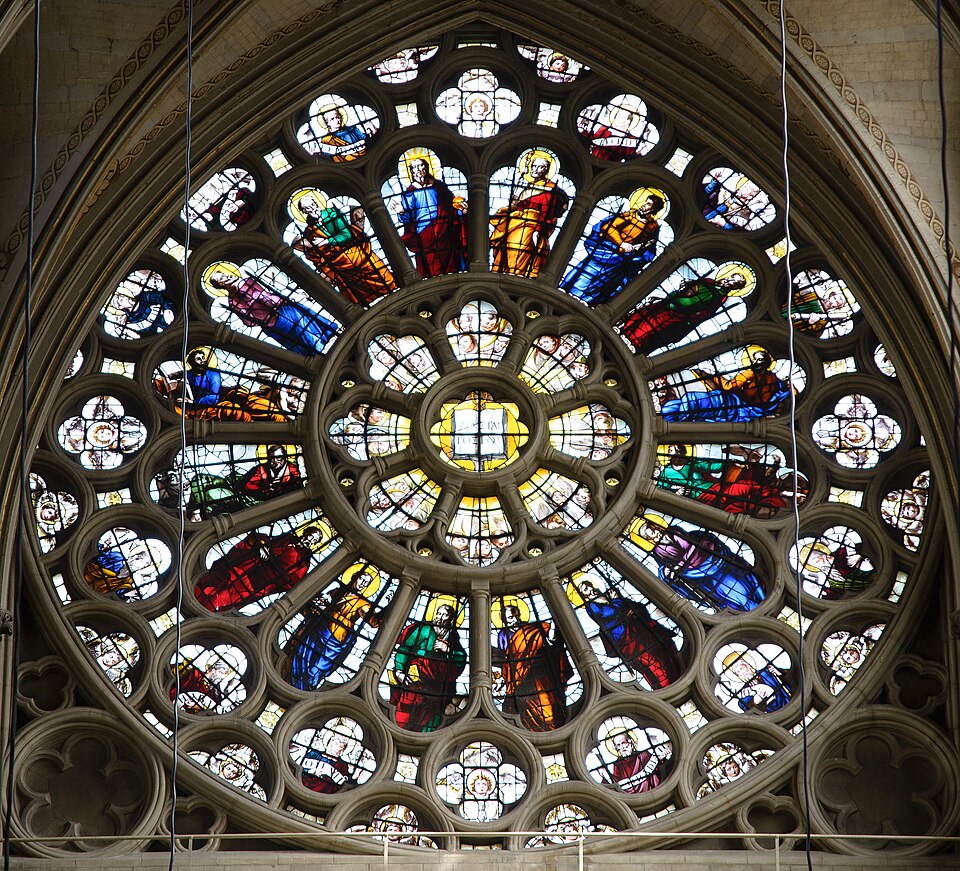 The North Transept EntranceThe North Rose Window
Directing your gaze upward, you see the magnificent North Rose Window, a hallmark of the High Gothic style. In medieval architecture, these immense circular windows were far more than just decorative features; they were symbolic 'eyes' intended to flood the stone-heavy interior with what was considered 'divine light.' This interplay of light and shadow was a crucial element of the Gothic experience, transforming the cold stone of the Abbey into a luminous space that felt closer to the heavens. While the stained glass you see within the window today dates from later periods—having replaced earlier, more fragile iterations—the surrounding stonework retains the intricate geometric spirit of the 13th century. The delicate stone tracery forms a complex web of circles and petals, radiating outward from the center like a blooming flower. This geometric precision was a source of great pride for medieval masons, who used advanced mathematical principles to ensure such a large void in the wall could remain stable while supporting the heavy glass. As you observe the window, notice how the stonework creates a permanent, elegant silhouette against the changing sky outside, a feature that has guided the eyes of visitors toward the heavens for over seven hundred years.
Photo: Jps3 · CC BY-SA 4.0
03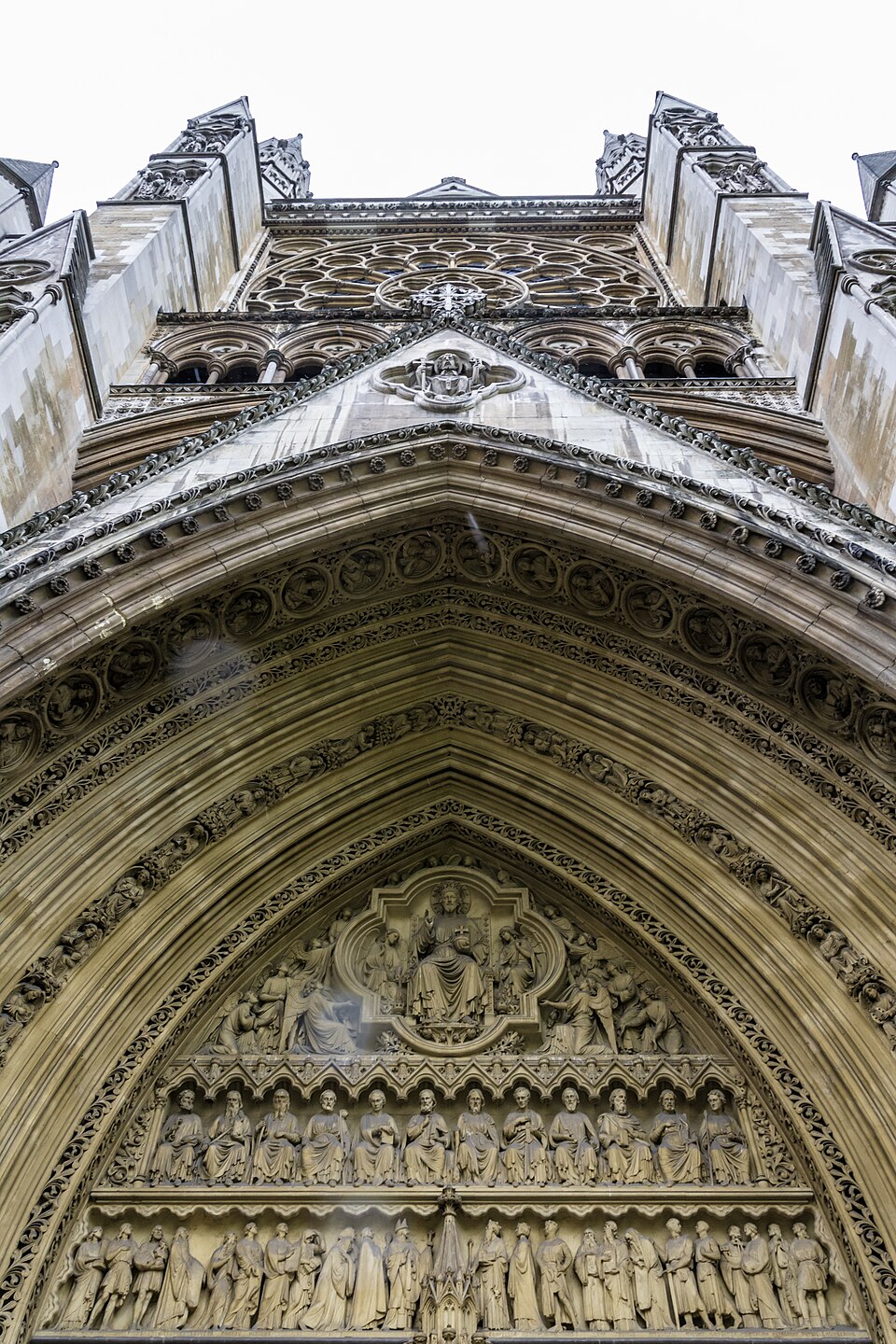 The North Transept EntranceThe Sculpted North Porch
Focusing on the area immediately above the entrance doors, you can see the incredibly detailed stonework of the North Porch. This elaborate display of sculpture is characteristic of the 13th-century Gothic style, which utilized every available surface to convey religious narratives and royal power. The facade is designed with multiple layers of pointed arches, creating a sense of depth and invitation that leads the eye toward the sacred interior. Within these arches, rows of seated figures populate the portal, representing kings, saints, and biblical patriarchs who oversee the threshold of the Abbey. These figures were intended to act as a bridge between the secular world outside and the spiritual realm within, reminding those who passed beneath them of the historical and divine continuity of the English church. The intricate carving extends beyond the human figures to include foliage, mythical creatures, and complex geometric patterns, all meticulously worked into the stone. In the Middle Ages, many of these figures would have been brightly painted, creating a vivid, multi-colored entrance that would have appeared even more striking to the medieval visitor than the weathered stone we see today. The portal remains a powerful example of how architecture was used to inspire awe and devotion before a visitor even stepped inside.
Listen in the appdconvertini · CC BY-SA 2.0
04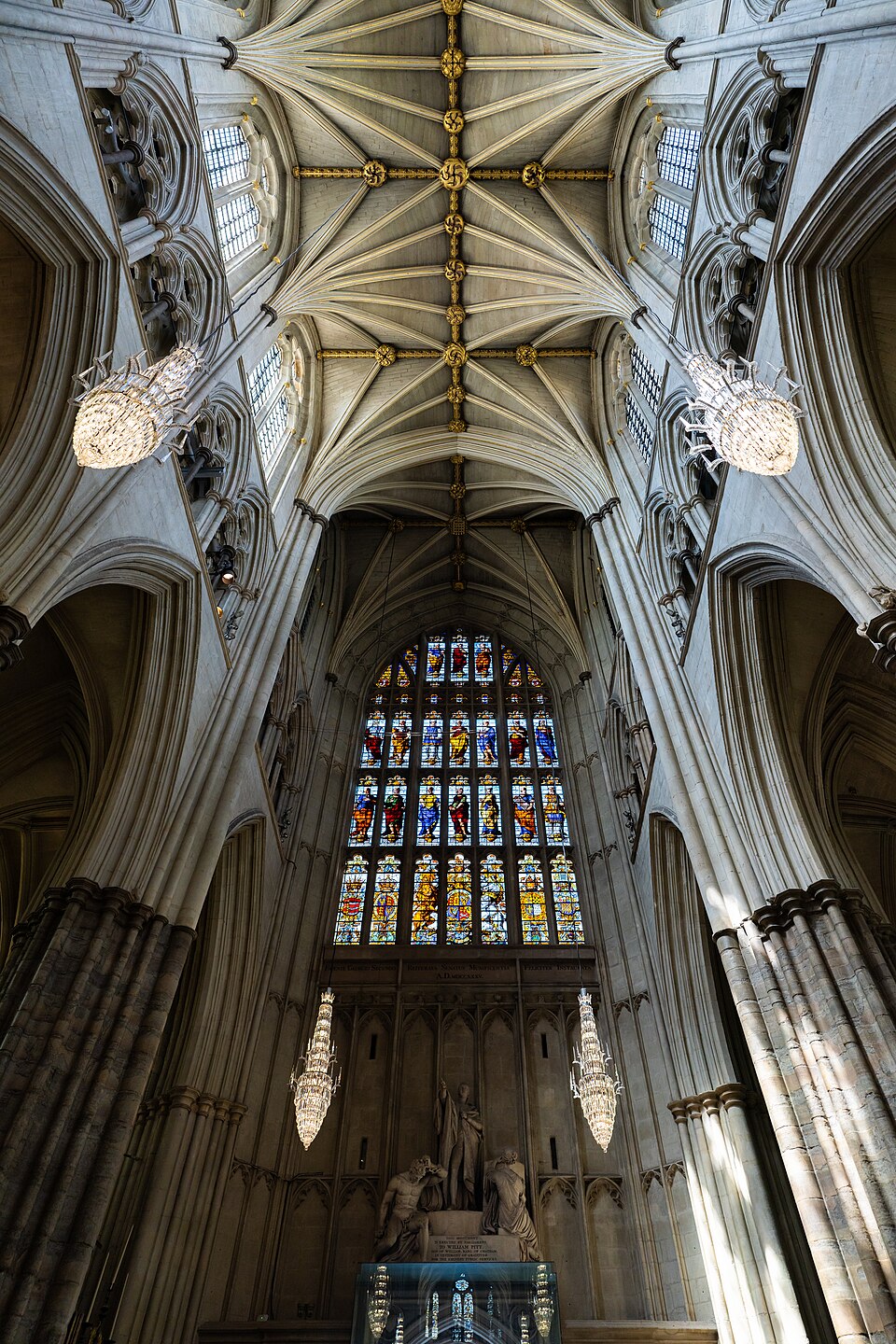 The Nave and Grave of the Unknown WarriorThe Highest Vault in England
As you step into the Nave, the sheer verticality of the space is designed to draw your eyes upward toward the ceiling. You are looking at the highest Gothic vault in all of England, reaching a staggering height of 31 meters, or roughly 101 feet. This soaring interior was a central part of King Henry III’s plan to create a cathedral-like space that surpassed all others in the kingdom. The weight of this massive stone roof is supported by a series of slender columns that run the length of the Nave. If you look closely at these columns, you will notice a striking contrast in materials. The main structural pillars are accompanied by smaller, dark, and highly polished shafts. These are made of Purbeck marble, a dense limestone from Dorset that could be polished to a mirror-like finish, a luxury material in the 13th century. These dark accents are set against the much paler Reigate stone used for the walls and the vaulting ribs above. This deliberate use of contrasting colors emphasizes the vertical lines of the architecture, making the ceiling feel even more distant and ethereal. This 'skeleton' of stone allowed for the inclusion of massive windows, replacing heavy walls with glass and light, creating a sense of weightlessness that remains breathtaking today.
Listen in the appMaksim Sokolov (maxergon.com) · CC BY-SA 4.0
05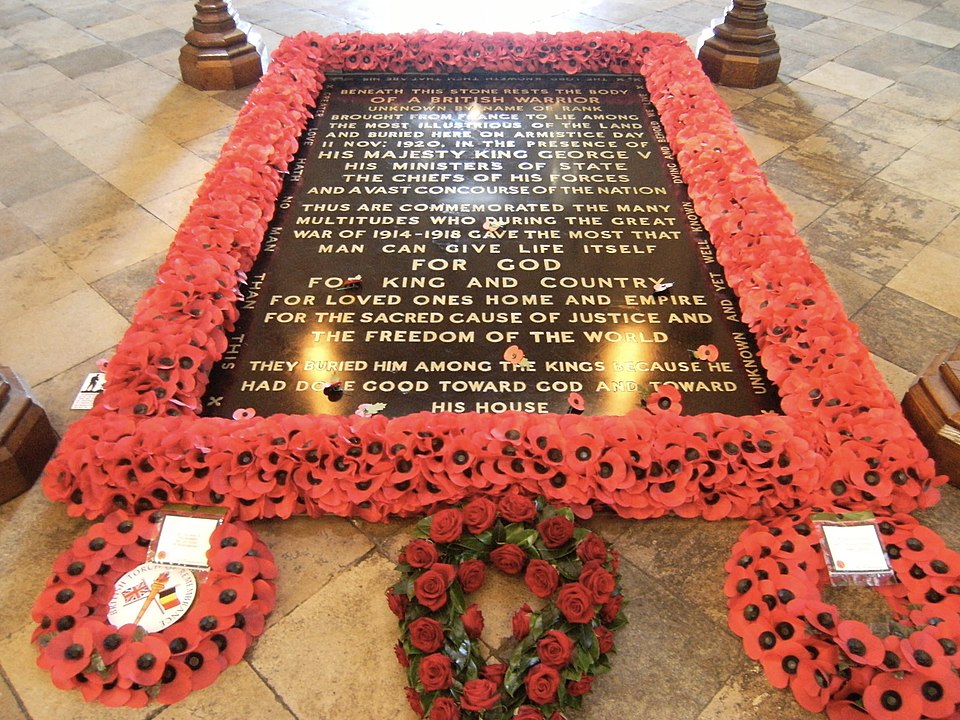 The Nave and Grave of the Unknown WarriorGrave of the Unknown Warrior
Located near the West Door, you will find a spot of immense solemnity: the Grave of the Unknown Warrior. This slab of black marble is the only grave in the entire Abbey that visitors are strictly forbidden to walk upon, a mark of deep respect for the sacrifice it represents. The story behind it began in 1920, shortly after the end of the First World War. To honor the hundreds of thousands of British soldiers whose bodies were never identified or recovered, the remains of an unidentified soldier were brought back from a French battlefield. He was buried here with full military honors, in soil brought from France, to represent all the 'unknown' who gave their lives. The grave quickly became a focal point for national mourning, allowing families who had no grave to visit a place where they could feel connected to their lost loved ones. The inscription, which is composed of brass from melted-down wartime ammunition, emphasizes that he is buried among kings because he 'had done good toward God and toward his home.' Even today, the grave remains a site of living tradition; every royal bride who marries in the Abbey has her bouquet placed on the stone after the ceremony, a practice started by the Queen Mother in 1923 to honor her brother who was killed in the war.
Listen in the appMike from England · CC BY-SA 2.0
06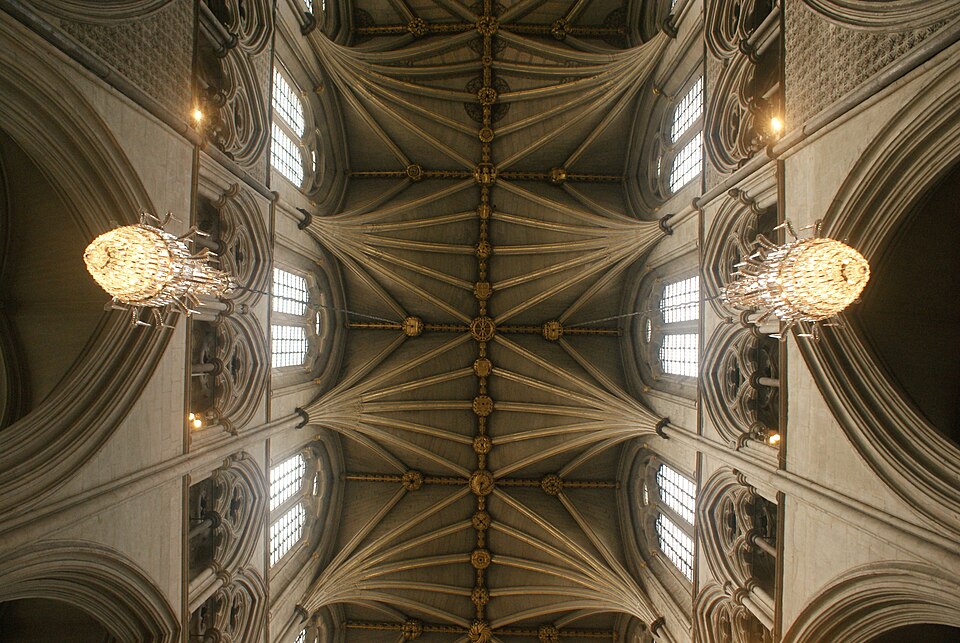 The Nave and Grave of the Unknown WarriorThe Gilded Vaulting
Looking back up to where the stone ribs of the ceiling meet, notice the decorative knobs known as 'bosses.' In this part of the Abbey, many of these bosses have been gilded, catching any available light to create a constellation of gold against the pale stone. While these bosses serve a functional purpose—masking the point where several structural ribs converge—they also provided medieval craftsmen with an opportunity for artistic expression. They often depict foliage, heraldic shields, or religious symbols. The vaulting here represents the culmination of a massive construction project that took roughly 24 years to reach this specific height and form under Henry III. However, the Abbey is far from a static monument of the 13th century. It has been a site of continuous evolution and restoration for over 800 years. As you follow the lines of the ribs, imagine the master masons who worked without modern machinery to set each stone in place with mathematical precision. The gilding you see today is part of the ongoing care and beautification that ensures the Abbey remains a vibrant center of national life. This ceiling serves as a bridge between the building's medieval foundations and its modern role as a site of coronation and commemoration.
Listen in the appRobert Lamb · CC BY-SA 2.0
07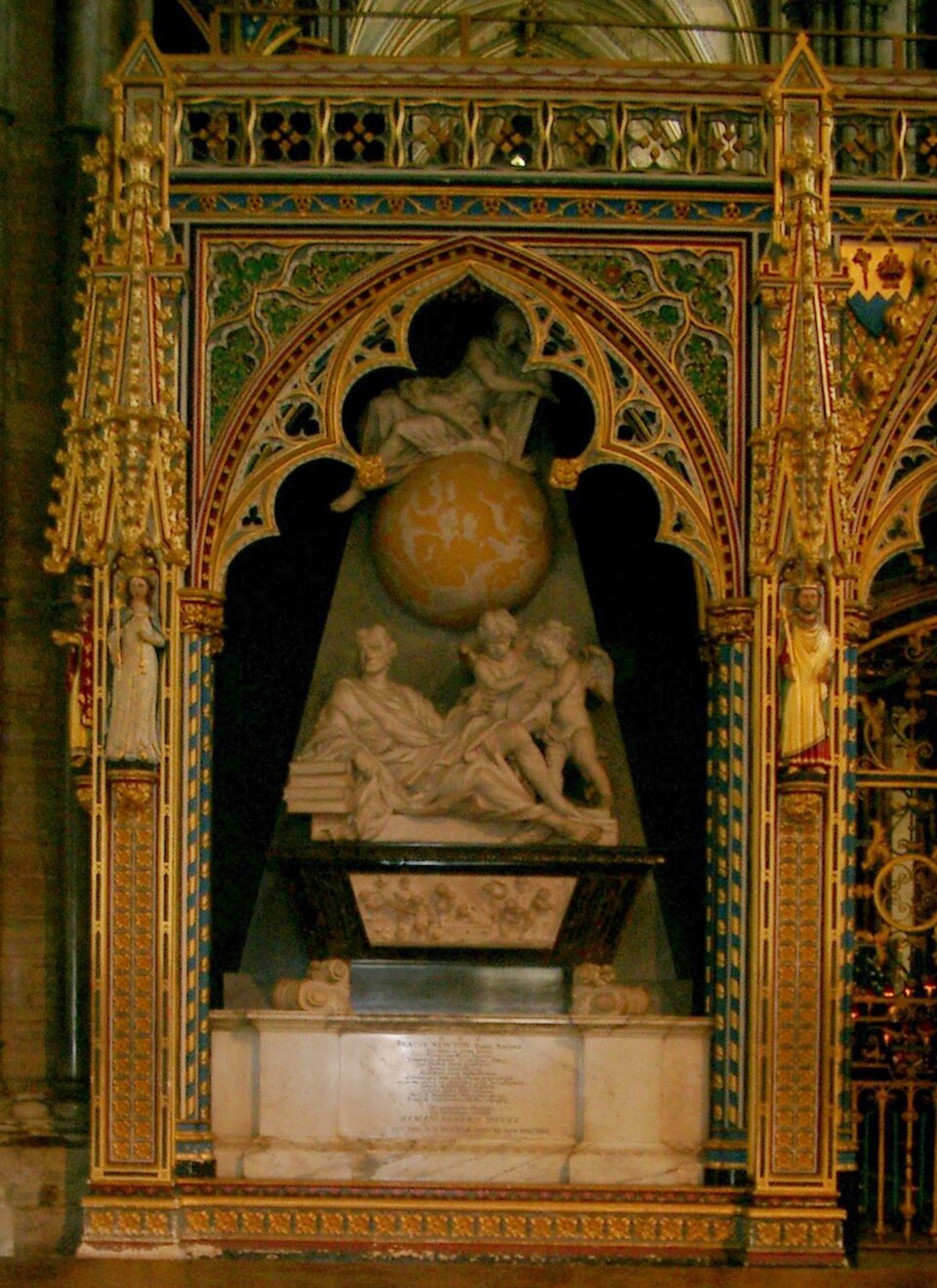 Scientists' Corner and the Choir Screenburials and memorials in Westminster Abbey
Positioned prominently at the Choir Screen is the magnificent monument to Sir Isaac Newton. This memorial is rich with symbols representing the extraordinary mind of the man it honors. At the top, you can see a large celestial globe, which is marked with the signs of the zodiac and depicts the exact path taken by the comet of 1680, a phenomenon Newton studied extensively. Below the globe, Newton is shown reclining, his arm resting on several volumes of his own work—the foundational texts that introduced his revolutionary theories on gravity and optics to the world. Newton’s burial here in 1727 was a landmark event for Westminster Abbey. Up until that point, the Abbey was primarily a burial place for royalty, high-ranking clergy, and the nobility. By granting Newton such a prominent position, the Abbey effectively established itself as a 'National Valhalla'—a place where the nation’s greatest heroes of science, literature, and thought would be memorialized alongside its kings and queens. It reflected the values of the Enlightenment, celebrating human reason and the discovery of natural laws as achievements worthy of the highest spiritual honor within these historic walls. This monument stands as a testament to the shift in how national merit was recognized.
Listen in the appKlaus-Dieter Keller · Public domain
08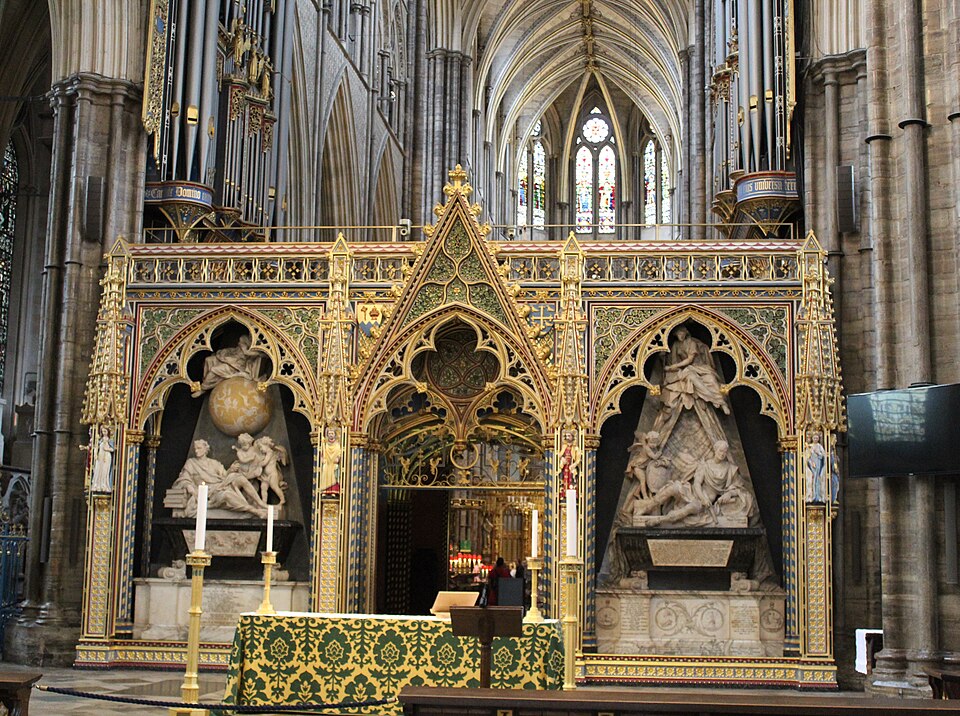 Scientists' Corner and the Choir ScreenThe Golden Choir Screen
The intricate and richly decorated screen you see here serves a vital role in the Abbey’s layout. It acts as a physical and symbolic barrier, separating the expansive, public Nave from the Choir, the more intimate and sacred space where daily choral services are performed. Historically, such screens were meant to enclose the monastic community during their prayers, creating a 'church within a church' where they could focus on divine service. In the context of Westminster Abbey, which has been described as a 'National Valhalla,' this screen also serves as a bridge between different aspects of English identity. On one side, in the Nave, you have monuments to human discovery and national achievement, like the Newton memorial nearby. On the other side, through the screen, lies the religious heart of the building, where the coronation of monarchs and the worship of God have taken place for nearly a millennium. The current screen, while featuring a striking gilded design, sits upon a much older structural foundation. It is a place where the worlds of history, science, and faith converge. As you look through its arches, you can see the choir stalls beyond, where the Abbey’s choir still sings the same psalms and hymns that have echoed through these vaults since the time of the monks.
Listen in the appPhoto: 14GTR · CC BY-SA 4.0
09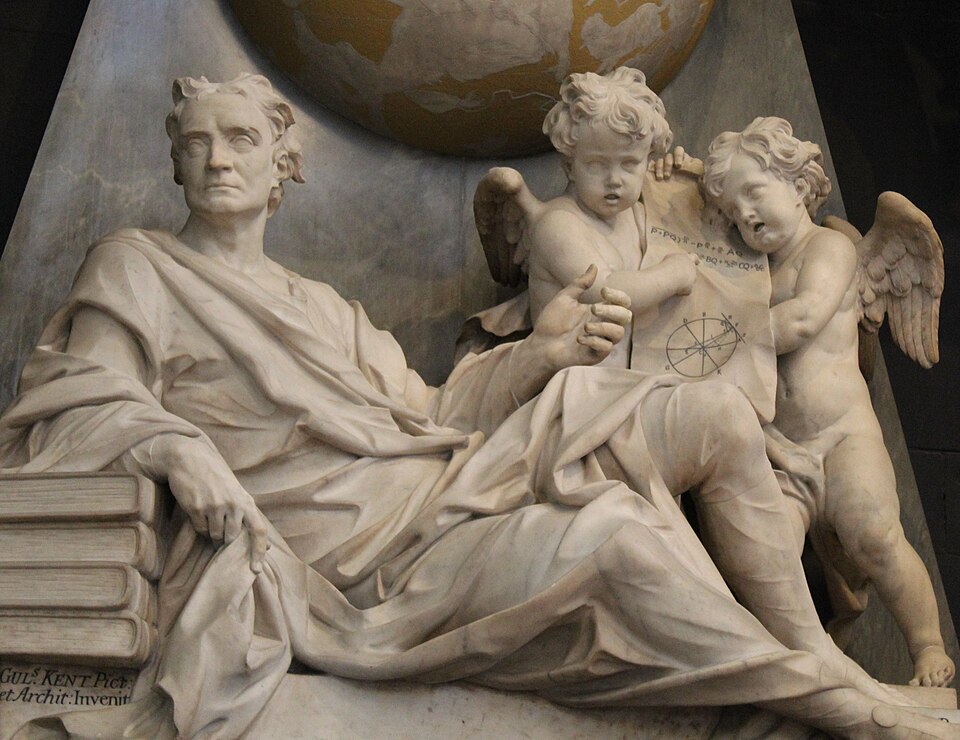 Scientists' Corner and the Choir ScreenSymbols of Enlightenment
Looking closely at the lower portion of the Newton memorial, you will notice a group of cherubs engaged in what might seem like unusual activities for a church. Rather than playing harps or singing, these figures are holding mathematical diagrams and scientific instruments. One cherub points to a scroll featuring Newton's famous prism experiments, while others handle a reflecting telescope and a mathematical formula. These decorative elements are a wonderful reflection of the 18th-century Enlightenment period. During this era, there was a growing belief that the study of the natural world through science and reason was not a challenge to religious faith, but rather a way of uncovering the divine order of the universe. By incorporating these 'Symbols of Enlightenment' into a funeral monument within the Abbey, the creators were making a bold statement about the compatibility of intellectual discovery and spiritual devotion. The cherubs represent the youthful curiosity and human ingenuity that Newton championed. Their presence here, carved with great delicacy and playfulness, serves to humanize the great scientist while emphasizing that the laws of physics and mathematics were seen as part of a grander, sacred design that was perfectly at home within this medieval cathedral. It is a unique artistic marriage of faith and the dawning age of reason.
Listen in the appPhoto: 14GTR · CC BY-SA 4.0
10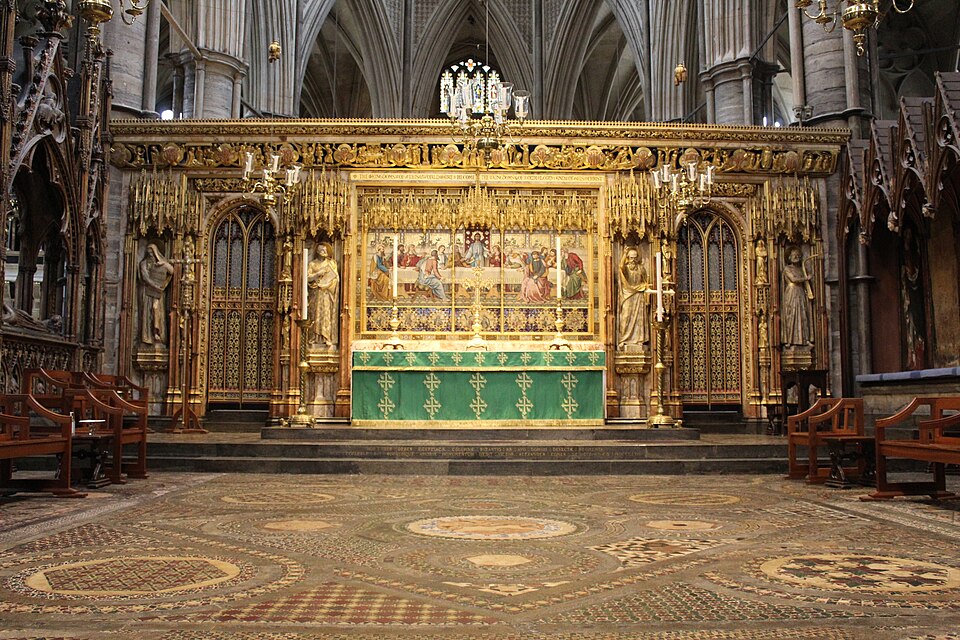 The High Altar and Cosmati PavementThe Coronation Altar
The area before the High Altar is arguably the most historically significant square of ground in the United Kingdom. This has been the destination for every coronation procession for nearly a thousand years, beginning with William the Conqueror on Christmas Day in 1066. When a monarch is crowned, they are seated here, facing the altar, to be anointed with holy oil and receive the crown. Behind the altar stands an impressive 19th-century mosaic reredos, which depicts the Last Supper in vibrant colors, adding to the visual splendor of the sanctuary. However, the most important element of this space is actually beneath your feet—or rather, just ahead of you. The floor in front of the altar is a masterpiece of medieval art and symbolic philosophy. While the Abbey is full of grand monuments and soaring arches, it is this specific spot that serves as the nexus of church and state. It is here that the spiritual authority of the church is invoked to confirm the temporal power of the sovereign. Every detail of this area, from the gilded altar to the floor's ancient patterns, is designed to create an atmosphere of profound solemnity, marking the transition of a person into a monarch and linking the present ruler to a line stretching back nearly a millennium.
Listen in the appPhoto: 14GTR · CC BY-SA 4.0
Westminster Abbey
Frequently asked questions
How much does the guide cost?
Free app download. Listed guide price: $0.99. Guide price shown in the app. Audio guide only. Venue admission is separate.
Can I listen without internet?
Yes. Download the guide’s audio, images, and maps in the app before your visit. Your downloaded content is then available offline.
Can I listen in my language?
Stanza supports 15 languages. Check the app for the languages available for this guide.
Do I need to follow a schedule?
No. This is a self-guided experience. Choose your stops, pause whenever you like, and return to a story at your own pace.
At your own pace
Explore Westminster Abbey.
Download Stanza, then search for “Westminster Abbey”.
Free app download · Guide price shown in the app
Keep exploring
Nearby audio guides

London
Big Ben
Content & sources
Dave Bezaire · CC BY-SA 2.0
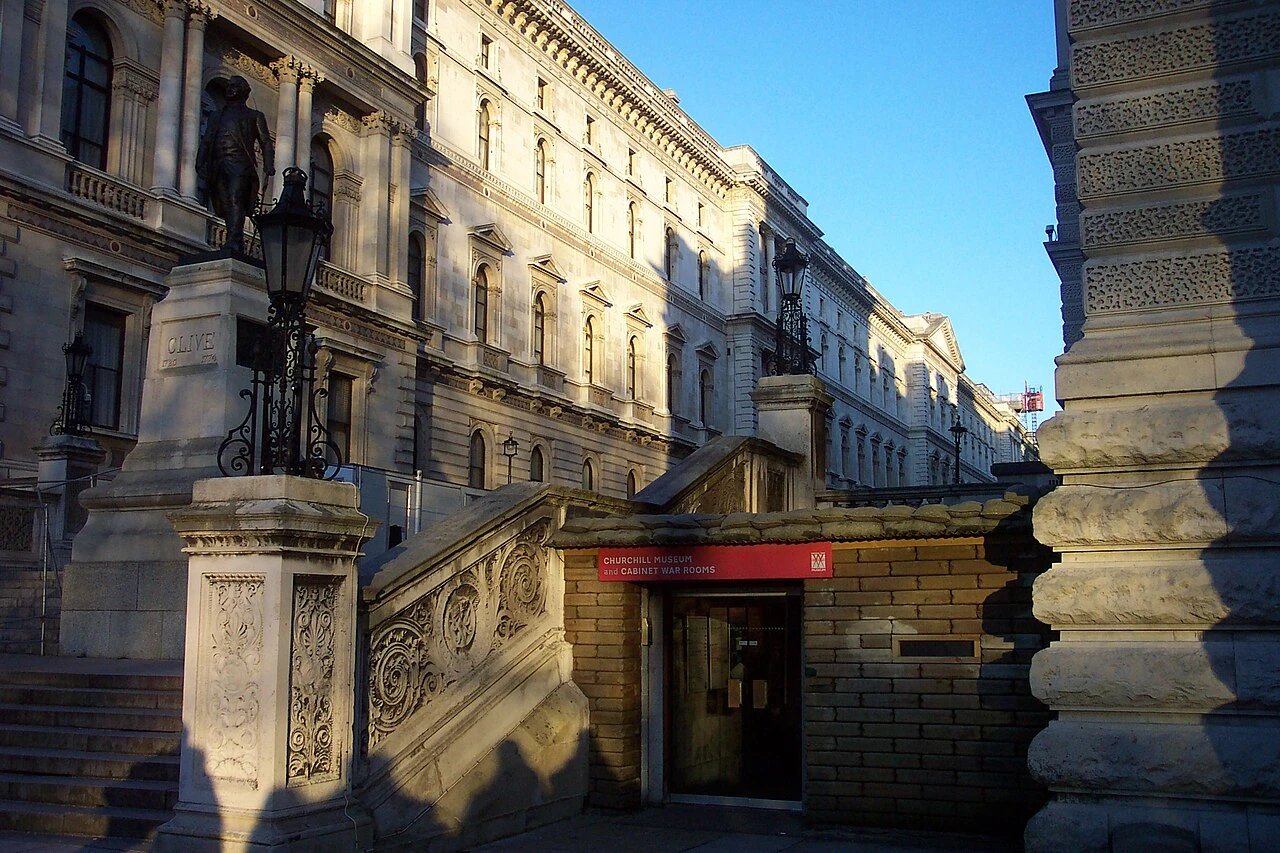
London
Churchill War Rooms
Content & sources
en:User:Jdhowens90 · CC BY-SA 3.0
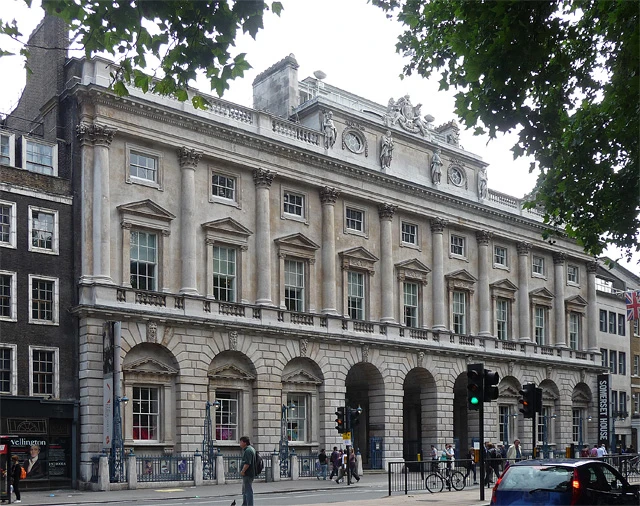
London
Courtauld Institute of Art
Content & sources
Stephen Richards · CC BY-SA 2.0
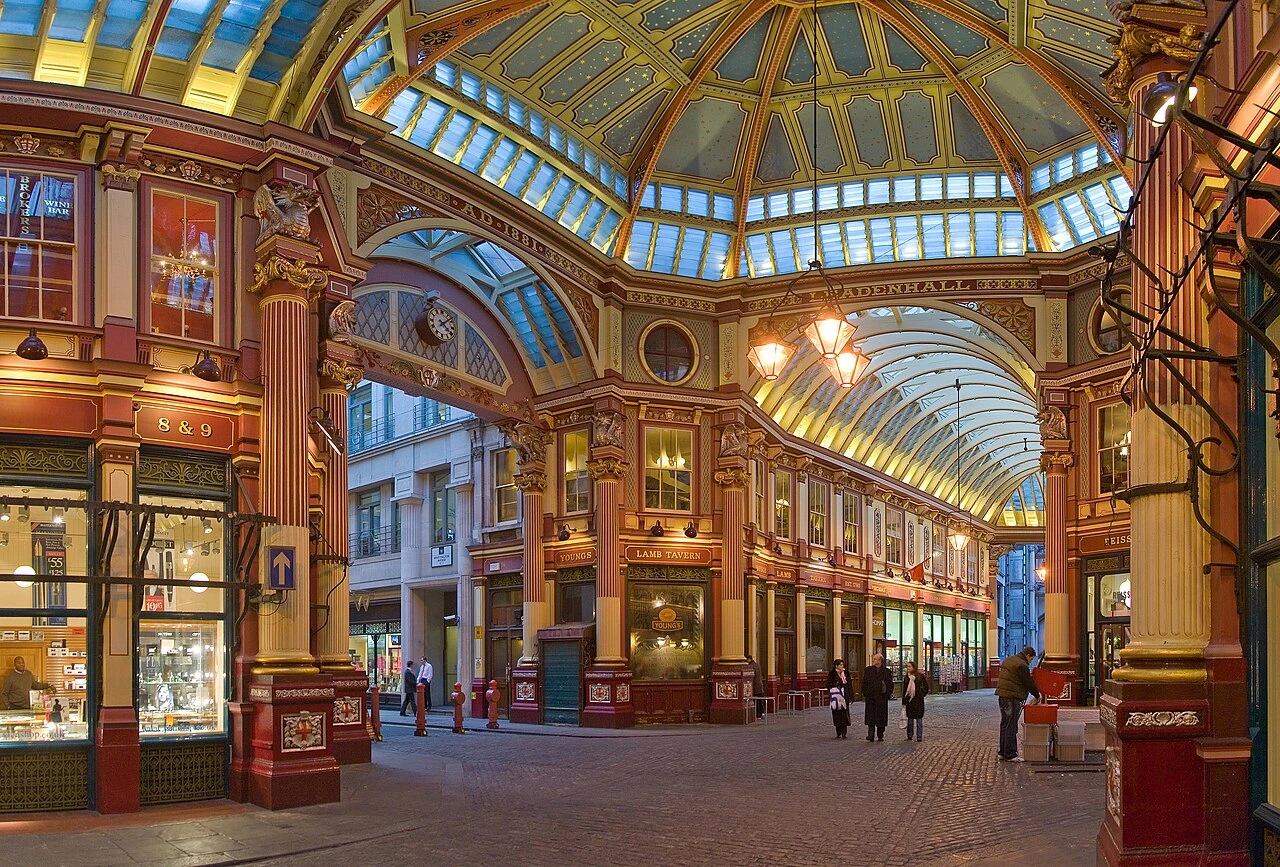
London
Leadenhall Market
Content & sources
Diliff · CC BY 2.5