Stanza · Audio guide
Hoover DamAudio guide
A place to remember. A story to take with you.
Hoover Dam is an arch-gravity dam on the Colorado River, straddling the border between Arizona and Nevada. It serves as a major hydroelectric power station and a prominent tourist attraction.
Download Stanza, then search for “Hoover Dam”.
About the tour
One guide. Your kind of visit.
Hoover Dam is an arch-gravity dam on the Colorado River, straddling the border between Arizona and Nevada. It serves as a major hydroelectric power station and a prominent tourist attraction.
Ready when you are.
- 01Get the free Stanza app.
iOS & Android
- 02Find your guide.
“Hoover Dam”
- 03Download before you go.
Works offline
Audio guide / 20 narrated stops
Inside the guide
Get to know a few of the stories before you go. Open a stop to read more.
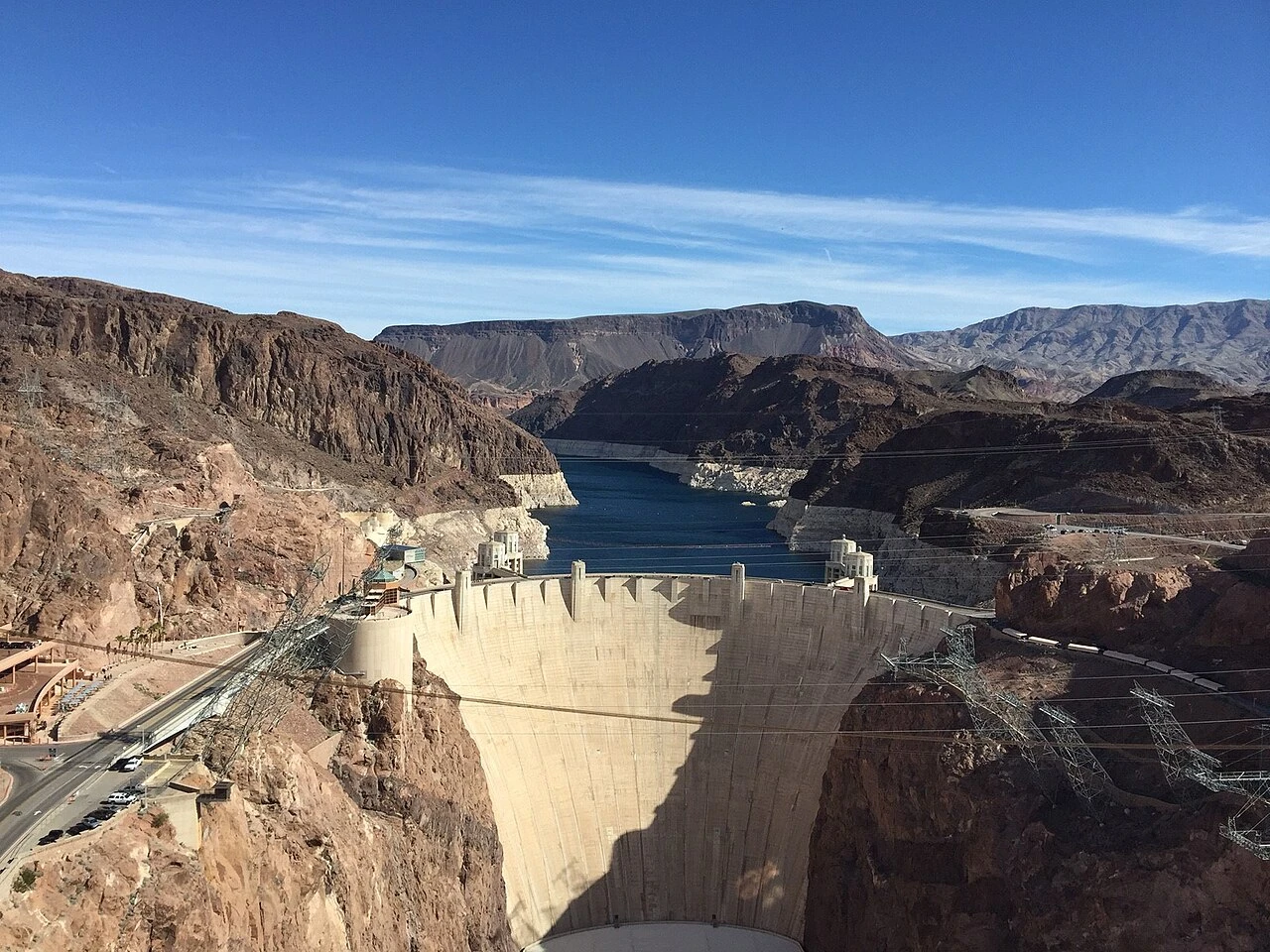
01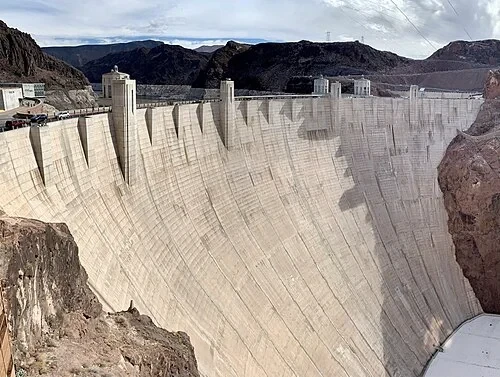 The Black Canyon Arrival: Nevada OverlookThe Nevada Side Overlook
Welcome to the Hoover Dam, a structure so massive it redefined the limits of human engineering in the early 20th century. Standing before you is a concrete giant that rises 726.4 feet from the floor of the Black Canyon. To understand how this works, consider its 'arch-gravity' design. The dam relies on two fundamental principles: its immense weight�approximately 6.6 million tons�and its elegant curved shape. This curve isn't just for aesthetics; it acts as an arch that transfers the staggering pressure of the Colorado River into the solid rock of the canyon walls. The sheer volume of material used here is difficult to grasp. To put it into perspective, engineers used enough concrete to pave a standard highway stretching all the way from San Francisco to New York City. This 6.6 million tons of concrete creates a barrier so thick that the base is 660 feet wide�nearly the length of two football fields. As you look out over the expanse, imagine the power of the water behind it. The dam creates Lake Mead, the largest reservoir in the United States, which provides water and power to millions across the Southwest. This overlook offers the perfect vantage point to appreciate the harmony between industrial force and the natural ruggedness of the Black Canyon.
Photo: APK · CC BY-SA 4.0
02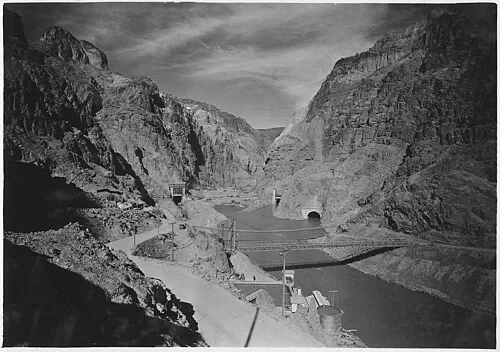 The Black Canyon Arrival: Nevada OverlookTaming the Black Canyon
The construction of the dam began in 1931, but the work didn't start with pouring concrete. First, the Colorado River itself had to be moved. Engineers achieved this by blasting four massive diversion tunnels through the solid volcanic rock of the canyon walls. Each of these tunnels measured 56 feet in diameter�large enough to drive two semi-trucks through side-by-side. Once these were completed, cofferdams were built to force the river away from its natural bed and into the tunnels, leaving the canyon floor dry for the main construction. This monumental project took place during the height of the Great Depression. For many of the men working here, the dam was a desperate lifeline. Thousands of families traveled to this harsh desert environment, living in makeshift camps like Ragtown, just for the chance at a grueling job. The conditions were brutal, with summer temperatures regularly soaring above 120 degrees Fahrenheit, but the necessity of employment drove a pace of work that was unprecedented. These tunnels remain as silent witnesses to that initial struggle to tame the river, even though most of them are now partially filled with concrete or used for the dam�s internal operations.
Unknown author · Public domain
03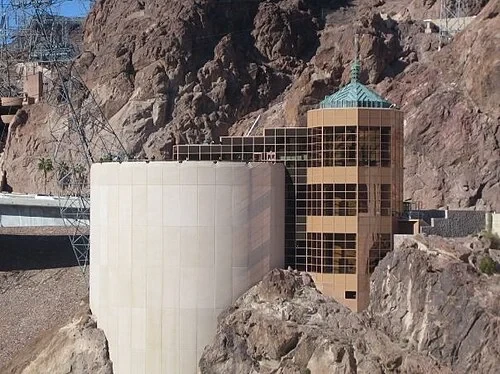 Building a Modern Marvel: Visitor Center and HistoryThe Visitor Center
While the dam is primarily a triumph of engineering, its visual identity is equally significant. In the early stages of planning, the structure was intended to be purely functional, with little regard for appearance. However, the government eventually brought in architect Gordon Kaufmann to refine the design. Kaufmann was a leading figure in the Art Deco movement, and he sought to give the project a sense of permanence and grandeur that matched its scale. You can see his influence in the streamlined turrets and the clean, modernist lines of the surrounding buildings. Kaufmann stripped away traditional ornamentation, replacing it with the bold, geometric forms that were popular in the 1930s. This aesthetic transition turned the dam from a simple industrial utility into a monument of American achievement. The Visitor Center and the surrounding structures exhibit this 'Stripped Classical' style, emphasizing the dam's power through simplicity and strength. These features ensure that even the functional components, like the elevator towers and powerhouses, contribute to the site�s unified and dignified appearance, making it as much a work of art as it is a powerhouse.
Listen in the appPhoto: Veronidae · CC BY-SA 3.0
04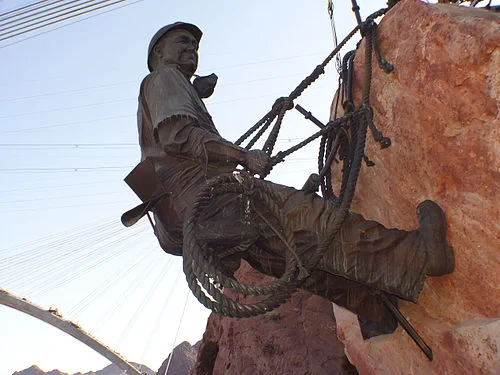 Building a Modern Marvel: Visitor Center and HistoryThe High Scaler Statue
Among the thousands of laborers who built the dam, few took on more risk than the 'high scalers.' Their job was to clear loose rock from the canyon walls to ensure the dam and powerhouses would have a stable foundation. These men worked while suspended from ropes hundreds of feet in the air, using heavy jackhammers and even sticks of dynamite to chip away at the cliffs. They were often buffeted by high winds and the extreme desert heat, with only their physical strength and simple ropes keeping them from falling into the abyss. One worker became a legend among his peers: a man known as the 'Human Pendulum.' He was famous for his ability to swing himself across the canyon, using his momentum to move supplies or perform daring stunts for the early tourists who gathered to watch the construction from above. High scalers were also known for their 'hard hats,' which were often just cloth hats dipped in tar to protect against falling rocks�a precursor to modern safety gear. This statue captures a high scaler in a characteristic pose, leaning back against his harness, a reminder of the immense physical courage required to build this monument.
Listen in the appSerge Melki from Indianapolis, USA · CC BY 2.0
05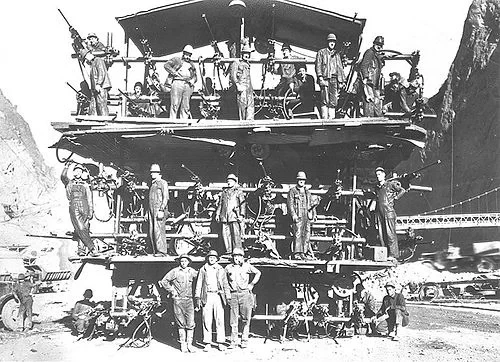 Building a Modern Marvel: Visitor Center and HistoryThe Jumbo Rig
To blast the massive diversion tunnels through the canyon walls, traditional drilling methods were simply too slow. The solution was the 'Jumbo Rig.' This was a massive frame mounted on the back of a truck, allowing 30 men to operate 30 different drills simultaneously. By attacking the rock face in a coordinated grid, workers could drill a full set of holes for explosives in a fraction of the time it would have taken previously. This efficiency was critical to keeping the project moving during the peak of construction in July 1934. At that time, over 5,200 workers were on site, laboring in shifts 24 hours a day. The environment was incredibly hostile; in the tunnels, the heat and humidity were compounded by the fumes from the machinery. Outside, the Nevada sun pushed temperatures above 120 degrees. Despite these hardships, the coordination made possible by innovations like the Jumbo Rig allowed the team to break records for excavation and concrete pouring. The scale of the rig shown here reflects the 'bigger is better' philosophy that defined the entire project, proving that when standard tools failed, the engineers of the 1930s would simply invent something new to get the job done.
Listen in the appBureau of Reclamation · Public domain
06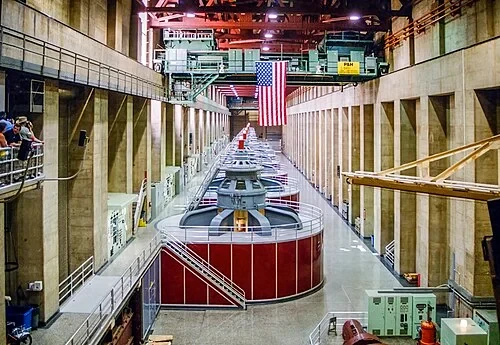 The Heart of the Dam: Powerhouse InteriorNevada Powerhouse
The Nevada Powerhouse is one wing of the massive U-shaped structure located at the base of the dam. Inside this cavernous space, you will find several of the dam's 17 main turbine-generators. The process begins hundreds of feet above in Lake Mead. When water is released, it travels down through massive pipes, using gravity to gain tremendous speed. This rushing water strikes the blades of the turbines, spinning them at high speeds to create mechanical energy. That mechanical energy is then converted into electricity by the massive generators sitting atop the turbines. The total power capacity of the Hoover Dam is a staggering 2,080 megawatts. This isn't just a local utility; the electricity generated here is distributed across a massive grid, powering millions of homes and businesses in Nevada, Arizona, and Southern California. Standing in this wing, you can almost feel the vibration of the machinery. The scale of the generators, which rise several stories high, is a testament to the industrial might of the era. This facility remains one of the largest hydroelectric plants in the United States, continuing a legacy of clean energy production that began nearly a century ago.
Listen in the appPhoto: Acroterion · CC BY-SA 4.0
07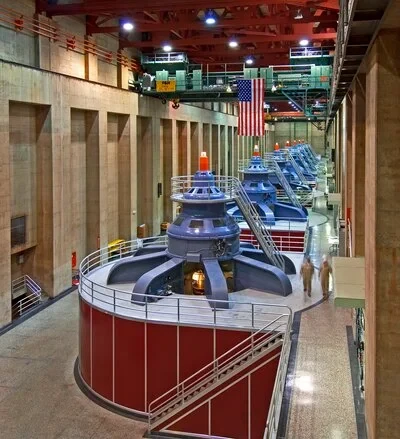 The Heart of the Dam: Powerhouse InteriorArizona Powerhouse Gallery
Looking down the length of the Arizona Powerhouse, the perspective truly highlights the monumental scale of the project. To build a structure this size, the government and the contractors had to manage a supply chain of unprecedented proportions. As we noted earlier, the dam contains enough concrete to pave a two-lane road across the entire United States. Managing the pouring of that concrete was a logistical feat that required constant innovation, from the massive overhead cableways to the specialized cooling systems embedded in the walls. Remarkably, the entire project was completed in 1936, more than two years ahead of the government's original schedule. This was achieved through a 24-hour work cycle and the intense drive of a workforce that knew every day of work meant another day of survival during the Depression. The gallery you see here houses the machinery that turned the Colorado River from a destructive force into a source of stability for the American West. The clean, organized layout reflects the efficiency that defined the project from day one. Today, these galleries continue to function as they did when they were first commissioned, serving as a operational museum of 20th-century industrial design.
Listen in the appJeffrey G. Katz · CC BY 3.0
08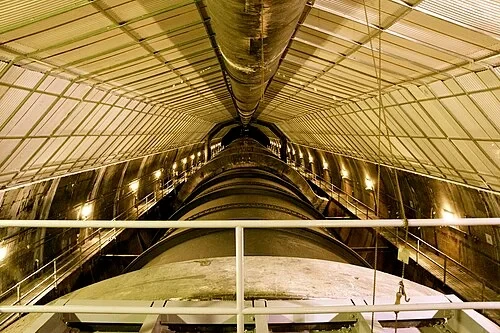 The Heart of the Dam: Powerhouse InteriorThe Cooling System
One of the greatest challenges in building a dam of this size was the heat generated by the curing concrete. If the dam had been poured as a single, solid block, the chemical reaction of the cement would have created so much internal heat that it would have taken over 125 years to cool down to ambient temperatures. During that time, the concrete would have contracted and cracked, likely causing the dam to fail. This is known as the '125-year cooling problem.' To solve this, engineers designed the dam as a series of interlocking blocks rather than one mass. Inside these blocks, they embedded 582 miles of one-inch steel pipes. Once the concrete was poured, they circulated ice-cold water from a massive onsite refrigeration plant through these pipes. This allowed the engineers to 'shrink' the dam artificially and at a much faster rate. Once a section was cooled, the pipes were filled with grout to become a permanent part of the structure. You can see remnants of this internal infrastructure in the service tunnels and galleries. This cooling system was a world-first on this scale and remains one of the most brilliant solutions devised by the project's engineering team.
Listen in the appMark Gorman · CC BY-SA 3.0
09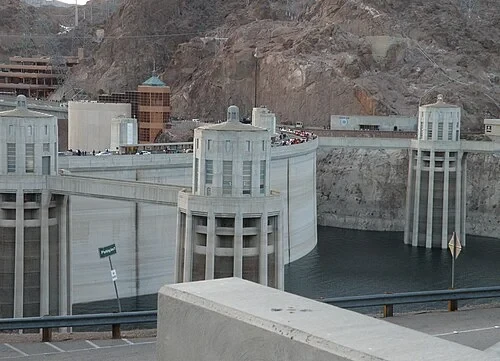 Walking the Crest: Engineering and Intake TowersThe Intake Towers
Standing tall in the waters of Lake Mead, the four intake towers are both functional and decorative. These 395-foot-tall structures serve as the 'faucets' for the entire operation. They draw water from the reservoir through massive gates and send it down into huge pipes called penstocks, which lead directly to the turbines in the powerhouses. Their Art Deco design, with its vertical ribbing and geometric turrets, was carefully chosen to complement the main dam. However, these towers also hold a somber place in the dam's history due to the Tierney family tragedy. In 1922, a surveyor named J.G. Tierney became the first person to die during the project's early stages when he drowned in the river. Exactly thirteen years later to the day, on December 20, 1935, his son, Patrick Tierney, became the final person to die during construction when he fell from one of these very intake towers. This tragic coincidence is often cited by locals as a symbol of the immense human cost of the project. Today, the towers continue to regulate the water levels of Lake Mead, ensuring a steady flow of energy and water to the Southwest while standing as monuments to those who built them.
Listen in the appMARELBU · CC BY 3.0
10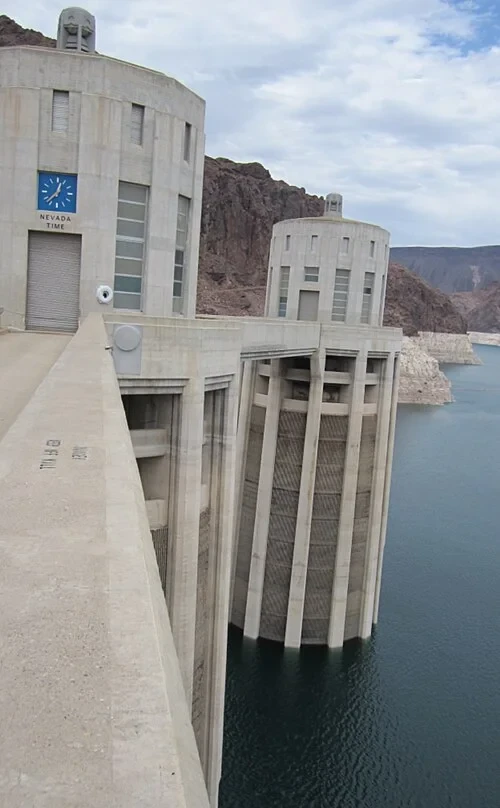 Walking the Crest: Engineering and Intake TowersThe Art Deco Clocks
As you observe the intake towers, you will notice large clock faces prominently displayed on their upper levels. These aren't just for telling time; they symbolize the dam's unique position on the border between two states and two time zones. One tower represents Nevada time, while the other represents Arizona time. Because Arizona does not observe Daylight Saving Time, the clocks often show different hours depending on the season, highlighting the regional complexity the dam helps manage. These clocks were an integral part of Gordon Kaufmann�s Art Deco vision. He wanted the dam to be a place of utility and artistic flair, and these clock faces are a perfect example of that philosophy. The bold blue backgrounds and simple, white markers are hallmarks of the modernist aesthetic of the 1930s. Beyond their artistic value, they serve as a constant reminder of the dam's role as a connector. It bridges the gap between these two states, not just physically through its crest, but also economically and socially through the water and power it distributes. The clocks stand as small but significant details that humanize the massive concrete structures they inhabit, blending the mechanical precision of the dam with the daily lives of the people it serves.
Listen in the appPhoto: Lsaldivar · CC BY-SA 3.0
Hoover Dam
Frequently asked questions
How much does the guide cost?
Free app download. Listed guide price: $1.99. Guide price shown in the app. Audio guide only. Venue admission is separate.
Can I listen without internet?
Yes. Download the guide’s audio, images, and maps in the app before your visit. Your downloaded content is then available offline.
Can I listen in my language?
Stanza supports 15 languages. Check the app for the languages available for this guide.
Do I need to follow a schedule?
No. This is a self-guided experience. Choose your stops, pause whenever you like, and return to a story at your own pace.
At your own pace
Explore Hoover Dam.
Download Stanza, then search for “Hoover Dam”.
Free app download · Guide price shown in the app
Keep exploring
Nearby audio guides
San Francisco
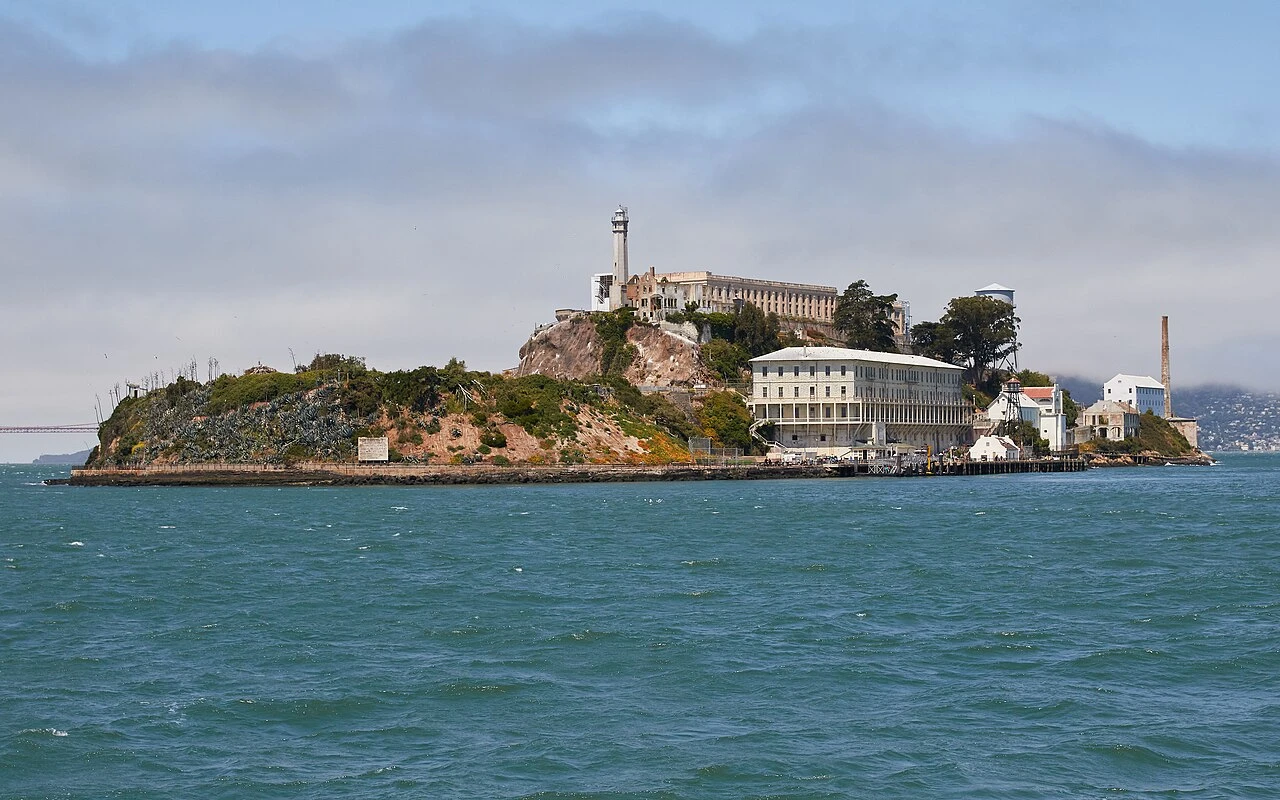
Alcatraz Island, Alcatraz
Content & sources
Photo: Frank Schulenburg · CC BY-SA 4.0
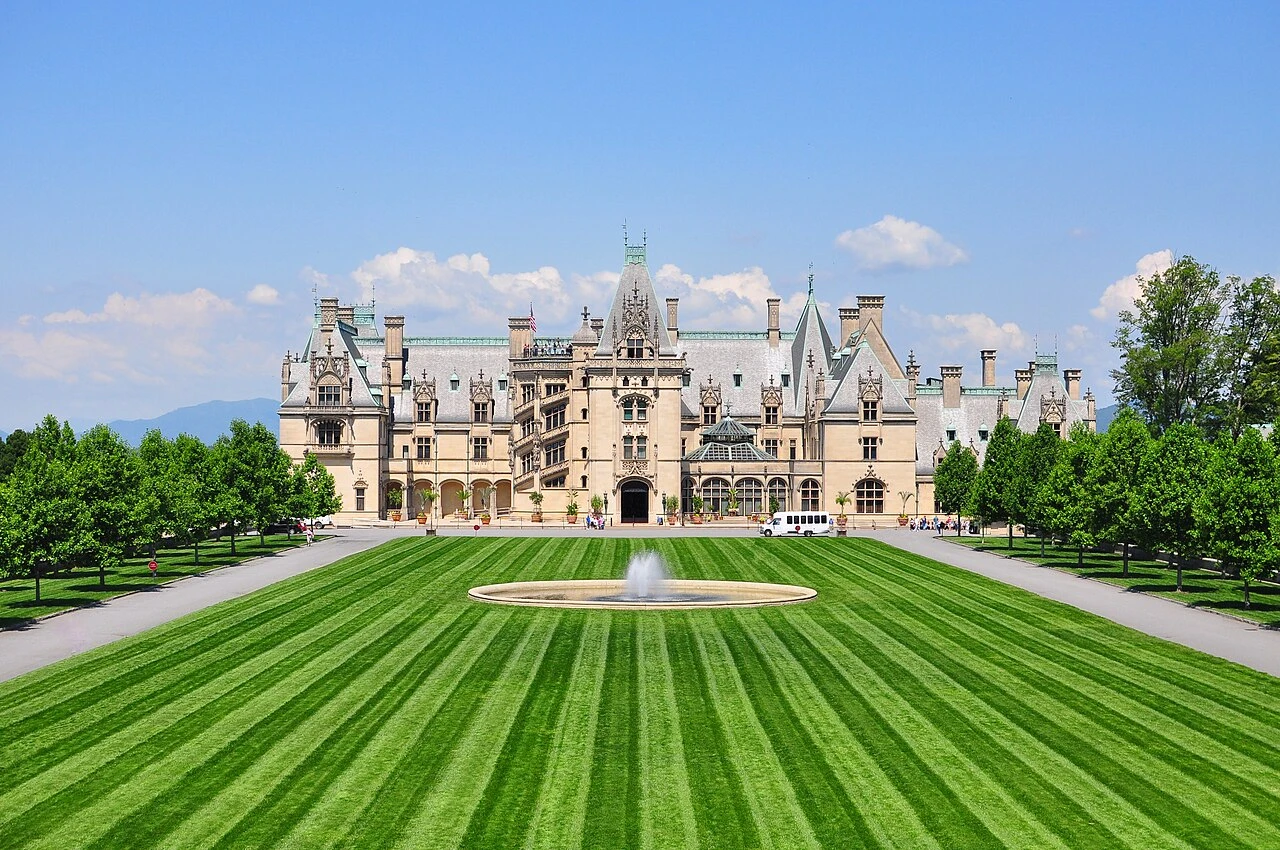
Asheville
Biltmore Estate
Content & sources
Blake Lewis · CC BY-SA 2.0
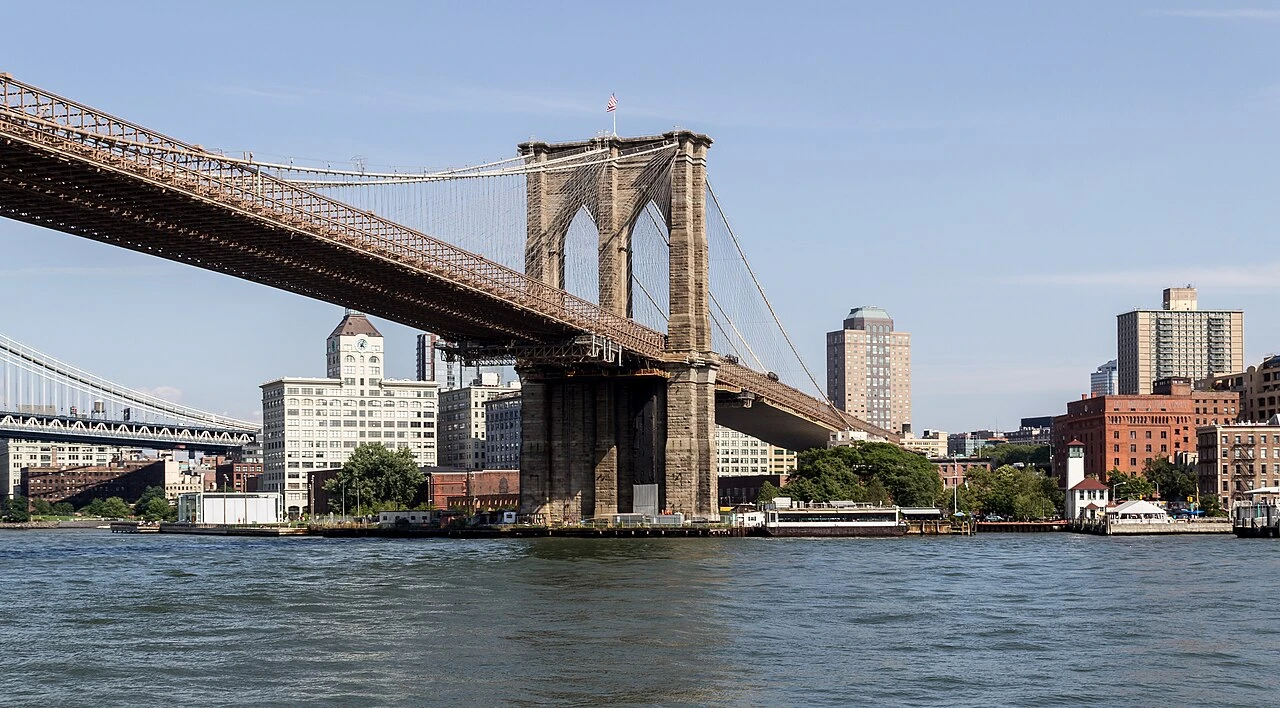
New York
Brooklyn Bridge
Content & sources
Dietmar Rabich · CC BY-SA 4.0
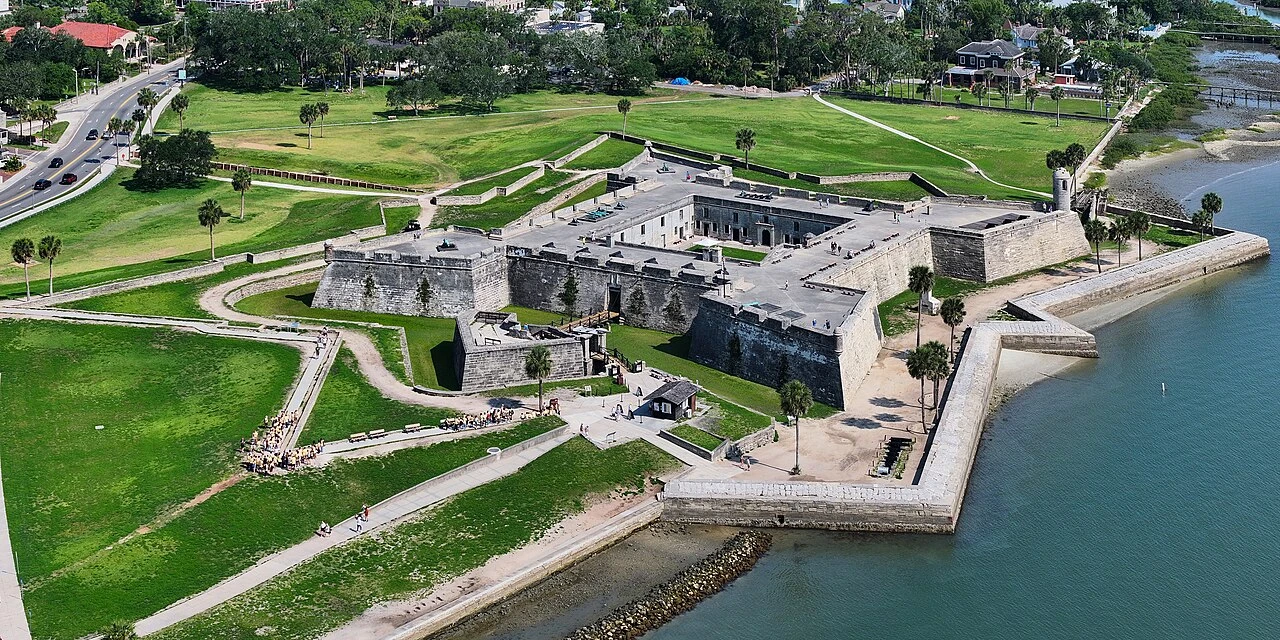
Saint Augustine
Castillo de San Marcos
Content & sources
Photo: Schwerdf · CC BY 4.0