 Stanza / Audio guide
Content & sources
Stanza · Audio guide
Serpent Mound Audio Guide
A place to remember. A story to take with you.
The Great Serpent Mound is a 1,348-feet-long precontact effigy mound located in Peebles, Ohio. It is the largest serpent effigy known in the world.
Download Stanza, then search for “Serpent Mound”.
About the tour
One guide. Your kind of visit.
The Great Serpent Mound is a 1,348-feet-long precontact effigy mound located in Peebles, Ohio. It is the largest serpent effigy known in the world.
Ready when you are.
- 01Get the free Stanza app.
iOS & Android
- 02Find your guide.
“Serpent Mound”
- 03Download before you go.
Works offline
Audio guide / 8 narrated stops
Inside the guide
Get to know a few of the stories before you go. Open a stop to read more.
01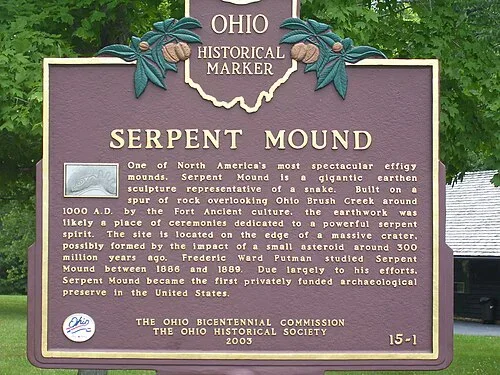 Park Entrance and Conical Burial Mounds
Ohio Historical Marker: Serpent Mound
Welcome to Serpent Mound, in Adams County, southern Ohio. A serpent made of earth lies along a bluff above Ohio Brush Creek, its body stretching thirteen hundred and forty-eight feet. That makes it the largest serpent effigy known in the world. The mound rises only about four feet high, shaped along a rock spur above the creek. The historical marker here was installed in 2003, and it preserves the story of how the serpent survived. In the 1880s, Frederic Ward Putnam of Harvard watched plowing and development destroy mound after mound across the Midwest. In 1886 he began raising money to buy land here, helped by a group of wealthy Boston women led by Alice C. Fletcher. The purchase covered sixty acres. It was completed by 1889, and it made Serpent Mound the first privately funded archaeological preserve in the United States. The marker dates the serpent to about 1000 A.D. and credits the Fort Ancient culture with building it. Hold that date loosely. It is one side of a scholarly argument this tour will come to later.
Photo: Stepshep · CC BY-SA 3.0
02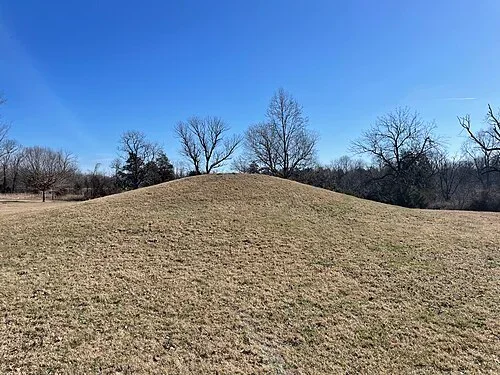 Park Entrance and Conical Burial Mounds
The Conical Adena Burial Mound
Not far from the serpent stands a very different mound, a rounded dome of earth just north of the parking lot. This is a conical burial mound of the Adena culture, a traditional grave mound rather than an effigy. Frederic Putnam dug into it in 1890, after securing the land. The excavation uncovered artifacts of a principal burial from the Adena period. It also revealed an ash bed north of the mound, rich in prehistoric material, and within the mound itself nine later burials had been placed. When the work was done and published, Putnam had the mound reconstructed, and that rebuilt dome stands there today. In 2011, before utility lines were installed, archaeologists reopened three sides of the same mound. Charcoal from the ash bed dated to the Fort Ancient period, the centuries around 1100 CE. Burials in the mound reached back to the Early Woodland period as well. The same ground, it seems, was reused ritually across many centuries.
Photo: Blervis · CC0
03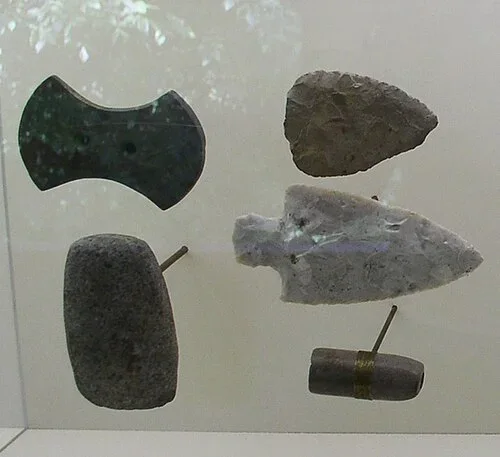 Serpent Mound Museum
Artifacts of the Mound Builders
The display case in the museum gives the mound's builders a tangible presence. Laid out inside are gorgets and stone points of the Adena culture, recovered here at Serpent Mound, alongside pipes, points, and an earspool made by the Hopewell. An earspool is a round ornament worn at the earlobe. Names like Adena and Hopewell are not tribes. Archaeologists use them as labels for peoples who shared styles of tools, ornaments, and practices across a region and an era. The Adena lived in the Early Woodland period, from roughly 800 BCE to the first century CE, concentrated in the river valleys of southern Ohio. The Hopewell tradition followed in the Middle Woodland, a time of flourishing ritual and artistic life. Both cultures left objects in this ground, and both are part of the serpent's story.
Listen in the appPhoto: Heironymous Rowe · CC BY-SA 3.0
04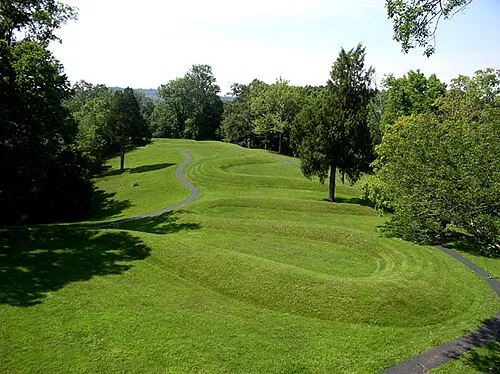 Observation Tower Platform
Reading the Serpent from the Tower
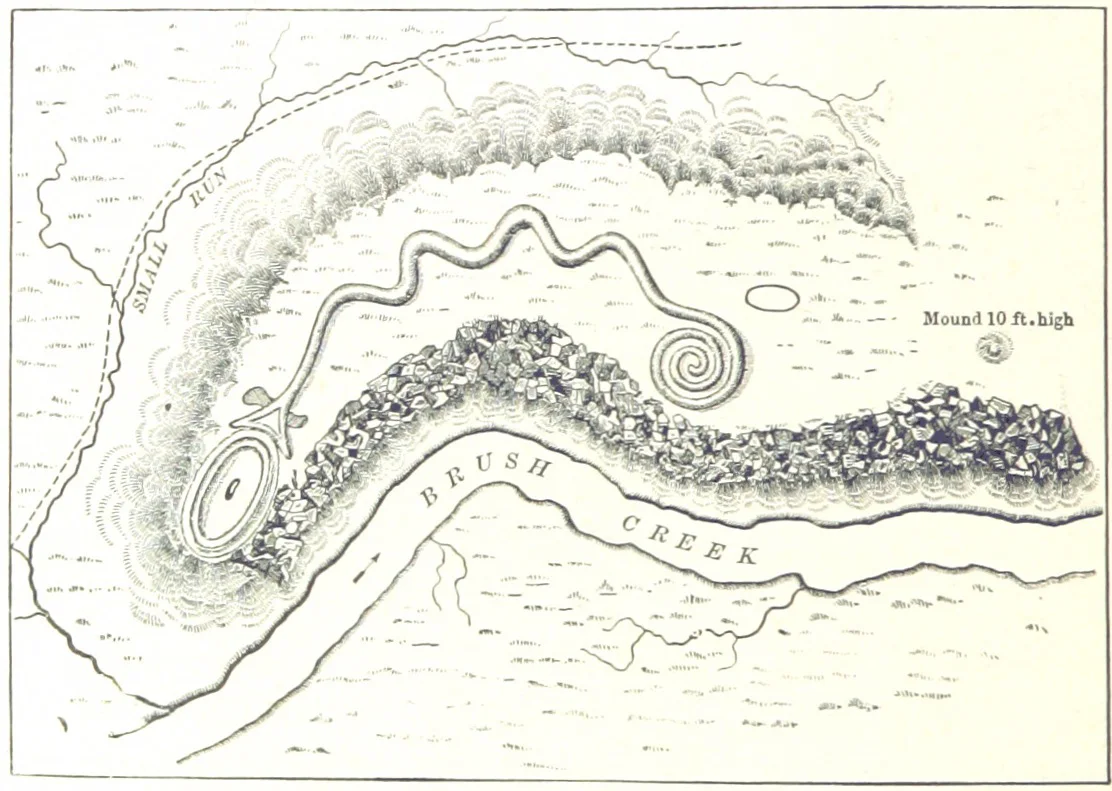
From the ground, the serpent is nearly impossible to read. In places the earthwork stands only nine inches high, and nowhere does it rise much more than three feet. The shape dissolves into a line of low green ridges. That is why the observation tower matters. When the site passed in 1900 to the Ohio State Archaeological and Historical Society, today the Ohio History Connection, the society built a tower overlooking the mound, and from its platform the whole creature comes together at last. The body winds back and forth across more than eight hundred feet of ground, coiling in seven places, before ending in a tight triple spiral. Its width holds remarkably steady, about two dozen feet across the whole run. The builders shaped the mound to follow the natural contours of the bluff. Yellowish clay and ash form the core, and a layer of rocks and soil reinforces the outside. Keeping a steady width across hundreds of feet of curves, in hand-placed earth, took careful work.
Listen in the appHeironymous Rowe (talk) · CC BY-SA 3.0
05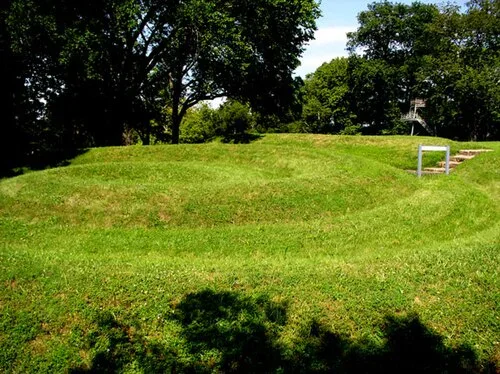 The Coiled Tail and Undulating Body
The Triple-Coiled Tail
The spiral at the southern end of the serpent is its signature feature, a triple coil often treated as the benchmark of the whole design. Laying out three tight turns of earth at this scale took genuine geometric precision. In 1987, Clark and Marjorie Hardman published a finding that gave the tail a possible purpose. The coiled tail, they showed, points toward the sunrise on the winter solstice. Other parts of the serpent seem to line up with the summer solstice sunrise, the equinox, or moonrises in the lunar cycle. Read together, those alignments suggest the mound may have worked as a kind of prehistoric calendar. The evidence has limits, though. The lines of sight for some curves are short and vague, too uncertain to confirm. The winter solstice sunrise at the tail remains the most compelling of the proposed alignments.
Listen in the appHeironymous Rowe at English Wikipedia (Original text: Herb Roe) · CC BY-SA 3.0
06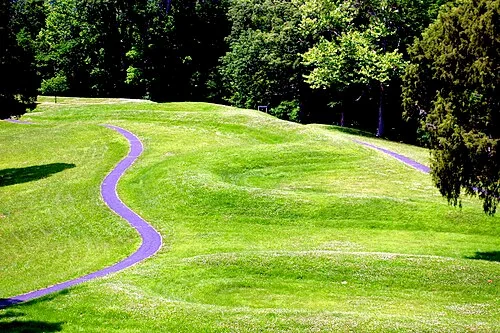 The Coiled Tail and Undulating Body
The Undulating Body
The body's curves carry the site's oldest argument. Who built the serpent, and when? Through much of the twentieth century, archaeologists split between two candidates, the Adena and the Fort Ancient. Radiocarbon dating published in 2014 pointed to the Adena era. It put construction at about 300 BCE. A further study in 2019 reached the same result. But the archaeologist Brad Lepper challenged that case. The dated material, he argued, was not charcoal at all, but organic sediment, and it came from soil cores rather than an exposed soil layer. Dates from such cores, other researchers have shown, can run as much as three thousand years too old. Lepper also pointed to the art. The Adena are not known to have built effigy mounds or used serpent imagery. The Fort Ancient, by contrast, built the Alligator Effigy Mound in Granville, Ohio, and depicted serpents often. A legend attaches to the other dating as well. Charcoal found in an old excavation trench gave a date around 1070 CE. From that, some archaeologists have speculated that Halley's Comet, blazing overhead in 1066, inspired the builders. Neither date has settled the question.
Listen in the appPhoto: Kabir · CC BY-SA 2.5
07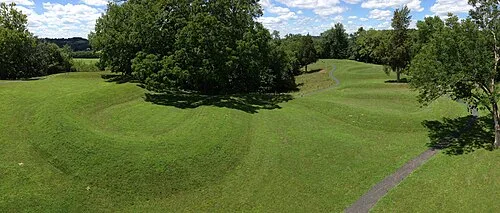 The Serpent's Head and the Oval Earthwork
The Serpent's Head and the Oval
At the head, the serpent's jaws open wide around a hollow oval earthwork about a hundred and twenty feet long. The first published reading came from E. G. Squier and Edwin Hamilton Davis, whose 1848 survey for the Smithsonian described a serpent about to swallow an egg. That egg has never quite left the conversation, but rival readings gathered. J. P. McLean saw the whole figure as the body of a frog. At one time, some observers of Christian conviction read the serpent as a mark of God, indicating the site of the Garden of Eden. Brad Lepper offered another possibility. The mound, he suggested, may depict a Dhegihan Siouan origin story, in which the Great Serpent, called Toothy Mouth, lord of the Beneath World, impregnated the First Woman. The sky may figure here too. The Hardmans found that the head and oval align with the sunset on the summer solstice. What the builders themselves meant was never recorded. Every reading since, egg or frog or Eden or origin story, is an interpretation reaching across the centuries.
Listen in the appEric Ewing · CC BY-SA 3.0
08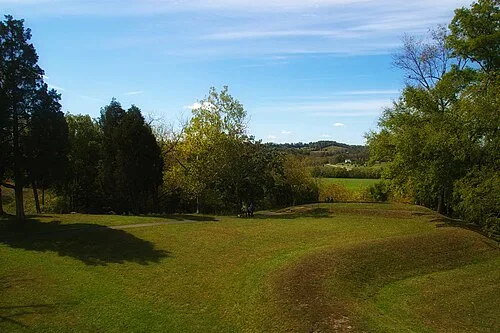 Crater Bluff and Valley Overlook
The Crater Bluff and Ohio Brush Creek
The ground beneath the serpent is far older than anything built on it. This plateau lies within the Serpent Mound crater, the buried scar of a meteorite impact roughly nine miles across. It formed more than two hundred fifty million years ago. Erosion has erased the crater from the surface so thoroughly that nothing of it can be seen. In 2003, the state's natural resources department assembled a team of geologists to confirm the buried structure. Their work, building on a survey from 1975, corroborated the meteorite origin. Why the mound's builders chose this plateau is not recorded, though its distinctive ground must have set it apart. The bluff looks down on Ohio Brush Creek as the creek winds through the valley below. A serpent of earth, on the plateau of an ancient impact, above the winding creek.
Listen in the appPhoto: Niagara66 · CC BY-SA 4.0
Serpent Mound
Frequently asked questions
How much does the guide cost?
Free app download. Listed guide price: $0.99. Guide price shown in the app. Audio guide only. Venue admission is separate.
Can I listen without internet?
Yes. Download the guide’s audio, images, and maps in the app before your visit. Your downloaded content is then available offline.
Can I listen in my language?
This audio guide is available in 15 languages, including English.
Do I need to follow a schedule?
No. This is a self-guided experience. Choose your stops, pause whenever you like, and return to a story at your own pace.
At your own pace
Explore Serpent Mound.
Download Stanza, then search for “Serpent Mound”.
Free app download · Guide price shown in the app
Keep exploring
Audio guides — United States
Stewart Township
Fallingwater
Content & sources
Carol M. Highsmith · Public domain

Asheville
Biltmore Estate
Content & sources
Blake Lewis · CC BY-SA 2.0

Chicago
Art Institute of Chicago
Content & sources
ajay_suresh · CC BY 2.0

Chicago
Willis Tower
Content & sources
Daniel Schwen · CC BY-SA 4.0