Languages
15Willis Tower Audio Guide
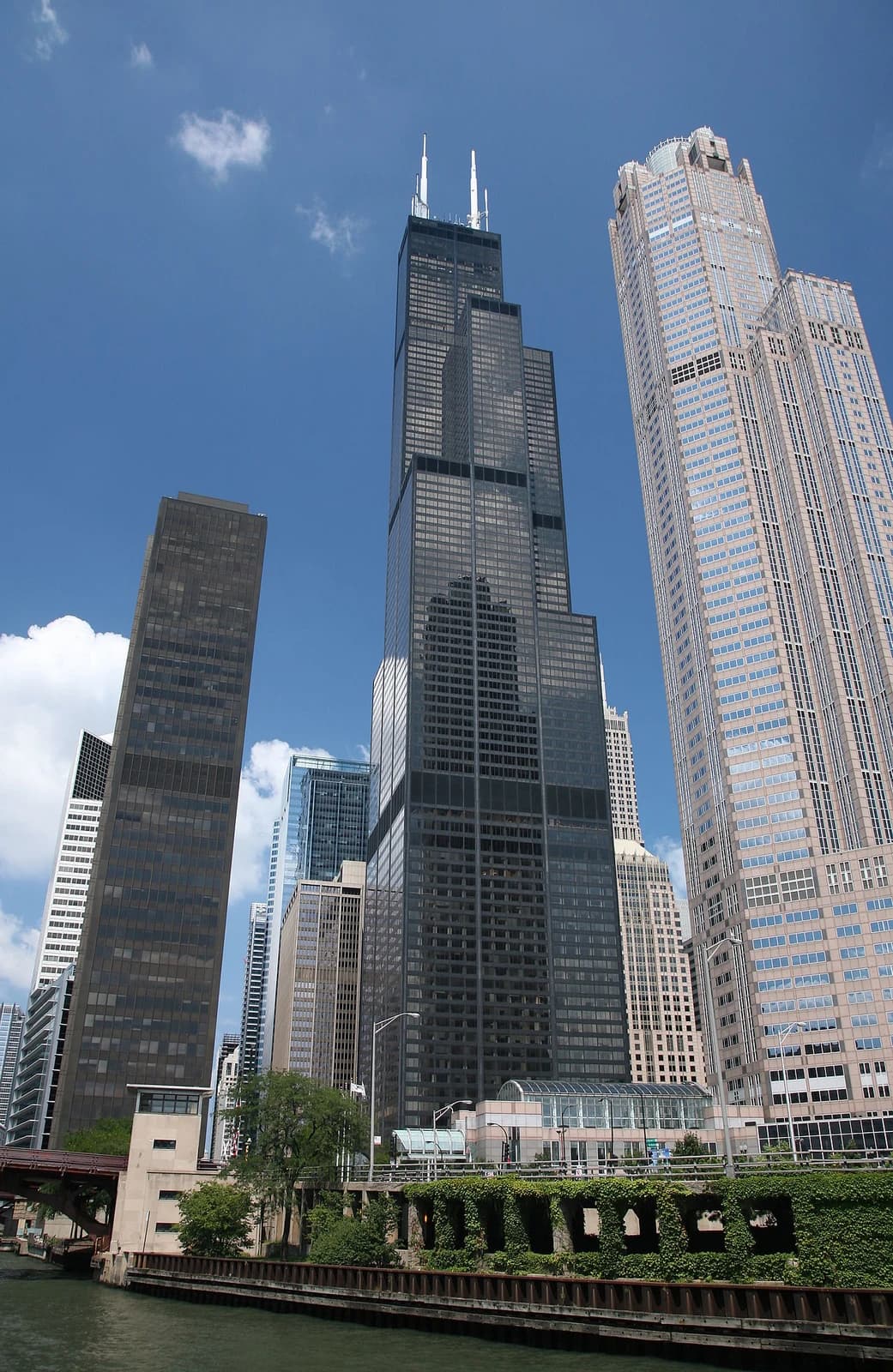
Willis Tower is a landmark in Chicago, United States. Explore it with Stanza's GPS-triggered offline audio guide — available in 15 languages.
Quick Facts
22
Stops
15
Languages
100%
Offline
📍 Chicago, United States · 41.8786°N, -87.6358°E
About Willis Tower
The Willis Tower is a 110-story skyscraper in Chicago, Illinois, United States. Once the tallest building in the world, it remains an iconic landmark featuring an observation deck that attracts numerous visitors.
Willis Tower is also known as Sears Tower, 233 S. Wacker Drive, 233 South Wacker Drive, 233 S Wacker Drive.
This self-guided audio tour features 22 narrated stops organized across 6 sections, including The Engineering of a Giant, The High-Speed Ascent, The Skydeck and The Ledge, Northern and Eastern Vistas, The Urban Grid: South and West, The Summit Antennas. As a tower, Willis Tower offers a unique cultural experience in the heart of Chicago, United States.
The Stanza audio guide is available in 15 languages and works entirely offline — download the complete tour including audio narration, maps, and images before your visit. As you walk through Willis Tower, GPS-triggered narration plays automatically at each point of interest.
Last updated:
What you will hear
The Engineering of a Giant
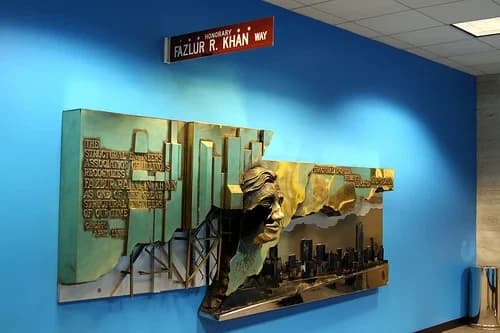
Explaining the revolutionary 'bundled tube' design and honoring structural engineer Fazlur Rahman Khan.
The Structural Engineer
The figure honored in this commemorative sculpture is Fazlur Rahman Khan, a man often described as the 'Einstein of Structural Engineering.' Khan was the lead structural engineer on the tower, and his innovative thinking is why the building exists today. Before his breakthroughs, the height of skyscrapers was limited by the weight of the materials required to keep them stable against the wind. Khan's 'tube' system, which you can see represented in the abstract forms of the sculpture, solved this problem by using the outer walls of the building as a rigid structural member. His work didn't just impact this one tower; it fundamentally changed the DNA of architecture. Every modern supertall building, including the Burj Khalifa in Dubai, owes its existence to the pioneering concepts Khan introduced here in Chicago. The sculpture captures his likeness alongside a stylized representation of the city's skyline, serving as a reminder that the giants of the city are built not just of steel and glass, but of human ingenuity. His legacy is one of reaching higher and thinking differently about how we shape the urban environment.
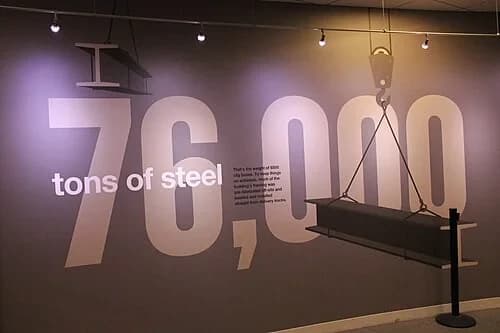
The Steel Skeleton
The graphic before you provides a glimpse into the staggering scale of the construction process that took place here in the early 1970s. Building the world's tallest tower was a Herculean task that required the coordinated efforts of over 2,000 workers over the course of four years. The sheer amount of material involved is difficult to wrap the mind around. The building's primary skeleton is composed of roughly 76,000 tons of steel. To put that in perspective, that is the equivalent weight of about 6,500 city buses. Because the site was so cramped in the heart of the city, much of this steel had to be prefabricated off-site and delivered precisely when needed. Each beam was hoisted into place by massive cranes, fitting into the 'bundled tube' design like pieces of a giant vertical puzzle. This level of precision and scale was unprecedented at the time. As you stand here, imagine the roar of machinery and the constant activity of the workers who pieced together this massive iron giant, creating a monument to American industry and engineering prowess.
The High-Speed Ascent
Preparing visitors for the 60-second elevator journey to the 103rd floor.
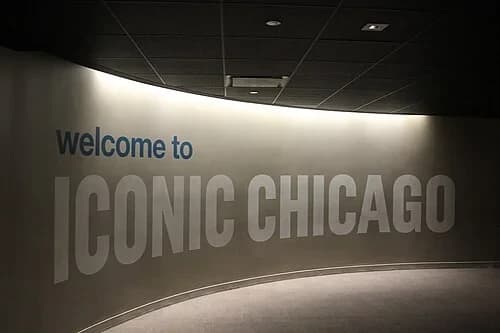
Arrival at the Skydeck
Step out onto the Skydeck on the 103rd floor, and you have officially reached the highest observation point in the United States. From this altitude, the city of Chicago unfolds beneath you like a massive living map. This deck is one of the most popular tourist destinations in the country, drawing approximately 1.7 million visitors every year. On a perfectly clear day, your vision can stretch far beyond the city limits, allowing you to see into four different states: Illinois, Indiana, Michigan, and Wisconsin. The atmosphere up here is entirely different from the bustling lobby below; there is a sense of quiet vastness as you look out over the curved horizon of the Earth. This is the moment to catch your breath and take in the panoramic views of the skyscrapers, the vast blue of the lake, and the grid of the city stretching toward the horizon. The 103rd floor was designed to give everyone a chance to feel like they are standing on top of the world, providing a unique perspective on the scale of human achievement and the beauty of the Midwestern landscape.
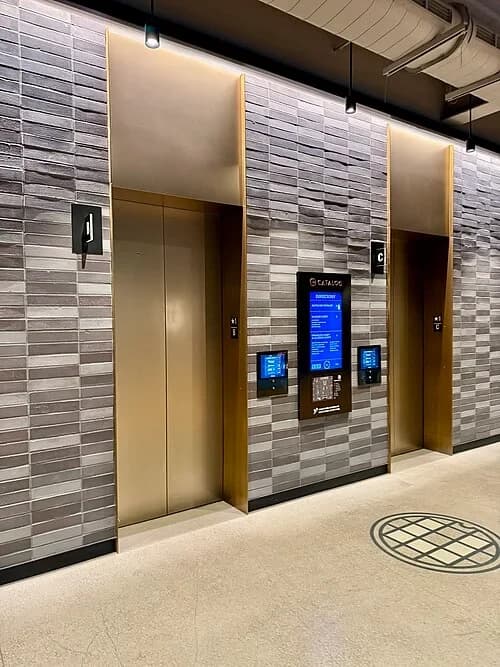
High-Speed Elevators
As you prepare for your ascent, you are standing before some of the most advanced vertical transportation systems in the world. The tower is equipped with 104 elevators, including sixteen sophisticated double-decker cabs that can serve two floors at once to maximize efficiency. The trip from the lobby to the 103rd-floor Skydeck takes only sixty seconds, meaning you will be traveling at speeds of up to 1,600 feet per minute. Because of this incredible speed, many visitors experience an 'ear-popping' sensation. This is a result of the rapid change in atmospheric pressure as you climb nearly a quarter-mile into the sky in just one minute. These are not merely utility machines; they are high-performance vehicles designed to move thousands of people through the building every day. The technology behind these elevators was as revolutionary as the building's structure itself, requiring specialized dampening systems to ensure a smooth ride even as the building subtly sways in the wind. In just a few moments, the doors will open, and you will step out into a completely different world far above the city streets.
The Skydeck and The Ledge
The signature experience of the tour: standing in glass boxes 1,353 feet above the city.
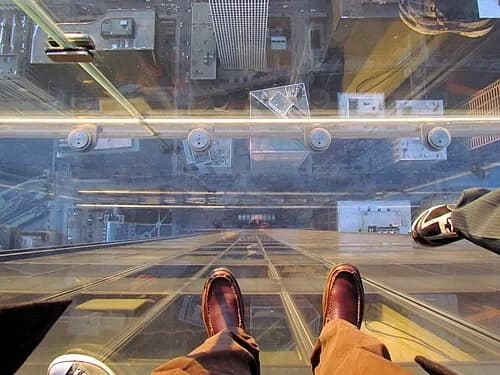
Skydeck
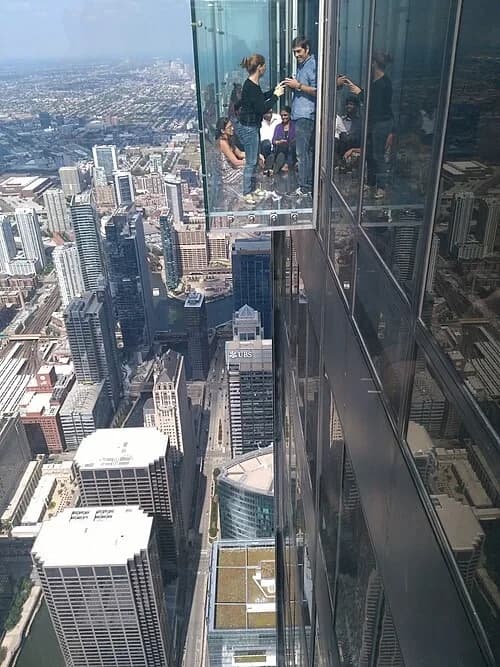
Prepare for a sensation that is both thrilling and slightly unnerving. As you stand here, you are invited to look straight down through the transparent floor beneath your feet. You are peering at the city from a height of 1,353 feet. Directly below you is Wacker Drive, and the tiny rectangular shapes moving along it are actually full-sized cars and buses. This is the ultimate sensory experience of the tour, challenging your sense of height and balance in a way few other places on Earth can. The visual of seeing the pavement so far below your own shoes often triggers a physical response—a quickening of the heart or a tingle in the feet. It is a rare opportunity to see the world from a bird's-eye perspective while still having a solid, albeit invisible, surface beneath you. This view highlights the incredible density of the Chicago Loop and provides a true sense of the tower's staggering verticality. Take a moment to settle your nerves and appreciate the unique perspective that only a supertall structure can provide.
The Glass Balconies
These glass balconies, famously known as 'The Ledge,' are an engineering feat designed to give you the sensation of floating in mid-air. These boxes extend four feet out from the main facade of the building, hanging over the street below. While they may look delicate, they are incredibly robust. Each balcony is built with three layers of half-inch thick glass that have been laminated together to ensure absolute safety. An interesting detail about these boxes is their retracting mechanism. Because the tower's windows must be cleaned regularly, these glass boxes are designed to slide back into the building's structure, allowing window-washing equipment to pass by unhindered. This functionality was a key part of their design when they were added in 2009. Standing inside 'The Ledge' offers a 360-degree view of the sky, the horizon, and the depths below, removing the traditional barrier of the building's wall. It is a masterpiece of both structural engineering and visitor experience, providing a safe but heart-pounding way to interact with the skyscraper's extreme altitude.
Northern and Eastern Vistas
Exploring the skyline views toward Lake Michigan and the historic financial district.
The Lakefront and Grant Park
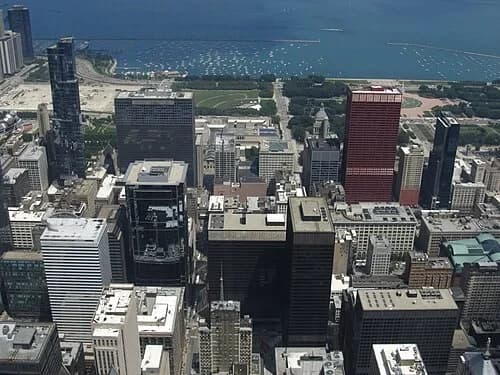
Looking toward the east, the cityscape gives way to the immense, shimmering blue of Lake Michigan. This vast body of water is so large it creates its own horizon, making the city feel like a coastal metropolis. Spreading out along the lakefront is the lush greenery of Grant Park, often referred to as Chicago's 'front yard.' This historic park is home to world-class museums and the famous Buckingham Fountain. Within the cluster of buildings nearby, you can spot the distinctive reddish hue of the CNA Center, a bold splash of color in a skyline dominated by silver, black, and stone. This view also covers the Loop, Chicago’s historic financial district, where the city’s first skyscrapers were born. The contrast between the dense, gray architecture of the Loop and the vibrant blue of the lake is one of the most beautiful aspects of the Chicago landscape. It highlights the city’s commitment to preserving public green space alongside its drive for vertical growth, creating a balanced and world-renowned urban environment.
Northern Vistas
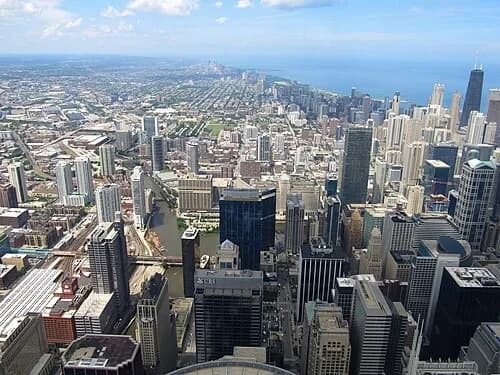
Directing your attention toward the north, you can follow the winding, blue-green ribbon of the Chicago River as it cuts through the city. This view leads your eye toward the famous Magnificent Mile, the city's premier shopping and cultural district. Standing out in the distance is the distinctive white form of 875 North Michigan Avenue, formerly known as the John Hancock Center. Notice its unique X-braced exterior, which, like this tower, was a pioneering structural design. These two towers have served as the northern and southern bookends of the Chicago skyline since the 1970s, defining the city’s iconic silhouette for generations. Between them, you can see a dense forest of architecture, ranging from historic skyscrapers to modern glass towers. This northern vista captures the elegance and ambition of Chicago's development. The river below is often dotted with tour boats and kayaks, which from this height appear as tiny, slow-moving icons. It is a view that encapsulates the harmony between the city's natural waterways and its towering man-made achievements.
The Urban Grid: South and West
Viewing the massive rail yards and neighboring skyscrapers like 311 South Wacker.
The White Crown
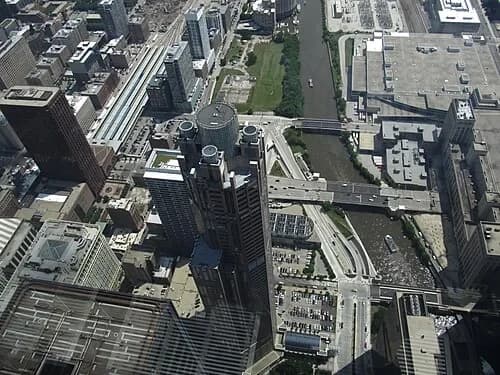
Looking out from the Skydeck, one building immediately commands attention due to its proximity and unique topper. This is 311 South Wacker Drive. Completed in 1990, it is famous for its sixty-five-foot-tall translucent cylinder, surrounded by four smaller ones. This illuminated feature is affectionately known by Chicagoans as the 'Wedding Cake.' At night, it glows with a brilliant white light that can be seen for miles across the Midwestern plains. What is most striking from our vantage point is the perspective. On the ground, 311 South Wacker is a towering giant, one of the tallest reinforced concrete buildings in the world. Yet, from the peak of the Willis Tower, you are looking down upon its ornate roof. It serves as a reminder of the staggering elevation you have reached. Even massive structures that define the city skyline seem reduced in scale, appearing almost like architectural models set against the backdrop of the Loop. This perspective allows you to appreciate the sheer verticality of Chicago’s skyline, where even the giants have neighbors that look down upon them.
The Summit Antennas
Discussing the tower's role as a broadcasting hub and its total pinnacle height.
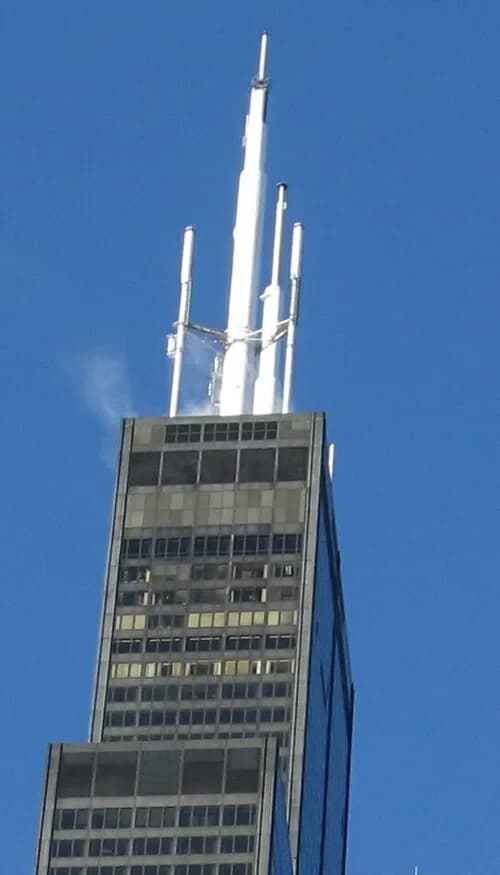
Reaching for the Sky
Standing at the very top of the tower, you are in a realm where the rules of the ground no longer apply. At this extreme altitude, the building becomes a massive target for nature’s electricity. It is estimated that the tower is struck by lightning several hundred times every year. During a heavy storm, the lightning rods at the pinnacle can be hit multiple times in a single minute, creating a spectacular, though often unseen, display of natural power. The building's steel skeleton is designed to safely channel this immense energy down into the ground, protecting the occupants inside. Beyond the weather, simply maintaining equipment at this height is a feat of engineering in itself. Imagine the technical difficulty of replacing a light bulb or repairing an antenna when you are nearly a third of a mile in the air, buffeted by freezing winds. Maintenance crews who work on the roof and the masts must be specially trained for high-altitude environments, often working in harness systems with specialized tools that won't blow away. This upper reach of the tower is a harsh, demanding environment that requires constant vigilance and specialized care to ensure that the city’s tallest landmark remains functional and safe, standing strong against the elements year after year.
Want to hear the rest?
Download the Stanza app to unlock all 22 stops and full GPS-guided navigation.
Frequently Asked Questions
How long does the Willis Tower audio tour take?
The Willis Tower audio guide includes 22 narrated stops. Most visitors spend 45 minutes to 1.5 hours exploring the complete tour, though you can listen at your own pace and skip or revisit any stop.
Is the Willis Tower audio guide available in my language?
Stanza supports 15 languages: English, Spanish, French, German, Italian, Portuguese, Russian, Japanese, Chinese, Korean, Arabic, Hindi, Polish, Dutch, Hebrew. Check the guide in the app to confirm the languages currently available for this tour.
Can I use the audio guide offline at Willis Tower?
Yes! Download the complete Willis Tower tour — including all audio, maps, and images — before your visit. The Stanza app works completely offline, so you don't need WiFi or mobile data at the venue.
How much does the Willis Tower audio guide cost?
The Stanza app is free to download. The current listed price for the Willis Tower audio guide is $2.99; app-store region and currency may affect the final price.
How do I use the Stanza audio guide at Willis Tower?
Download the free Stanza app, search for "Willis Tower", and download the tour. When you arrive at the venue, the app uses GPS to detect your location and automatically plays the relevant narration as you move between points of interest — completely hands-free.
What makes the Stanza audio guide different from other Willis Tower tours?
Stanza offers GPS-triggered narration that plays automatically as you walk through Willis Tower — no need to manually select stops. The tour is available in 15 languages, works fully offline, and includes 22 expertly narrated stops with images and historical context.
What other audio guides are available near Willis Tower?
Stanza offers multiple audio guides in Chicago, United States and nearby areas. After downloading the app, browse the map to discover all available tours near Willis Tower. Each guide can be downloaded for offline use.