Languages
15Colonial Williamsburg Audio Guide
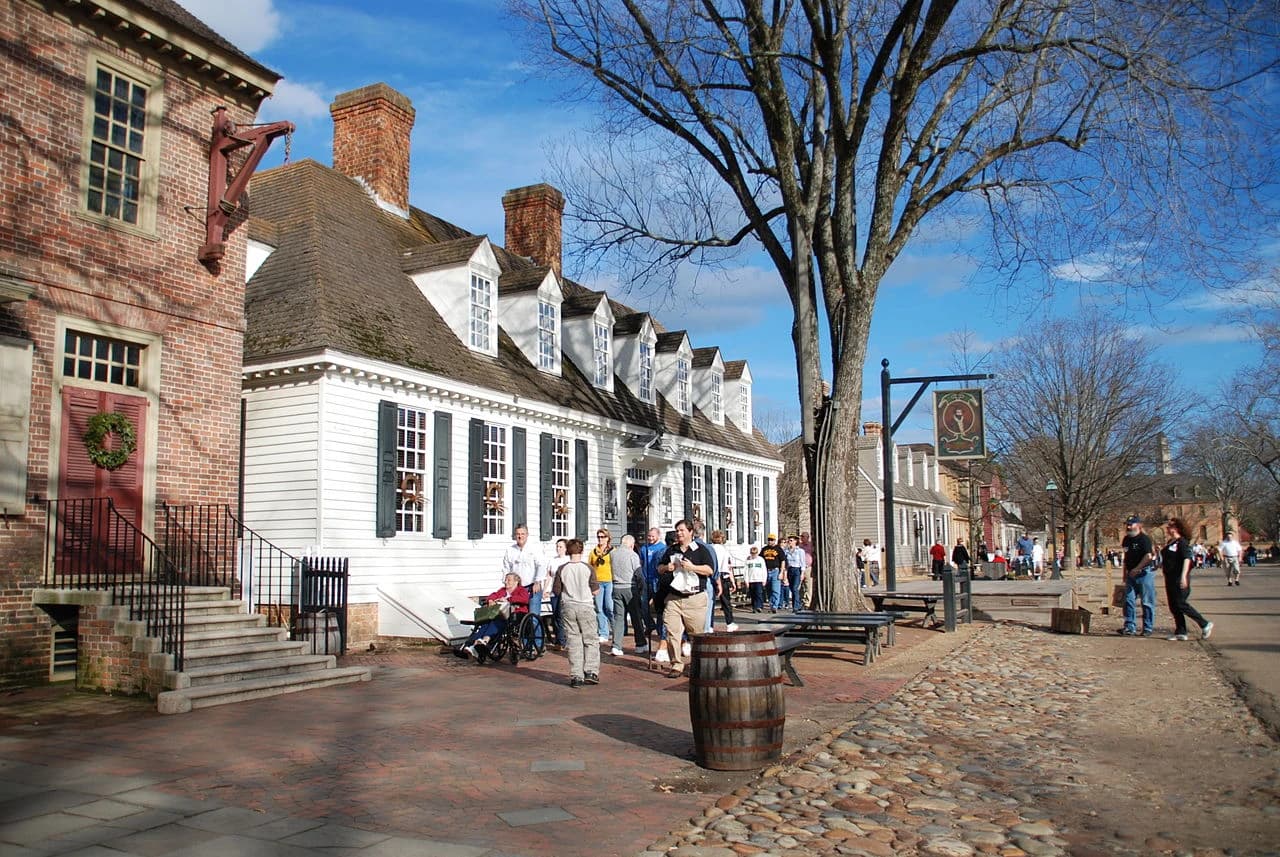
Colonial Williamsburg is an archaeological site in Williamsburg, United States. Explore it with Stanza's guided offline audio tour — narrated in 15 languages.
Quick Facts
26
Stops
15
Languages
100%
Offline
📍 Williamsburg, United States · 37.2714°N, -76.7003°E
About Colonial Williamsburg
Colonial Williamsburg is a living history museum and historic district located in Williamsburg, Virginia. It recreates the 18th-century American colonial capital with restored buildings and interpretive programs.
This self-guided audio tour features 26 narrated stops organized across 9 sections. As a historic district, Colonial Williamsburg offers a unique cultural experience in the heart of Williamsburg, United States.
The Stanza audio guide is available in 15 languages and works entirely offline — download the complete tour including audio narration, maps, and images before your visit. As you walk through Colonial Williamsburg, GPS-triggered narration plays automatically at each point of interest.
Last updated:
What you will hear
Williamsburg Bray School
A recently identified and highly significant site, this was an 18th-century school dedicated to the education of enslaved and free Black children.

Williamsburg Bray School
The Williamsburg Bray School represents a vital, long-hidden chapter of the American story. Recently identified as the oldest surviving educational institution for Black children in North America, this building operated between 1760 and 1774. During those fourteen years, it provided a religious education to nearly 400 students, including both enslaved and free Black children from the local community. The school was established by 'The Associates of Dr. Bray,' a London-based philanthropic organization dedicated to spreading Christianity and literacy among enslaved people. While the school's primary mission was religious instruction, the fact that Black children were being taught to read and write in a society that increasingly restricted such skills for the enslaved was profoundly significant. The students who walked through these doors gained tools of literacy that were otherwise difficult to obtain. For over two centuries, the building’s true history was obscured as it was moved and repurposed. Now rediscovered and carefully studied, the Bray School stands as a powerful reminder of the resilience and the quest for learning that existed even within the confines of an 18th-century slave society. It offers a rare opportunity to center the experiences of Black youth in the narrative of colonial Virginia.
DeWitt Wallace Decorative Arts Museum
Housed within the reconstructed Public Hospital of 1773, this museum contains an extensive collection of colonial-era furniture, metals, and textiles.

Public Hospital and Art Museum
The tall, multi-story brick building you see here is a faithful reconstruction of the Public Hospital for Persons of Insane and Disordered Minds. When the original facility opened its doors in 1773, it was a pioneering institution, marking the first time in North America that a hospital was built specifically for the treatment of those with mental illness. In an era when such individuals were often neglected or imprisoned, this hospital reflected a growing Enlightenment-era belief that mental disorders were medical conditions requiring specialized care. However, treatment in the 18th century was starkly different from modern standards, often involving physical restraint and isolation. The reconstruction tells the difficult story of early psychiatry and the evolving understanding of the human mind. Beyond its historical significance as a hospital, the building today serves a dual purpose. While its exterior honors the past, its interior provides access to the modern, underground DeWitt Wallace Decorative Arts Museum. This state-of-the-art facility houses one of the world's premier collections of American and British decorative arts, including furniture, paintings, and metalwork. This combination of a somber historical site and a world-class art gallery creates a unique space for reflection on both the challenges of the past and the beauty of human craftsmanship.
Wythe House
The home of George Wythe, a signer of the Declaration of Independence and mentor to Thomas Jefferson; it served as Washington's headquarters during the Siege of Yorktown.

The Scientific Study
Inside the Wythe House, one room stands out for its unique collection: the scientific study. This space reflects the intellectual curiosity of George Wythe, a man deeply committed to the principles of the Enlightenment. In the 18th century, science was known as 'natural philosophy,' and it was viewed as a critical part of a well-rounded education. Wythe used this room to teach his students about the physical world, moving beyond textbooks to provide hands-on experience with the latest technology of the era. Notice the various instruments on display, such as the globe and the microscope. These tools allowed Wythe and his pupils, including a young Thomas Jefferson, to explore geography, mathematics, and biology. A globe was essential for understanding the burgeoning trade networks and the political boundaries of the known world, while a microscope opened a window into the tiny complexities of nature. For Wythe, understanding these scientific principles was not just an academic exercise; it was a way to train the mind for logical thinking and problem-solving, skills he believed were essential for legal and political leadership. This room captures a moment in history when the boundaries of human knowledge were rapidly expanding, and it shows how the founding generation used the tools of science to inform their vision for a new, rational society.
Governor's Palace
The grand residence of Virginia's Royal Governors, this building was a symbol of British authority and social prestige in the colonies.

Palace Arms Display
As you enter the Governor’s Palace, your eyes are immediately drawn to a startling sight: hundreds of muskets, pistols, and swords arranged in elaborate, sunburst-like patterns across the walls and ceiling. This is not merely an armory; it is a carefully calculated display of military power. In the 18th century, when a visitor arrived to meet with the royal governor, they were greeted by this overwhelming collection of weaponry. The message was clear: the British Crown possessed the force necessary to protect the colony, but also the power to suppress any internal dissent. These weapons were fully functional and kept in a state of readiness. While the decorative arrangement was a common feature in royal residences in Europe, its presence here in Virginia took on a specific local meaning. It asserted the King's authority over a vast territory and served as a reminder of the military strength that backed his appointed governors. For the enslaved people who worked in the palace and the colonists who came to petition for land or legal help, the arms display was a constant, visual reminder of who held ultimate control. Today, this recreated display captures the tense atmosphere of a colonial capital where power was often expressed through the presence of arms, illustrating the blend of elegance and intimidation that defined royal governance.

Governor's Palace
The Governor’s Palace is a striking visual statement of the power and prestige of the British Crown in the Virginia colony. While the building you see is a 20th-century reconstruction, it stands on the original foundations of the grand palace completed in 1722. For over half a century, it served as the official residence for seven royal governors, who acted as the King’s direct representatives in Virginia. Every detail of the palace, from its tall chimneys and formal gardens to its elaborate interior, was designed to impress and remind colonists of their ties to Great Britain. The original palace was a center of social and political life, hosting lavish balls, elegant dinners, and high-stakes diplomatic meetings. However, its role changed dramatically during the American Revolution. After the last royal governor fled in 1775, it briefly housed Virginia’s first two commonwealth governors, Patrick Henry and Thomas Jefferson, before the capital moved to Richmond. Tragically, the original structure burned to the ground in 1781 while serving as a military hospital. The reconstruction we see today was meticulously researched and rebuilt in the 1930s to bring back this symbol of colonial governance. It stands as a reminder of a time when Virginia was the largest and wealthiest of the British colonies, ruled from this very site with all the ceremony and authority of the monarchy.
Peyton Randolph House
Home to the first President of the Continental Congress, this house is notable for its complex construction and the stories of the 27 enslaved people who lived here.

Peyton Randolph House
The Peyton Randolph House is one of the most historically significant residences in Williamsburg. Its owner, Peyton Randolph, was a giant of the revolutionary era, serving as the first President of the Continental Congress. He was a man of immense political influence, and his home was a frequent meeting place for Virginia’s leaders. The house is visually striking for its deep-red color, a hue achieved through the use of iron oxide pigments that were popular among the wealthy elite in the 18th century. However, the story of this house is not just about its famous owner. It was also the site of life and labor for a large community of 27 enslaved people who lived and worked on the property. People like Betty, Eve, and Johnny performed the essential tasks that allowed the Randolph family to maintain their prominent social position. They cooked the meals, tended the fires, and managed the complex domestic operations of a wealthy household. Their lives were intertwined with the Randolphs, yet they existed in a state of constant unfreedom. Today, the interpretation of the Peyton Randolph House focuses on this duality: the public story of the quest for American liberty alongside the private, daily struggle of those who were denied that very liberty. It provides a vital perspective on the contradictions of the colonial era, where high ideals and the harsh reality of slavery lived under the same roof.
Ludwell–Paradise House
The first property purchased by the Williamsburg Restoration in 1926, marking the beginning of the city's transformation into a museum.

Ludwell–Paradise House
The Ludwell–Paradise House is more than just a fine 18th-century residence; it is the cornerstone of the modern historic area. In 1926, this was the very first property purchased by the Williamsburg Restoration, funded by John D. Rockefeller Jr. at the urging of Reverend W.A.R. Goodwin. This acquisition marked the beginning of one of the largest and most ambitious historic preservation projects in American history. As you look at the exterior, take a moment to examine the brickwork. It features a sophisticated 'Flemish Bond' pattern, where the bricks are laid in alternating 'headers'—the short ends—and 'stretchers'—the long sides. In many of the houses here, the headers are often glazed with a darker color, creating a decorative, checkered effect that was a mark of quality and status in colonial Virginia. This house served as a laboratory for the architects and historians who worked to peel back centuries of changes to reveal the original character of the town. Its successful restoration proved that the dream of a 'living museum' was possible, setting the standard for the hundreds of buildings that would follow.
Wetherburn's Tavern (Original Building)
An original 18th-century tavern that provided lodging and entertainment for the 'middling sort' and gentry alike.

Wetherburn's Tavern (Original Building)
Wetherburn’s Tavern is a rare survival, an original 18th-century building that provides an unfiltered look into colonial social life. Owned by Henry Wetherburn, a man known for his hospitality and fine punch, this establishment was a vital hub for travelers and locals alike. Taverns were the great social equalizers of the day. Inside these walls, a wealthy planter might find himself sharing a communal table—or even a bed—with a modest merchant or a traveling craftsman. While the classes were strictly defined in public life, the tavern was a place where those boundaries blurred. Beyond food and lodging, Wetherburn’s was a place of business and politics. Over bowls of punch and tankards of ale, land deals were negotiated, legal matters were discussed, and political alliances were forged. The atmosphere would have been a cacophony of voices, clinking glasses, and the smells of roasting meat and tobacco. It was in spaces like this that the day-to-day work of the colony was accomplished, far from the formal halls of the Capitol. Walking through these rooms, you are following in the footsteps of the diverse crowds who shaped the city’s history.
Raleigh Tavern
One of the most famous taverns in colonial America, where burgesses met in secret to discuss revolution after the Governor dissolved the assembly.

Raleigh Tavern
The Raleigh Tavern stands as one of the most politically significant sites in Williamsburg. While it was famous for its hospitality, it became legendary for its role in the American Revolution. When the Royal Governor dissolved the House of Burgesses in 1769 and again in 1774 for their protesting of British policies, the delegates didn't simply go home. Instead, they marched down the street to the Raleigh Tavern. In the privacy of this establishment, they continued their meetings in secret, making the critical decisions that would eventually lead to independence. The most famous room here is the Apollo Room. Under its motto, 'Hilaritas Sapientiae et Bonae Vitae Proles'—or 'Jollity is the offspring of wisdom and good living'—this room hosted both elegant balls and heated revolutionary debates. Figures like Thomas Jefferson and Patrick Henry danced here one night and planned the future of a new nation the next. This dual nature of the tavern—as a place of refined social gatherings and radical political action—perfectly captures the spirit of Williamsburg on the eve of the Revolution.
Capitol
The seat of Virginia's colonial government, where the House of Burgesses met and where Patrick Henry delivered his famous 'Caesar had his Brutus' speech.

Capitol
The Capitol building is a reconstruction of the original 1705 structure, which was the first of its kind in the American colonies. Its most striking feature is its unique 'H-shape' design, which wasn't just an aesthetic choice—it was a functional representation of the colonial government. Each wing of the building served a distinct branch of authority. One wing was the domain of the elected House of Burgesses, where representatives from across Virginia debated laws and taxes. The opposite wing housed the Governor’s Council and the General Court, representing the interests of the British Crown and the highest level of the judiciary. Connecting these two separate worlds was a central gallery on the second floor. This physical separation underscored the balance of power—and the frequent tensions—between the colonists' desire for self-representation and the authority of the King. Within these walls, some of the most famous figures in American history, including George Washington and Patrick Henry, honed their political skills and eventually voted to declare independence from Great Britain. The Capitol stands as a powerful symbol of the birth of American democracy.
Want to hear the rest?
Download the Stanza app to unlock all 26 stops and the complete guided audio tour.
Frequently Asked Questions
How long does the Colonial Williamsburg audio tour take?
The Colonial Williamsburg audio guide includes 26 narrated stops. Most visitors spend 45 minutes to 1.5 hours exploring the complete tour, though you can listen at your own pace and skip or revisit any stop.
Is the Colonial Williamsburg audio guide available in my language?
Stanza supports 15 languages: English, Spanish, French, German, Italian, Portuguese, Russian, Japanese, Chinese, Korean, Arabic, Hindi, Polish, Dutch, Hebrew. Check the guide in the app to confirm the languages currently available for this tour.
Can I use the audio guide offline at Colonial Williamsburg?
Yes! Download the complete Colonial Williamsburg tour — including all audio, maps, and images — before your visit. The Stanza app works completely offline, so you don't need WiFi or mobile data at the venue.
How much does the Colonial Williamsburg audio guide cost?
The Stanza app is free to download. The current listed price for the Colonial Williamsburg audio guide is $1.99; app-store region and currency may affect the final price.
How do I use the Stanza audio guide at Colonial Williamsburg?
Download the free Stanza app, search for "Colonial Williamsburg", and download the tour. When you arrive at the venue, the app uses GPS to detect your location and automatically plays the relevant narration as you move between points of interest — completely hands-free.
What makes the Stanza audio guide different from other Colonial Williamsburg tours?
Stanza offers GPS-triggered narration that plays automatically as you walk through Colonial Williamsburg — no need to manually select stops. The tour is available in 15 languages, works fully offline, and includes 26 expertly narrated stops with images and historical context.
What other audio guides are available near Colonial Williamsburg?
Stanza offers multiple audio guides in Williamsburg, United States and nearby areas. After downloading the app, browse the map to discover all available tours near Colonial Williamsburg. Each guide can be downloaded for offline use.