Languages
15Ellis Island Audio Guide
Ellis Island is a landmark in Jersey City, United States. Explore it with Stanza's GPS-triggered offline audio guide — available in 15 languages.
Quick Facts
22
Stops
15
Languages
100%
Offline
📍 Jersey City, United States · 40.6994°N, -74.0397°E
About Ellis Island
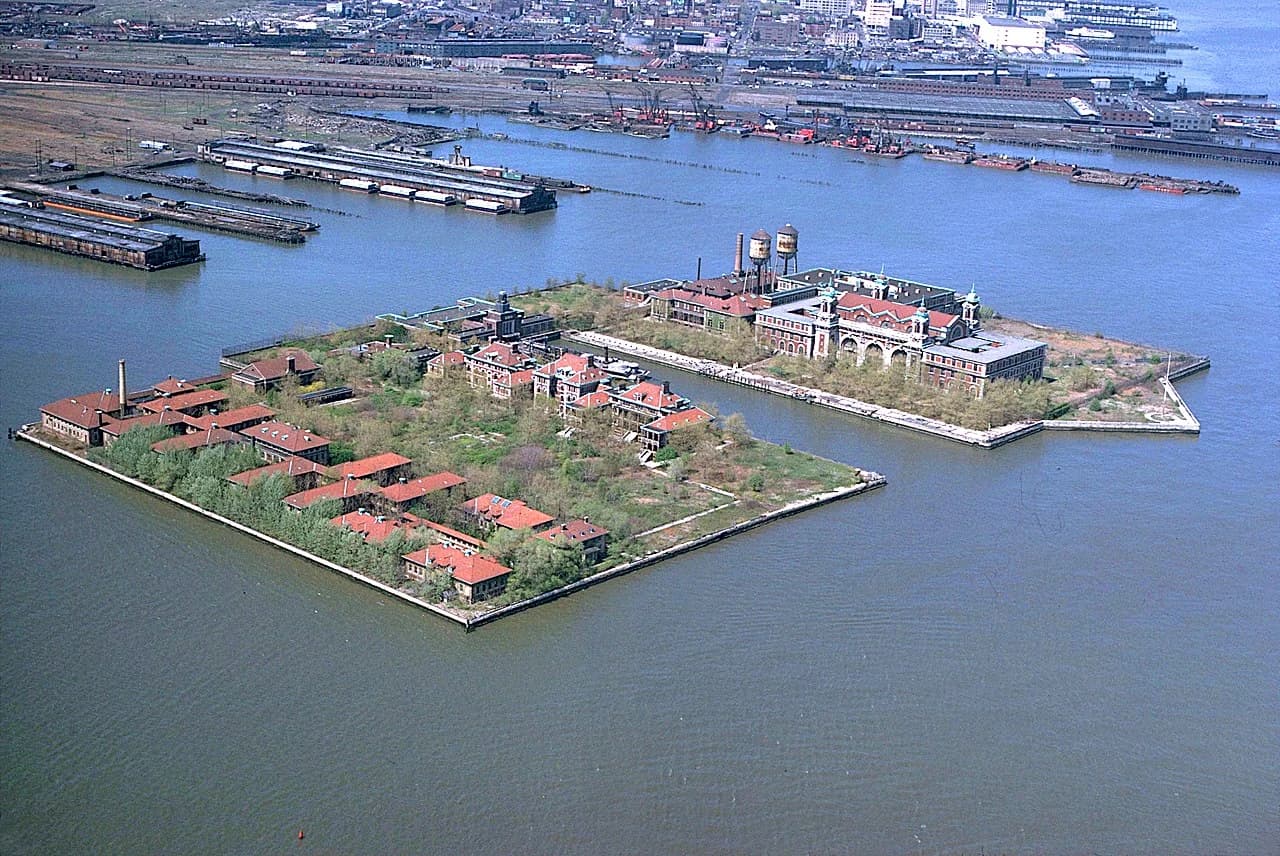
Ellis Island is a historic island located in New York Harbor. It served as the busiest immigrant inspection station in the United States and is now a National Monument and tourist attraction.
Ellis Island is also known as Ellis Island National Monument, Fort Gibson, Anderson's Island, Bucking Island, and 9 other names in various languages.
This self-guided audio tour features 22 narrated stops organized across 8 sections. As a monument, Ellis Island offers a unique cultural experience in the heart of Jersey City, United States.
The Stanza audio guide is available in 15 languages and works entirely offline — download the complete tour including audio narration, maps, and images before your visit. As you walk through Ellis Island, GPS-triggered narration plays automatically at each point of interest.
Last updated:
What you will hear
Arrival at the Gateway to America
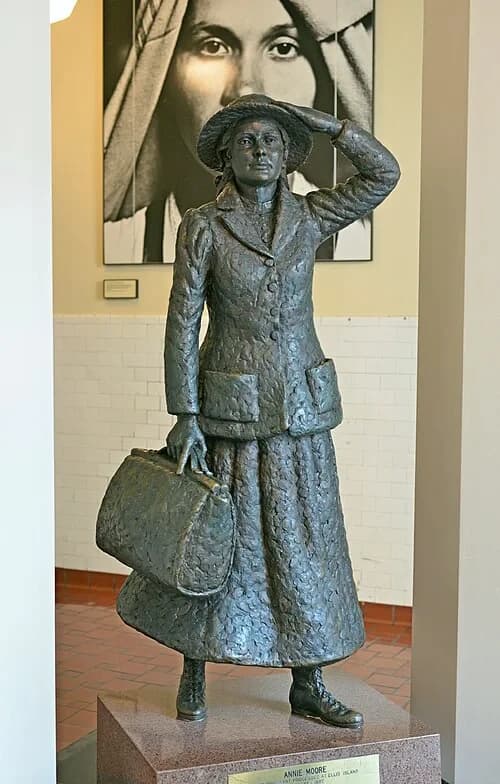
Establishes the scale of the island and its unique geography. Includes the main entrance and the statue of Annie Moore, the first immigrant processed here.
Statue of Annie Moore
This statue captures a pivotal moment in history through the likeness of seventeen-year-old Annie Moore. Arriving from County Cork, Ireland, on January 1, 1892, she was the very first immigrant to be processed at the newly opened federal station on Ellis Island. The sculpture shows her dressed in the typical fashion of the era, clutching a bag that likely held her few worldly possessions as she looked toward her new future. To mark the grand opening of the facility, officials presented her with a ten-dollar gold piece, a gesture that for many represented the promise of their new home. For the millions who followed her, Ellis Island was known as the 'Island of Hope.' Annie was traveling with her two younger brothers to reunite with their parents, who had already settled in New York. Her story serves as a personal entry point into the massive historical narrative of migration. The figure reminds us that behind the staggering statistics of millions of processed individuals are the specific, human journeys of people seeking opportunity and family reunification.
The Stairs of Separation
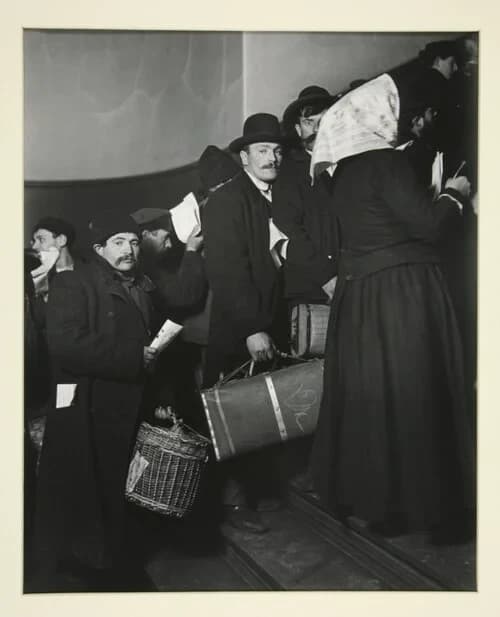
Where the 'six-second physical' took place as doctors watched immigrants climb the stairs for signs of illness or lameness.
The Stairs of Separation
The ascent from the baggage room was the beginning of the 'six-second physical.' Medical inspectors stood at the top of these stairs, observing every person as they climbed. They looked for signs of difficulty: shortness of breath that might suggest a heart condition, a slight limp indicating lameness, or any facial expression that might hint at mental distress. Because people were often carrying their heavy belongings, any physical weakness became more apparent. This historical photograph by Lewis Hine captures the profound tension of this moment. The men pictured are focused and anxious, unaware that they are being evaluated with every step they take. This was a critical filtering point. If a doctor noticed something unusual, the immigrant would be pulled out of the main line for a more thorough examination. For many, these stairs represented the first hurdle in a process that could lead to either admission or devastating news. The simple act of climbing became a test of fitness and a defining moment in their American journey, marking the transition from the boat to the inspection hall.
The Registry Room (Great Hall)
The emotional and architectural heart of Ellis Island. Highlights the Guastavino tile ceilings and the wait for legal clearance.
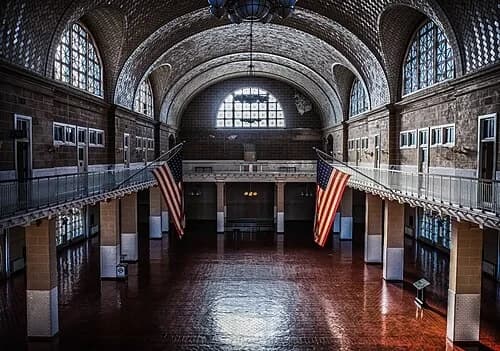
The Registry Room
The Great Hall, or Registry Room, is the architectural and emotional heart of the entire station. Looking at the vast space today, you can appreciate the scale of the room, with its high vaulted ceilings and large American flags. In its years of operation, however, this space was rarely quiet. It was filled with a labyrinth of long, metal-railed lines where immigrants would wait for hours, sometimes an entire day, for their turn to speak with a legal inspector. The atmosphere was one of intense anticipation. Each person held their inspection card, which matched a specific line on the ship's manifest. When they finally reached the high wooden desks at the far end of the room, they would face a series of questions intended to confirm their identity, their background, and their ability to support themselves. Despite the grand proportions of the hall, for the people standing in those lines, the world had narrowed down to the few feet of space between the rails and the looming interview that would decide their future in America.
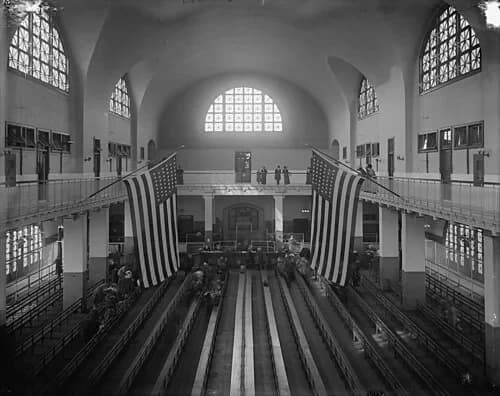
The Great Hall in Motion
This photograph provides a stark contrast to the quiet hall we see now. During the peak years of immigration, the room was divided into a grid of 'pens' made of iron railings, designed to organize the massive flow of humanity. At any given moment, thousands of people from dozens of different countries were packed into these aisles. The air would have been thick with the cacophony of many languages and the scent of thousands of people who had spent weeks in the cramped steerage compartments of steamships. There was a shared sense of anxiety as the lines slowly moved forward toward the inspectors' desks. Each person had survived the long sea voyage and the medical screening downstairs, and now only this legal questioning stood between them and the ferry to the mainland. The photo captures the scale of the federal effort required to process such a large population. It was a place of high pressure, where the sounds of crying children, shouting officials, and the constant murmur of a thousand conversations created an unforgettable environment.
Legal and Financial Processing
Where immigrants proved their legal right to enter and exchanged their home currency for American dollars.
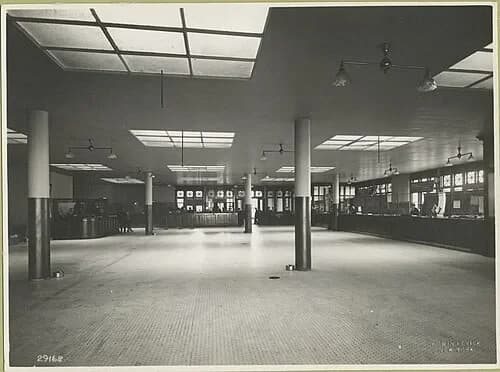
The Money Exchange Hall
Clearing the legal and medical inspections was a massive relief, but it was not the end of the process. Immigrants then moved into the Money Exchange Hall, a space that resembled a large bank. Here, they could trade the currency of their home countries for American dollars. The room was lined with tellers' cages where officials carefully calculated exchange rates for dozens of different types of coins and paper notes. This historical photograph captures the busy atmosphere of people handling their first American money. For many, this was the moment they finally felt their new life had truly begun. Once they had cash in hand, they could proceed to the nearby ticket office to buy rail passage to destinations across the United States, from the factories of Chicago to the farmlands of the Great Plains. The hall was a hive of activity, filled with the sounds of counting money and the clatter of travelers preparing for the final leg of their journey. It represents the transition from being a subject of inspection to becoming a participant in the American economy.
Detention and Dormitories
Shows the living conditions for the 'two percent' who were held overnight or for weeks during appeals.
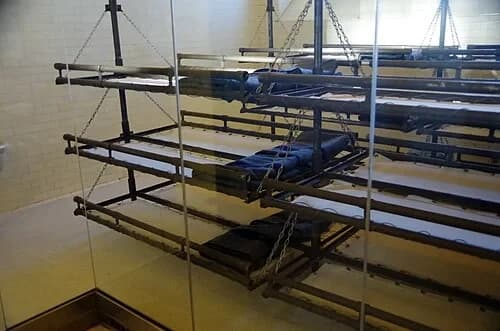
The Dormitories
Not everyone left Ellis Island on the same day they arrived. Those awaiting a legal appeal, a medical recovery, or the arrival of a relative were held in dormitories like this one. The room is filled with rows of triple-tiered iron bunks, which were designed to maximize space in the crowded facility. Each bunk featured a canvas bottom that could be folded up during the day to allow for easier cleaning. While most people stayed in these rooms for only a few hours or a single night, some found themselves living here for weeks or even months as their cases were reviewed. The environment was often cramped and noisy, with hundreds of people from different backgrounds sharing the same echoing space. Despite the institutional feel, the staff made efforts to keep the areas sanitary and to provide basic comforts. For the detainees, these rooms were a place of limbo, situated between the world they had left behind and the one they hoped to enter. The simple, functional design of the bunks serves as a reminder of the massive scale of the detention operations.
Faces of a New Nation
A tribute to the diverse individuals who passed through the station, featuring the famous Augustus Sherman portraits.
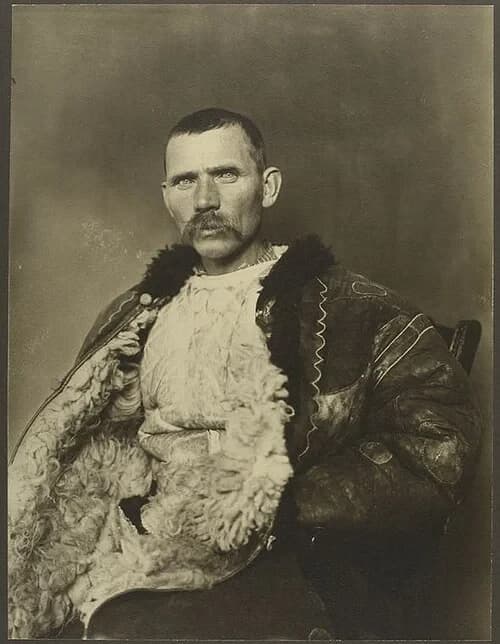
A Romanian Shepherd
This is another iconic portrait from the collection of Augustus Sherman, depicting a Romanian shepherd. The man is wearing a heavy, ornate sheepskin coat, a functional and traditional garment from his homeland. Sherman would often encourage immigrants to unpack their finest traditional clothing for these sessions, even if they had already started wearing more conventional Western attire. The photograph highlights the rough, layered texture of the sheepskin and the man's weathered, stoic expression. Like many of Sherman's subjects, this shepherd represents a world that was in the process of rapid change. Once these individuals left Ellis Island and settled into American communities, they often set aside these traditional garments in favor of modern clothing to avoid being singled out. These portraits serve as a valuable historical record of the diverse ethnic identities that arrived at the nation's doorstep. The man's presence in the photograph is a reminder of the millions of rural workers and tradespeople who brought their specific skills and traditions across the Atlantic, contributing to the cultural fabric of their new country while leaving behind the familiar landscapes of their birth.
The Immigrant's Contribution
Examines the mural history and the industrial impact of the millions who arrived here.
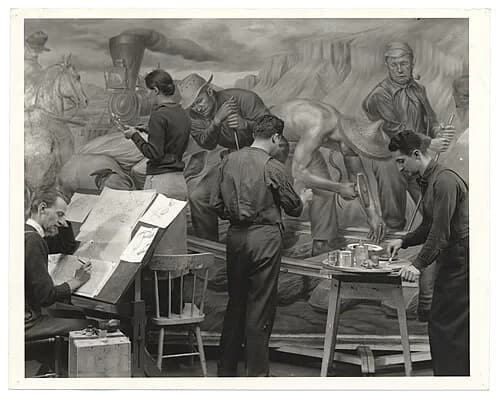
The Role of the Immigrant Mural
During the Great Depression, the Works Progress Administration’s Federal Art Project commissioned a series of murals titled "The Role of the Immigrant." The archival photograph captures several artists at work on large-scale panels, meticulously bringing to life the diverse contributions of newcomers. These murals focused on the physical labor that defined American expansion in the late 19th and early 20th centuries. One panel illustrates workers laying the iron tracks of the transcontinental railroad, while another shows the tilling of the vast Midwestern plains. These artworks departed from the typical administrative records of the island, highlighting instead the sweat and industry that transformed the landscape into a modern power. By depicting these specific roles, the WPA aimed to acknowledge that the country's infrastructure was built by those who arrived at these shores with little more than their skills. The project served both to provide employment for artists during the Depression and to create a permanent visual record of the immigrant's hand in building the nation.

A Modern Tapestry
Beyond the historical artifacts, the museum features contemporary works that illustrate how the story of migration continues long after the station's official closure in 1954. This modern piece is a study in vibrant color and symbolism. Monarch butterflies appear throughout the composition, serving as a metaphor for the natural and often difficult journey of migration across borders. Interlocking hands of various skin tones weave through the design, suggesting the community and support systems that sustain newcomers. The artwork also incorporates a wide array of diverse faces, reflecting the changing demographics of the United States in the 21st century. By bringing these modern visuals into the historic setting, the museum bridges the era of the Great Hall with the ongoing global movement of people today. This tapestry emphasizes that the American journey is not a closed chapter of history, but a living process that evolves with every new arrival.
The Hospital of Hope and Tears
The abandoned medical complex on the south side, where the 'Island of Tears' nickname was truly felt.
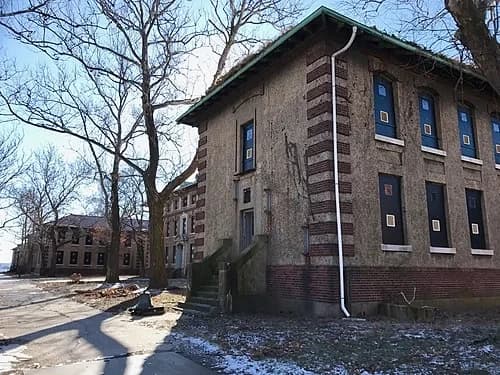
Ellis Island Hospital
1900
Looking toward the south side of the island reveals the sprawling hospital complex on Island 3. At the time of its operation, this was among the most sophisticated medical facilities in the world. It was designed specifically to quarantine and treat immigrants suffering from infectious diseases like measles, trachoma, and scarlet fever. The weathered red brick and boarded-up windows create a desolate atmosphere that stands in sharp contrast to the restored main processing building. For a sick immigrant, a stay here was fraught with anxiety, as recovery was the only path to legal entry. Unlike the museum areas, these buildings are currently in a state of arrested decay and are not open for general wandering. Access is limited to specialized 'hard hat' tours that guide visitors through the echoing corridors and silent wards. These structures remain as a physical record of the medical challenges faced by millions of arrivals who were held back just short of the mainland.
Want to hear the rest?
Download the Stanza app to unlock all 22 stops and full GPS-guided navigation.
Frequently Asked Questions
How long does the Ellis Island audio tour take?
The Ellis Island audio guide includes 22 narrated stops. Most visitors spend 45 minutes to 1.5 hours exploring the complete tour, though you can listen at your own pace and skip or revisit any stop.
Is the Ellis Island audio guide available in my language?
Stanza supports 15 languages: English, Spanish, French, German, Italian, Portuguese, Russian, Japanese, Chinese, Korean, Arabic, Hindi, Polish, Dutch, Hebrew. Check the guide in the app to confirm the languages currently available for this tour.
Can I use the audio guide offline at Ellis Island?
Yes! Download the complete Ellis Island tour — including all audio, maps, and images — before your visit. The Stanza app works completely offline, so you don't need WiFi or mobile data at the venue.
How much does the Ellis Island audio guide cost?
The Stanza app is free to download. The current listed price for the Ellis Island audio guide is $1.99; app-store region and currency may affect the final price.
How do I use the Stanza audio guide at Ellis Island?
Download the free Stanza app, search for "Ellis Island", and download the tour. When you arrive at the venue, the app uses GPS to detect your location and automatically plays the relevant narration as you move between points of interest — completely hands-free.
What makes the Stanza audio guide different from other Ellis Island tours?
Stanza offers GPS-triggered narration that plays automatically as you walk through Ellis Island — no need to manually select stops. The tour is available in 15 languages, works fully offline, and includes 22 expertly narrated stops with images and historical context.
What other audio guides are available near Ellis Island?
Stanza offers multiple audio guides in Jersey City, United States and nearby areas. After downloading the app, browse the map to discover all available tours near Ellis Island. Each guide can be downloaded for offline use.