Languages
15Castillo de San Marcos Audio Guide
Castillo de San Marcos is a landmark in Saint Augustine, United States. Explore it with Stanza's GPS-triggered offline audio guide — available in 15 languages.
Quick Facts
19
Stops
15
Languages
100%
Offline
📍 Saint Augustine, United States · 29.8978°N, -81.3114°E
About Castillo de San Marcos
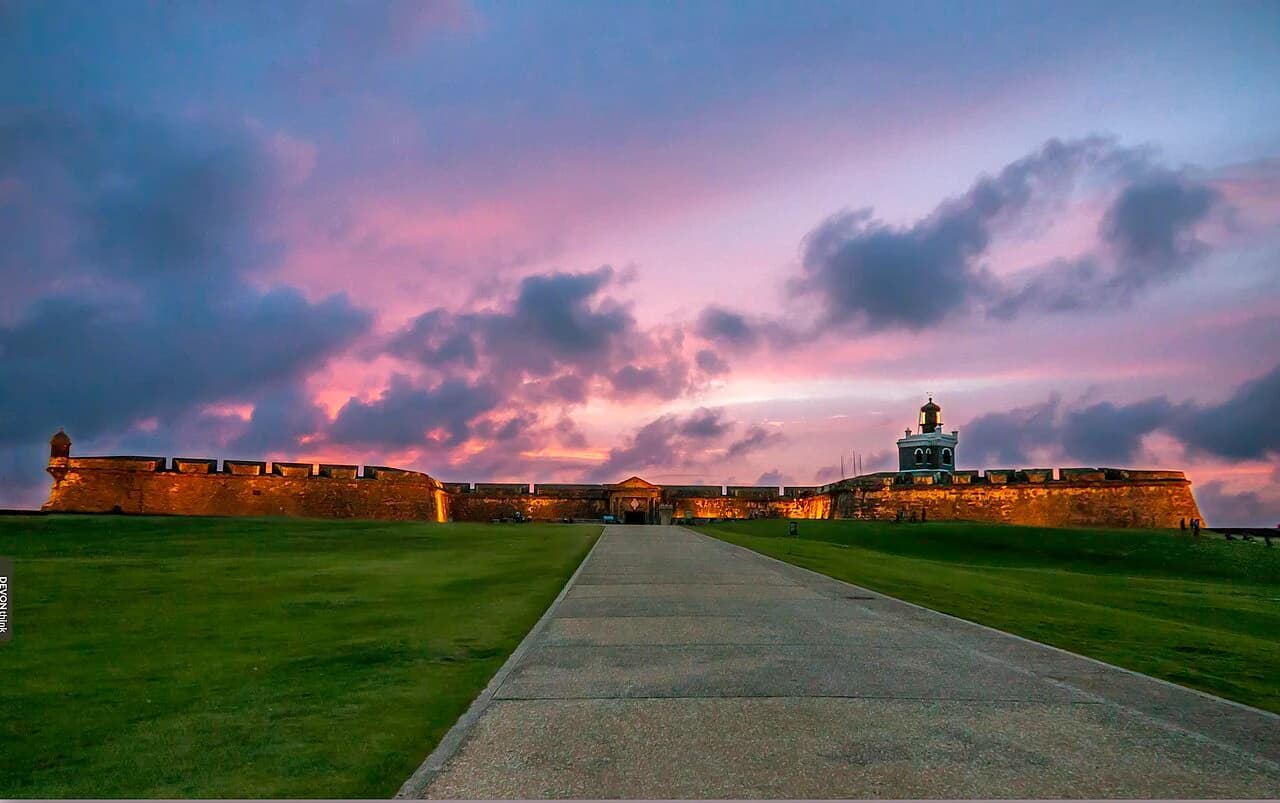
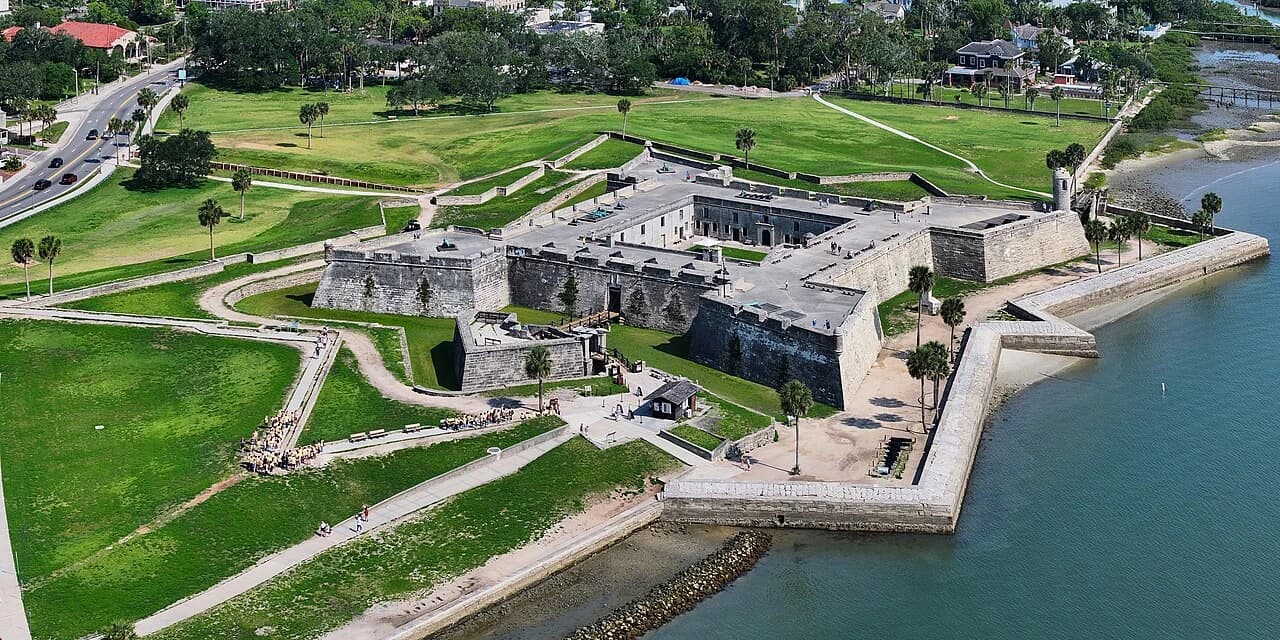
Castillo de San Marcos National Monument is a large masonry fort built by the Spanish in the 17th century. Located in St. Augustine, Florida, it served as a vital defensive outpost and is now preserved as a historic site and history museum.
Castillo de San Marcos is also known as CASA.
This self-guided audio tour features 19 narrated stops organized across 7 sections. As a fort, Castillo de San Marcos offers a unique cultural experience in the heart of Saint Augustine, United States.
The Stanza audio guide is available in 15 languages and works entirely offline — download the complete tour including audio narration, maps, and images before your visit. As you walk through Castillo de San Marcos, GPS-triggered narration plays automatically at each point of interest.
Last updated:
What you will hear
The Ravelin and Moat
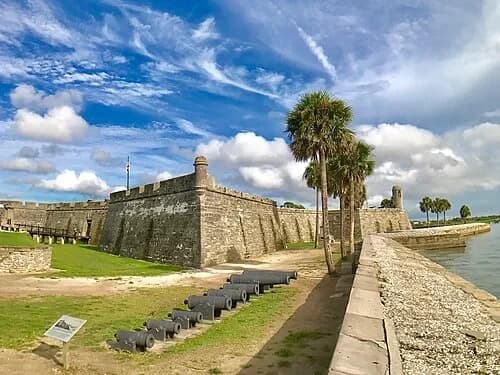
Establishing the fort's defensive perimeter and its unique 'cannonball sponge' material. Includes a wide view of the star-shaped layout and a close-up of the coquina stone.
The Fortress Overview
Welcome to one of the most significant historical sites in North America. This fortress, the Castillo de San Marcos, is the oldest masonry fort in the continental United States. Its construction was ordered by the Spanish in 1672, following a devastating pirate raid on St. Augustine. The fort was designed by the Spanish engineer Ignacio Daza, who utilized a sophisticated "star" or "bastion" system, which was the cutting edge of military architecture at the time. This layout features four prominent triangular bastions at each corner. These points were crucial because they allowed defenders to cover every angle of the walls, completely eliminating any "dead zones" where an enemy could hide or scale the walls undetected. Building this massive structure was no small feat; it took 23 years to complete the initial phase. The construction effort relied on a diverse workforce, including labor from Native American missions and highly skilled stonemasons brought over from Havana. As you stand here, you are looking at a structure that has witnessed over three centuries of colonial power struggles and has never been captured in battle.
The Sally Port and Drawbridge
The only entrance to the fortress, featuring the heavy defensive gates and the Spanish royal identity.
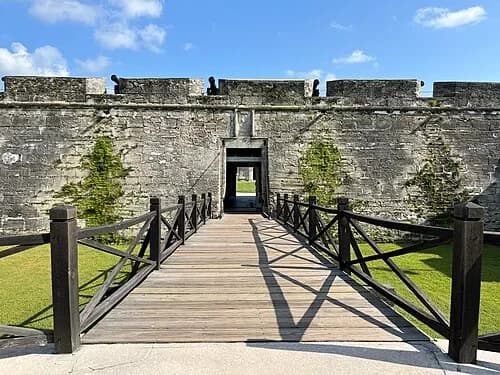
The Main Drawbridge
Crossing the threshold into the heart of the fortress happens through the Sally Port. This was the only entrance to the entire structure, a design choice intended to make the fort as defensible as possible. The wide moat beneath was a formidable layer of defense. While it often appears dry today, in times of conflict, it could be flooded with seawater from the Matanzas River. This prevented enemy soldiers from reaching the base of the walls, which are twelve feet thick at their foundation. The drawbridge itself was a vital component of the security system. At the first sign of trouble, the bridge would be pulled up, and the heavy gates of the Sally Port would be locked, effectively turning the Castillo into an island of stone. As you transition from the bright Florida sun into the cool shadow of the entry tunnel, imagine the thousands of Spanish soldiers, prisoners, and local townspeople who have walked this exact path over the last three centuries, moving from the vulnerability of the outside world into the absolute security of these coquina walls.
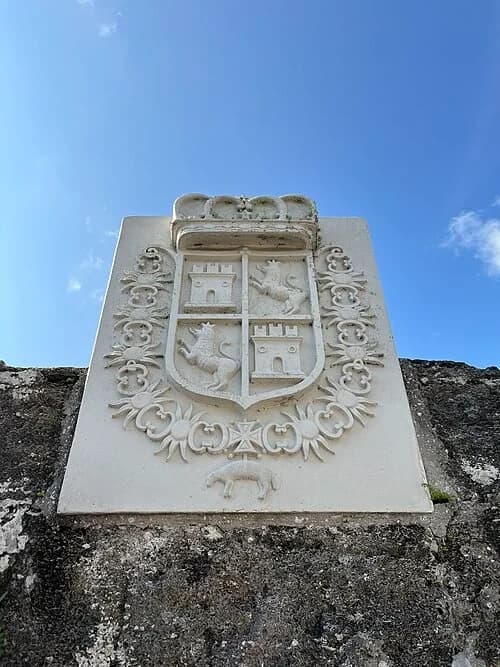
The Royal Seal
Mounted high above the main entrance is a weathered stone relief representing the Royal Seal of Spain. This heraldic emblem served as a permanent reminder of who controlled this strategic outpost. If you examine the shield, you will see it is divided into four sections. Two of these feature a castle, representing the kingdom of Castile, while the other two depict a lion, the symbol of the kingdom of León. Together, they represent the unified Spanish crown. Surrounding the shield is the Order of the Golden Fleece, a prestigious order of chivalry. For nearly 250 years, this seal stood as a bold statement of Spanish sovereignty over Florida. In an era when few people were literate, such symbols were essential; they communicated power and ownership to everyone who approached the gates, from loyal subjects to foreign invaders. Even after the fort changed hands and flags, this seal remained carved into the stone, a lasting legacy of the Spanish Empire’s presence in North America and their determination to hold this land against all rivals.
Plaza de Armas
The central courtyard that served as a refuge for the entire population of St. Augustine during major sieges.

The Central Plaza
The Plaza de Armas is the central courtyard around which the entire life of the fort once revolved. On a typical day, this space would be filled with the sounds of drilling soldiers, the clatter of carts, and the smell of cooking fires from the various casemates. However, this courtyard also holds a more dramatic history of survival. In 1702, during a massive British siege, the entire population of St. Augustine—approximately 1,500 people—fled their homes and moved inside these walls. For two long months, they lived right here in this crowded plaza. Men, women, children, and even livestock sought shelter from the constant bombardment. Conditions would have been incredibly difficult, with limited sanitation and supplies, but the massive coquina walls held firm against the British ships in the harbor. The resilience of the people in this very square ensured that the Spanish flag continued to fly over St. Augustine. Today, the plaza is much quieter, offering a space to appreciate the scale and engineering of the surrounding rooms, but its history reminds us that it was once a crowded city of refuge.
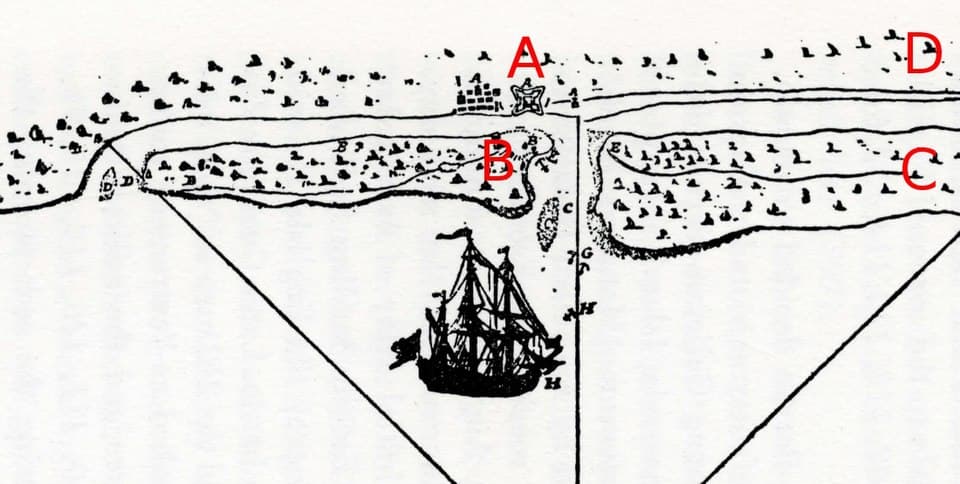
Map of the 1702 Siege
This map provides a bird’s-eye view of the strategic landscape that defined the survival of Spanish Florida. It illustrates the 1702 siege when the British forces from South Carolina attempted to wipe out the Spanish presence here. One can see the position of the fort relative to the Matanzas River and the narrow inlet leading to the Atlantic Ocean. The Spanish understood that if they could hold the fort, they could control the entire region. During the siege, the British successfully occupied the town of St. Augustine, but they were unable to breach the coquina walls of the Castillo. The porous stone simply swallowed their cannonballs, refusing to shatter. Frustrated and realizing they could not win a battle of attrition against such a fortress, the British forces eventually burned the town to the ground and retreated. This map underscores the tactical brilliance of the fort's placement. It wasn't just a building; it was an anchor for the entire colony. By holding this ground, the Spanish forces ensured that while the town could be rebuilt, the empire’s foothold remained secure.
The Casemates and Barracks
The vaulted interior rooms designed to support the weight of the heavy cannons above and protect the garrison.
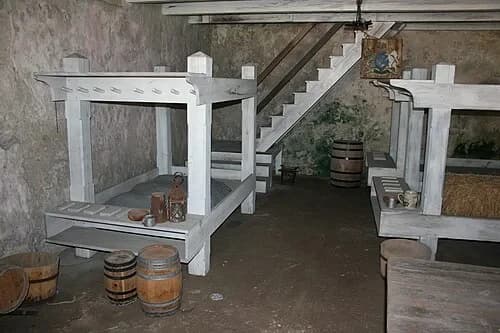
The Soldiers' Quarters
This room is a casemate, which served as the living quarters for the soldiers stationed at the Castillo. Life in the garrison was often a mix of intense routine and long periods of waiting. A typical room like this would have housed dozens of soldiers, who slept on simple wooden bunks and kept their personal belongings in chests. Notice the thick walls and the lack of windows; while this made the rooms incredibly safe during a bombardment, it also meant they were often damp, dark, and poorly ventilated. In the 1730s, the fort underwent a significant renovation project. The rooms were modified to improve living conditions and structural integrity. The ceilings were vaulted with stone to support heavier weight on the deck above, and new partitions were added. Despite these improvements, the Florida humidity and the crowded conditions made this a challenging place to call home. As you look around, imagine the sounds of Spanish conversation, the scent of tobacco, and the sight of soldiers mending their uniforms by candlelight, all within the constant, cooling presence of these massive stone walls.
The Prison and Native American History
A somber look at the fort's 19th-century role as a military prison for Native American leaders and tribes.
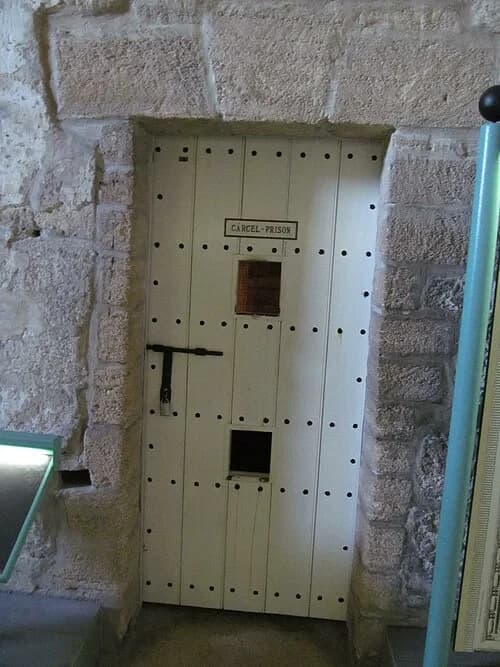
The Prison Door
As you continue through the fortress, notice the heavy wooden door with a sign that reads "Carcel," the Spanish word for prison. This marks a significant turning point in the Castillo's story. In the 19th century, Florida became a United States territory, and the fort was renamed Fort Marion. Under American control, the structure’s primary role shifted from a defensive outpost protecting a colonial city to a military prison. The rooms that once housed Spanish soldiers were repurposed as jail cells. This transition reflects the changing nature of the frontier. The heavy bolts, small viewing ports, and iron bars are physical reminders of a darker chapter in the fort's legacy. While it remained a symbol of military might, its purpose became focused on the detention of prisoners, ranging from deserters and criminals to political prisoners. This door serves as a gateway into that era of incarceration, representing the fort’s evolution from a shield against foreign empires to a tool used by a growing nation to exert control within its expanding borders.
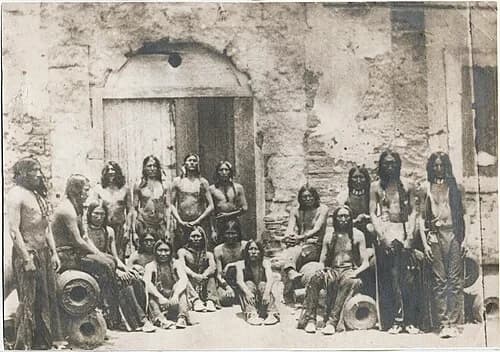
Captured Native Americans
During its time as an American military prison, the Castillo held many notable figures, most notably members of the Seminole tribe during the Indian Removal era. In 1837, several prominent Seminole leaders, including Osceola and Coacoochee, were imprisoned within these stone walls after being captured under a flag of truce. The conditions were harsh, and the loss of freedom for these leaders was a devastating blow to their people. One of the most famous stories from this period is the daring escape of Coacoochee. Recognizing that the walls were thick but the openings were narrow, he reportedly underwent a period of self-starvation to thin his body. Along with several companions, he managed to squeeze through a tiny ventilation slit high up in the wall of their cell and drop down into the moat below. While Coacoochee successfully escaped to continue the resistance, Osceola remained behind and was later moved to another fort, where he eventually died. This period of incarceration remains a poignant and somber part of the Castillo's history, reflecting the complex and often tragic struggles between the U.S. government and the indigenous peoples of the Southeast.
The Ramp to the Terreplein
The massive stone incline used to move heavy artillery from the courtyard to the upper gun deck.
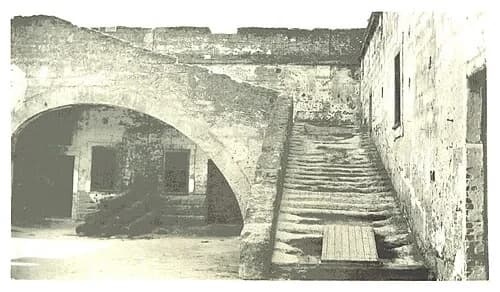
The Artillery Ramp
Notice the long, wide stone slope known as the "Incline Plane" or artillery ramp. This was the primary logistical artery of the fort. While the stairs were fine for soldiers, they were useless for moving the heavy weaponry that made the Castillo so formidable. The massive bronze cannons used here could weigh several thousand pounds each. To get these pieces of artillery from the courtyard up to the gun deck, teams of men and animals had to work together. Using systems of ropes, pulleys, and pure physical strength, they would haul the cannons and their heavy wooden carriages up this ramp. It was a slow, grueling, and dangerous process that required careful coordination. The ramp's wide, steady incline was designed to handle this immense weight while minimizing the risk of a runaway gun. This feature is a reminder that the fort was not just a static building, but a functional machine of war that required constant maintenance and the heavy lifting of equipment to remain an effective shield for the city and its people.
The Watchtower (Garita)
The iconic bell-shaped sentry box on the northeast bastion, offering a strategic view of the Atlantic inlet.
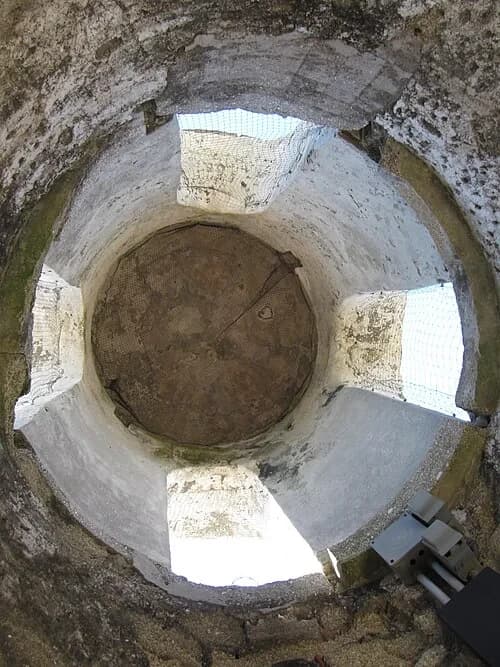
Sentry Box Interior
Peering through the narrow slits of the sentry box, you get a sense of the intense focus required of the soldiers who once stood here. The interior is small and circular, with thick masonry walls designed to offer protection from both the elements and incoming fire. If you look up, you can see the internal structure of the domed ceiling, which helped to shelter the watcher from the sun and rain. The narrow windows are tapered—wide on the inside and very narrow on the outside. This clever design provided a wide field of view for the sentry while presenting a tiny, difficult target for an enemy sharpshooter. Imagine the conditions: the salty sea breeze whistling through these openings, the sound of the waves crashing against the coquina walls below, and the heavy silence of a night watch. For a sentry, these stone slits were the frame through which they monitored the survival of the settlement. Every flash of light on the horizon or change in the wind was a detail that could mean the difference between a quiet night and a sudden, violent siege.
Want to hear the rest?
Download the Stanza app to unlock all 19 stops and full GPS-guided navigation.
Frequently Asked Questions
How long does the Castillo de San Marcos audio tour take?
The Castillo de San Marcos audio guide includes 19 narrated stops. Most visitors spend 45 minutes to 1.5 hours exploring the complete tour, though you can listen at your own pace and skip or revisit any stop.
Is the Castillo de San Marcos audio guide available in my language?
Stanza supports 15 languages: English, Spanish, French, German, Italian, Portuguese, Russian, Japanese, Chinese, Korean, Arabic, Hindi, Polish, Dutch, Hebrew. Check the guide in the app to confirm the languages currently available for this tour.
Can I use the audio guide offline at Castillo de San Marcos?
Yes! Download the complete Castillo de San Marcos tour — including all audio, maps, and images — before your visit. The Stanza app works completely offline, so you don't need WiFi or mobile data at the venue.
How much does the Castillo de San Marcos audio guide cost?
The Stanza app is free to download. The current listed price for the Castillo de San Marcos audio guide is $1.99; app-store region and currency may affect the final price.
How do I use the Stanza audio guide at Castillo de San Marcos?
Download the free Stanza app, search for "Castillo de San Marcos", and download the tour. When you arrive at the venue, the app uses GPS to detect your location and automatically plays the relevant narration as you move between points of interest — completely hands-free.
What makes the Stanza audio guide different from other Castillo de San Marcos tours?
Stanza offers GPS-triggered narration that plays automatically as you walk through Castillo de San Marcos — no need to manually select stops. The tour is available in 15 languages, works fully offline, and includes 19 expertly narrated stops with images and historical context.
What other audio guides are available near Castillo de San Marcos?
Stanza offers multiple audio guides in Saint Augustine, United States and nearby areas. After downloading the app, browse the map to discover all available tours near Castillo de San Marcos. Each guide can be downloaded for offline use.