Languages
15Brooklyn Bridge Audio Guide
Brooklyn Bridge is a landmark in New York, United States. Explore it with Stanza's GPS-triggered offline audio guide — available in 15 languages.
Quick Facts
16
Stops
15
Languages
100%
Offline
📍 New York, United States · 40.7057°N, -73.9963°E
About Brooklyn Bridge
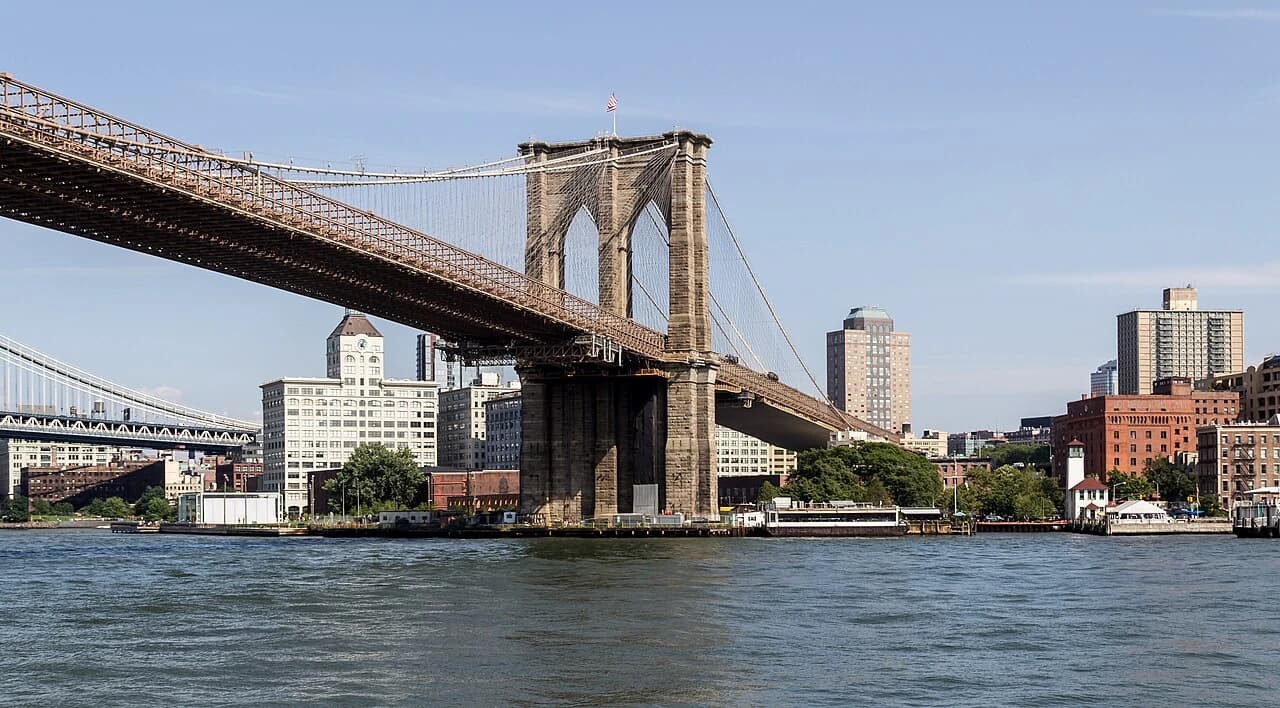
The Brooklyn Bridge is an iconic suspension bridge in New York City, connecting Manhattan and Brooklyn across the East River. Completed in 1883, it is one of the oldest roadway bridges in the United States and a celebrated architectural landmark.
Brooklyn Bridge is also known as New York and Brooklyn Bridge, East River Bridge.
This self-guided audio tour features 16 narrated stops organized across 8 sections. As a landmark, Brooklyn Bridge offers a unique cultural experience in the heart of New York, United States.
The Stanza audio guide is available in 15 languages and works entirely offline — download the complete tour including audio narration, maps, and images before your visit. As you walk through Brooklyn Bridge, GPS-triggered narration plays automatically at each point of interest.
Last updated:
What you will hear
The Manhattan Anchorage & Secret Vaults
Focuses on the massive stone structures that secure the cables and the hidden history of the wine cellars.
The Granite Anchorages
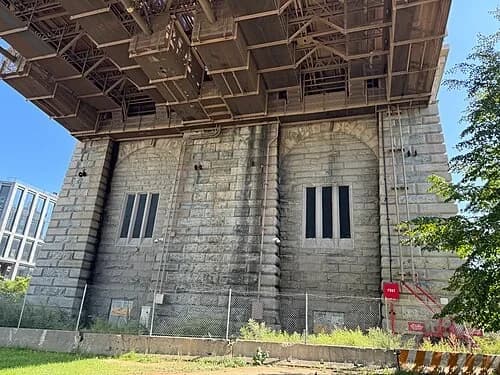
Look at the massive stone blocks that form the anchorages on either side of the river. These monumental structures serve a critical engineering purpose: they secure the ends of the four main cables, using their sheer weight to counteract the immense tension pulling from the center of the span. However, these blocks aren't solid all the way through. Inside, they contain vast, cavernous vaults. Shortly after the bridge opened, the city realized that the thick masonry and deep interior location created a naturally climate-controlled environment—perfectly dark and consistently cool. To help fund the bridge’s early maintenance costs, the city rented these spaces out as commercial wine cellars. For decades, some of New York’s finest wine and champagne aged quietly beneath the feet of commuters. The "Blue Grotto" on the Manhattan side was particularly famous for its impressive inventory. While you can no longer store your vintage spirits here, the story of the wine cellars serves as a reminder of the ingenious ways the city sought to make this massive investment pay for itself. The anchorages remain some of the sturdiest parts of the bridge, anchoring not just the steel cables but also a curious chapter in the city's commercial history.
The Manhattan Tower & Gothic Revival
Explores the architectural style and the construction dates carved into the granite.
Gothic Revival Towers
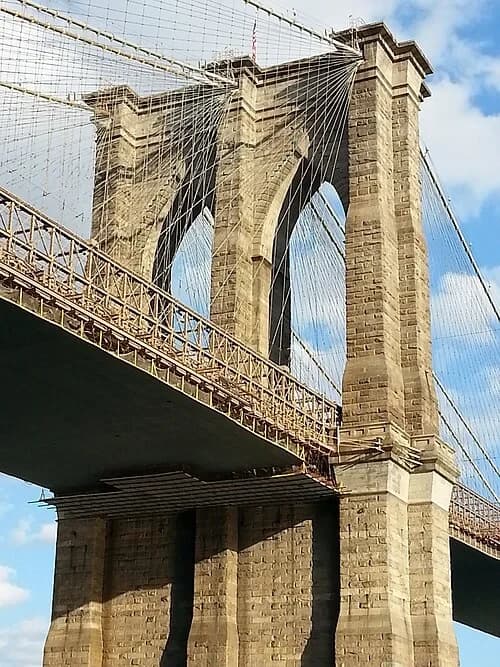
The two massive towers are perhaps the most recognizable features of the Brooklyn Bridge. Rising 278 feet above the river, they were, at the time of their completion, among the tallest structures in the Western Hemisphere. Notice the characteristic pointed arches; this is the hallmark of the Gothic Revival style. John Roebling chose this architectural language to give the bridge a sense of dignity and eternal permanence, similar to the great cathedrals of Europe. He wanted the bridge to be more than just a piece of infrastructure; he intended it to be a monument to human progress. The towers were constructed using a combination of granite, much of it sourced from Maine, and limestone. Each block was carefully positioned to support the massive weight of the suspension system. The double arches in each tower allow the cables and the roadways to pass through while maintaining the structural integrity of the stone. By using stone for the towers instead of iron or steel, Roebling created a visual link to the past, grounding this high-tech engineering marvel in ancient traditions of masonry. Even today, as they are surrounded by modern glass skyscrapers, these towers command a sense of awe, standing as stoic guardians of the East River for over a century.
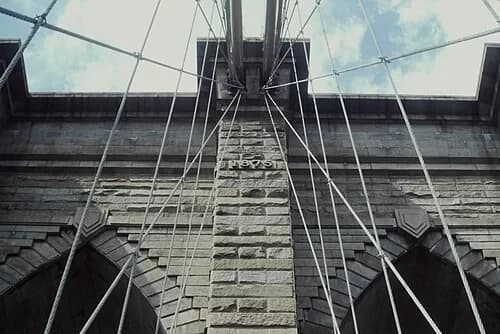
The 1875 Inscription
High on the masonry, you can see the year 1875 carved into the stone. While the bridge didn’t open until 1883, this date serves as a reminder of the long, arduous journey of its construction. Work officially began in 1870, but progress was frequently halted by a series of disasters and setbacks. The project faced intense scrutiny and was nearly derailed by political fraud and financial mismanagement typical of the era's city politics. On the construction site itself, workers battled dangerous conditions, including major fires that broke out within the underwater caissons. Perhaps the most significant hurdle was the health of the chief engineer, Washington Roebling. After spending too much time in the pressurized atmosphere of the foundations, he developed a severe case of decompression sickness, then known as "the bends." The illness left him partially paralyzed and confined to his home in Brooklyn Heights. From his window, he watched the construction through a telescope, relaying instructions to the site through his wife, Emily. The 1875 inscription represents a time when the project was in full swing but still years away from completion. It stands as a testament to the perseverance required to see this massive undertaking through to the end, despite the physical and political tolls it took on those who built it.
Engineering Marvels: The Steel Wires
Explains the revolutionary use of steel wire and the 'over-engineered' cable-stayed design.
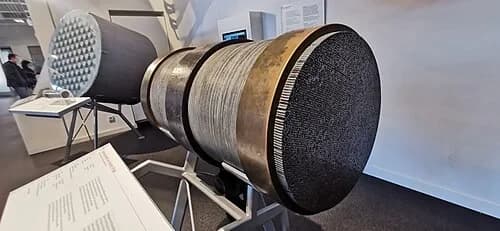
The Steel Cable Cross-Section
To understand the true strength of the Brooklyn Bridge, you have to look inside the four main cables that stretch from anchorage to anchorage. This cross-section reveals a hidden complexity. Each cable is 15.75 inches in diameter, but it isn't a solid bar of metal. Instead, it is composed of exactly 5,282 individual parallel galvanized steel wires. This was a revolutionary choice at the time. Before this bridge, suspension cables were typically made of iron. John Roebling, however, was a pioneer in the manufacture of steel wire and insisted on its use here because of its superior strength-to-weight ratio. This was the first major project in the world to utilize steel wire for its primary support system. The process of "spinning" these cables was a feat of coordination. A traveling wheel moved back and forth across the river, carrying the wire and slowly building up the thickness of the bundles over many months. Once all the wires were in place, they were wrapped in a protective outer layer of wire and painted to prevent corrosion. This internal web of steel is what allows the bridge to support the thousands of tons of weight that cross it every day, maintaining its shape and stability even under the most extreme conditions.
The Center Span & Manhattan Skyline
Highlights the iconic views of the Financial District and One World Trade Center from the middle of the river.
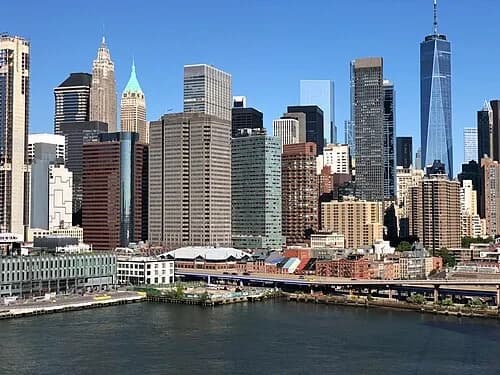
Lower Manhattan Panorama
Pause here at the center of the bridge and take in the sensory experience. You are standing at the midpoint of one of the world's most famous crossings. Below you, the East River flows toward the harbor, and you can feel the subtle vibrations of the bridge as traffic hums beneath your feet. Looking toward Manhattan, the dense skyline of the Financial District rises up, a canyon of steel and glass that serves as the global center of commerce. One of the key requirements during the bridge's construction was ensuring it didn't block the vital maritime traffic of the 19th century. To accommodate the tall masts of the sailing ships that once dominated these waters, the bridge was designed to provide 127 feet of vertical clearance at the center of the span. Even today, large vessels can pass safely underneath. From this vantage point, you can truly appreciate the scale of the city and the river that defines it. The bridge acts as a grand viewing platform, offering a perspective on New York that is both intimate and expansive. Take a moment to feel the wind coming off the water and listen to the sounds of the city—the distant sirens and the rhythmic clicking of footsteps on the wooden slats. It is a quintessentially New York moment, suspended between the clouds and the river.
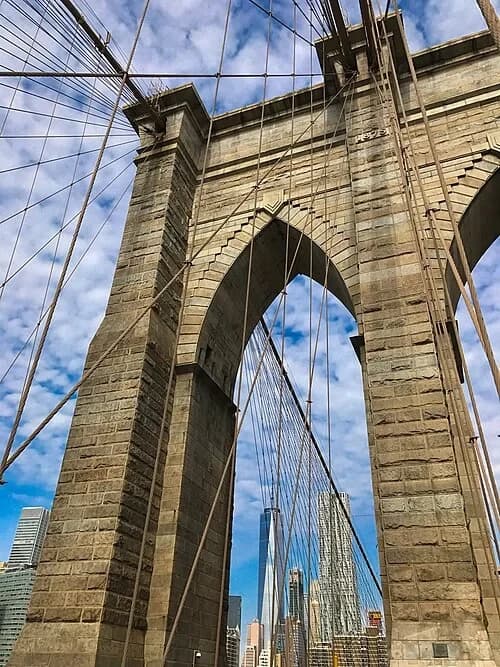
Old Engineering Meets New
Here, you can see a striking visual contrast between two different centuries of New York engineering. In the foreground, the massive granite of the 19th-century tower stands as a monument to the industrial age. Through the web of steel cables, your eye is drawn to the sleek, reflective silhouette of One World Trade Center, a 21st-century icon of the city's resilience. The Brooklyn Bridge is a survivor. It has stood through world wars, the Great Depression, and the transformation of the city from a harbor of sailing ships to a global metropolis of skyscrapers. When it was built, it was designed for horses and carriages, yet it has successfully adapted to the automobile age. Today, it is a vital artery of the city's infrastructure, carrying approximately 120,000 vehicles every single day across its lower levels. It is rare for a structure to remain so functional and so beautiful for so long. As you look at the bridge's cables framing the modern skyline, consider how this span has become a permanent part of the New York identity. It isn't just a relic of the past; it is a living, working part of the city's present, connecting the history of the 1800s with the aspirations of the modern day.
The Roebling Legacy: Design & Sacrifice
Tells the human story of John, Washington, and Emily Roebling through historical plans and the reality of the workers.
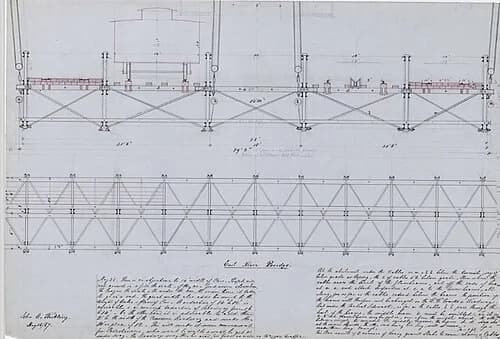
John Roebling's Blueprint
Every stone and cable you see began as a line on a blueprint. These original cross-section drawings represent the genius of the bridge’s designer, John Augustus Roebling. A German immigrant and a master of suspension bridge design, Roebling spent years perfecting the plans for this span. However, he would never see his masterpiece completed. In 1869, while conducting a survey for the bridge's location, his foot was crushed between a ferry and a piling. He developed tetanus from the injury and died just weeks later, before construction had truly even started. The monumental task of building the bridge fell to his 32-year-old son, Washington Roebling. Washington was a brilliant engineer in his own right, having worked alongside his father for years. He took these very plans and moved the project forward, navigating the unprecedented challenges of building deep underwater and high in the sky. These drawings were not just technical guides; they were a legacy. Washington felt a deep responsibility to fulfill his father's vision, even as the project took a heavy toll on his own health. As you look at the bridge today, you are seeing a father’s dream realized through the tireless dedication of his son. The precision of these early drawings is why the bridge remains so structurally sound more than a century after the last stone was laid.
The Brooklyn Tower & The Elephant Parade
Covers the completion of the bridge and P.T. Barnum's famous 1884 demonstration of its stability.
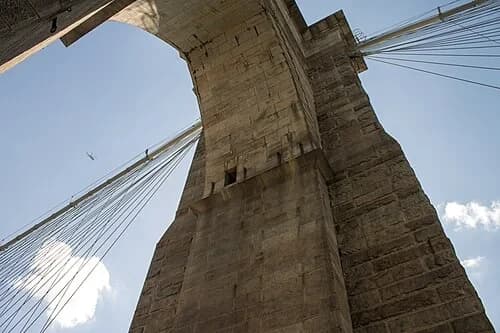
Looking Through the Arches
As you pass through the towers, take a moment to look straight up at the underside of the stone arches. From this perspective, the sheer scale of the masonry is overwhelming. You can see the individual textures and colors of the granite blocks, which were precisely cut and fitted together by skilled stonemasons. The weight of these towers is what provides the stability for the entire bridge. This structure was designed to be incredibly robust, with a capacity to hold a total load of 18,700 short tons. When it was built, this was far more than was necessary for the traffic of the day, but it is this foresight that has allowed the bridge to handle the much heavier loads of modern vehicles. Standing beneath these arches, you get a sense of the bridge as a piece of sculpture as well as engineering. The way the stone curves and meets the sky creates a frame for the views beyond. The arches are not just functional openings; they are aesthetic statements. They evoke the feel of an ancient gateway, inviting you to transition from one world to another. The massive blocks above you have been in place for over 140 years, resisting the elements and the vibrations of millions of commuters, remaining as solid today as the day they were first positioned.
The Brooklyn Approach & DUMBO
The descent into the Brooklyn neighborhood of DUMBO, following the approach ramps.
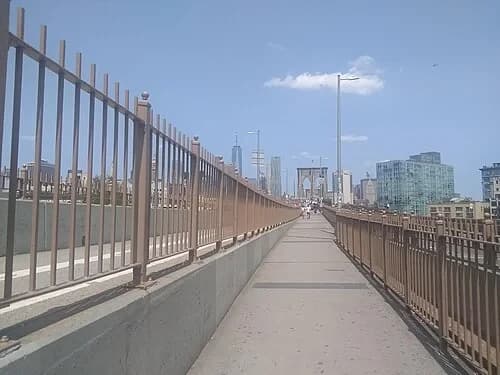
The Modern Path
The experience of crossing the Brooklyn Bridge continues to evolve even in the 21st century. For many years, pedestrians and cyclists shared this narrow wooden promenade, which often led to crowded "pinch points," especially where the cables meet the path near the towers. However, in 2021, a significant change was made to improve the flow of traffic. A dedicated bike lane was installed on the lower roadway level, repurposing a lane that was previously used by cars. This move returned the entire upper boardwalk to pedestrians. This change has made the stroll across the bridge much more relaxed, allowing you to focus on the architecture and the views without having to watch out for fast-moving bicycles. It reflects a modern effort to prioritize sustainable transit and public space in New York City. The boardwalk itself is made of durable wood slats that provide a unique, rhythmic sound as people walk over them. Maintenance is an ongoing process; you may notice sections of newer wood mixed with older, weathered pieces. This constant care ensures that the bridge remains a safe and inviting space for the millions of people who visit each year. It is a rare example of a historic landmark that is still actively being improved to meet the needs of a modern city.
Reflection: The Eighth Wonder of the World
A final look back at the completed bridge from the Brooklyn waterfront at night.
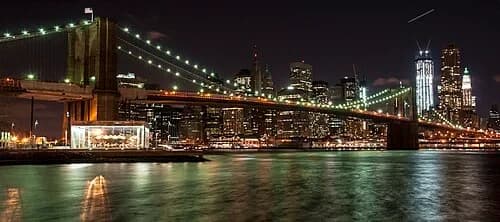
A Family Legacy in Lights
We conclude our tour by honoring a woman whose contribution was essential to the bridge’s completion: Emily Warren Roebling. When her husband Washington became bedridden with decompression sickness, the project faced a crisis. However, Emily stepped into the breach. For the final 11 years of construction, she served as her husband’s eyes, ears, and voice. She studied higher mathematics and bridge engineering so she could communicate effectively with the site's assistant engineers and the bridge's board of trustees. Emily was far more than a messenger; she managed the day-to-day logistics, handled the political pressures, and ensured that John Roebling’s original vision was carried out to the letter. She became the face of the bridge's leadership during a time when women were rarely seen in such prominent professional roles. Her dedication was so widely recognized that she was given the honor of being the first person to cross the completed bridge on opening day, carrying a rooster as a symbol of victory. A plaque on the Brooklyn tower commemorates her and the Roebling family's legacy. As you finish your walk today, remember that the Brooklyn Bridge is not just a feat of stone and steel, but a story of human resilience and the extraordinary partnership of the Roebling family. Thank you for joining this tour of one of New York's greatest landmarks.
Want to hear the rest?
Download the Stanza app to unlock all 16 stops and full GPS-guided navigation.
Frequently Asked Questions
How long does the Brooklyn Bridge audio tour take?
The Brooklyn Bridge audio guide includes 16 narrated stops. Most visitors spend 45 minutes to 1.5 hours exploring the complete tour, though you can listen at your own pace and skip or revisit any stop.
Is the Brooklyn Bridge audio guide available in my language?
Stanza supports 15 languages: English, Spanish, French, German, Italian, Portuguese, Russian, Japanese, Chinese, Korean, Arabic, Hindi, Polish, Dutch, Hebrew. Check the guide in the app to confirm the languages currently available for this tour.
Can I use the audio guide offline at Brooklyn Bridge?
Yes! Download the complete Brooklyn Bridge tour — including all audio, maps, and images — before your visit. The Stanza app works completely offline, so you don't need WiFi or mobile data at the venue.
How much does the Brooklyn Bridge audio guide cost?
The Stanza app is free to download. The current listed price for the Brooklyn Bridge audio guide is $4.99; app-store region and currency may affect the final price.
How do I use the Stanza audio guide at Brooklyn Bridge?
Download the free Stanza app, search for "Brooklyn Bridge", and download the tour. When you arrive at the venue, the app uses GPS to detect your location and automatically plays the relevant narration as you move between points of interest — completely hands-free.
What makes the Stanza audio guide different from other Brooklyn Bridge tours?
Stanza offers GPS-triggered narration that plays automatically as you walk through Brooklyn Bridge — no need to manually select stops. The tour is available in 15 languages, works fully offline, and includes 16 expertly narrated stops with images and historical context.
What other audio guides are available near Brooklyn Bridge?
Stanza offers multiple audio guides in New York, United States and nearby areas. After downloading the app, browse the map to discover all available tours near Brooklyn Bridge. Each guide can be downloaded for offline use.