Languages
15St. Patrick's Cathedral Audio Guide
St. Patrick's Cathedral is a landmark in New York, United States. Explore it with Stanza's GPS-triggered offline audio guide — available in 15 languages.
Quick Facts
21
Stops
15
Languages
100%
Offline
📍 New York, United States · 40.7586°N, -73.9764°E
About St. Patrick's Cathedral
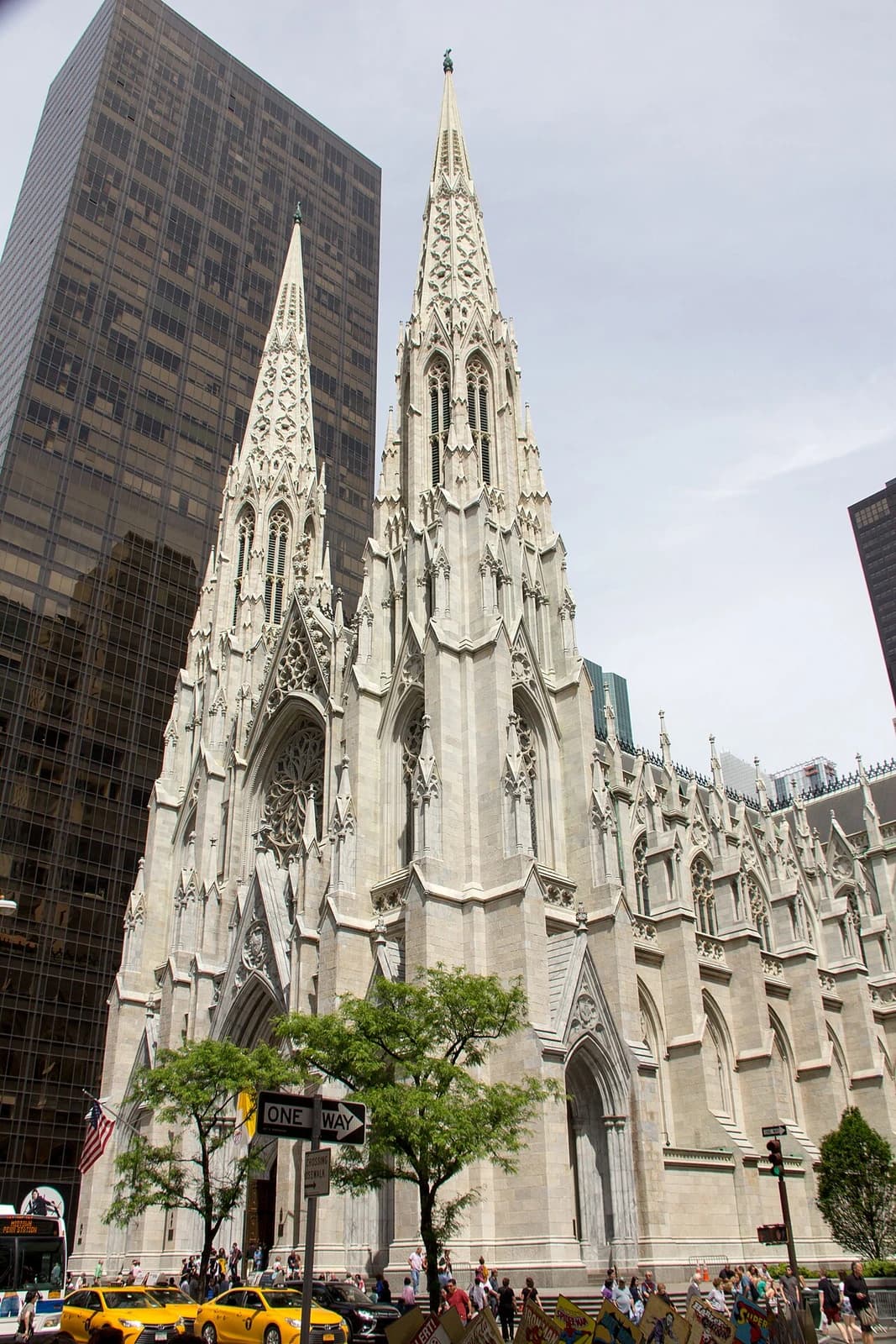
St. Patrick's Cathedral is a prominent Catholic cathedral serving as the seat of the Catholic Archdiocese of New York. It is a significant landmark located on Fifth Avenue in Manhattan.
St. Patrick's Cathedral is also known as St. Patrick's Cathedral, New York City.
This self-guided audio tour features 21 narrated stops organized across 8 sections. As a cathedral, St. Patrick's Cathedral offers a unique cultural experience in the heart of New York, United States.
The Stanza audio guide is available in 15 languages and works entirely offline — download the complete tour including audio narration, maps, and images before your visit. As you walk through St. Patrick's Cathedral, GPS-triggered narration plays automatically at each point of interest.
Last updated:
What you will hear
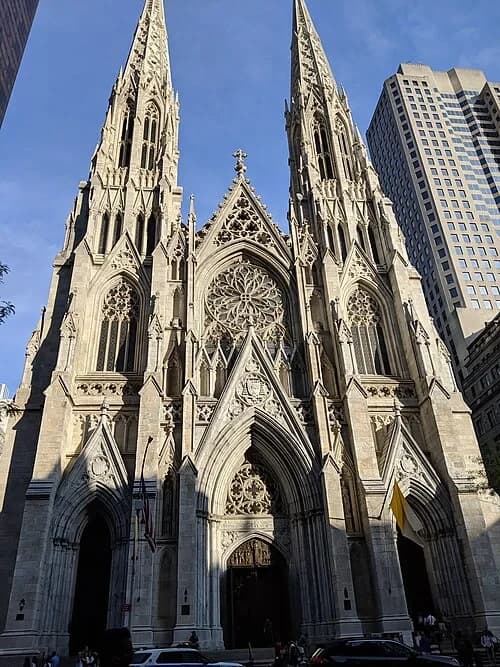
The Fifth Avenue Facade
Establishes the grand Neo-Gothic scale of the cathedral, focusing on the 329.5-foot spires and the intricate stone carvings of the main facade.
The Main Facade
Welcome to St. Patrick’s Cathedral, a masterpiece of Gothic Revival architecture designed by James Renwick Jr. This white marble structure was envisioned as a monumental statement of faith and presence when construction began in the mid-19th century. Its twin spires rise to exactly 329.5 feet, dominating the Midtown skyline for generations. The facade is a forest of intricate stone carvings that turn heavy marble into what appears to be delicate lace, a hallmark of the Gothic style which emphasizes verticality and light. Renwick's design was intended to inspire awe, creating a stark visual contrast with the brownstone buildings that once populated this area. Today, it remains an architectural landmark nestled among modern glass and steel skyscrapers. As you stand outside, notice how the building fills nearly an entire city block, representing both the growth of the Catholic Church in New York and the craftsmanship of the thousands of laborers who brought this vision to life over several decades. This monumental entrance sets the stage for the spiritual journey found within its massive doors, bridging the history of old New York with the bustling energy of the modern city.
The Great Bronze Doors
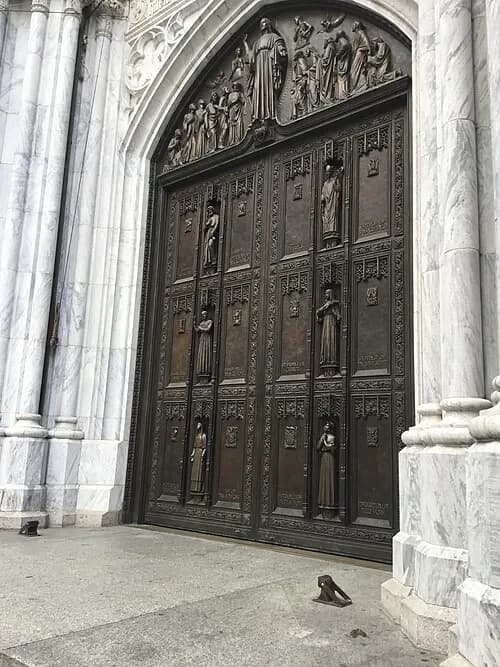
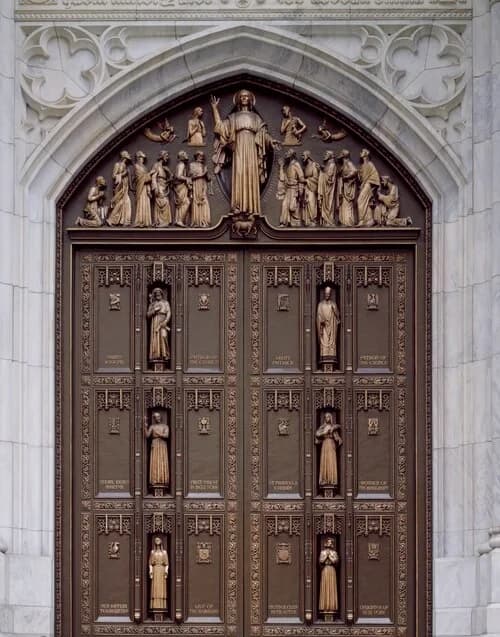
Focuses on the massive entrance doors installed in 1949, featuring relief sculptures of saints important to New York's history.
The Relief of Saints
Cast directly into the surface of the main bronze doors are six figures representing saints with deep connections to the history of New York and the Catholic Church in North America. These figures include St. Isaac Jogues, a missionary to the Americas, and St. Frances Cabrini, the first American citizen to be canonized. Each figure is rendered with incredible detail, from the textured folds of their robes to the specific symbols they carry, such as a cross or a book. These reliefs allow the doors to serve as a vertical history of faith for everyone who stands at the entrance. The choice to include these specific individuals highlights the cathedral's role as a spiritual home for a diverse, historically immigrant-heavy population. Notice how the figures seem to step forward from the bronze background, creating a sense of depth. The craftsmanship captures subtle expressions that are often lost in larger architectural features. This detailed metalwork was part of the cathedral's updates in the late 1940s, ensuring that the building's iconography continued to evolve alongside the community it serves. Small inscriptions nearby identify each saint for those who wish to study the relief more closely.
The Main Bronze Doors
Standing before the central entrance, your eyes are met by massive bronze doors installed in 1949. Each door weighs several tons, yet they are engineered with such precision that they are perfectly balanced. This allows them to be opened with the pressure of a single finger, a remarkable feat of mid-20th-century craftsmanship. At the very top of the central portal, you can see the figure of Christ the King presiding over all who enter. The doors are divided into multiple panels featuring intricate reliefs and symbolic patterns. These portals replaced earlier wooden doors, providing a more permanent and grand entrance for the millions of visitors who pass through every year. The bronze surface has aged to a deep, dark patina, providing a sharp visual contrast to the bright white marble of the surrounding archway. The scale of the doors is intentionally overwhelming, signifying the transition from the secular world of Fifth Avenue into a sacred interior space. If you look closely at the handle area, you may notice where the metal has been polished smooth by the hands of countless congregants and visitors who have crossed this threshold over the last several decades.
The Gallery Organ
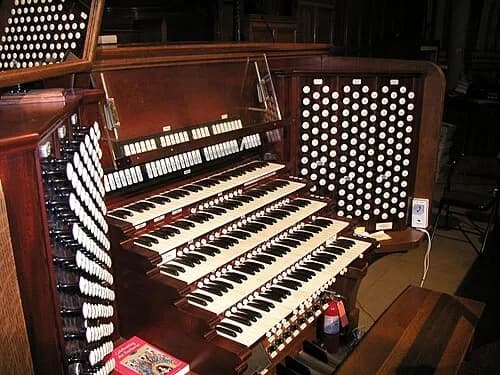
Features the massive pipe organ located in the gallery, one of two organs in the cathedral with a combined total of over 9,000 pipes.
The Organ Console
The complexity of the cathedral's musical system is managed from the organ console, a massive command center with multiple keyboards, known as manuals, and hundreds of white stop knobs. This console allows a single organist to control both the gallery and chancel organs simultaneously, blending over 9,000 pipes into a single performance. Each stop knob controls a specific set of pipes, allowing for an incredible range of tones, from soft flutes to thundering basses. The organist must use both hands on the manuals and both feet on the pedalboard, while also managing the stops to adjust the sound for the cathedral’s unique acoustics. In a space this large, sound takes time to travel, so the organist often hears the notes a split second after playing them, requiring immense skill to manage the lag. The console itself is a masterpiece of woodworking and engineering, tucked away where the musician has a clear view of the sanctuary. From this seat, the organist leads the congregation in song and provides the powerful music that defines the cathedral's atmosphere. The modern console integrates digital technology with traditional mechanics to ensure precision during the most complex musical pieces.
The Stained Glass Windows
Highlights the cathedral's 103 stained-glass windows, many crafted in Chartres, France, depicting biblical scenes and saints.
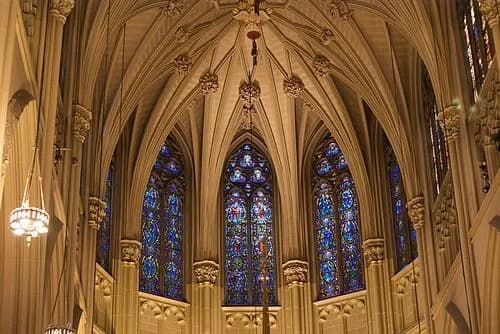
The Clerestory Windows
The cathedral is illuminated by 103 stained-glass windows, many of which are masterpieces of color and light. The 'clerestory' refers to the highest row of windows along the upper walls of the nave. Because they sit so high above the ground, they are designed to catch the most direct sunlight, filtering it through deep blues and vibrant reds that dance across the marble interior. Many of these specific windows were manufactured in Chartres, France, a city world-renowned for its stained-glass tradition since the Middle Ages. The glass is not just decorative; it serves to soften the natural light and create a meditative atmosphere within the sanctuary. Each window is composed of thousands of small pieces of colored glass held together by lead strips. From the floor, the details may appear small, but they represent complex biblical scenes and historic figures. The blue glass used here is particularly famous, often referred to as 'Chartres blue' for its unique depth and intensity. As the sun moves across the sky outside, the patterns of light inside the cathedral shift and change, ensuring that the interior atmosphere is never exactly the same twice during the day.
The Pietà
A significant work of art by William Ordway Partridge, this marble sculpture is one of the most visited shrines in the cathedral.
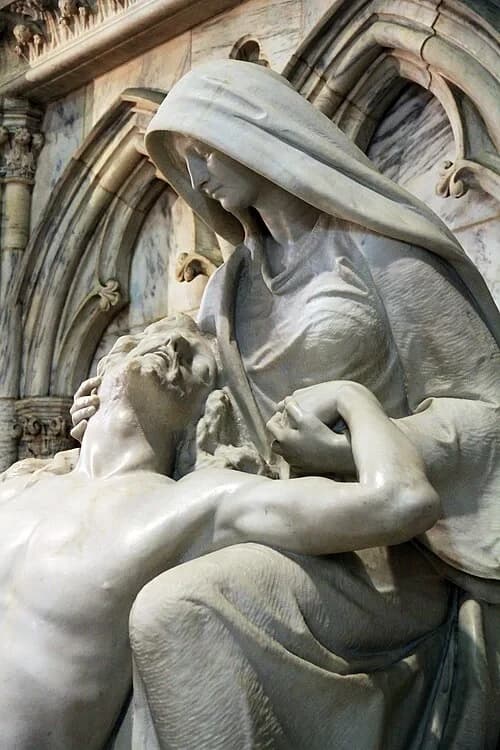
The Pieta Sculpture
In a side aisle near the back of the cathedral sits a moving sculpture of the Pieta, created by American artist William Ordway Partridge. While many are familiar with Michelangelo’s Pieta in Rome, this version is unique in its scale, standing roughly three times larger than the famous masterpiece in St. Peter's Basilica. The work depicts Mary cradling the lifeless body of Jesus after he was taken down from the cross. Carved from a single block of white marble, the sculpture captures the profound emotional weight of the scene through its immense physical presence. Notice the expression of grief on Mary’s face and the relaxed, heavy posture of Jesus's body. The smoothness of the marble highlights the anatomical detail in the figures, from the muscles in the torso to the delicate folds of the cloth. Partridge worked on this piece in the early 20th century, bringing a sense of American realism to the Gothic setting of the cathedral. Because of its size and placement, it offers a powerful point of contemplation for visitors. The white stone seems to glow against the darker shadows of the side chapel, drawing the eye to the central themes of maternal sorrow.
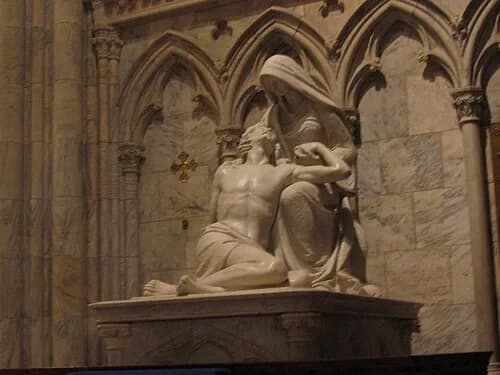
The Shrine of Mary
The Shrine of Mary is one of the most visited locations for prayer and quiet reflection within the cathedral. It is framed by a pointed Gothic arch that mirrors the architectural themes found throughout the nave. The statue of Mary is positioned within this arch, surrounded by soft lighting that creates a sense of intimacy and peace. This area is intentionally kept darker than the main nave to provide a retreat for those seeking a moment of silence away from the busy Fifth Avenue sidewalk just a few feet away. Votive candles often flicker at the base of the shrine, representing the personal prayers of the many thousands who stop here daily. The side aisle location allows for a continuous flow of visitors while maintaining a space that feels separated from the grand scale of the main altar. Notice how the archway frames the figure, drawing your focus directly to the central statue. This shrine serves as a reminder of the cathedral's role as a place of personal devotion as much as public ceremony. Many people leave small tokens or flowers here, making it one of the most living and active spaces in the entire building.
The Lady Chapel
Located behind the high altar, this chapel is a masterpiece of 13th-century style, dedicated to the Virgin Mary.
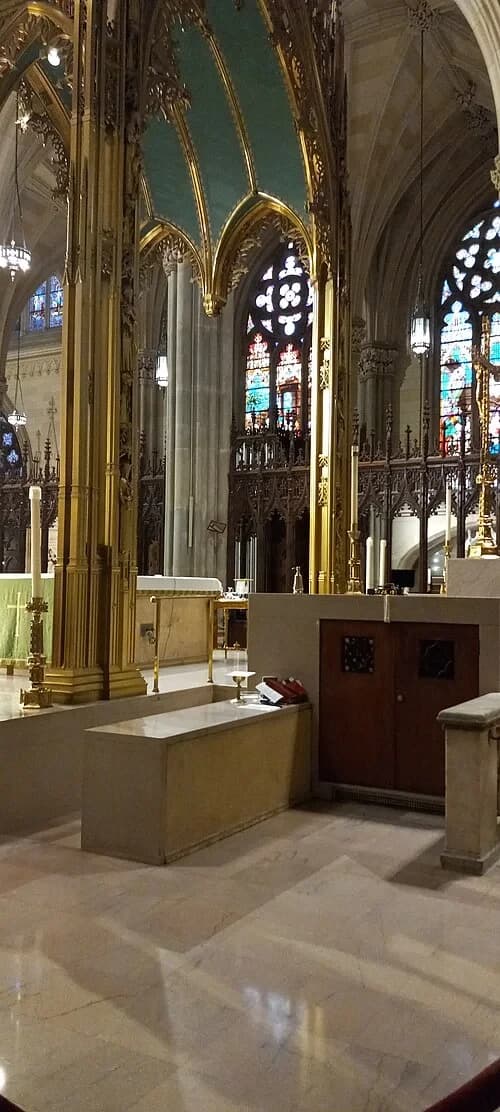
The Sanctuary Floor
Standing at the edge of the sanctuary, you are looking at the most sacred portion of the cathedral. Take note of the floor beneath you, where the light plays across intricate geometric patterns of polished marble. These designs are not merely decorative; they define the space where the most significant liturgical rituals in the archdiocese occur. A low marble railing separates this elevated area from the nave, maintaining a sense of openness while clearly delineating the sanctuary’s boundaries. This floor has felt the footsteps of history. It is here that every Archbishop of New York is formally installed in their office, a tradition dating back generations. Looking even further back, this sanctuary has hosted multiple Popes. Pope Paul VI, Pope John Paul II, Pope Benedict XVI, and Pope Francis have all stood in this very spot during their historic visits to the city. During major holidays, this area is filled with the vivid colors of clerical robes and the scent of incense, but even in the quiet moments between services, the sheer scale of the marble patterns conveys the grandeur required for such a central religious site.
The Archbishop’s Cathedra
The official throne or 'cathedra' that makes this building a cathedral, signifying it as the seat of the Archbishop of New York.
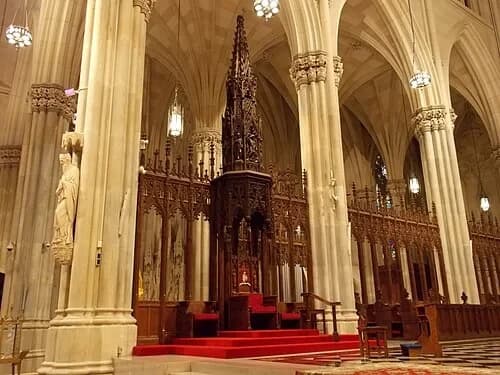
The Archbishop's Cathedra
This impressive, towering wooden chair is the cathedra. The term is Latin for "seat," and it is the defining feature of any cathedral. In fact, a church only becomes a cathedral when it houses the official throne of a bishop. This specific cathedra belongs to the Archbishop of New York. Because this throne is located here, St. Patrick's serves as the mother church for the entire archdiocese, overseeing hundreds of parishes. Examine the intricate Gothic carving that rises above the seat. The woodwork mirrors the pointed arches and delicate spires seen in the stone architecture of the building, creating a miniature version of the cathedral's own silhouette. While it may look like an antique, it remains a functional part of the church. During major masses and ceremonies, the Archbishop presides from this seat, symbolizing his role as a teacher and leader of the local faith community. Its position on the side of the sanctuary ensures that the Archbishop is visible to the thousands of congregants gathered in the nave while keeping the central focus on the altar. It stands as a physical marker of authority and tradition within the heart of the city.
A Gothic Statement in a Modern City
Illustrates the dramatic contrast between the 19th-century Gothic spires and the 20th-century skyscrapers of Midtown Manhattan.
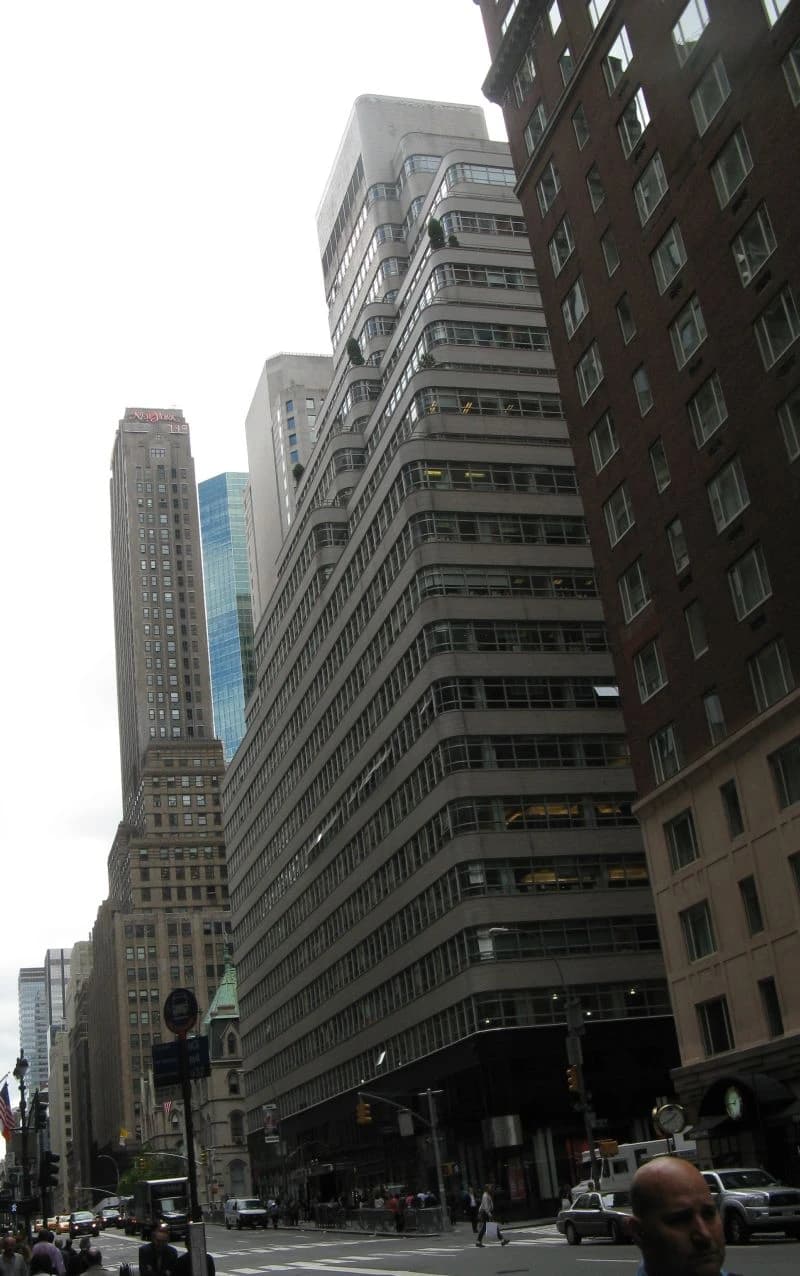
The Midtown Skyline
Turning your attention toward the windows or exiting onto the street, the contrast between the cathedral and its neighbors is startling. The delicate, lace-like Gothic spires of St. Patrick’s stand in direct opposition to the sleek, unadorned surfaces of the modern glass and steel skyscrapers across Madison and Fifth Avenues. This architectural clash highlights the cathedral's survival through over 160 years of New York City's relentless growth. The building has witnessed the city evolve from a hub of low-rise brick structures into the world's most famous vertical skyline. It has also been at the center of several historical storms. In 1914, a bomb was detonated on the northwest corner of the cathedral, an event linked to the political tensions of the era. Decades later, in 1989, the cathedral became the site of one of the most significant protests in modern history when the activists from "ACT UP" disrupted a mass to demand action during the AIDS crisis. These events, though controversial, underscore the cathedral's role as a public square where faith and the pressing issues of the day often intersect. Even as the city transforms around it, the white marble remains a steadfast presence amidst the ever-shifting Midtown landscape.
Want to hear the rest?
Download the Stanza app to unlock all 21 stops and full GPS-guided navigation.
Frequently Asked Questions
How long does the St. Patrick's Cathedral audio tour take?
The St. Patrick's Cathedral audio guide includes 21 narrated stops. Most visitors spend 45 minutes to 1.5 hours exploring the complete tour, though you can listen at your own pace and skip or revisit any stop.
Is the St. Patrick's Cathedral audio guide available in my language?
Stanza supports 15 languages: English, Spanish, French, German, Italian, Portuguese, Russian, Japanese, Chinese, Korean, Arabic, Hindi, Polish, Dutch, Hebrew. Check the guide in the app to confirm the languages currently available for this tour.
Can I use the audio guide offline at St. Patrick's Cathedral?
Yes! Download the complete St. Patrick's Cathedral tour — including all audio, maps, and images — before your visit. The Stanza app works completely offline, so you don't need WiFi or mobile data at the venue.
How much does the St. Patrick's Cathedral audio guide cost?
The Stanza app is free to download. The current listed price for the St. Patrick's Cathedral audio guide is $2.99; app-store region and currency may affect the final price.
How do I use the Stanza audio guide at St. Patrick's Cathedral?
Download the free Stanza app, search for "St. Patrick's Cathedral", and download the tour. When you arrive at the venue, the app uses GPS to detect your location and automatically plays the relevant narration as you move between points of interest — completely hands-free.
What makes the Stanza audio guide different from other St. Patrick's Cathedral tours?
Stanza offers GPS-triggered narration that plays automatically as you walk through St. Patrick's Cathedral — no need to manually select stops. The tour is available in 15 languages, works fully offline, and includes 21 expertly narrated stops with images and historical context.
What other audio guides are available near St. Patrick's Cathedral?
Stanza offers multiple audio guides in New York, United States and nearby areas. After downloading the app, browse the map to discover all available tours near St. Patrick's Cathedral. Each guide can be downloaded for offline use.