Stanza · Audio guide
National September 11 Memorial & MuseumAudio guide
A place to remember. A story to take with you.
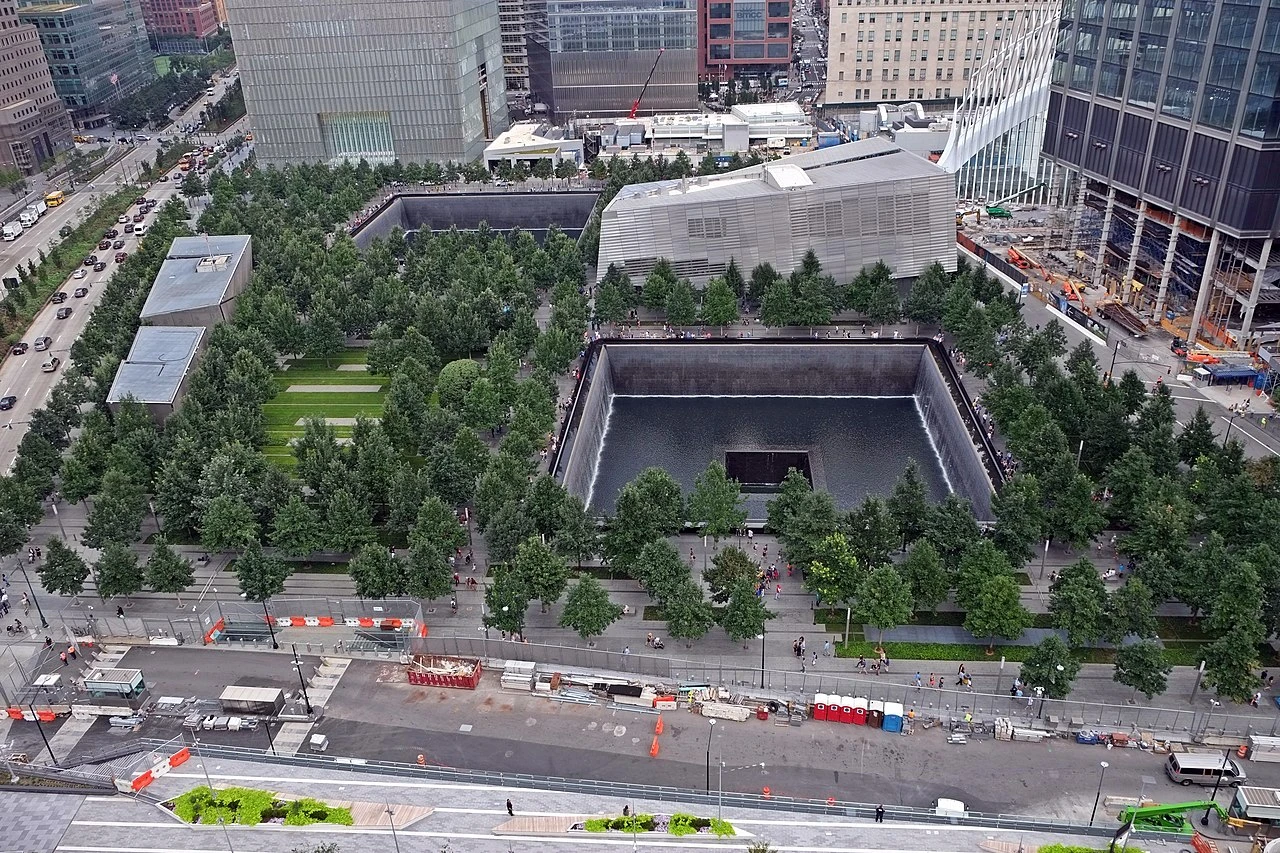
The National September 11 Memorial & Museum honors the victims of the September 11, 2001, terrorist attacks and the 1993 World Trade Center bombing. It is located at the site of the former World Trade Center…
Download Stanza, then search for “National September 11 Memorial & Museum”.
About the tour
One guide. Your kind of visit.
The National September 11 Memorial & Museum honors the victims of the September 11, 2001, terrorist attacks and the 1993 World Trade Center bombing. It is located at the site of the former World Trade Center complex in Lower Manhattan.
Ready when you are.
- 01Get the free Stanza app.
iOS & Android
- 02Find your guide.
“National September 11 Memorial & Museum”
- 03Download before you go.
Works offline
Audio guide / 18 narrated stops
Inside the guide
Get to know a few of the stories before you go. Open a stop to read more.
01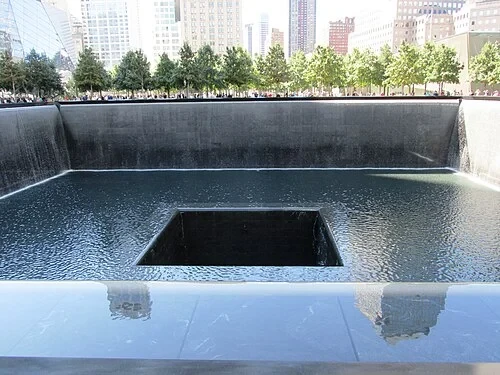 The Twin Reflecting PoolsNational September 11 Memorial North Pool
Designed by architects Michael Arad and Peter Walker, the memorial is centered around two reflecting pools. Construction on this site began in 2006, and it was officially dedicated on the tenth anniversary of the attacks, September 11, 2011. The core concept behind the design is titled Reflecting Absence. This idea is physically manifested through the cascading water that falls thirty feet into the pools before disappearing into a second, deeper central void. By placing the pools within the precise footprints of the North and South Towers, the design creates a visible representation of what was lost. The constant flow of water provides a sense of renewal, yet the deep center remains unreachable, representing an absence that can never be filled. As the water falls along the granite walls, consider the scale of the original buildings that once occupied this very space. This open plaza provides a somber environment for reflection, set apart from the busy activity of Lower Manhattan. It provides a location for collective mourning and individual contemplation.
brewbooks from near Seattle, USA · CC BY-SA 2.0
02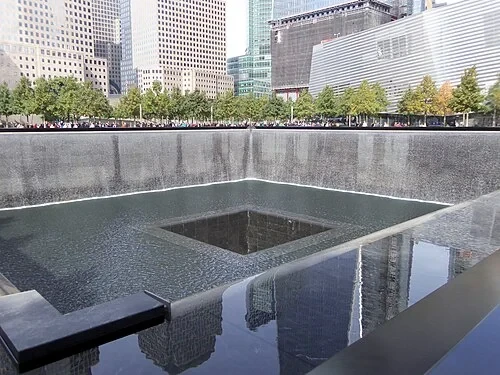 The Twin Reflecting PoolsNational September 11 Memorial South Pool
The engineering behind these waterfalls is a significant feat, as they are the largest man-made falls on the continent. Each minute, thousands of gallons of water circulate through the system, spilling over the weir and descending thirty feet. This constant motion creates a specific white noise designed to dampen the surrounding sounds of New York City traffic and construction. The intention is to create a sound curtain that facilitates a more intimate and contemplative environment. Looking toward the center, the water flows into a square void that drops another twenty feet. The total depth of these recessed basins emphasizes the immense scale of the towers and the void left in their wake. While the first pool introduced the design's footprint, this pool highlights how the sensory experience of falling water and acoustic isolation defines the memorial's atmosphere. The granite lining the walls is carefully textured to manage the flow, ensuring the water falls in a consistent, shimmering sheet regardless of wind conditions. This acoustic isolation allows for a focused experience even in the center of a bustling financial district.
Photo: Farragutful · CC BY-SA 3.0
03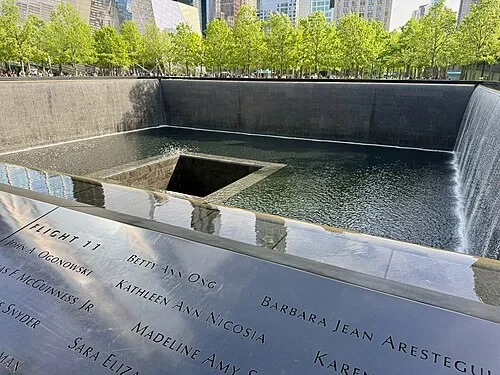 The Twin Reflecting PoolsThe Bronze Parapets
Encircling the North and South pools are bronze panels inscribed with the names of every person killed in the terrorist attacks of September 11, 2001, and February 26, 1993. The arrangement of these names is not alphabetical. Instead, the Memorial used a concept called meaningful adjacencies. During the design process, family members and colleagues requested that certain names be placed together. As a result, you will find family members, close friends, and co-workers who were together on that day honored side-by-side. For example, names are grouped by those who were on the same flight, worked in the same office, or served in the same emergency response unit. This system creates a hidden map of relationships, ensuring that no name stands in isolation. The bronze itself is a dark, weathered material that allows for tactile interaction; visitors often touch the names or place flowers in the cut-out letters. These panels serve as a permanent record of the individuals lost, grounding the immense scale of the disaster in the lives of the people who perished. The names include victims from the World Trade Center site, the Pentagon, and Shanksville, Pennsylvania.
Listen in the appPhoto: Oleg Yunakov · CC BY-SA 4.0
04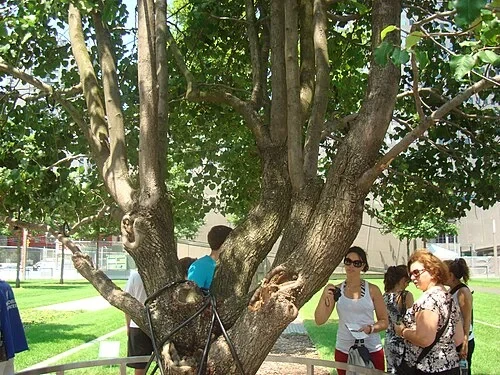 The Survivor TreeSurvivor Tree
In October 2001, recovery workers discovered a severely damaged Callery pear tree among the debris of the World Trade Center. It was nearly dead, with charred bark and only one living branch remaining. The tree was moved to a nursery in the Bronx, under the care of the New York City Department of Parks and Recreation, where it underwent nearly a decade of rehabilitation. In 2010, the Survivor Tree was successfully replanted here on the memorial plaza. A striking visual contrast is evident on the trunk and branches. The lower portions of the tree feature gnarled, scarred bark—lasting physical evidence of the disaster it endured. Above that damage, the new growth is significantly smoother and straighter, representing the tree's recovery and continued life. Every spring, the tree blooms with white flowers, standing as a unique living element amidst the stone and water of the surrounding memorial. It remains a focal point for visitors, often adorned with ribbons or small tributes left by those who come to pay their respects. The tree's journey from the wreckage to the Bronx and back to Lower Manhattan reflects the broader timeline of the site's reconstruction.
Listen in the appPhoto: PumpkinSky · CC BY-SA 3.0
05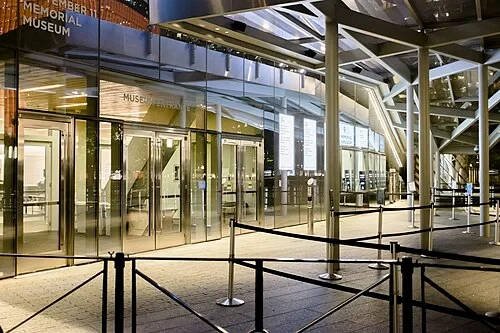 The Museum Pavilion and The TridentsMuseum Entrance Pavilion
Designed by the architectural firm Snøhetta, the entrance pavilion serves as a bridge between the memorial plaza above and the museum galleries below. The building is designed in a deconstructivist style, characterized by its sharp angles, tilted surfaces, and reflective glass facade. These architectural choices are intended to echo the appearance of the original towers and the wreckage found at the site without being a literal recreation. The way the structure leans and cuts into the sky is meant to remind visitors of the site's complex history. Passing through this threshold begins a descent that will eventually lead seventy feet below ground level. The transition from the bright, open plaza into the enclosed space of the pavilion marks the start of a journey into the bedrock of the original World Trade Center. The interior of the pavilion is expansive, spanning 110,000 square feet, and provides the first glimpses of the massive structural artifacts that were preserved from the towers. This building facilitates the physical and psychological shift from the public memorial to the historical narrative of the museum. The sharp glass prow stands as a distinct contrast to the surrounding skyscrapers.
Listen in the appBillie Grace Ward from New York, USA · CC BY 2.0
06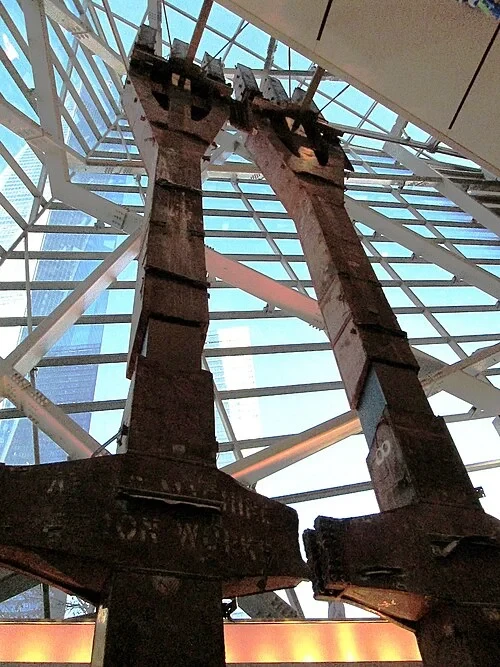 The Museum Pavilion and The TridentsThe Steel Tridents
Standing within the glass pavilion are two massive steel structures known as Tridents. These columns were part of the original exterior facade of the North Tower. They earned their nickname because of the way the single base splits into three distinct prongs at the top. In the original buildings, these prongs supported the floors above the lobby levels. Each Trident stands approximately seventy feet tall and weighs over fifty tons. These specific pieces were recovered from the wreckage and were among the first artifacts to be returned to the site. Because of their immense size and weight, they had to be lowered into position by cranes before the rest of the museum's entrance pavilion was constructed around them. They are now encased in the glass building, visible to people outside on the plaza as well as those entering the museum. The weathered, rusty surface of the steel has been preserved, showing the physical reality of the material that once formed the skin of the Twin Towers. They serve as a monumental introduction to the scale of the original architecture and the force of the structural engineering used in the towers.
Listen in the appPhoto: Beyond My Ken · CC BY-SA 4.0
07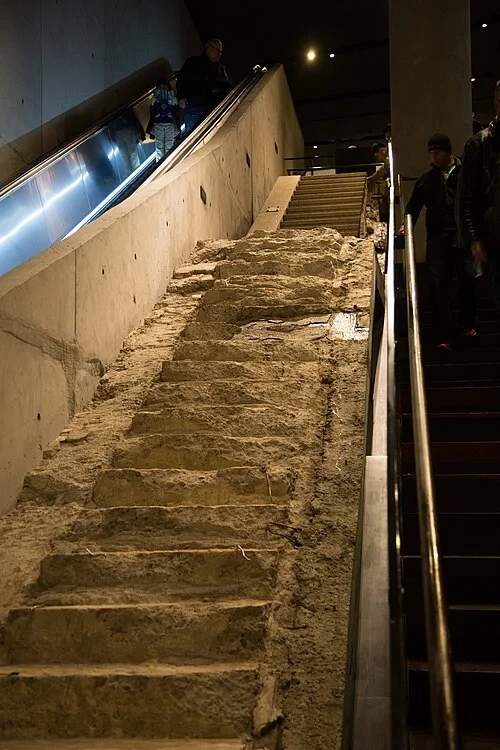 The Survivors' StaircaseThe Survivors' Staircase
This weathered flight of concrete and granite steps is known as the Survivors' Staircase. Originally located at the edge of the World Trade Center plaza on Vesey Street, it connected the elevated plaza to the sidewalk below. On the morning of September 11, these stairs served as a crucial exit for hundreds of people fleeing the North Tower and the surrounding buildings. As the towers collapsed, much of the plaza was destroyed, but this staircase remained largely intact. It was preserved as a remnant of the ordinary—an everyday architectural feature that took on profound significance because it facilitated life-saving passage during the disaster. During the site's reconstruction, the staircase was moved and carefully integrated into the museum's descent. It now sits adjacent to the modern escalators used by visitors. By keeping the original, damaged concrete and the metal railings, the museum highlights the physical reality of the escape path. It stands as a silent witness to the thousands who navigated this terrain to reach safety, representing a tangible link between the world that existed before the attacks and the recovery that followed. The stairs are often one of the first objects to convey the human experience of that morning.
Listen in the appMark Kent · CC BY-SA 2.0
08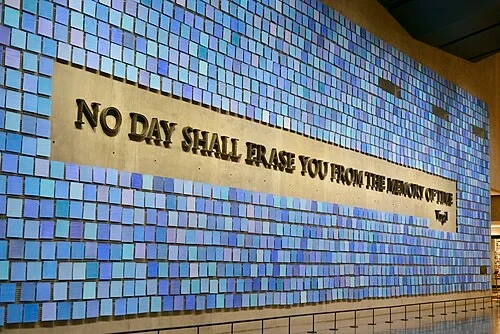 Memorial Hall: No Day Shall Erase YouThe Memorial Wall
This expansive hall features a massive art installation titled Trying to Remember the Color of the Sky on That September Morning. Created by artist Spencer Finch, the work consists of 2,983 individual squares of hand-painted paper. Each tile represents one victim of the 2001 attacks and the 1993 bombing. Notably, every single tile is a slightly different shade of blue. The variation reflects the subjective nature of human memory; while many people remember the sky that morning as a clear, piercing blue, no two people remember the exact same hue. Together, the tiles form a mosaic that covers a significant portion of the museum's wall. The sheer number of individual pieces helps visitors visualize the scale of the human loss in a way that names alone might not. The installation is set against the backdrop of the original foundation wall, creating a contrast between the delicate paper and the massive, industrial concrete. It invites a quiet moment of reflection on the shared experience of that day and the individual lives that are commemorated through this collective sky. The installation remains one of the few contemporary artworks commissioned for the museum's permanent galleries.
Listen in the appPhoto: Alberto-g-rovi · CC BY 3.0
09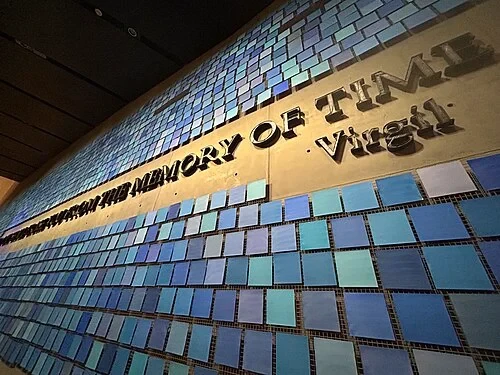 Memorial Hall: No Day Shall Erase YouThe Virgil Quote
Positioned across the field of blue tiles is an inscription that reads: No day shall erase you from the memory of time. These words are taken from the Aeneid, written by the Roman poet Virgil. Each individual letter in the quote was forged by blacksmith Tom Joyce using steel recovered from the World Trade Center site. The material itself provides a direct physical connection to the buildings that once stood here. The placement of this quote is highly significant, as the wall it rests upon serves as a barrier to a restricted area. Behind this wall is the repository containing the remains of unidentified victims. This space is managed by the Office of Chief Medical Examiner and is not open to the general public; it is accessible only to the family members of the deceased. The quote serves as a solemn dedication to those individuals, ensuring their presence is honored within the museum even though their final resting place remains private. The industrial texture of the forged steel letters stands out against the smooth concrete, emphasizing the permanence of the tribute. The typeface was specially designed to be legible from across the vast hall.
Listen in the appMemeGod27 · CC0
10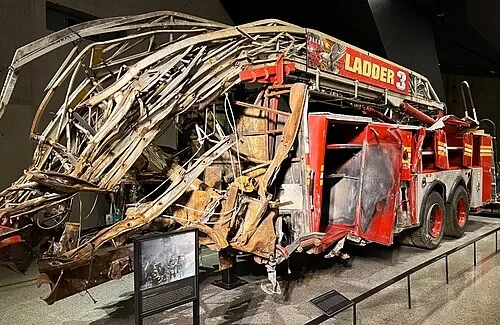 The Historical Exhibition: Ladder 3Ladder Company 3 Truck
Among the largest artifacts in the museum is the mangled wreckage of a fire truck from Ladder Company 3. Based in the East Village, this company was led by Captain Patrick Paddy Brown, a highly decorated veteran of the department. On the morning of September 11, the crew of Ladder 3 was among the first responders to enter the North Tower. The truck was parked on West Street, positioned near the base of the building to support the ongoing rescue operations. When the North Tower collapsed, the vehicle was buried under tons of falling steel and concrete. All fifteen members of Ladder Company 3 who responded to the site that day were killed. The truck serves as a stark visual representation of the immense physical forces unleashed during the collapse. It also stands as a tribute to the 343 members of the New York City Fire Department who died in the line of duty that morning. The twisted metal and crushed cab tell a story of the extreme conditions faced by those who ran toward the danger. Its presence in the gallery illustrates the sudden impact of the buildings' failure on the infrastructure located at the base of the towers.
Listen in the appChepry 💬 (Andrzej Barabasz) 📷 🇵🇱 · CC BY-SA 4.0
National September 11 Memorial & Museum
Frequently asked questions
How much does the guide cost?
Free app download. Listed guide price: $3.99. Guide price shown in the app. Audio guide only. Venue admission is separate.
Can I listen without internet?
Yes. Download the guide’s audio, images, and maps in the app before your visit. Your downloaded content is then available offline.
Can I listen in my language?
Stanza supports 15 languages. Check the app for the languages available for this guide.
Do I need to follow a schedule?
No. This is a self-guided experience. Choose your stops, pause whenever you like, and return to a story at your own pace.
At your own pace
Explore National September 11 Memorial & Museum.
Download Stanza, then search for “National September 11 Memorial & Museum”.
Free app download · Guide price shown in the app
Keep exploring
Nearby audio guides
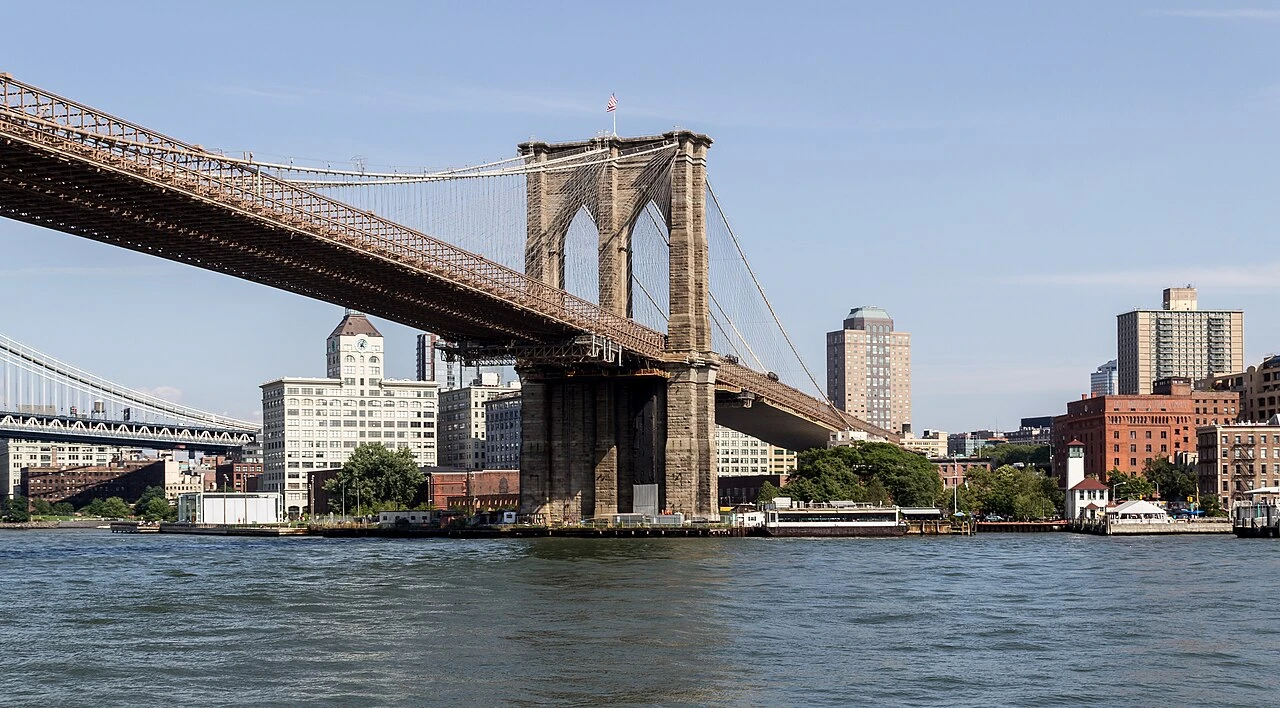
New York
Brooklyn Bridge
Content & sources
Dietmar Rabich · CC BY-SA 4.0
New York
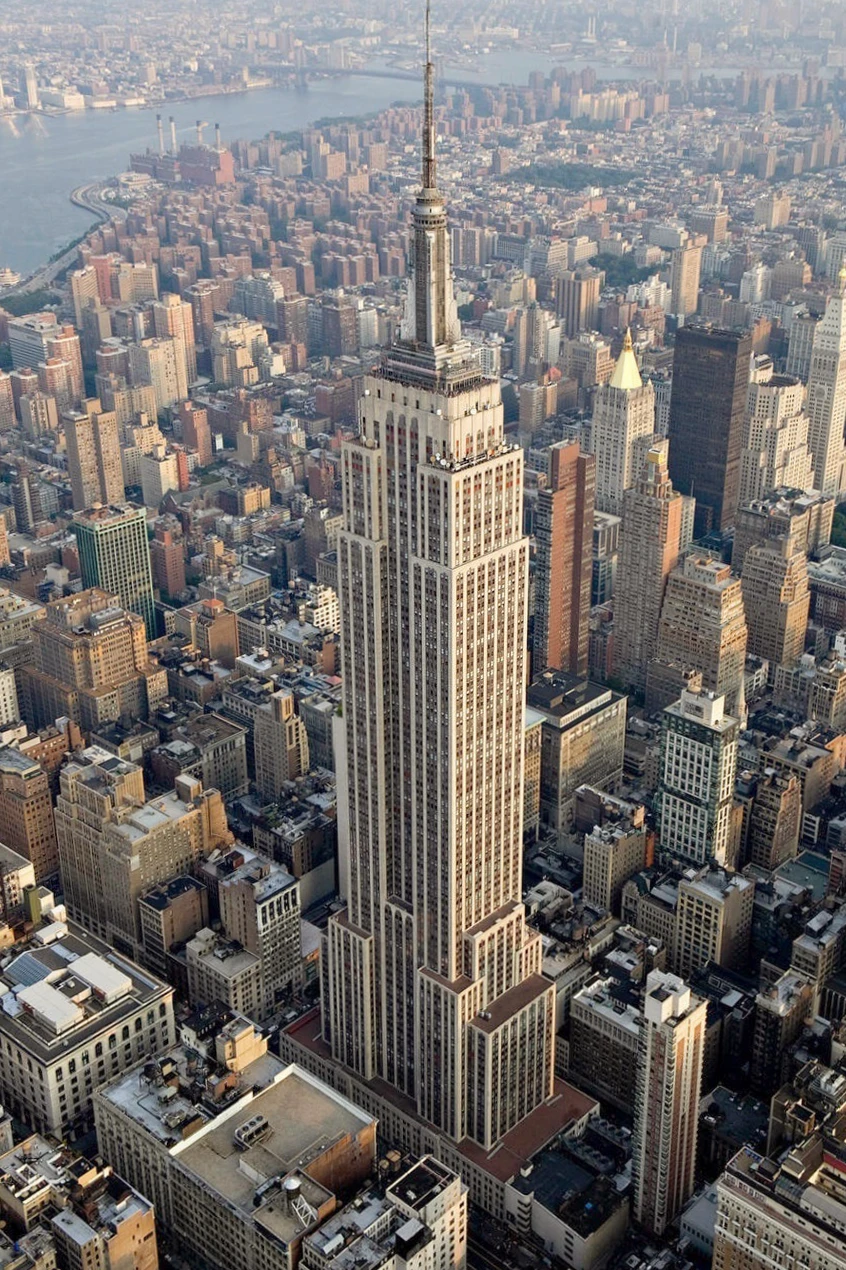
Empire State Building
Content & sources
Sam Valadi · Public domain
New York
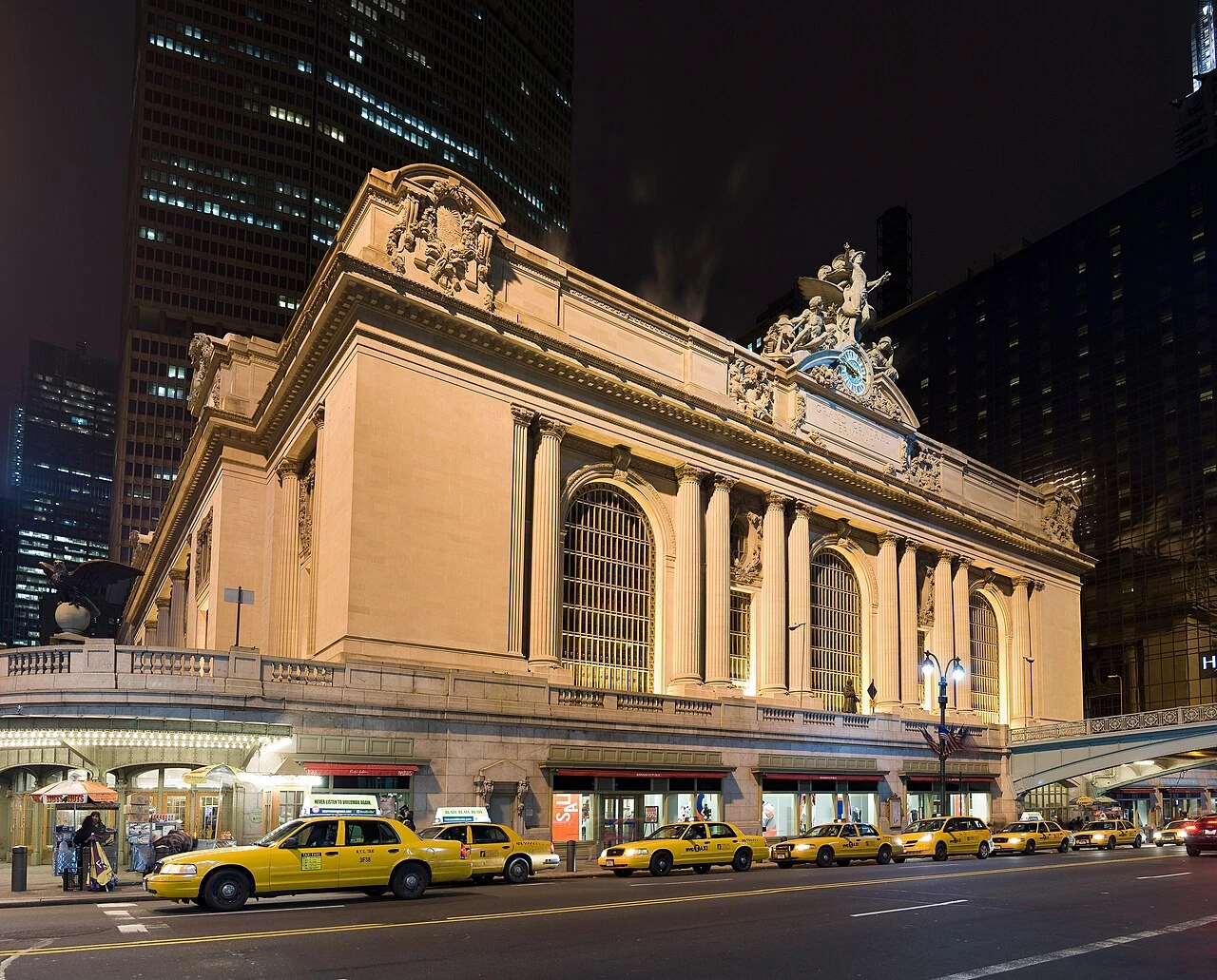
Grand Central Terminal
Content & sources
Fcb981 ; Eric Baetscher (attribution required) · CC BY-SA 3.0
New York
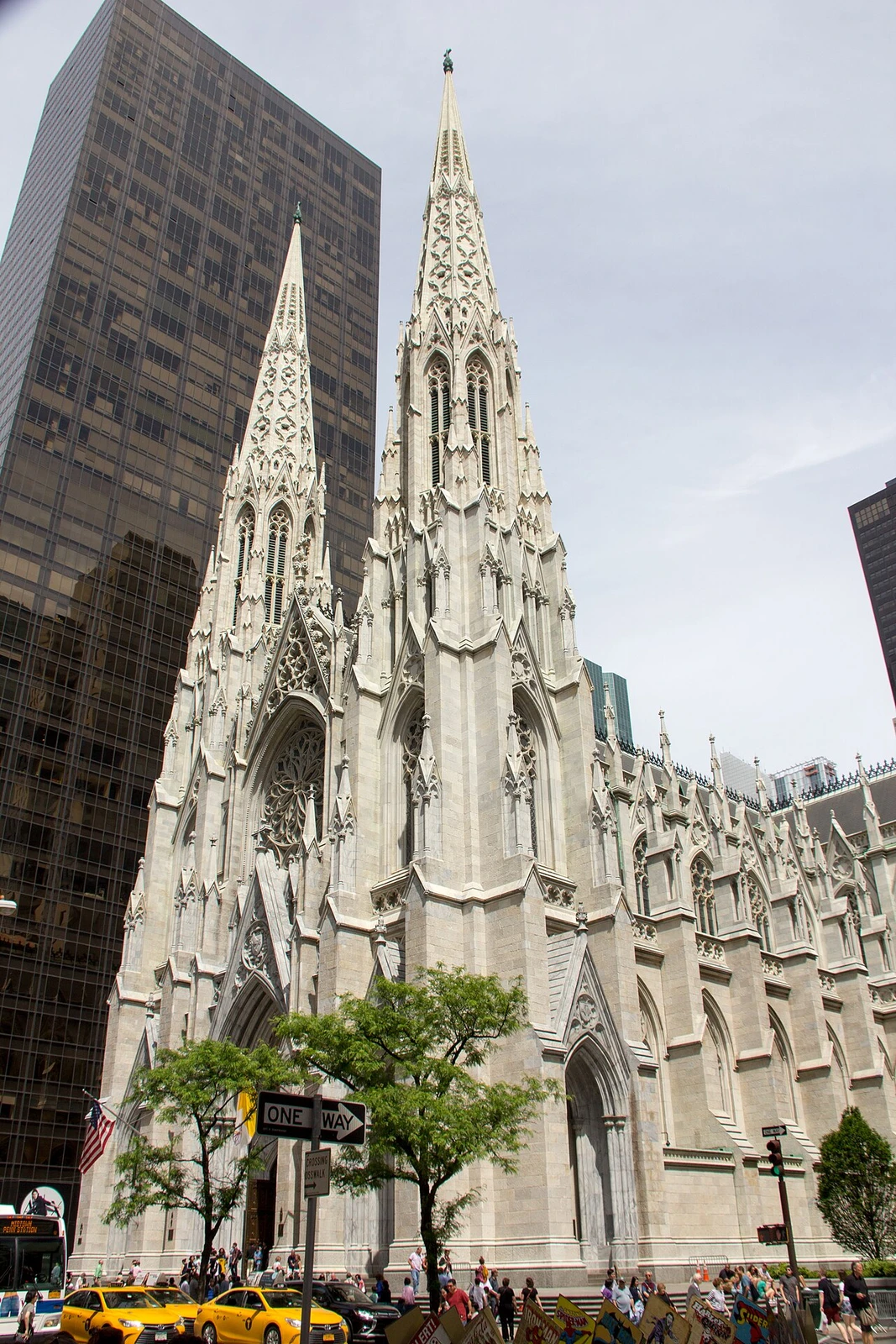
St. Patrick's Cathedral
Content & sources
Photograph by Mike Peel (www.mikepeel.net). · CC BY-SA 4.0