Stanza · Audio guide
Gur-e-Amir Audio Guide
A place to remember. A story to take with you.
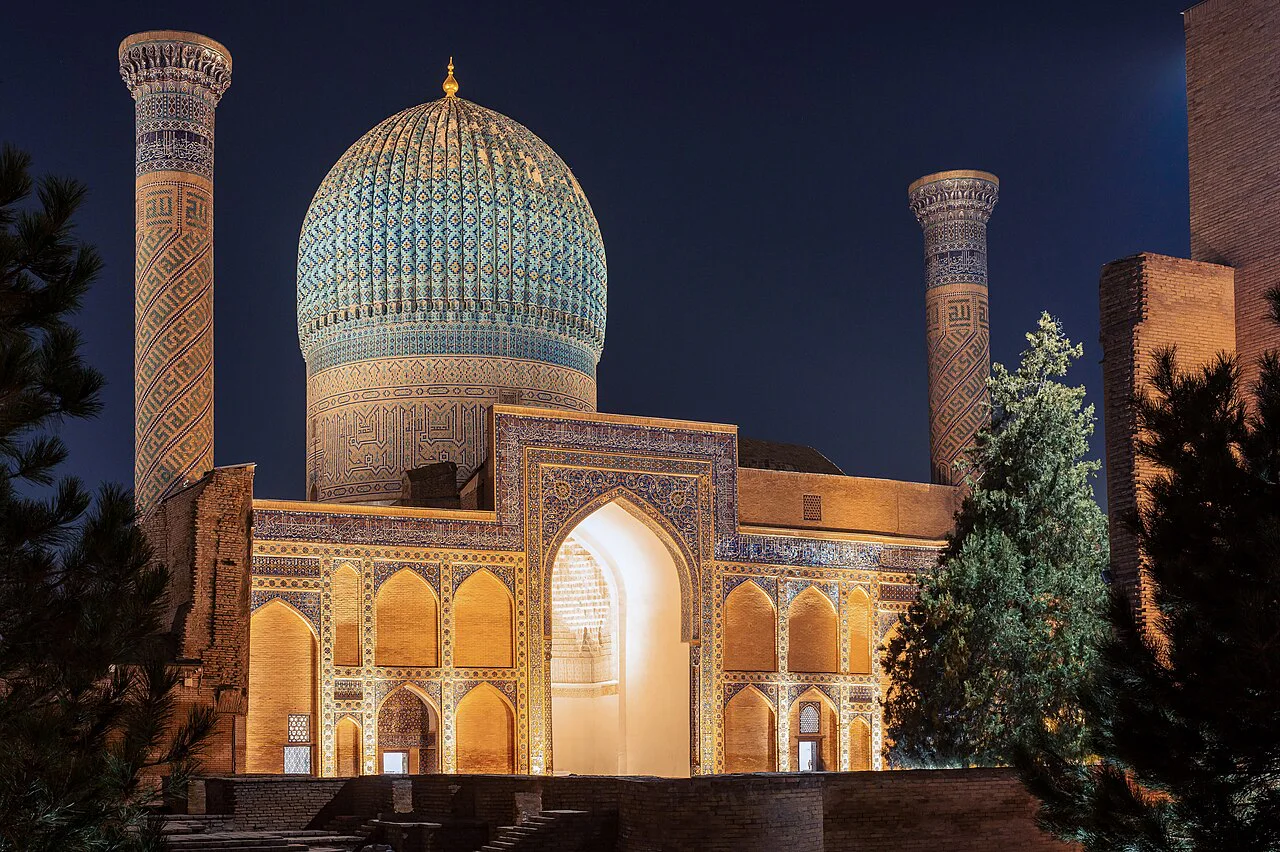
The Gur-e-Amir is a mausoleum of the Turco-Mongol conqueror Timur located in Samarkand, Uzbekistan. It is significant in the history of architecture as a precursor to later Mughal tombs such as the Taj Mahal.
Download Stanza, then search for “Gur-e-Amir”.
About the tour
One guide. Your kind of visit.
The Gur-e-Amir is a mausoleum of the Turco-Mongol conqueror Timur located in Samarkand, Uzbekistan. It is significant in the history of architecture as a precursor to later Mughal tombs such as the Taj Mahal.
Ready when you are.
- 01Get the free Stanza app.
iOS & Android
- 02Find your guide.
“Gur-e-Amir”
- 03Download before you go.
Works offline
Audio guide / 9 narrated stops
Inside the guide
Get to know a few of the stories before you go. Open a stop to read more.
01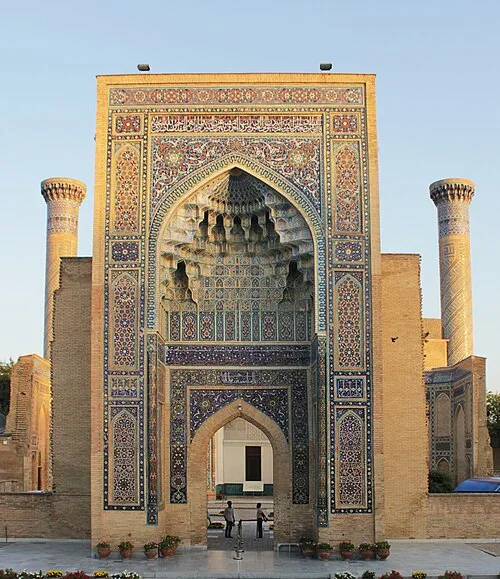 Monumental Entrance Portal and Courtyard Ruins
The Entrance Portal of the Muhammad Sultan Ensemble
Gur-e-Amir means 'Tomb of the King', and this monumental portal was its front door. The story begins with a death. In 1403 Muhammad Sultan, Timur's grandson and chosen heir, died suddenly after a campaign against the Ottoman Empire. The prince had already built his own ensemble here, a madrasah for teaching and a khanqah where Sufi devotees could gather, in the southeastern part of the medieval city. After his death Timur ordered a mausoleum for the young prince, and the ensemble became the setting for his tomb. The gateway itself is sheathed in carved brick and mosaic, geometric patterns set beside bands of calligraphy. Two ribbed minarets flank it, standing free of the main building rather than attached, to stress the scale of the whole complex. This tour follows the place from that gateway to the graves at its heart.
Photo: Nassima Chahboun · CC BY-SA 4.0
02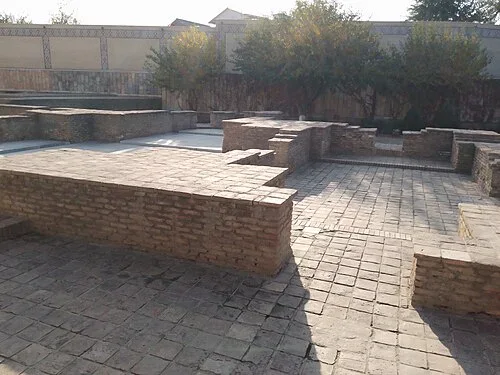 Monumental Entrance Portal and Courtyard Ruins
Courtyard Ruins of the Madrasah and Khanqah
These low brick walls are all that remains of half the original plan. Excavations in the courtyard uncovered the foundations of a madrasah on one side and a khanqah on the other, facing each other across the open square. Around them ran two storeys of small cells, the rooms where students and devotees lived and worked. So the mausoleum was never meant to stand alone. It was one wing of a full religious complex, built by the prince Muhammad Sultan himself. When restorers later repaired the site, they rebuilt the mausoleum, its dome and its portal. The madrasah and the khanqah were left untouched, and what remains of them is exactly this: foundations and low walls, tracing the footprint of the prince's grand design.
Photo: Hasan Tohirov · CC BY-SA 4.0
03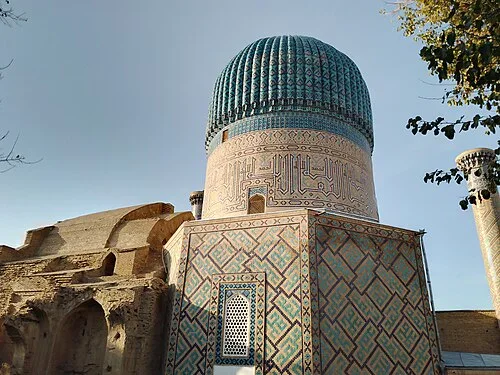 The Fluted Azure Dome and Grand Iwan
The Fluted Azure Dome
The fluted cupola is the signature of this building, and its engineering is the quiet wonder. Sixty-four rounded ribs run over the shell. The lower ring spans about fifteen metres, and the dome rises about twelve and a half above it. All that weight passes through a beautifully worked band below the cupola, down into a solid ring in the foundation, so the great mass seems to hover. And beneath it lies someone who never meant to be there. Timur had prepared his own tomb in Shahrisabz, near his Ak-Saray palace. In February 1405 he died at Otrar, on the march toward China. Snow blocked the passes to Shahrisabz. His body, embalmed and placed in an ebony coffin lined with silver brocade, was carried to Samarkand instead, against his stated wish, at the initiative of his grandson Khalil Sultan. He was buried beside Muhammad Sultan, in a mausoleum still unfinished.
Listen in the appPhoto: Hasan Tohirov · CC BY-SA 4.0
04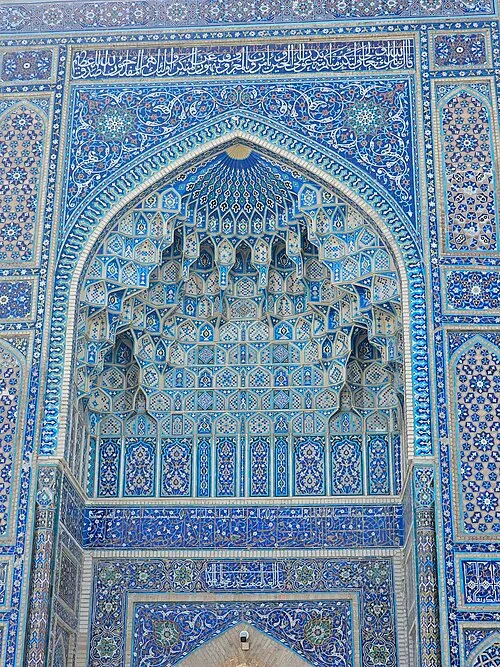 The Fluted Azure Dome and Grand Iwan
The Grand Iwan and Ulugh Beg's Entrance
The great arch rewards a slow reading. Its underside dissolves into muqarnas, a honeycomb of tiered little cells that seems to melt the vault into air. Around it run tiles in blue, light blue and white over terracotta brick, geometry and long bands of writing interwoven. This entrance belongs to the second phase of the story. Ulugh Beg, another of Timur's grandsons and later a famed astronomer-ruler, enlarged and completed the complex by 1425, and under him the mausoleum became the family crypt of the dynasty. His additions are attributed to Muhammad ibn Mahmud, an architect from Isfahan. One detail survives about the door itself. Ulugh Beg opened the eastern entrance in that same year, because coming in by the old north door meant passing close to the head of Mir Sayyid Baraka, the family's spiritual teacher, and he counted that a disrespect.
Listen in the appPhoto: შალვა მინდაძე 11 · CC BY-SA 4.0
05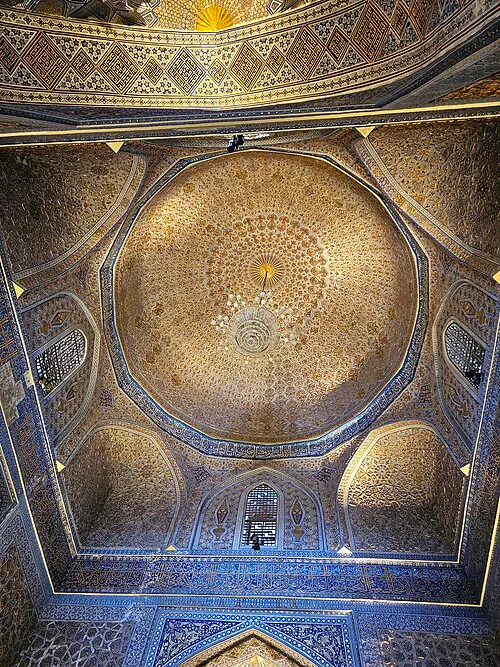 Interior Chamber and Gilded Cupola
The Gilded Interior Dome
Inside, the chamber opens upward into a high, wide space. The lower walls are faced with slabs of onyx composed as a single panel, each slab finely painted, and above them runs a marble cornice carved into stalactite forms. Higher still, the arches and the inner dome are covered in high-relief cartouches of papier-mâché, gilded and painted, in a technique the workshops called kundal. A contemporary historian, Sharafuddin Ali Yazdi, described the building in his own words: a dome high as heaven, its walls faced with marble, gold and lapis lazuli. Much of the glitter overhead was renewed by restorers in the 1970s, working from what the original craftsmen left behind.
Listen in the appPhoto: შალვა მინდაძე 11 · CC BY-SA 4.0
06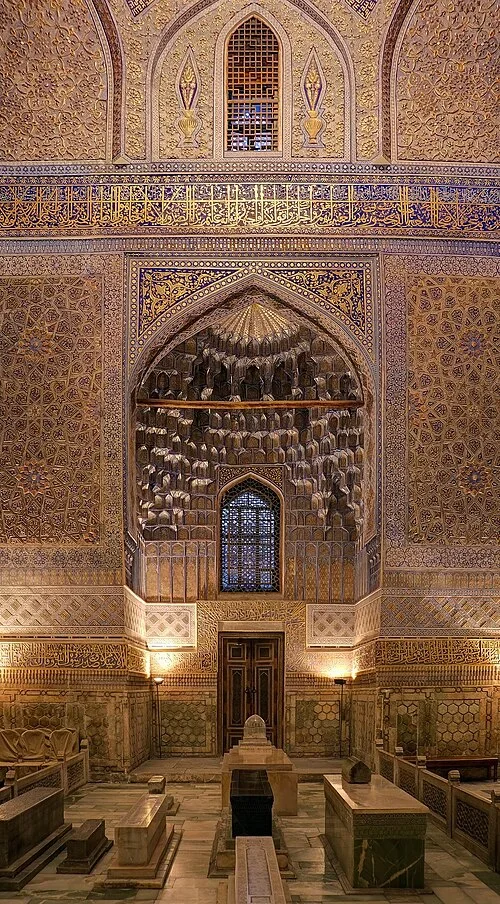 The Royal Cenotaphs and Timur's Jade Stone
The Hall of the Timurid Princes
The carved headstones in this hall are markers only. The real graves lie in a crypt directly beneath the chamber. Gathered here are Timur, his sons and his grandsons, princes of the Timurid line. And in the most honoured position stands the stone of Mir Said Baraka, a Sufi sheikh descended from the Prophet Muhammad. Baraka gave Timur the drum and the banner of power when he rose in 1370, blessed him before his battles, and rode with him on campaign. A chronicler recorded that Timur kept saying every conquest he made came through Baraka's prayers and blessing. So Timur was not given the central place of honour, but lay at his teacher's feet. It was Timur's son Shah Rukh who had Baraka's remains brought here to rest among the family.
Listen in the appEkrem Canli · CC BY-SA 3.0
07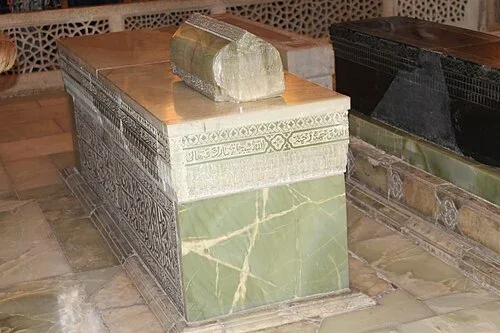 The Royal Cenotaphs and Timur's Jade Stone
Timur's Nephrite Jade Cenotaph
The dark green slab over Timur's grave is nephrite jade, and it had lives before this one. It served first as a place of worship in the Chinese emperor's palace, then as the throne of a descendant of Genghis Khan, before it was set here in the reign of Timur's grandson. In 1740 the Persian conqueror Nader Shah, who idolized Timur, tried to carry the sarcophagus away. The stone broke in two during the removal. His advisers read it as a terrible omen and urged him to send it back, and back it went. The modern chapter is stranger. Rumours had run through Samarkand that the tomb carried a curse, and an inscription was said to promise an invader more terrible than Timur to whoever disturbed it. In June 1941 the Soviet anthropologist Mikhail Gerasimov opened the grave, two days before Nazi Germany invaded the Soviet Union. People close to Gerasimov called the inscription story a fabrication, but the legend has never quite died. What the excavation did establish is solid: from the skull, Gerasimov reconstructed Timur's face, and the remains confirmed he walked with a pronounced limp. Timur was reburied with full Islamic rites in December 1942.
Listen in the appFaqscl · CC BY-SA 3.0
08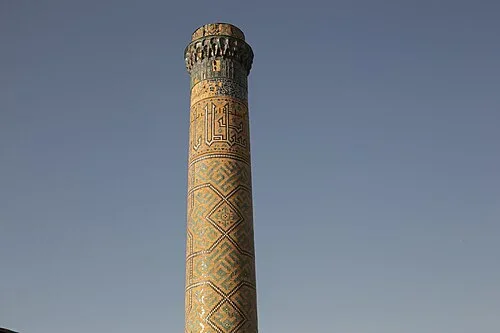 Courtyard Minaret and Dynastic Legacy
A Surviving Corner Minaret
This ribbed shaft is one of only two minarets left from the original four. They stood beside the portal. After the end of the seventeenth century, Samarkand fell into a long decline. The city lost its rank as capital to Bukhara, and the great Silk Road shifted away, leaving its monuments empty and forgotten. Timur's descendants in India did not forget. In 1621, under the Mughal emperor Jahangir, about thirty thousand rupees reached Samarkand for the shrine's upkeep. Five thousand of that was set aside for Timur's grave alone. Extensive restoration here began only after the Second World War, with the dome, portal and minarets renewed in the 1950s and the interior following in the 1970s. The tiled bands climbing this shaft are part of that careful modern conservation.
Listen in the appPhoto: AIDEPCUL · CC BY 4.0
09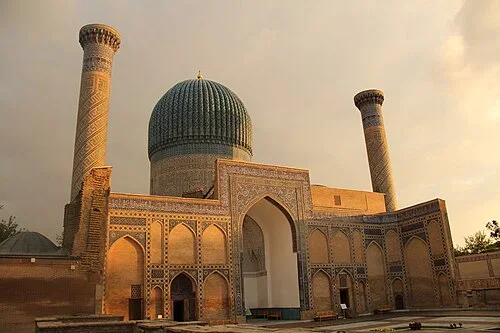 Courtyard Minaret and Dynastic Legacy
The Model for the Taj Mahal
What began as a grieving grandfather's monument to a lost heir became the dynastic vault of an empire. And its architectural idea travelled further than Timur's armies ever did. Architectural historians regard Gur-e-Amir as the direct forerunner of the great Mughal dynastic tombs: the Bagh-e-Babur in Kabul, Humayun's Tomb in Delhi, and the Taj Mahal in Agra. All were built by Timur's descendants, the Mughals, who carried Central Asian form into Indian culture. They adapted what stands here: the octagon rising to a square, the soaring ribbed dome, the deep recessed arches. A tomb raised in Samarkand for one young prince became the pattern the Mughals carried to India, and the whole place remains what its builders made it, the resting house of a dynasty.
Listen in the appPhoto: Игорь Улитин · CC BY-SA 4.0
Gur-e-Amir
Frequently asked questions
How much does the guide cost?
Free app download. Listed guide price: $0.99. Guide price shown in the app. Audio guide only. Venue admission is separate.
Can I listen without internet?
Yes. Download the guide’s audio, images, and maps in the app before your visit. Your downloaded content is then available offline.
Can I listen in my language?
This audio guide is available in 15 languages, including English.
Do I need to follow a schedule?
No. This is a self-guided experience. Choose your stops, pause whenever you like, and return to a story at your own pace.
At your own pace
Explore Gur-e-Amir.
Download Stanza, then search for “Gur-e-Amir”.
Free app download · Guide price shown in the app
Keep exploring
Nearby audio guides
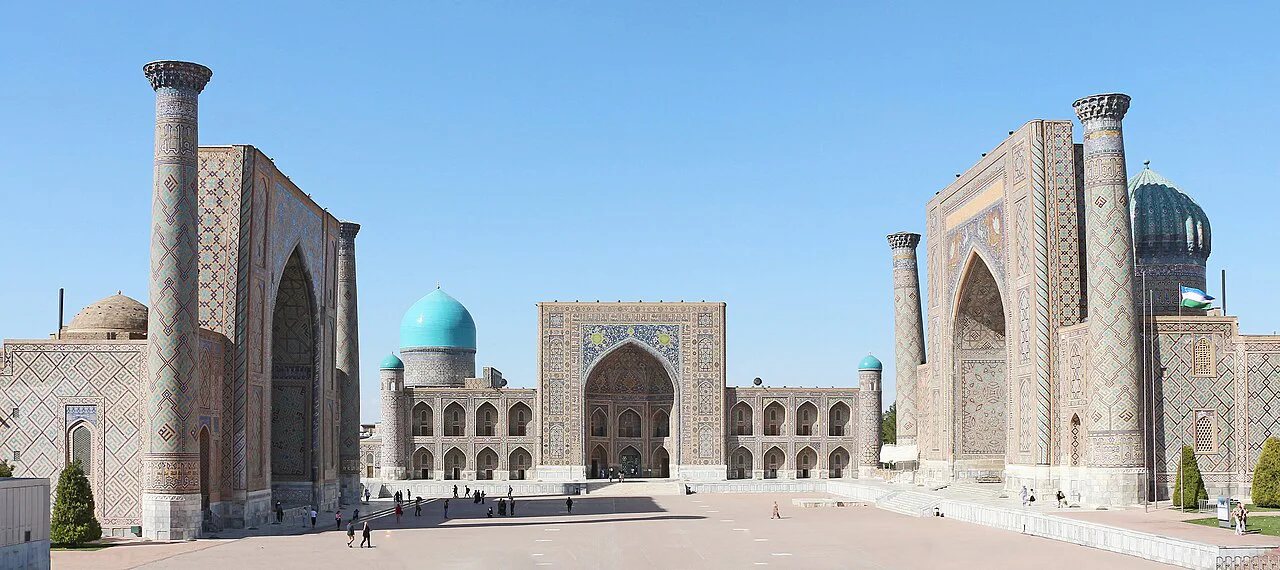
Samarkand · 1 km
Registan
Content & sources
Bernard Gagnon · CC0
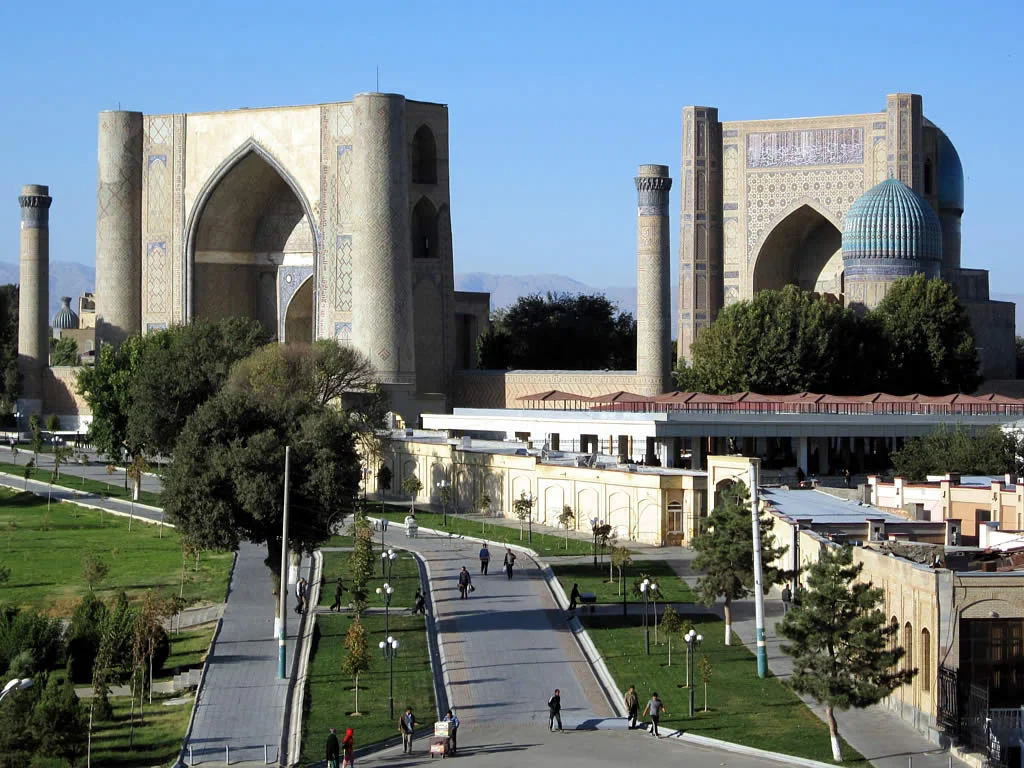
Samarkand · 2 km
Bibi-Khanym Mosque
Content & sources
David Stanley from Nanaimo, Canada · CC BY 2.0
Samarkand · 3 km
Afrasiyab
Content & sources
Unknown author · Public domain
Shahrisabz · 66 km
Ak-Saray Palace
Content & sources
Photo: Ymblanter · CC BY-SA 4.0