Stanza · Audio guide
Citadel of the Hồ Dynasty Audio Guide
A place to remember. A story to take with you.
The Citadel of the Hồ Dynasty is a 15th-century stone fortress located in Thanh Hóa province, Vietnam. It served as the western capital of the Hồ dynasty and was an important political, economic, and cultural…
Download Stanza, then search for “Citadel of the Hồ Dynasty”.
About the tour
One guide. Your kind of visit.
The Citadel of the Hồ Dynasty is a 15th-century stone fortress located in Thanh Hóa province, Vietnam. It served as the western capital of the Hồ dynasty and was an important political, economic, and cultural centre.
Ready when you are.
- 01Get the free Stanza app.
iOS & Android
- 02Find your guide.
“Citadel of the Hồ Dynasty”
- 03Download before you go.
Works offline
Audio guide / 9 narrated stops
Inside the guide
Get to know a few of the stories before you go. Open a stop to read more.
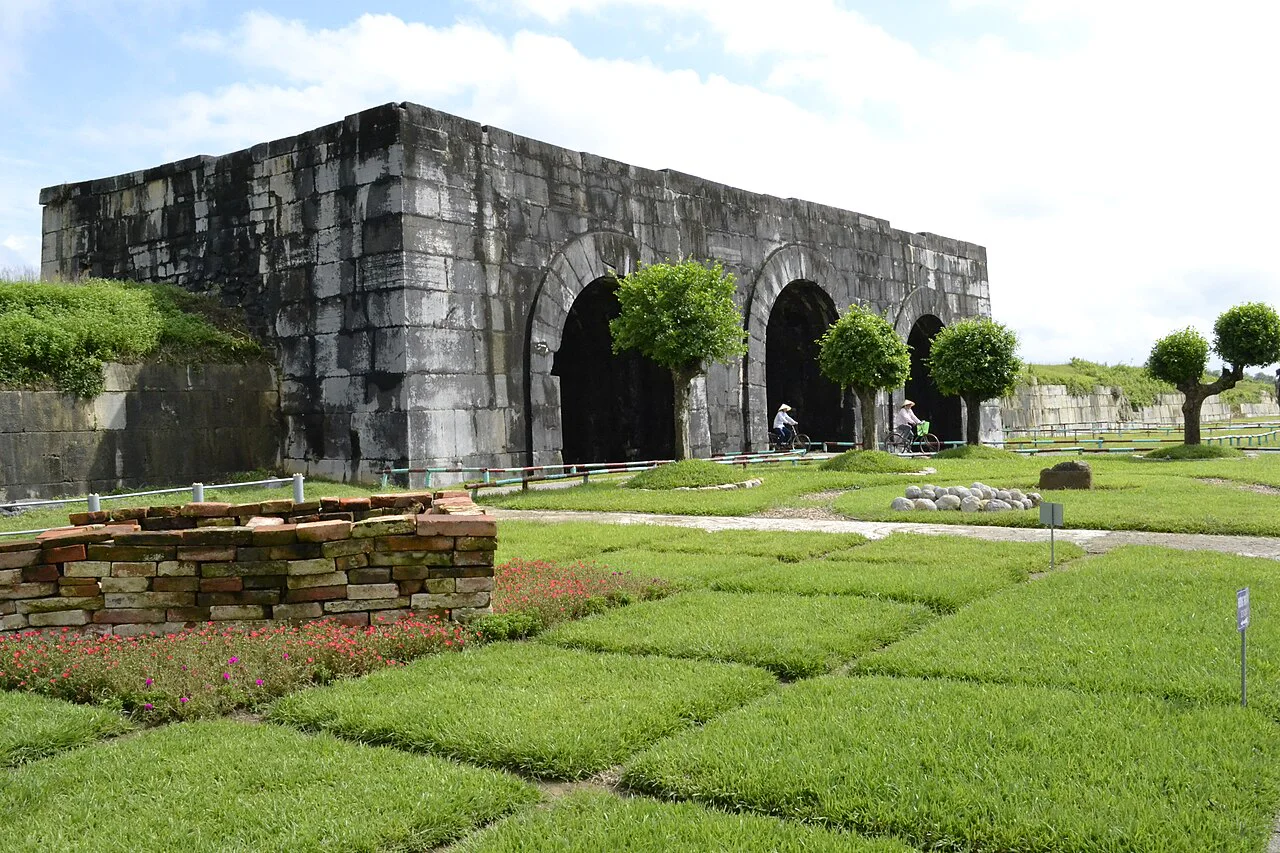
01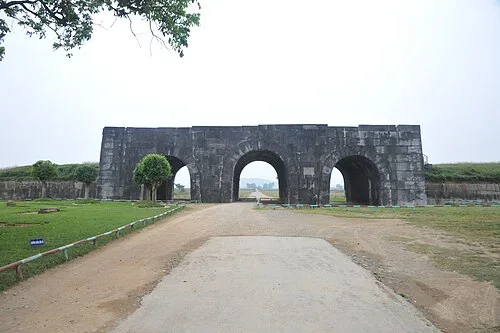 The South Gate (Cửa Nam)
Welcome to the Citadel of the Hồ Dynasty, the story of a capital raised in a single season. Three vaulted portals of grey limestone open onto grass and sky. This is the South Gate, the main entrance of Tây Đô, the Western Capital of Vietnam's short-lived Hồ dynasty. Work began here in 1397, ordered by Hồ Quý Ly, the most powerful man of the fading Trần court. He intended the new city to draw the royal court away from Thăng Long, to ground he controlled, while the threat of invasion from Ming China grew. The result was a fortified capital in Thanh Hóa province, laid out by the principles of feng shui, with mountains and rivers folded into the design of the city. These walls are the finest surviving part of the only large-scale stone fortress left in Vietnam. The south gate stands about nine and a half metres high. It is more than fifteen metres wide, with three passages, and the central one belonged to the emperor. In 2011 UNESCO inscribed the citadel on the World Heritage list, the fifth such site in the country.
Cổng Nam Thành Nhà Hồ · CC BY-SA 3.0
02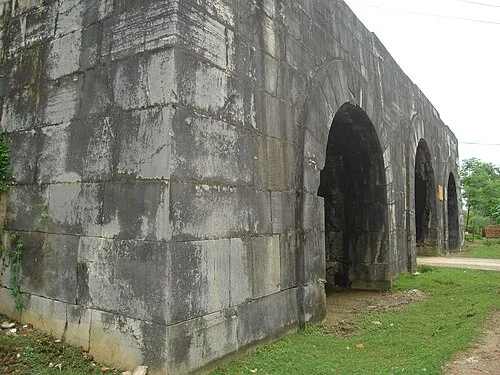 The South Gate (Cửa Nam)
South Gate Masonry Up Close
Not a drop of mortar holds these blocks together. The gate is dressed limestone, cut into squarish slabs and stacked so that each locks into its neighbours in an interlocking joint. The blocks weigh on average between ten and sixteen tons. The heaviest of them weighs over twenty-six tons. Fitted without any bonding material, the joints have held through more than six centuries of rain and monsoon. What makes the speed remarkable is the calendar. The main stone walls went up in about three months, from the first month to the third of 1397. A court minister named Đỗ Tỉnh organised and directed the whole undertaking. Thousands of hands must have shaped, hauled and set the stone. Only the gates and stretches of wall remain of what they built. The rest of the fortress, its palaces and its outer works, took longer to finish and has fared far worse.
vi:Thành viên:Silviculture · Public domain
03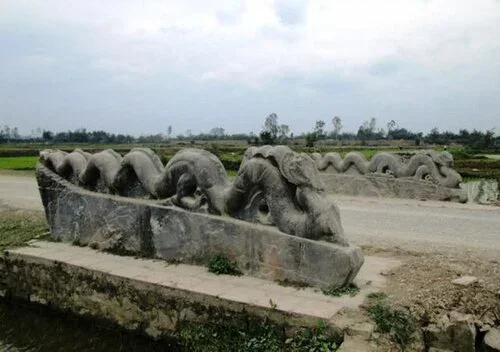 Central Palace Grounds and Royal Relics
The Royal Stone Dragons
Two carved stone dragons lie along the base of the main palace hall, and both have lost their heads. Each figure is just over three and a half metres long, coiling along a balustrade that once edged the steps of the imperial building. Above them stood the chính điện, the main hall where the Hồ emperors held court. Its timber and brick superstructure collapsed long ago, leaving only this stone footing. The dragons are the clearest sign of where the heart of the capital once beat. In 2026 archaeologists digging behind the pair made a striking find. Dozens of terracotta ornaments surfaced there, glazed with gold and shaped like Bodhi leaves, worked with dragon motifs. They are roughly six hundred years old. The discovery finally fixed the exact position of the main hall of the ancient citadel. How and when the dragons lost their heads, no account explains.
Listen in the appPhoto: Khoailangvietnam · CC BY-SA 4.0
04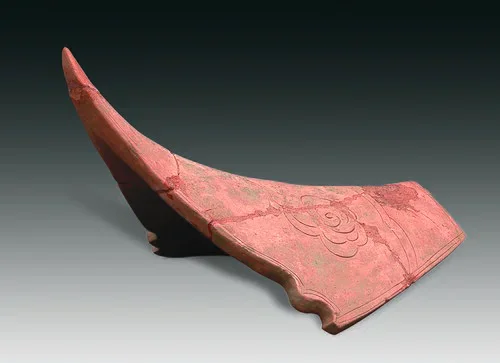 Central Palace Grounds and Royal Relics
Imperial Roof Tile (Đầu Đao)
The stone was only the base of the city. Above it rose brick walls and roofed palaces, and this curved tile with its faded painted surface is a fragment of that vanished skyline. It is a đầu đao, a decorated roof-corner tile, shaped like a blade sweeping up from the eaves. The brick storey has its own story. The court chronicle records that in 1401 the emperor Hán Thương ordered bricks fired in every province of the realm for the building works. An earlier attempt had failed: stone walls raised on their own had partly collapsed, so the builders rebuilt with stone below and brick above. The levy reached across the whole country. Bricks recovered from the walls carry inscriptions naming the villages and districts that supplied them. The count of contributing places stands at two hundred and ninety-four. A single roof tile, then, is the small visible end of an empire-wide effort.
Listen in the appPhoto: Nhi NV · CC BY-SA 3.0
05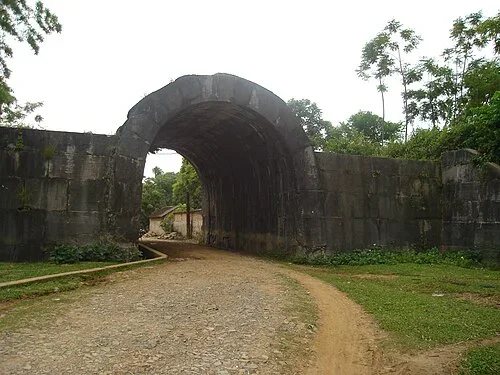 The Eastern and Northern Fortifications
The East Gate
A sorrowful legend belongs to the eastern wall. Tradition tells that a section of it collapsed again and again during construction, and the supervisor, Cống Sinh Trần Công Sỹ, was blamed. Suspected of treason, he was executed. His wife, Bình Khương, is said to have died by dashing her head against the stone in grief. The story comes down through the temple tradition, not through the court chronicles, and the details rest on what her cult has preserved. A temple to her stands close against the eastern wall, just outside this gate. Inside are votive tablets and stone steles raised in 1903, recording her story and her husband's. The gate itself is one of the citadel's four cardinal portals, this one the left gate of the city, a single deep stone vault through the wall. Whatever the truth of the legend, the gate has carried her name with it for centuries.
Listen in the appvi:Thành viên:Silviculture · Public domain
06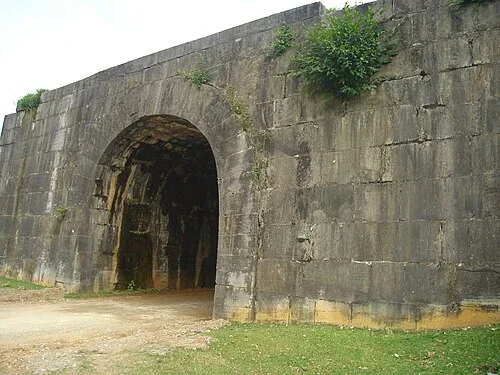 The Eastern and Northern Fortifications
The North Gate
This was the back gate of a capital built in fear of the north. The Hồ dynasty had scarcely finished its city when the invasion it dreaded arrived. Ming forces came in 1407, and the dynasty fell, barely a decade after work on Tây Đô began. The stone walls never had the chance to serve the long reign their builder imagined. Yet the place did not empty. Through the sixteenth, seventeenth and eighteenth centuries the citadel remained an important political, economic and cultural centre of the region. That long use is one reason the stone skeleton outlasted the palaces. The blocks of this gate show what six centuries of weather do to limestone. Their faces are worn and discoloured, and shrubs root in the joints near the top of the wall. The arch itself still stands full and round above the dark passage.
Listen in the appvi:Thành viên:Silviculture · Public domain
07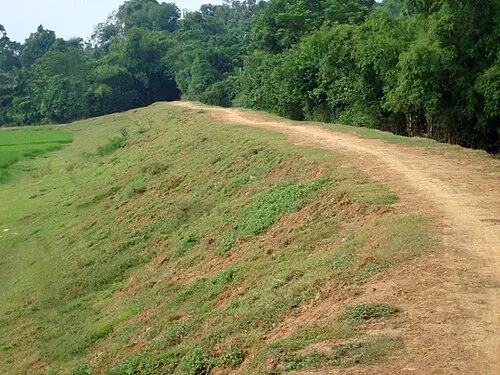 Outer Defenses and Military Arsenal
La Thanh Outer Rampart
Beyond the stone walls, the capital wore a second skin of earth and bamboo. This grassed embankment is part of the La Thanh, the outer wall that ringed Tây Đô well outside the citadel. The stone face of the inner walls hid packed earth within; here the earth itself was the defence. Hồ Quý Ly went further and made the landscape fight. The chronicle records his order to plant thorny bamboo along the rampart, from Đốn Sơn in the south to An Tôn in the north, and out to the Mã river. The spiny wall of living trees closed the ring around the capital. The same chronicle sets the penalty for stealing bamboo shoots at death. Long stretches of the La Thanh survive after six centuries, shaded by old bamboo groves. Local tradition traces those groves back to the fourteenth-century plantings.
Listen in the appLa thành · CC BY-SA 3.0
08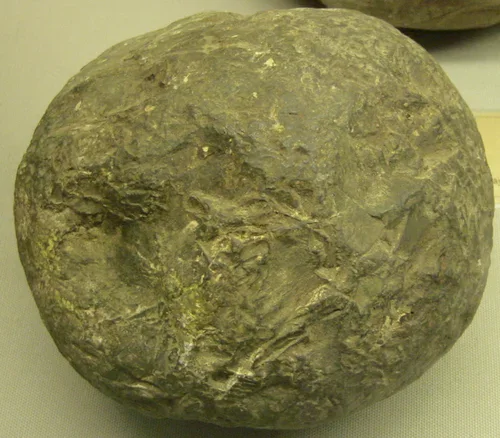 Outer Defenses and Military Arsenal
Stone Cannonball from Tây Đô
One carved stone ball says more about this city's purpose than any wall. It is a cannonball, found at the castle of Tây Đô, and it is physical evidence of the capital's defences, in an age when gunpowder artillery was new to the region. In the late fourteenth century, stone-shot cannon were an emerging technology across East and Southeast Asia. A capital raised against an expected invasion would have counted on such weapons, and its builders stocked for them. The ball itself is rough and heavy, a sphere of chipped stone the size of a skull. Who fired its fellows, and from which walls or towers, the finds do not say. It sits quietly as the arsenal's one surviving word.
Listen in the appPhoto: Binh Giang · Public domain
09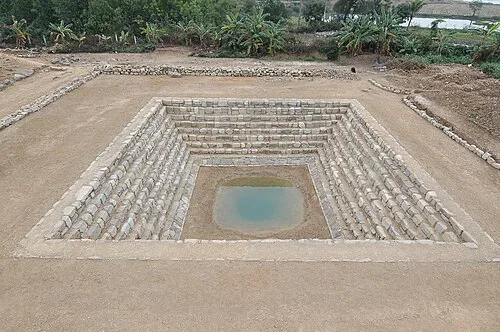 Nam Giao Imperial Altar and the King's Well
The King's Well at Nam Giao Altar
On the slopes of Mount Đốn Sơn, the capital's ritual heart still holds water. The Nam Giao altar was built here in 1402, as the court chronicle records, for the Giao sacrifice, the great rite an emperor performed to heaven and earth. The chronicle of the later Nguyễn court tells the scene: Hán Thương chose an auspicious day, mounted the Vân Long carriage, and went out through the South Gate of the citadel, with the hundred officials and the palace ladies following in order behind him. At the centre of the altar complex lies the King's Well, a square stone-lined shaft with stepped walls terracing down to the water. It is among the best-preserved structures in the whole complex, its stone courses still sharp-edged. The palaces are gone and the dynasty lasted barely seven years. The stone of Tây Đô, from its gates to this well, is what remains of the world its builders made.
Listen in the appGiếng Vua · CC BY-SA 3.0
Citadel of the Hồ Dynasty
Frequently asked questions
How much does the guide cost?
Free app download. Listed guide price: $0.99. Guide price shown in the app. Audio guide only. Venue admission is separate.
Can I listen without internet?
Yes. Download the guide’s audio, images, and maps in the app before your visit. Your downloaded content is then available offline.
Can I listen in my language?
This audio guide is available in 15 languages, including English.
Do I need to follow a schedule?
No. This is a self-guided experience. Choose your stops, pause whenever you like, and return to a story at your own pace.
At your own pace
Explore Citadel of the Hồ Dynasty.
Download Stanza, then search for “Citadel of the Hồ Dynasty”.
Free app download · Guide price shown in the app
Keep exploring
Audio guides — Vietnam
Hanoi · 109 km
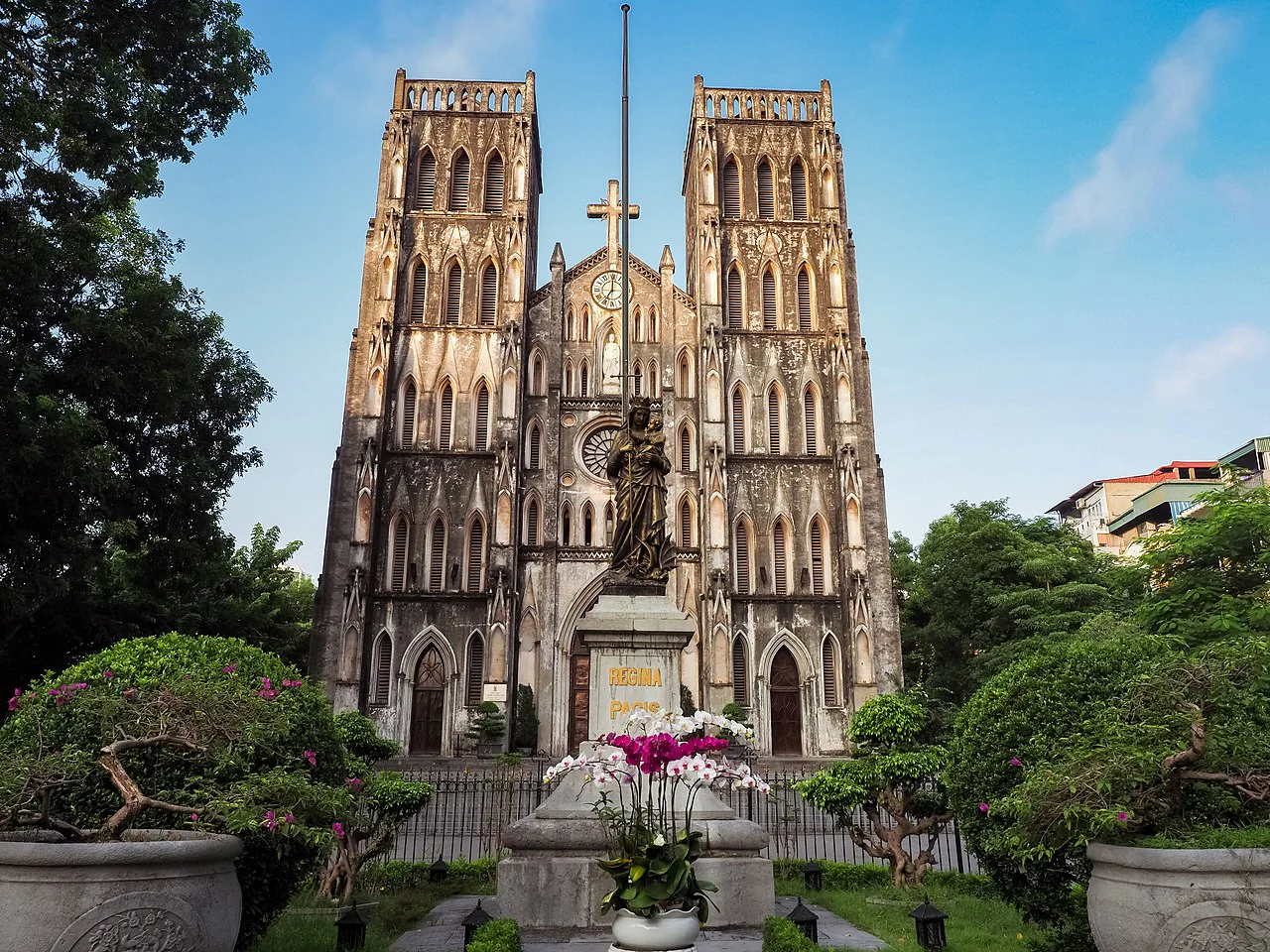
St. Joseph's Cathedral, Hanoi
Content & sources
John Ragai · CC BY 2.0
Hanoi · 109 km
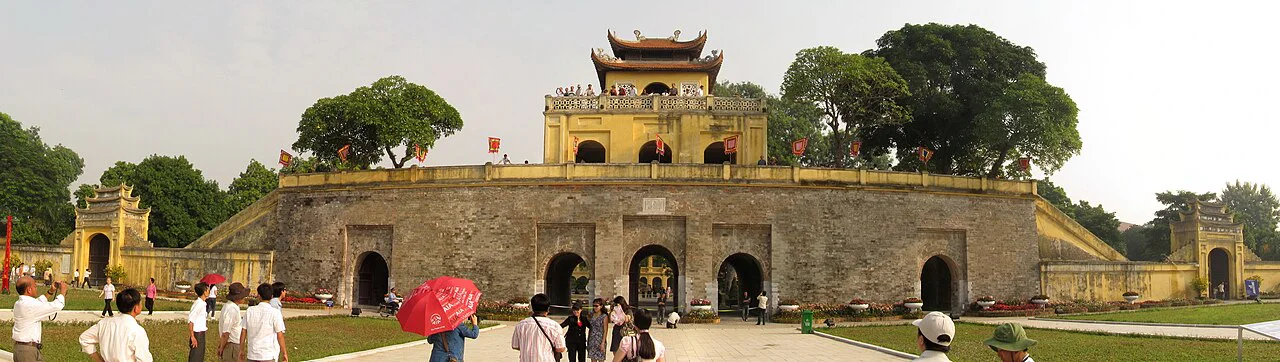
Imperial Citadel of Thăng Long
Content & sources
Photo: Grenouille vert · CC BY-SA 3.0
Hanoi · 109 km
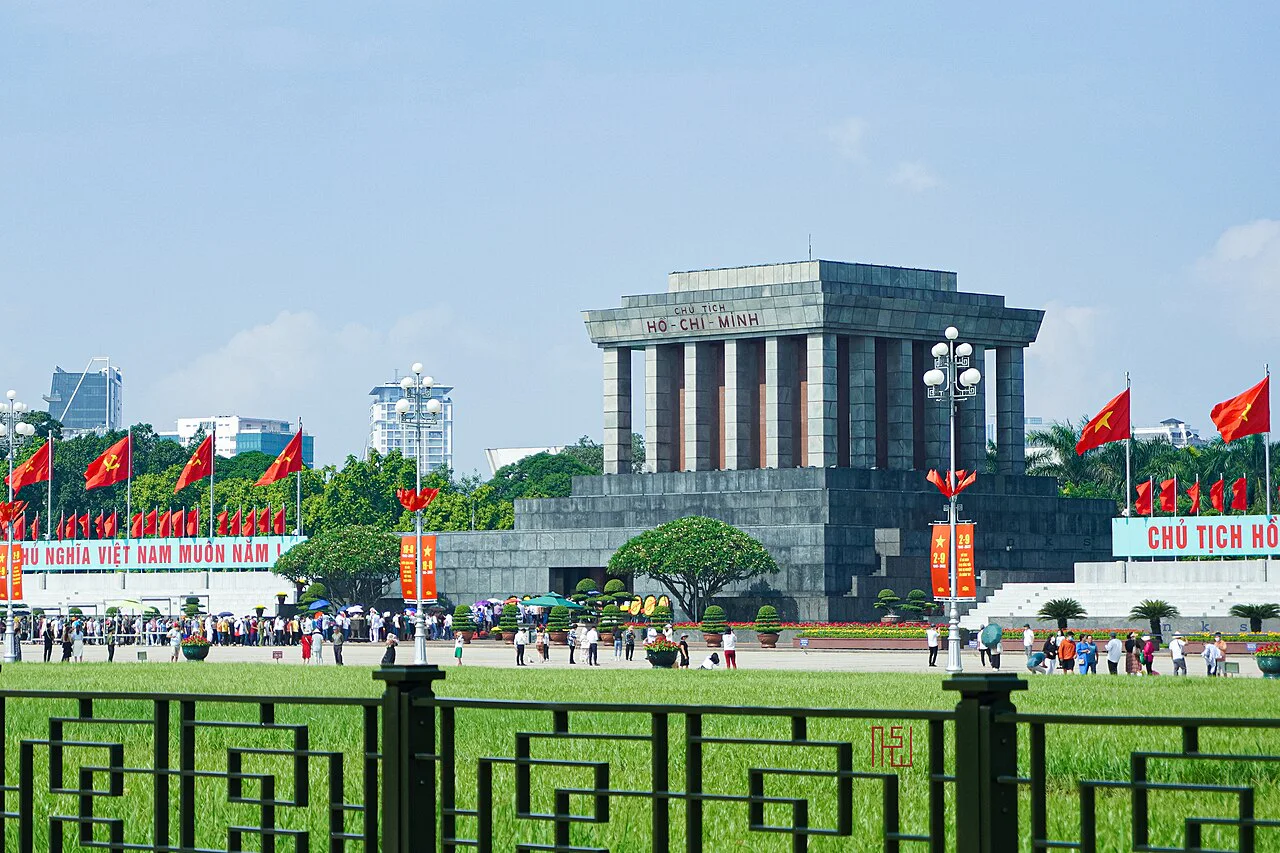
Ho Chi Minh Mausoleum
Content & sources
Photo: NKSTTSSHNVN · CC BY-SA 4.0
Huế
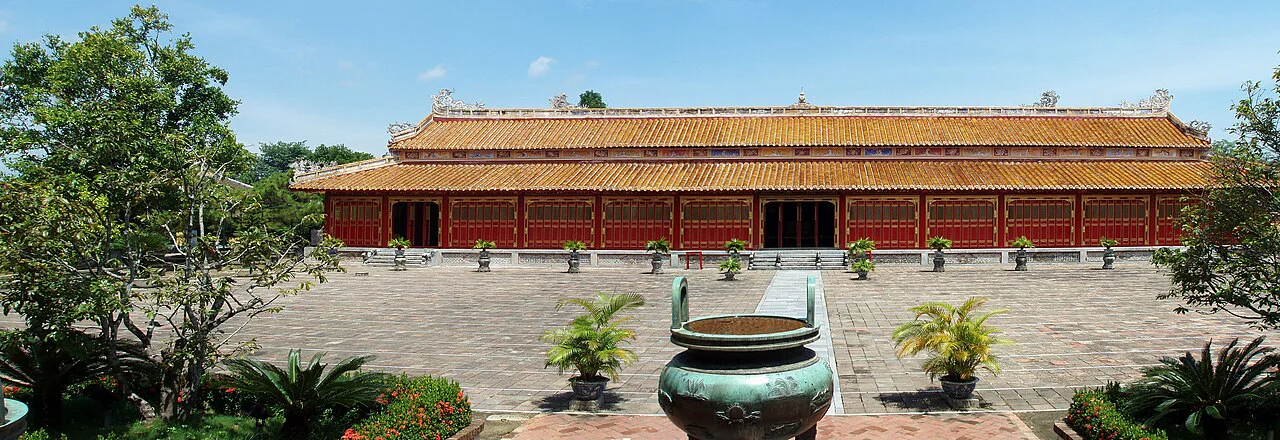
Imperial City of Huế
Content & sources
https://www.flickr.com/photos/sixty4coupe/ · CC BY-SA 2.0