Venue spotlights/Tomar, central Portugal
Tomar’s Convent of Christ: a route through eight centuries
A round sanctuary, an enlarged church and a monastery built for a different life: follow the changes rather than count the cloisters.
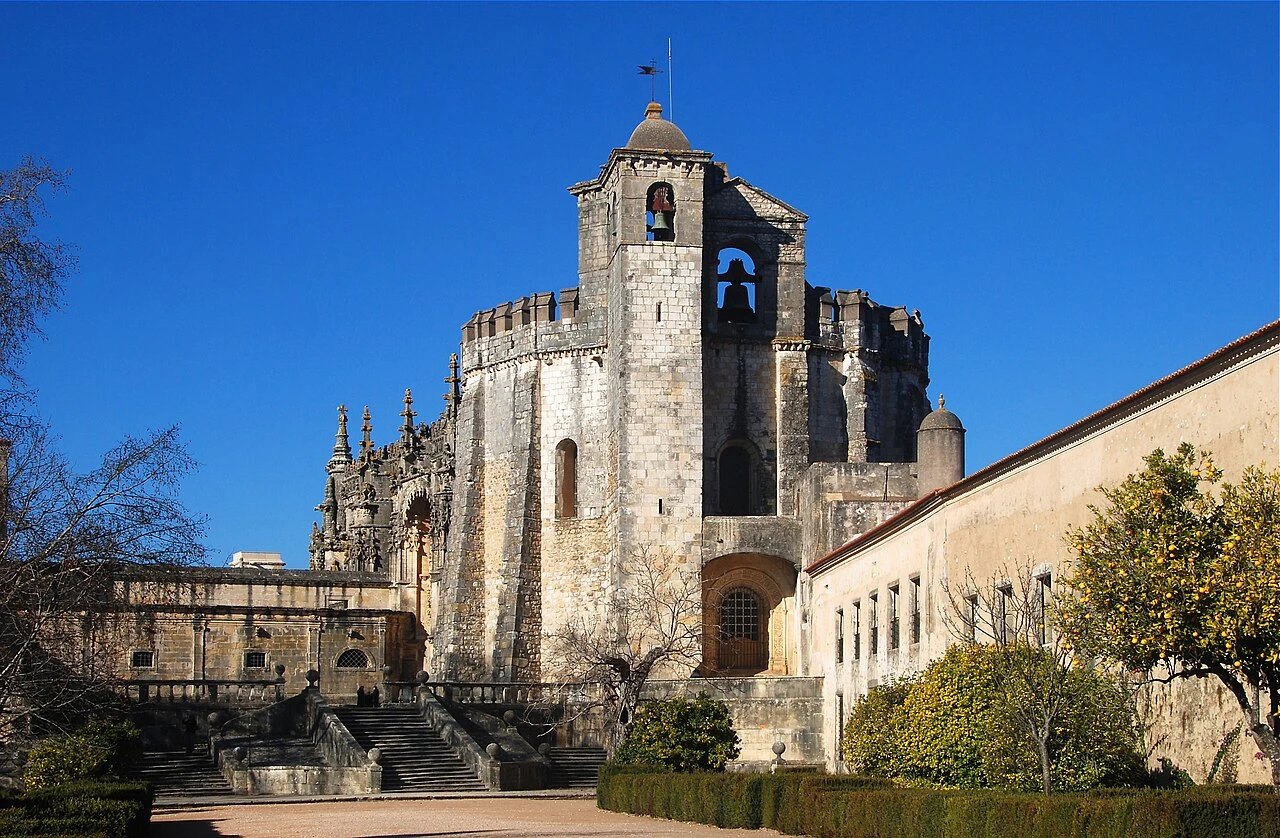
At Tomar, a change in the building’s shape can explain a change in the institution that used it. The complex began with a Templar castle in 1160; later communities enlarged the church and built spaces for enclosed monastic life. More than eight centuries later, conservation is another chapter. Visit for those relationships, not only the Chapter Window.
Arrive at the hill, not merely in Tomar
The convent stands above the town. Arriving at Tomar railway station is not arriving at its entrance: check CP for the actual outward and return train, then plan the uphill approach separately. Walking suits those comfortable with a climb; a taxi can reduce it. Confirm the drop-off and entry arrangements if mobility is a concern, rather than treating the entire complex as step-free.
The municipal tourism page currently marks the Templar castle temporarily closed, and the Sete Montes park page also carries a temporary closure notice. Do not build your access around a walk through the park or a castle-wall circuit. The convent reopened on 27 February 2026 after storm damage, according to the municipality, with restrictions possible. A reopened convent does not mean every adjoining space has reopened.
1. Find the medieval centre in the Charola
The Charola is the Templars’ round oratory, with an octagonal core and a passage around it. Where the current circuit allows, notice how your attention circles the centre rather than simply following a long nave. Its twelfth-century form is the useful starting point; the complex was inscribed by UNESCO in 1983.
The rich interior is not all twelfth-century decoration. Biblical paintings and gilded sculpture include important sixteenth-century work. Separate the age of the spatial form from the age of what covers it. The later wide opening into the church changes how the older sanctuary is approached: look for that junction rather than imagining an isolated medieval chapel.
2. Read the church extension before the window
The early-sixteenth-century campaign under Manuel I enlarged the liturgical space. Diogo de Arruda began work in 1510–1513, followed by João de Castilho in 1513–1515. Compare the round sanctuary with the more directional space added to it. An institution could retain its old sacred centre while changing the scale of worship.
The Chapter Window belongs to this enlargement, not the founding castle. Its carved density makes more sense after that comparison: royal ambition and the Order of Christ are expressed through architectural display. Ask staff for the currently permitted viewpoint; do not assume access through Santa Bárbara Cloister or to the room behind the window. A photograph online proves neither viewpoint is open today.
3. Let a cloister show the change in daily life
The fifteenth-century Cemetery and Washing cloisters belong to the phase associated with Prince Henry. The large sixteenth-century expansion under João III provided a different monastic setting. If the Main Cloister is accessible, compare its repeated classical arches and columns with the denser Manueline carving. Diogo de Torralva reshaped it in the later sixteenth century; Filipe Terzi completed the work.
A cloister is also circulation: sheltered edges link rooms, and repetition sets a pace for movement and reflection. You need not see every courtyard to understand that change. Follow the official circuit and substitute another open viewpoint if conservation blocks a section. Ask about the available view of the Main Cloister before making it the reason for buying a ticket.
Keep the visit within what the ticket actually offers
When checked, Museus e Monumentos de Portugal listed standard admission at €15; October–May hours 09:00–17:30, last entry 17:00, and June–September 09:00–18:30, last entry 18:00. Confirm your date and exceptions through the operator’s booking link. Its current notice says conservation work can condition or restrict spaces; this article does not promise a fixed room-by-room circuit.
Stanza’s independent Convent of Christ page lists 34 narrated stops and public previews. Listen before choosing, check language and price in the app, and download before arrival. Use only stops matching the open route. Audio does not include admission or access to closed rooms; official information, signs and independent reading are useful alternatives.
A few more questions before you go
Do I need to see every cloister to understand the convent?
No. The most useful comparison is between the round sanctuary, the later church and an accessible monastic courtyard. A shorter attentive visit can still explain the changing building; current closures should decide the physical route.
Sources & further reading
Visitor information checked .
Official operator, municipality, national tourism and UNESCO sources checked on 19 October 2026. Conservation restricts some spaces; municipal castle and park closure notices remain separate from the convent’s reopening. This is an interpretive sequence, not a verified all-access walking route. Confirm the open circuit, tickets and arrival arrangements before travelling.
- Museus e Monumentos de Portugal: official visitor information
- UNESCO: Convent of Christ in Tomar
- Tomar municipality: architectural features
- Municipal tourism: convent and castle notice
- Tomar municipality: February 2026 reopening
- Municipal tourism: Sete Montes park notice
- CP: current train planning
- VisitPortugal: access information
Questions or a correction? Let us know. Our content standards (English).