Stanza · Audio guide
Sanahin Monastery Audio Guide
A place to remember. A story to take with you.
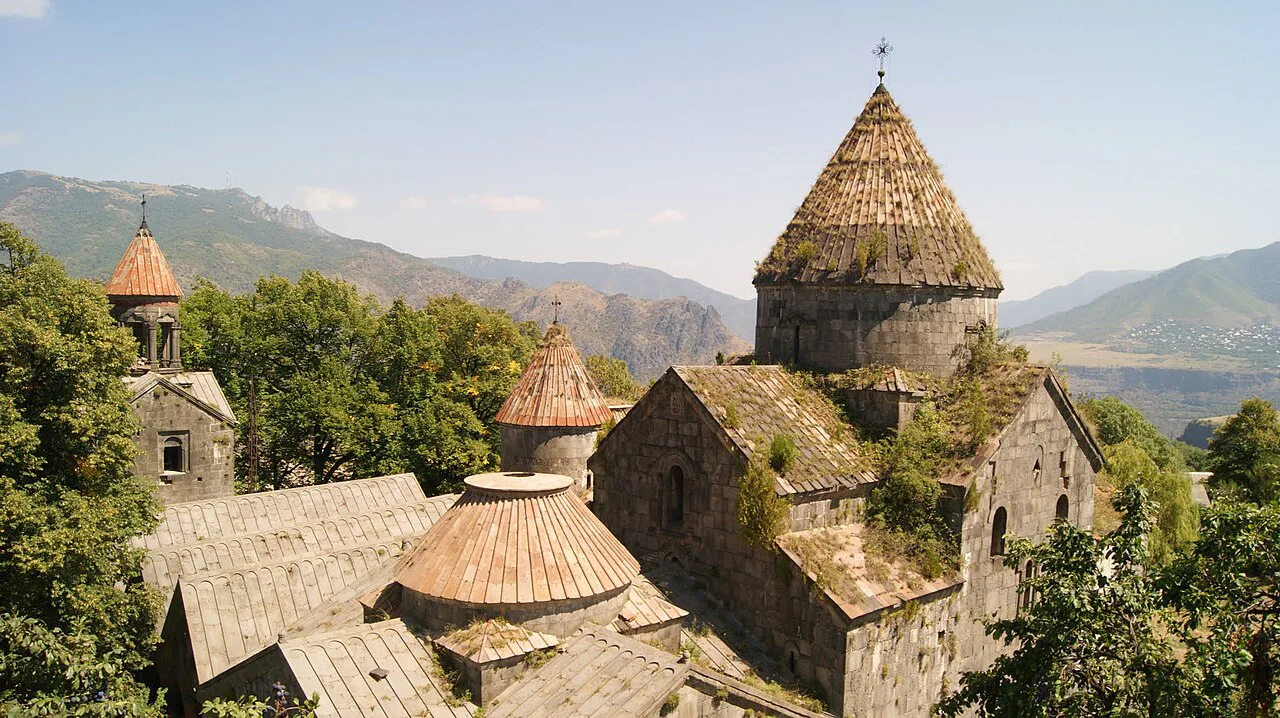
Sanahin Monastery is an Armenian monastery founded in the 10th century in Sanahin. It is a cultural heritage monument of Armenia.
Download Stanza, then search for “Sanahin Monastery”.
About the tour
One guide. Your kind of visit.
Sanahin Monastery is an Armenian monastery founded in the 10th century in Sanahin. It is a cultural heritage monument of Armenia.
Ready when you are.
- 01Get the free Stanza app.
iOS & Android
- 02Find your guide.
“Sanahin Monastery”
- 03Download before you go.
Works offline
Audio guide / 10 narrated stops
Inside the guide
Get to know a few of the stories before you go. Open a stop to read more.
01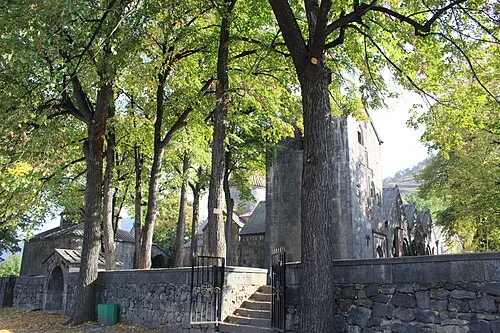 Main Gate and Outer Courtyard
Monastery Gate and Courtyard
Welcome to Sanahin, a monastery founded in the tenth century in the mountains of Lori, in northern Armenia. The name itself is a boast. In Armenian it translates as 'this one is older than that one', a claim of seniority over the monastery of Haghpat, which sits about three kilometres to the east. The two monasteries lie in plain sight of each other across a deep gorge cut by a small river, and today they share a single UNESCO World Heritage listing. Everything here is built of local light-grey polished basalt, cut smooth enough to catch the light. Over roughly three centuries, from the tenth to the thirteenth, generation after generation added churches, porches, a school, a library and tombs, each new building fitted around the old ones.
Photo: Soghomon Matevosyan · CC BY-SA 4.0
02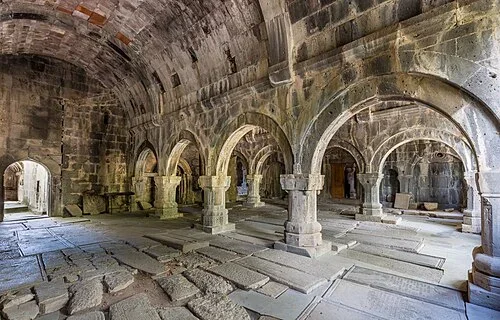 Gavit of Saint Astvatsatsin
Gavit of Surb Astvatsatsin
This vaulted hall is the gavit, the vestibule of the Holy Mother of God church. In Armenian monasteries a gavit did many jobs at once: a narthex where worshippers gathered, a meeting hall, a teaching space, and often a burial ground. Princes competed to add one to a church, because it announced their patronage to everyone who entered. This one went up in 1211, by order of Prince Vache Vachutyan, and an inscription on the south wall still records his name. Two massive arched columns divide the space into three equal naves, a layout that has no exact parallel in Armenian architecture. The floor is paved with old tombstones, so the dead quite literally lie underfoot as visitors pass through. Light falls through the wide arched openings of the western wall, three pairs of them, once the main entrances.
Diego Delso · CC BY-SA 4.0
03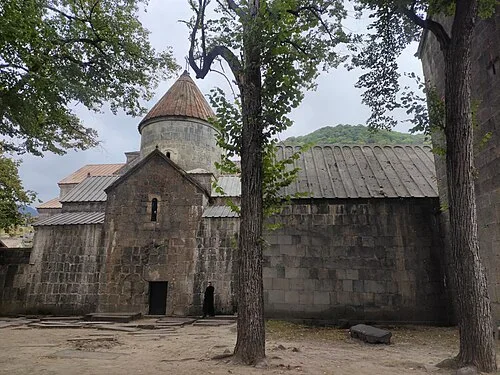 Saint Astvatsatsin Church
Surb Astvatsatsin Church
The little church with the conical roof is the Holy Mother of God, the oldest building in the complex. It went up in the 930s and 940s, under King Abas the First of the Bagratuni line, and everything else here grew around it. In 979 a decree of King Smbat the Second made Sanahin the seat of a bishop, and its importance followed from that. The dome drum was originally many-sided; a later renovation turned it into a cylinder and crowned it with the plain cone visible today. Traces of frescoes still cling to the walls inside. The builders left a legend here. A father and son worked together, the father raising the walls, the son cutting the stones. The son died before the work was done, and the father walked away without ever dismantling the scaffolding. Much later, the story goes, the father told the secret of taking the scaffolding apart to a man from the village of Shnogh, who came here, did the job and earned a pile of money for it.
Listen in the appPhoto: Soghomon Matevosyan · CC BY-SA 4.0
04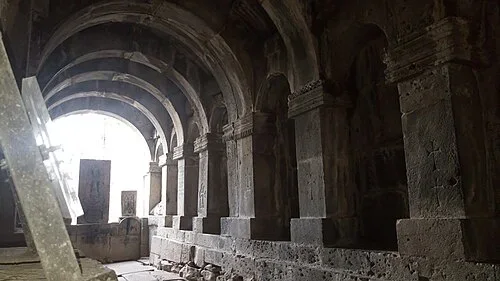 Academy of Gregory Magistros
Academy of Grigor Magistros
This long vaulted corridor between the two main churches was once the monastery's lecture hall. Builders raised it in the first half of the eleventh century, though its exact date is unknown. By tradition, Grigor Magistros Pahlavuni, a scholar of great fame, taught here, with students seated on stone benches lined along both sides. The seminary took his name. The curriculum went far beyond theology: philosophy, rhetoric, music, medicine, even the making of calendars. Scholarly monks such as Anania Sanahnetsi and Hakobos Karapnetsi studied, taught and wrote their works here. Under one abbot the school grew into a large educational centre, drawing clergymen and writers from across the region. A monastery that taught medicine and astronomy was rare anywhere in the medieval world, and this corridor was where it happened.
Listen in the appPhoto: Dav Sargsyan · CC BY-SA 4.0
05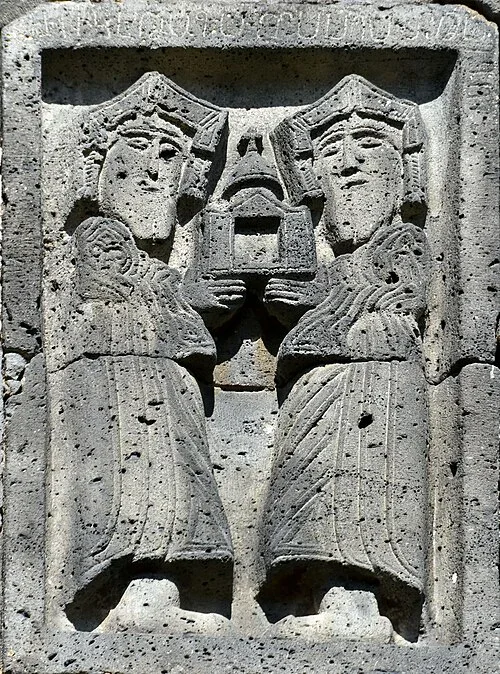 Saint Amenaprkich Church and the Founders' Relief
Founders' Relief of Smbat and Gurgen
High on the east facade of the Holy Saviour church, just under the cornice, two crowned figures stand facing each other, holding a model of a church between them. Their names are carved along the top of the frame: Smbat and Gurgen, the sons of Queen Khosrovanuysh. She built this church in 966, as wife of King Ashot the Third, and her sons went on to found the monastery's congregation and school. The brothers then ruled apart from each other. Gurgen founded and headed the Kyurikian kingdom, while Smbat reigned in Ani with the title 'Master of the Universe'. Holding the model of the church was the medieval way of saying: we paid for this. The carving became a landmark in Armenian art, a precedent that donor portraits at Haghpat, Ani and elsewhere followed for centuries.
Listen in the appjacgroumo · CC BY 2.5
06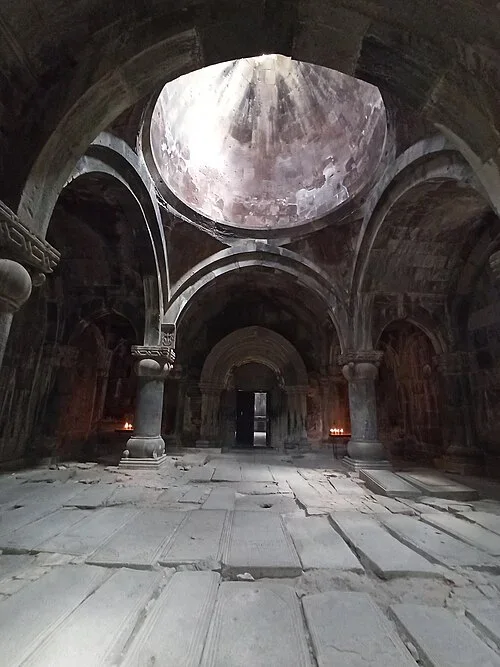 Gavit of Saint Amenaprkich
Gavit of Surb Amenaprkich
This spacious hall is the gavit of the Holy Saviour church, built in 1181 by the Kyurikian family. Abbot Yovhannēs raised the structure and left a dedicatory inscription recording the work. Four thick columns stand at its centre, linked by arches to the walls, and the central square above them is crowned with a low dome. The columns carry woven ornaments and carved capitals, including symbolic animal heads worked into the stone. An inscription here preserves something precious: the name of the architect, Zhamhayr. Medieval builders are usually anonymous, so a recorded name is rare. An earlier shared vestibule of the two churches, dating from the tenth century, probably stood here before and was demolished to make way for this grander hall. The monastery kept outgrowing itself.
Listen in the appPhoto: VardanMn · CC BY-SA 4.0
07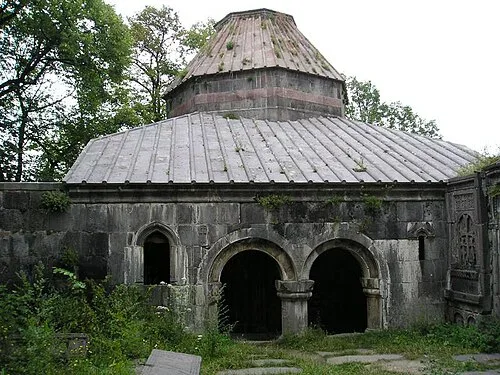 The Library and Scriptorium
The Library (Matenadaran)
This stone hall with the octagonal drum is the monastery's library, the oldest library building in Armenia and the largest of its kind. It was built in 1063 on the initiative of Father Dioscoros Sanahnetsi, with the support of Queen Hranush, daughter of David Anhoghin. Deep niches opened into the walls, crowned with arched tops; these were the vaults where books and precious relics were stored. Because the temple's treasures were kept here alongside the manuscripts, the building was also called Nshkharatun, the repository of treasures. The writing art flourished here for centuries. A monk named Stephanos, a polisher of paper, prepared two thousand quires, enough for about a hundred manuscripts of middle size. Thirty-five manuscripts written at Sanahin survive today, kept in the Matenadaran in Yerevan.
Listen in the appPhoto: Numerius Negidius · Public domain
08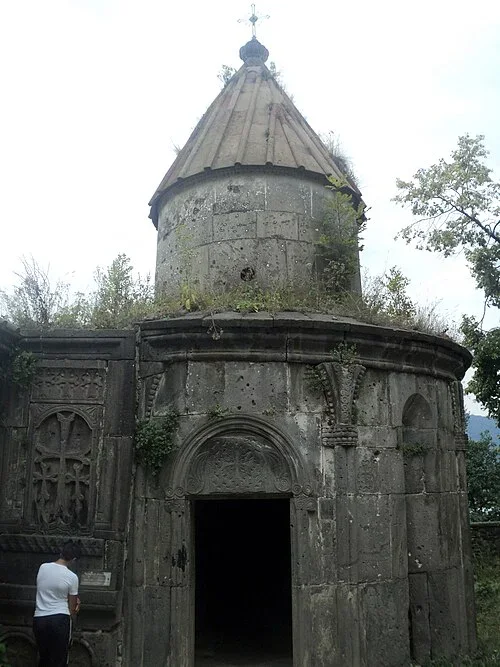 Saint Gregory Chapel and the Bell Tower
St. Gregory Chapel
This small round chapel is St Gregory's, built in 1061 by Queen Hranush, the same patron who backed the library. It is circular outside and cruciform inside, with a central dome surrounded by four altars. An earthquake destroyed the original dome; in 1652 it was rebuilt, and the upper walls changed the chapel's first appearance. The story goes that one window here had sight of Kayan Fortress. When lookouts there saw invaders coming, they raised smoke signals, giving the monks time to hide their manuscripts before raiders arrived. Whether the line of sight truly worked, no one can now prove; it is a tale the monastery tells about itself. Nearby stands the monastery's bell tower, a three-storey tower of the early thirteenth century that called the monks and students to their hours. Its builders closed out the great campaign of construction that had run for three centuries.
Listen in the appPhoto: Armineaghayan · CC BY-SA 3.0
09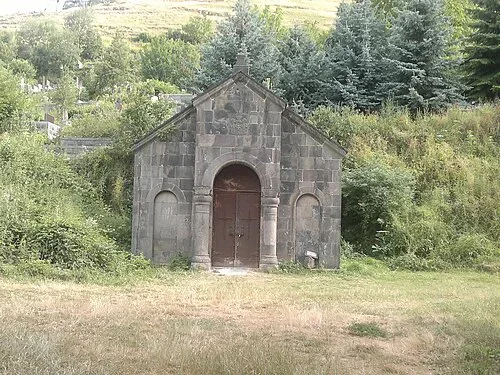 Zakaryan Family Tomb
Tomb of the Zakaryans
Seljuk invasions in the second half of the eleventh century, and the fall of the Kyurikian kingdom in 1113, brought Sanahin a bad period; the monastery faded from the life of the country. Recovery came at the end of the twelfth century, when the lands passed to the Zakaryan princes of Tashirk, and Sanahin regained its religious and cultural role. A wave of large-scale building followed, including vestibules, the bell tower and the library's outer hall. This tomb belonged to that family. The brothers Ivane and Zakare built its western part in 1189 over the graves of their grandfather Vahram and their father Sargis; the older eastern part, from the late tenth or early eleventh century, carries three small chapels on its roof. An inscribed cross-stone also stands in their father's memory. The Zakaryan house ruled long enough to shape the region, until Mongol invasions from the 1230s interrupted the monastery's life once more.
Listen in the appArman musikyan · CC BY-SA 3.0
10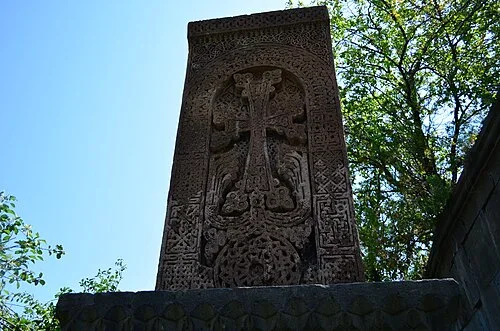 Tootevordi Khachkar
Khachkar of Grigor Tuteordi
This carved cross-stone, a khachkar, was raised in 1184 by the master carver Mkhitar Kazmich. It commemorates Grigor Tuteordi, whose name means 'son of Tute', and it is the most famous of about fifty khachkars preserved around the monastery, prized for both its history and its carving. The lacework around the cross is cut deep, each pattern distinct, against the open sky. Across the whole complex, about 190 inscriptions from the tenth to the nineteenth centuries survive, on walls, khachkars and tombstones. Nineteen record construction work; the rest carry royal proclamations, prayers, memoirs and notes on donations. Every generation here left its record in stone, so the monastery itself reads as a written archive of faith and learning, from the tenth century to the nineteenth.
Listen in the appPhoto: Sonashen · CC BY-SA 3.0
Sanahin Monastery
Frequently asked questions
How much does the guide cost?
Free app download. Listed guide price: $0.99. Guide price shown in the app. Audio guide only. Venue admission is separate.
Can I listen without internet?
Yes. Download the guide’s audio, images, and maps in the app before your visit. Your downloaded content is then available offline.
Can I listen in my language?
This audio guide is available in 15 languages, including English.
Do I need to follow a schedule?
No. This is a self-guided experience. Choose your stops, pause whenever you like, and return to a story at your own pace.
At your own pace
Explore Sanahin Monastery.
Download Stanza, then search for “Sanahin Monastery”.
Free app download · Guide price shown in the app
Keep exploring
Nearby audio guides
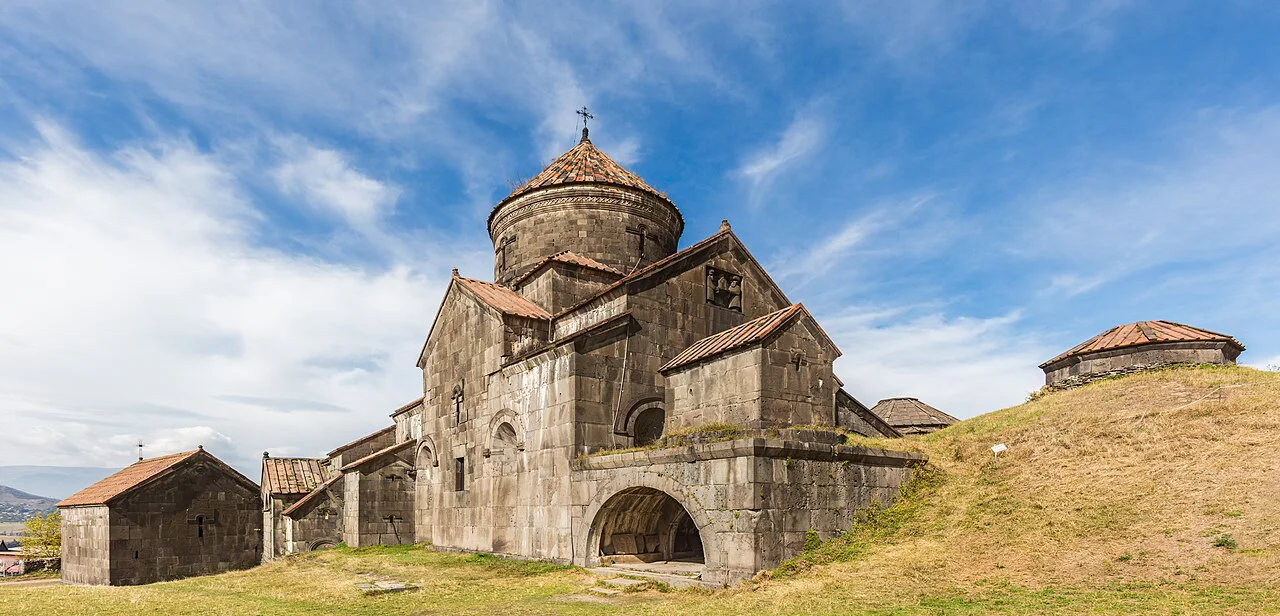
Haghpat · 4 km
Haghpat Monastery
Content & sources
Diego Delso · CC BY-SA 4.0
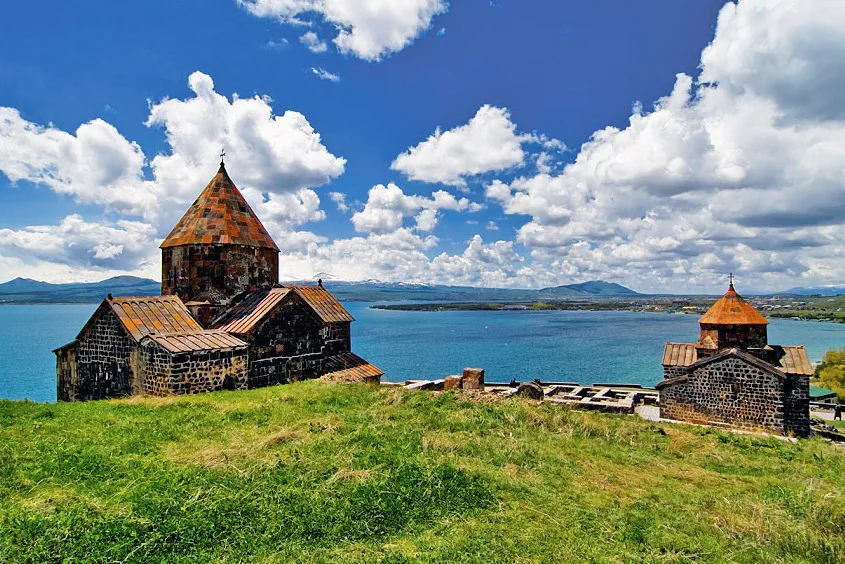
Sevan · 65 km
Sevanavank
Content & sources
Vigen Hakhverdyan · CC BY-SA 3.0
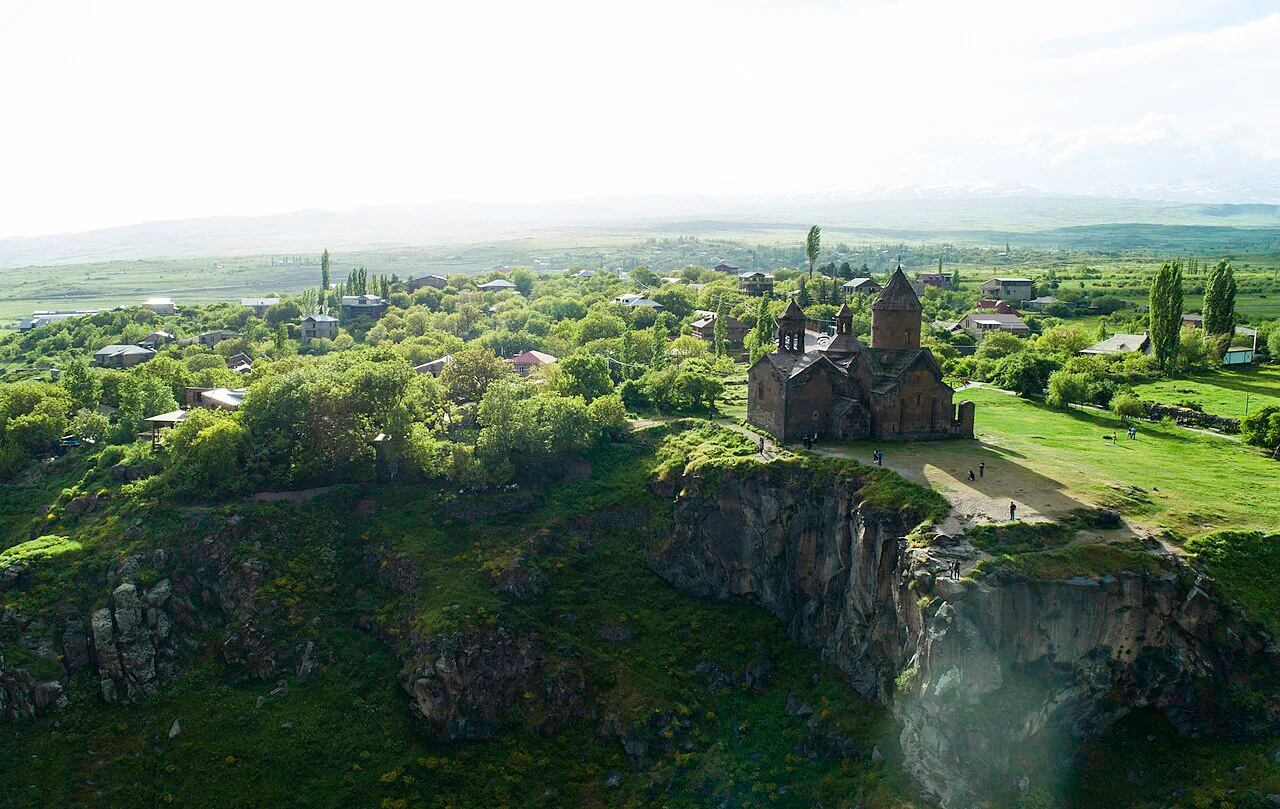
Artashavan · 82 km
Saghmosavank
Content & sources
Vahagn Grigoryan · CC BY-SA 4.0
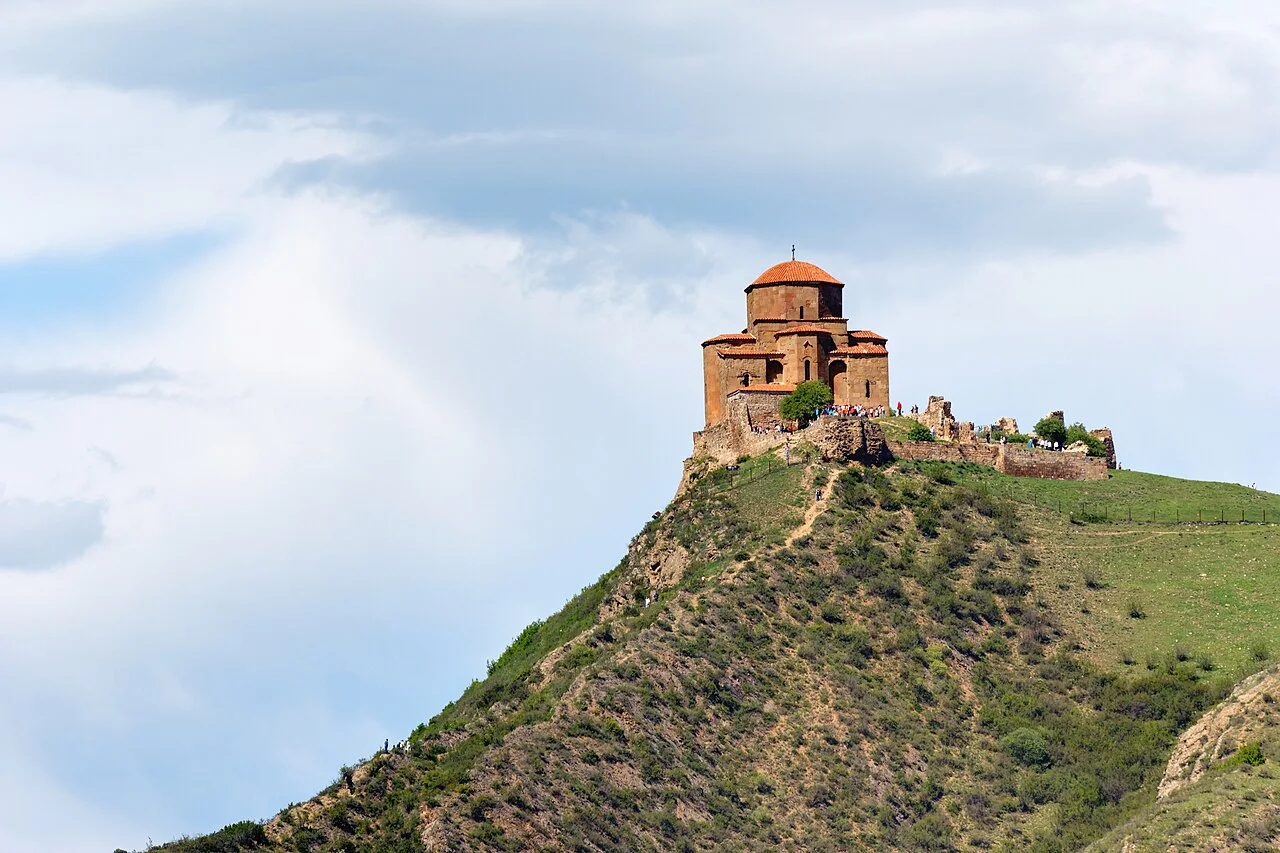
Mtskheta Municipality · 84 km
Jvari Monastery
Content & sources
Photo: Alexxx1979 · CC BY-SA 4.0