Stanza · Audio guide
Kathedraal van Sint-Michiel en Sint-Goedele Audio Guide
A place to remember. A story to take with you.
The Cathedral of St. Michael and St. Gudula is a medieval Catholic cathedral located in central Brussels. It is dedicated to the patron saints of the city and serves as a major example of Brabantine Gothic…
Download Stanza, then search for “Kathedraal van Sint-Michiel en Sint-Goedele”.
About the tour
One guide. Your kind of visit.
The Cathedral of St. Michael and St. Gudula is a medieval Catholic cathedral located in central Brussels. It is dedicated to the patron saints of the city and serves as a major example of Brabantine Gothic architecture.
Ready when you are.
- 01Get the free Stanza app.
iOS & Android
- 02Find your guide.
“Kathedraal van Sint-Michiel en Sint-Goedele”
- 03Download before you go.
Works offline
Audio guide / 13 narrated stops
Inside the guide
Get to know a few of the stories before you go. Open a stop to read more.
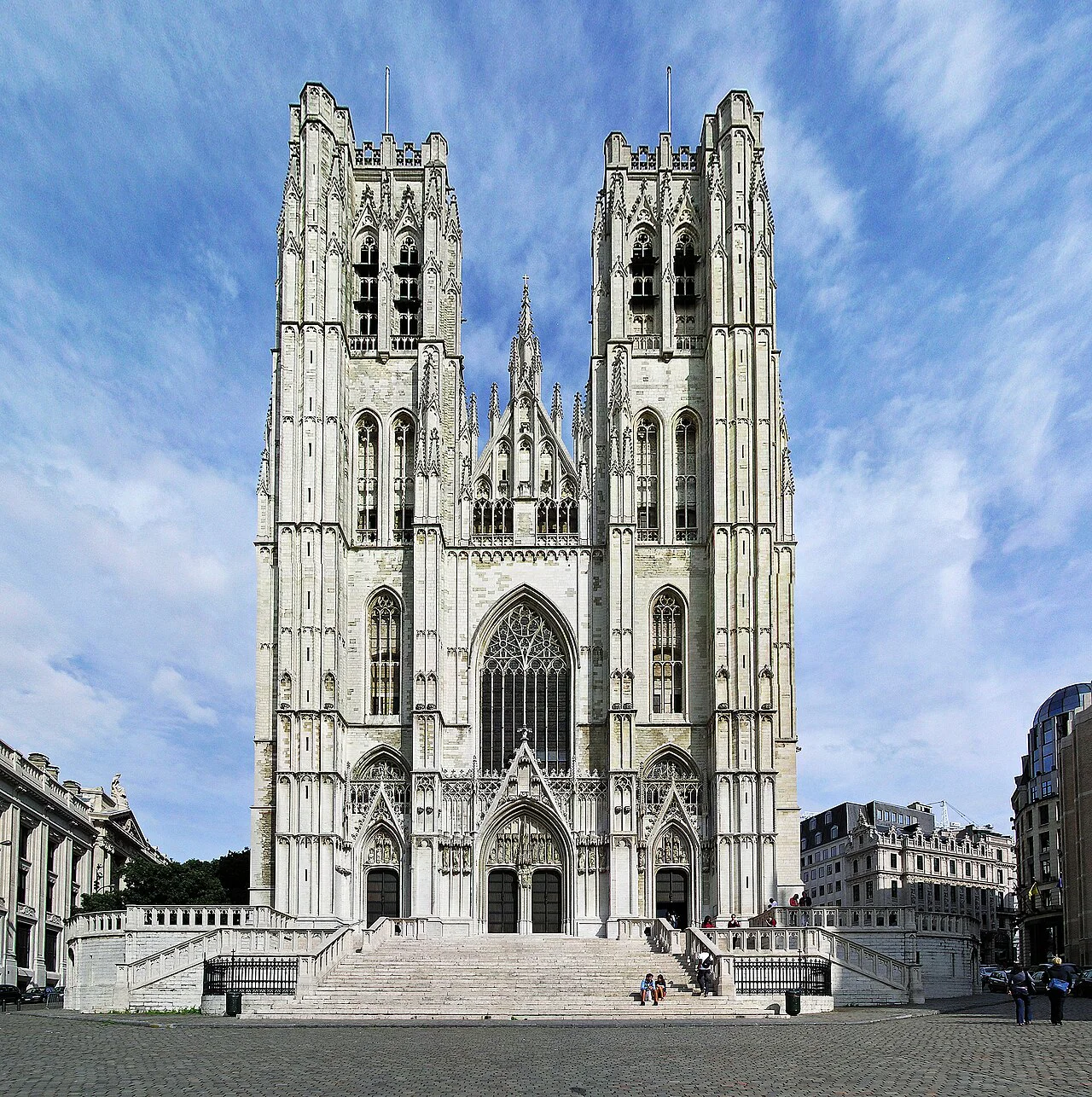
01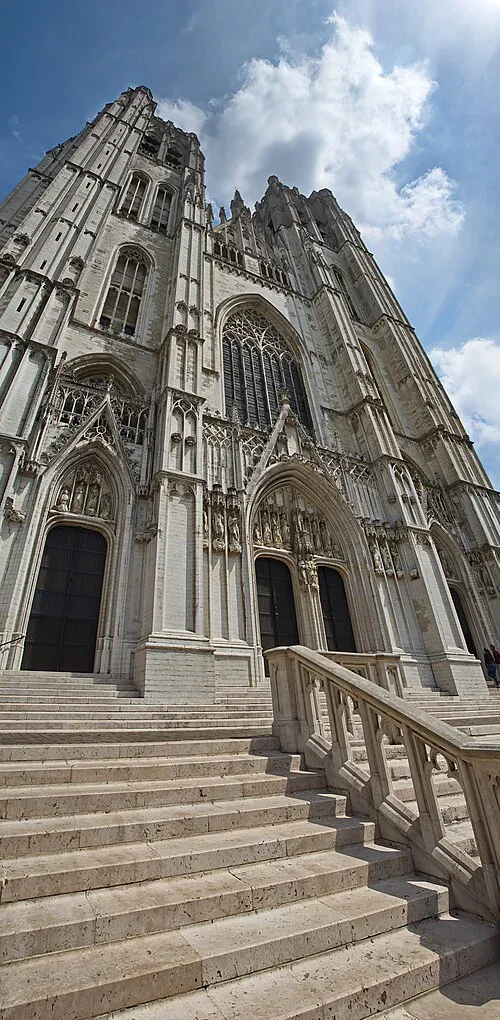 Monumental Staircase and Western Façade
 with Twin Towers
Welcome to the cathedral of Saint Michael and Saint Gudula, the great medieval church of Brussels. Its two towers rise about sixty-four metres above the façade, flat-topped and without spires. They are attributed to Jan Van Ruysbroeck, court architect to Duke Philip the Good, who also built the town hall tower. The towers were probably meant to reach much higher, closer to the spire of the town hall. Whether they were left unfinished or deliberately cut short, nobody can say for certain. The church itself took nearly three centuries to build. Duke Henry II of Brabant started the Gothic rebuilding in 1226, and the main structure was completed just before Emperor Charles V took the throne in 1519. The broad staircase leading up was designed by Pieter Paul Merckx and placed here in the early seventeen hundreds, a gift from the city. Michael and Gudula, the two saints honoured here, are also the patron saints of Brussels itself. And high on the northern tower, a pair of peregrine falcons has nested in recent years, watched around the clock by cameras.
Uwe Brodrecht · CC BY-SA 2.0
02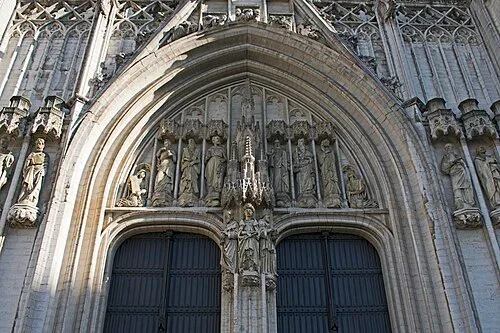 Monumental Staircase and Western Façade
Central Portal of the Western Façade
Three portals open in the western façade, in the French Gothic manner, framed by gables and deep arches. Sculpted figures fill the arches and the tympanum above the central door, greeting everyone who enters. The whole façade follows the French scheme of three portals and twin towers, but it trades the usual rose window for one great pointed window. The deeper story begins long before this stonework. In 1047, Count Lambert II of Leuven and his wife Oda founded a chapter of clergy in the church that stood here. That same year, they had the relics of Saint Gudula, a local martyr, brought here from another Brussels church. Her presence gave the building the dedication it still carries, alongside Saint Michael, whose statue once stood slaying a dragon above the entrance. So the name on the door, so to speak, is some four centuries older than the door itself.
Photo: Ymblanter · CC BY-SA 4.0
03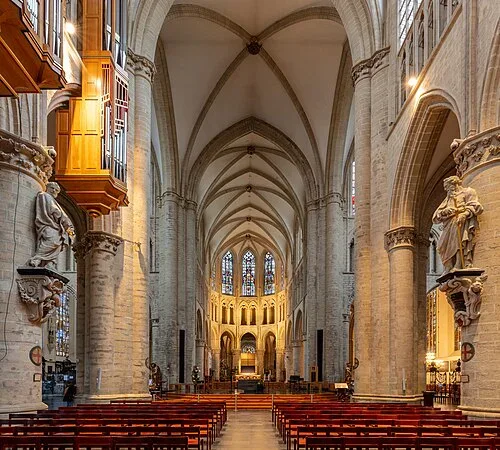 The Central Nave and Apostle Pillars
The Central Nave
Step inside, and the nave opens into one of the largest Gothic interiors in the Low Countries. This is Brabantine Gothic at its most typical. Four-part vaults rise overhead at a moderate height, and sturdy round columns carry them. Each column is crowned with a capital carved in the shape of cabbage leaves, the signature detail of this style. The effect is bright and airy rather than dark and heavy. The stone came from the Gobertange quarry, roughly forty-five kilometres away in what is now Walloon Brabant. Remember that this church grew over about three hundred years. The nave and the transept, the arms of the cross-shaped plan, belong to its later medieval phases, the fourteenth to the sixteenth centuries. So the interior is not one moment of building but the layered result of generations of masons working in the same manner.
Listen in the appDiego Delso · CC BY-SA 4.0
04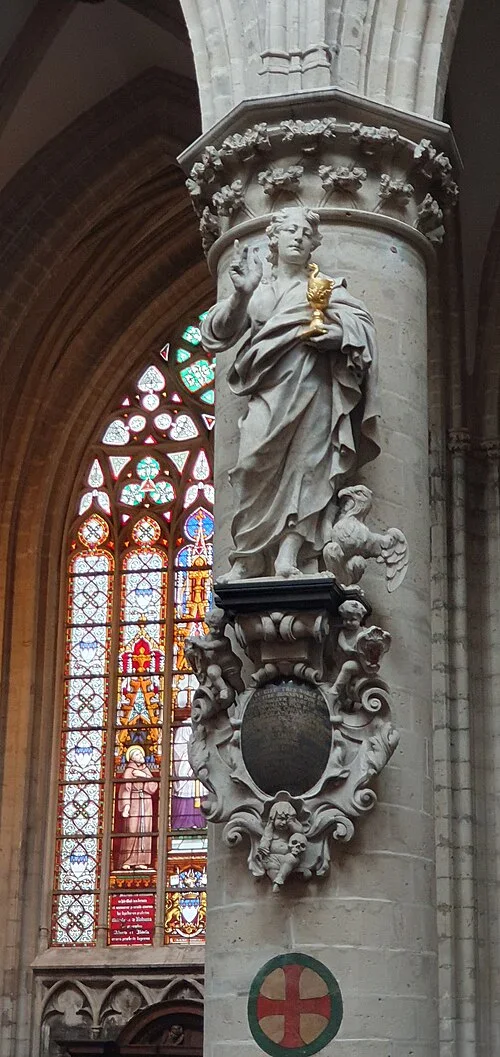 The Central Nave and Apostle Pillars
A Statue of Saint John among the Twelve Apostles
Fixed to the round columns of the nave stand the twelve apostles, including a Saint John holding a golden chalice with an eagle at his feet. They look at home here, but they are replacements. In 1566, iconoclasts swept through the Low Countries and destroyed the original statues. The church suffered again in 1579, when Protestant Geuzen pillaged the building and dug up Saint Gudula's relics, scattering them. The figures seen today were carved in the seventeenth century by the leading sculptors of the day. Lucas Faydherbe, Jérôme Duquesnoy the Younger, Johannes van Mildert and Tobias de Lelis each contributed. So every apostle on these pillars is both a work of Baroque art and a quiet answer to the violence that emptied these niches a century before.
Listen in the appPhoto: Yair-haklai · CC BY-SA 4.0
05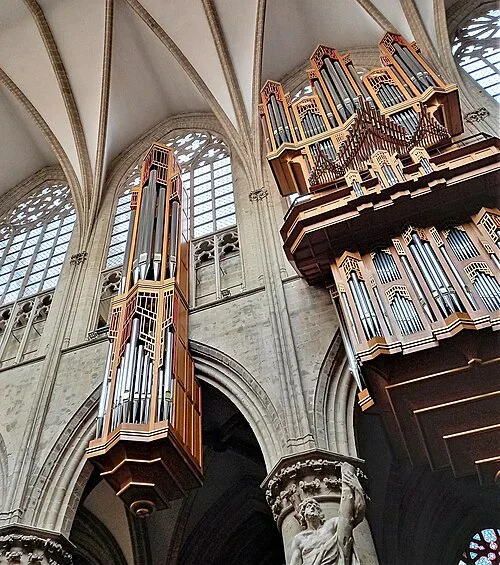 The Suspended Grenzing Organ
The Grenzing Swallow's-Nest Organ
High on the nave wall, at the level of the triforium, hangs a gleaming pipe organ that seems to float. Organ builders call this arrangement a swallow's nest, because the case clings to the wall like the bird's mud nest under a roof. It was inaugurated in October 2000 and has around four thousand three hundred pipes. The instrument was built by Gerhard Grenzing, a German organ-builder based in Barcelona, working with the English architect Simon Platt, who designed the case. It is a reminder that this is a living church, not only a monument. Seven hundred years of music-making continue under these vaults.
Listen in the appPhoto: Cmcmcm1 · CC BY-SA 4.0
06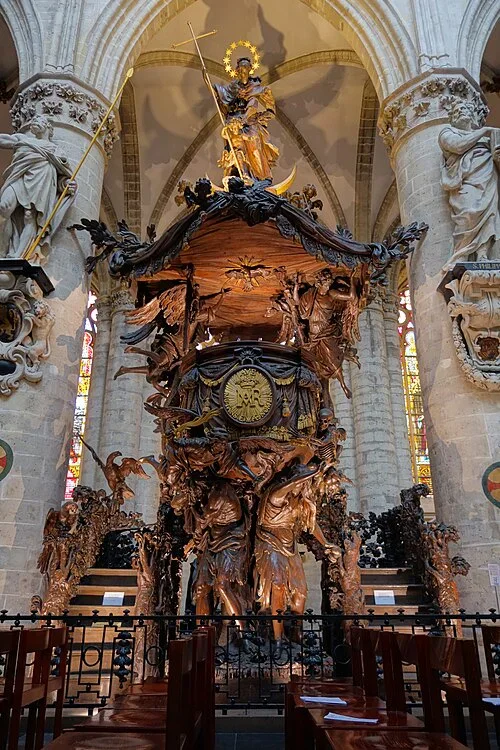 The Baroque Pulpit of the Fall and Redemption
In the nave stands the most theatrical object in the church: a Baroque pulpit of carved oak, made by the Antwerp sculptor Hendrik Frans Verbruggen between 1696 and 1699. It was originally made for the Jesuit church of Saint Michael in Leuven, and came to Brussels in 1776 after an exchange in which Empress Maria Theresa personally intervened. The pulpit preaches a whole sermon in wood. At the base, an archangel drives Adam and Eve out of the earthly paradise. Eve shields herself in terror, still clutching the apple in her other hand, while Adam hides his face. From the tree of knowledge a giant serpent coils upward, winding all the way over the sounding board. And there, at the very top, it is crushed by the triumphant Madonna and her Child. Sin below, redemption above, all in a single swirling composition.
Listen in the appPhoto: Florian Prischl · CC0
07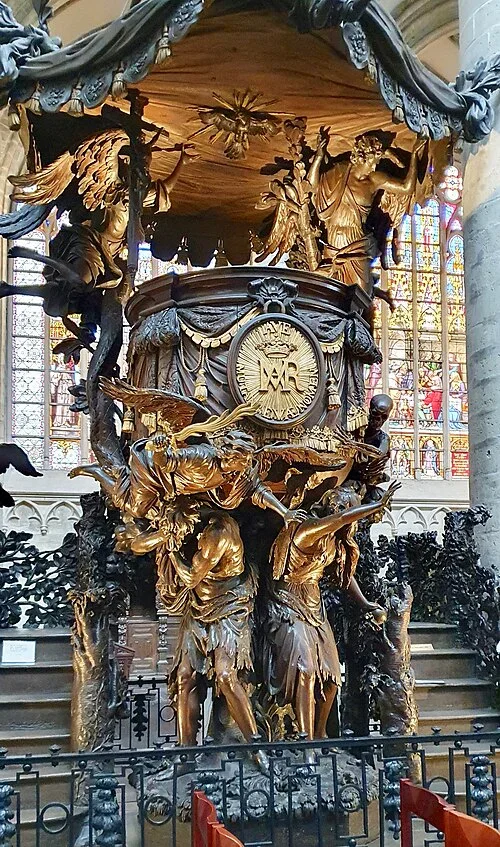 The Baroque Pulpit of the Fall and Redemption
The Expulsion from Paradise - Pulpit in Detail
Seen from nearby, the pulpit rewards a slower look. Verbruggen carved the trees and foliage of Eden with an almost botanical naturalism, every leaf and trunk given its own movement. The figures of the Expulsion twist and flee. Typical of Verbruggen are the two fluttering angels that appear to lift the sounding board from below. High above the canopy, gilded figures complete the contrast the carving sets up below. Human failure rendered in dark, earthbound oak; divine grace shining in gold above it.
Listen in the appYair Haklai · CC BY-SA 4.0
08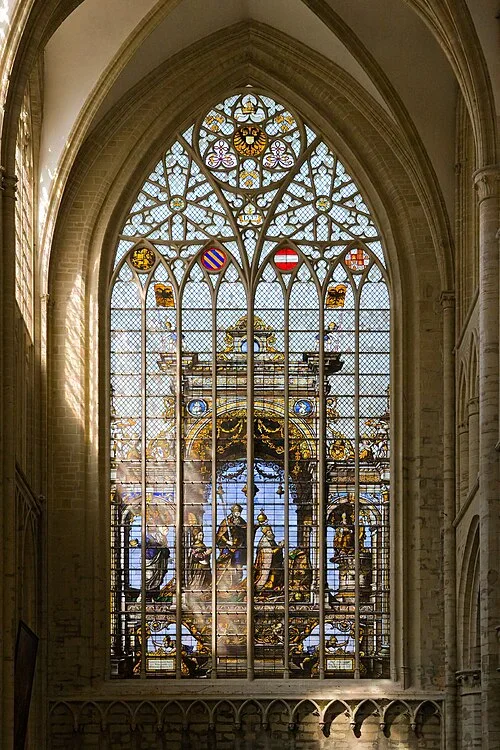 Northern Transept and Imperial Stained Glass
The Charles V Window in the Northern Transept
In the northern transept glows one of the great political images of sixteenth-century Brussels. The window shows Emperor Charles V and his wife Isabella of Portugal kneeling in adoration of the Holy Sacrament, flanked by their patron saints, Charlemagne and Elizabeth of Hungary. It dates from 1537 and was drawn by Bernard van Orley, court artist to the Habsburgs, and executed by the Antwerp glazier Jan Haeck. The same two men made the great Last Judgement window of 1528 in the western façade, the one this building greets arrivals with. Together, these windows are the Habsburg court's statement in glass. The finished church had become the stage for the empire Charles V ruled, and his court paid to have itself remembered here in colour and light.
Listen in the appPhoto: Mylius · GFDL
09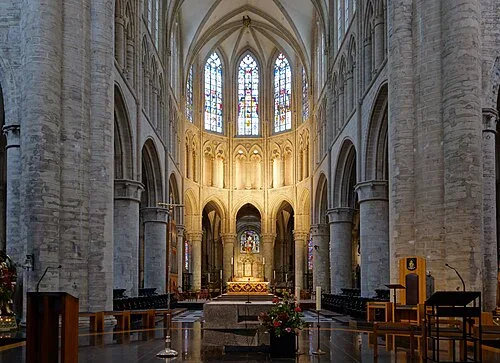 The High Choir and Ducal Sanctuary
The Gothic Choir and Ducal Mausoleums
The choir, the space around the high altar, is the oldest part of the present church. It was built between 1226 and 1276 under Duke Henry II of Brabant, in three rectangular bays ending in a five-sided apse. Here stand the seventeenth-century mausoleums of the Dukes of Brabant, and of Archduke Ernest of Austria, made by the sculptor Robert Colyn de Nole. For centuries this was where the ruling house of Brabant buried its dead. In 1962 the old collegiate church was promoted to co-cathedral, sharing the Archbishop's seat with Saint Rumbold's in Mechelen. And it remains Belgium's stage for national ceremony. In 1999, Prince Philippe married Mathilde d'Udekem d'Acoz here, and every National Day the Te Deum is sung in the presence of the king.
Listen in the appPhoto: Florian Prischl · CC0
10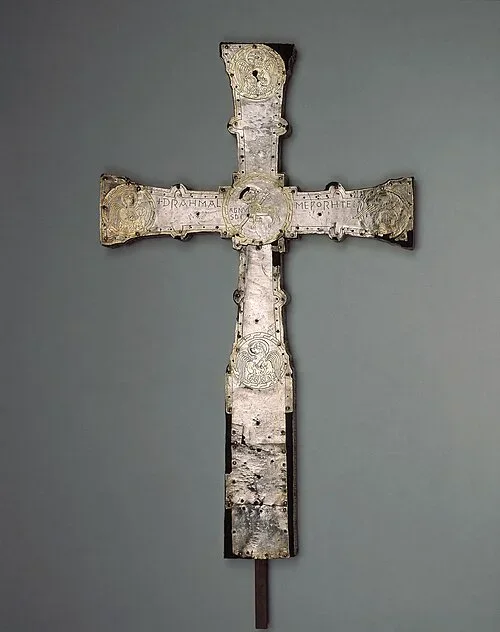 Chapel of the Blessed Sacrament and Treasury
The Drahmal Cross in the Treasury
In the Flamboyant Gothic chapel beside the choir, built between 1534 and 1539, the cathedral keeps its treasury. Its oldest treasure is the Drahmal Cross, also called the Brussels Cross, an Anglo-Saxon cross-reliquary of silver over wood from the early eleventh century. Its surfaces carry inscribed panels and the name of its maker, Drahmal, worked into the metal. But the chapel's name carries a harder story. It honours the so-called Sacrament of Miracle of 1370, when Brussels' Jewish community was accused of stabbing stolen hosts, and was punished for it. The legend fuelled centuries of persecution, and nineteenth-century windows in the church were even made to celebrate its supposed anniversary. In 1968 the diocesan authorities acknowledged the biased and legendary character of the accusation. Then in 1977, Cardinal Leo Joseph Suenens installed a plaque in the cathedral formally disavowing the events of 1370.
Listen in the appJean-Louis Torsin · CC BY 4.0
- 11
Michiel Coxie's Crucifixion Triptych
A Renaissance Crucifixion triptych, signed by the Flemish Raphael.
- 12
Chapel of Our Lady of Deliverance
A Rubens pupil's glass in the southern chapel, and the looting of the 1790s.
- 13
The Mausoleum of Frédéric de Merode
The marble tomb of a revolutionary hero, and eight centuries of memory in one church.
Kathedraal van Sint-Michiel en Sint-Goedele
Frequently asked questions
How much does the guide cost?
Free app download. Listed guide price: $0.99. Guide price shown in the app. Audio guide only. Venue admission is separate.
Can I listen without internet?
Yes. Download the guide’s audio, images, and maps in the app before your visit. Your downloaded content is then available offline.
Can I listen in my language?
This audio guide is available in 15 languages, including English.
Do I need to follow a schedule?
No. This is a self-guided experience. Choose your stops, pause whenever you like, and return to a story at your own pace.
At your own pace
Explore Kathedraal van Sint-Michiel en Sint-Goedele.
Download Stanza, then search for “Kathedraal van Sint-Michiel en Sint-Goedele”.
Free app download · Guide price shown in the app
Keep exploring
Nearby audio guides
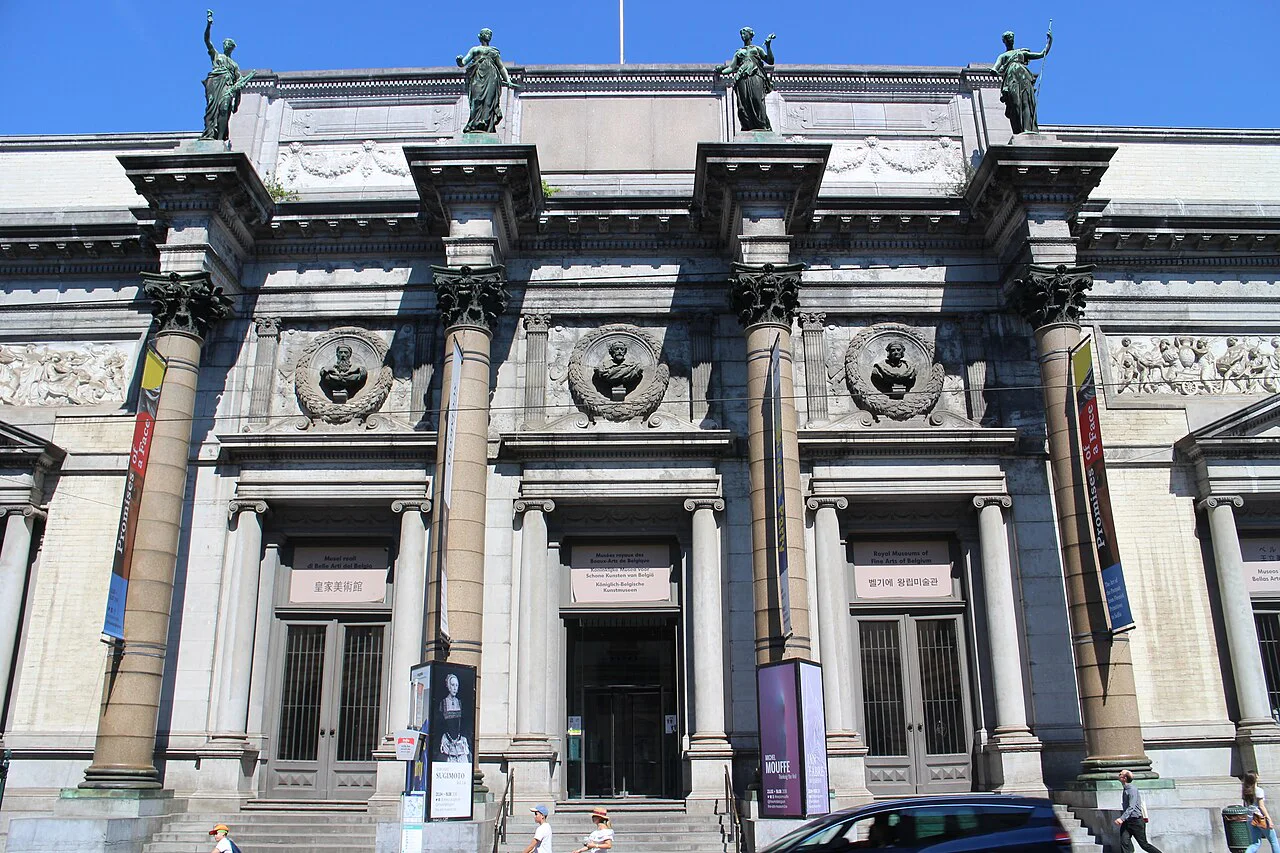
Brussels · 1 km
Royal Museums of Fine Arts of Belgium
Content & sources
Photo: Suicasmo · CC BY-SA 4.0
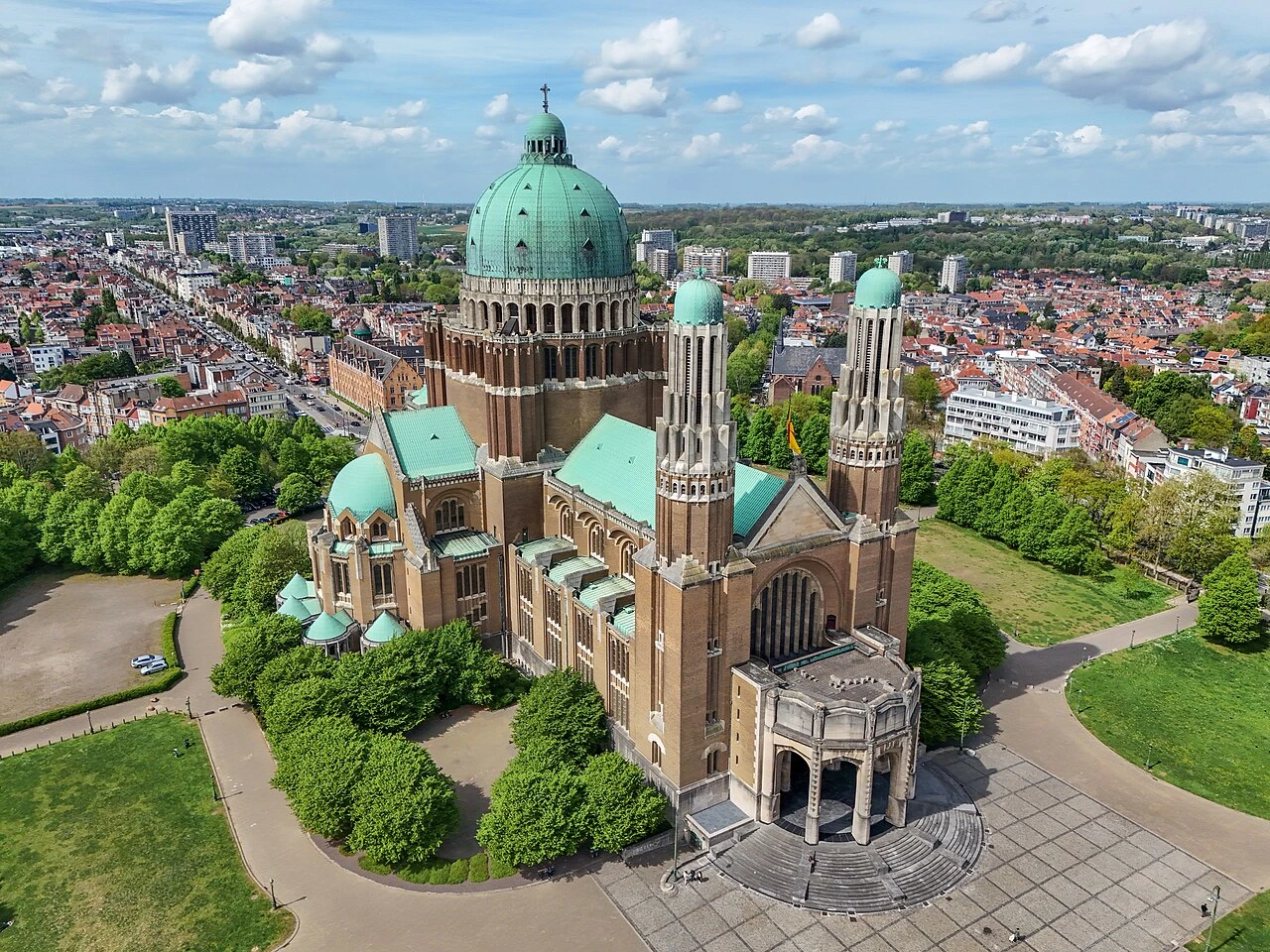
Koekelberg · 4 km
Basilica of the Sacred Heart, Brussels
Content & sources
Photo: Giles Laurent · CC BY-SA 4.0
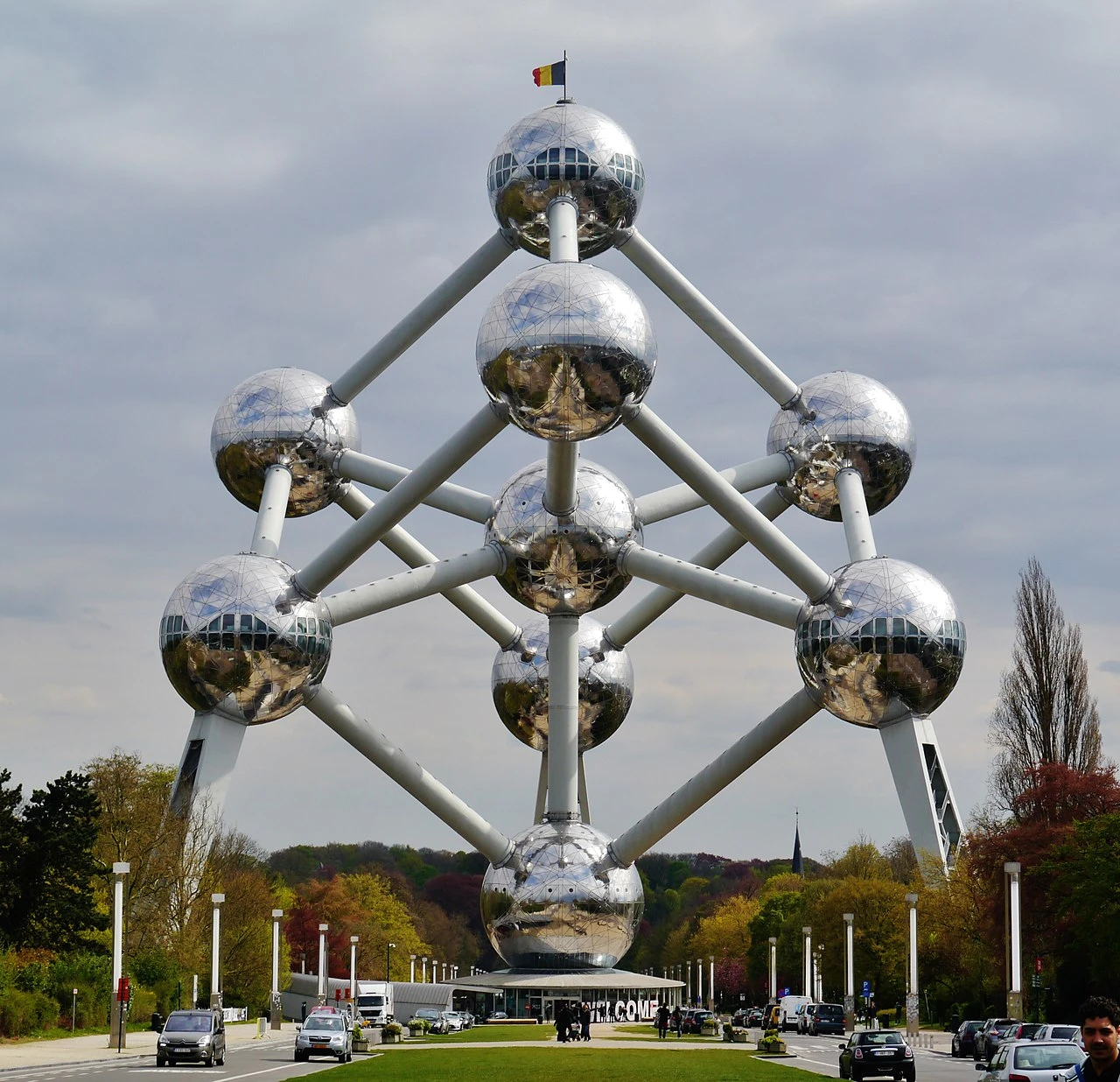
Brussels · 5 km
Atomium
Content & sources
Photo: Zairon · CC BY-SA 4.0
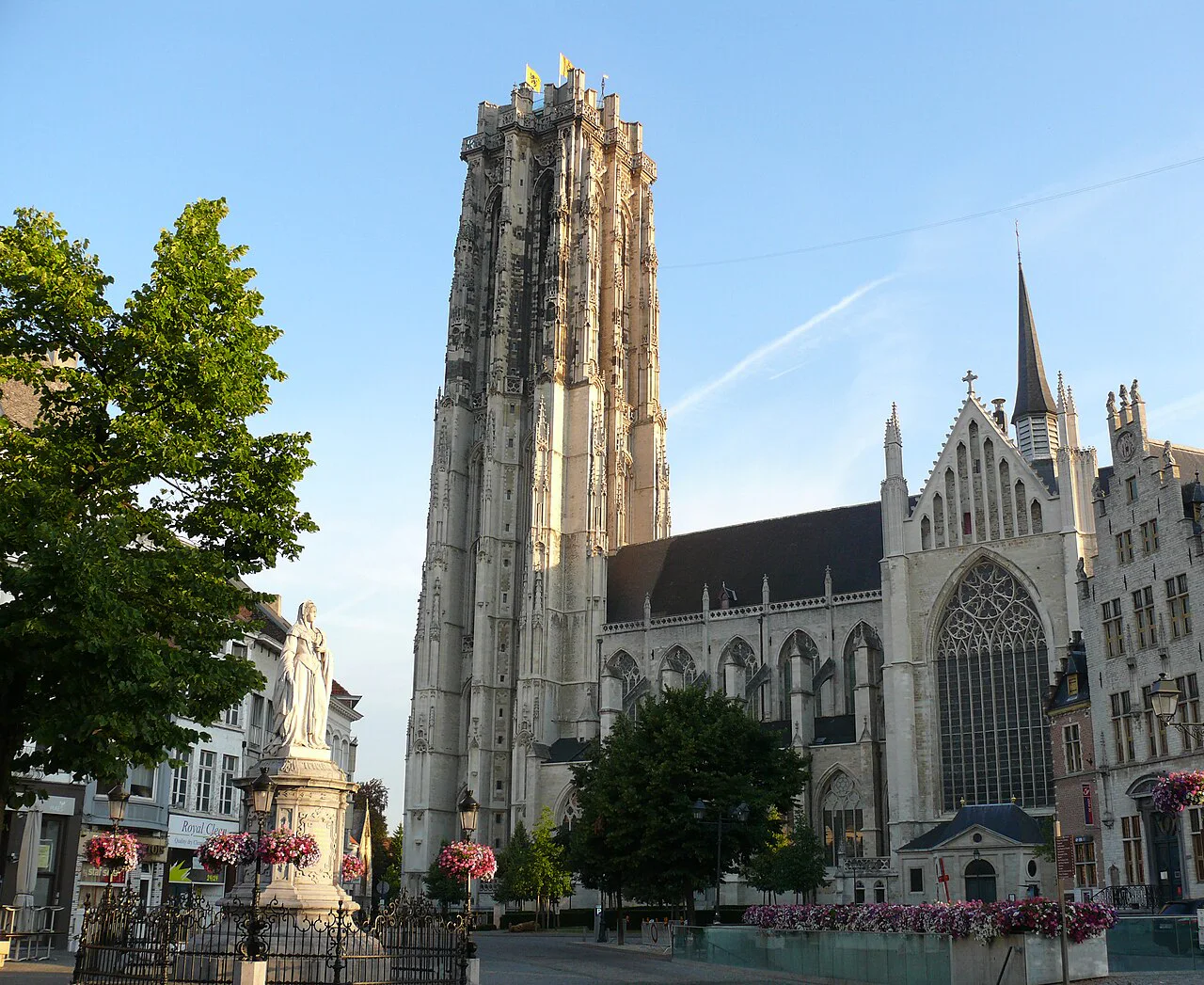
Mechelen · 22 km
Sint-Romboutskathedraal
Content & sources
Photo: Ad Meskens · CC BY-SA 3.0