Stanza · Audio guide
Sint-Romboutskathedraal Audio Guide
A place to remember. A story to take with you.
St. Rumbold's Cathedral is the Roman Catholic metropolitan archiepiscopal cathedral in Mechelen, Belgium. It is dedicated to Saint Rumbold, whose remains are rumoured to be buried inside the cathedral.
Download Stanza, then search for “Sint-Romboutskathedraal”.
About the tour
One guide. Your kind of visit.
St. Rumbold's Cathedral is the Roman Catholic metropolitan archiepiscopal cathedral in Mechelen, Belgium. It is dedicated to Saint Rumbold, whose remains are rumoured to be buried inside the cathedral.
Ready when you are.
- 01Get the free Stanza app.
iOS & Android
- 02Find your guide.
“Sint-Romboutskathedraal”
- 03Download before you go.
Works offline
Audio guide / 12 narrated stops
Inside the guide
Get to know a few of the stories before you go. Open a stop to read more.
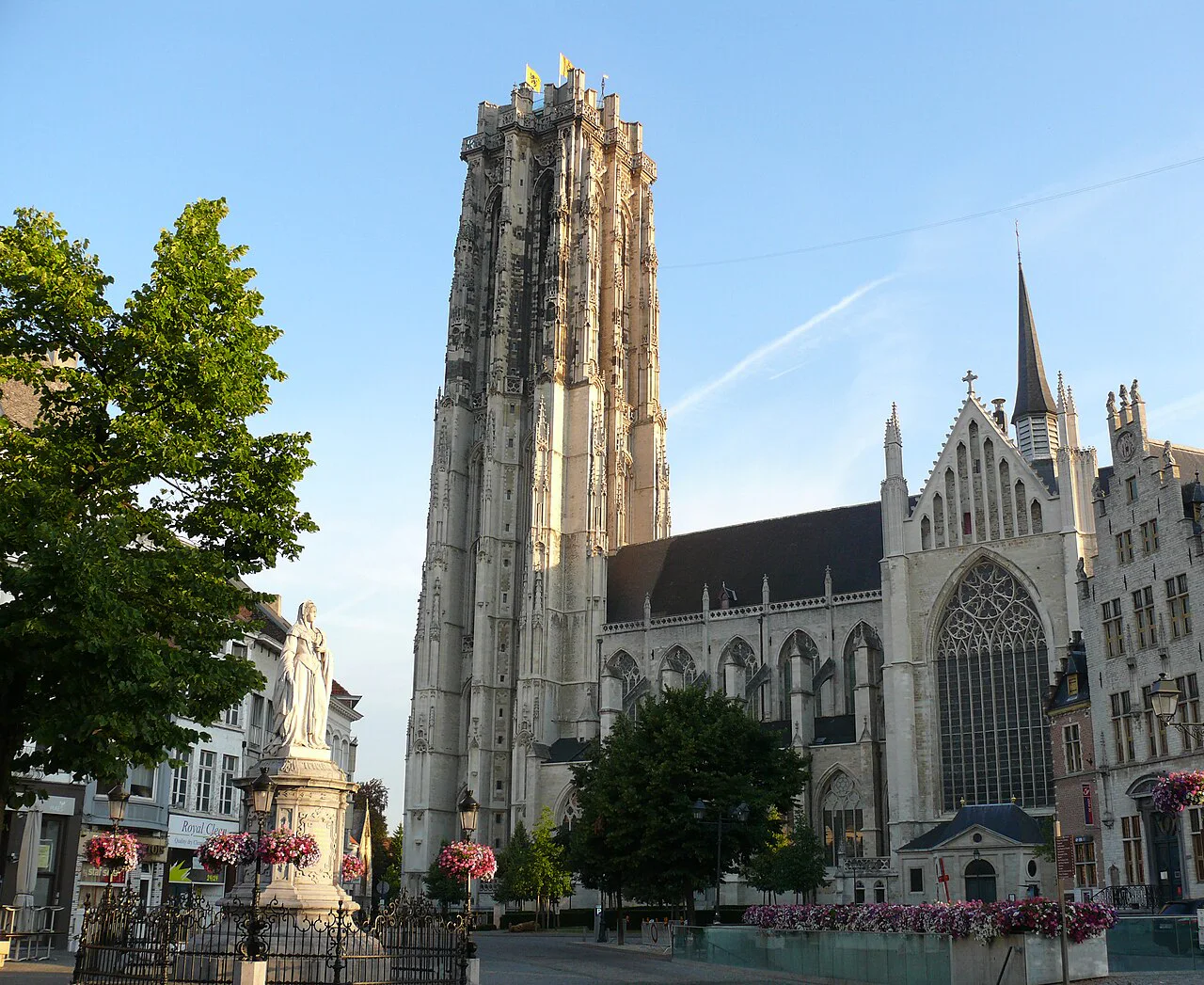
01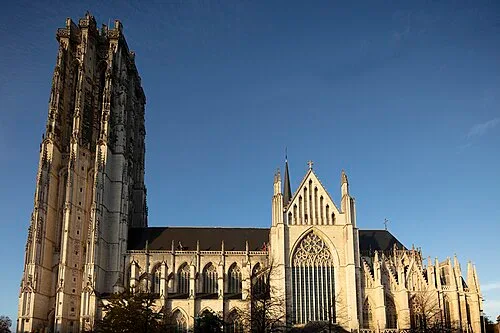 Western Facade and the Unfinished Tower
St. Rumbold's Cathedral and its Tower from the Outside
Welcome to St. Rumbold's Cathedral in Mechelen. This tour moves from the open square into the church, and finally up the giant tower beside it. The building was begun shortly after 1200, and it took about three hundred and twenty years to reach its present shape. It runs nearly a hundred and twenty metres from the west door to the choir wall. For its first centuries it was a collegiate church, served by a college of canons rather than a bishop. In 1559 the pope raised Mechelen to a bishopric, and this church became the cathedral of the archdiocese of Mechelen-Brussels. From then on it counted as the primate church of the country. Above the entrance rises the flat-topped tower, ninety-seven metres of stone, where this tour ends.
Photo: PMRMaeyaert · CC BY-SA 4.0
02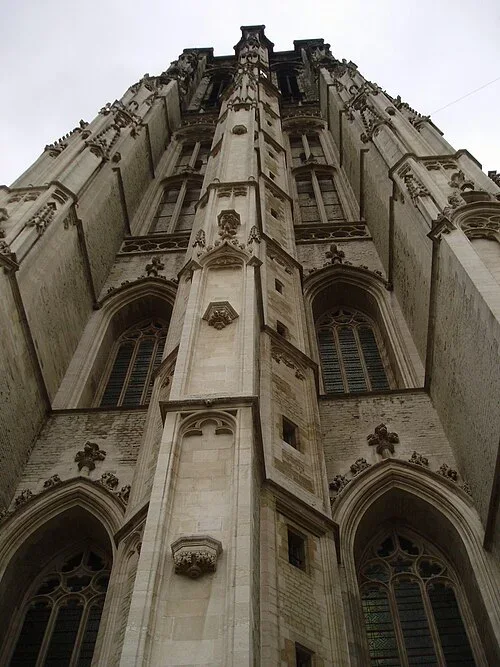 Western Facade and the Unfinished Tower
The Tower That Was Never Finished
Flat-topped and huge, this tower was meant to become the tallest church tower in the world. The first stone was laid on 22 May 1452, with the Keldermans family of master masons directing the work. About a metre and a half of stone went up each year, paid for first by pilgrims and later by the city. The design called for six hundred Mechlinian feet, roughly a hundred and sixty-seven metres. No church tower has ever reached that height. Ulm Minster, the tallest of them all, measures a hundred and sixty-one metres. All this rose on ground that had once been wetland, on foundations only three metres deep, and the ground held. In 1454 the chief architect, Andries Keldermans, built a similar tower in Zierikzee, where sagging began to threaten the church beside it. That scare set a firm rule here: tower and church stand as separate structures, joined by a deliberately weak connection. Around 1520 the money ran out and work stopped at ninety-seven metres. Only the first seven metres of the planned seventy-seven-metre spire were ever built. Then in 1546 the Zandpoort gate, where the city stored its gunpowder, exploded. The blast wrecked a third of the old town, and some two hundred people died. That deepened the money troubles, and the spire was never taken up again. In 1649 the engraver Wenceslaus Hollar recorded the finished tower as it was meant to look.
No machine-readable author provided. WO2~commonswiki assumed (based on copyright claims). · Public domain
03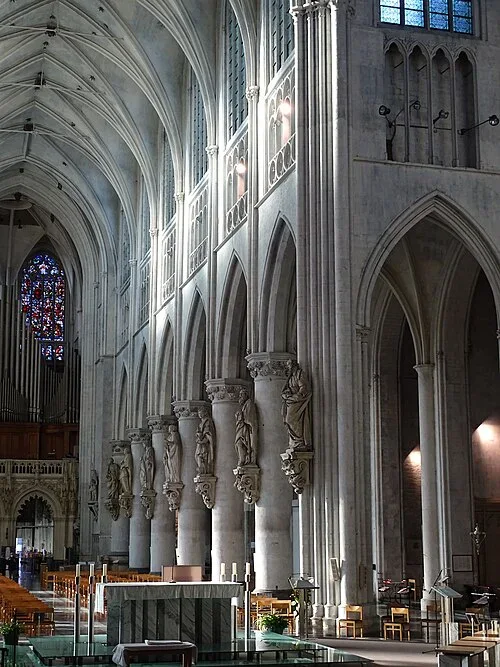 The Brabantine Gothic Nave and Baroque Pulpit
Inside the Nave: Brabantine Gothic Prototype
Inside, the nave belongs to a style this church invented. A city fire in 1342 gutted the earlier building, and the master mason Jean d'Oisy took charge of the rebuilding. From 1324 onwards the flying buttresses and the reworked choir had already taken on Brabantine Gothic traits, a style distinct from the French Gothic it grew out of. By d'Oisy's death in 1375 his work had formed the prototype of the style, and other churches followed it, among them the choir of St. Gummarus in Lier. His successors vaulted the nave by 1437 and the choir by 1451. A campaign from around 1335 raised the nave higher and added a choir ambulatory with seven radiating chapels. The side chapels along the north aisle followed around the year 1500. One ornament has vanished: the capitals once carried sculpted cabbage leaves, a detail that inspired many Brabantine Gothic churches. In the eighteenth century they were replaced with a double ring of carved crops, proof that this church kept being reworked, century after century.
Listen in the appAd Meskens You are free to use this picture for any purpose as long as you credit its author, Ad Meskens. Example: © Ad Meskens / Wikimedia Commons If you use this work outside of the Wikimedia projects, a message or a copy is very much appreciated. This image is not in the public domain. A statement such as "From Wikimedia Commons" or similar is not by itself sufficient. If you do not provide clear attribution to the author you do not comply with the terms of the file's license and you may not use this file. If you are unable or unwilling to provide attribution you should contact Ad Meskens to negotiate a different license. · CC BY-SA 4.0
04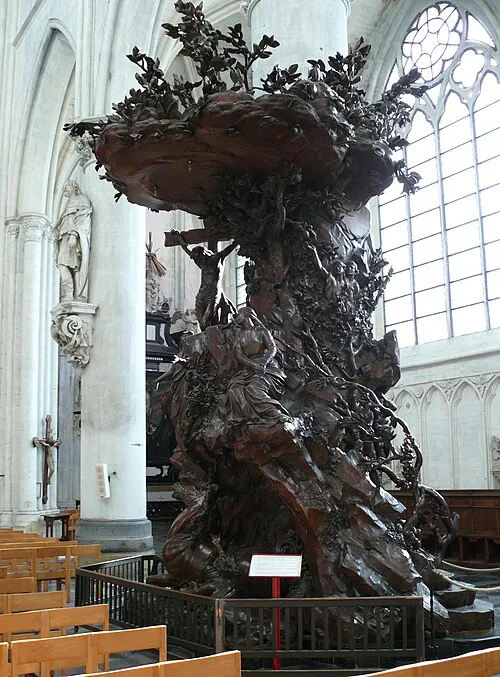 The Brabantine Gothic Nave and Baroque Pulpit
The Baroque Pulpit of Michiel van der Voort
This oak pulpit was carved for another church altogether. Michiel van der Voort cut it between 1721 and 1723, with Theodoor Verhaegen assisting, and filled it with figures, foliage and story from top to bottom. The Norbertine convent of Leliëndaal commissioned it for its own church. When that monastery was destroyed, the pulpit came here in 1809. It did not fit as it stood. The sculptor Jean-François Van Geel gave it a new back and rebuilt the whole construction around one of the cathedral's pillars. A terracotta model from 1721 has survived, and set against it, the changes made in the move can still be traced. Overhead, the sounding board spreads out like the crown of a tree.
Listen in the appPhoto: Ad Meskens · CC BY-SA 3.0
05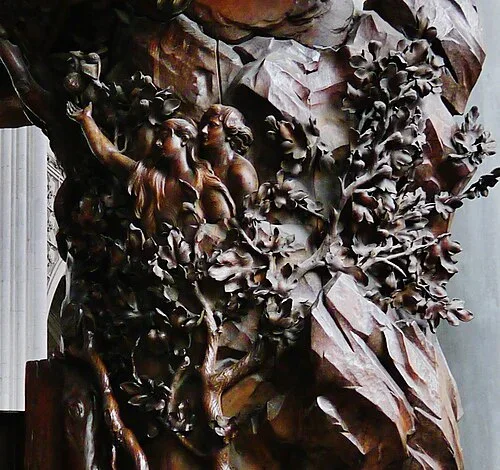 The Brabantine Gothic Nave and Baroque Pulpit
Adam and Eve: Reading the Pulpit's Scenes
Everything on this pulpit tells a story at once. The carvers worked it like a tableau vivant: the temptation of Adam and Eve among the leaves, the crucifixion close by, and the conversion of Saint Norbert woven into the same tangle of branches. The sounding board above the preacher is nothing less than the crown of the tree of knowledge of good and evil. Whoever climbs these steps to preach stands beneath the very Fall his sermon addresses. The architectural parts melt into the natural ones, until it is hard to say where the pillar ends and the forest begins. With this much story carved into one object, it hardly counts as furniture anymore.
Listen in the appZairon · CC BY-SA 4.0
06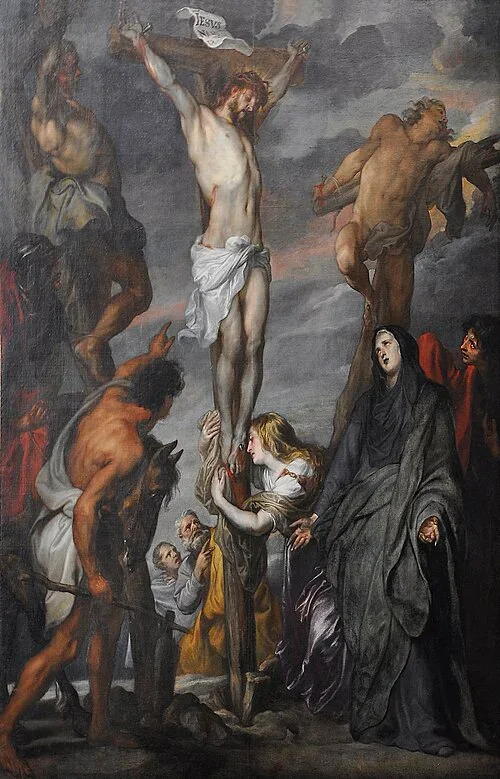 The Transept and Van Dyck's Masterpiece
Van Dyck's Crucifixion
Anthony van Dyck painted this Crucifixion in 1630, and it is Flemish Baroque at full intensity. Christ hangs against a stormy sky, lit as if by a last break in the clouds. One thief twists toward him on his cross; the other turns away. The Virgin faints into the arms of the women, and Mary Magdalene clings to the foot of the cross. The painting came from the Minderbroederskerk, the church of the Friars Minor in this city. It matters all the more because almost none of the cathedral's original furnishings survived the violence of the late sixteenth century. A canvas like this is one of the few old treasures still in its keeping.
Listen in the appAnthony van Dyck · Public domain
07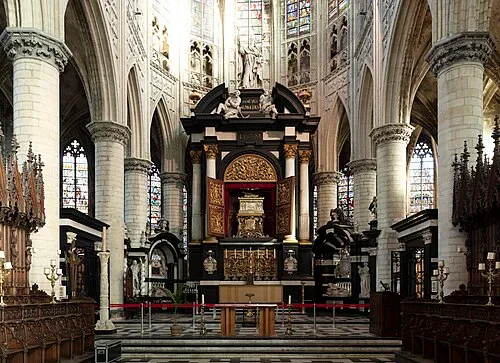 High Choir and Lucas Faydherbe's Altar
The High Altar of Lucas Faydherbe
The high altar at the head of the choir is the work of Lucas Faydherbe, a sculptor of Mechelen itself, finished in 1665. He had an important share in giving this Gothic church its Baroque dressing. The altar rises in marble and gilding beneath the stained glass. Around the choir hang twenty-five paintings illustrating the life of Saint Rumbold, the patron whose relics rest behind it. Beside the altar stands another Faydherbe work, the tomb monument of Archbishop Andreas Creusen. Several more monuments to Mechelen's archbishops line the choir around it.
Listen in the appPhoto: PMRMaeyaert · CC BY-SA 4.0
08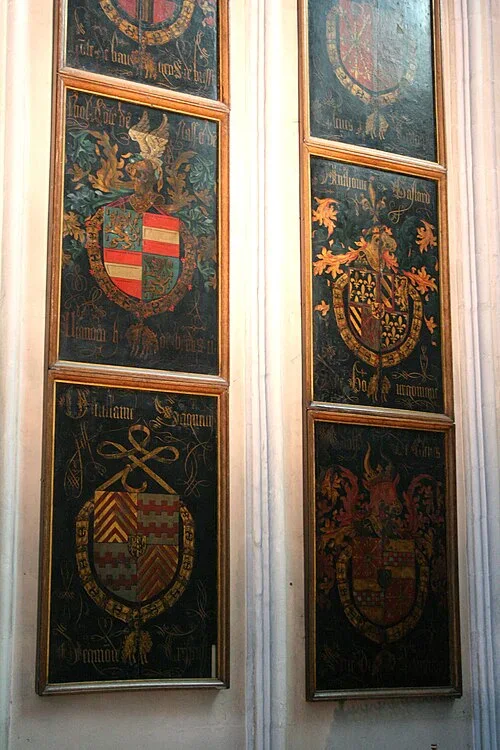 High Choir and Lucas Faydherbe's Altar
Shields of the Knights of the Golden Fleece
Painted shields along the choir ambulatory recall Mechelen's courtly golden age. Thirty-three of them hang here, armorial boards of the Order of the Golden Fleece. The chapter met in this church in 1491. Philip the Handsome presided over it, while his Burgundian inheritance was still held in guardianship by his father. The boards record the knights who gathered under his presidency, their coats of arms painted with crests and mottoes on dark grounds. They are among the very few original furnishings this church still owns, and as recently as 2022 they were being restored.
Listen in the appPhoto: Michel wal · CC BY-SA 3.0
09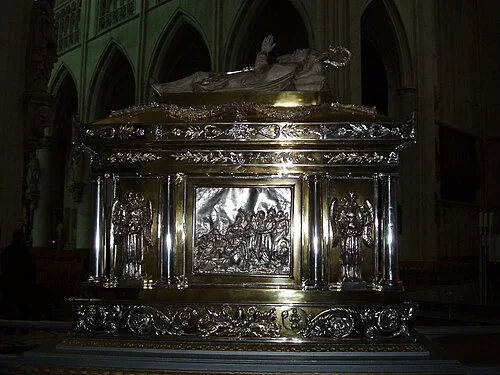 The Retro-Choir and Legend of Saint Rumbold
The Shrine of Saint Rumbold
The gilded shrine behind the choir holds the bones of Saint Rumbold, the missionary and martyr who founded an abbey nearby and gave this church its name. Science has rewritten his story. Examination of the relics showed a man of about forty years. He died sometime between 580 and 655. Tradition had long claimed the year 775. The bones themselves nearly vanished. In 1580, during the English Fury, mercenaries pillaging for the States General wrecked the church's contents, and the saint's remains were scattered. The pious population gathered them back together. Under the Calvinist rule that followed, the church served protestant worship, until it was reconciled to Catholic use on 4 August 1585.
Listen in the appPhoto: Queeste · CC BY-SA 3.0
10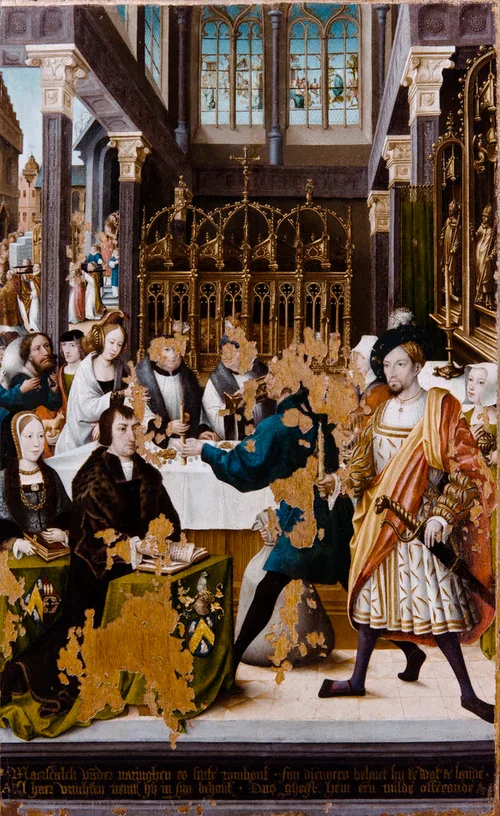 The Retro-Choir and Legend of Saint Rumbold
The Rumoldus Legend Panels
One panel from the medieval legend of Saint Rumbold shows his own townspeople at devotion. Members of the Brotherhood of Saint Rumbold gather inside a Gothic church to honour their patron, a picture of how the saint was actually venerated here, long before his church became a cathedral. The panel belongs to a cycle of twenty-five paintings on the saint's legend. They date from the fifteenth century. Its surface is scarred: the paint has flaked away in patches, and the losses are clearly visible today. It is also one of the rare medieval furnishings that never left this church.
Listen in the appWorkshop of Colijn de Coter / Master of the Legend of the Magdalene · Public domain
- 11
The Clock Drum and the Old Carillon
Hemony bells, Jef Denyn's concert art, and the treadwheel that hauled eight-ton bells up the outside.
- 12
The Tower Crown and the Moon Extinguishers
Moonlight mistaken for fire, a pope's remark, and the unfinished crown that became Mechelen's emblem.
Sint-Romboutskathedraal
Frequently asked questions
How much does the guide cost?
Free app download. Listed guide price: $0.99. Guide price shown in the app. Audio guide only. Venue admission is separate.
Can I listen without internet?
Yes. Download the guide’s audio, images, and maps in the app before your visit. Your downloaded content is then available offline.
Can I listen in my language?
This audio guide is available in 15 languages, including English.
Do I need to follow a schedule?
No. This is a self-guided experience. Choose your stops, pause whenever you like, and return to a story at your own pace.
At your own pace
Explore Sint-Romboutskathedraal.
Download Stanza, then search for “Sint-Romboutskathedraal”.
Free app download · Guide price shown in the app
Keep exploring
Nearby audio guides
Willebroek · 10 km
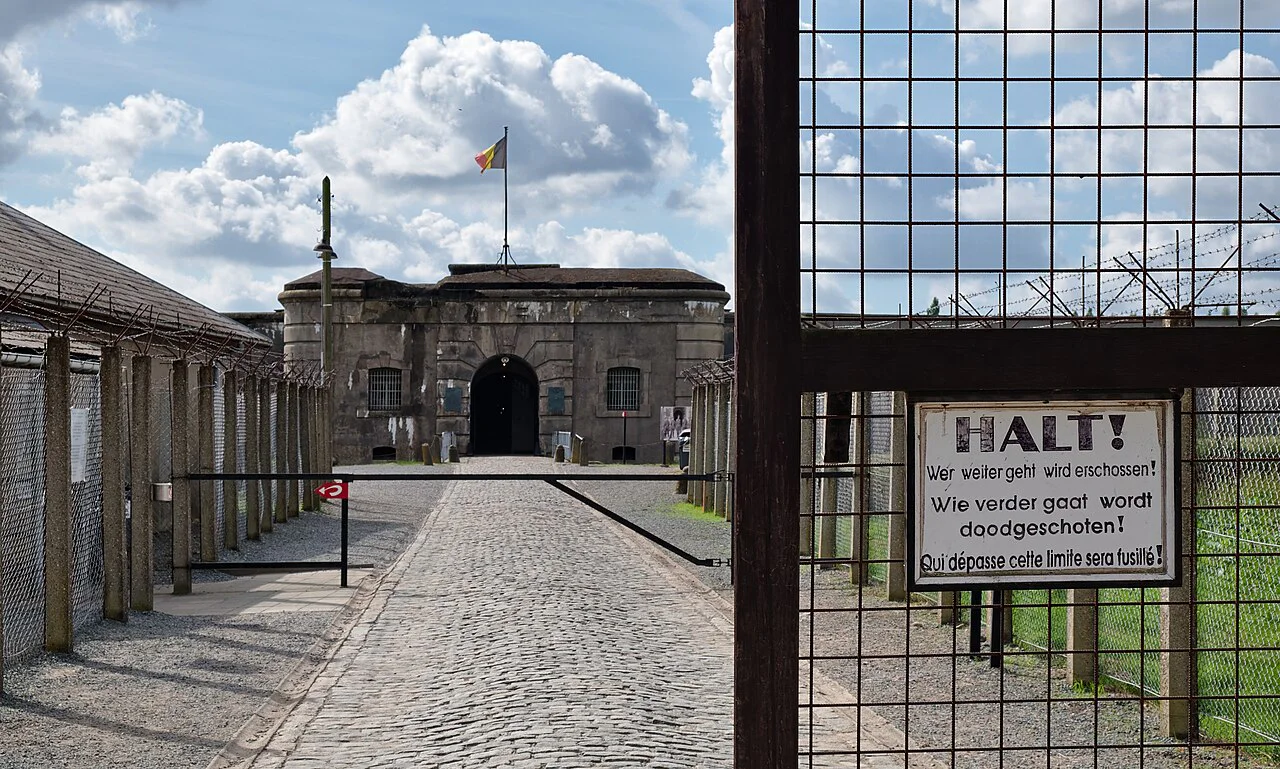
Fort van Breendonk
Content & sources
Trougnouf (Benoit Brummer) · CC BY 4.0
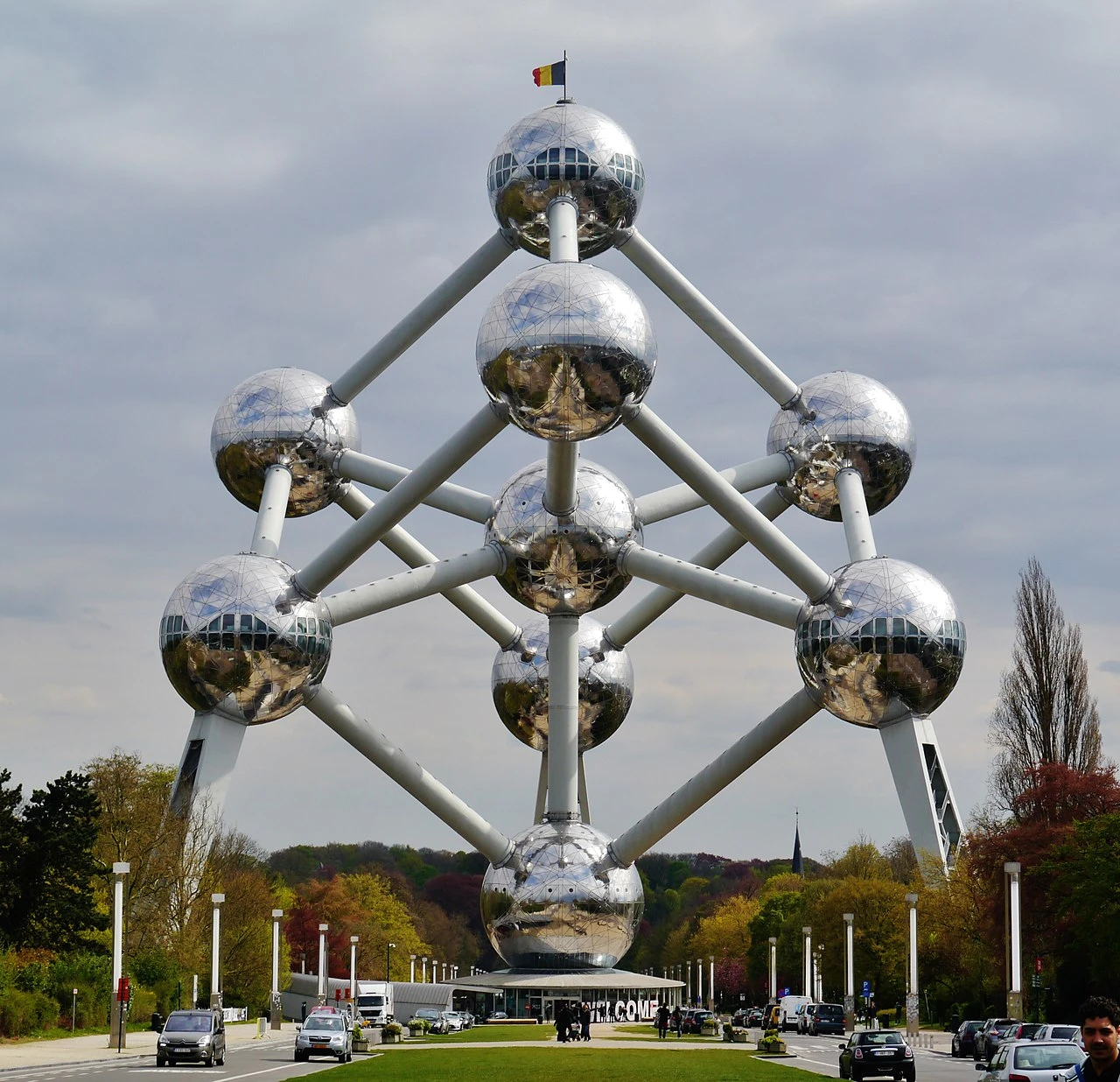
Brussels · 18 km
Atomium
Content & sources
Photo: Zairon · CC BY-SA 4.0
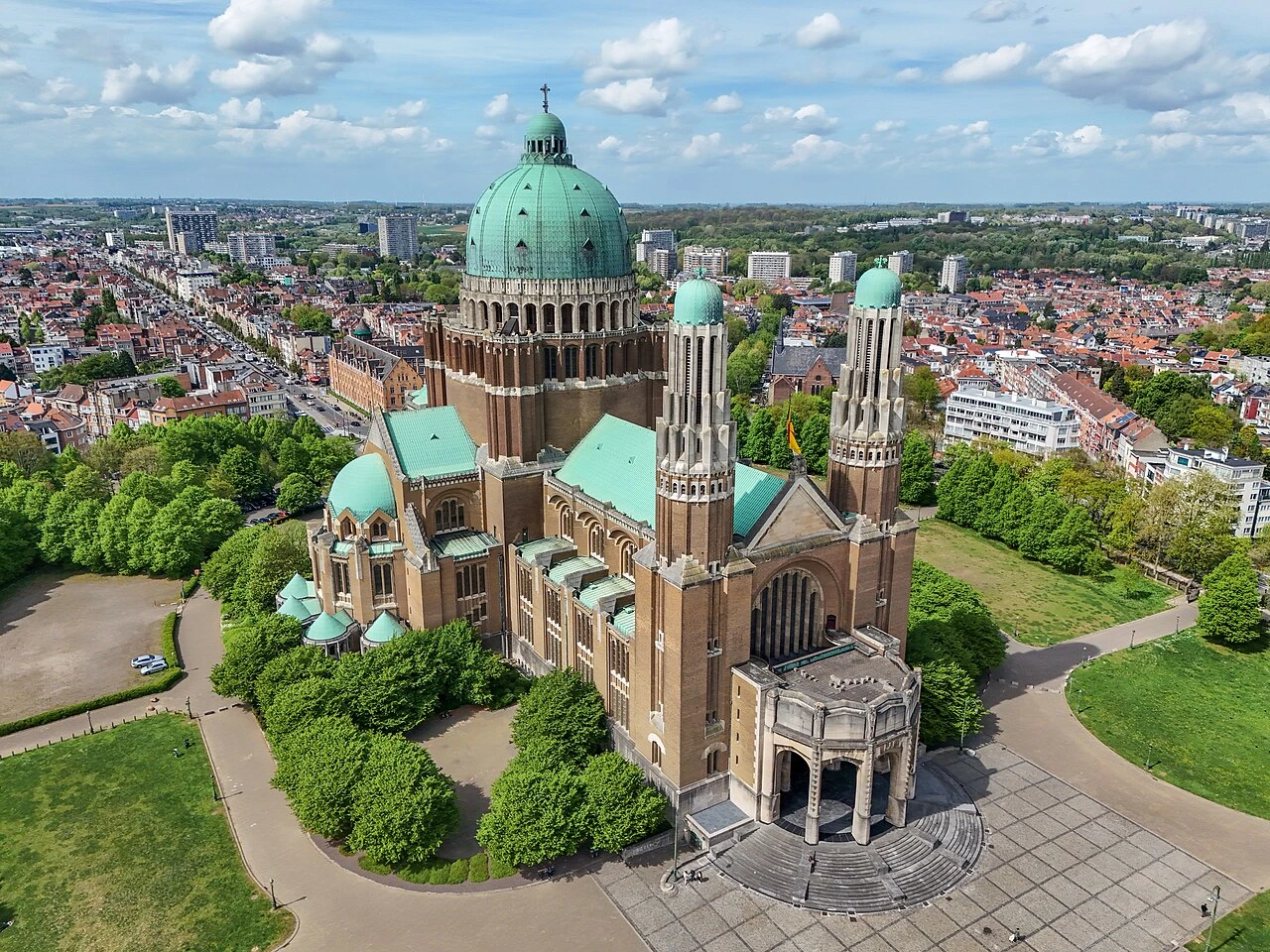
Koekelberg · 21 km
Basilica of the Sacred Heart, Brussels
Content & sources
Photo: Giles Laurent · CC BY-SA 4.0
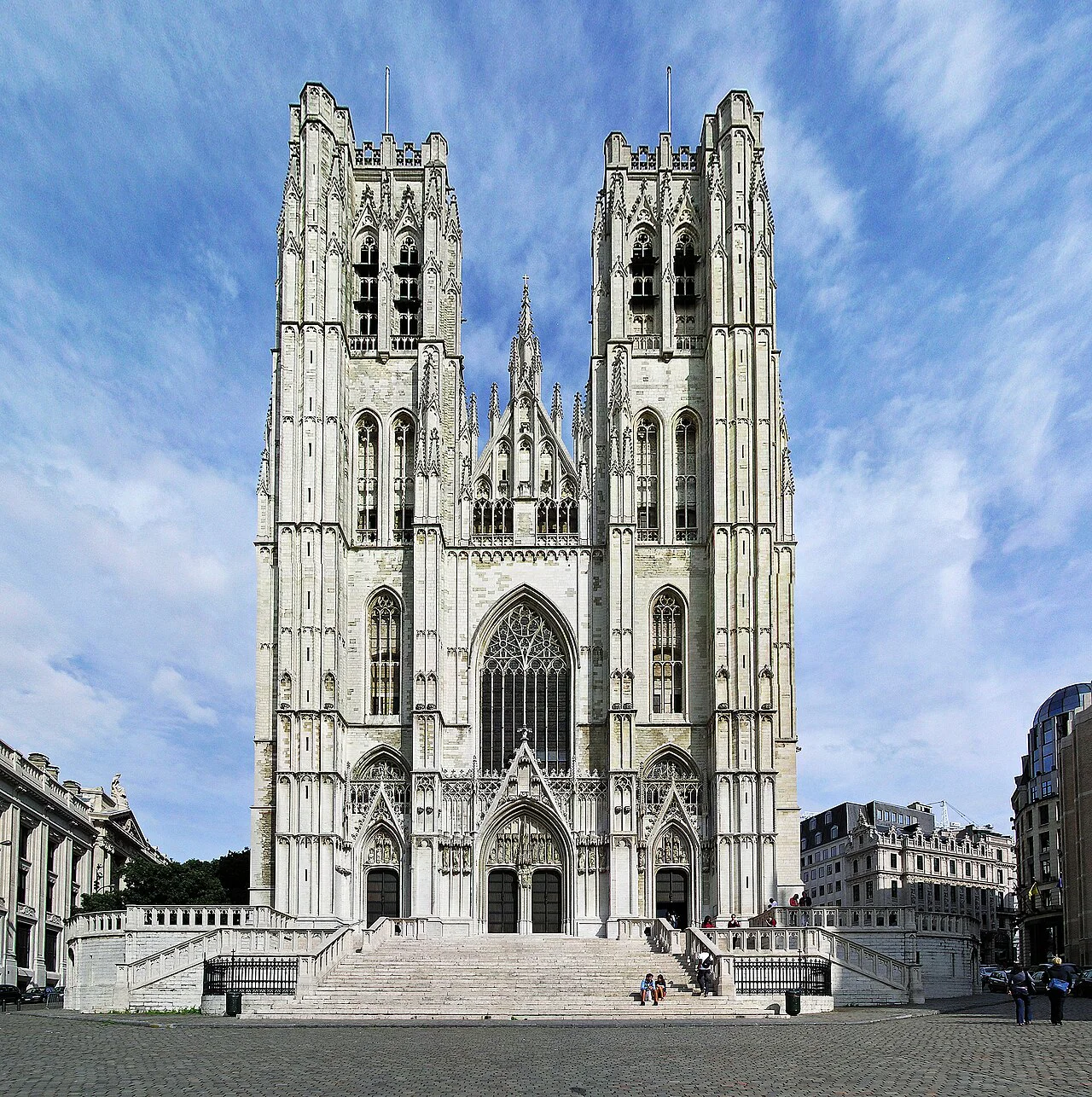
Brussels · 22 km
Kathedraal van Sint-Michiel en Sint-Goedele
Content & sources
Photo: Donaldytong · CC BY-SA 3.0