 Stanza / Audio guide
Stanza · Audio guide
Onze-Lieve-Vrouwekathedraal Audio Guide
A place to remember. A story to take with you.
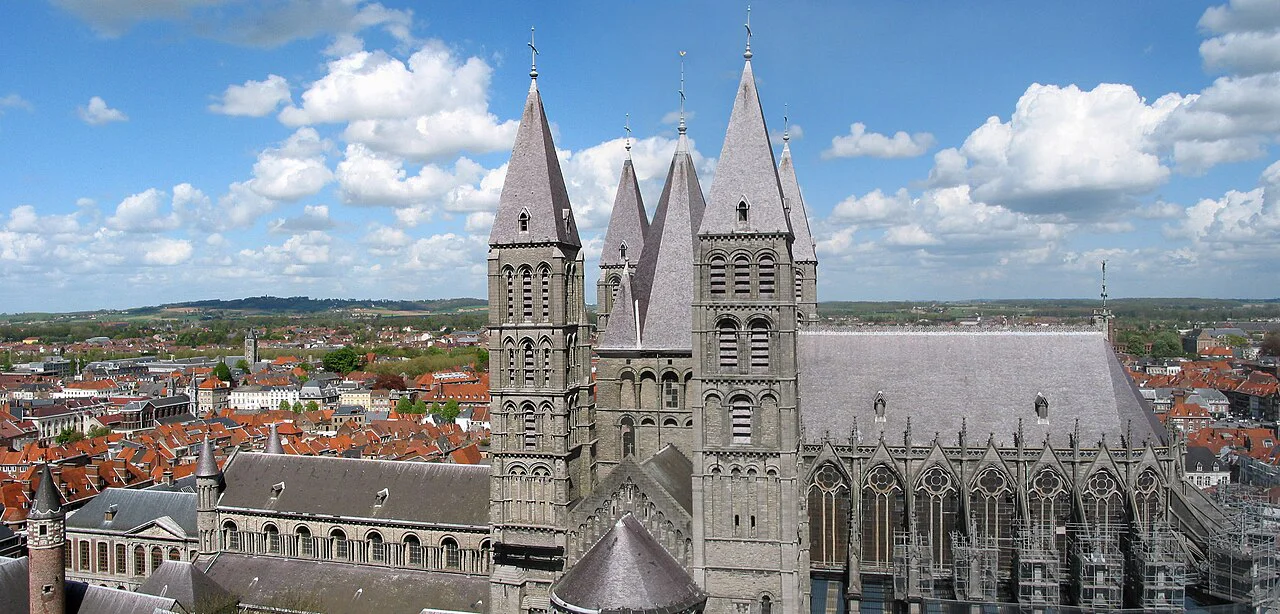
The Cathedral of Our Lady is a Roman Catholic cathedral located in Tournai, Belgium. It is classified as a Wallonia major heritage site and a World Heritage Site.
Download Stanza, then search for “Onze-Lieve-Vrouwekathedraal”.
About the tour
One guide. Your kind of visit.
The Cathedral of Our Lady is a Roman Catholic cathedral located in Tournai, Belgium. It is classified as a Wallonia major heritage site and a World Heritage Site.
Ready when you are.
- 01Get the free Stanza app.
iOS & Android
- 02Find your guide.
“Onze-Lieve-Vrouwekathedraal”
- 03Download before you go.
Works offline
Audio guide / 13 narrated stops
Inside the guide
Get to know a few of the stories before you go. Open a stop to read more.
01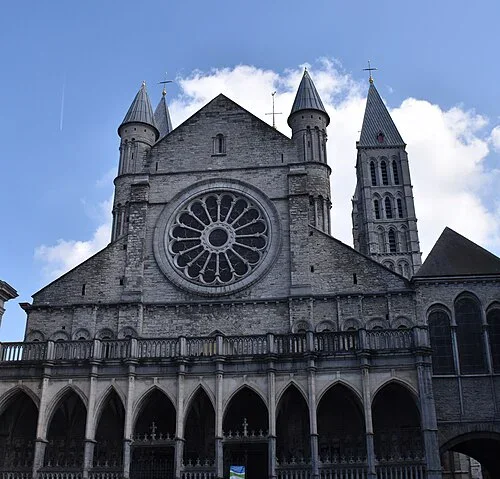 Western Facade and Late-Gothic Porch
Western Facade: Arrival at the Cathedral of Our Lady
Welcome to the Cathedral of Our Lady in Tournai, the mother church of the diocese and one of the great churches of Belgium. This tour follows the building from its western facade, through the nave and choir, to the towers and treasury. The building began in the twelfth century on foundations far older than that, and it stretches a hundred and thirty-four metres from end to end. In front of the Romanesque wall stands a late-Gothic portico from around 1500, with carved figures under its vaulted bays. Above it, a great rose window opens in the stone, flanked by the massive square towers. UNESCO listed the cathedral as a World Heritage Site in 2000, and it is easy to see why. Two great medieval styles meet here in a single building, and the contrast is the story. Inside, three periods of design wait in succession.
Photo: PMRMaeyaert · CC BY-SA 4.0
02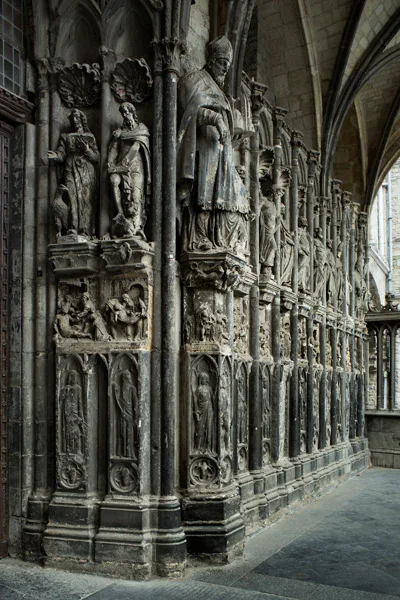 Western Facade and Late-Gothic Porch
Portal Statuary and the Scars of 1566
Rows of carved statues line the deep entrance bays, saints and prophets stacked in tiers of stone. In the Middle Ages, images like these were how a church taught, a scripture in sculpture for people who could not read. That is exactly what made them targets. On 23 August 1566, the wave of iconoclasm known as the Beeldenstorm reached Tournai, and the cathedral was broken into. At the main western portal, the fourteenth-century statue of Our Lady of the Sick was beheaded. A preacher named Ambroise Wille ordered the church archives burned, destroying records with the images. The statues that remain in these arcades survived that day and the centuries after it. Their weathered faces carry the marks of a long and sometimes violent history.
Photo: PMRMaeyaert · CC BY-SA 4.0
03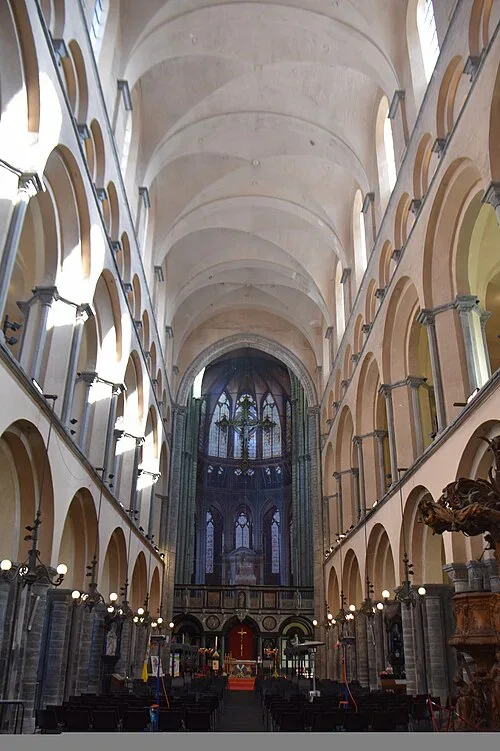 Romanesque Nave and Four-Tier Elevation
The Romanesque Nave
The nave opens ahead in round arches and pale stone, heavy and severe in the Romanesque manner. Most of it was built in the first third of the twelfth century. By the consecration of 1171, the whole church stood complete, apart from the towers. A bishop has sat in Tournai since the late sixth century, a see with a very long history. The building rises on high ground near the south bank of the Scheldt, the river that cuts the city in two. Its blue-gray limestone came from the local quarries, and it gives the walls their particular color. The severity of this nave sets up the contrast with what lies beyond the crossing, which is the point of the whole building.
Listen in the appPhoto: PMRMaeyaert · CC BY-SA 4.0
04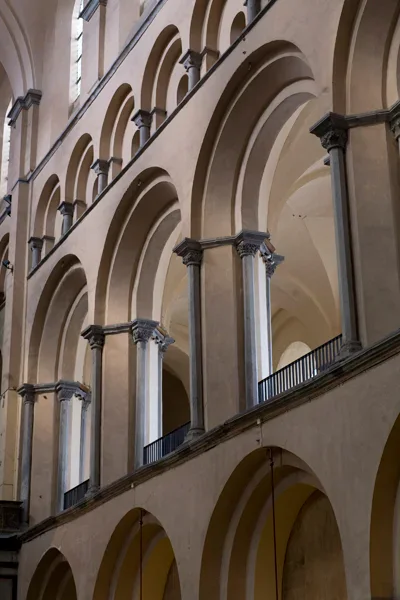 Romanesque Nave and Four-Tier Elevation
The Four-Tier Elevation
The nave wall rises in four stacked levels, and the design is remarkably ahead of its time. A second-tier gallery runs between the ground-floor arcade and the triforium above it, that band of small arcades at the third level. That arrangement prefigured the Early Gothic style, which would soon flourish in France. Between the round-arched windows of the clerestory, the topmost tier, pilasters climb up to meet the vaults. Those pilasters help carry the vaulting visible today, which is eighteenth-century work. It replaced the original ceiling, which was made of wood and completely flat. So the smooth curves overhead are later, but the wall beneath them is essentially the twelfth-century original.
Listen in the appPhoto: PMRMaeyaert · CC BY-SA 4.0
05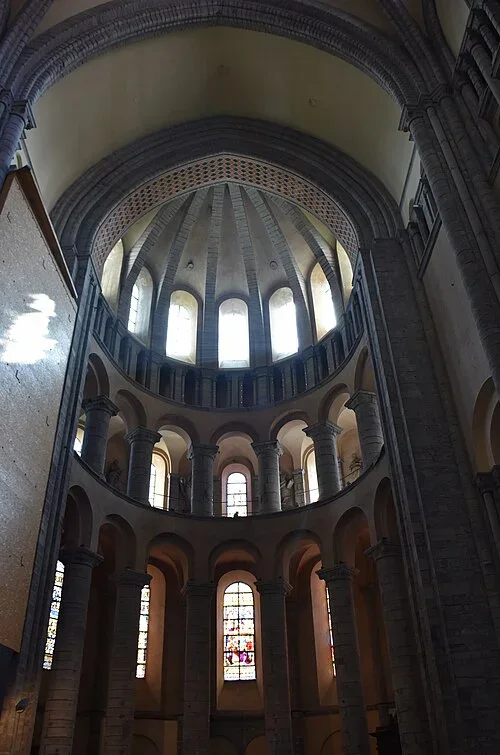 Transept Crossing and Lantern Tower
The Apsidal Transept Arm
The transept arms of this cathedral end in rounded, apsidal curves, a distinctive feature. They were built in about the mid-twelfth century. The idea was borrowed, in all probability, from certain churches along the Rhine, in German lands. But the traffic in ideas ran both ways. The feature appears to have made its influence felt in the north-east of France, in churches such as Noyon and Soissons. Research has dated the transept roof structure itself to around 1145. The curved end here, with its rings of arcades and windows, is one of the most striking spaces in the building.
Listen in the appPhoto: Renhour48 · CC0
06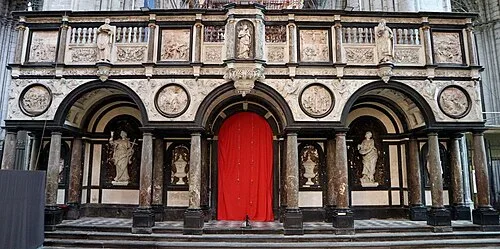 Renaissance Rood Screen
The Renaissance Rood Screen of Cornelis Floris
Across the church runs an elaborate screen of marble and alabaster, crowded with figures, reliefs and arcades. It is the rood screen, a Renaissance masterpiece by the Flemish sculptor Cornelis Floris de Vriendt, dated 1573 or 1574. Its job was to divide the building: the clergy sang the services in the choir behind it, while the lay congregation stayed in the nave. Only a curtain now hangs in its central arch, but the structure itself makes the old division plain. Sculpted figures stand in niches above the arches, and round reliefs punctuate the friezes. It ranks among the finest Northern Renaissance sculptural monuments in Belgium. Standing at the crossing, the two worlds it once separated are still easy to read.
Listen in the appJpcuvelier · CC BY-SA 4.0
07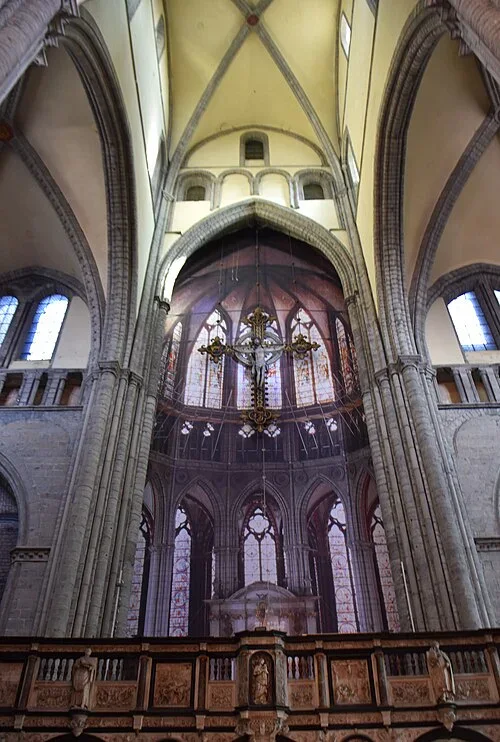 Soaring High Gothic Choir
The Gothic Choir of Bishop Gautier de Marvis
Beyond the rood screen, the architecture suddenly changes scale. In the thirteenth century, Bishop Gautier de Marvis had the old Romanesque choir demolished, to replace it with a Gothic choir of far grander dimensions. An inspiration was Amiens Cathedral, then rising as one of the great buildings of France. Work on the new choir began in 1242 or 1243 and was finished in 1255. Inside, its vaults soar far above those of the nave. The clustered pillars branch upward in slender shafts all the way into the ribbed vaulting. The bishop's ambition went further: the whole cathedral was supposed to be rebuilt in this style. That was never attempted, and only the western porch and a large Gothic chapel along a side aisle were later added.
Listen in the appPhoto: Renhour48 · CC0
08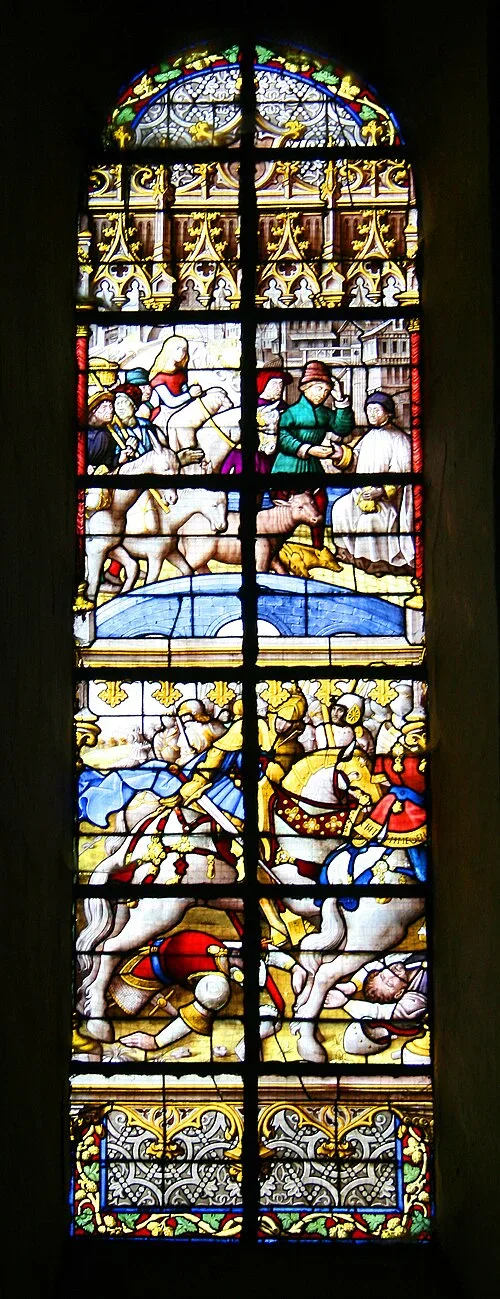 Soaring High Gothic Choir
Stained Glass by Arnold of Nijmegen
Light falls through the choir's stained glass in deep blues, reds and golds. The windows are the work of Arnold of Nijmegen and date from 1507. One panel records the privilege of charging a toll on crossing the Scheldt, the river tax that fed Tournai's medieval prosperity. Its panels show a busy riverside world: riders crossing a bridge over blue water, townsfolk in bright green and red, and below, armoured horsemen clashing in a fight. Framed borders of gold foliage run around each scene. A window like this ties the church directly to the wealth the river brought the city. Every merchant who paid the toll helped pay for glass like this.
Listen in the appPhoto: Jean-Pol GRANDMONT · CC BY 3.0
09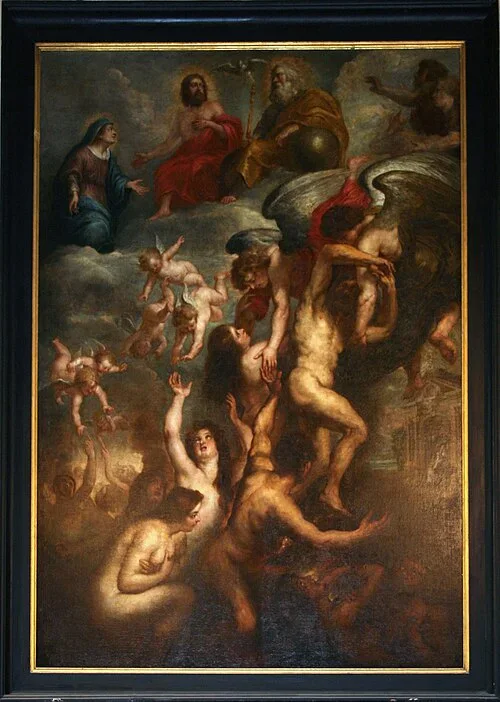 Saint Louis Chapel
Rubens: The Release of Souls from Purgatory
In the Saint Louis Chapel hangs a large canvas by Peter Paul Rubens, The Release of Souls from Purgatory. He completed it in 1635 for this very chapel, showing souls rising from the flames through prayer to the Holy Trinity. During the French Revolution it was carried off to Paris, together with a companion painting, The Triumph of Judas Maccabaeus. The companion never came back. This canvas returned damaged in 1815, after Napoleon's defeat. It was restored in 1993 thanks to the King Baudouin Foundation. It remains the only Rubens in Wallonia still hanging in the exact place it was painted for.
Listen in the appPhoto: Jean-Pol GRANDMONT · Public domain
10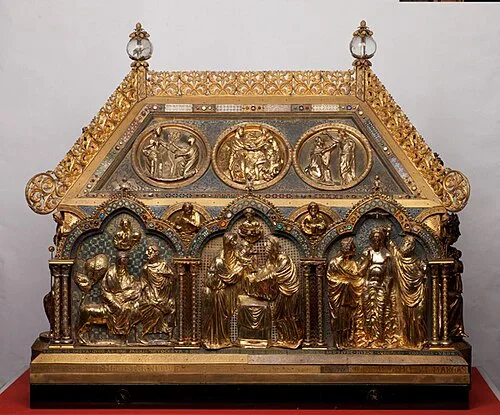 Cathedral Treasury
The Shrine of Our Lady
The cathedral treasury holds its most celebrated piece: the reliquary shrine of Our Lady. It is counted among the so-called Seven Wonders of Belgium, a list of the country's most treasured works. The shrine is attributed to Nicholas of Verdun and his circle, masters of the Mosan goldsmith tradition. It takes the form of a gabled casket, like a small golden building. Chased goldwork covers every surface, with enameled medallions set along the roof and figured panels below, showing holy figures in repoussé relief. Colored enamel glints between the gold in blues and greens. It was made to hold relics, and to make their holiness visible in precious metal.
Listen in the appPhoto: PMRMaeyaert · CC BY-SA 4.0
- 11
Mosan Goldsmiths in the Treasury
A second gabled shrine and the Mosan goldsmiths whose work was prized across medieval Europe.
- 12
The Fire of 18 May 1940
May 1940: a prison director, nine guards and fifteen convicts who fought the fire for the cathedral.
- 13
The Five Towers and the Living Monument
Five towers of eighty-three metres, seven planned, and a monument still being cared for today.
Onze-Lieve-Vrouwekathedraal
Frequently asked questions
How much does the guide cost?
Free app download. Listed guide price: $0.99. Guide price shown in the app. Audio guide only. Venue admission is separate.
Can I listen without internet?
Yes. Download the guide’s audio, images, and maps in the app before your visit. Your downloaded content is then available offline.
Can I listen in my language?
This audio guide is available in 15 languages, including English.
Do I need to follow a schedule?
No. This is a self-guided experience. Choose your stops, pause whenever you like, and return to a story at your own pace.
At your own pace
Explore Onze-Lieve-Vrouwekathedraal.
Download Stanza, then search for “Onze-Lieve-Vrouwekathedraal”.
Free app download · Guide price shown in the app
Keep exploring
Nearby audio guides
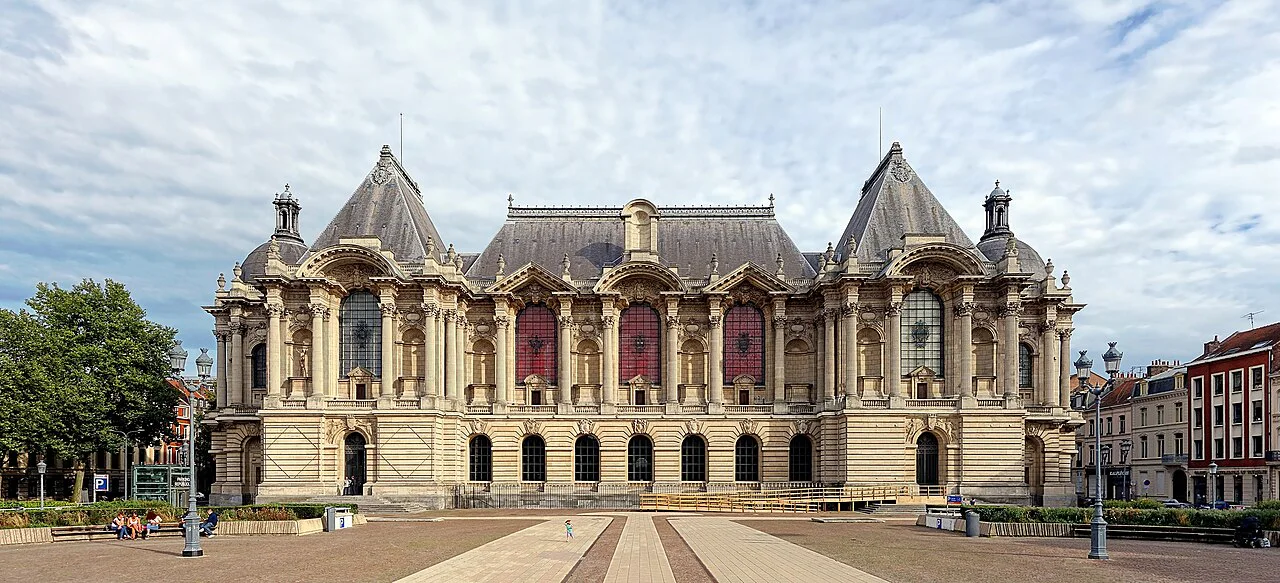
Lille · 23 km
Palais des Beaux-Arts de Lille
Content & sources
Photo: Velvet · CC BY-SA 3.0
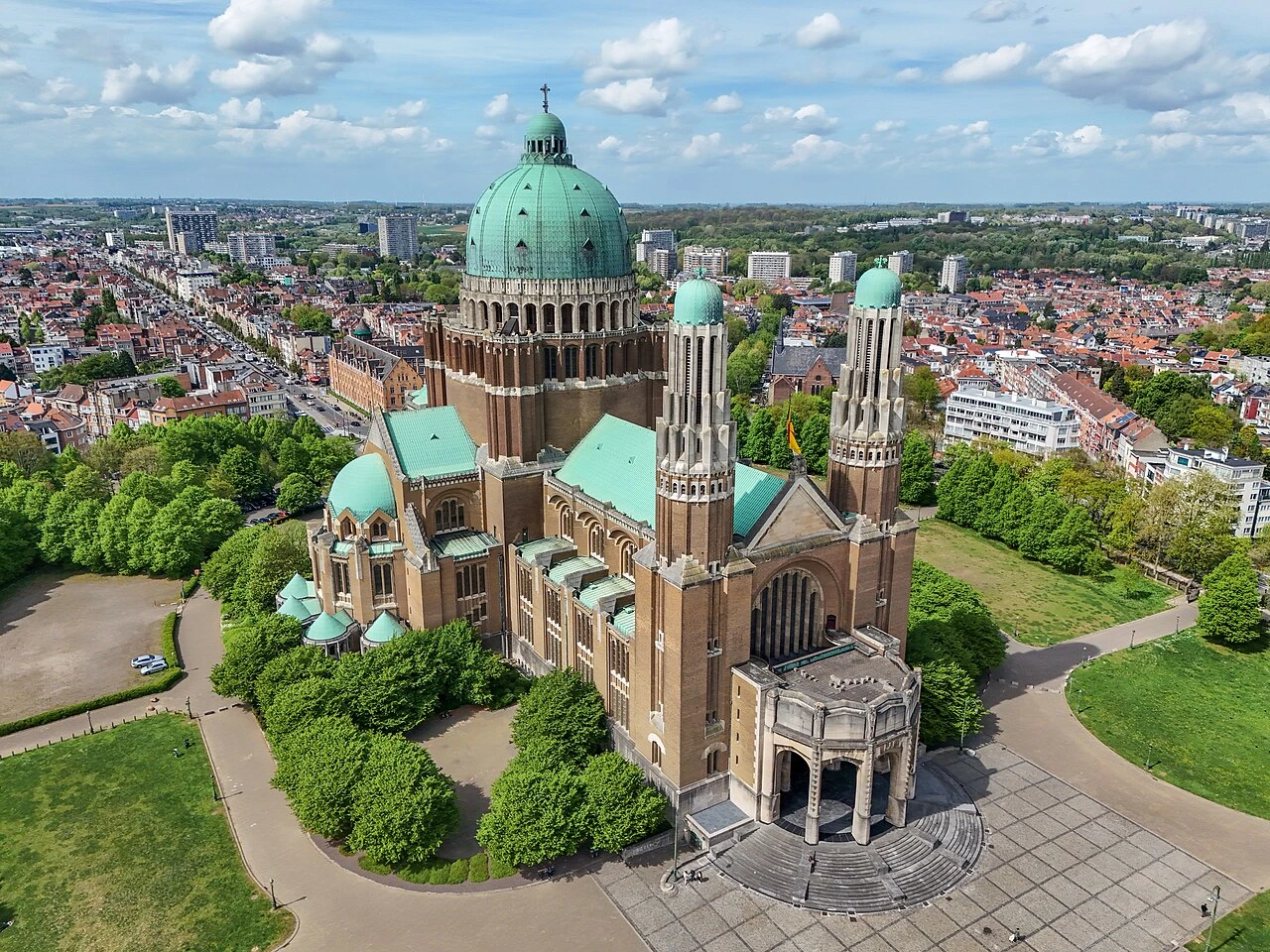
Koekelberg · 71 km
Basilica of the Sacred Heart, Brussels
Content & sources
Photo: Giles Laurent · CC BY-SA 4.0
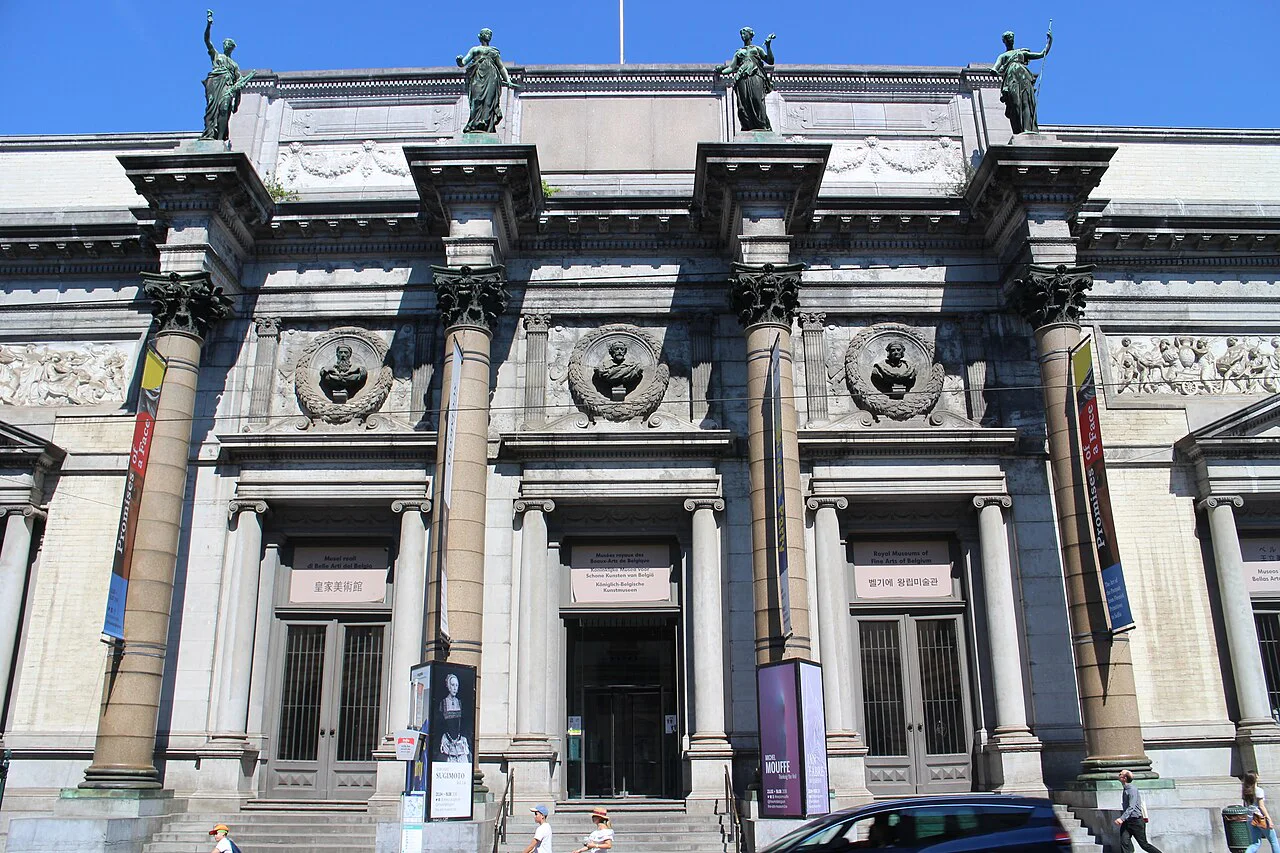
Brussels · 73 km
Royal Museums of Fine Arts of Belgium
Content & sources
Photo: Suicasmo · CC BY-SA 4.0
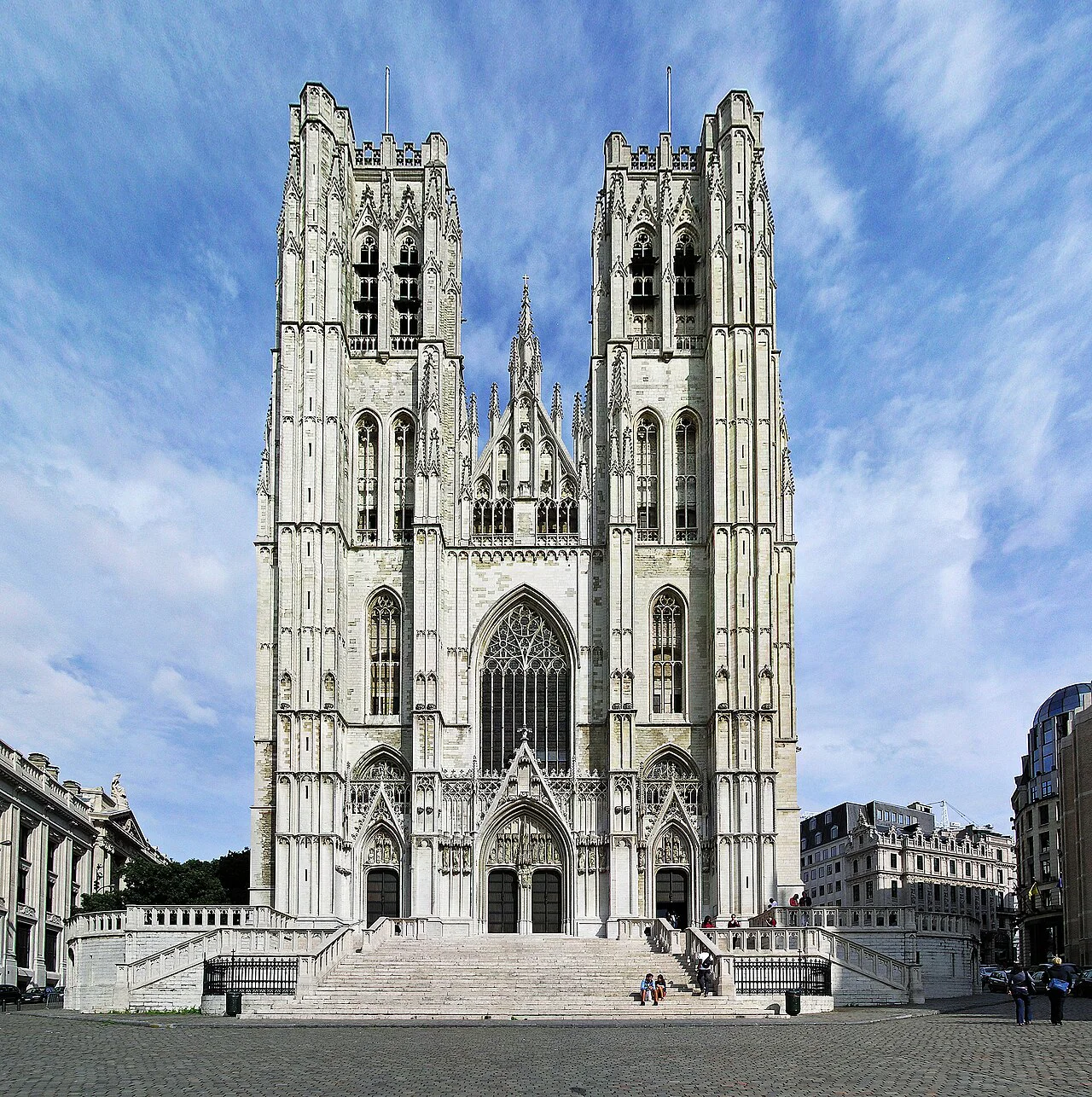
Brussels · 73 km
Kathedraal van Sint-Michiel en Sint-Goedele
Content & sources
Photo: Donaldytong · CC BY-SA 3.0