Stanza · Audio guide
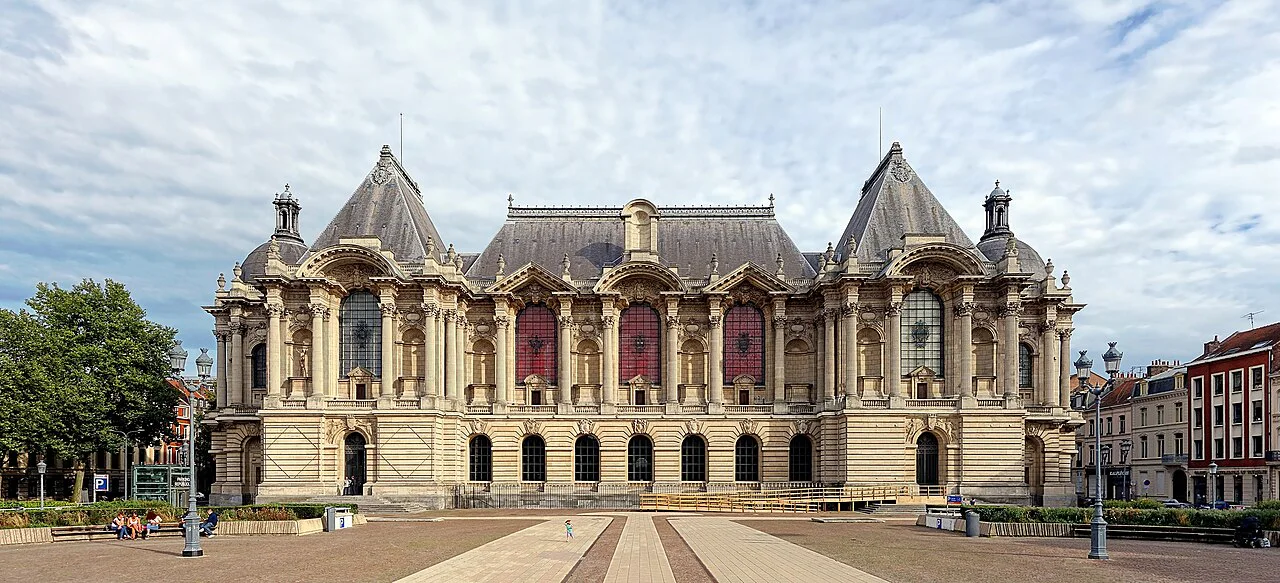
Palais des Beaux-Arts de Lille Audio Guide
A place to remember. A story to take with you.
The Palais des Beaux-Arts de Lille is a municipal museum in Lille dedicated to fine arts, modern art, and antiquities. It is one of the largest art museums in France.
Download Stanza, then search for “Palais des Beaux-Arts de Lille”.
About the tour
One guide. Your kind of visit.
The Palais des Beaux-Arts de Lille is a municipal museum in Lille dedicated to fine arts, modern art, and antiquities. It is one of the largest art museums in France.
The Palais des Beaux-Arts de Lille guide tells the stories of 96 artworks, including Belisarius Begging for Alms (Jacques-Louis David), After Dinner at Ornans (Gustave Courbet), Concert in the Egg (Hieronymus Bosch), Nymph abducted by a faun (Alexandre Cabanel), Crucifixion (Anthony van Dyck), Napoleon in Imperial Costume (Jacques-Louis David), The Abduction of Europa (Jacob Jordaens), and The Descent from the Cross (Peter Paul Rubens). 1 of the most famous are longer stories that move across the picture detail by detail, set to music. Every artwork is free to hear in the Stanza app until 1 January.
Ready when you are.
- 01Get the free Stanza app.
iOS & Android
- 02Find your guide.
“Palais des Beaux-Arts de Lille”
- 03Download before you go.
Works offline
Audio guide / 96 artworks
Inside the guide
Get to know a few of the stories before you go. Open a stop to read more.
01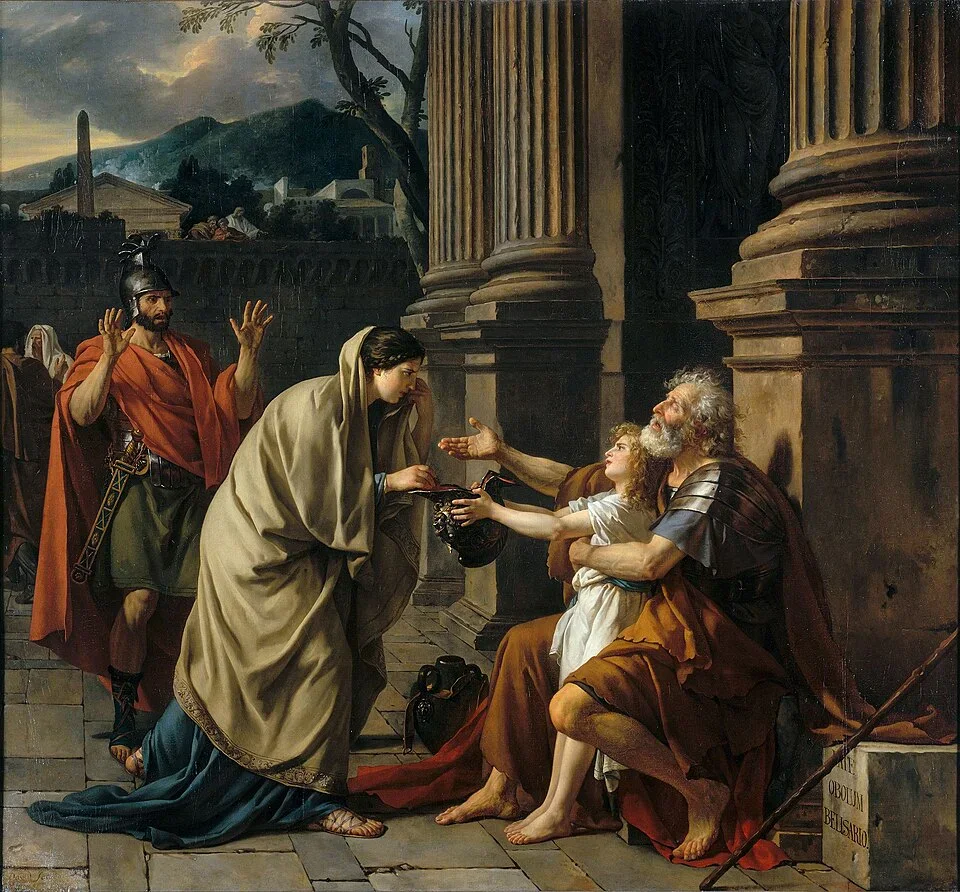
Belisarius Begging for Alms
You pass a beggar by the road. Most people would. But a soldier in a red cloak has stopped dead. This beggar is Belisarius, and the painter is Jacques-Louis David. The soldier's hands fly up, fingers spread. His mouth is open. He has just recognised the old man. Why such shock? Because this beggar once beat the Vandals in North Africa for his emperor. Now he sits against a column, still wearing the metal plates of his armour on his shoulder. A general, down on the stones. His eyes are lifted, but they see nothing. He cannot even see the man who sees him. And his hand is open, palm up. Asking. A boy is held in the old man's arm, and his hand reaches for the jug. The boy is young. Belisarius is old. Between them, the glory of youth and the wreck of age. Then the woman. Her head is covered, her brow is tight, and one hand rises to her face. Below, her hand rests on the jug, the boy's hand grips it too, and the old man's open palm waits above. Their hands all reach sideways, as if need and love passed between them. Now look back at the soldier. The hands below reach sideways. His go straight up. Astonishment shoots to the sky. And no written telling of the story has this meeting. David invented it. He even painted a plea carved on the stone beside the beggar. Give a coin to Belisarius. A general brought down by unjust rule. In 1781, perhaps, a painter could use such a story to speak about the men in power in his own day, and stay safe. And that open hand is still held out. Will you pass by?
Listen in the appJacques-Louis David · Public domain
02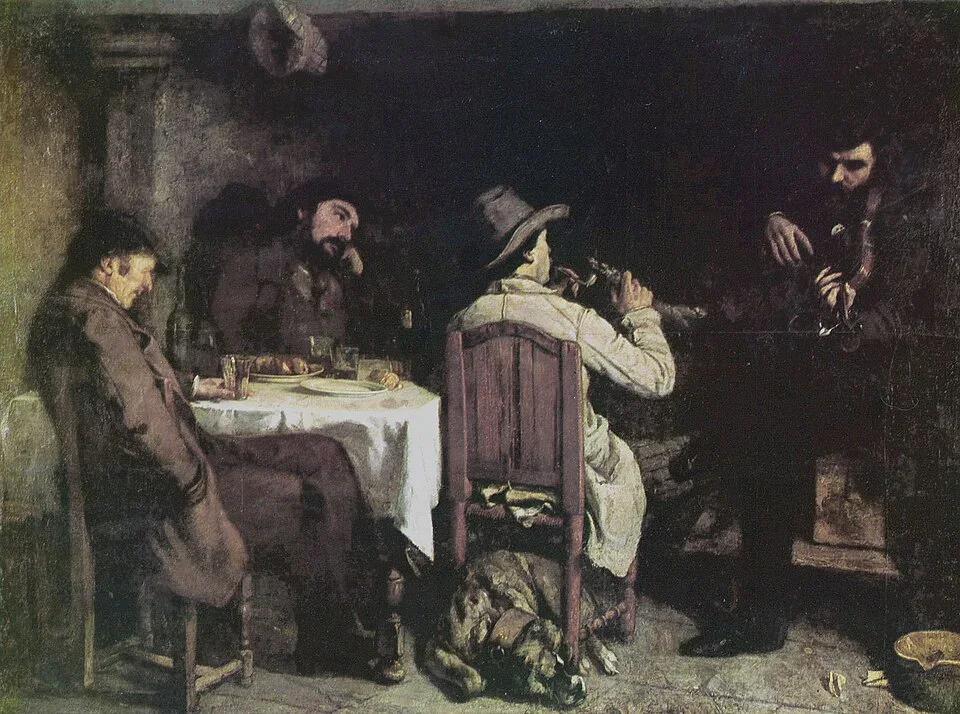
After Dinner at Ornans
One November, Courbet was back home in Ornans, at his friend Cuenot's house. Marlet had just come in from hunting, and Promayet took up his violin and played for the painter's father. Courbet wrote those words himself, to explain the picture when it hung at the Salon of 1849. He painted the evening just as it happened, and he painted it big. The men are almost life size, on a canvas of a size then kept for gods, kings and battles. Here it holds four men lingering after a meal, the remains of the food still on the table. Promayet plays his violin, facing a man whose back is turned to you, lighting his pipe. Under that chair a bulldog sleeps. Cuenot leans on his elbow, lost in thought. The gamble worked. The picture won a medal, which meant Courbet never had to face the Salon jury again, and the French state bought it. It was the first of his paintings to enter a museum. People still argue over whether Courbet gave himself a place among these men.
Listen in the appGustave Courbet · Public domain
03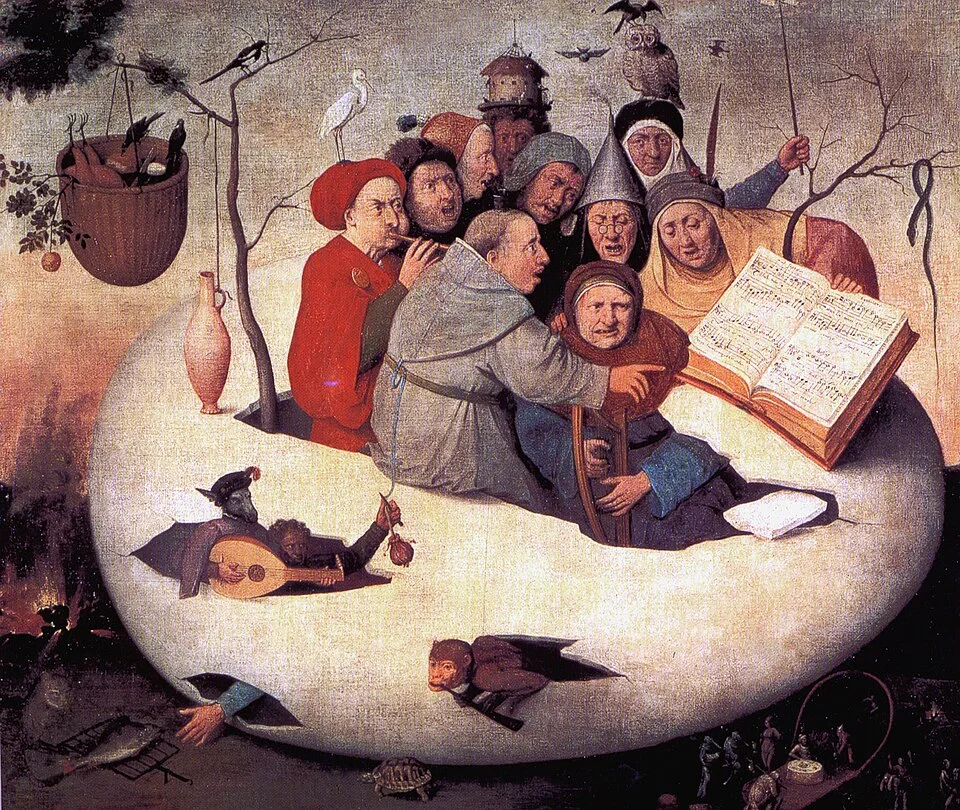
Concert in the Egg
Nobody knows who painted this. It has traveled under the name of Hieronymus Bosch, but it comes from the hand of a follower whose name is lost. What you see is a concert inside an eggshell. The singers huddle together and form the yolk. One of them points at the songbook, singing with everything he has. So much so that he never notices the lute player beside him picking his pocket. An eel drifts through the scene, drawn to look like ale. Fools, drink, theft. It all feels like Bosch. Then comes the clue. The book is open, and its notes are real. They carry a song by Thomas Crecquillon, published in 1549. Bosch had died thirty-three years before that. Whoever painted this egg knew a song the master never could. The music gave him away.
Listen in the appFollower of Hieronymus Bosch · Public domain
04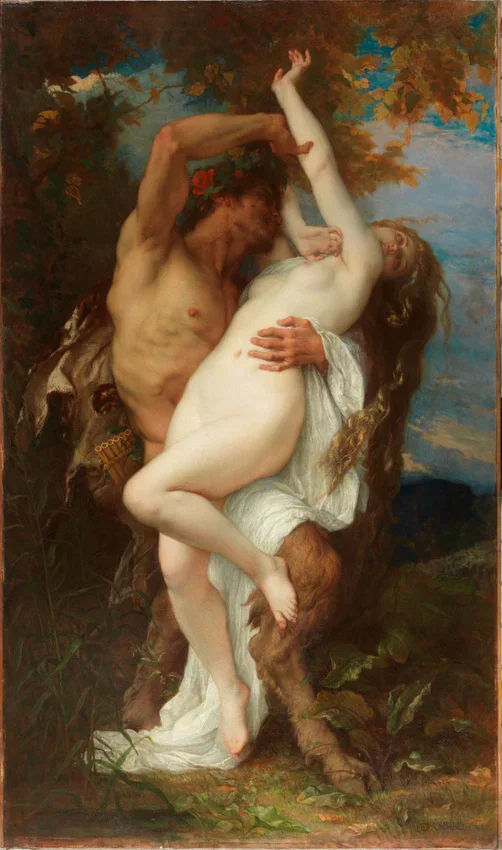
Nymph abducted by a faun
A man with a goat's legs has lifted a naked woman off the ground. He is a faun, and a pan flute hangs at his side. She pushes against him with both arms crossed, leaning away as far as she can. And yet he holds her almost carefully, as if he were trying to set her down on his leg. So which is this, a theft or a meeting? Her body says one thing. Her face says something harder to pin down, because it could be distress, or it could be something else entirely. Alexandre Cabanel, the emperor Napoleon the Third's favorite painter, showed this at the Paris Salon of 1861, and the emperor bought it on the spot for fifteen thousand francs. The nymph has the same pale skin and the same hair as the famous Venus Cabanel painted.
Listen in the appAlexandre Cabanel · Public domain
05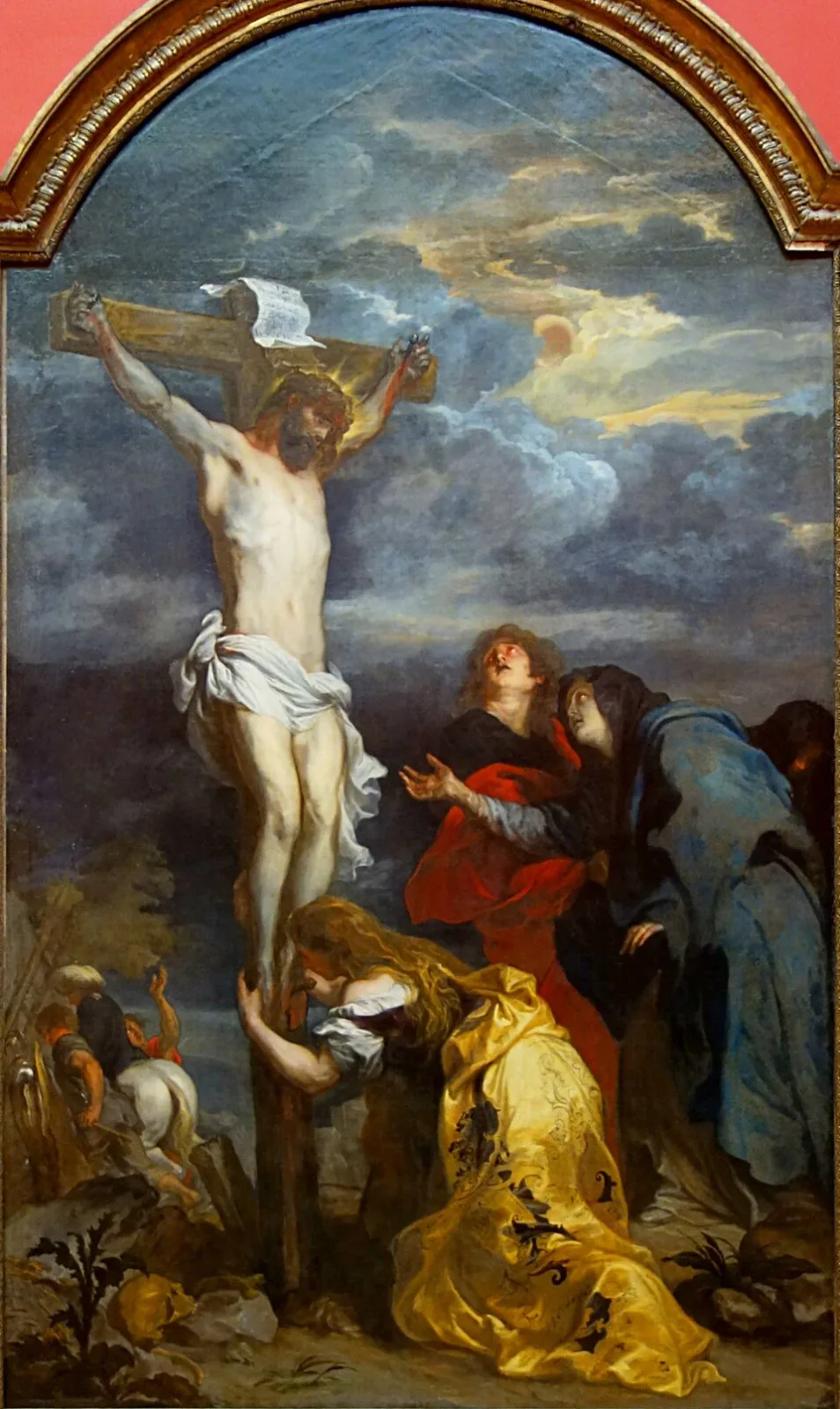
Crucifixion
Down at the lower left, under a thistle, there is a skull. It is easy to walk past. It belongs to Adam, the first man. The hill where Christ died is called Golgotha, which means the place of the skull, and so Adam's skull rests here at the foot of the cross. The thistle growing over it stands for the Fall, and its spines call to mind the crown of thorns above. Van Dyck painted this around 1630 for the high altar of a convent here in Lille, fresh from Italy, where the Venetian painters had taught him a sky like this one, stormy with orange light breaking through. He set the cross off center, leaning, to pull the scene into depth. At its foot the mourners wear their meaning. Mary Magdalene, in golden yellow, the color of light that never ends, kisses the bleeding feet. John, in red for the Passion, looks up with eyes red from weeping. The Virgin, in blue, which stands for humanity itself, reaches toward her son. And at the very top, cut faintly into the arch of the frame, there is a triangle. The sign of the Trinity, over all of it.
Listen in the appAnthony van Dyck · Public domain
06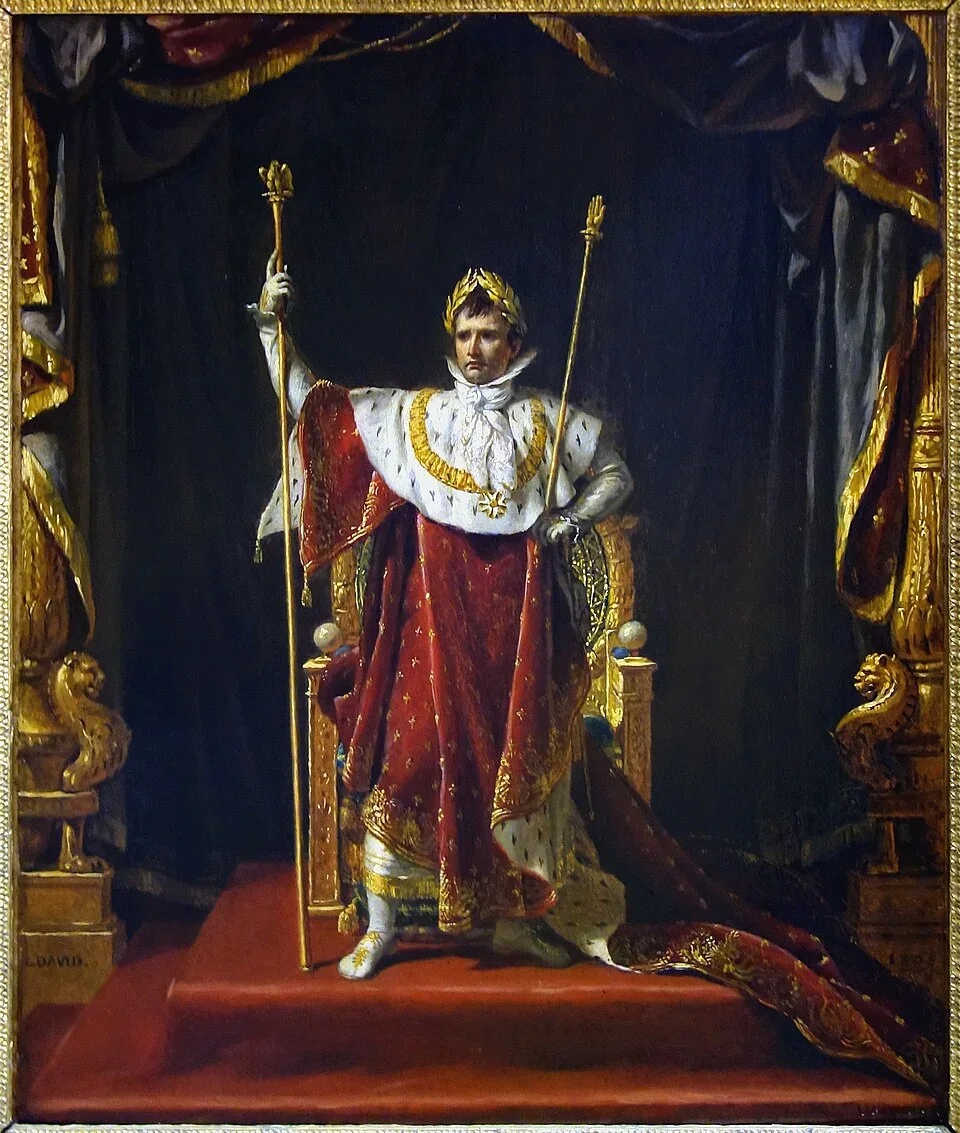
Napoleon in Imperial Costume
What you are looking at is not the portrait itself. It is David's first try, a small oil sketch made to work out the big one. He made it in 1805, showing the emperor in his full coronation robes, the dress he wore at his own crowning. The large portrait was meant for the Tribuna in Genoa. But Napoleon was not happy with it, and David left the big canvas unfinished. A second version was painted for Napoleon's brother Jerome, king of Westphalia. That one is lost. So this little sketch, kept here, is how we know the refused portrait today.
Listen in the appJacques-Louis David · Public domain
07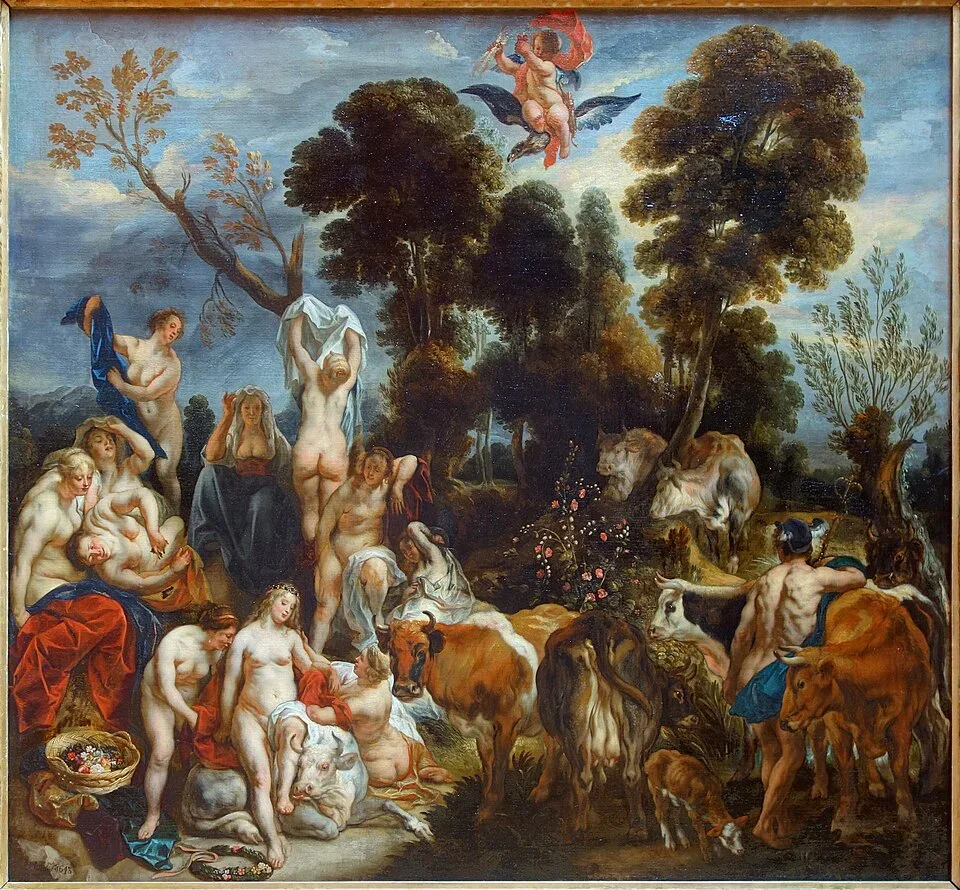
The Abduction of Europa
It looks like a lazy afternoon in a meadow. Young women playing in the grass, a white bull resting on the ground, a herd grazing off to the right, watched over by a man with a staff. Nobody is hurrying anywhere. But look at the girl settling onto the bull's back. That is Europa, a princess, and the bull is the god Jupiter, who took this shape so she would not be afraid of him. She has just climbed on. The garland of flowers she gave him still lies on the ground. And his front leg is already stretched out, ready to rise. When it does, he will carry her into the sea and away to Crete. Above the trees, an eagle carries Cupid, who holds the god's lightning and his flaming heart hidden from her, for now. Jordaens painted this in 1643, at the height of his fame. It still looks like a game.
Listen in the appJacob Jordaens · Public domain
08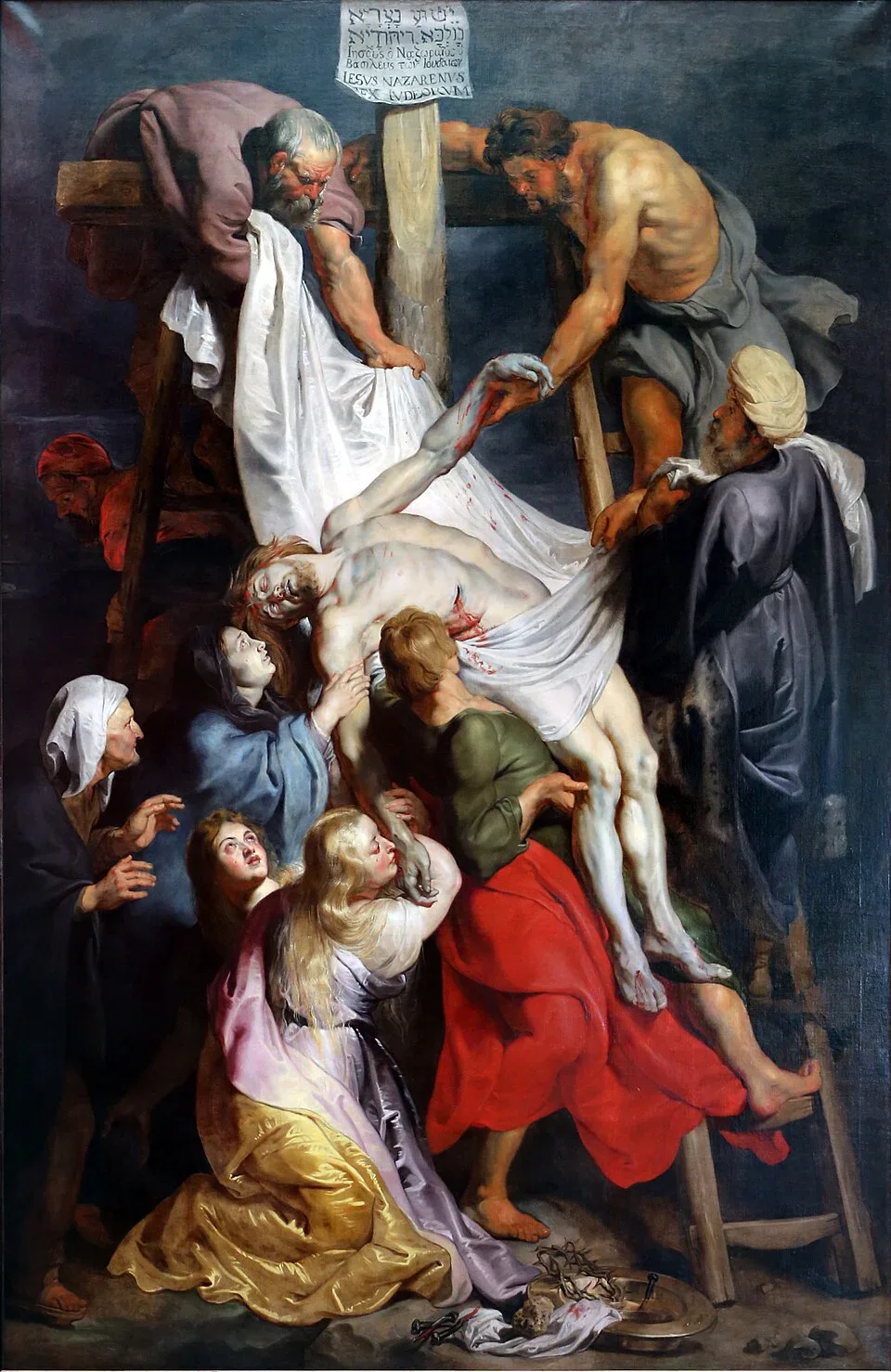
The Descent from the Cross
Mary Magdalene presses her lips to the hand of Christ, and the hand is still bleeding. That kiss is the key to the whole picture. Rubens painted it around 1616 to 1617 for the chapel of a Capuchin convent in Lille, and he meant it to speak about the Eucharist, the rite of the altar. So the shroud the body is lowered onto stands for the altar cloth. John brings his face right up to the open wound in Christ's side. The dead body comes down the way a priest holds the bread over the altar. Rubens had already painted a famous Descent from the Cross for the cathedral in Antwerp, but here he let the grief and the blood carry that second meaning. And on the far left, an old woman walks into the scene who was never in his first sketch.
Listen in the appSailko · CC BY 3.0
09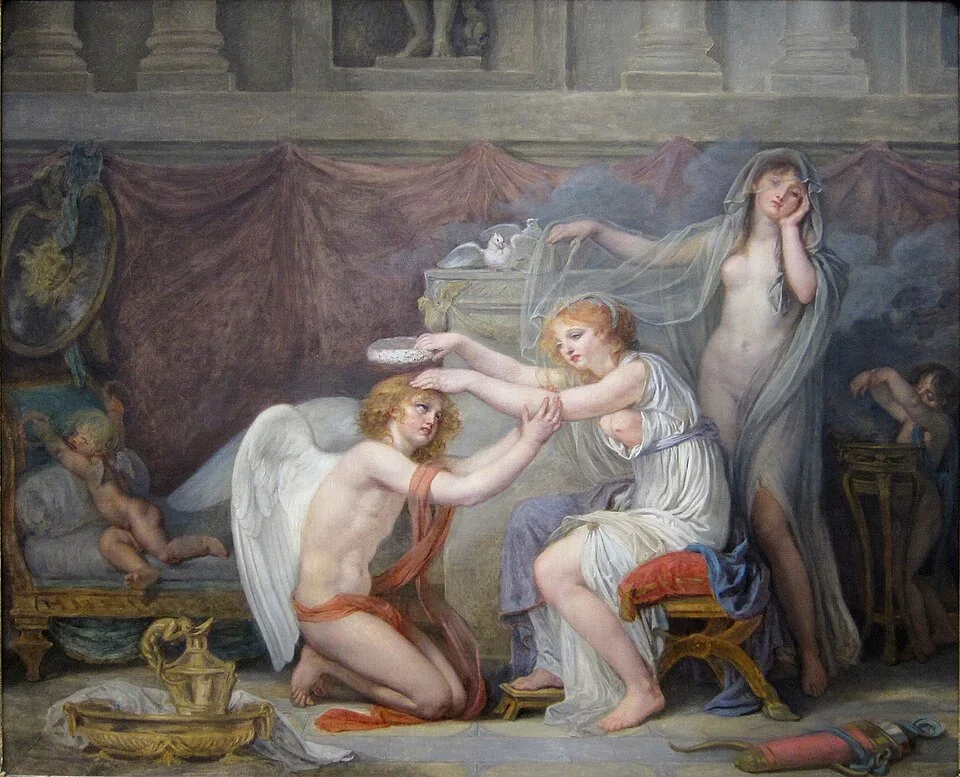
Cupid Crowned by Psyche
A young woman is about to lay a white crown on the forehead of the god kneeling before her. Behind her, a figure called Modesty turns her face away. And in the background, two little cupids are busy. One lays rose wreaths on a bed. The other throws incense into a burner. This is the moment the myth turns around. Venus was jealous of Psyche, so she sent her son Cupid to shoot the girl with one of his arrows, which would make her fall in love with the ugliest of creatures. But it was Cupid who fell under her spell. He ended up marrying her. Here, Psyche crowns him with her crown of purity. Greuze worked on this painting around 1785 to 1790, as the Revolution was coming. He never finished it. It stayed with his family until 1842, when his daughter Caroline, his heir, died. Only then was it shown to the public.
Listen in the appJean-Baptiste Greuze · Public domain
10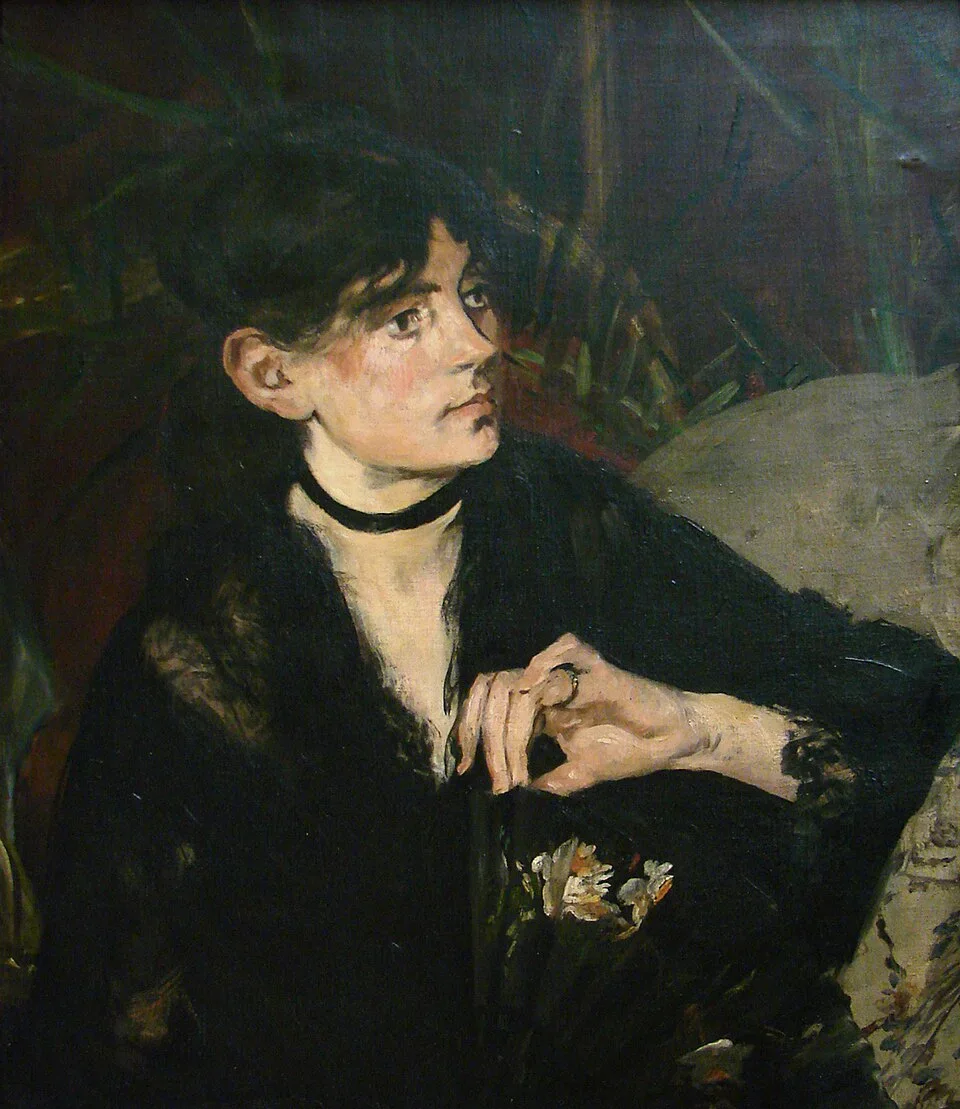
Berthe Morisot with a Fan
She will not look at you. She does not look toward the painter at all. That turned face is the whole point of this picture. Manet had painted Berthe Morisot twelve times between 1868 and 1874, and in every earlier portrait she looked at him. This one came in 1874, around the time she married his brother Eugène. After that, she never posed for him again. So the portrait seems to be a kind of goodbye. She is in black, mourning her father, though a ring shows on the hand that holds a flowered fan. Even her eyes are black here, though in life they were green. The painting came from Morisot's own collection, perhaps given to her by Manet himself. In 1999 it passed to the French state, and since 2000 it has hung here in Lille.
Listen in the appÉdouard Manet · Public domain
- 11
Apelles Painting Campaspe in the Presence of Alexander the Great
Jacques-Louis David · c. 1813–1823
- 12
The Time and the old woman
Francisco Goya · 1810–1812
- 13
The Letter
Francisco Goya · 1814–1819
- 14
St Mary Magdalene in Ecstasy
Peter Paul Rubens · c. 1619–1620
- 15
The Ascension of the Elect or Paradise
Dieric Bouts · c. 1470
- 16
The Fall of the Damned
Dieric Bouts · c. 1450–1470
- 17
The Sleep
Pierre Puvis de Chavannes · 1867
- 18
Noli me tangere
Lambert Sustris · 1548–1560
- 19
The Nativity
Philippe de Champaigne · c. 1643
- 20
The Beaked
Jean-François Millet · 1860
- 21
The Emperor Augustus Closes the Doors of the Temple of Janus
Carlo Maratta · 1655–1657
- 22
Medea
Eugène Delacroix · 1836–1838
- 23
Allegory of the vanities of the world
Pieter Boel · 1663
- 24
The Wolf of Gubbio
Luc-Olivier Merson · 1877
- 25
The Triumph of Marat
Louis-Léopold Boilly · 1794
- 26
Judith
Lambert Sustris · 1550–1554
- 27
The Temptation of St Anthony (Lille)
David Teniers the Younger · c. 1650
- 28
Birth of Venus
Eugène Emmanuel Amaury Duval · 1862
- 29
Vanitas
Jan Sanders van Hemessen · 1535–1540
- 30
Houses of Parliament, stormy sky
Claude Monet · 1904
- 31
The resurrection of the son of the widow of Naim
Jean-Baptiste Wicar · 1816
- 32
Triptych of the mystic bath
Jehan Bellegambe · 1525
- 33
Hercules Fighting Achelous
Noël Coypel · 1667–1669
- 34
Soldier Playing Dice for Christ's Tunic
Nicolas Régnier · c. 1620
- 35
Volga and Mikula fireplace
Mikhail Vrubel · 1899
- 36
The Pear Pickers
Émile Bernard · 1888
- 37
Lady with candle
School of Dutch · 17th century
- 38
The Martyrdom of S. Catherine
Peter Paul Rubens · c. 1615
- 39
Joanna the Mad Awaiting the Resurrection of Philip the Handsome, Her Husband
Charles de Steuben · 1836
- 40
Sketch for a Paradise
Paolo Veronese · 1578
- 41
Cleopatra
Charles Gauthier · 1880
- 42
The Look
Odilon Redon · c. 1910
- 43
Port-Marly, Frost
Alfred Sisley · 1872
- 44
A Woman with a Serving Girl
Pieter de Hooch · c. 1675
- 45
Hilly wheat field
Jacob van Ruisdael · c. 1660
- 46
Arab Merchant Presenting a Mare
Théodore Chassériau · 1853
- 47
Wife of Jeroboam and the Prophet Ahijah
Frans van Mieris the Elder · 1671
- 48
Cutting a Pig
Isaac van Ostade · 1645
- 49
Le Baiser enfantin
Jacques-Eugène Feyen · 1865
- 50
Fortuna
Alfred Agache · 1885
- 51
Seascape or View of Honfleur
Eugène Louis Boudin, Gustave Courbet · 1841
- 52
The Sleeping Man
Carolus-Duran · 1861
- 53
The murdered, memory of the Roman campagna
Carolus-Duran · 1865
- 54
Tarquin and Lucretia
Jan Matsys · 16th century
- 55
Saint Jerome
Jusepe de Ribera · 1643
- 56
Flowers in a roemer with a butterfly and a bumble bee
Roelant Savery · c. 1610–1612
- 57
Napoléon, Prince Imperial, by Jean-Baptiste Carpeaux
Jean-Baptiste Carpeaux · 1888
- 58
Baptismal Font of Cousolre, 12th Century
inc · 12th century
- 59
Femme asphyxiée
Charles Porphyre Alexandre Desains · 1822
- 60
Fire in Constantinople
J. M. W. Turner · c. 1834
- 61
The Feast of Herod
Donatello · c. 1435
- 62
Landscape at Grandcamp
Georges Seurat · 1885
- 63
Still-life with Dish of Fruits
Balthasar van der Ast · 1623
- 64
Triumph of Silenus
Gerard van Honthorst · 1626
- 65
A whipper-in and his dogs
Jacob Jordaens · 1635
- 66
Temptation of Saint Mary Magdalen
Jacob Jordaens · 1620
- 67
St Francis receives the Christ Child from Mary
Peter Paul Rubens · 1617
- 68
Christ crowned with Thorns
Lucas Cranach the Elder · c. 1540
- 69
Portrait of Madame Ernest Feydeau
Carolus-Duran · 1870
- 70
Study of five cows
Jacob Jordaens · c. 1620
- 71
The Prodifgal Son als a shepherd repents his sins (Luke 15:15)
Jacob Jordaens · 1650–1675
- 72
Christ among the Pharisees.
Jacob Jordaens · 1662
- 73
Baudouin VI the Peaceful and Richilde of Hainaut
Arnould de Vuez · c. 1713
- 74
The Death of Timophanes
Léon Comerre · 1874
- 75
Dante et Virgile aux Enfers
Eugène Deully · 1897
- 76
Birth of the Virgin
Jacques Stella · 1644–1645
- 77
Belles du Nord
Unknown Artist
- 78
Tête Wicar - PL 1
Unknown Artist · 1700
- 79
The Rectory and the Church of Gerberoy
Henri Le Sidaner · 1903
- 80
Lille PdBA Knight
Emmanuel Frémiet · 1878
- 81
The First Steps
Henri Plé · 1887
- 82
Silence
Odilon Redon · 1895–1900
- 83
The Kiss
Carolus-Duran · 1868
- 84
The Silver Goblet
Jean-Baptiste-Siméon Chardin · c. 1730
- 85
Isaac sitting in bed blesses Jacob who, disguised in Esau's clothes, brings food to his father
Jacob Jordaens · 1660
- 86
The Lille Procession of 1789, on the Grand Place
François-Louis-Joseph Watteau · 1801
- 87
Maquette of Maastricht
Unknown Artist · 1748–1752
- 88
Département des sculptures, Palais des Beaux-Arts de Lille
Unknown Artist
- 89
Descent of Christ into Limbo, Brabant Altarpiece 16th Century
inc · 16th century
- 90
Pâris and Oenone
Reyer van Blommendael · c. 1655
- 91
Mademoiselle de Lambesc et le comte de Brionne
Jean-Marc Nattier · 1732
- 92
Interior of the Church in Delft with the Tomb of William the Silent
Emanuel de Witte · 1656
- 93
The Lamentation over the Dead Christ
Master of the Von Groote Adoration · 16th century
- 94
Venus and Cupid
Dirck de Quade van Ravesteyn · 17th century
- 95
Portrait of an Old Man Decorated with a Cross of the Holy Spirit
Johann Julius Heinsius · 1788
- 96
Lille PdBA Chaudet Belisarius
Antoine Denis Chaudet · 1800
Palais des Beaux-Arts de Lille
Frequently asked questions
How much does the guide cost?
Free app download. Free until 1 January. Listed guide price: $0.99. Audio guide only. Venue admission is separate.
Can I listen without internet?
Yes. Download the guide’s audio, images, and maps in the app before your visit. Your downloaded content is then available offline.
Can I listen in my language?
In English for now. More languages soon.
Do I need to follow a schedule?
No. This is a self-guided experience. Choose your stops, pause whenever you like, and return to a story at your own pace.
Which artworks are in the Palais des Beaux-Arts de Lille audio guide?
96 artworks, including Belisarius Begging for Alms (Jacques-Louis David), After Dinner at Ornans (Gustave Courbet), Concert in the Egg (Hieronymus Bosch), Nymph abducted by a faun (Alexandre Cabanel), Crucifixion (Anthony van Dyck), Napoleon in Imperial Costume (Jacques-Louis David), The Abduction of Europa (Jacob Jordaens), and The Descent from the Cross (Peter Paul Rubens). The full list is on this page.
Is this the museum’s official audio guide?
No. Stanza is an independent audio guide app and is not affiliated with Palais des Beaux-Arts de Lille. Museum admission is separate.
At your own pace
Explore Palais des Beaux-Arts de Lille.
Download Stanza, then search for “Palais des Beaux-Arts de Lille”.
Free app download · Guide price shown in the app
Keep exploring
Nearby audio guides
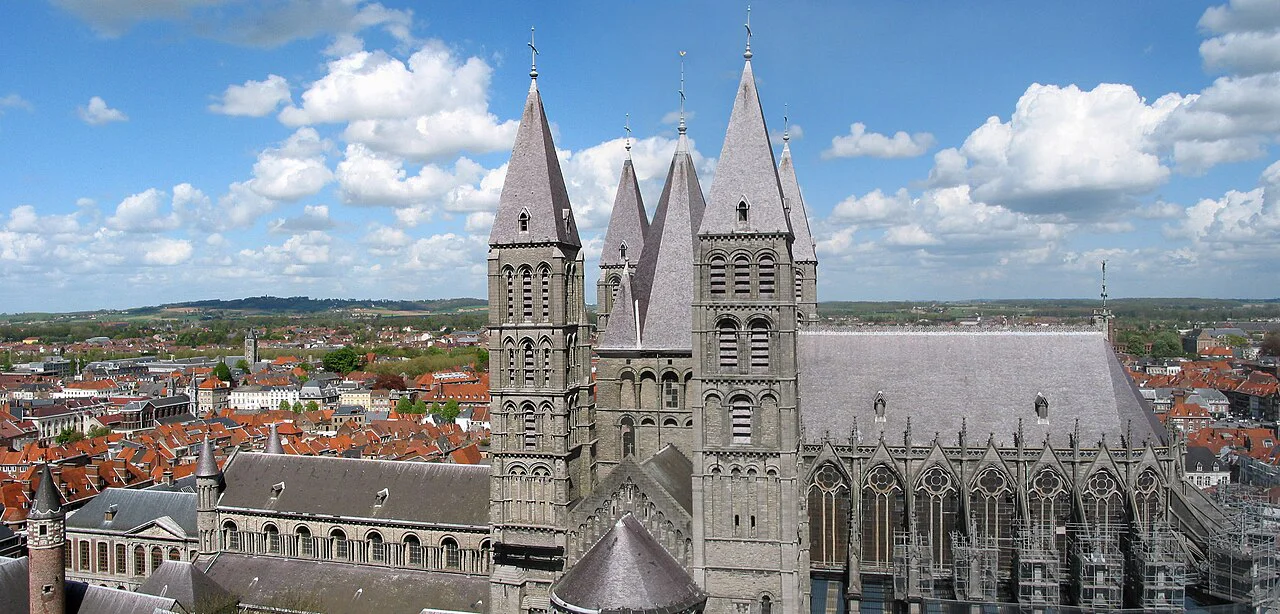
Tournai · 23 km
Onze-Lieve-Vrouwekathedraal
Content & sources
self-made composite, from photos taken by Jean-Pol Grandmont · CC BY 2.5
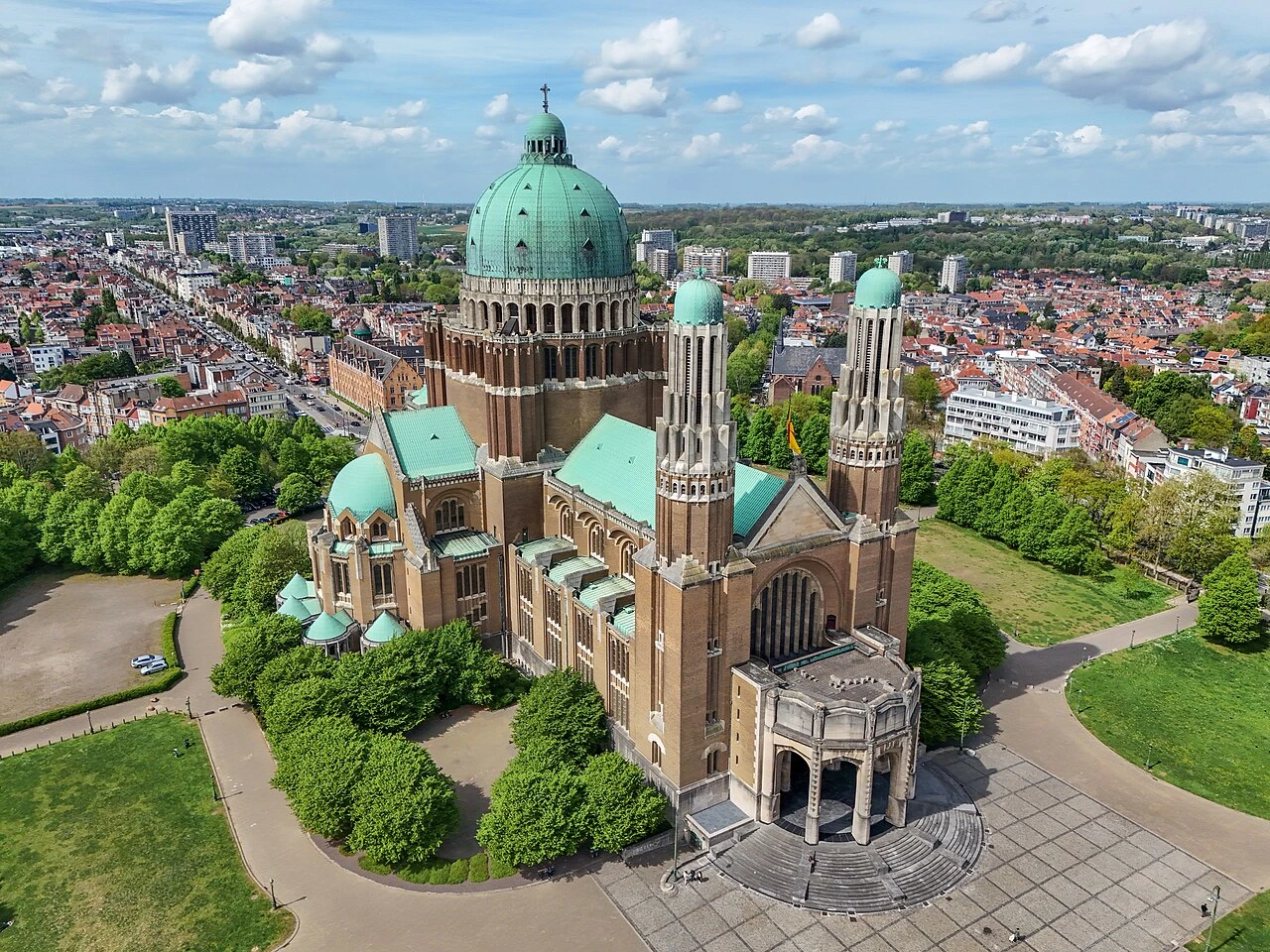
Koekelberg · 92 km
Basilica of the Sacred Heart, Brussels
Content & sources
Photo: Giles Laurent · CC BY-SA 4.0
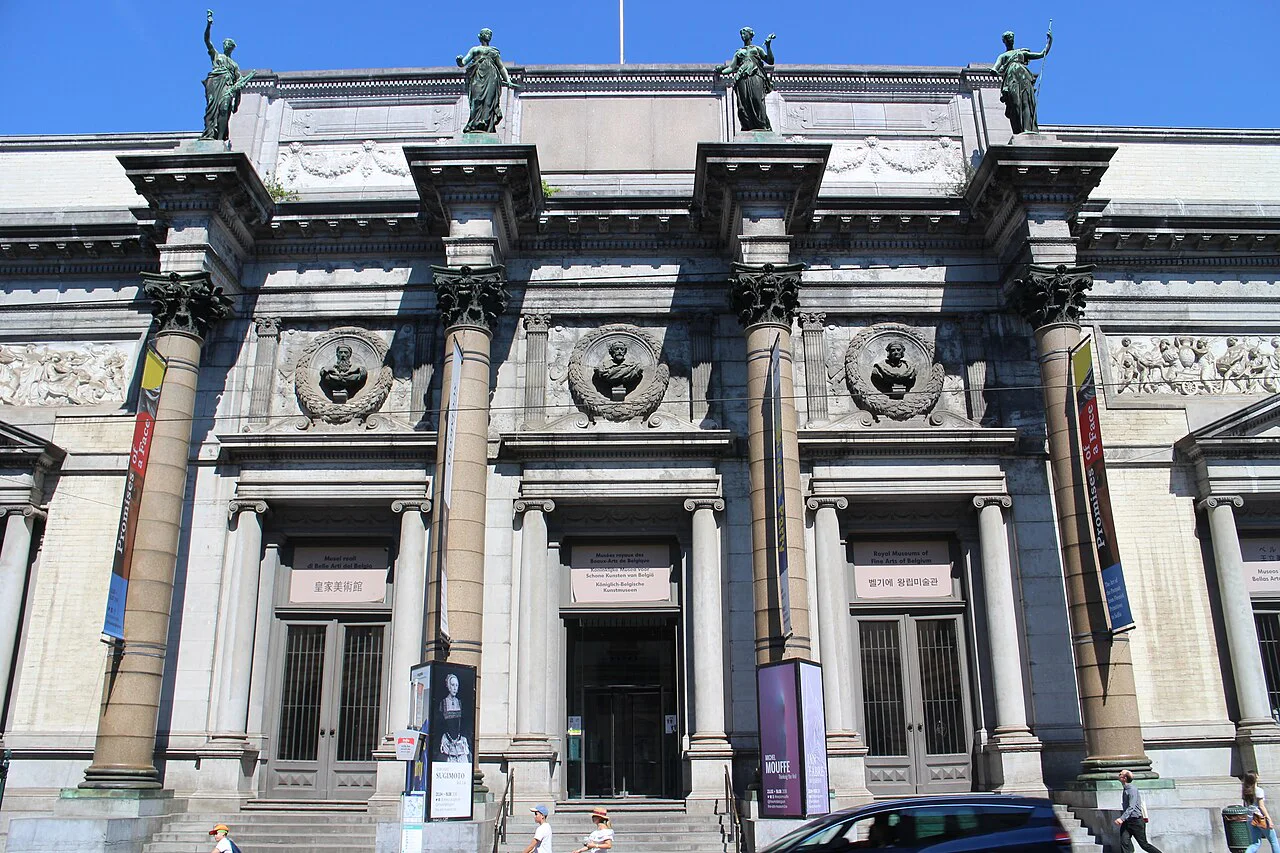
Brussels · 94 km
Royal Museums of Fine Arts of Belgium
Content & sources
Photo: Suicasmo · CC BY-SA 4.0
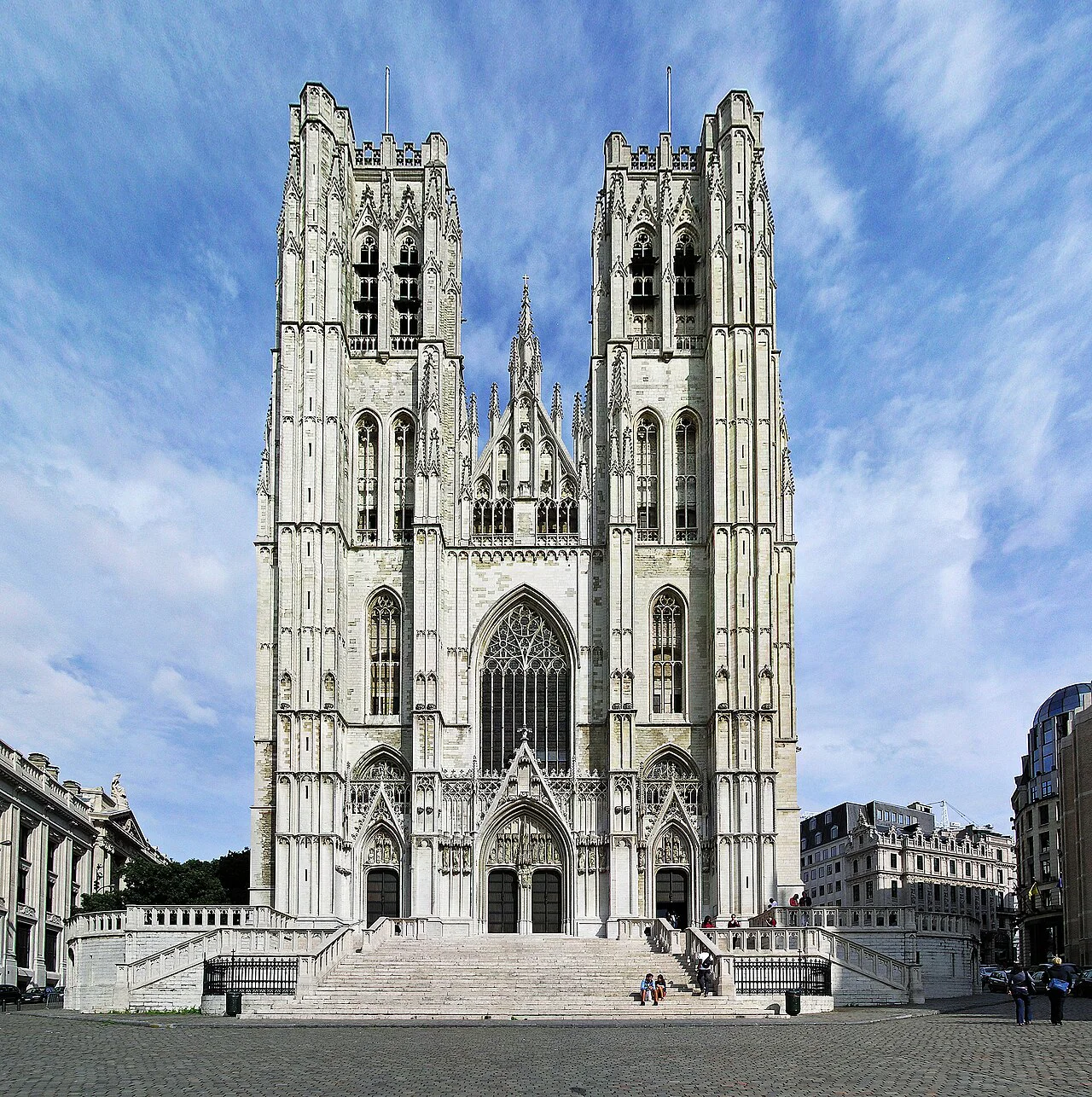
Brussels · 95 km
Kathedraal van Sint-Michiel en Sint-Goedele
Content & sources
Photo: Donaldytong · CC BY-SA 3.0
Art museums
More art museum audio guides
Brussels · 127 artworks
Royal Museums of Fine Arts of Belgium
Content & sources
Photo: Suicasmo · CC BY-SA 4.0
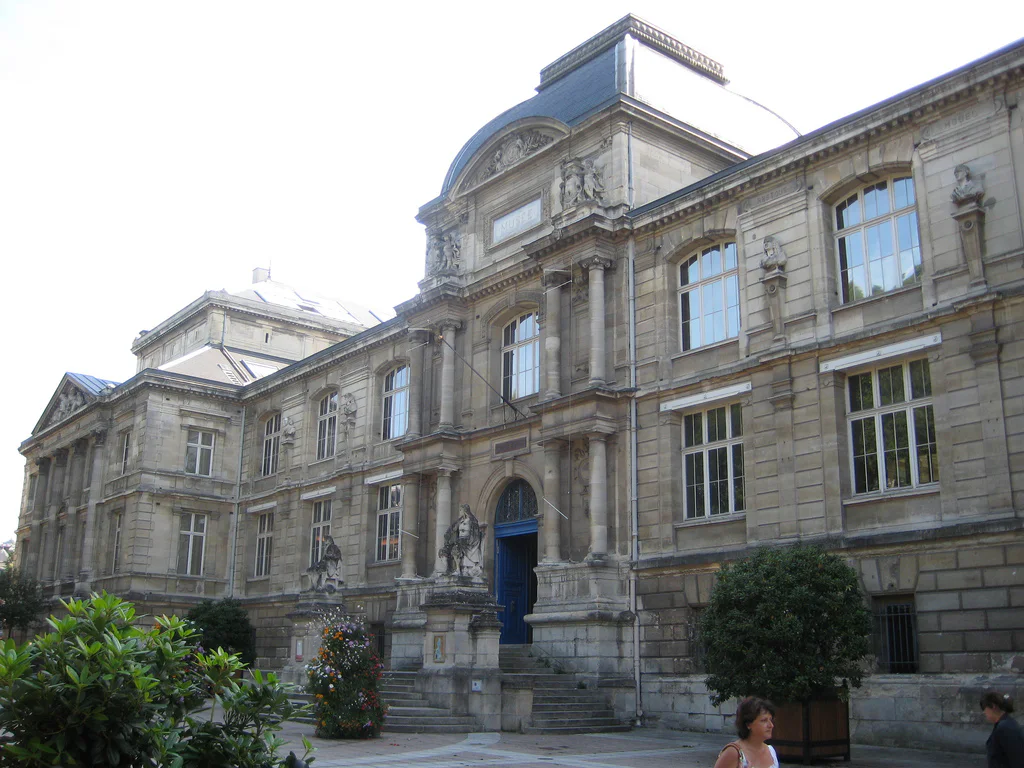
Rouen · 45 artworks
Musée des Beaux-Arts de Rouen
Content & sources
Allie_Caulfield · CC BY 2.0
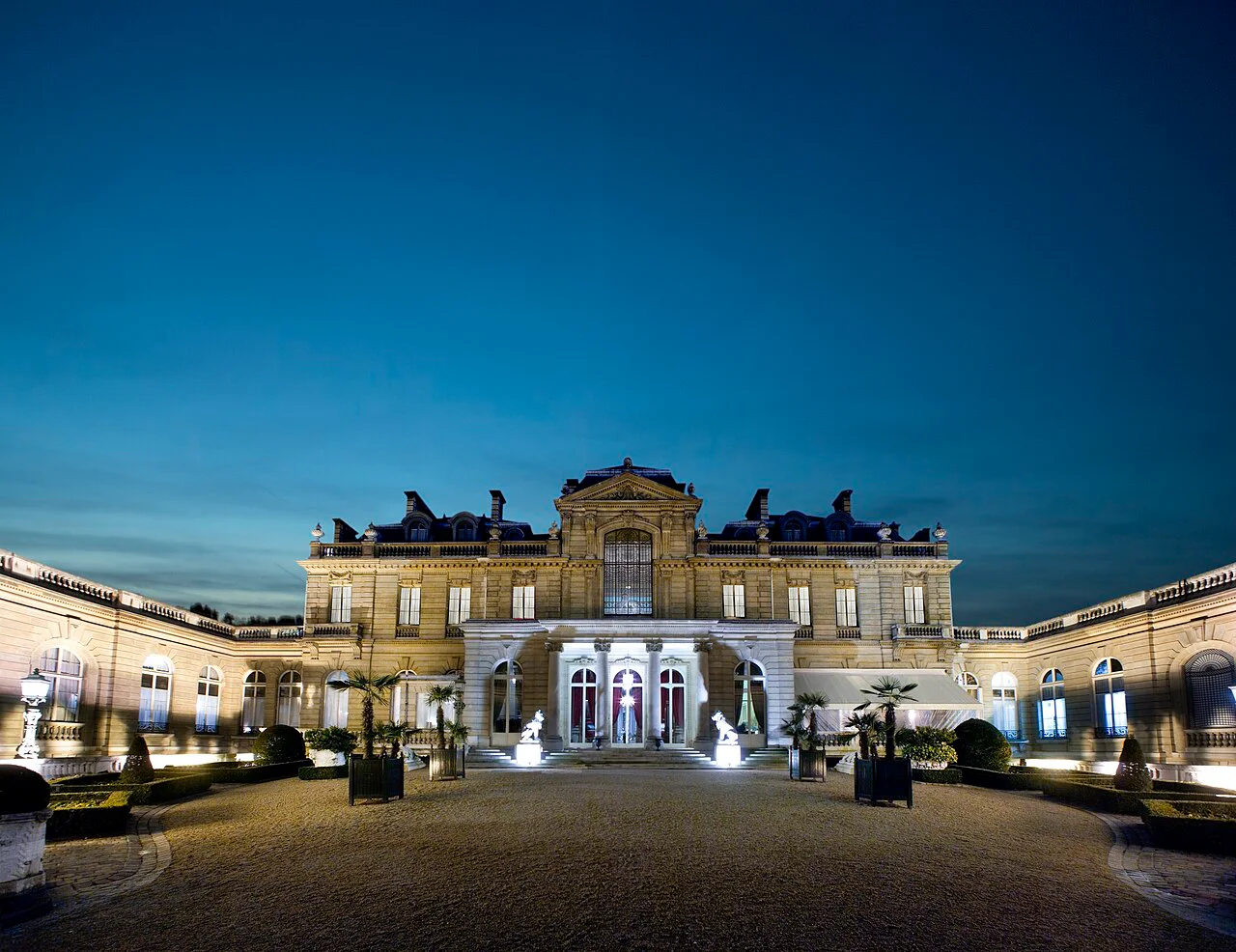
Paris · 24 artworks
Musée Jacquemart-André
Content & sources
Christophe Recoura · CC BY-SA 3.0
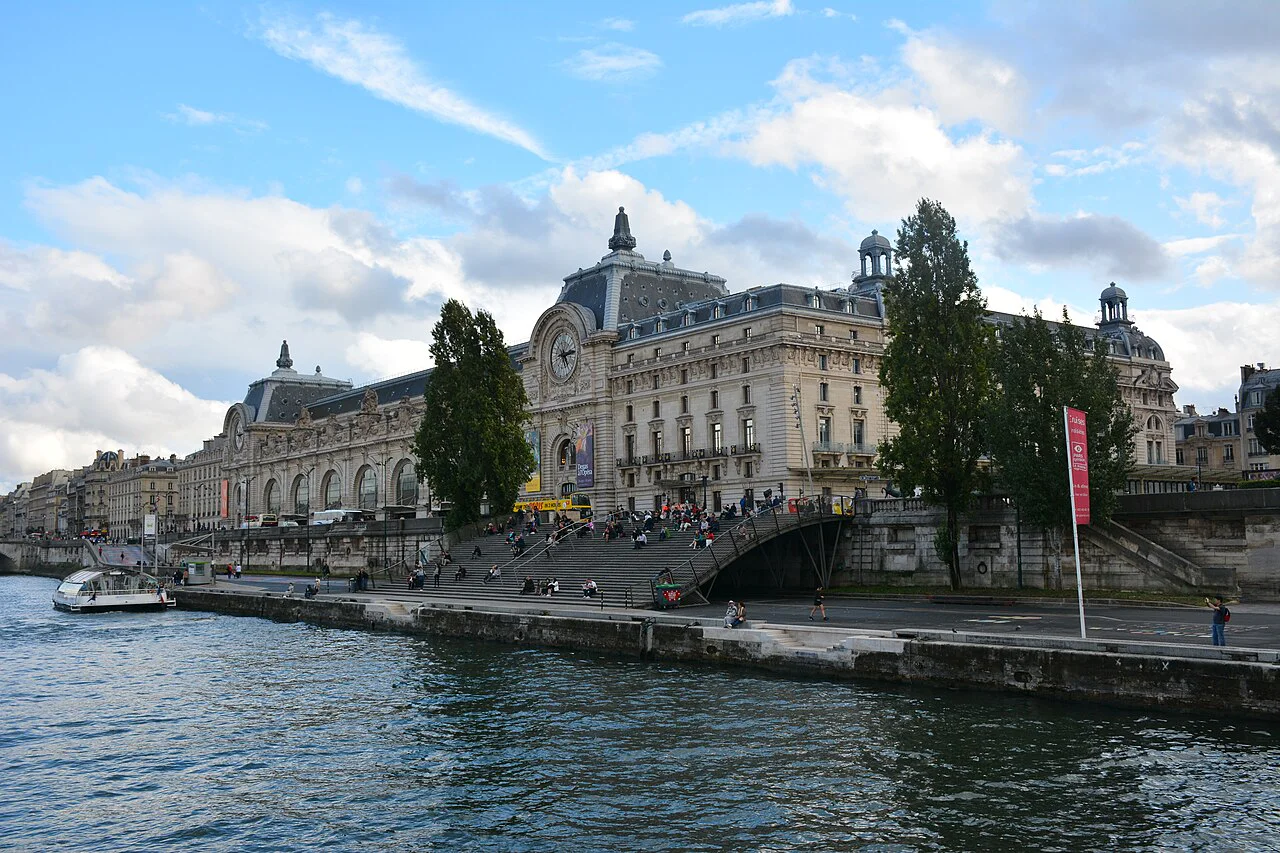
Paris · 205 artworks
Musée d'Orsay
Content & sources
Cheng-en Cheng from Taichung City, Taiwan · CC BY-SA 2.0
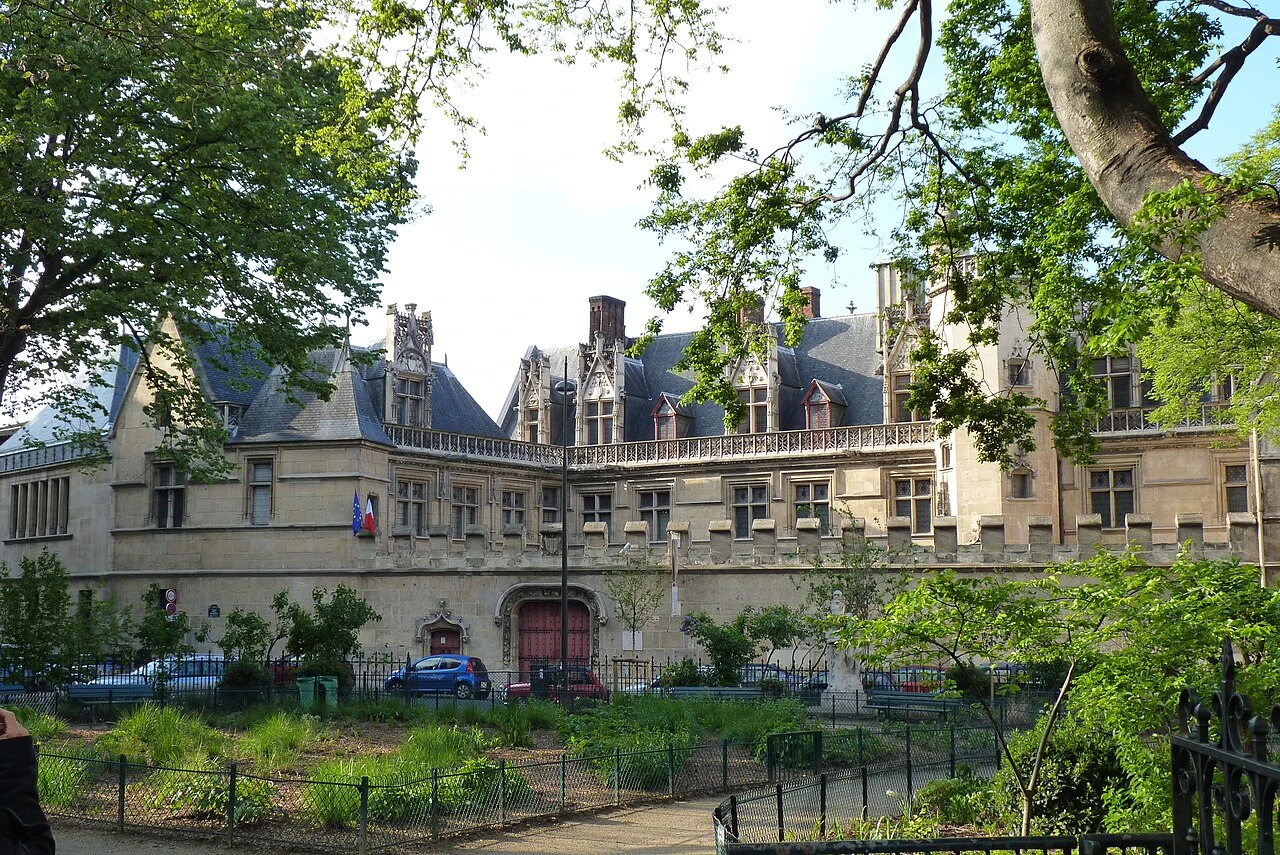
Paris · 29 artworks
Cluny Museum
Content & sources
ctj71081 · CC BY-SA 2.0
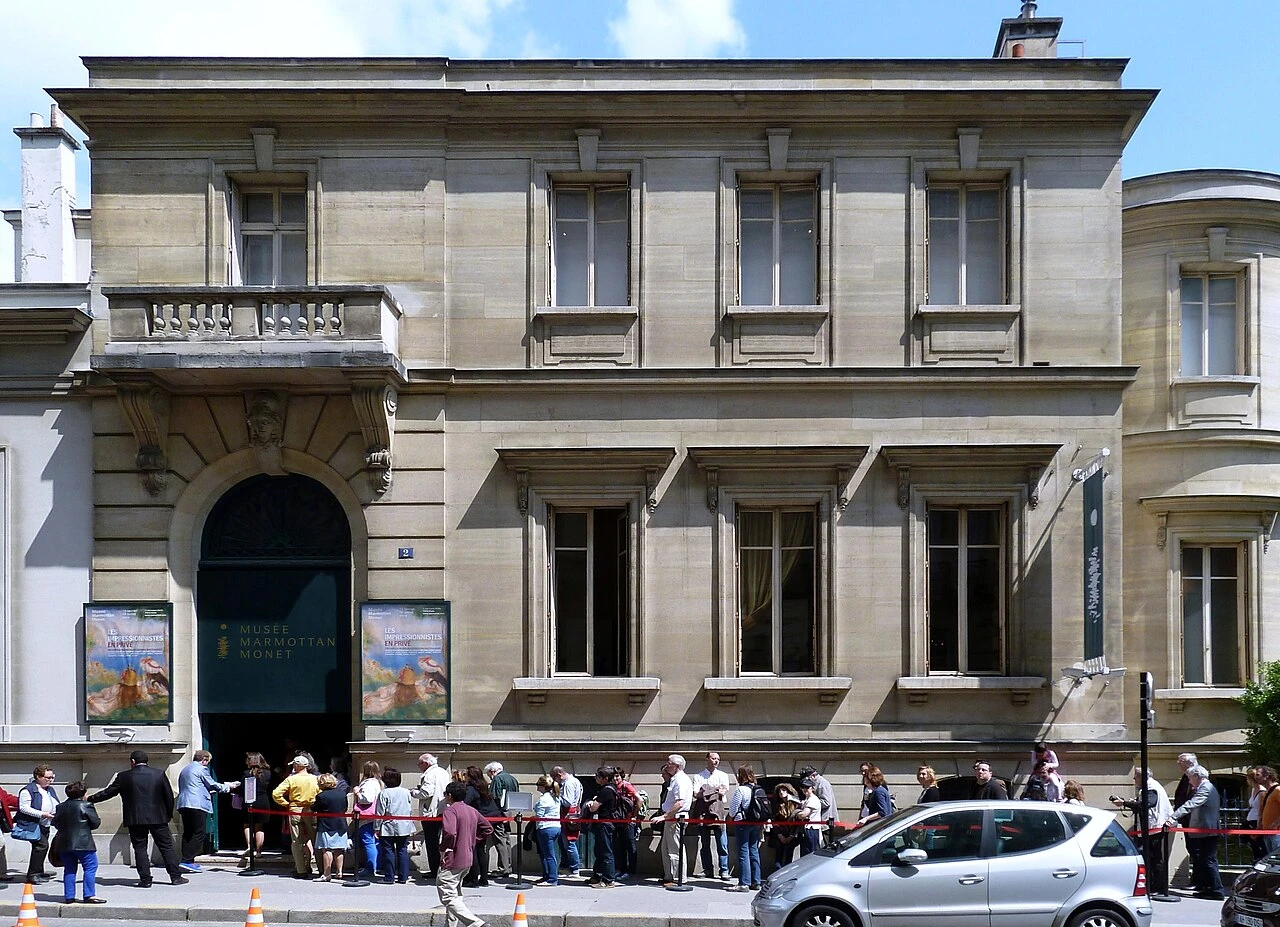
Paris · 25 artworks
Musée Marmottan Monet
Content & sources
PIERRE ANDRE LECLERCQ · CC BY-SA 4.0