Stanza · Audio guide
Musée Jacquemart-André Audio Guide
A place to remember. A story to take with you.
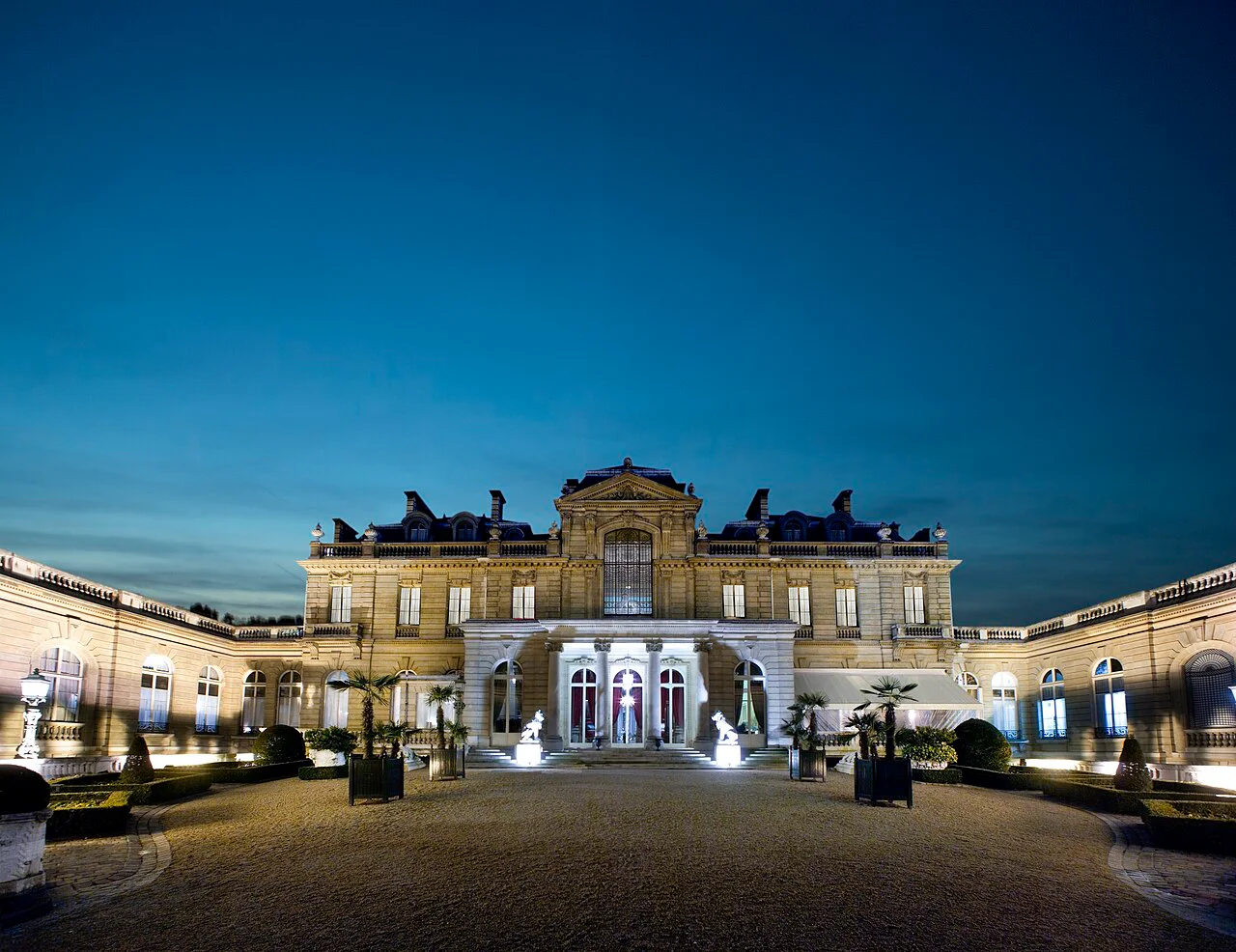
The Musée Jacquemart-André is a private museum located at 158 Boulevard Haussmann in Paris. It was created from the private home of Édouard André and Nélie Jacquemart to display the art they collected during…
Download Stanza, then search for “Musée Jacquemart-André”.
About the tour
One guide. Your kind of visit.
The Musée Jacquemart-André is a private museum located at 158 Boulevard Haussmann in Paris. It was created from the private home of Édouard André and Nélie Jacquemart to display the art they collected during their lives.
The Musée Jacquemart-André guide tells the stories of 24 artworks, including The Supper at Emmaus (Rembrandt), Candelabra Angels (Donatello), Hours of Jean de Boucicaut (Master of Boucicaut), Portrait du comte Antoine Français de Nantes (Jacques-Louis David), Portrait of countess Yekaterina Skavronskaya (Élisabeth Louise Vigée Le Brun), Ecce Homo (Andrea Mantegna), Madonna and Child with saints Jerome and Louis (Andrea Mantegna), and Portrait de Mathilde de Canisy, marquise d'Antin (Jean-Marc Nattier). Every artwork is free to hear in the Stanza app until 1 January.
Ready when you are.
- 01Get the free Stanza app.
iOS & Android
- 02Find your guide.
“Musée Jacquemart-André”
- 03Download before you go.
Works offline
Audio guide / 24 artworks
Inside the guide
Get to know a few of the stories before you go. Open a stop to read more.
01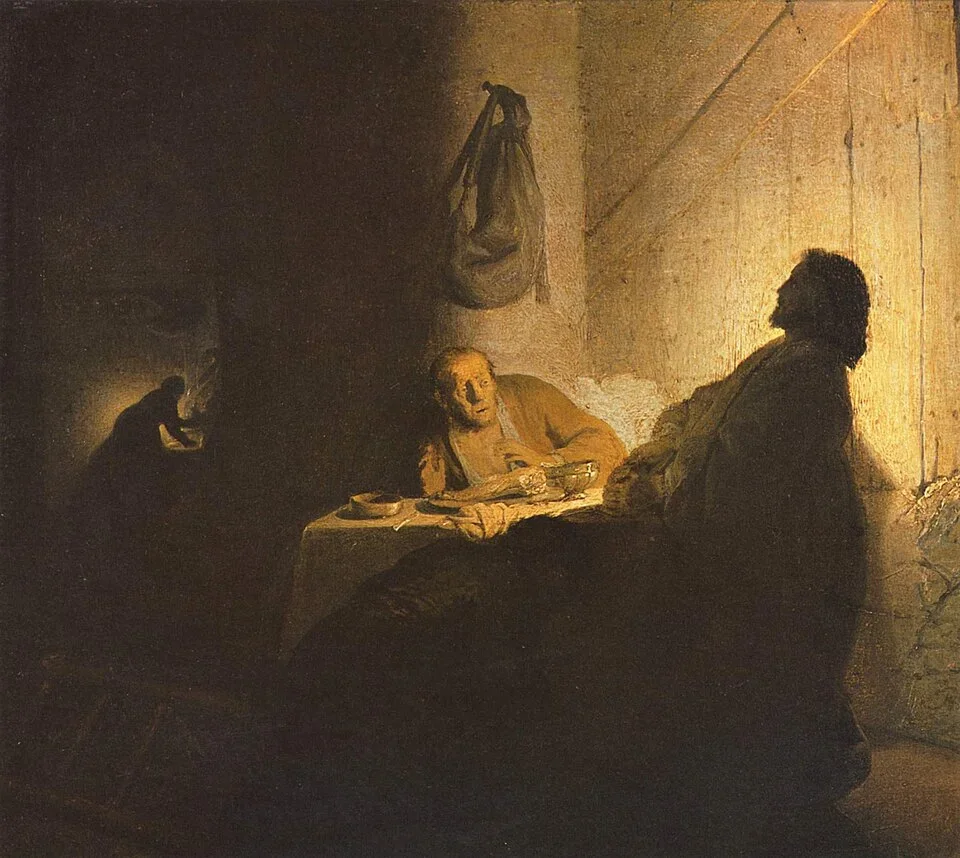
The Supper at Emmaus
Rembrandt built this whole scene out of hidden light. He was a young painter in Leiden. This was the first time he painted the supper at Emmaus, a subject he would return to all his life. The instant he wanted was the moment the two disciples recognized the stranger at their table. At first this looks like an inn. People are at a table, and the arrangement is off balance. Then Christ, at the right, blocks the light behind him. His body becomes an insubstantial silhouette, and the glow around him is enough to show he is divine. In the next moment he will vanish from the disciples' sight. One of them falls to his knees at Christ's feet and knocks over a chair. The other, behind the table, stares at him in wonder. At the back, a maid busy at her work hides a second light. That is what gives the room its sharp contrast between light and dark. Then Christ breaks the bread and hands it to them. That is when they know who he is.
Listen in the appRembrandt · Public domain
02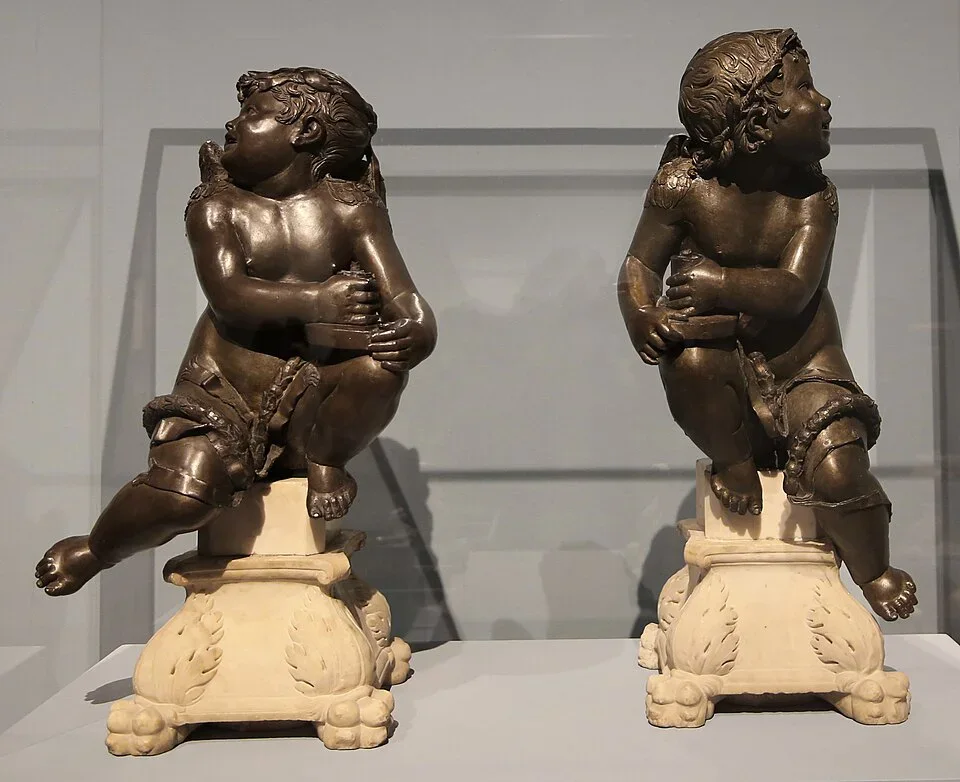
Candelabra Angels
What are these two children holding? In their hands they hold small sockets. A spike once fitted into each socket, and it is now lost. A large wax candle was fixed on that spike. These children were candle-holders. They sit, one small foot resting on the plinth beneath them, the other leg hanging down more loosely. The two are almost mirror images, but not quite. One twists to the right, the other to the left, and each turns its head further the same way. The arms rest on the opposite knee, curling each small body into a spiral. They are almost certainly the two child angels from the singing gallery of Luca della Robbia in Florence Cathedral. Perhaps they were made to crown the matching singing gallery Donatello carved for that same cathedral.
Listen in the appFrancesco Bini · CC BY-SA 4.0
03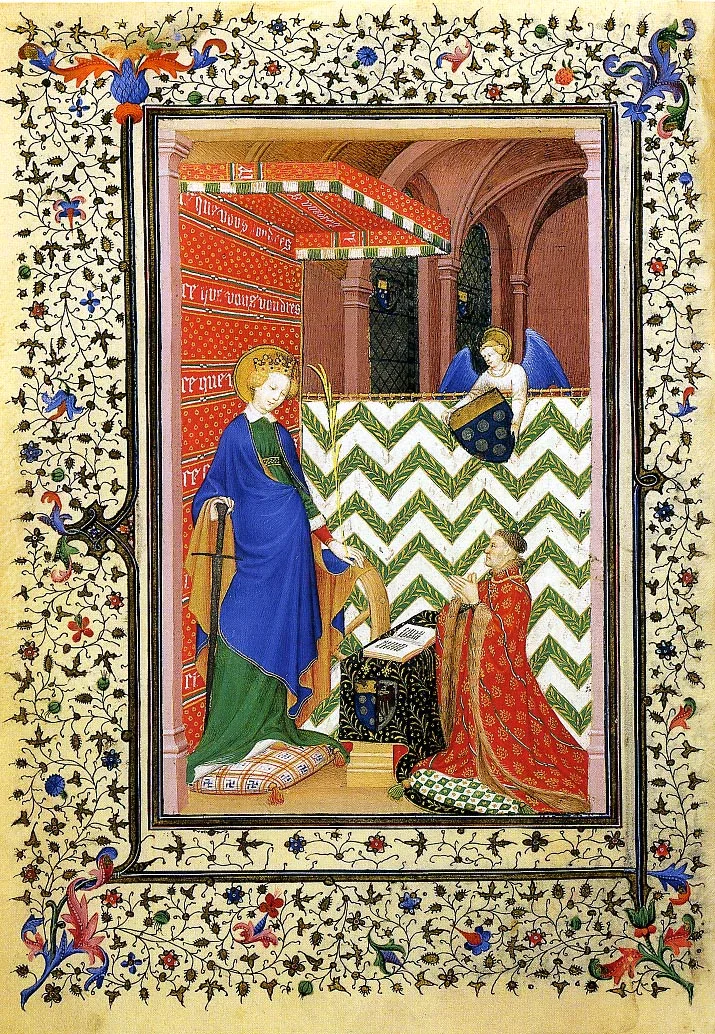
Hours of Jean de Boucicaut
In the Adoration of the Magi, the youngest wise man is dressed in black. He alone wears a gold collar. This should be a joyful scene, but black is mourning. Boucicaut had his friend Louis de Orleans painted in that place, after Louis was assassinated in 1407. That mourner hints at when the book was finished. It is a book of hours, made for private prayer. But Boucicaut, a Marshal of France, filled it with his own life. The painter, known only as the Master of Boucicaut, painted the scenes the marshal asked for. The marshal's eagle spreads its wings across many pages, and his motto, whatever you want, runs through them too. A man of his standing did not display his emblem so often, least of all in a book meant for quiet devotion. He even had his wedding to Antoinette de Turenne painted in. Saint Leonard, patron of prisoners, appears with the marshal kneeling before him. That page gives thanks for Boucicaut's release, after the Turks captured him and a ransom was paid to Bayazid. Later, Aymar de Poitiers owned the book and blacked out the motto and the eagle.
Listen in the appMeister des Maréchal de Boucicaut · Public domain
04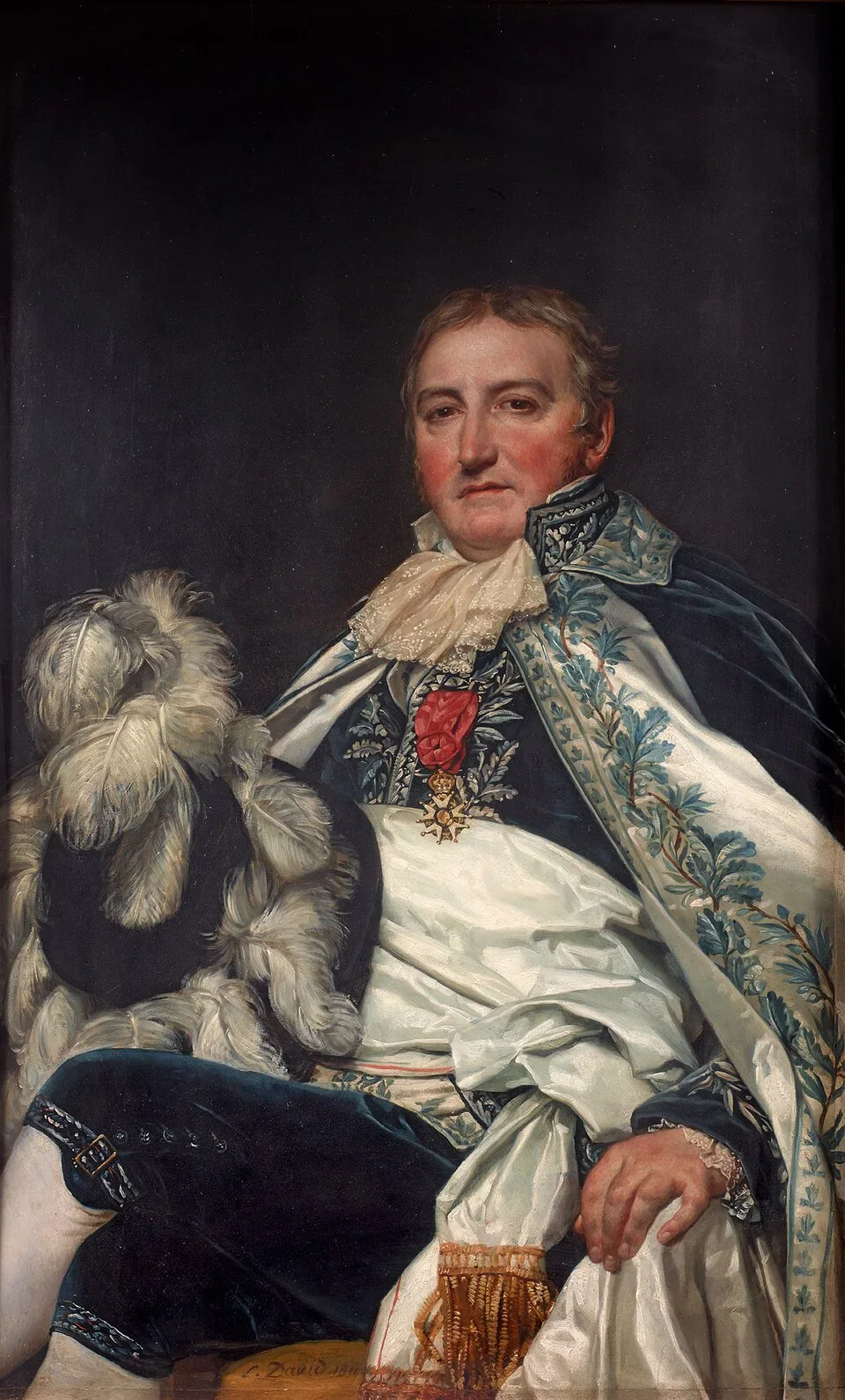
Portrait du comte Antoine Français de Nantes
One red ribbon stands out against all that pale clothing. It is the Legion of Honour ribbon, France's highest award, the one bold note against robes of white, blue, silver and gold. It tells you what this picture was for, to make one man look important. He is the count, and in 1811 he asked Jacques-Louis David to paint him. The painter filled the whole panel with him and set the viewpoint low, so you look up at him. That gives him a commanding position, and it suited a man people thought of as proud and overbearing. His rich official robes were there to show his standing, and the painting carries the glory of Napoleon's First Empire as well. He worked on wood rather than canvas, as the early Flemish painters did, to make the image more convincing. It is one of the very few ceremonial portraits he made. Afterwards it left the family for a private collection, and in 1892 the dealer Paul Durand-Ruel bought it and sold it to Édouard André. In 1912 André left it, with the rest of his collection, to the Institut de France.
Listen in the appJacques-Louis David · Public domain
05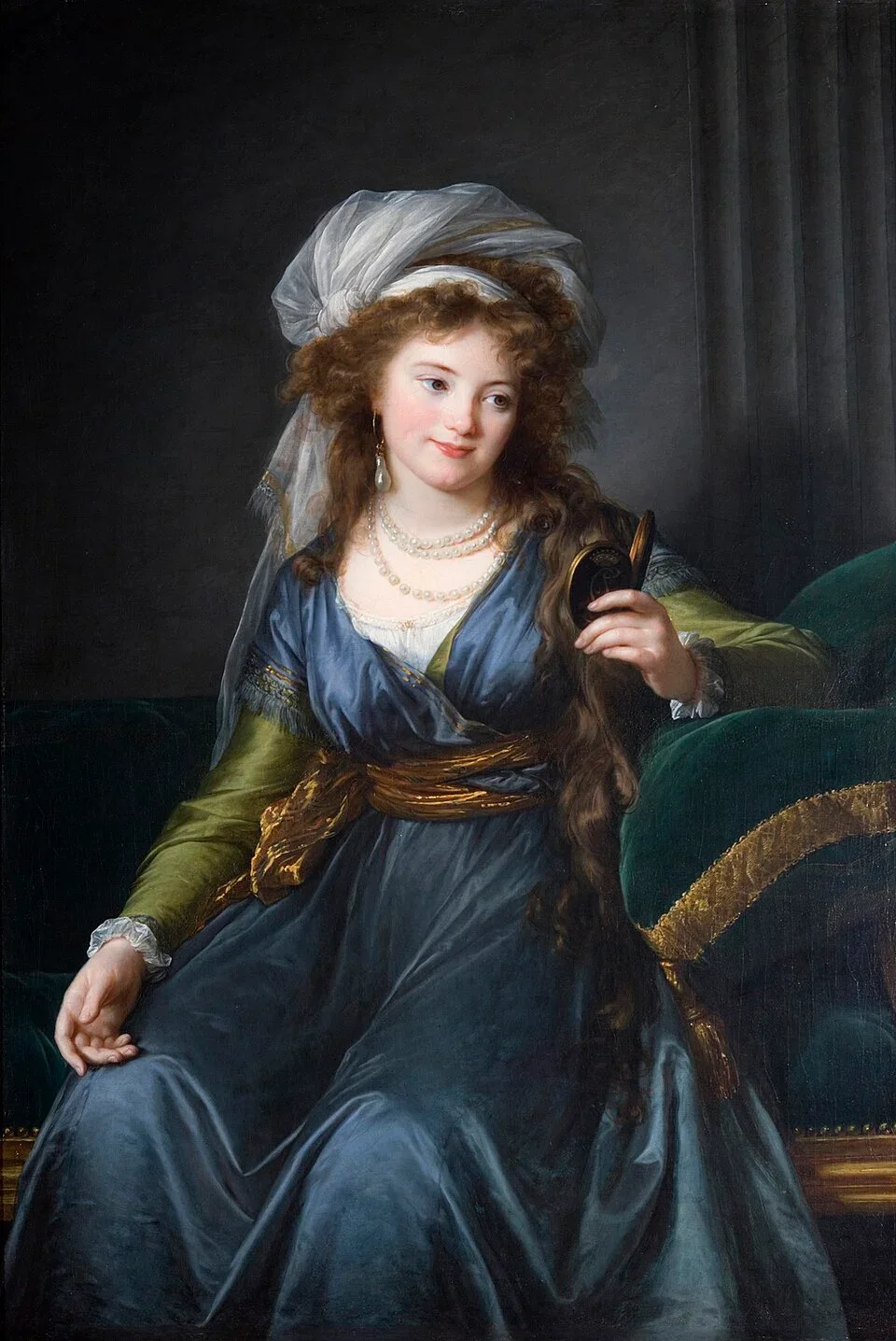
Portrait of countess Yekaterina Skavronskaya
Count Pavel Skavronsky was Russia's minister to Naples, and he wanted a portrait of his wife. There she is, leaning on the arm of the sofa, languid and dreamy. Vigée Le Brun painted her three times in Naples, and this is one of them. In her diary the painter was plain about her. Sweet and lovely as an angel, she did nothing all day, had no schooling, and her talk was mostly empty. And still, she wrote, she had a charm nobody could resist, and it came from that lovely face and that gentle, angelic manner. In her hand she holds a miniature she is looking at. Most likely it shows her husband, the very man who wanted this picture. The miniature has two letters on its back, C and P. The C is for Catherine, the French form of her Russian name Yekaterina. The P is for Pavel. Those two letters are her name and his, written together.
Listen in the appÉlisabeth Louise Vigée Le Brun · Public domain
06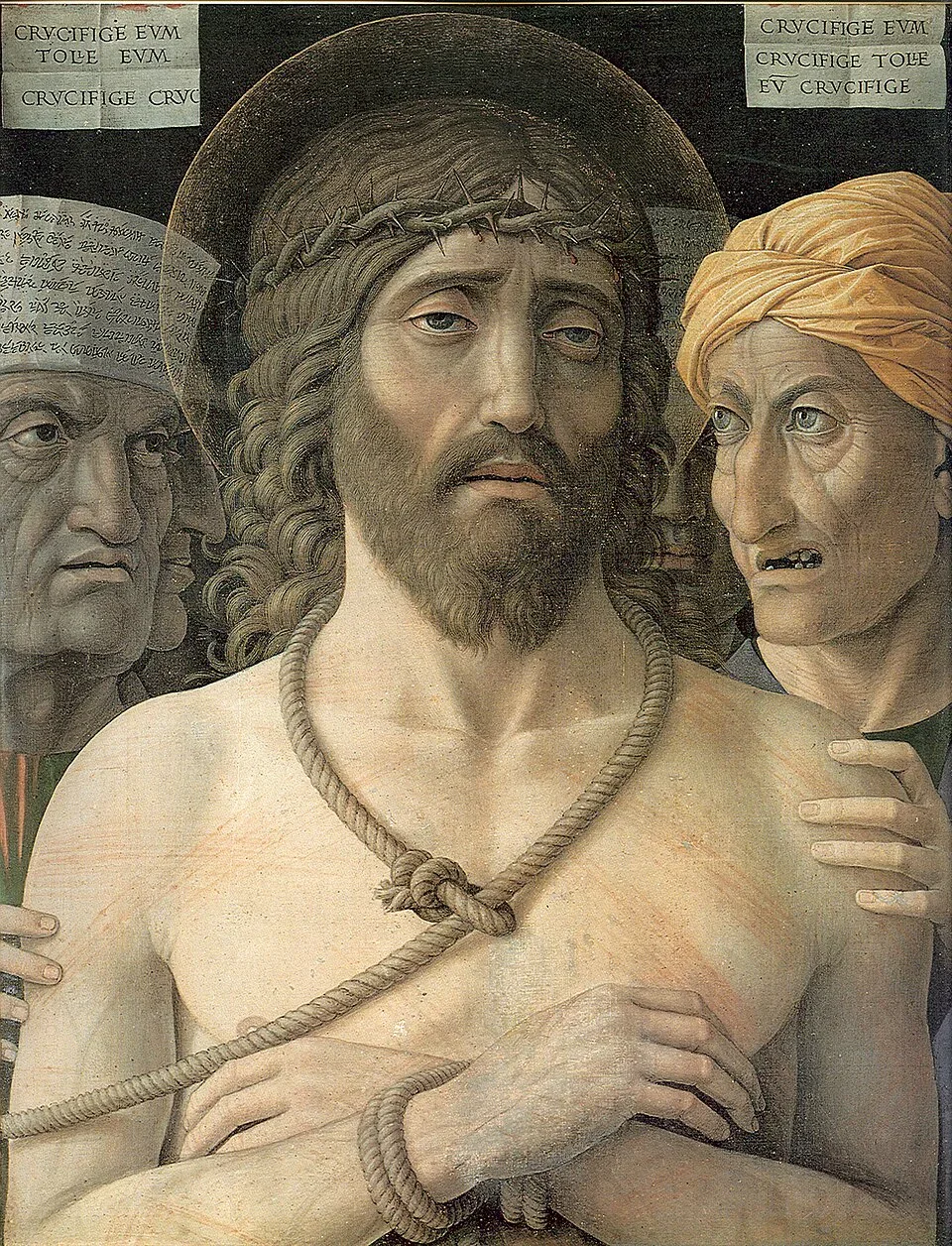
Ecce Homo
There was a time when nobody was sure who painted this. Christ's bust fills the whole picture, and he is shown naked, which is unusual for this subject. At either side there are only the heads of the figures turned toward him, each with a hand on him to hold him. The figure on the left has a lined face, and a paper on his head holds writing that only looks like Hebrew. The one on the right wears a golden turban and has just a few teeth left. On other papers, Latin words call for Christ to be crucified. The faces are fixed in grimaces, and the crowd presses in behind, so the whole scene feels tight and uneasy. You can feel Leonardo's influence in that. He was in Mantua in 1499, where Mantegna lived. Today it is given to him, a work from the last years of his life. It is tempera and gold on canvas over a panel, apparently the original support, with no varnish, and in unusually good condition.
Listen in the appAndrea Mantegna · Public domain
07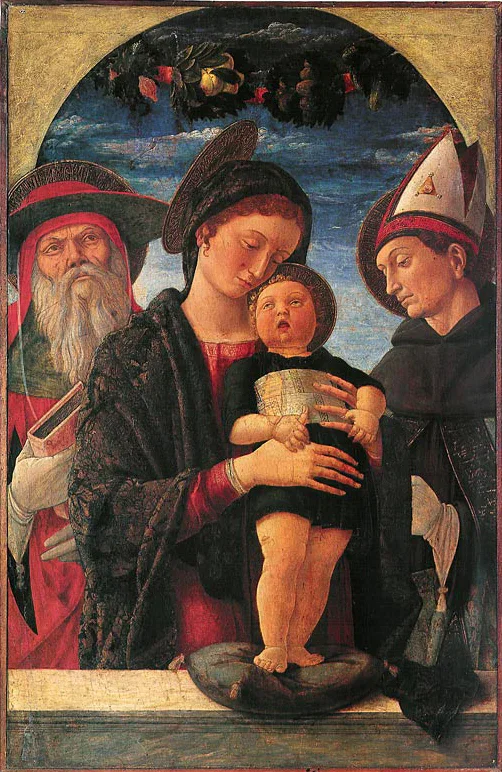
Madonna and Child with saints Jerome and Louis
You are looking up at all of them. That low angle is the daring part of this picture. It pulls the holy figures toward you. Mary's veil falls over the front of the parapet, and the saints' heads sit in front of the arch behind them. Both details bring the group nearer to you. The broad, strong face of Christ and this sharp view from underneath are marks of Mantegna's early work. The layout is one Jacopo Bellini used over and over. Mary and Christ in the middle, a saint on either side, all behind a parapet and under a garland of leaves and fruit. Mantegna married Jacopo Bellini's daughter in 1453. About 1455, when this was made, the two painters' styles were closest. Some have doubted that Mantegna painted it.
Listen in the appAndrea Mantegna · Public domain
08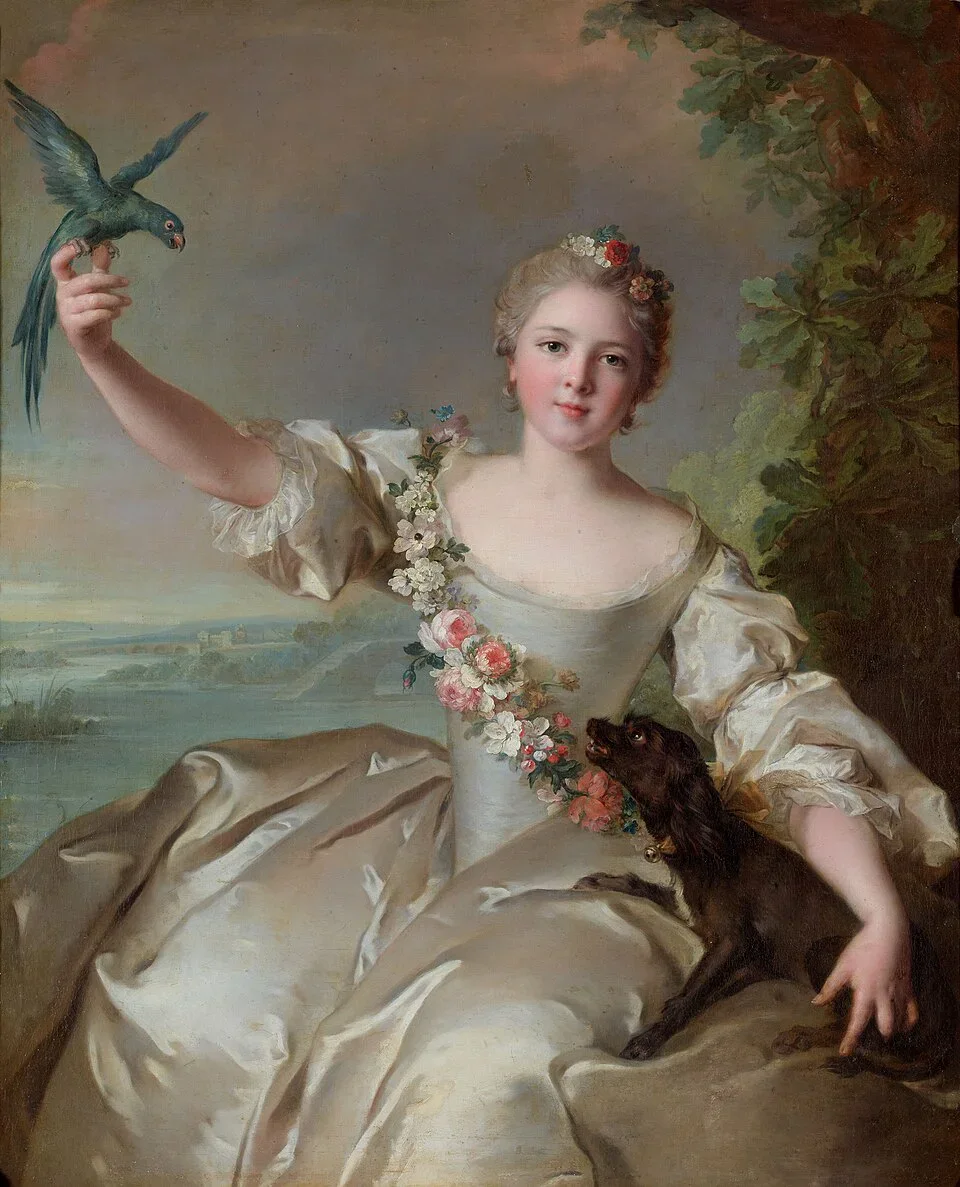
Portrait de Mathilde de Canisy, marquise d'Antin
How old is she? She looks grown up, but she was fourteen. She had lost both parents at three and was raised by her grandmother. At twelve she married the Marquis d'Antin, a man sixteen years older than her, in a chapel in Normandy. This portrait was painted two years after the wedding, shortly before she was widowed, before she turned sixteen. She stands at the foot of an oak, overlooking a landscape. In her left hand she holds back a small black dog. It barks toward a parakeet held out at the end of her right hand. Her arms cross the picture in a single diagonal. The white silk dress was one Nattier had used in other portraits, and he chose it to make her look older.
Listen in the appJean-Marc Nattier · Public domain
09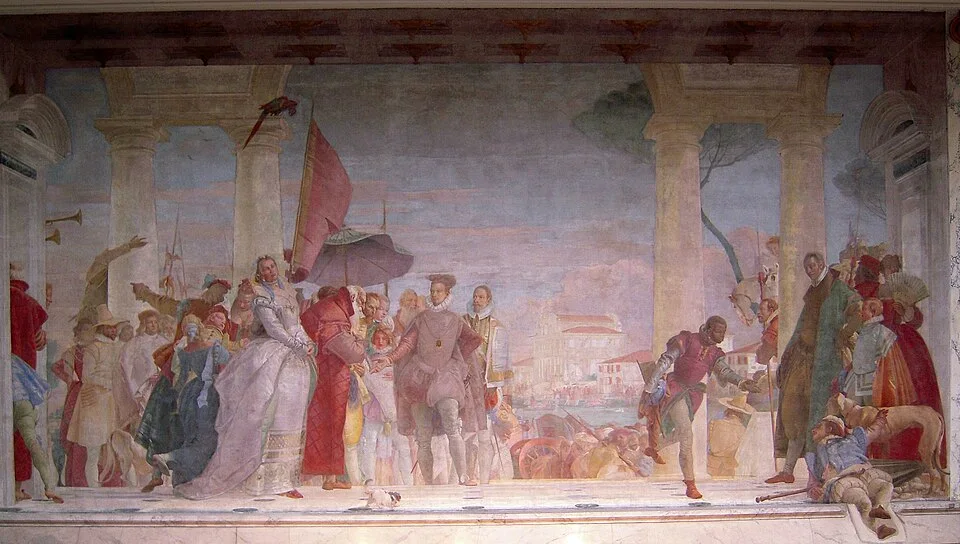
The Visit of Henry III to the Villa Contarini
At the front, a young man leans back until his legs hang past the scene's edge. He is not simply resting. His pose is a trick of perspective, tipping the painted space beyond its frame. That room is painted too. Arcades and columns frame an elegant gallery. Henry the Third climbs the villa steps, welcomed by the Contarini family and watched by a crowd of courtiers, guards and onlookers. None of this was quite a state visit. Henry, whose mother was Italian, had been chosen king of Poland in 1573. When his brother Charles the Ninth died, he gave up that crown and hurried through Vienna and Venice to claim the French throne. In the summer of 1574 his boat stopped briefly at Federico Contarini's villa on the Brenta, on its way to Padua. The Pisani family, who owned the villa later, chose to remember it as a great occasion. In 1744 Vincenzo Pisani inherited the villa and set about modernizing it. Tiepolo came to decorate the loggia. Colonna designed the monumental architecture, on Doric columns modeled on a triumphal arch Palladio built for the king in Venice. From the villa, the painted loggia mirrored the real view of the Brenta. In 1893 the frescoes were bought, lifted from the walls onto canvas and carried to Paris. In 2018, copies were set back in the villa's loggia.
Listen in the appGiovanni Battista Tiepolo · Public domain
10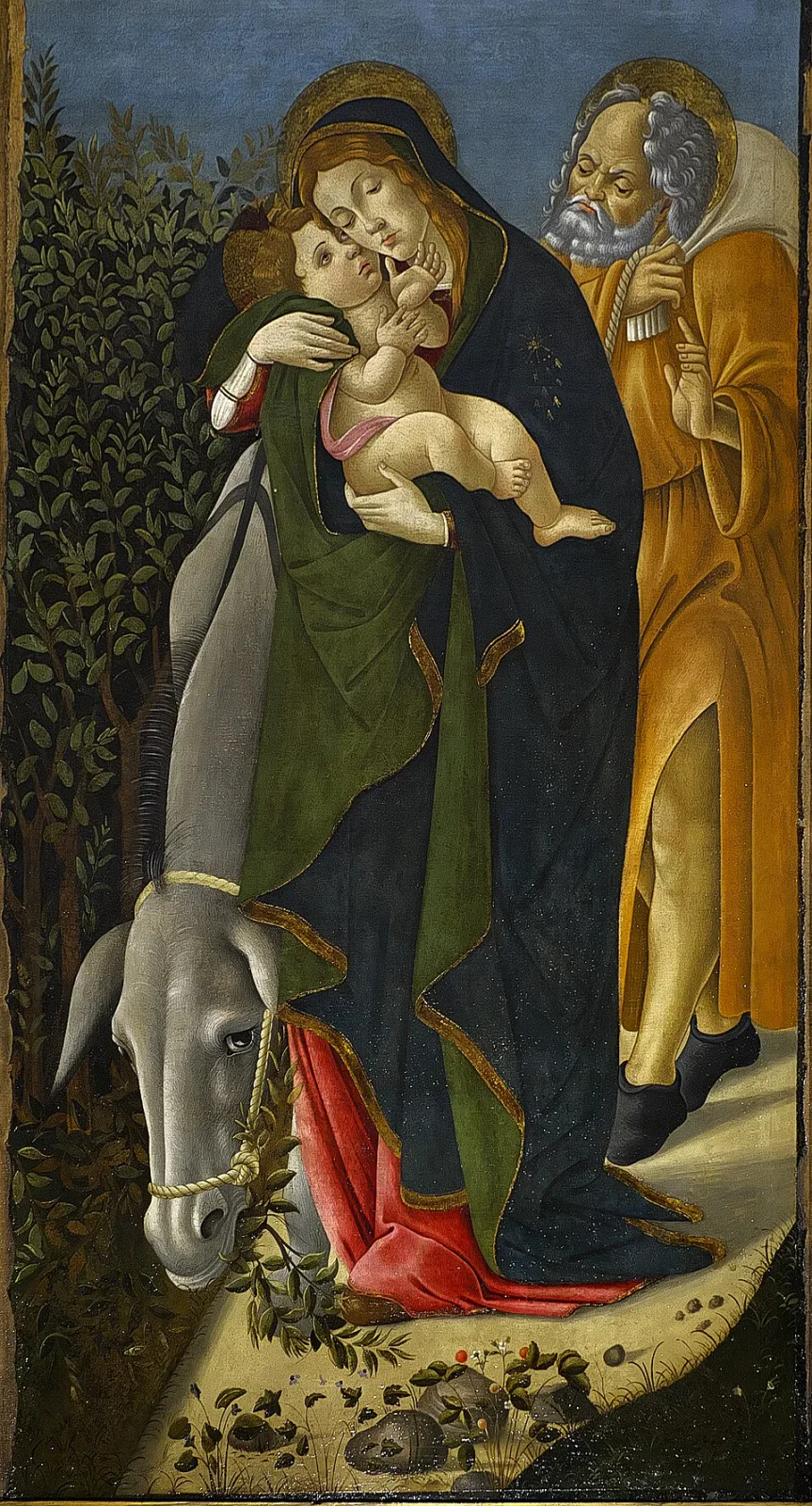
The Flight into Egypt
Mary, Joseph, the child and a donkey are gathered here for the Flight into Egypt. But the journey is not what fills the frame. Botticelli cut the picture close around the group and used foreshortening. Both moves single out the mother and child. He painted that pair again and again, this time with an assistant. At the very center, Mary and the child form a full-length Madonna.
Listen in the appPhoto: Jl FilpoC · Public domain
- 11
Portrait of Princess Amalia van Solms
Rembrandt · 1632
- 12
Madonna with child and three saints
Andrea Mantegna · c. 1490–1500
- 13
Portrait of a man
Frans Hals · 1660–1666
- 14
Portrait of a Man, possibly Arnout Tholincx
Rembrandt · 1656
- 15
Saint George and the Dragon
Paolo Uccello · 1435
- 16
Time clipping the Wings of Love
Anthony van Dyck · c. 1627
- 17
The Visit of Hippolyta, Queen of the Amazons, to Theseus, King of Athens
Vittore Carpaccio · c. 1495
- 18
Virgin and Child
Pietro Perugino · c. 1470
- 19
Portrait of an Old Man
Quinten Metsys · 1513–1517
- 20
Bellini - Virgin and Child, 1510
Giovanni Bellini · 1510
- 21
Portrait of a Judge
Anthony van Dyck · c. 1620
- 22
Allegory of Chastity
Hans Memling · 1479–1480
- 23
The Battle of Pydna
Andrea del Verrocchio · c. 1475
- 24
Virgin and Child
Alesso Baldovinetti · 1455–1460
Musée Jacquemart-André
Frequently asked questions
How much does the guide cost?
Free app download. Free until 1 January. Listed guide price: $0.99. Audio guide only. Venue admission is separate.
Can I listen without internet?
Yes. Download the guide’s audio, images, and maps in the app before your visit. Your downloaded content is then available offline.
Can I listen in my language?
In English for now. More languages soon.
Do I need to follow a schedule?
No. This is a self-guided experience. Choose your stops, pause whenever you like, and return to a story at your own pace.
Which artworks are in the Musée Jacquemart-André audio guide?
24 artworks, including The Supper at Emmaus (Rembrandt), Candelabra Angels (Donatello), Hours of Jean de Boucicaut (Master of Boucicaut), Portrait du comte Antoine Français de Nantes (Jacques-Louis David), Portrait of countess Yekaterina Skavronskaya (Élisabeth Louise Vigée Le Brun), Ecce Homo (Andrea Mantegna), Madonna and Child with saints Jerome and Louis (Andrea Mantegna), and Portrait de Mathilde de Canisy, marquise d'Antin (Jean-Marc Nattier). The full list is on this page.
Is this the museum’s official audio guide?
No. Stanza is an independent audio guide app and is not affiliated with Musée Jacquemart-André. Museum admission is separate.
At your own pace
Explore Musée Jacquemart-André.
Download Stanza, then search for “Musée Jacquemart-André”.
Free app download · Guide price shown in the app
Keep exploring
Nearby audio guides
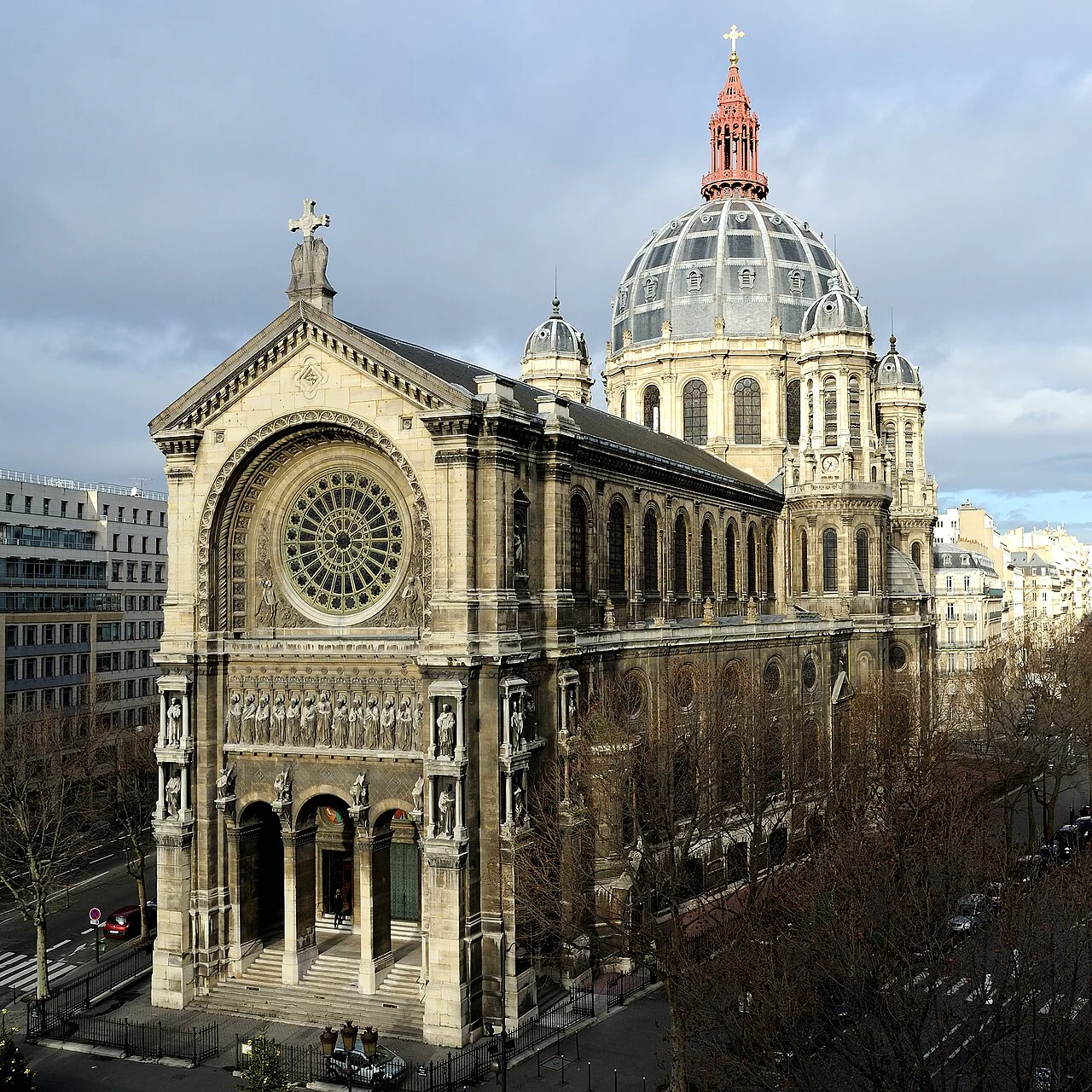
Paris · 1 km
Église Saint-Augustin de Paris
Content & sources
Photo: Saffron Blaze · CC BY-SA 3.0
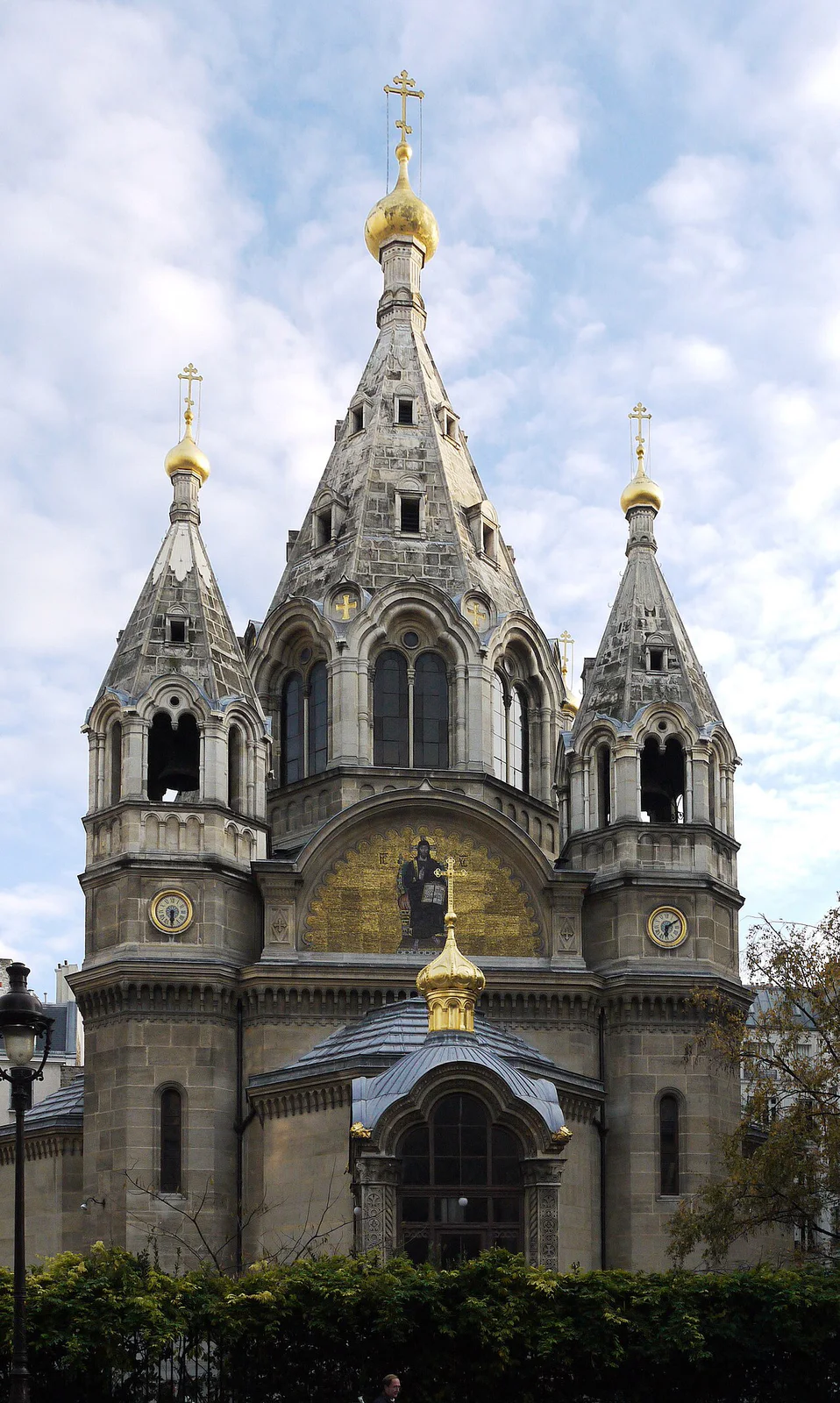
Paris · 1 km
Cathédrale Saint-Alexandre-Nevsky de Paris
Content & sources
Photo: Pline · CC BY-SA 3.0
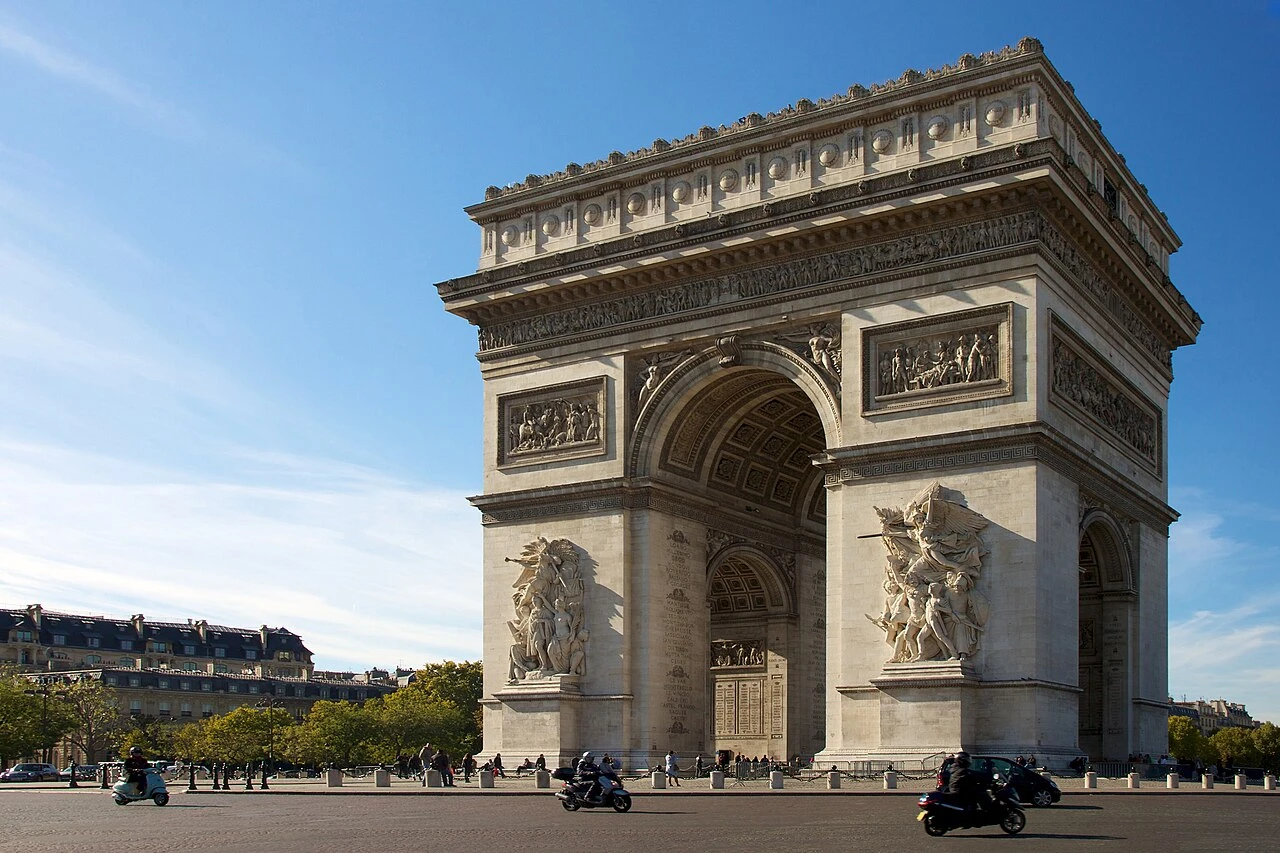
Paris · 1 km
Arc de Triomphe
Content & sources
Jiuguang Wang · CC BY-SA 2.0
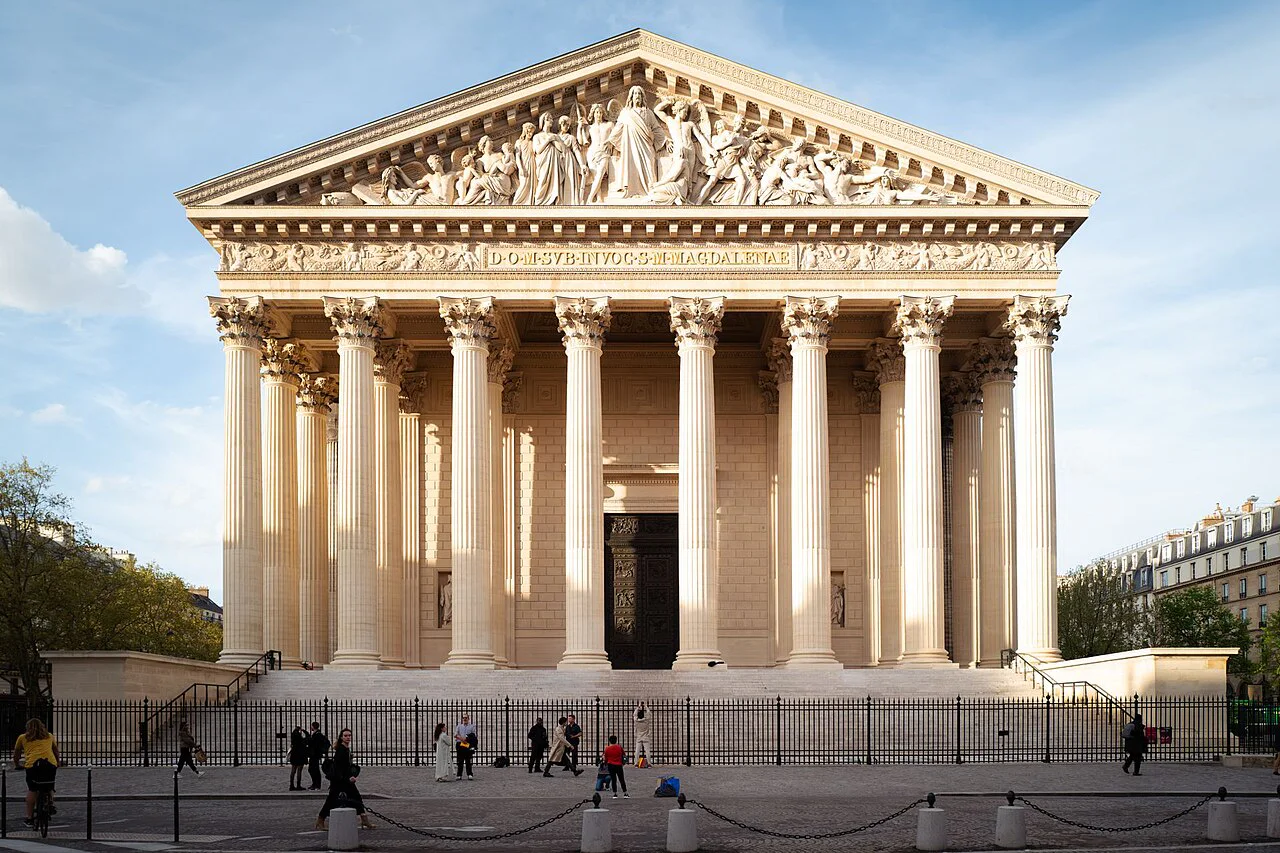
Paris · 1 km
Église de la Madeleine
Content & sources
Callaway Kosine – de Suzannet · CC BY 3.0
Art museums
More art museum audio guides
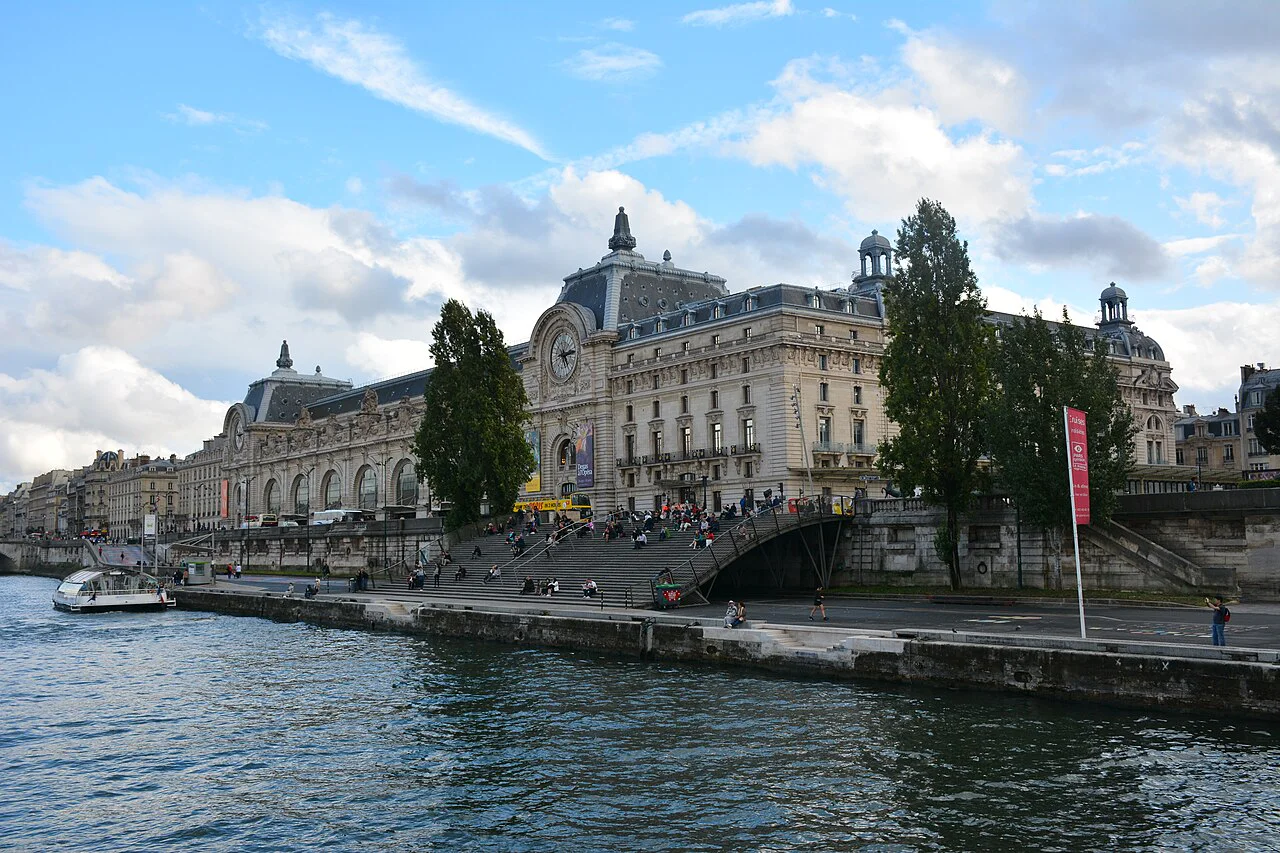
Paris · 205 artworks
Musée d'Orsay
Content & sources
Cheng-en Cheng from Taichung City, Taiwan · CC BY-SA 2.0
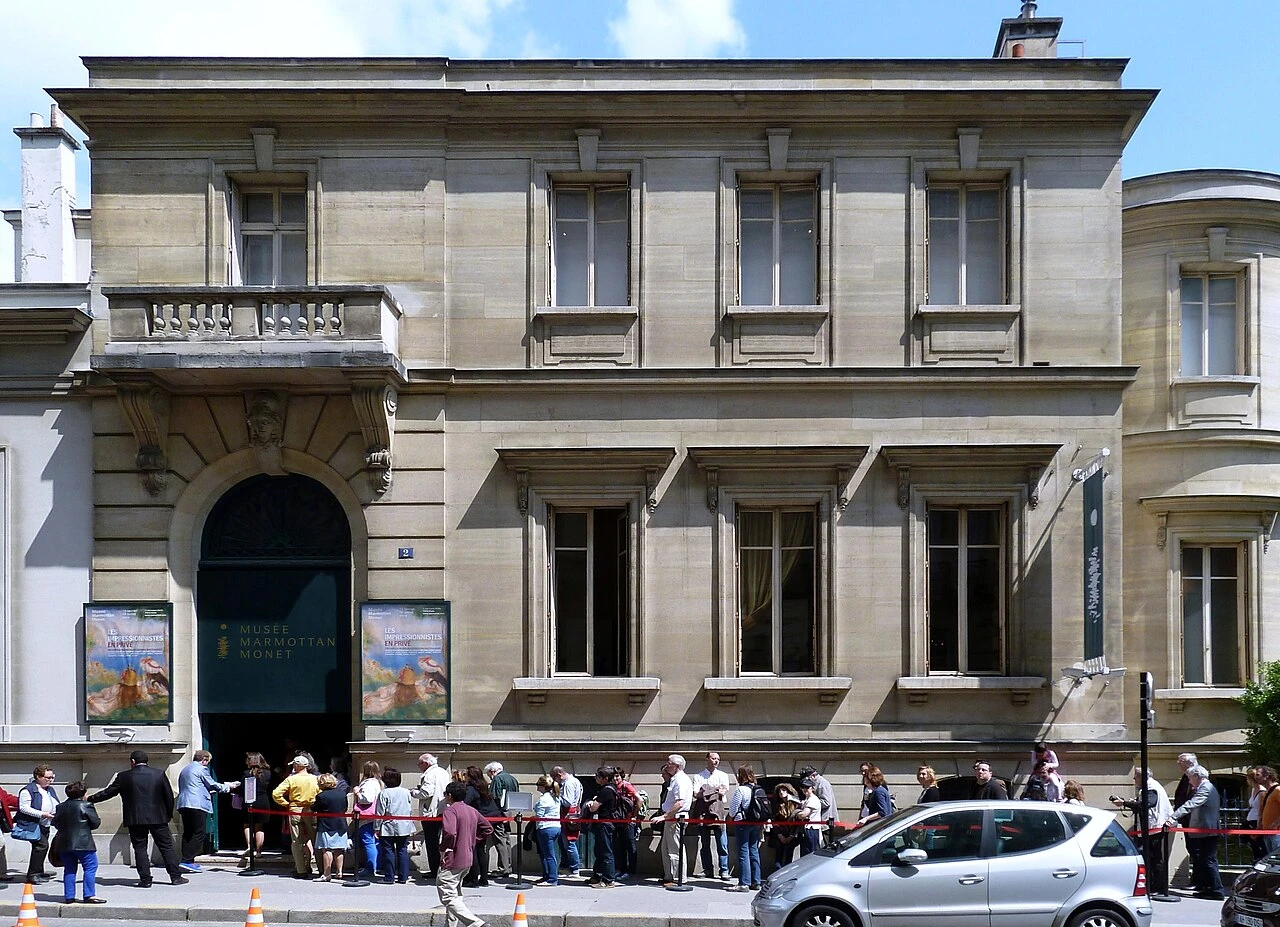
Paris · 25 artworks
Musée Marmottan Monet
Content & sources
PIERRE ANDRE LECLERCQ · CC BY-SA 4.0
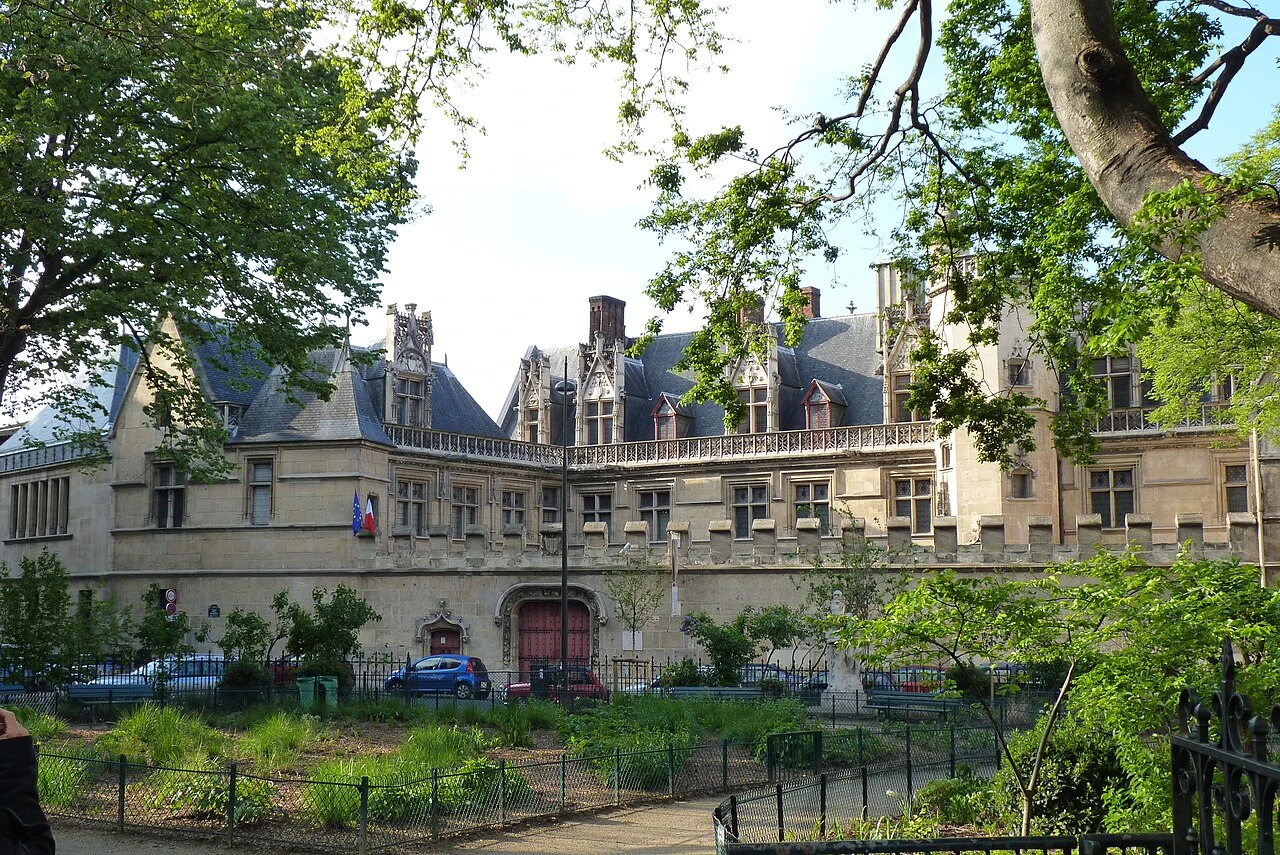
Paris · 29 artworks
Cluny Museum
Content & sources
ctj71081 · CC BY-SA 2.0
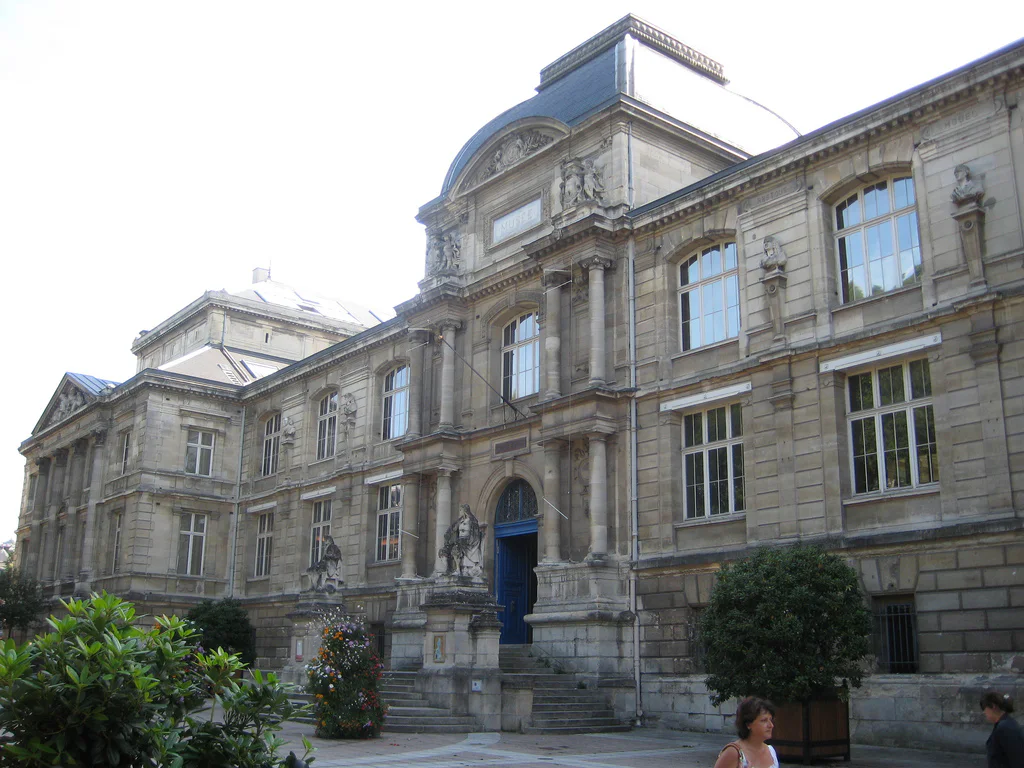
Rouen · 45 artworks
Musée des Beaux-Arts de Rouen
Content & sources
Allie_Caulfield · CC BY 2.0
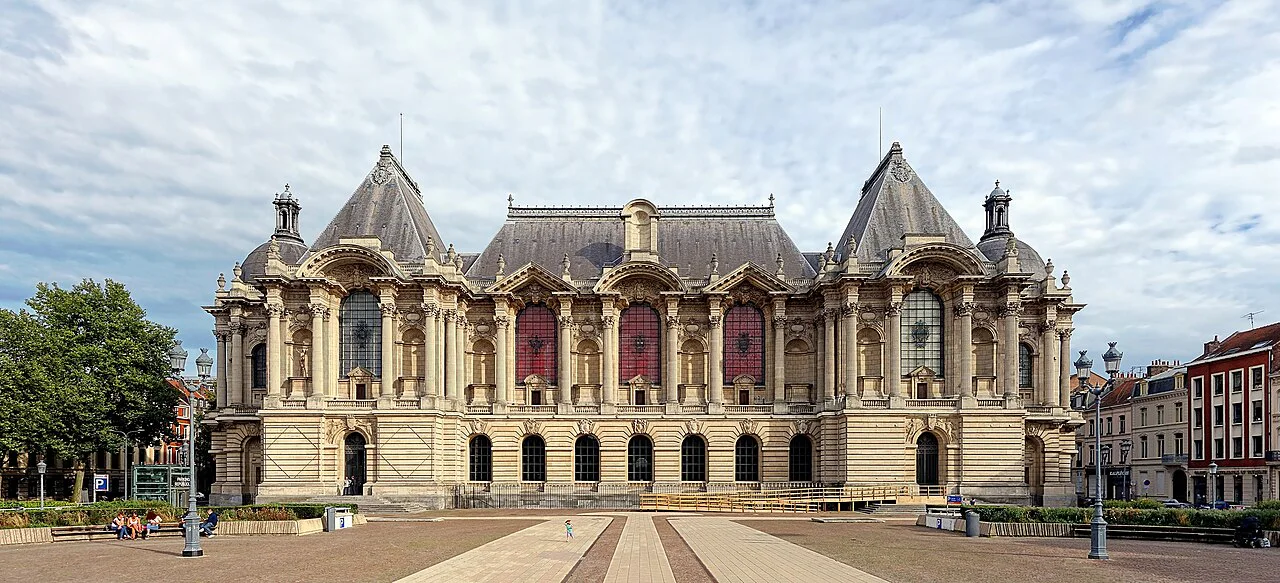
Lille · 96 artworks
Palais des Beaux-Arts de Lille
Content & sources
Photo: Velvet · CC BY-SA 3.0
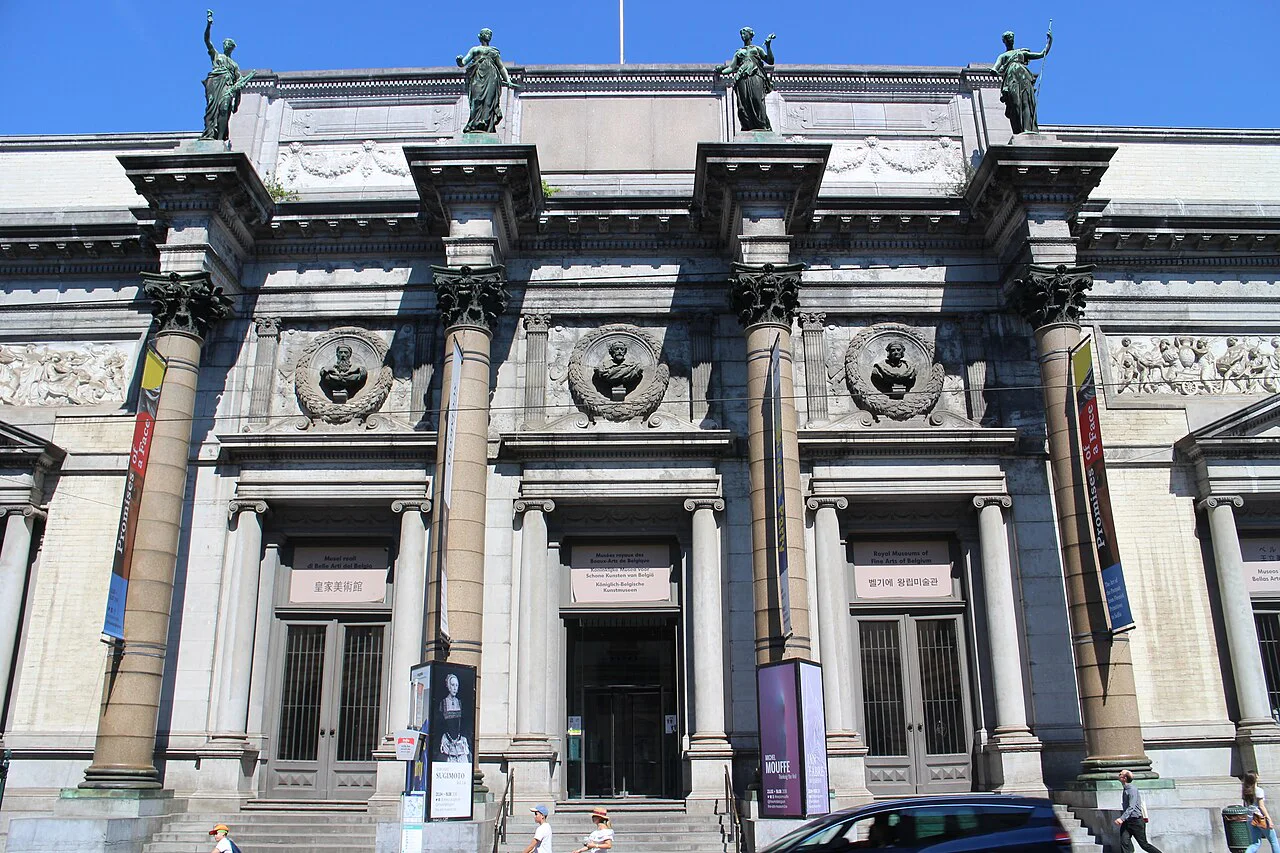
Brussels · 69 artworks
Royal Museums of Fine Arts of Belgium
Content & sources
Photo: Suicasmo · CC BY-SA 4.0