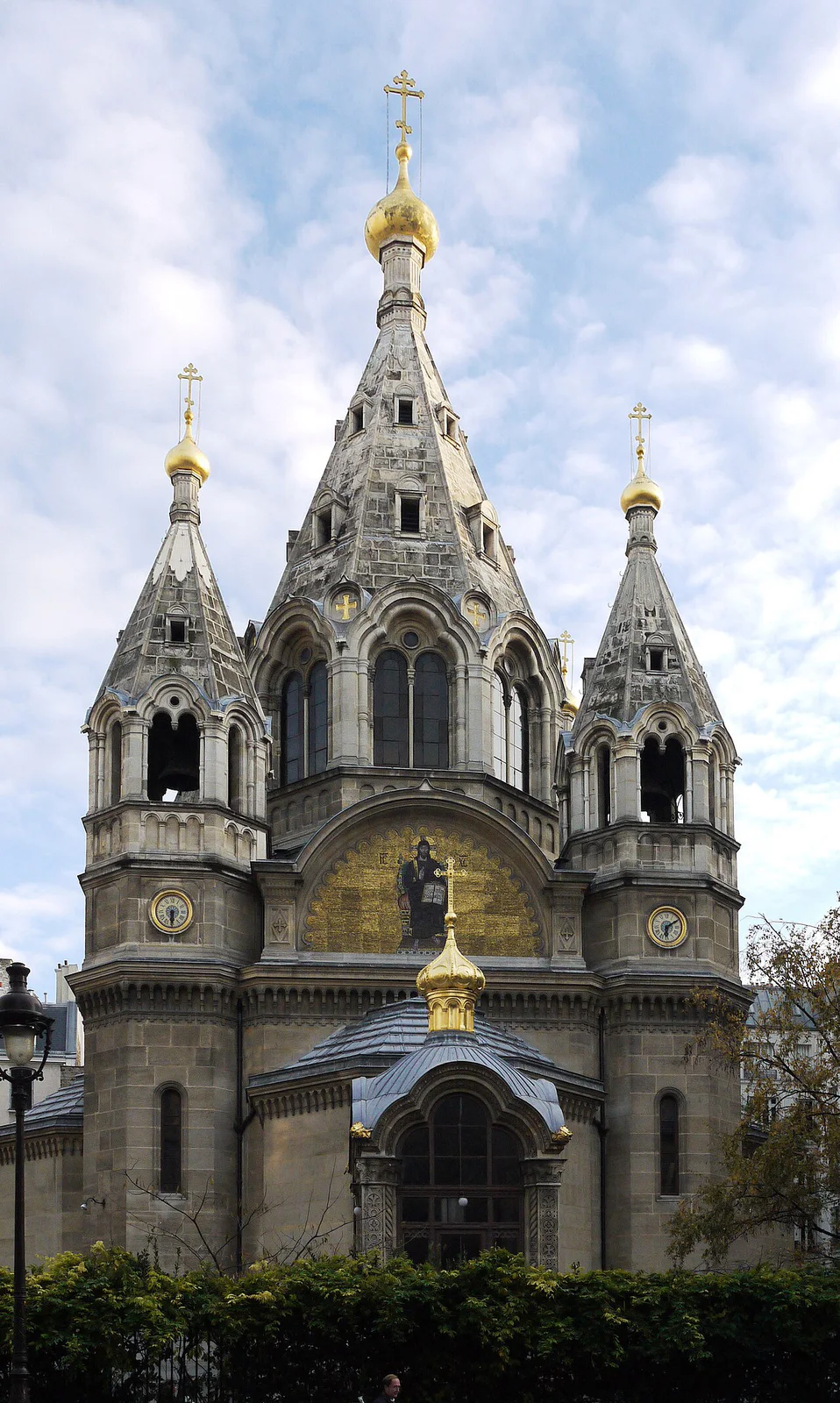
Stanza · Audio guide
Cathédrale Saint-Alexandre-Nevsky de Paris Audio guide
A place to remember. A story to take with you.
The Alexander Nevsky Cathedral is a Russian Orthodox cathedral church located at 12 Rue Daru in Paris. It is situated in the 8th arrondissement near the Courcelles métro station.
Download Stanza, then search for “Cathédrale Saint-Alexandre-Nevsky de Paris”.
About the tour
One guide. Your kind of visit.
The Alexander Nevsky Cathedral is a Russian Orthodox cathedral church located at 12 Rue Daru in Paris. It is situated in the 8th arrondissement near the Courcelles métro station.
Ready when you are.
- 01Get the free Stanza app.
iOS & Android
- 02Find your guide.
“Cathédrale Saint-Alexandre-Nevsky de Paris”
- 03Download before you go.
Works offline
Audio guide / 8 narrated stops
Inside the guide
Get to know a few of the stories before you go. Open a stop to read more.
01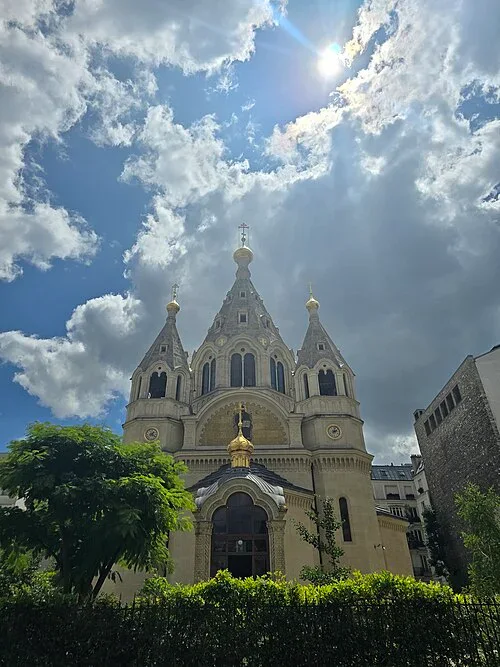 Rue Daru and the Gilded Onion DomesAlexander Nevsky Cathedral from Rue Daru
Welcome to the cathedral of Saint Alexander Nevsky, on a quiet street in the eighth arrondissement of Paris. It looks unexpected here, and it is. Russian Orthodox worshippers in Paris began with a small oratory on Rue de Berri, opened in 1816. As the Russian community grew through the nineteenth century, that little chapel could no longer hold them. In 1847 the chaplain of the Russian Embassy, Father Joseph Vassiliev, set out to build a permanent church. The Russian government was slow, and French bureaucracy was slower, but Emperor Napoleon III finally gave his consent. Work began in 1859, and the church was consecrated on the eleventh of September, 1861. That makes it the first purpose-built Russian Orthodox place of worship in all of France. The date was chosen with care, the day before the feast of its patron saint, a Russian prince and national hero.
Photo: ShadowMitia · CC BY 4.0
02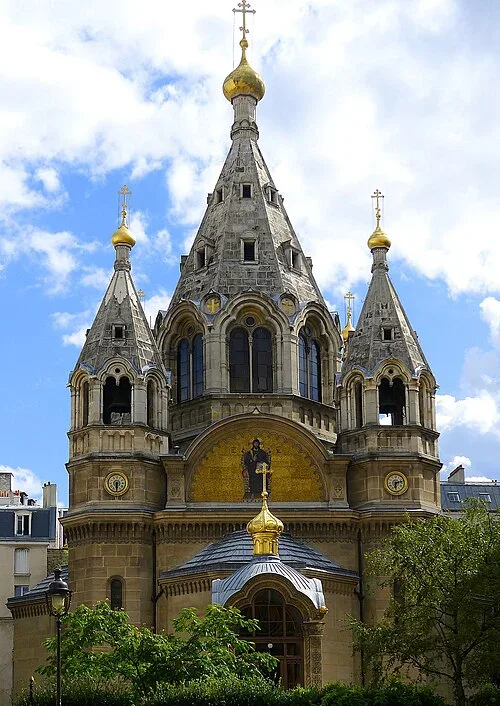 Rue Daru and the Gilded Onion DomesThe Five Gilded Domes
Five dark towers rise from the roof, each crowned with a gilded bulb and an Orthodox cross. The man who drove the project, the diplomat Joseph Vassiliev, called the style Byzantine Muscovite. Byzantine is the body of the church, Muscovite is the silhouette on top. The five towers stand for Christ and the four Evangelists. The gilded bulbs beneath the crosses are meant to suggest candle flames, carrying the prayers of worshippers up to heaven. The central tower reaches about forty-eight metres and carries the eight-pointed Russian Orthodox cross. The design came from Roman Kouzmine, chief architect of the Russian imperial court, working with the engineer Ivan Strohm. From a Paris street, that cluster of onion domes is unmistakable.
Photo: Mbzt · CC BY 3.0
03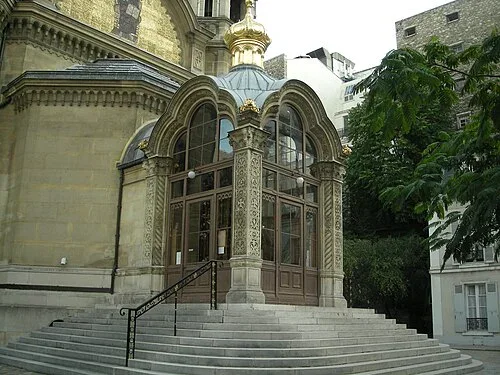 Entrance Pavilion and the Blessing Christ MosaicThe Entrance Porch and Steps
Every visitor and worshipper climbs these stone steps to the covered porch. The building behind them was paid for in an unusual way. Tsar Alexander II gave from his personal purse, roughly one hundred and fifty thousand gold francs. The rest came from a subscription drive across Russia and among Russian communities around the world. What makes the effort remarkable is who gave. Orthodox donors gave, but so did Catholics and Protestants in France, where interest in the project ran high. A church for one faith, raised by the generosity of three. The ornate carved porch at the top of the steps has welcomed worshippers since the eighteen-sixties.
Listen in the appcous · CC BY 2.0
04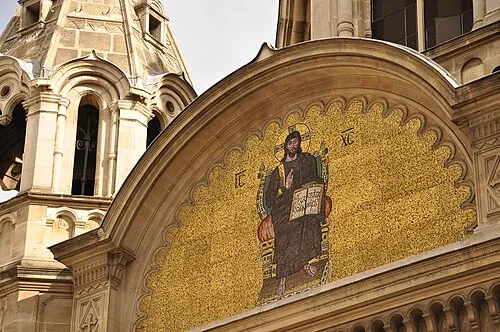 Entrance Pavilion and the Blessing Christ MosaicThe Christ Mosaic on the Pediment
Above the entrance, set into the curved pediment, Christ raises his hand in blessing against a field of gold. The gold ground is pure Byzantine, the half of Vassiliev's formula that belongs to the body of the church. This image is the first thing a visitor meets on the way in. The street outside has seen its own ceremonies. In April 1915, during the First World War, a Russian ambulance convoy was blessed here on Rue Daru by an archpriest. Crowds filled the street to watch the priest bless the vehicles before they left for the front. It was one sign of how deeply this foreign church had taken root in Paris.
Listen in the appPhoto: Moonik · CC BY-SA 3.0
05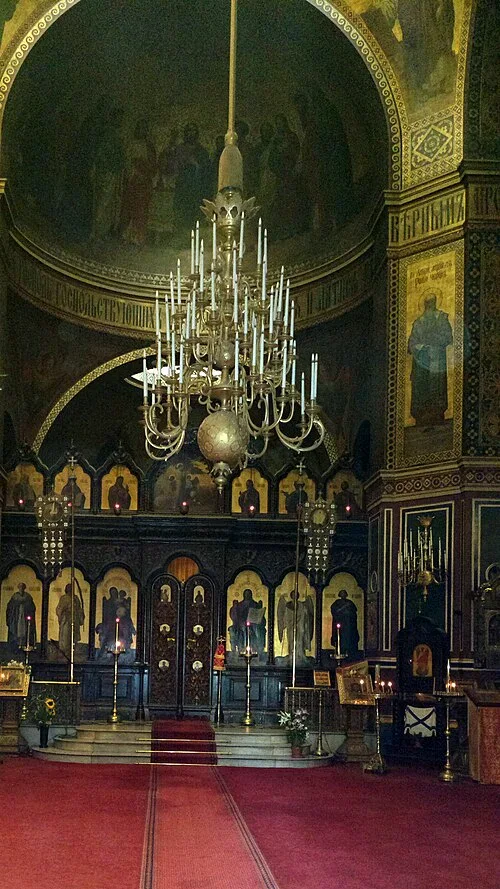 The Greek Cross Nave and Central CupolaThe Nave under the Greek Cross
Inside, the plan is a Greek cross, with each of the four arms ending in a rounded apse. The inspiration was the great Hagia Sophia in Constantinople. Every surface carries paintings, gilding and polychrome decoration, and a great chandelier hangs over the crossing. This room was built for Orthodox liturgy, and services in the main cathedral are still sung in Church Slavonic. The nave holds the worshippers, gathered under the vaults for the service. One famous ceremony took place here in July 1918. Pablo Picasso married the Russian dancer Olga Khokhlova in this church. The witnesses were Jean Cocteau, Max Jacob and Guillaume Apollinaire, three of the leading writers of Paris.
Listen in the appSigoise · CC BY-SA 3.0
06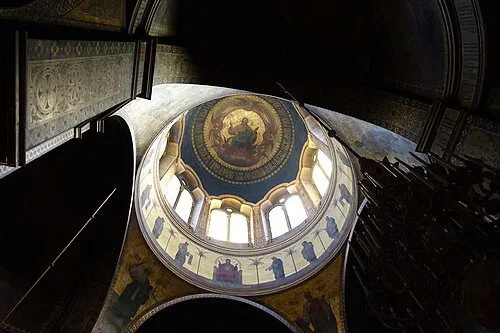 The Greek Cross Nave and Central CupolaThe Painted Cupola
High above, the cupola opens into a ring of painted figures around a dark blue centre. The walls around the church carry murals by D. Sorokine and Feodor Bronnikov. They show the great events of Christian history and the moments of the liturgy. The Adoration of the Shepherds, the Sermon on the Mount, the Entry of Christ into Jerusalem, the Last Supper. In the apses hang canvases by Alexeï Bogolioubov, including Christ Walking on the Waters and Christ Preaching at the Lake of Tiberias. For a congregation, all this painting worked like a book in images, telling the story of the faith to those who could not read it.
Listen in the appGuilhem Vellut from Paris, France · CC BY 2.0
07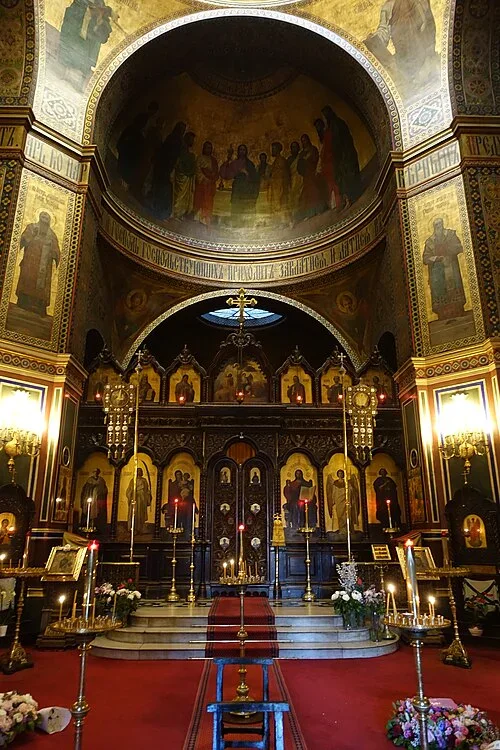 The Grand Iconostasis and SanctuaryThe Iconostasis and Royal Portal
Facing the nave stands the iconostasis, a tall gilded screen covered in icons. In an Orthodox church it does a precise job: it separates the altar area, reserved for the clergy, from the worshippers in the nave. It has three portals. The central one is the Royal Portal, and only the clergy may pass through it. Its doors carry icons of the Annunciation and the four Evangelists, painted by Evgraf Sorokine. To the right of those doors stand Christ, Alexander Nevsky himself, and the Archangel Michael. To the left are the Virgin Mary, Saint Stephen and Saint Nicholas of Myra. Higher up, the Holy Trinity looks down over the whole screen, painted by Pavel Sorokine.
Listen in the appGuilhem Vellut from Paris, France · CC BY 2.0
08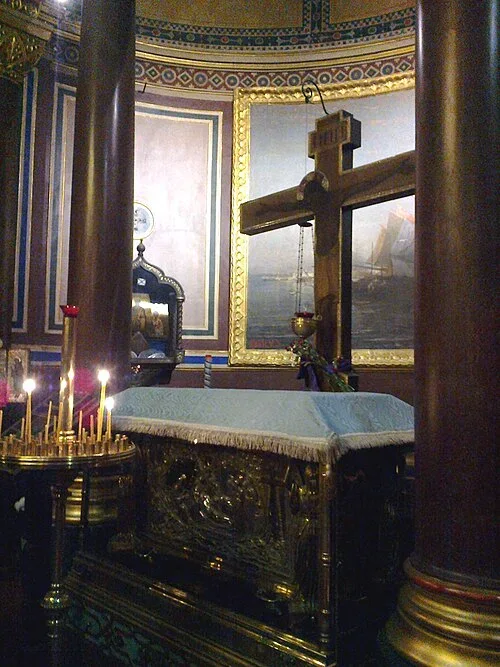 The Grand Iconostasis and SanctuaryThe Sanctuary and the Church of the Exiles
Candles burn beside the cross at the heart of the sanctuary. After the Russian revolution, this church changed in meaning. In 1922 Archbishop Euloge made it the seat of his diocese of émigré parishes, and it became a spiritual refuge for White Russian exiles in Paris. It was also where the community buried its great ones. The funeral of Ivan Turgenev was held here in 1883, long before the exile years. Wassily Kandinsky was mourned here in 1944, and the film director Andrei Tarkovsky in the late nineteen-eighties. For more than a century and a half, this has been the spiritual home of Russians in Paris.
Listen in the apprene boulay · CC BY-SA 3.0
Cathédrale Saint-Alexandre-Nevsky de Paris
Frequently asked questions
How much does the guide cost?
Free app download. Listed guide price: $0.99. Guide price shown in the app. Audio guide only. Venue admission is separate.
Can I listen without internet?
Yes. Download the guide’s audio, images, and maps in the app before your visit. Your downloaded content is then available offline.
Can I listen in my language?
This audio guide is available in 15 languages, including English.
Do I need to follow a schedule?
No. This is a self-guided experience. Choose your stops, pause whenever you like, and return to a story at your own pace.
At your own pace
Explore Cathédrale Saint-Alexandre-Nevsky de Paris.
Download Stanza, then search for “Cathédrale Saint-Alexandre-Nevsky de Paris”.
Free app download · Guide price shown in the app
Keep exploring
Nearby audio guides
Paris · 1 km
Arc de Triomphe
Content & sources
Jiuguang Wang · CC BY-SA 2.0
Paris · 1 km
Église Saint-Augustin de Paris
Content & sources
Photo: Saffron Blaze · CC BY-SA 3.0
Paris · 2 km
Église de la Madeleine
Content & sources
Callaway Kosine – de Suzannet · CC BY 3.0
Paris · 2 km
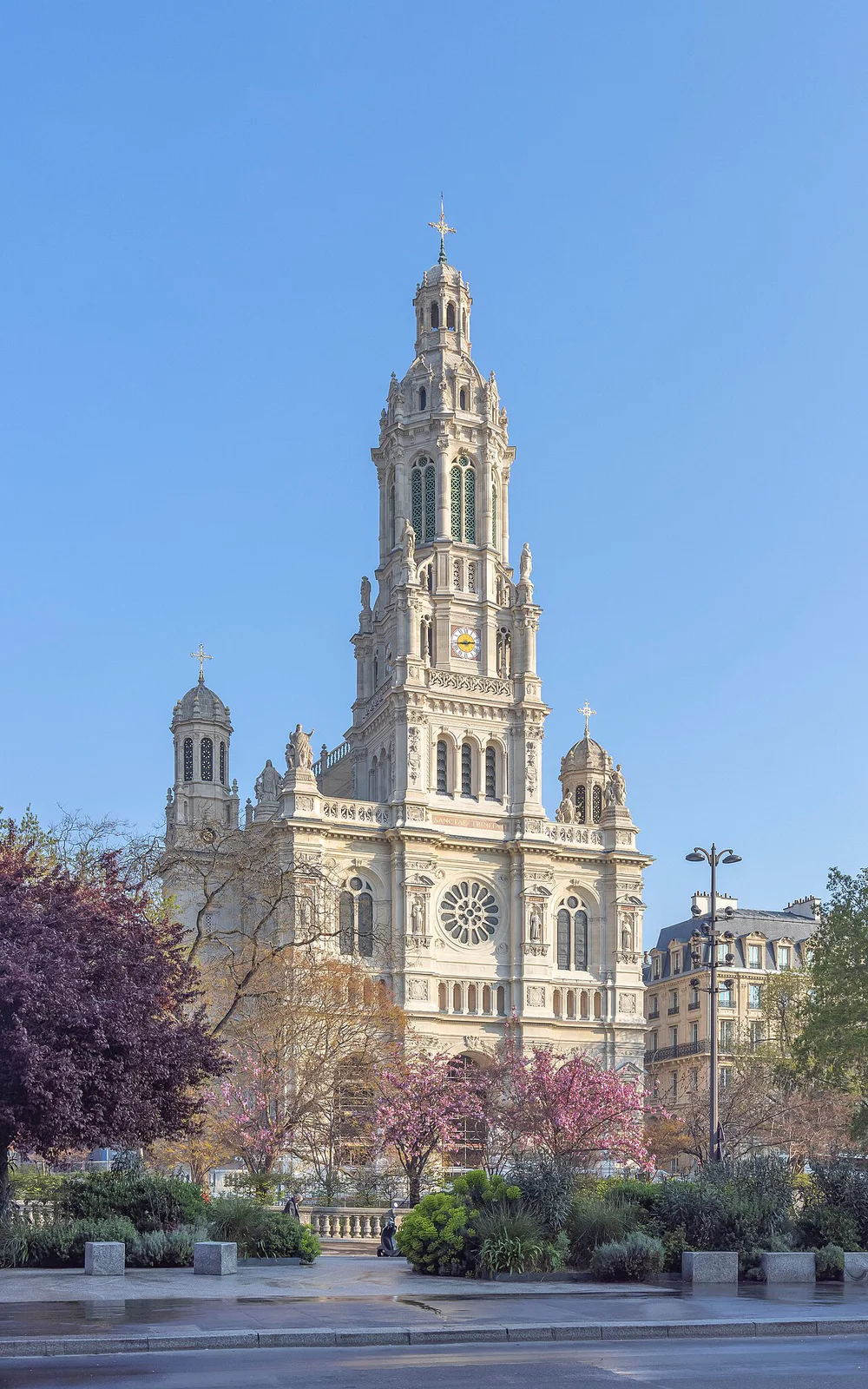
Église de la Sainte-Trinité de Paris
Content & sources
Photo: ZeusUpsistos · CC BY-SA 4.0