Stanza · Audio guide
Église de la Sainte-Trinité de Paris Audio guide
A place to remember. A story to take with you.
The Église de la Sainte-Trinité is a Roman Catholic church located in the 9th arrondissement of Paris. Built between 1861 and 1867, it features an ornate Neo-Renaissance style and a 65-meter-tall belfry.
Download Stanza, then search for “Église de la Sainte-Trinité de Paris”.
About the tour
One guide. Your kind of visit.
The Église de la Sainte-Trinité is a Roman Catholic church located in the 9th arrondissement of Paris. Built between 1861 and 1867, it features an ornate Neo-Renaissance style and a 65-meter-tall belfry.
Ready when you are.
- 01Get the free Stanza app.
iOS & Android
- 02Find your guide.
“Église de la Sainte-Trinité de Paris”
- 03Download before you go.
Works offline
Audio guide / 10 narrated stops
Inside the guide
Get to know a few of the stories before you go. Open a stop to read more.
01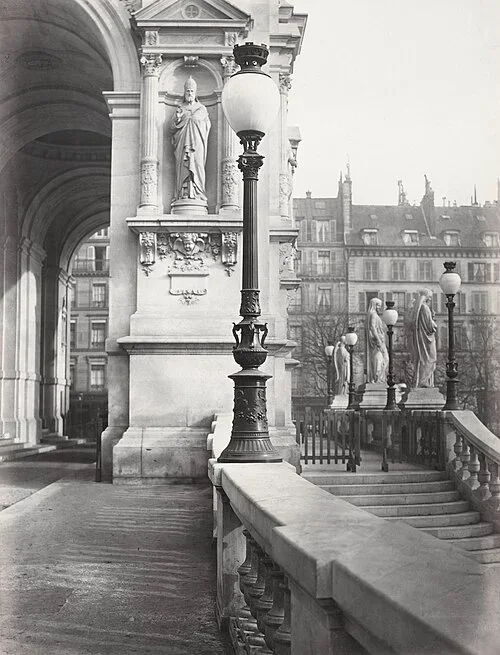 Square d'Estienne d'Orves and the Theological Virtues FountainsThe Church and Its Square
Welcome to La Trinité, a parish church of the Second Empire in the ninth arrondissement of Paris. Its story begins with a problem: too many parishioners and nowhere to put them. The first church of the parish went up in 1850 on the rue de Calais, then outside the city limits. It was too small for the growing population, and too far from the centre of the parish. A second church followed in 1852 on the rue de Clichy, and it too proved too small. So the curé of the parish, the Abbé Modelonde, appealed directly to the Emperor, Napoleon III. The Emperor and his prefect, Baron Haussmann, were then remaking Paris with new boulevards, squares and landmarks. They had just brought the well-to-do district of the Chaussée d'Antin inside the city limits, and it needed a landmark of its own. The site chosen sits on the beginning of the slope of Montmartre, so the church was raised on an embankment, with a small square laid out before it. In 1878 the photographer Charles Marville recorded this new square and its terrace, about a decade after the church was finished. The stone lanterns and broad stairways in his view were part of the design from the start: a dignified, elevated approach to the parish church.
Charles Marville · Public domain
02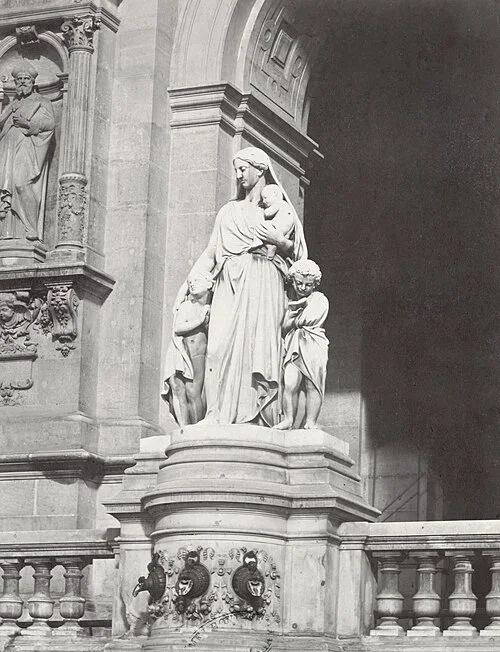 Square d'Estienne d'Orves and the Theological Virtues FountainsLa Charité (Charity) fountain figure by Francisque Joseph Duret
Among the fountains of the square stands a carved mother with children gathered against her. She is Charity, a figure by the sculptor Francisque Joseph Duret, dated 1867. The square was planned with three fountains, each with a triple basin, and each crowned by a statue of one of the three theological virtues: Faith, Charity and Hope. Duret and his fellow sculptor Lequesne divided the figures between them. Water, stone and sculpture were conceived together, as a single decoration for the approach to the church. Even the plumbing had its ornament, with bronze spouts feeding the basins below the statue. It is a small thing beside the church above, but it shows the ambition of the whole setting: nothing here was left plain.
Charles Marville · Public domain
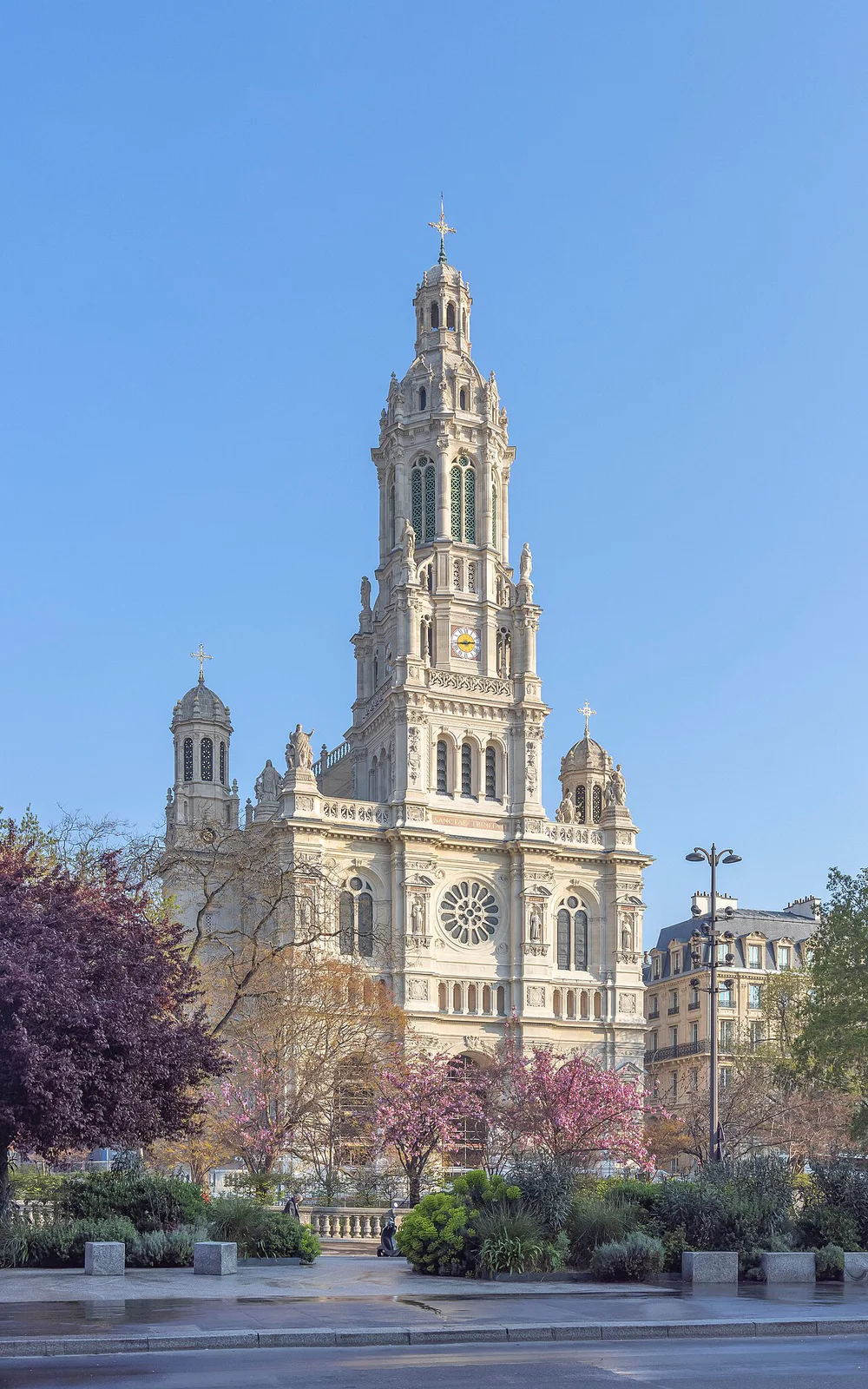
03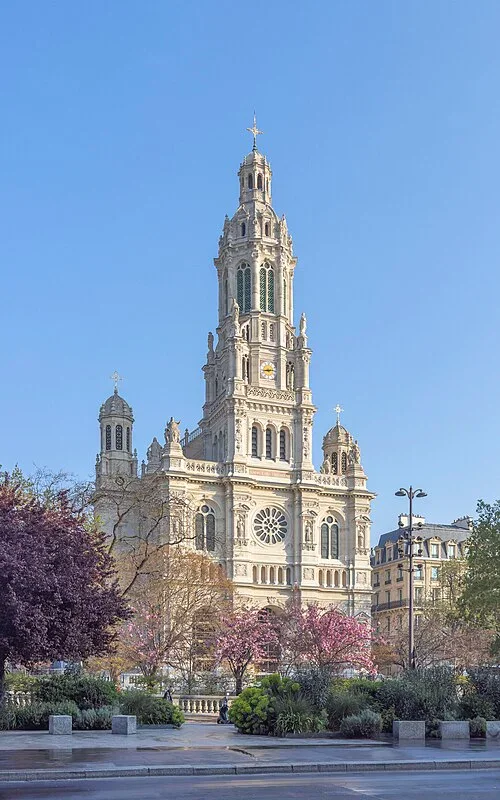 Main Façade and the 65-Meter BelfryMain façade and Haussmann perspective
Théodore Ballu, the chief architect of Paris for religious buildings, designed this church to close a view. It stands at the far end of the perspective opened by the rue de la Chaussée-d'Antin, and it was conceived to be seen from the Paris Opera. Work began in 1861 and was largely finished by 1867. Baron Haussmann put the cost at three point two million francs, and the church passed for economical despite its lavish decoration. The style is eclectic Neo-Renaissance, mixing French and Italian Renaissance elements in the imaginative way the reign of Napoleon III favoured: deep niches like those of Saint-John Lateran in Rome, pediments and pilasters. The niches hold statues by prominent Paris sculptors, most of them winners of the Prix de Rome. One group shows doctors of the church defending it against heresies, another shows saints. Alongside the façade stand the four Cardinal Virtues. Strength carries a sword; Temperance is by Jean-Baptiste Carpeaux, who would soon sculpt for the Opera itself.
Listen in the appPhoto: ZeusUpsistos · CC BY-SA 4.0
04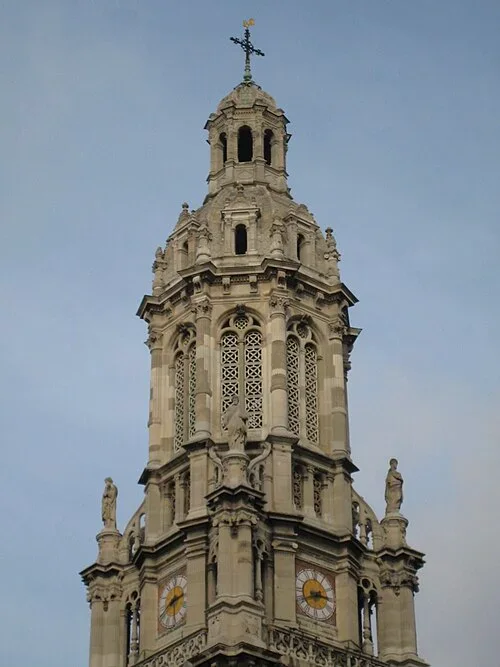 Main Façade and the 65-Meter BelfryThe 65-meter belfry and the Notre-Dame twin clock
The bell tower climbs sixty-five meters, and for a long while it was the tallest thing in the quarter. A square base rises to an octagonal tower crowned by a dome, in the manner of the French Renaissance. Two smaller domed towers on the corners of the façade balance it, giving the whole front its symmetry. The tower keeps a secret that surfaced only in May 2019, during an inventory. The church's clocks turned out to be built on the same mechanism as the clock of Notre-Dame cathedral. Both had come from the same workshops, Collin-Wagner, in the same year, 1867. The only difference was size: the Trinité's clocks are the smaller ones. Weeks earlier, on the fifteenth of April 2019, the fire at Notre-Dame had destroyed its clock. The careful study of the clocks here could serve as a reference for a possible rebuilding of Notre-Dame's lost timepiece exactly as it was. The two dials with their gilded faces still keep the time in the tower.
Listen in the appJean-Nicolas 92 · CC BY-SA 3.0
05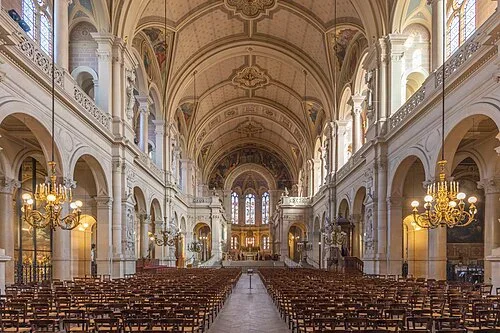 The Grand Nave and Second Empire EclecticismThe nave: iron frame, light and the siege hospital
The nave is a hall about ninety meters long and thirty-four meters wide, with a ceiling thirty meters high. What makes that open space possible is hidden: the church is built on an iron frame, a modern engineering trick dressed in Renaissance stone. Light pours in from the upper windows, which are made mostly of white decor glass with only a minimum of colour. That whiteness sets off the polychrome paintings that cover the top level of the walls and vaults. The lower level is white columns and pillars, and each pillar carries two statues of apostles, told apart by their symbols. Then came the winter of 1870 to 1871, when Prussian armies surrounded Paris and the city was under siege. The church became a hospital, because it was one of the few large Paris buildings with a working furnace. A big stove stood in the nave for extra heat, and its smoke darkened the ceiling. The chapels were emptied and turned into a pharmacy, a linen closet, a laundry and storerooms.
Listen in the appPhoto: ZeusUpsistos · CC BY-SA 4.0
06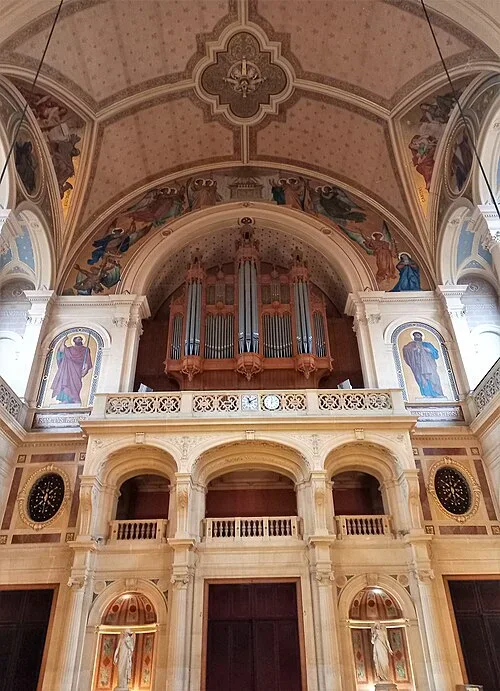 The Cavaillé-Coll Organ Loft and Imperial TribuneThe Cavaillé-Coll grand organ and Olivier Messiaen
Aristide Cavaillé-Coll, the greatest French organ builder of the century, built this grand organ in 1869. It barely survived its first decade. During the Paris Commune the instrument was gravely damaged, and in 1871 the same firm rebuilt it entirely. Alexandre Guilmant was named titular organist after the rebuilding, and he held the post until 1901, playing most of his own works here. Later the organ was reworked again and again, by Merklin in 1901 and by other firms after, a sign of how much it was used. In 1931 the post went to a twenty-three-year-old composer named Olivier Messiaen. He kept it for sixty-one years, until his death in 1992. Sunday after Sunday he improvised at these keys, and listeners came from around the world to hear him. Many of his most important works were written for this instrument, in this gallery, under the painted vaults.
Listen in the appPhoto: Cmcmcm1 · CC BY-SA 4.0
07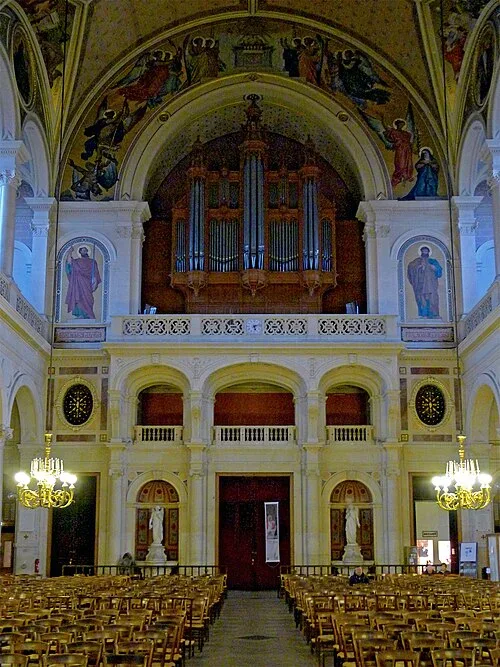 The Cavaillé-Coll Organ Loft and Imperial TribuneThe imperial tribune beneath the organ gallery
On the second level of the nave, above the entrance, opens a decorated central balcony. It was built for one man: Emperor Napoleon III, who was meant to hear mass from there. He never used it once. The Empire fell in 1870, with the war against Prussia, and the balcony was left to the pigeons and the paint. Above it stretches a triumphal arch painted by Jobbé-Duval with a scene from the Apocalypse of Saint John, Christ and the Easter Lamb. The church's ties to music ran deep in its earliest years. The funeral of Gioachino Rossini was held here in November 1868. Four months later, in March 1869, came the funeral of Hector Berlioz. And in 1875 the church buried Georges Bizet, the composer of Carmen, dead at thirty-six.
Listen in the appPhoto: Mbzt · CC BY-SA 3.0
08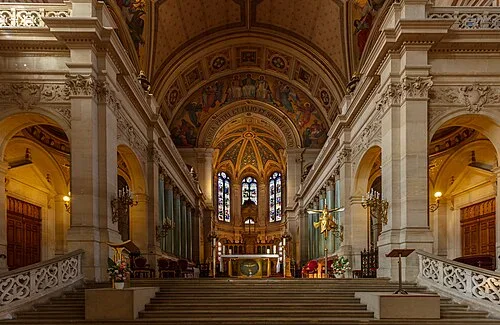 Elevated Choir Sanctuary and Ten Commandments ColumnsThe raised sanctuary and the Ten Commandments columns
The choir rises ten steps above the floor of the nave. That was not ceremony for its own sake: the ground beneath the church slopes toward Montmartre, and the builders turned an awkward site into drama. The climb lifts the altar high above the congregation, framed beneath the painted vault. The immense main altar is the work of Puissielgue-Rusand, who also made the altar of Saint-François-Xavier across town. Around it stand ten columns, one for each of the Ten Commandments, so the law given to Moses literally encloses the place of worship. On a high stand before the altar rises a more modern crucifix, made in 1992 by the sculptor Philippe Kaeppelin. More than a century of church art, in one glance.
Listen in the appDiego Delso · CC BY-SA 4.0
09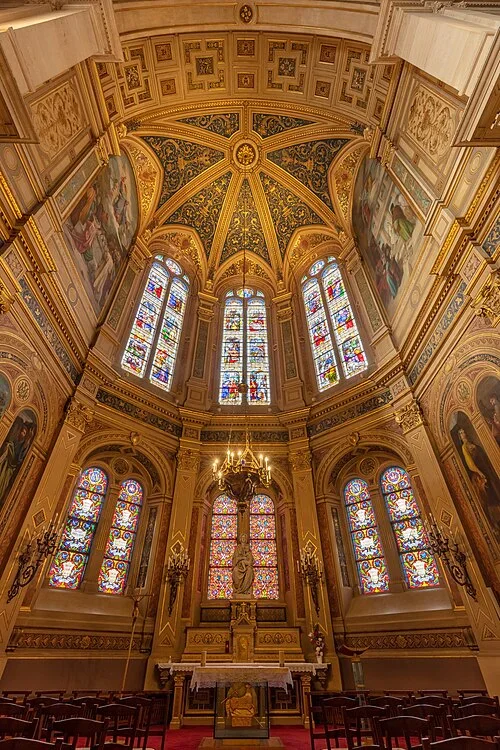 Apse Chapel of the Virgin and Stained GlassThe Chapel of the Virgin and its stained glass
Behind the high altar, reached by walking around the choir, lies the largest chapel of the church. The Chapel of the Virgin sits in the traditional apse position, facing the morning sun, and it catches the light from the first hours of the day. The windows were commissioned in 1864 from three glass masters: Eugène Oudinot, Auguste Leloir and Paul Nicod. The upper windows, by Oudinot and Leloir, show scenes from the life of the Virgin, drawn from the Bible and church tradition, with Joseph appearing in the upper lights. The lower windows behind the altar take a different path entirely: they are abstract, and full of colour, Nicod's work. Together they form the most prominent windows in the church's notable collection of nineteenth-century glass. Over the altar, an arch carries a monumental painting of the Holy Trinity, God the Father wrapping his cloak around Christ and the Holy Ghost.
Listen in the appDiego Delso · CC BY-SA 4.0
10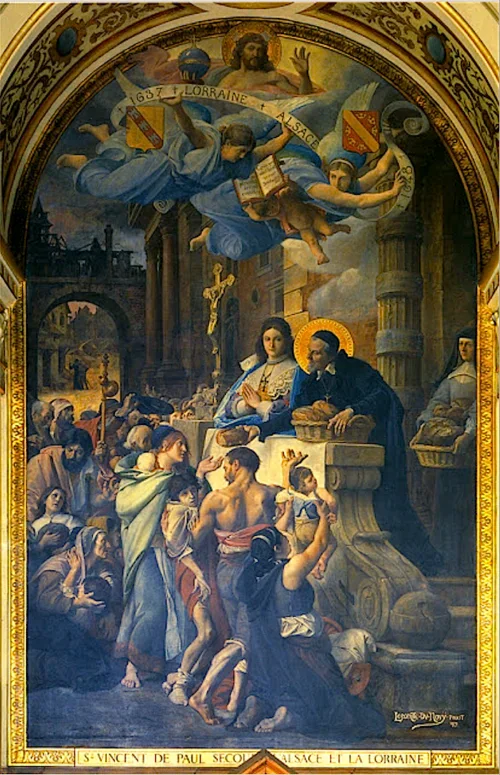 Perimeter Chapels and 19th-Century Academic MuralsSide chapel mural by Jean-Jules-Antoine Lecomte du Nouÿ
Small chapels line both sides of the nave and the choir, and each one is a framed painting in stone. The decoration was given to the major French academic painters of the day, most of them trained at the French Academy in Rome. In the chapel of Saint Vincent de Paul, Jean-Jules-Antoine Lecomte du Nouÿ painted the saint in his blue clerical cloak, standing at a table and handing bread to the people of Lorraine, devastated by war. The banner across the top of the painting carries the year 1637. In another chapel, Désiré François Laugée painted the death of Saint Denis. These painters and their colleagues went on from here to decorate many of the new churches Paris built in the nineteenth century. That was the point of the whole enterprise: Napoleon III's Paris did not simply build a church, it commissioned architecture, sculpture, painting and glass together, as one work. Few buildings tell how that regime fused faith, city planning and state-sponsored art as completely as La Trinité.
Listen in the appJean Lecomte du Nouÿ · Public domain
Église de la Sainte-Trinité de Paris
Frequently asked questions
How much does the guide cost?
Free app download. Listed guide price: $0.99. Guide price shown in the app. Audio guide only. Venue admission is separate.
Can I listen without internet?
Yes. Download the guide’s audio, images, and maps in the app before your visit. Your downloaded content is then available offline.
Can I listen in my language?
This audio guide is available in 15 languages, including English.
Do I need to follow a schedule?
No. This is a self-guided experience. Choose your stops, pause whenever you like, and return to a story at your own pace.
At your own pace
Explore Église de la Sainte-Trinité de Paris.
Download Stanza, then search for “Église de la Sainte-Trinité de Paris”.
Free app download · Guide price shown in the app
Keep exploring
Nearby audio guides
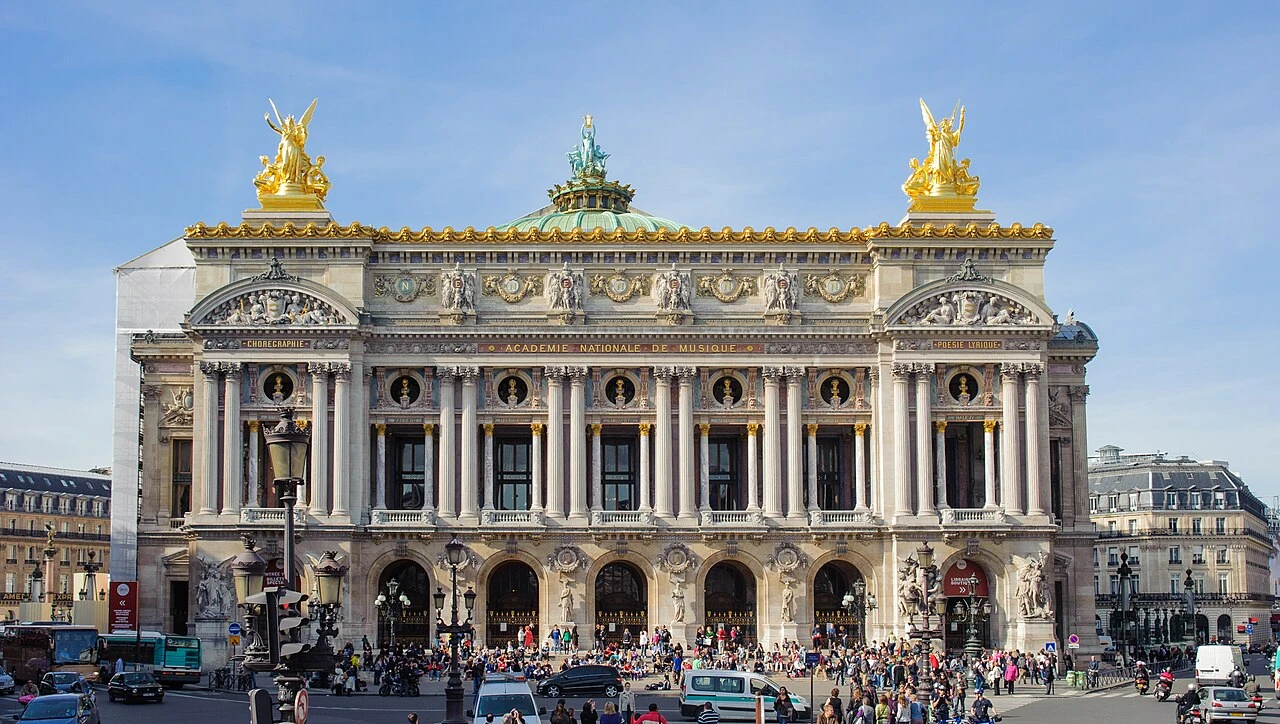
Paris · 1 km
Palais Garnier
Content & sources
Photo: Alexander Hoernigk · CC BY 3.0
Paris · 1 km
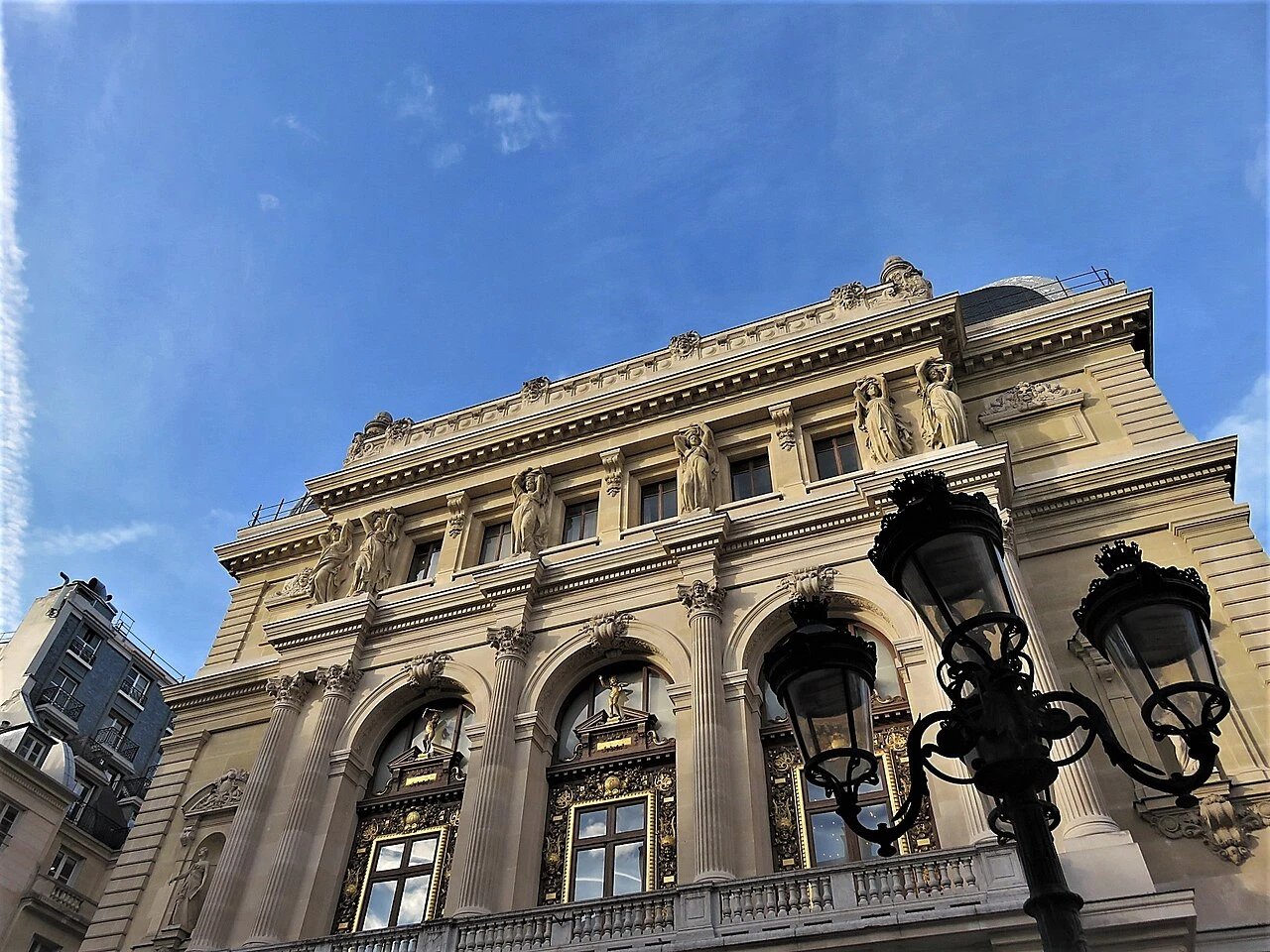
Opéra-Comique
Content & sources
Arthur Weidmann from Paris, France · CC BY-SA 2.0
Paris · 1 km
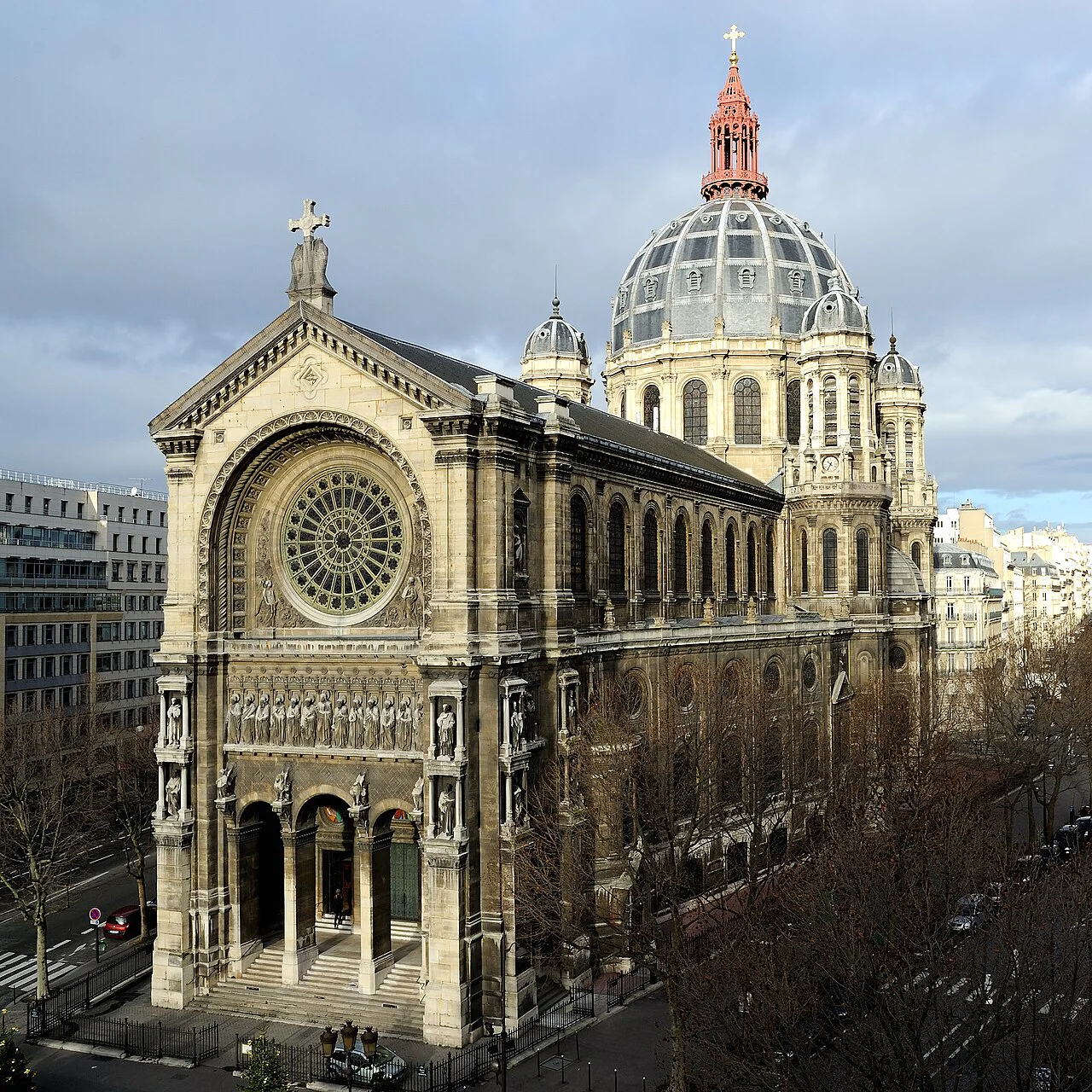
Église Saint-Augustin de Paris
Content & sources
Photo: Saffron Blaze · CC BY-SA 3.0
Paris · 1 km
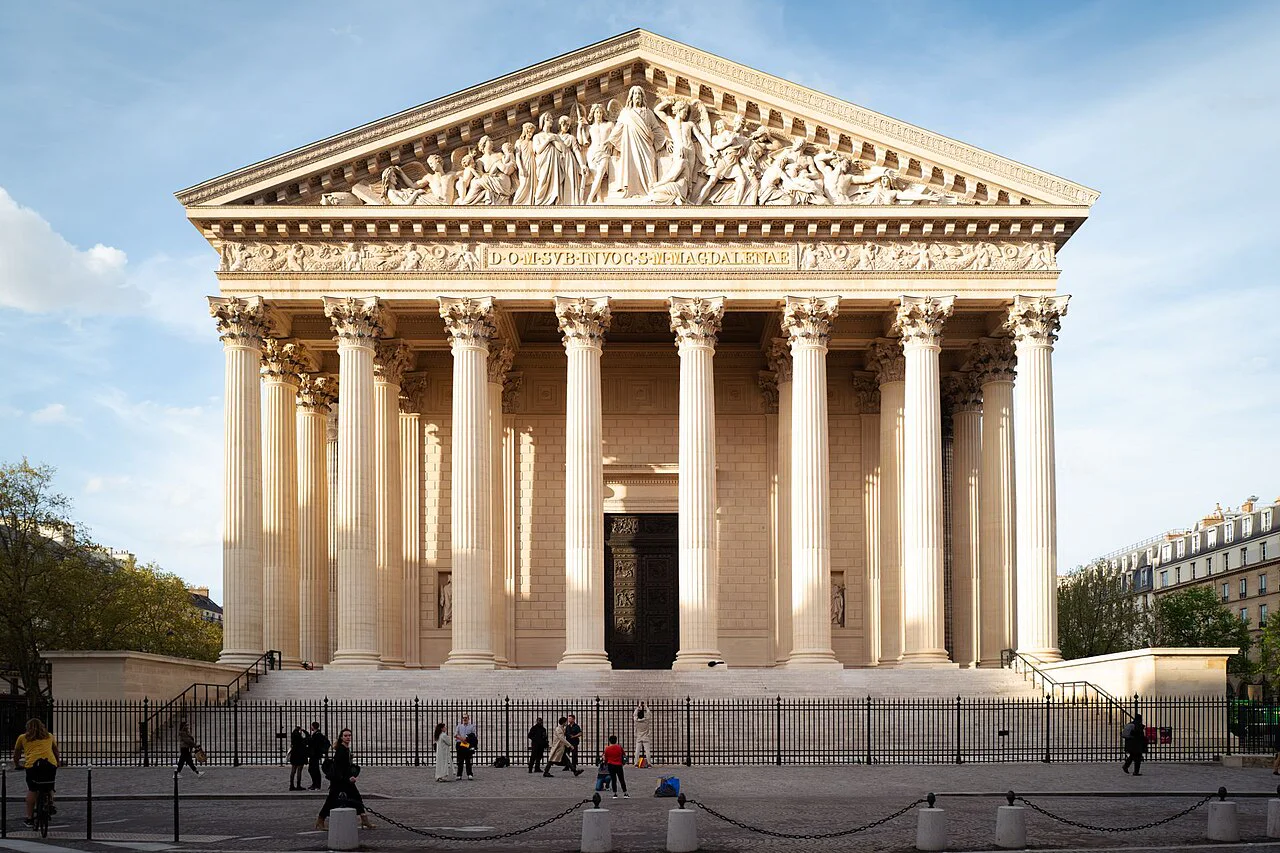
Église de la Madeleine
Content & sources
Callaway Kosine – de Suzannet · CC BY 3.0