Stanza · Audio guide
Église de la Madeleine Audio guide
A place to remember. A story to take with you.
La Madeleine is a Catholic parish church located on Place de la Madeleine in Paris. The building is noted for its Neoclassical architecture, Corinthian columns, and interior frescoes and sculptures.
Download Stanza, then search for “Église de la Madeleine”.
About the tour
One guide. Your kind of visit.
La Madeleine is a Catholic parish church located on Place de la Madeleine in Paris. The building is noted for its Neoclassical architecture, Corinthian columns, and interior frescoes and sculptures.
Ready when you are.
- 01Get the free Stanza app.
iOS & Android
- 02Find your guide.
“Église de la Madeleine”
- 03Download before you go.
Works offline
Audio guide / 11 narrated stops
Inside the guide
Get to know a few of the stories before you go. Open a stop to read more.
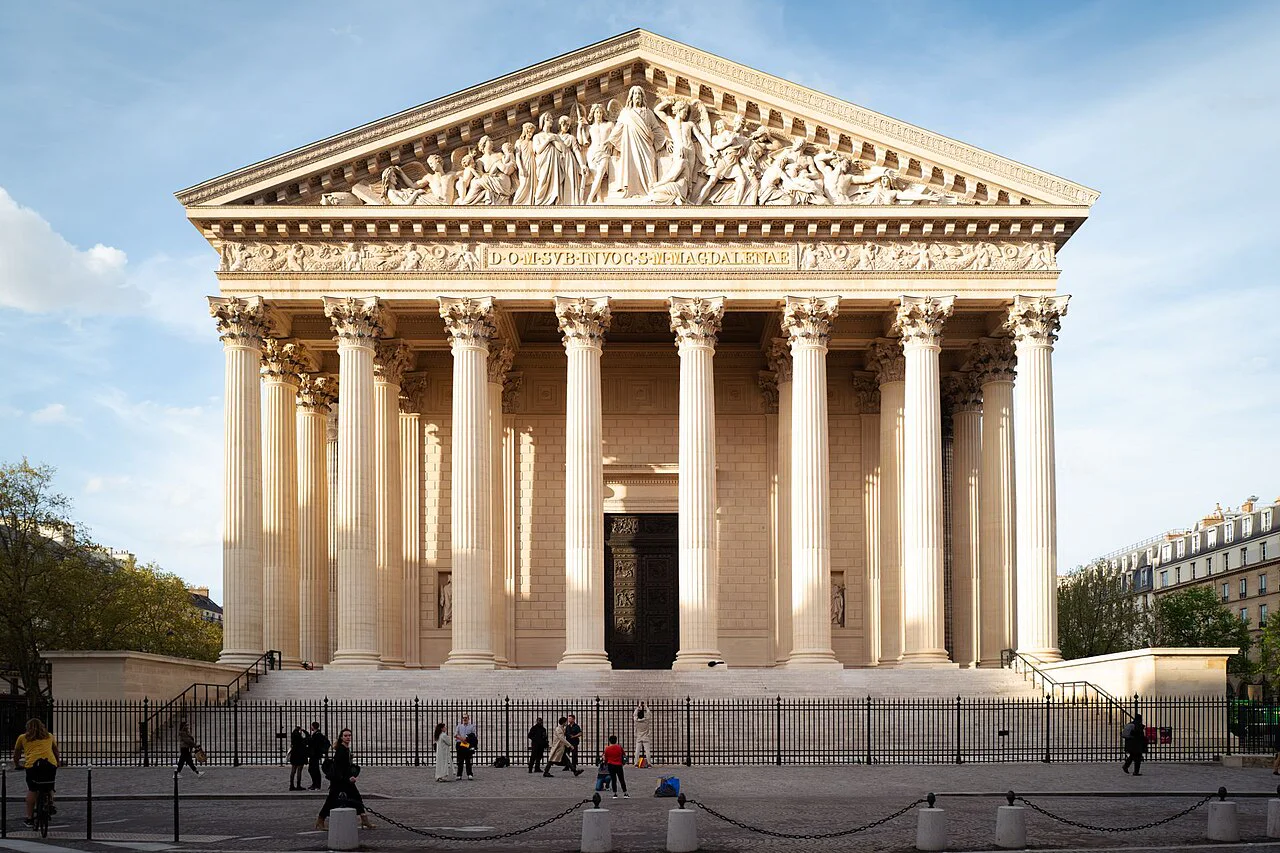
01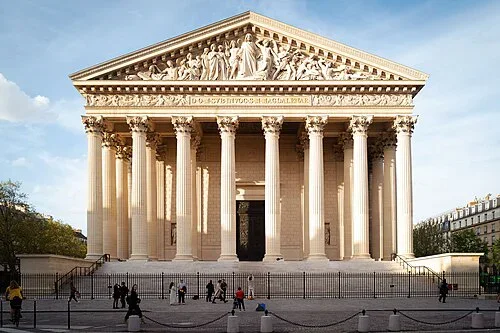 Southern Approach and Neoclassical FacadeThe Temple on Place de la Madeleine
Welcome to the Madeleine, a Catholic parish church dressed as an ancient temple. Fifty-two Corinthian columns surround the building on all four sides, not just across the front. Each column is twenty metres tall. It is one of the rare large neo-classical buildings to have copied the whole form of a temple, rather than a single portico. The story begins with a church that had grown too small. An older church of Saint Mary Magdalene, built in the thirteenth century, could no longer hold the booming neighbourhood. Louis XV authorised a larger replacement, set to close the view down the new Rue Royale towards what is now the Place de la Concorde. The king laid the first stone in person on the third of August, 1763. The first design put a dome over a cross-shaped church, in the manner of the Invalides. A later architect scrapped that for something simpler and more classical. One thing here is recent, though: the pale stone was cleaned and restored between 2020 and 2024, finished just in time for the Paris Olympics.
Callaway Kosine – de Suzannet · CC BY 3.0
02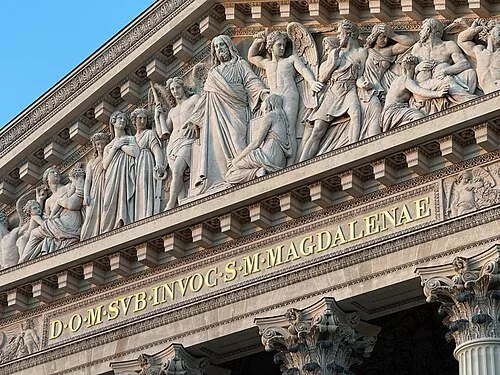 The South Portico and Last Judgement PedimentThe Last Judgement Pediment
High on the facade, the triangular pediment carries the Last Judgement, carved by Philippe Joseph Henri Lemaire. It arrived by competition. Pierre-Alexandre Vignon, the architect of the temple, died in 1828 with the church unfinished, and his assistant Jacques-Marie Huvé took charge. A competition for the pediment sculpture followed across 1828 and 1829, and Lemaire's design won. Christ stands at the centre, presiding over the judgement, flanked by angels. On one side the Archangel Michael gathers the Vices, the figures who will be refused entry to heaven. On the other, the Virtues escort those who are admitted. Kneeling there is the church's own patron, Mary Magdalene, praying for the sinners. Lemaire's sculpture also holds a prominent place on the Arc de Triomphe. Below the carving, a gilded Latin inscription runs along the frieze. It reads D.O.M. SVB INVOC S.M. MAGDALENAE, meaning to God, all-powerful and very great, under the invocation of Saint Mary Magdalene.
Photo: Chabe01 · CC BY-SA 4.0
03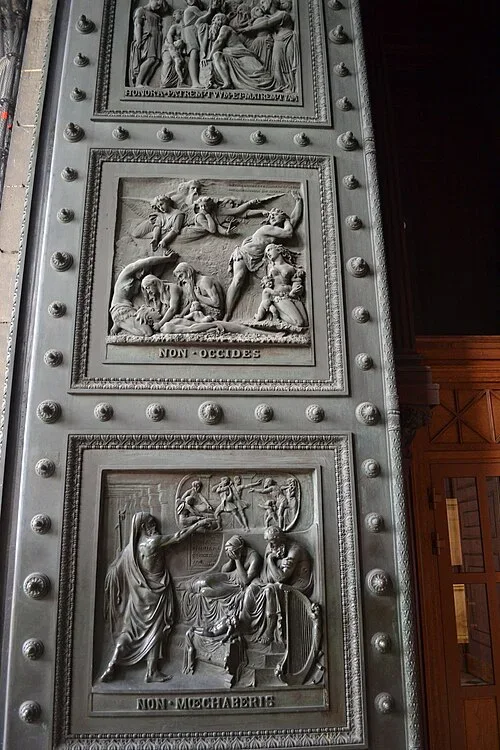 The Ten Commandments Bronze PortalThe Ten Commandments Bronze Doors
The bronze doors of the south portal carry the Ten Commandments in relief, panel after panel. Their maker, Henri de Triqueti, won the commission when he was only about thirty years old. Each commandment has its own framed scene. One panel is titled Non occides, thou shalt not kill; another, Non mechaberis, thou shalt not commit adultery. Triqueti studied the great doors of Italy for his model: Ghiberti's panels for the Florence Baptistry, and the doors of the Pantheon and of basilicas in Pisa, Rome, Verona and Venice. His doors are larger than those of Saint Peter's Basilica in Rome, yet designed to be thinner and lighter. Unlike many bronze church doors, they carry no gilding at all, only the plain colour of the bronze itself. The commission made his career. King Louis-Philippe took him on as a royal sculptor, with work that included sculpture for Napoleon's tomb.
Listen in the appLadislav Luppa · CC BY-SA 4.0
04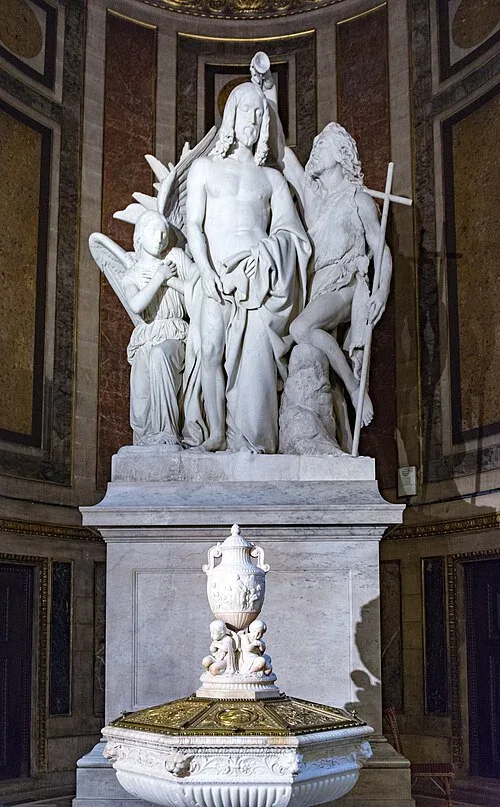 The Entrance Vestibule and the Baptism of ChristRude's Baptism of Christ
Just inside, in the south vestibule, stands François Rude's Baptism of Christ in white marble. Christ stands at the centre; John the Baptist, holding his cross, stands beside him; an angel kneels above. The sculpture rises over the church's baptismal font, which suits the subject exactly. Rude arrived here already famous. In 1836 he had made The Departure of the Volunteers for the Arc de Triomphe, and this group shows the same energy in a gentler key. From the doorway, the classical temple gives way to the church within.
Listen in the appxiquinhosilva from Cacau · CC BY 2.0
05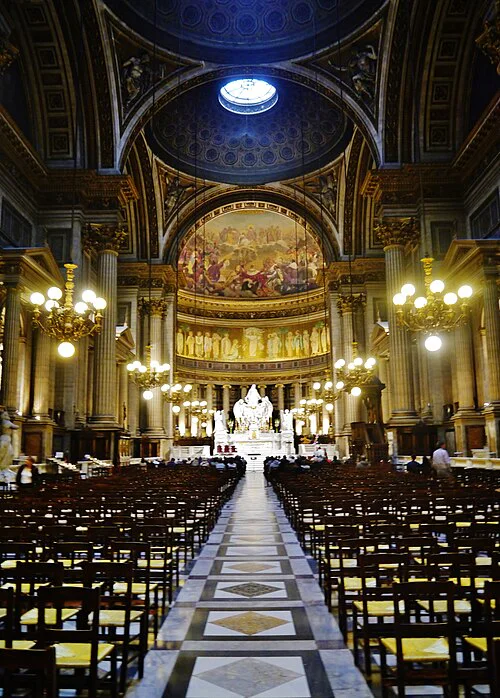 The Grand Nave and Skylit DomesA Building of Four Identities
The long hall of the nave has served, on paper, as a church, a temple, a library, a ballroom, a marketplace and a railway station. Work stopped outright with the Revolution of 1789, when only the foundations and the great portico stood. Under the Revolutionary government, the debate began over what the half-built shell should become. A library, a public ballroom and a marketplace were all seriously proposed. Then Napoleon settled it. He had been crowned emperor in 1804. In 1806 he declared that the building would become a Temple to the Glory of the Grand Army. He was on campaign in Poland, and personally chose the temple design of Pierre-Alexandre Vignon over the one recommended by the Academy of Architecture. Inside, the names of the soldiers of Ulm, Austerlitz and Jena were to be inscribed on marble tables, the fallen on gold, the departments of France on silver. After Napoleon's fall, the restored monarchy resumed work as a church, at one point intending a chapel of atonement for the Revolution, before the dedication settled on Mary Magdalene. Then came the strangest proposal of all. In 1837 the government considered gutting the building to make it the first railway station in Paris, and dropped the idea as expensive and impractical. The church was finally inaugurated on 24 July 1842, the feast day of Saint Mary Magdalene. Its consecration as a Catholic church followed a few years later.
Listen in the appPhoto: Zairon · CC BY-SA 4.0
06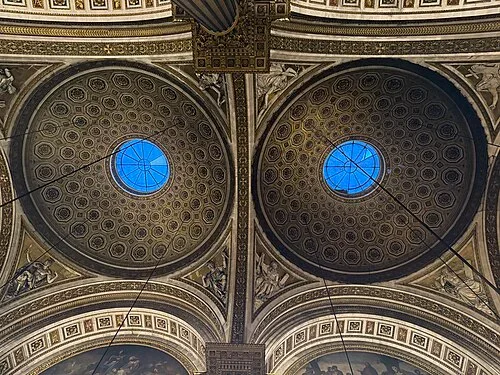 The Grand Nave and Skylit DomesUnder the Skylit Domes
Behind the Greek temple shell hides a Roman bath. The interior, designed by Jacques-Marie Huvé, takes its shape from the great thermal baths of ancient Rome, above all the frigidarium of the Baths of Caracalla, which French architects had just measured in the 1820s. There is no transept and no cross-shaped plan. One long hall is divided into three wide arched bays, each roofed by a dome. Each dome is pierced at its centre by a round skylight, glazed in blue, and that is nearly all the daylight the church receives. Huvé had wanted tall half-moon windows in the walls to flood the space with light. A supervising commission overruled him and ordered the skylights instead, a decision he openly deplored. The Roman inspiration goes further. The walls, arches and ceilings are sheathed in coloured marble laid in intricate geometric patterns, much of it gilded, echoing the polychrome decoration of Rome's Pantheon.
Listen in the appPhoto: Chabe01 · CC BY-SA 4.0
07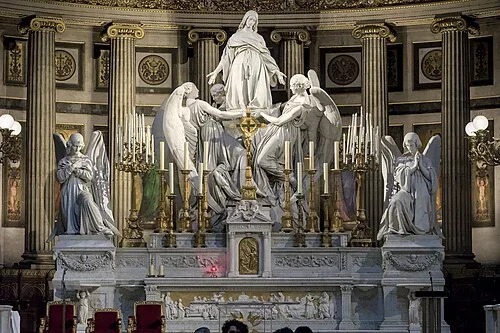 The High Altar and the Ecstasy of Saint Mary MagdaleneThe Ecstasy of Saint Mary Magdalene
At the head of the nave, a marble stairway climbs to the high altar. Behind it stands Carlo Marochetti's Ecstasy of Mary Magdalene, the liturgical heart of the church. The patron saint kneels in prayer, wrapped in marble drapery, as three angels lift her towards heaven. A row of Corinthian columns behind the altar forms a theatrical backdrop for the group. The dedication is the point of the whole building. This church belongs to Mary Magdalene, the follower of Christ who witnessed both his crucifixion and his resurrection. She is the woman kneeling to pray for sinners on the pediment outside, and she appears again in the painted and mosaic work above this altar.
Listen in the appPhoto: Romainbehar · CC0
08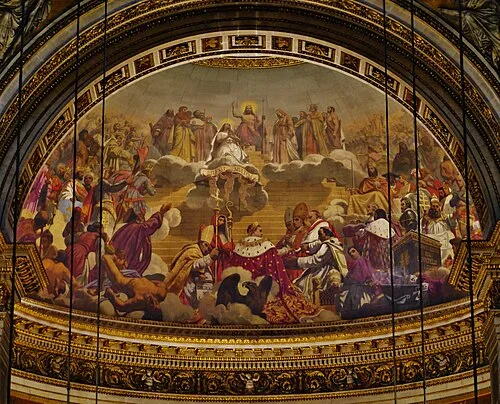 The Apse: History of Christianity Fresco and Sèvres MosaicZiegler's History of Christianity
The half-dome above the choir carries a fresco four years in the making: Jules-Claude Ziegler's History of Christianity. At its top, Christ sits among the Apostles, with Mary Magdalene beside him. The surprise is in the foreground. There stands Napoleon Bonaparte, shaking hands with Pope Pius VII at the signing of the Concordat of 1801. That agreement reconciled the French church and the state after the Revolution, and allowed Catholic churches across France to reopen. The painting is where this building's two identities meet. The emperor who once claimed it for his army stands honoured on the wall of a Catholic church. Ziegler painted his figures with striking realism and animation.
Listen in the appPhoto: Zairon · CC BY-SA 4.0
09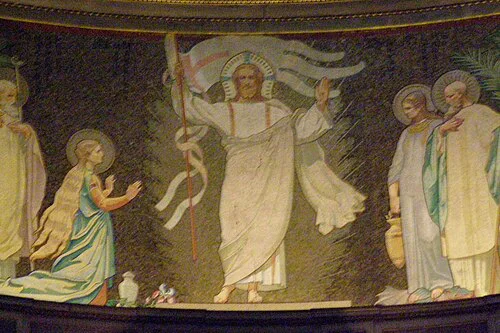 The Apse: History of Christianity Fresco and Sèvres MosaicThe Sèvres Mosaic of French Saints
Below the fresco, the style changes completely. This wide band of ceramic mosaic is Neo-Byzantine, unlike anything else in the choir. It was conceived between 1888 and 1893 by Father LeRebours, the church's own curate, painted by Charles-Joseph Lameire, and fired into ceramic by the Sèvres porcelain workshops. The Risen Christ stands at the centre, with Mary Magdalene kneeling before him, flanked by saints with ties to France, among them Saint Genevieve, patron of Paris. Two figures hide portraits. Saint Front carries the face of Lameire himself. Saint Ursin has the features of the architect Charles Garnier. In the dim light of this church, the gilded tiles often catch more light than any other artwork inside.
Listen in the appPhoto: Albertus teolog · Public domain
10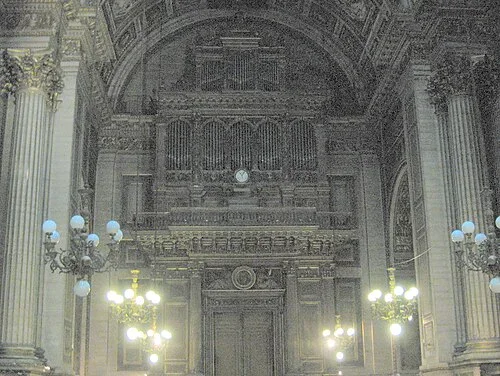 The Southern Tribune and Cavaillé-Coll Grand OrganThe Cavaillé-Coll Grand Organ
Above the south entrance, set on its tribune, sits the great organ. Aristide Cavaillé-Coll built it in 1846, in an elaborate case of sculpted angels and spires, harmonised with the décor around it. Today it has four manuals and a pedalboard, with about sixty stops. Its organists' chair has been held by some of the finest composers in France. And the church keeps one famous funeral. Frédéric Chopin's funeral here was delayed almost two weeks. It was finally held on 30 October 1849. He had asked for Mozart's Requiem to be sung. The Requiem has major parts for female voices, and the Madeleine had never permitted women to sing in its choir. The church finally relented, on one condition. The women sang entirely hidden behind a black velvet curtain.
Listen in the appPhoto: UHT · Public domain
Église de la Madeleine
Frequently asked questions
How much does the guide cost?
Free app download. Listed guide price: $0.99. Guide price shown in the app. Audio guide only. Venue admission is separate.
Can I listen without internet?
Yes. Download the guide’s audio, images, and maps in the app before your visit. Your downloaded content is then available offline.
Can I listen in my language?
This audio guide is available in 15 languages, including English.
Do I need to follow a schedule?
No. This is a self-guided experience. Choose your stops, pause whenever you like, and return to a story at your own pace.
At your own pace
Explore Église de la Madeleine.
Download Stanza, then search for “Église de la Madeleine”.
Free app download · Guide price shown in the app
Keep exploring
Nearby audio guides
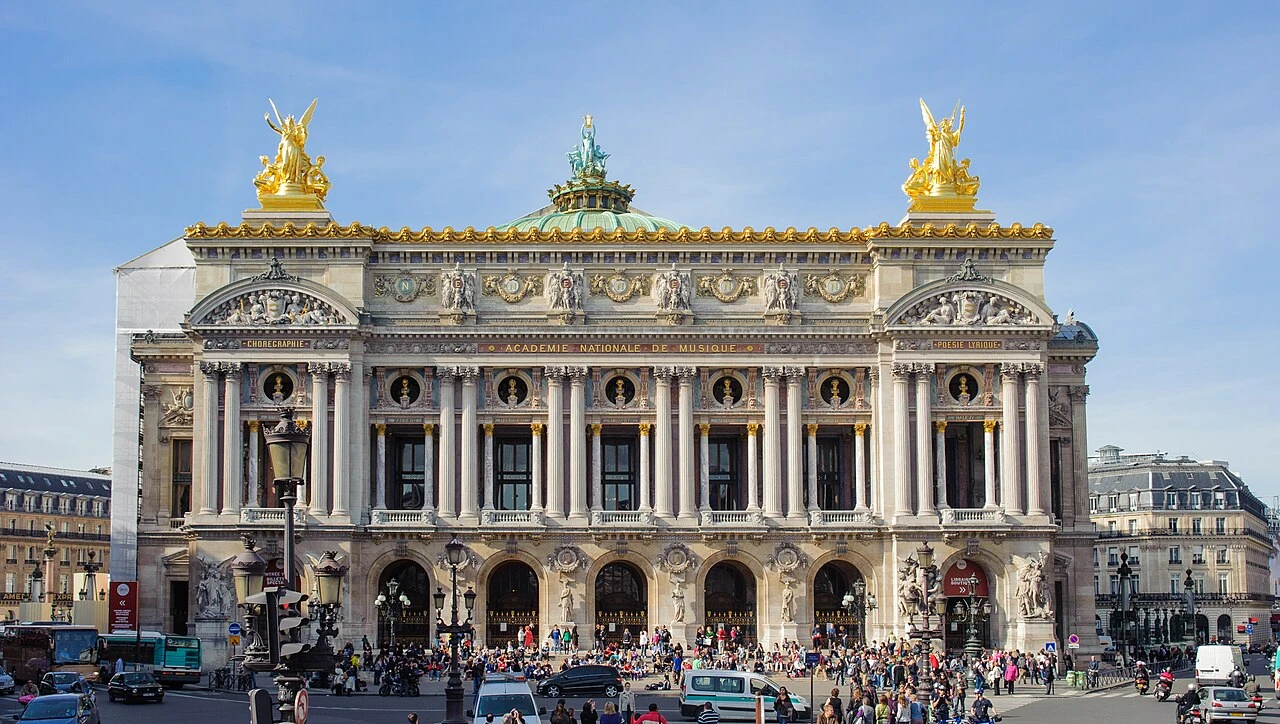
Paris · 1 km
Palais Garnier
Content & sources
Photo: Alexander Hoernigk · CC BY 3.0
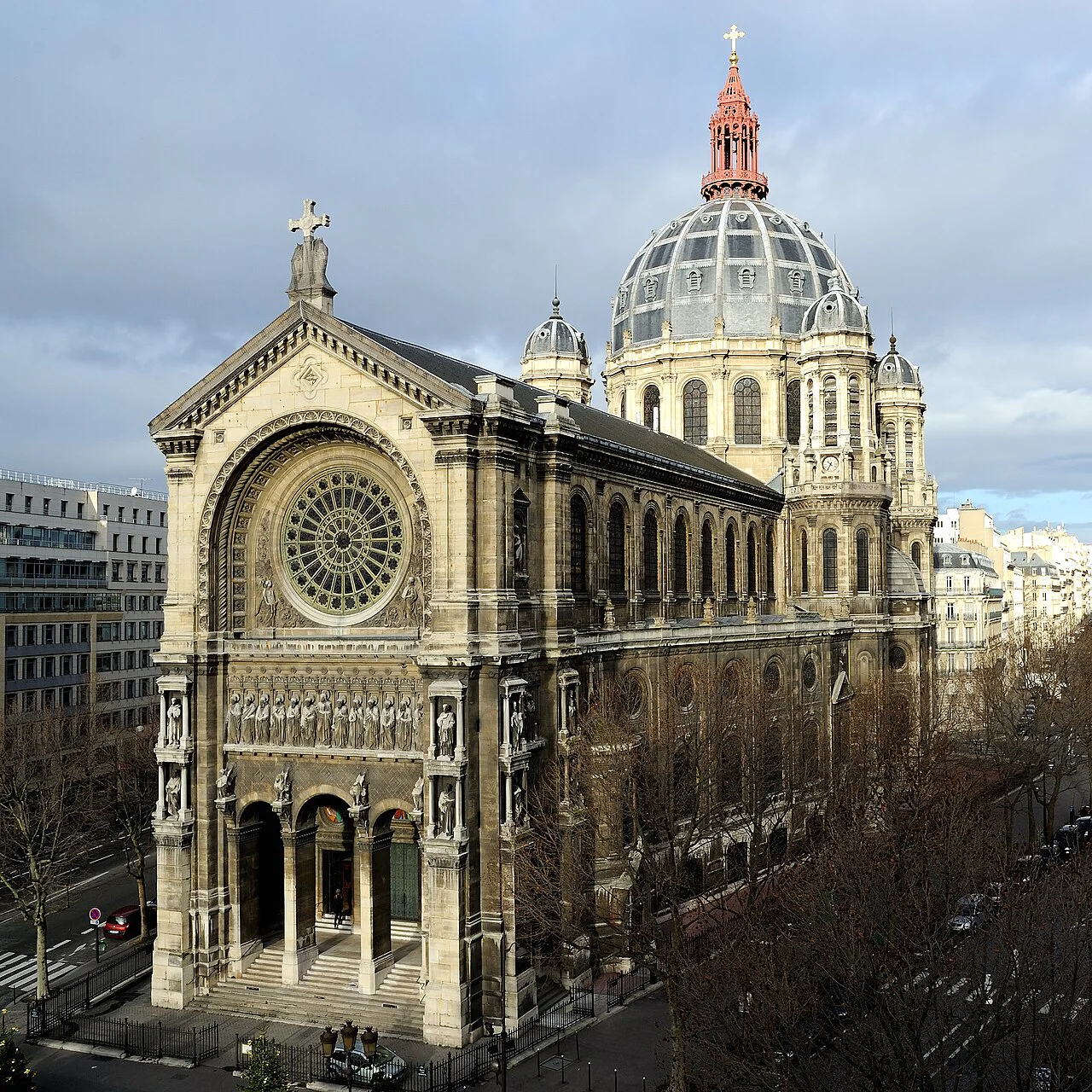
Paris · 1 km
Église Saint-Augustin de Paris
Content & sources
Photo: Saffron Blaze · CC BY-SA 3.0
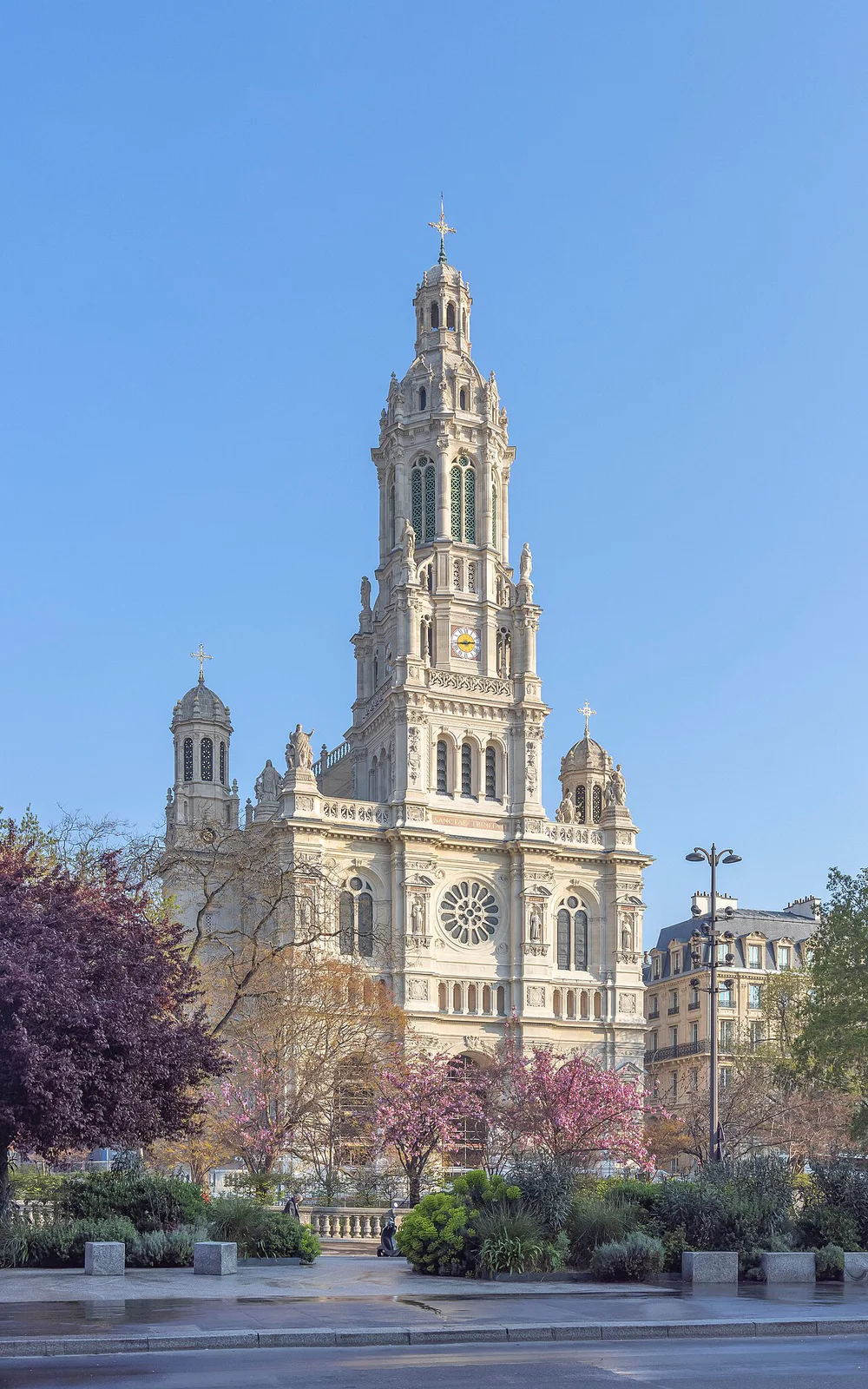
Paris · 1 km
Église de la Sainte-Trinité de Paris
Content & sources
Photo: ZeusUpsistos · CC BY-SA 4.0
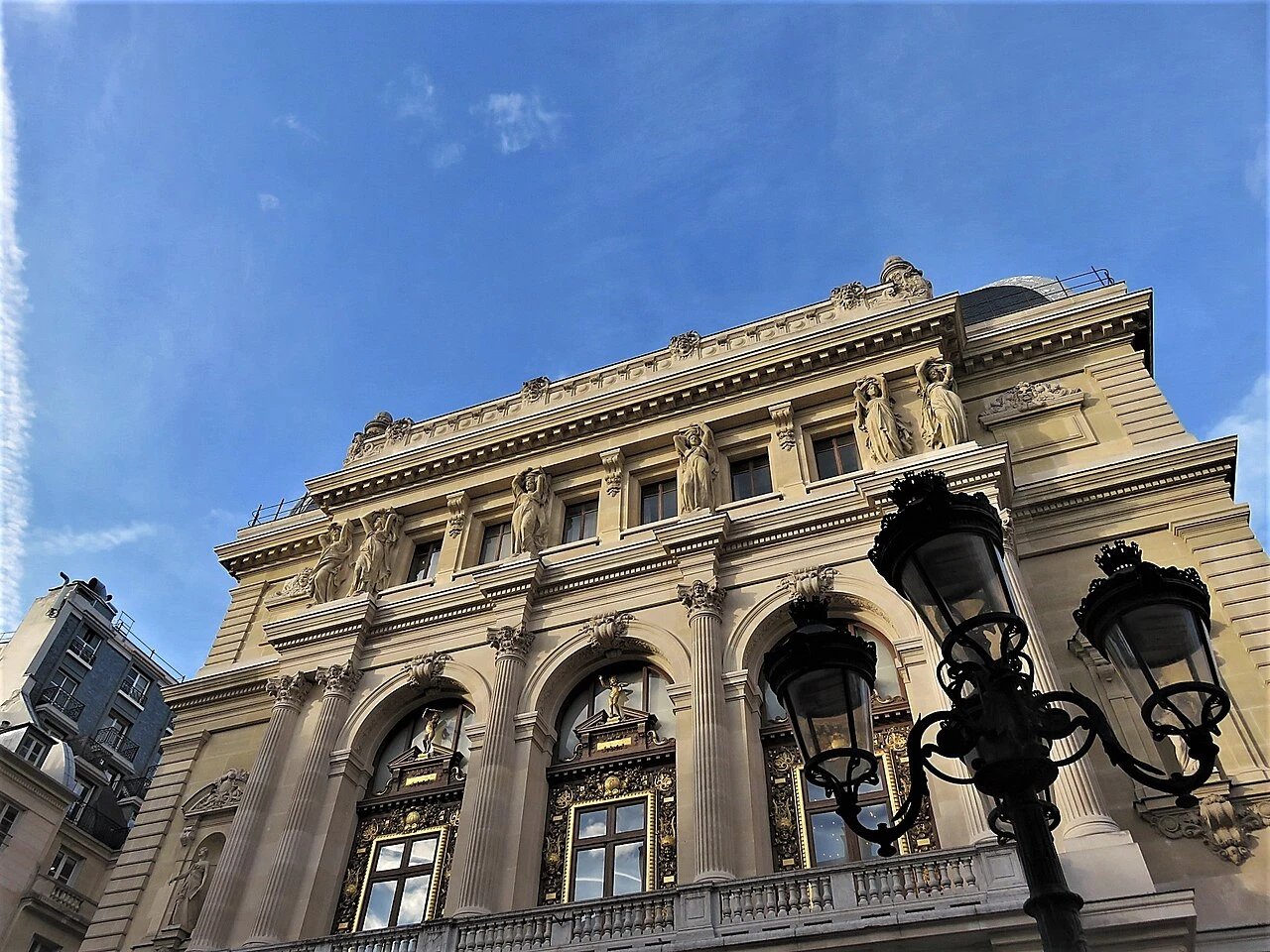
Paris · 1 km
Opéra-Comique
Content & sources
Arthur Weidmann from Paris, France · CC BY-SA 2.0