Stanza · Audio guide
Église Saint-Augustin de Paris Audio guide
A place to remember. A story to take with you.
The Church of St. Augustine is a Catholic church located at 46 boulevard Malesherbes in the 8th arrondissement of Paris. It was the first church in Paris to combine a cast-iron frame with stone construction.
Download Stanza, then search for “Église Saint-Augustin de Paris”.
About the tour
One guide. Your kind of visit.
The Church of St. Augustine is a Catholic church located at 46 boulevard Malesherbes in the 8th arrondissement of Paris. It was the first church in Paris to combine a cast-iron frame with stone construction.
Ready when you are.
- 01Get the free Stanza app.
iOS & Android
- 02Find your guide.
“Église Saint-Augustin de Paris”
- 03Download before you go.
Works offline
Audio guide / 9 narrated stops
Inside the guide
Get to know a few of the stories before you go. Open a stop to read more.
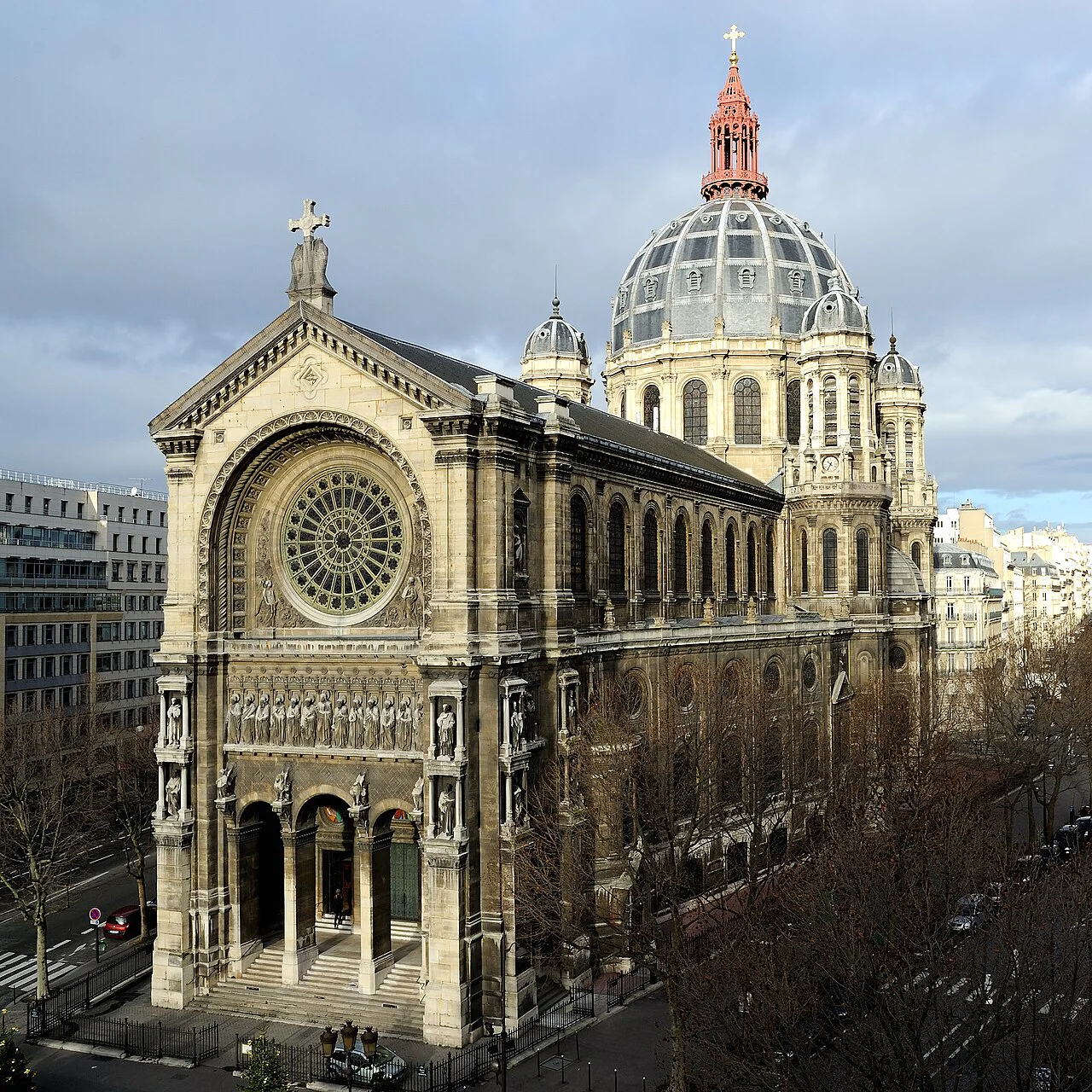
01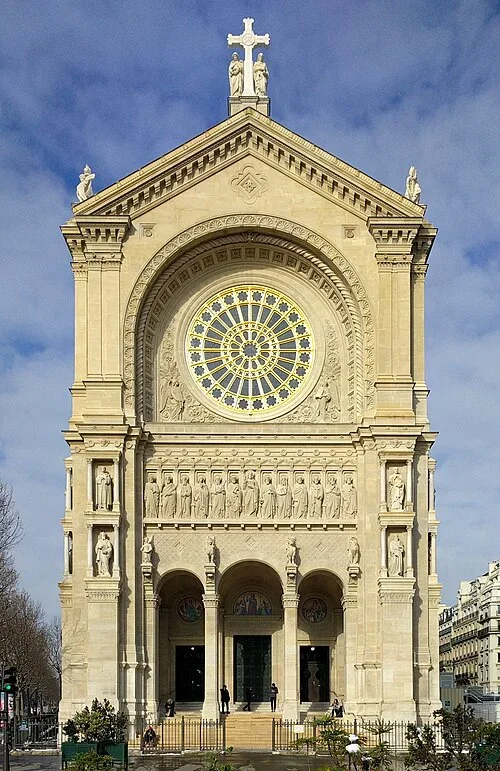 Place Saint-Augustin and the Imperial FacadeSaint-Augustin: A Church Built for a New Paris
Paris in the eighteen-sixties was a city under construction. Napoleon III and his prefect, Haussmann, were cutting broad new boulevards through the old medieval streets, and every major crossroads was to receive a monumental building. This church was planted where two of those boulevards meet, meant to anchor Boulevard Malesherbes and balance the Madeleine at its other end. It was also designed to be seen from the Arc de Triomphe, down the length of the avenue de Friedland. The man chosen for the job was Victor Baltard, chief architect of the city of Paris, already famous for the iron-and-glass markets of Les Halles. It is said that the scale of the design drew on the great churches of London, where the emperor had lived in exile before taking the throne. Whatever the inspiration, the style is deliberately hard to pin down, blending Roman, Byzantine, Gothic and Renaissance touches. Building stretched from 1860 to 1871, through the fall of the Empire itself. The facade has recently been through its own overhaul; the city and the culture ministry paid several million euros, and the work finished in 2018. One thing the architect could not design away: with traffic on two busy boulevards, this is said to be one of the noisiest churches in Paris. The carved apostles over the entrance come next, and inside waits an iron skeleton.
Photo: NDessenne · CC BY-SA 4.0
02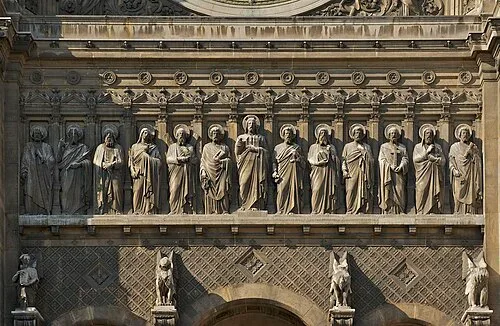 Place Saint-Augustin and the Imperial FacadeThe Portal Frieze of Christ and the Twelve Apostles
Over the main portal, carved in stone, Christ stands at the center of his twelve apostles. The frieze is the work of François Jouffroy, a sculptor of the Second Empire. Each figure is robed and haloed, and together they read like a procession across the front of the church. Below them, above the arcades of the entrance, sit the emblems of the four evangelists. This is the principal, south-facing facade, opening onto the Place Saint-Augustin. When these doors were new, the whole quarter around them was new too. The old district once called Petite Pologne was being renamed the quarter of Europe, its boulevards filling with elegant apartment buildings. This church was built to be that new neighborhood's parish, and its sculpted welcome was placed where every parishioner would pass it.
François Jouffroy · CC0
03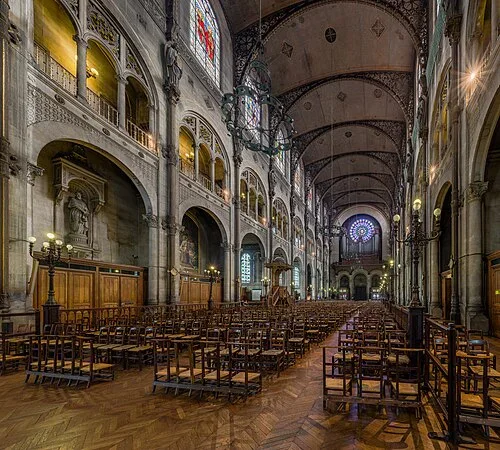 The Nave and Exposed Cast-Iron FrameworkThe Nave: Iron Frame and Trapezoidal Plan
The great open space of this nave rests on metal. Saint-Augustin was the first church in Paris to pair a fully visible cast-iron frame with stone construction, and the frame is on show everywhere, columns and ribs and all. Iron changed the rules of church building. Walls could be far thinner, and the heavy sloping buttresses that brace older churches from the outside simply disappear; there are none here. What remains is a tall, clear interior with nothing to block the view down the aisle. The floor plan is unusual as well. The plot where the boulevards converge was an irregular trapezoid, wider at the back than at the front, so Baltard drew the church to match it. The entrance front is the narrow end. From there the interior steadily expands, and the side chapels grow larger and larger as they approach the choir. All told, the building runs nearly a hundred meters long. The narrow portal makes the widening feel deliberate, a funnel drawing the eye toward the altar.
Listen in the appPhoto: Diliff · CC BY-SA 3.0
04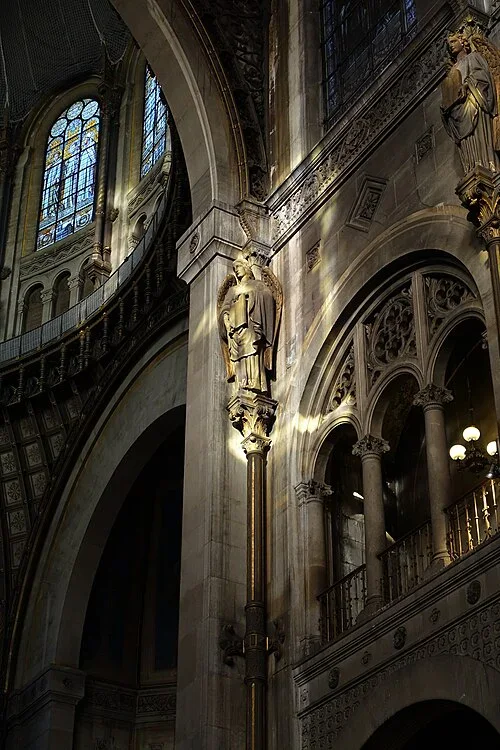 The Nave and Exposed Cast-Iron FrameworkPolychrome Angels on Cast-Iron Columns
The iron columns doing the real structural work were never allowed to look industrial. They are painted and gilded, and their capitals bloom into angels, modeled in relief and finished in color. The sculptor was Louis Schroeder, a Paris artist who died in 1898. These polychrome angels are his contribution to the church, and they turn each metal support into a piece of church furnishing. That was the point. Baltard had already proved at Les Halles that iron could roof a vast market hall. Here he set out to show that the same material could carry a church and still look like one, rather than a railway shed. So the metal that holds up the masonry wears gold leaf, paint and sculpture, structure and ornament in a single piece.
Listen in the appGuilhem Vellut from Paris, France · CC BY 2.0
05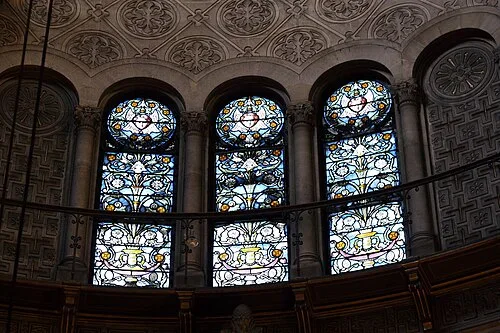 Grisaille and Clerestory Stained GlassGrisaille and Stained Glass in the Choir
Most churches of the nineteenth century filled their windows with white glass to flood the nave with light. Baltard refused. He chose colored glass throughout, and the result is a church that stays rather dim, with a muted, shadowed atmosphere. The choice was made window by window. On the two lower levels of the nave, the glass carries simple geometric figures. Higher up come portraits of saints and martyrs of the early centuries, the work of the glass painter Laurent-Charles Maréchal. Around the dome, the windows are grisaille, a monochrome glass painting heightened with gilded detail in a tone called jaune d'argent. The chapels around the nave and the choir hold windows devoted to saints and apostles, and at the bottom of each are the names of the donors who paid for them.
Listen in the appPhoto: GFreihalter · CC BY-SA 3.0
06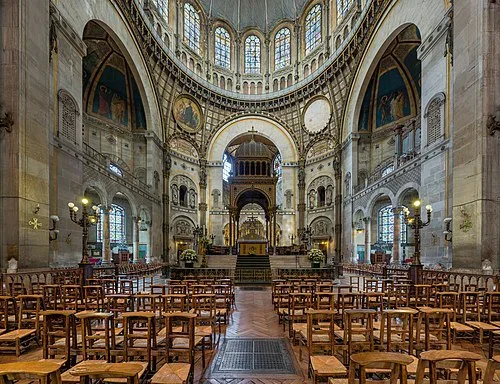 Choir, High Altar Ciborium, and the Grand DomeThe Raised Choir and the Gilded Ciborium
At the far end of the church the floor rises. This is the choir, the part reserved for the clergy, lifted above the level of the nave. Over its altar stands a ciborium, an open, domed canopy in the Renaissance style, made of gilded cast iron. It is the iron engineering of the nave translated into the language of the sanctuary, gold where the columns carry paint. In the middle of the choir sits a modern, moveable wooden altar, placed there so that Mass can be celebrated facing the people. The original high altar stands behind it, partly hidden, and the newer one can be taken away for services celebrated facing east, in the older manner. Beneath all of this lies a crypt with an unfinished story. Napoleon III intended it as the burial place of the princes of his family, while emperors and empresses were to remain at Saint-Denis. It never came to that. The emperor died in exile in England, and he was buried instead at the abbey of Farnborough, alongside his wife and their son.
Listen in the appPhoto: Diliff · CC BY-SA 3.0
07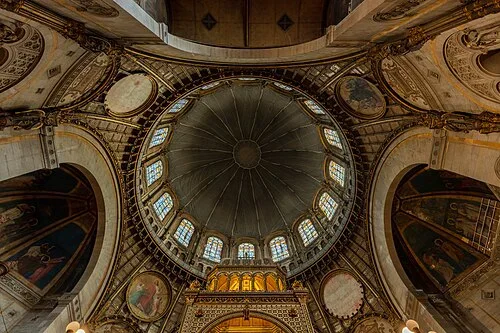 Choir, High Altar Ciborium, and the Grand DomeInside the 80-Meter Dome
Above the choir the dome opens, and its inside is left on display: the iron structure is fully visible, ringed by a band of windows that light it from below. The figures are worth hearing once. The lantern at the top rises eighty meters above the ground. The dome itself spans twenty-five meters across. Outside, four towers cluster around it, and they are not there for looks. They do the work of buttresses, bracing the outward push of the dome, standing in for the masonry supports that iron made unnecessary. This was the boldest test of Baltard's idea. A dome on this scale had been a feat of stone for centuries; here metal carries it instead. Seen from the street, the dome fills almost the entire facade.
Listen in the appDiego Delso · CC BY-SA 4.0
08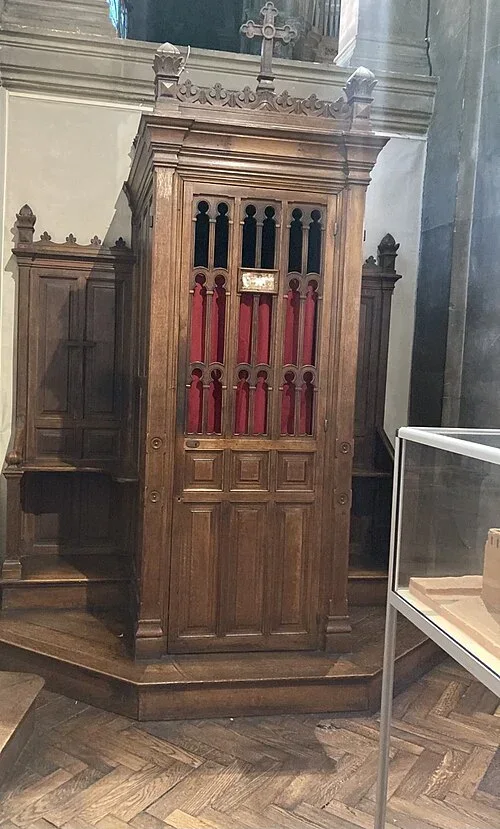 Chapel of Saint Charles de FoucauldThe Confessional of Saint Charles de Foucauld
To one side of the church, a chapel is dedicated to a man whose life changed here. Charles de Foucauld was a soldier, geographer and explorer when he began coming to Saint-Augustin in the eighteen-eighties. The parish vicar, Abbé Huvelin, guided him. In 1886, in this church, Foucauld returned to the Catholic faith. The confessional where that happened has been kept, a tall wooden booth crowned with a cross, and it stands in the chapel today. Around it the chapel displays documents relating to his life. His conversion led him far from Paris; he spent his later years as a hermit in the Sahara. He was beatified in 2005. On the fifteenth of May 2022, Pope Francis declared him a saint. Pilgrims now come to this quiet chapel for his sake, to the church where his turnaround began.
Listen in the appPhoto: Thomon · CC BY-SA 4.0
09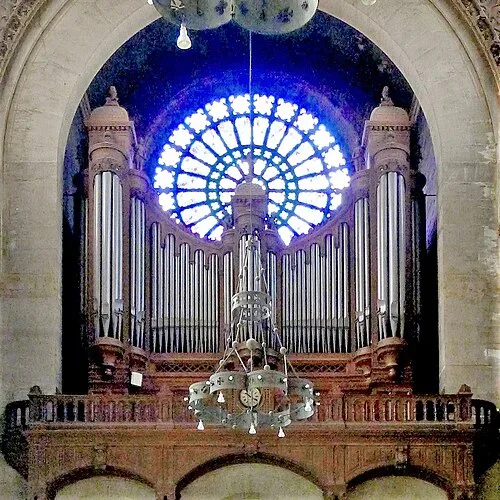 The Organ Tribune and West GalleryBarker's Grand Organ and the Rose Window
The last stop is high above the main entrance, where the grand organ fills the arch beneath the rose window. Both are statements of the same idea. The organ was built between 1867 and 1868 by Charles Spackman Barker, celebrated in the organ world for a single invention, the Barker lever. It is a device linking the keys to the pipes, and it made large organs light to play. This instrument was also among the first to use electricity. It was dedicated on the seventeenth of June 1868. Cavaillé-Coll restored it in 1899. Later work came from Beuchet-Debierre, and then from Dargassies in 1987. Behind the pipes glows the rose window, designed by Prosper Lafaye and reinforced, like so much else in this church, with an armature of cast iron. The parish's musical life touched a literary moment as well. On the eighth of April 1890 the playwright Edmond Rostand married Rosemonde Gérard here, with the composer Eugène Gigout at the organ. Saint-Augustin was built to show that the industrial age could still serve worship, and its iron frame, its glass, its organ and its saints have been proving the point ever since.
Listen in the appMbzt · CC BY 3.0
Église Saint-Augustin de Paris
Frequently asked questions
How much does the guide cost?
Free app download. Listed guide price: $0.99. Guide price shown in the app. Audio guide only. Venue admission is separate.
Can I listen without internet?
Yes. Download the guide’s audio, images, and maps in the app before your visit. Your downloaded content is then available offline.
Can I listen in my language?
This audio guide is available in 15 languages, including English.
Do I need to follow a schedule?
No. This is a self-guided experience. Choose your stops, pause whenever you like, and return to a story at your own pace.
At your own pace
Explore Église Saint-Augustin de Paris.
Download Stanza, then search for “Église Saint-Augustin de Paris”.
Free app download · Guide price shown in the app
Keep exploring
Nearby audio guides
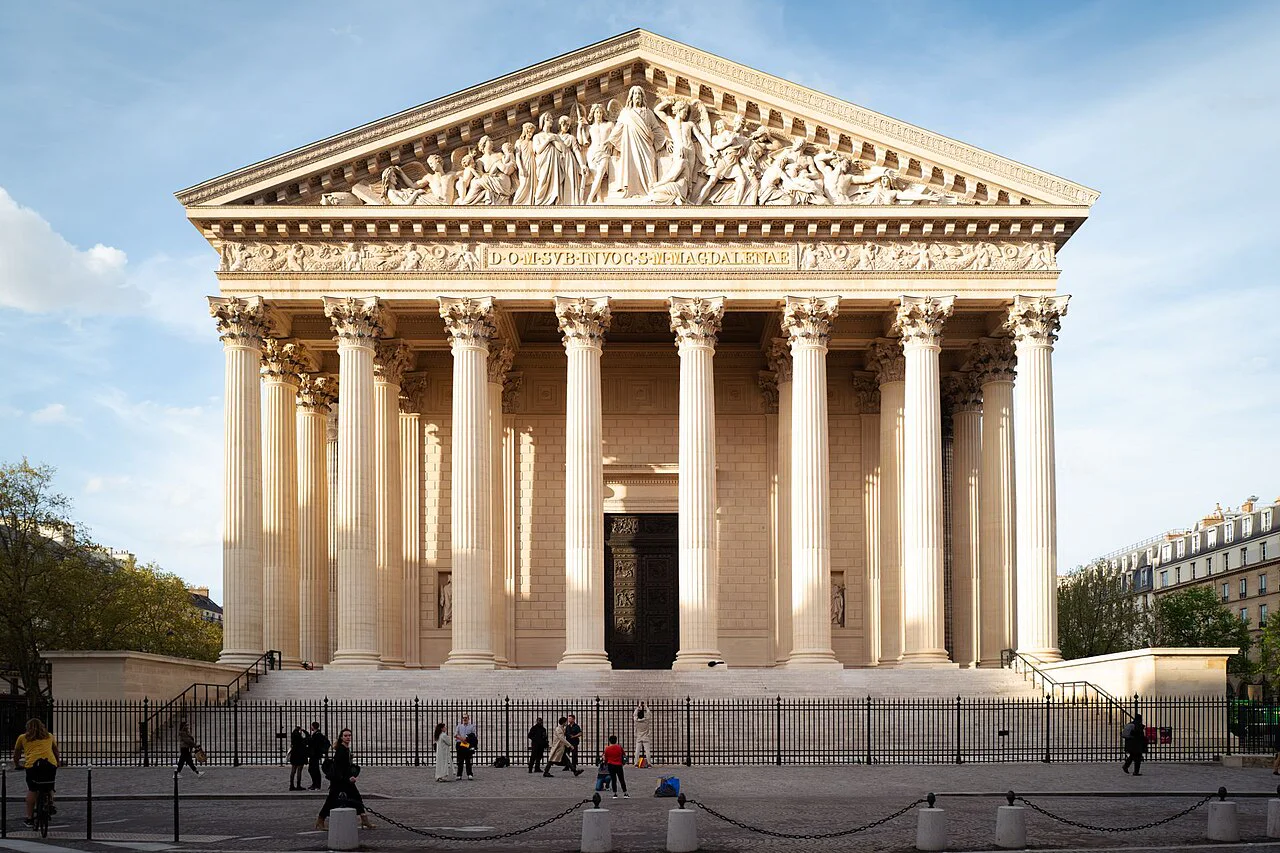
Paris · 1 km
Église de la Madeleine
Content & sources
Callaway Kosine – de Suzannet · CC BY 3.0
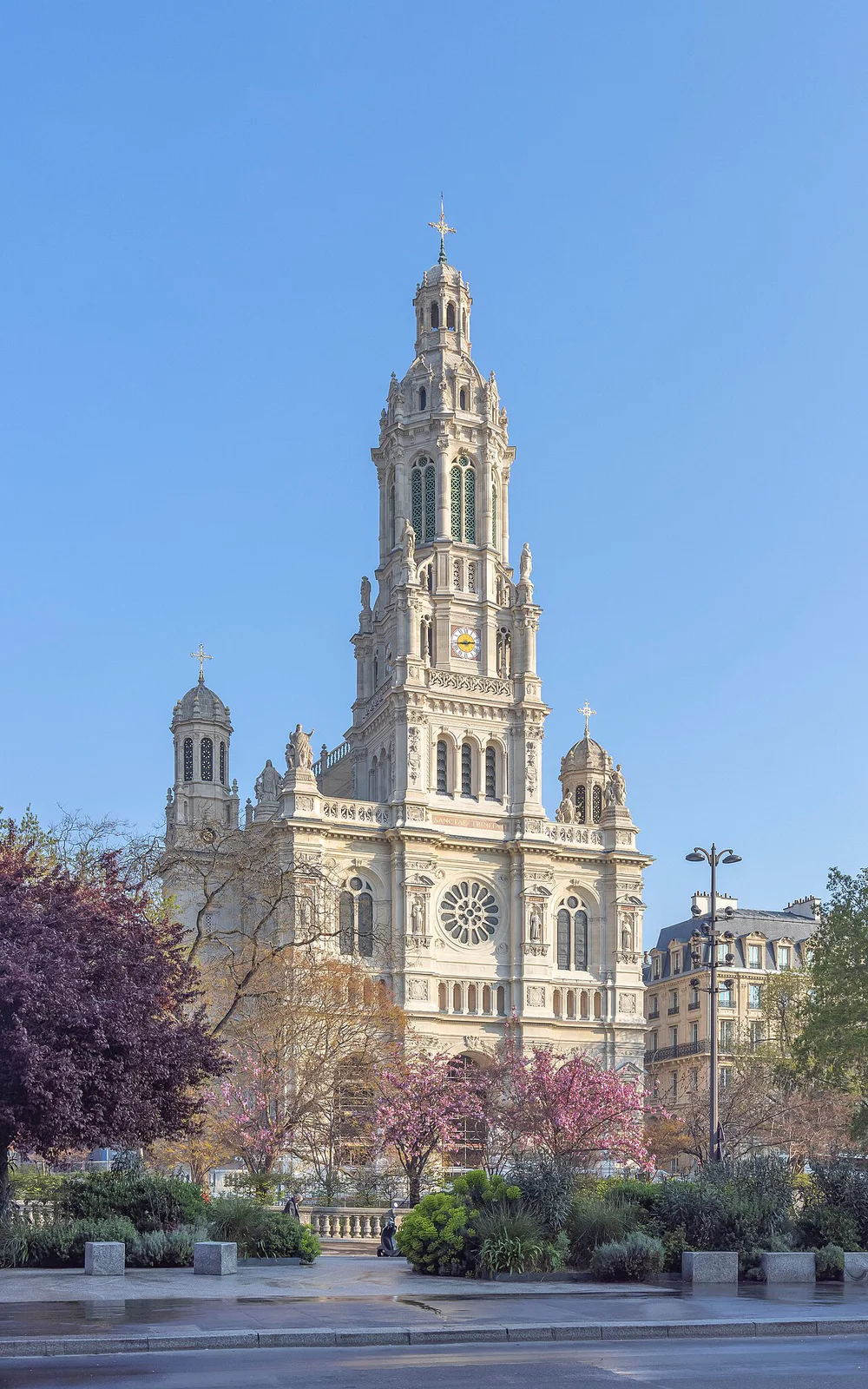
Paris · 1 km
Église de la Sainte-Trinité de Paris
Content & sources
Photo: ZeusUpsistos · CC BY-SA 4.0
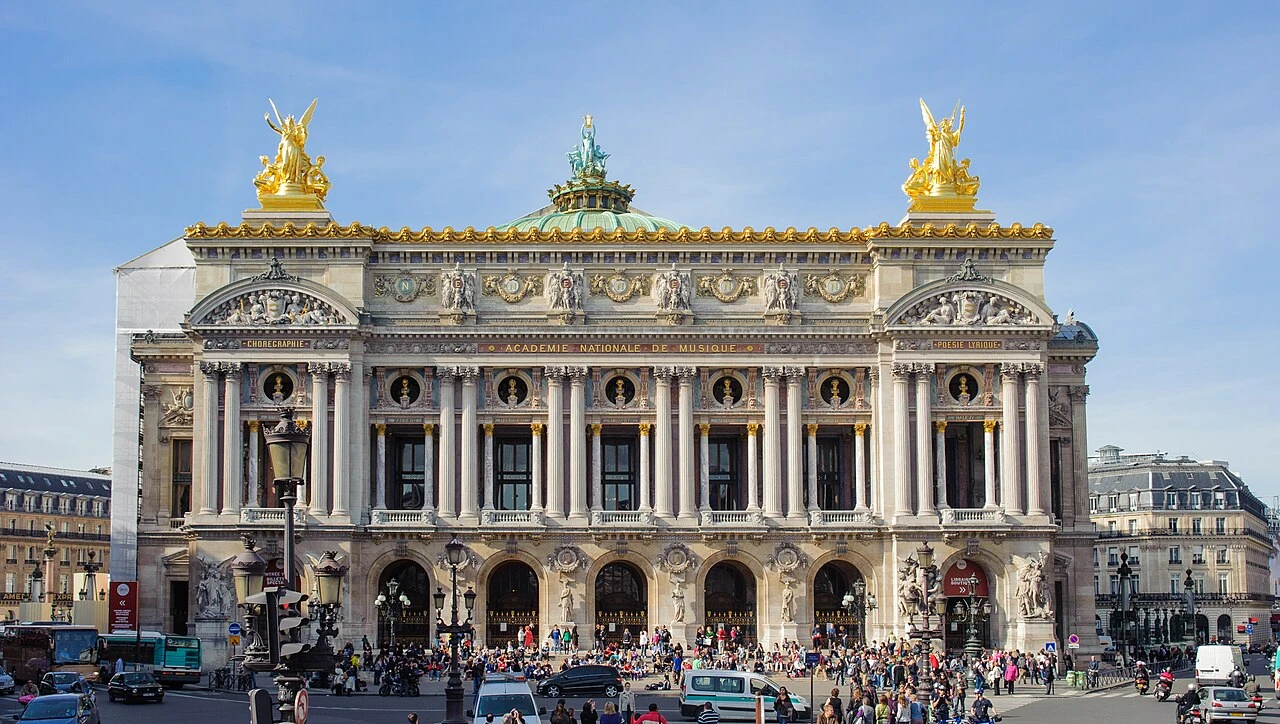
Paris · 1 km
Palais Garnier
Content & sources
Photo: Alexander Hoernigk · CC BY 3.0
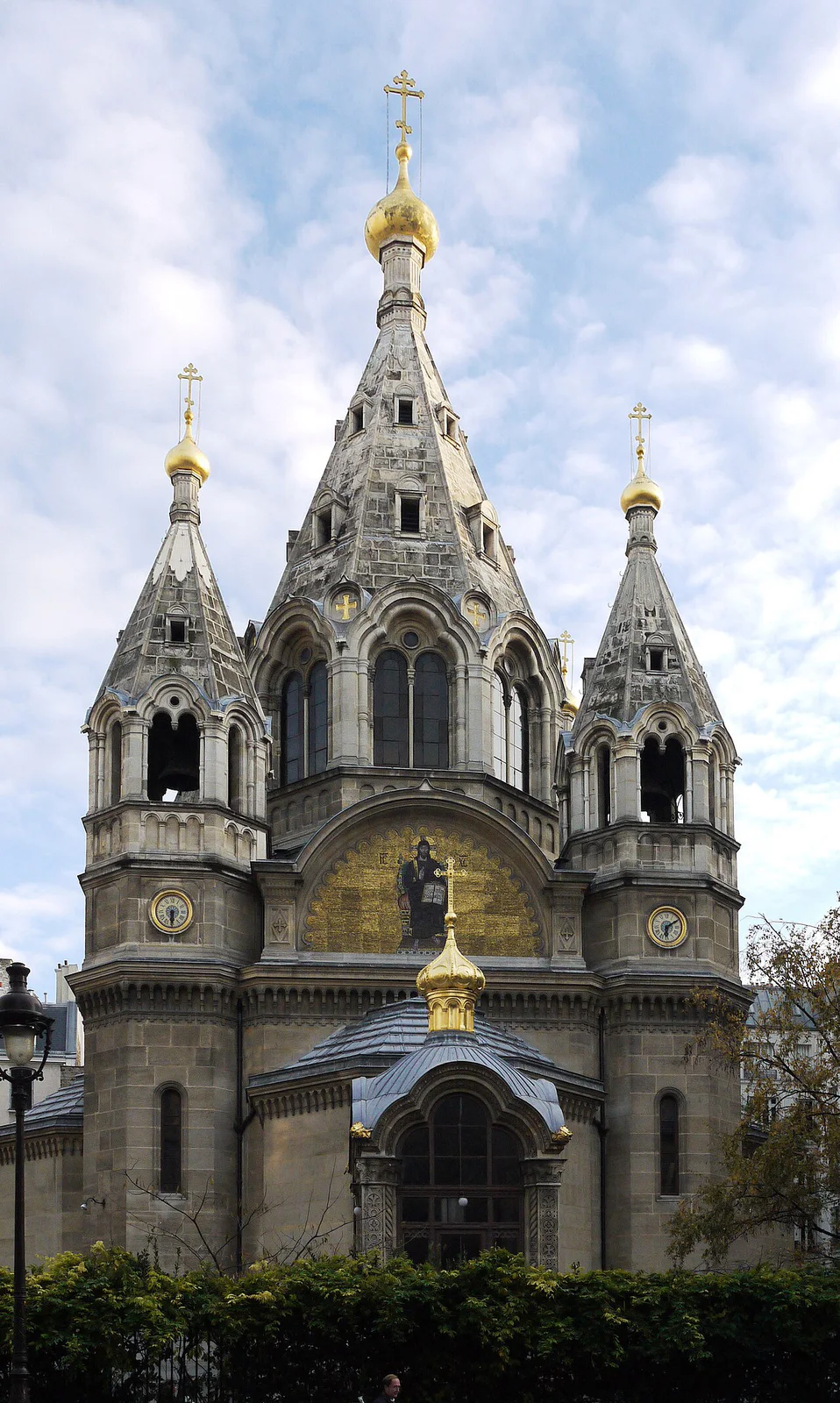
Paris · 1 km
Cathédrale Saint-Alexandre-Nevsky de Paris
Content & sources
Photo: Pline · CC BY-SA 3.0