Stanza · Audio guide
克孜尔千佛洞 Audio Guide
A place to remember. A story to take with you.
The Kizil Caves are a set of Buddhist rock-cut caves located near Kizil Township in China. They are considered the earliest major Buddhist cave complex in China and played an important role in the Silk Road…
Download Stanza, then search for “克孜尔千佛洞”.
About the tour
One guide. Your kind of visit.
The Kizil Caves are a set of Buddhist rock-cut caves located near Kizil Township in China. They are considered the earliest major Buddhist cave complex in China and played an important role in the Silk Road transmission of Buddhism.
Ready when you are.
- 01Get the free Stanza app.
iOS & Android
- 02Find your guide.
“克孜尔千佛洞”
- 03Download before you go.
Works offline
Audio guide / 16 narrated stops
Inside the guide
Get to know a few of the stories before you go. Open a stop to read more.
01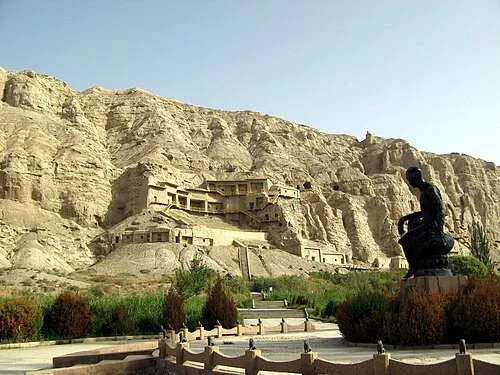 Kumarajiva Cultural Square & Valley Gateway
Kizil Entrance Plaza and Cliff Face
The Kizil Caves are Buddhist rock-cut caves on the northern bank of the Muzat River, about sixty-five kilometres west of Kucha. Their name means the Thousand Red Houses. The site lay in a commercial hub on the Silk Road, and Buddhism travelled that road. Kucha played a major part in carrying Buddhism into China. Translators such as Kumarajiva travelled between Kucha and Kashmir, and their journeys are part of the evidence for that link. The first painting style here, from 300 to 500 CE, draws on Gandharan themes and shows strong influence from India. It is reasonable to suggest that Kizil's art, and perhaps its artists, influenced the early painting at Mogao, near Dunhuang, further east along the same road. A bronze seated figure here is a memorial, and it is linked to Kumarajiva, though that identification is not confirmed.
Listen in the appPhoto: G41rn8 · CC BY-SA 4.0
02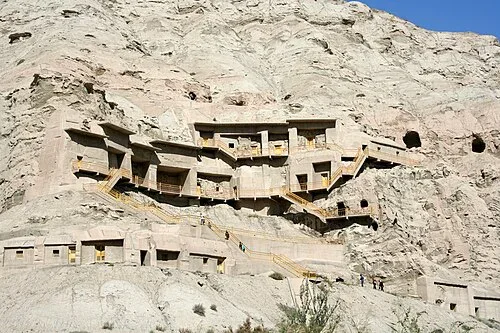 Kumarajiva Cultural Square & Valley Gateway
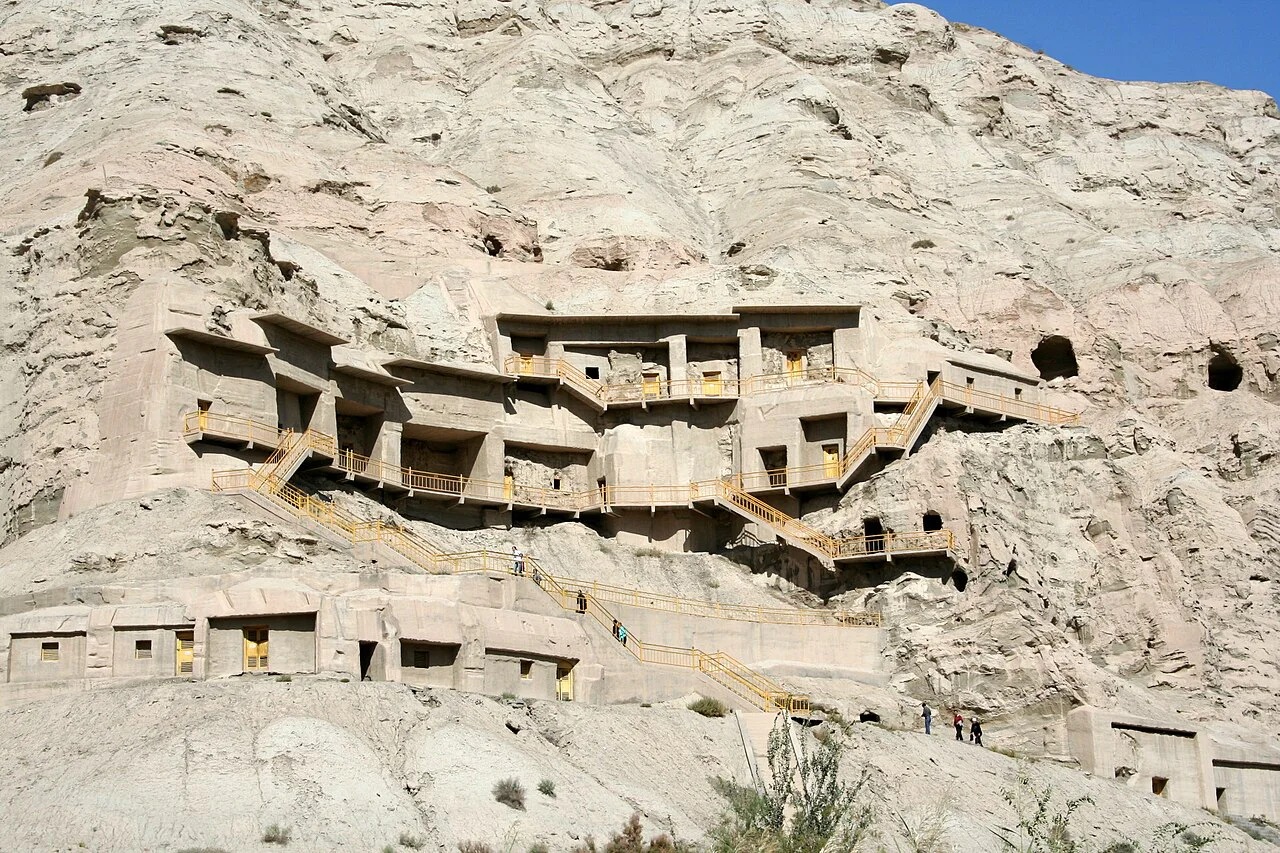
Tiered Cave Fronts and Cliffside Stairs
The stairs and railed walkways in front of you are modern. Photographs of the first seventeen caves, one taken in 1912 and one in 2015, show how much the cliff has been altered, both to protect the caves and to let visitors reach the upper tiers. Outsiders began exploring this rock between 1902 and 1904, when a Japanese expedition led by Tesshin Watanabe and Kenyu Hori, paid for by Count Otani, worked in the Kucha area. It left hurriedly after four months, following a local earthquake. A few years later the German scholar Albert Grünwedel arrived. In a letter of April 1906 he wrote that there were about three hundred caves here, some of them with frescoes, all of them very old and fine. Not every painting suffered equally. Cave 181, known as the Highest Cave, lies high up on the right side of a ravine, and that height kept its murals safe from the usual vandalism, so its faces are still well preserved. Its painters used no gold foil either, which gave thieves less reason to climb up.
Listen in the appPhoto: Rolfmueller · CC BY-SA 3.0
03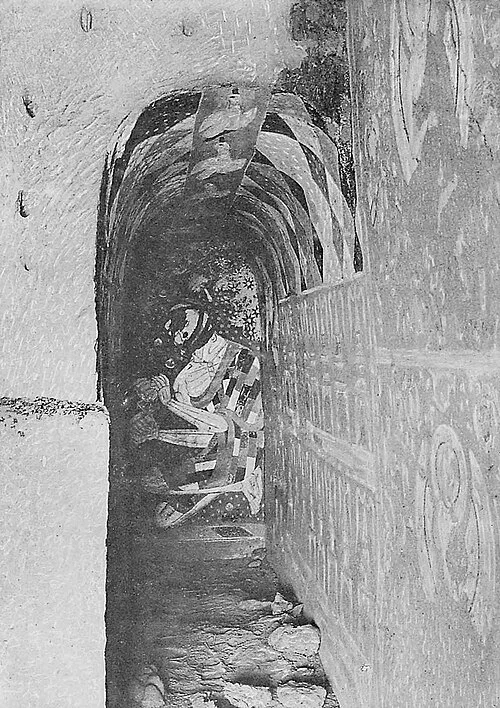 Rock-Cut Architecture & The Central Pillar
Central Pillar Cave: Side Corridor (Historical Photograph)
The central pillar in these caves is not really a pillar at all. It is solid rock, left standing, with a circular corridor cut around it. A typical central pillar cave has three parts: a large vaulted hall at the front, the rock block in the middle, and a smaller room behind. Narrow side corridors link the front and back rooms. The block holds a niche for a statue of the Buddha, and the column stands for a stupa, a shrine built around sacred relics. Pilgrims could walk around the block, following the corridor behind it. Buddhist custom is usually to walk clockwise around a shrine, though which way people walked here is not known. The layout may be related to the design of Kara Tepe, a site in northern Bactria. The great niche in the front hall would once have held a three-dimensional Buddha, but none of these statues survive at Kizil.
Listen in the appPainter: 6th century Photograph: Albert von Le Coq (-1930) (Published in 1928) · Public domain
04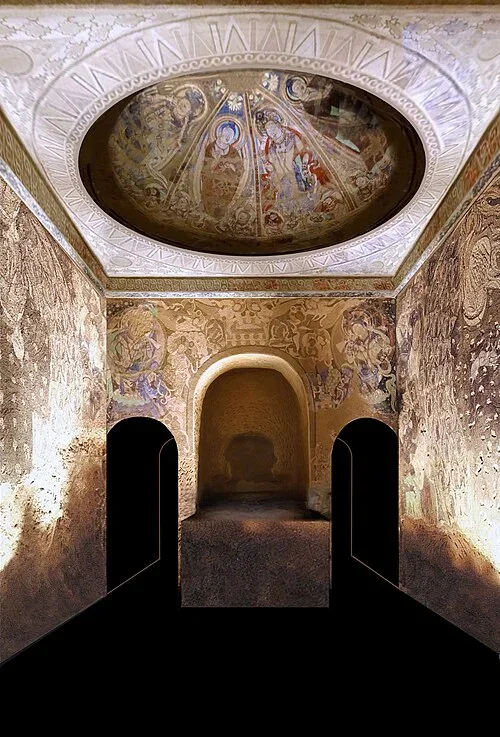 Rock-Cut Architecture & The Central Pillar
Cave of the Ring-Bearing Doves (Cave 123)
The Cave of the Ring-Bearing Doves is named after a pattern of birds holding a ring, or wreath, in their beaks. It dates to the years 600 to 650 CE. It belongs to a late variant of the central pillar design, one that appeared as Kizil's painting was nearing its end. The variant keeps the niche and the circling corridor. But its front hall is almost square, and a dome rises above it, decorated with standing Buddhist deities. The model for that kind of dome is in Group C of the caves at Bamiyan, in Afghanistan. Similar domes appear in one cave at Kumtura, elsewhere in the region. The painting centres on a cosmological Buddha, often surrounded by many smaller Buddhas. A rebuilt version of this cave stands in the Museum of Asian Art in Berlin.
Listen in the appCave painted in the 6th century CE. Photograph of the dome and back wall: Daderot (Public Domain C0) Photograph of the bottom and side of the back wall: Byrnzie500 (CC 2.0) Photograph of the side wall (extracted 2D surfaces): Iris Papodoupolos (PD-Art) Layout: पाटलिपुत्र (talk) · Public domain
05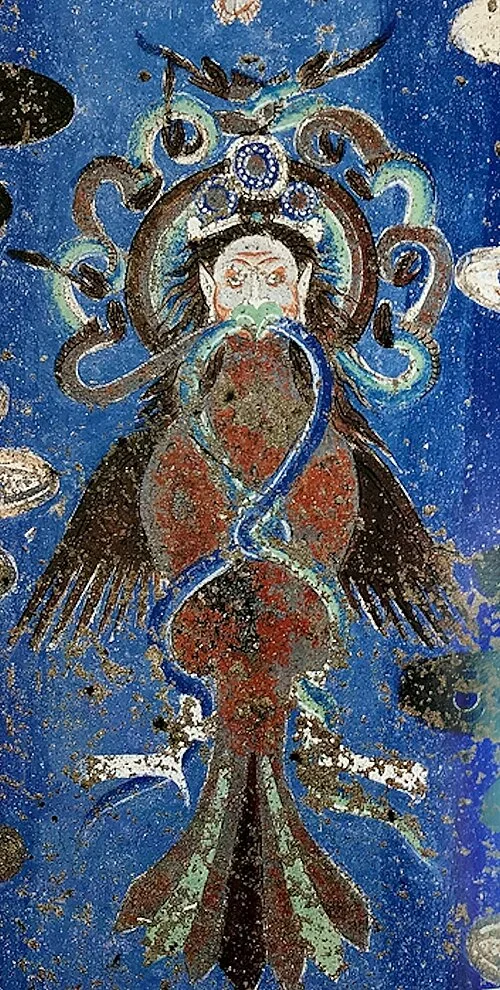 Cave 17: Diamond Vaults of the Bodhisattva
Cave 17 Ceiling Detail: Winged Figure on Blue
A winged figure with a human face appears against a deep blue ground, and serpent coils wind around its body. Blue was the colour that marked the second phase of painting here. The scholar Ernst Waldschmidt classified the art into phases, and the second phase used bluish pigments in abundance. A precious blue called ultramarine was made from lapis lazuli, a stone from Afghanistan. Analysis of the paintings at Kizil found lapis lazuli for the blues, and vermilion and red lead for the reds. Many of those reds have badly changed colour today. Greens came from a copper mineral called atacamite, and whites from gypsum.
Listen in the appPaintings: 6th century CE, Kizil Modern photographs of 2D paintings: undetermined · Public domain
06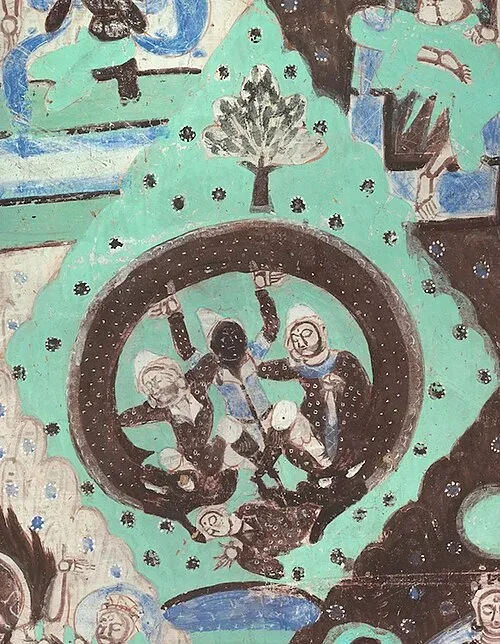 Cave 17: Diamond Vaults of the Bodhisattva
Cave 17 Lozenge Panel with a Narrative Scene
The main ceilings of many caves at Kizil are divided into diamond-shaped blocks, and Buddhist scenes fill them. The scenes are stacked in layers, so one vault can carry a long sequence. Most of the murals here show Jataka stories, the tales of the Buddha's earlier lives, along with legends of the Buddha himself. This green diamond has a dotted rim and a small tree at its top. Inside a dark ring, several figures are packed close together, and the ring itself is studded with small white dots.
Listen in the appPainter: 7th century CE Photographer: Undetermined · Public domain
07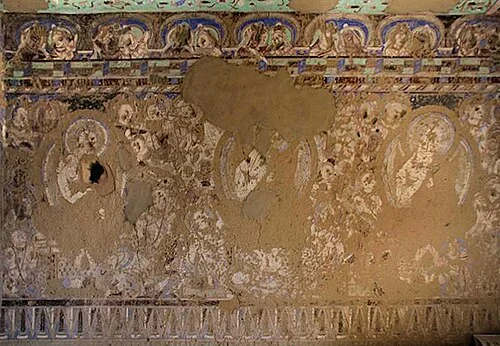 Cave 38: The Cave of the Musicians
Cave 38 Main Hall Wall
In Cave 38, the painters arranged the wall in registers, which are horizontal bands stacked one above another. The top band is a row of arches, and each arch holds a small figure. Below, the largest figures fill the middle band, and two of them have round haloes that still show clearly. Across the middle, though, large areas are bare or patched with plaster, and a dark hole cuts through near the left. A patterned strip runs along the base of the wall.
Listen in the appPainter: 6th century CE Photographer: undetermined · Public domain
08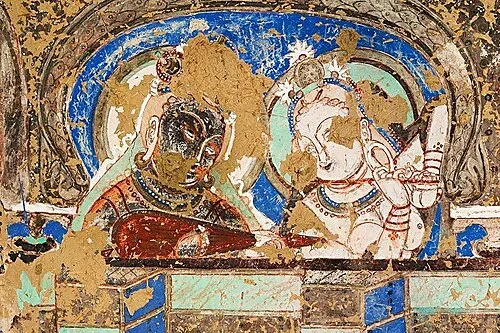 Cave 38: The Cave of the Musicians
Musicians in Cave 38
Two celestial figures appear inside a painted arch in the Cave of the Musicians, which is Cave 38. Both stand above a stepped base. The figure on the left has a dark complexion and a reddish garment. The figure on the right is paler and wears a headdress. Behind them the blue is bright, and the outlines are drawn in firm, sharp lines. In places the paint has flaked from the wall. This bright colour and line style is different from the earlier caves at the site.
Listen in the appDrawing: 6th-7th century painter, Kizil caves Photography: Undetermined · Public domain
09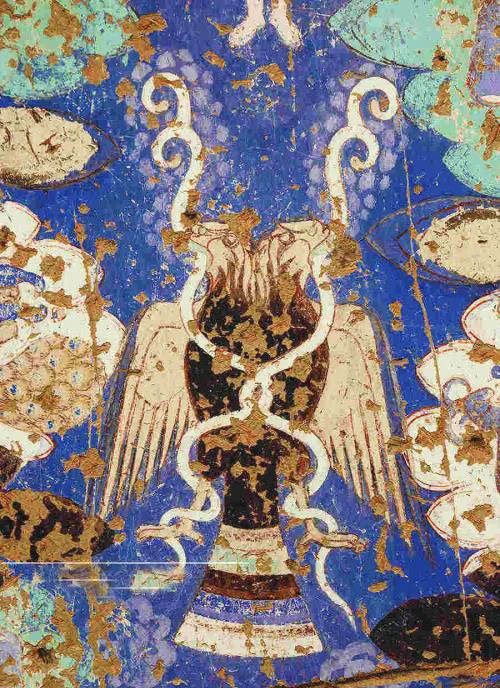 Cave 38: The Cave of the Musicians
Cave 38 Ceiling Figure with Wind-Blown Ribbons
The winged figure at the centre of this ceiling, with pale ribbons curling around it, has two possible names. One is Jivajivaka, a two-headed bird. The other is a wind god, either Boreas, the north wind of Greek myth, or Vayu, an Indian wind god. The question is still open. Either way, the painting draws on several traditions. Kizil's earlier paintings looked to India. Later ones show Iranian influence, from the Sasanian empire of Persia. Elsewhere in Cave 38, Sasanian-style ducks sit in bead-edged roundels. That motif spread across Central Asia, and it is known from the clothing of an envoy from Afrasiab.
Listen in the appUnknown author · Public domain
10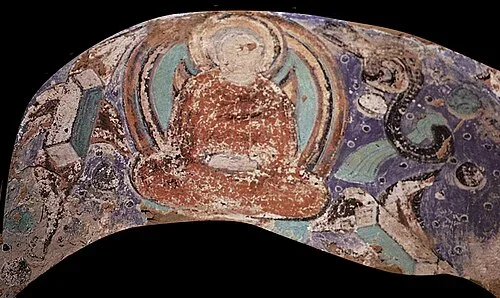 Cave 47: The Colossal Buddha Cavern
Cave 47 Lunette with a Seated Buddha
Some caves at Kizil were cut tall enough to hold a giant. Colossal image caves have a very tall main chamber, built to house an enormous statue of the Buddha. Often that chamber is about five metres high. In Cave 47 it reaches sixteen and a half metres. This curved panel from Cave 47 is a lunette, a half-moon-shaped wall space, often set under a vault or arch. It shows a seated Buddha with a halo, dressed in red-brown robes. Round medallions and swirls fill the violet ground behind him.
Listen in the appPainter: 6th century, Public Domain 2D painting. Photographer: undetermined · Public domain
- 11
Four Swordsmen Panel (Cave 8)
Men with swords in Cave 8, nicknamed the Tocharian donors, and the scholars who read their features differently.
- 12
War of the Relics Mural Panel
A mural of kings and the Buddha's relics, and the expeditions that sent its panels far from the cave walls.
- 13
Caves 175-188 in the Small Ravine
The plain cells where monks lived and stored their goods, which make up most of Kizil's caves.
- 14
Who Painted the Caves
A thin, cross-legged figure with closed eyes, painted as an ideal of meditation.
- 15
Cave of the Painters (Cave 207): The Buddha Preaching
The painters who painted their own likenesses in Cave 207, and the debate over the clothes they wore.
- 16
Cave of the Painters (Cave 207): Left Wall Today
A wall that was essentially intact in 1912 and now survives in fragments, and the year 648 that probably ended a painting style.
克孜尔千佛洞
Frequently asked questions
How much does the guide cost?
Free app download. Listed guide price: $1.99. Guide price shown in the app. Audio guide only. Venue admission is separate.
Can I listen without internet?
Yes. Download the guide’s audio, images, and maps in the app before your visit. Your downloaded content is then available offline.
Can I listen in my language?
This audio guide is available in 15 languages, including English.
Do I need to follow a schedule?
No. This is a self-guided experience. Choose your stops, pause whenever you like, and return to a story at your own pace.
At your own pace
Explore 克孜尔千佛洞.
Download Stanza, then search for “克孜尔千佛洞”.
Free app download · Guide price shown in the app
Keep exploring
Audio guides — China
Yalquntagh
高昌國
Content & sources
Colegota · CC BY-SA 2.5 es
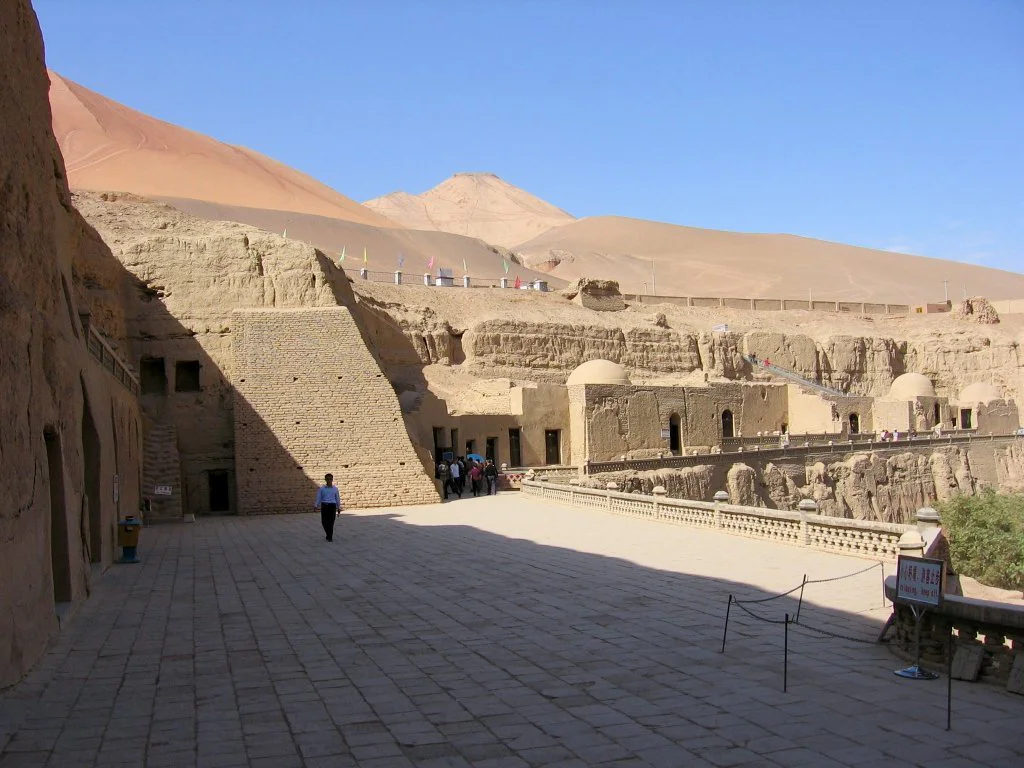
Turpan
柏孜克里克千佛洞
Content & sources
Photo: File Upload Bot (Colegota) · CC BY-SA 2.5 es
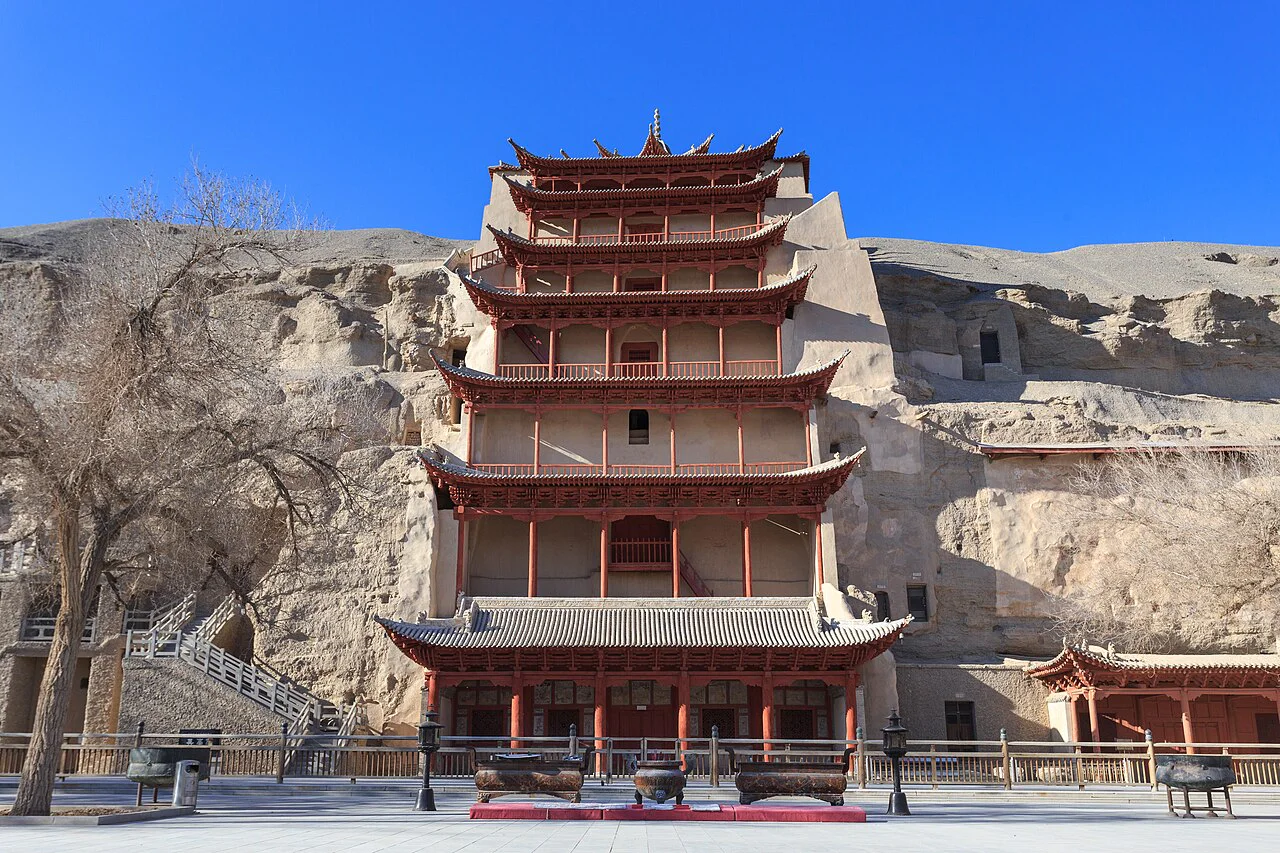
Dunhuang City
莫高窟
Content & sources
Photo: Zhangzhugang · CC BY-SA 4.0
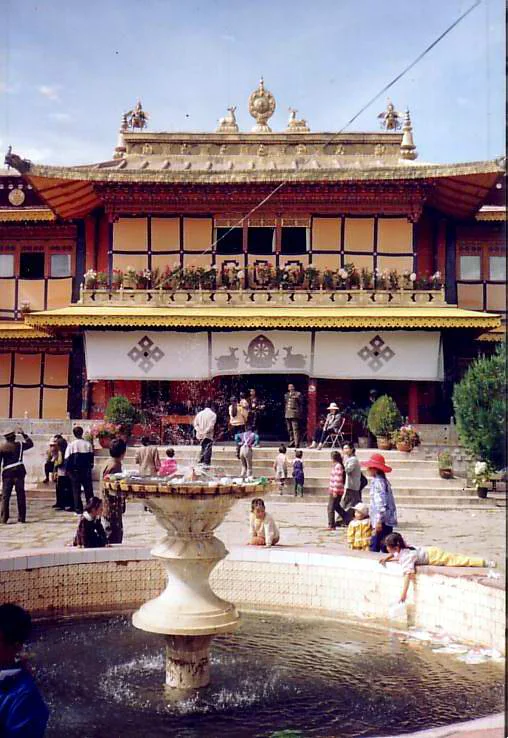
Lhasa
罗布林卡
Content & sources
John Hill at English Wikipedia · CC BY-SA 3.0