Languages
15Diocletian's Palace Audio Guide
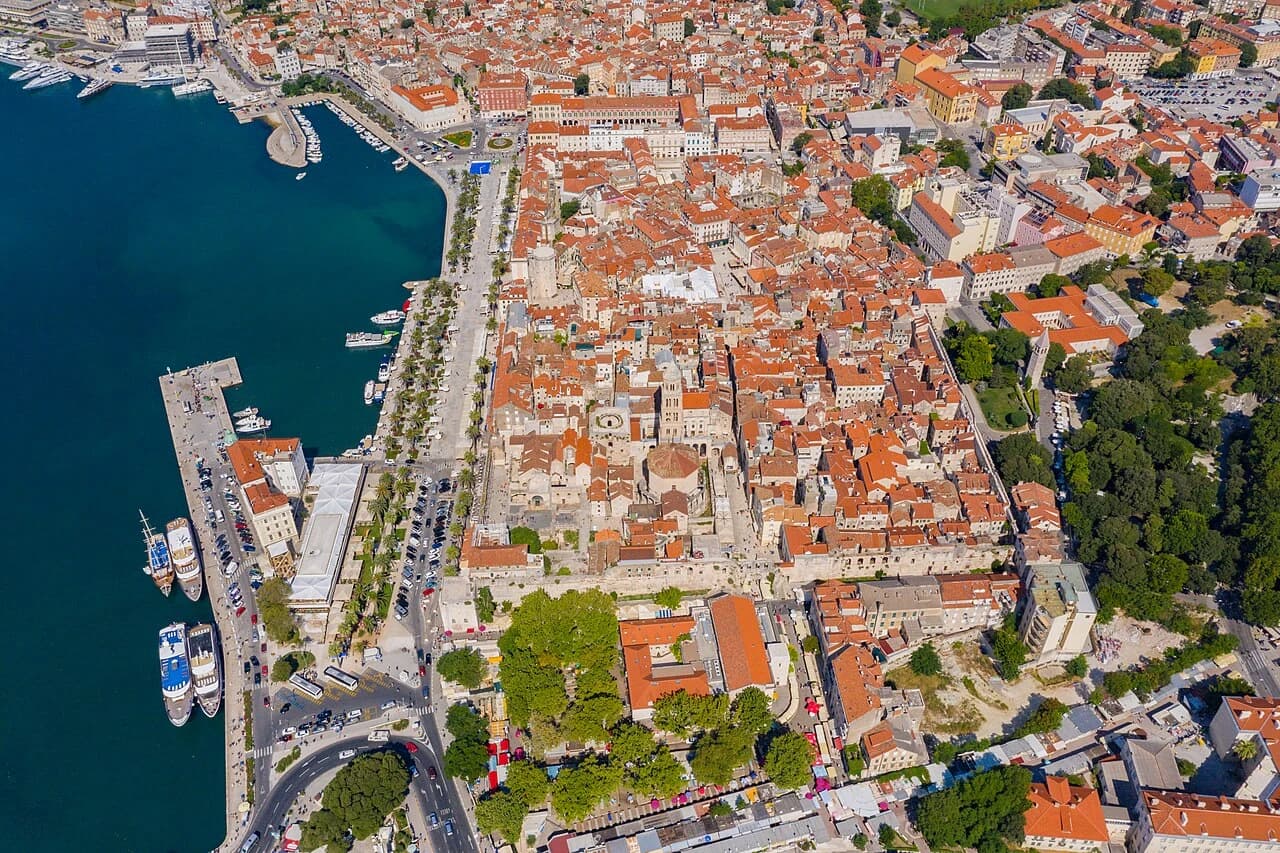
Diocletian's Palace is an archaeological site in Split, Croatia. Explore it with Stanza's guided offline audio tour — narrated in 15 languages.
Quick Facts
34
Stops
15
Languages
100%
Offline
📍 Split, Croatia · 43.5081°N, 16.4383°E
About Diocletian's Palace
Diocletian's Palace is an ancient palace complex built for the Roman emperor Diocletian at the turn of the 4th century AD. It now forms the heart of Split, Croatia, serving as a UNESCO World Heritage site and a vibrant part of the city.
This self-guided audio tour features 34 narrated stops organized across 8 sections. As a palace, Diocletian's Palace offers a unique cultural experience in the heart of Split, Croatia.
The Stanza audio guide is available in 15 languages and works entirely offline — download the complete tour including audio narration, maps, and images before your visit. As you walk through Diocletian's Palace, GPS-triggered narration plays automatically at each point of interest.
Last updated:
What you will hear
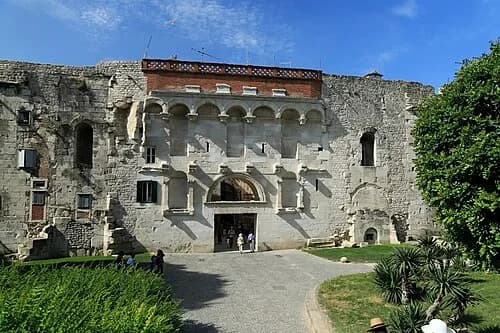
Golden Gate
The Porta Aurea was the main entrance used by Emperor Diocletian to enter his palace from the nearby city of Salona.
Golden Gate
This is the Porta Aurea, known today as the Golden Gate, the most magnificent of the four main entrances to Diocletian’s Palace. During the Roman era, this was a highly restricted passage; only the Emperor himself and his family members were permitted to walk through these majestic arches. It wasn't just a decorative entryway; it was a sophisticated piece of military engineering. The gate features a strategic double-entrance system. Between the inner and outer gates lies a rectangular courtyard designed specifically as a 'human trap.' If an enemy managed to breach the first gate, they would find themselves confined in this narrow space, where guards stationed on the walls above could rain down projectiles from a position of total safety. Looking up at the facade, you can see several empty stone niches. These once held statues of the four Tetrarchs—the rulers of the Roman Empire during the period when the palace was constructed. Though the statues are long gone, the niches remind us of the divine authority that once guarded this threshold. The gate’s transition from a strictly guarded imperial entrance to a public passage reflects the centuries of history that have passed through its stones.
Stone Protectors of the Gate
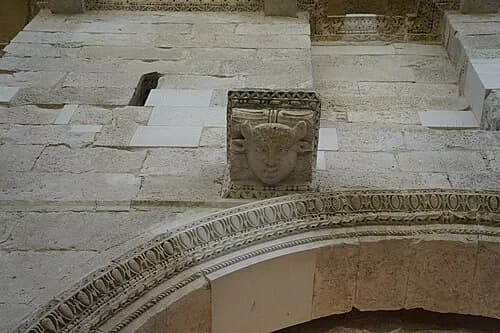
Above the grand arches of the Golden Gate, you can find small but significant details that speak to the beliefs of the ancient Romans. These are the high-relief carvings of weathered stone faces and bull heads. While they might look like simple architectural decorations today, they originally served a much more important purpose. In Roman culture, these were apotropaic symbols—images intended to ward off evil spirits, bad luck, and enemy forces. By placing these protectors at the main entrance, the Romans believed they were creating a spiritual barrier that complemented the physical strength of the walls. Notice the bull heads in particular; the bull was a symbol of strength and vitality, frequently used in Roman religious and protective imagery. Even after 1,700 years of exposure to the elements, the precision of the Roman masonry is still evident. The way the figures are integrated into the stonework shows the incredible skill of the craftsmen who built this fortress-palace. These silent sentinels have witnessed the entire transformation of Split, from an imperial retreat to a bustling medieval town and finally into the vibrant modern city we see today.
Church of Saint Martin
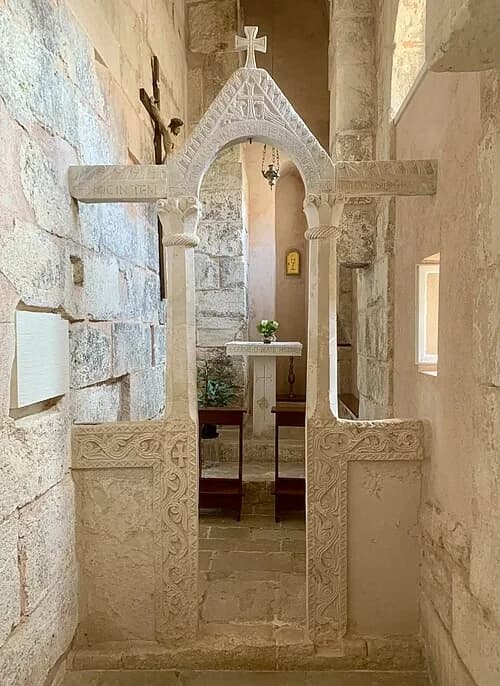
One of the smallest churches in Split, built inside the narrow corridor above the Golden Gate where Roman guards once patrolled.
The Church of St. Martin
Hidden within the very structure of the Golden Gate is the Church of Saint Martin, an architectural marvel of miniature proportions. This space is incredibly narrow, measuring just 1.64 meters wide. It wasn't originally intended for worship; it occupies the corridor where Roman soldiers once paced back and forth, guarding the northern entrance to the palace. In the Early Middle Ages, as the local population sought refuge within the palace walls, they repurposed this military space into a site for secret prayer. This transition represents the layering of history that defines Split—the conversion of a pagan military fortress into a sanctuary of Christian faith. Inside, you can find a remarkably well-preserved early Christian stone screen, which serves as a partition for the altar. This delicate stonework is one of the few remains from the pre-Romanesque period in Dalmatia. Standing in this tiny, quiet space, it is almost impossible to imagine that it was once a busy thoroughfare for armed guards. It serves as a powerful reminder of how the citizens of Split used every available inch of the Roman ruins to build their new, medieval world.
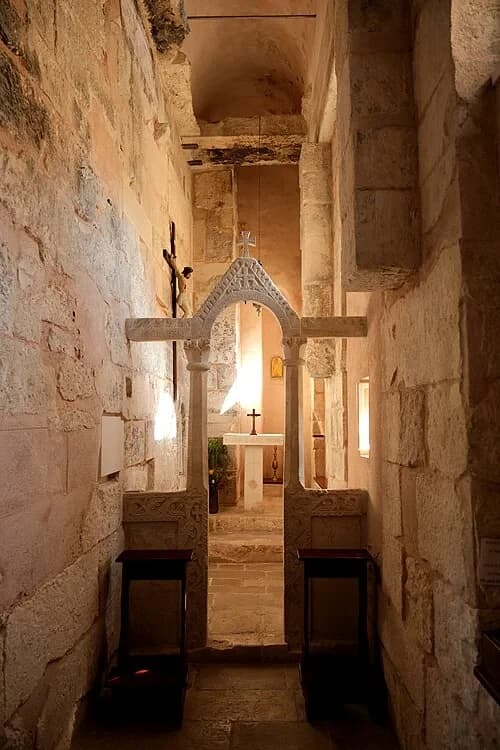
The Pre-Romanesque Altar
Inside the tiny Church of Saint Martin, the stone altar screen offers a rare glimpse into the artistic and religious life of the 11th century. The screen is decorated with a very specific style of carving known as 'pleter,' or wattle-work. This intricate, interlacing geometric pattern is the signature style of early Croatian art, symbolizing the unique cultural identity that was developing in this region during the Middle Ages. If you look closely at the horizontal beam of the screen, you can see a Latin inscription. It mentions the name of a priest, Dominicus, who likely commissioned the work. This inscription provides a tangible connection to a real person who lived and worshipped here nearly a millennium ago. The screen has remained largely untouched by time, surviving within the protective shell of the Roman wall. It represents a moment of peace and devotion squeezed into the heart of what was once a defensive fortification. For historians and art lovers, this screen is an invaluable treasure, showing how early medieval craftsmen combined Roman influence with their own local traditions to create something entirely new and enduring.
Grand Papalić Palace (Split City Museum)
This 15th-century Gothic palace now houses the City Museum, showcasing the evolution of Split from antiquity to the Renaissance.
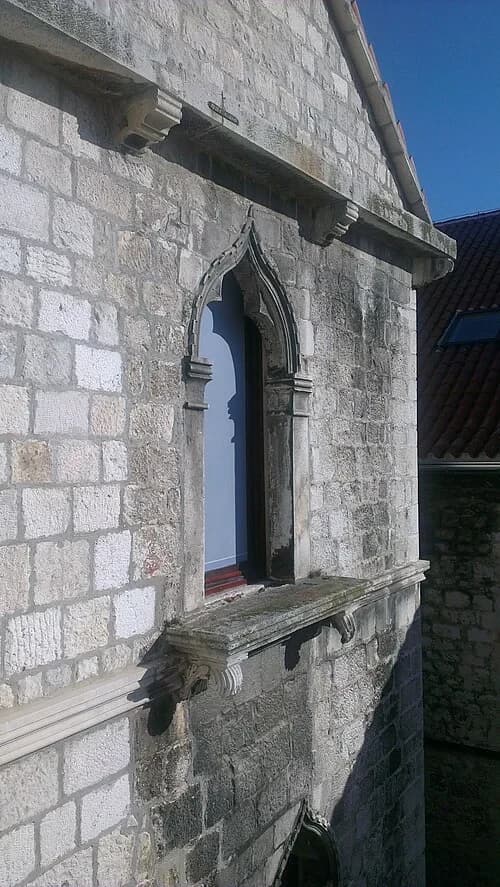
The Gothic Trifora Window
High on the facade of the Papalić Palace, you can see an exquisite architectural feature known as a 'trifora,' or a three-light window. This elegant opening is characterized by its three separate vertical sections divided by slender stone columns, topped with intricate 'clover' or trefoil shapes. In the 15th century, such a window was the ultimate status symbol, modeled after the grandest palaces found across the sea in Venice. The level of detail in the carving is remarkable, especially when you compare it to the surrounding masonry. Notice the sharp contrast between the massive, weathered Roman stone blocks of the original palace walls and the refined, delicate craftsmanship of this Gothic window frame. It shows that the Papalić family had both the immense wealth and the sophisticated taste required to hire the finest stonecarvers of the day. This window served as more than just a source of light; it was a public statement of the family's prestige, designed to catch the eye of anyone passing through the narrow streets below. It remains one of the most photographed architectural details in the old town, a frozen moment of late medieval luxury.
Silver Gate
The Porta Argentea led to the city's main market and has been heavily restored to show its original Roman structure.
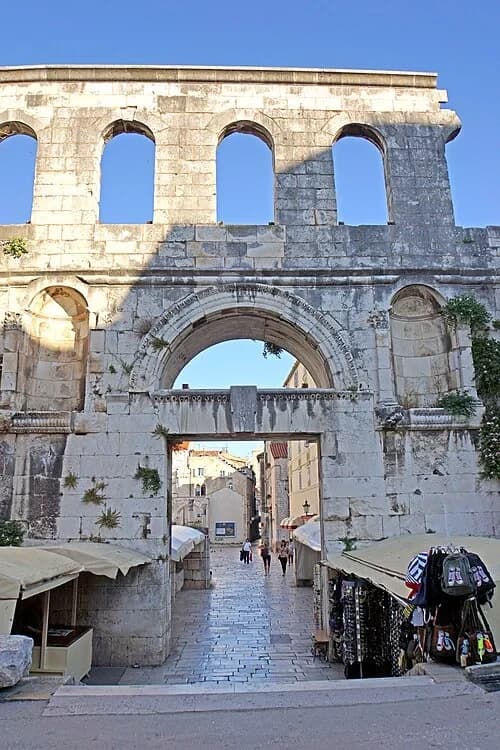
Silver Gate
The Silver Gate, or Porta Argentea, served as the eastern entrance to the Roman palace. In ancient times, it was a vital hub of activity, leading directly out toward the area that served as the city's main marketplace. However, for many centuries, the gate was almost entirely obscured. Medieval and Renaissance buildings were constructed right up against the palace walls, effectively sealing the gate from view and integrating it into the city's growing residential fabric. The Silver Gate was only returned to its former glory in the 1950s. Ironically, this restoration was made possible by the tragic events of World War II; Allied bombing destroyed many of the buildings that had leaned against the gate for centuries, allowing archaeologists to excavate and restore the original Roman structure. As you pass through the arch today, take a moment to look at the ground. You can see the original Roman paving stones, worn smooth and shiny by 1,700 years of footsteps. Walking over these stones, you are literally following in the path of Roman soldiers, medieval merchants, and modern travelers, all of whom have traversed this same threshold through the long ages of Split’s history.
Vestibule
A grand rotunda that served as the formal entrance to the Emperor's private apartments.
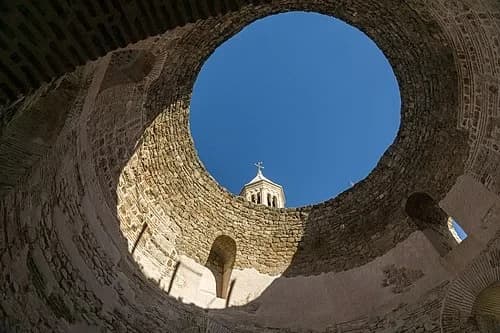
Vestibule of Diocletian's Palace
Standing in the center of this grand circular hall, you are positioned in what was once the most exclusive entry point of the palace. This is the Vestibule, the formal foyer that led directly to the Emperor Diocletian’s private residential quarters. In antiquity, this space was designed to overawe visitors. Today, the dome above is open to the sky through a circular hole known as an 'oculus,' but in the 4th century, it was fully enclosed and covered in shimmering, colorful mosaics that would have glittered in the torchlight. The architecture here is purely Roman, intended to create a sense of transition from the public square outside to the imperial sanctity within. Notice the height of the walls and the circular form, which creates a unique sonic environment. This shape produces incredible natural acoustics, making the Vestibule a favorite spot for local 'Klapa' groups. These groups perform traditional Croatian a cappella music, utilizing the echoing walls to amplify their harmonies. If you are lucky, you may hear their voices rising toward the open sky, a tradition that breathes life into these ancient stones. The scale of this room reminds us that even in retirement, Diocletian maintained the aura of a divine ruler.
Basement Halls
These substructures mirror the floor plan of the upper apartments and are among the best-preserved Roman vaulted spaces in the world.
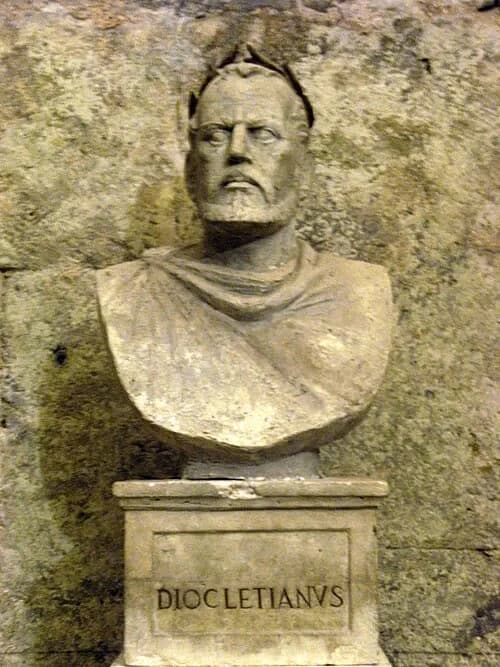
The Bust of Diocletian
This figure captures the likeness of Gaius Aurelius Valerius Diocletianus, the man who transformed the Roman Empire and chose this spot as his final home. Born to a family of low social standing in nearby Salona, Diocletian was a career soldier who rose through the military ranks through sheer talent and ambition. He eventually took the throne and ended a century of civil war by dividing the empire into four parts, ruled by a system known as the Tetrarchy. What makes Diocletian truly unique among Roman leaders was his departure from power. In 305 AD, he became the first Roman Emperor to voluntarily retire, abdicating his throne to live out his days in this very palace. He spent his retirement pursuing his passion for agriculture. History tells us that years later, when his successor begged him to return to the political chaos of Rome to help govern, Diocletian famously refused. He replied that if they could only see the size of the cabbages he was growing in his garden at Split, they would never ask him to rule again. This statue represents not just an emperor, but a man who valued peace and the simple rewards of the earth above the burdens of an empire.
Iron Gate
The Porta Ferrea is the only gate that has been in continuous use since Roman times, connecting the palace to the medieval city expansion.
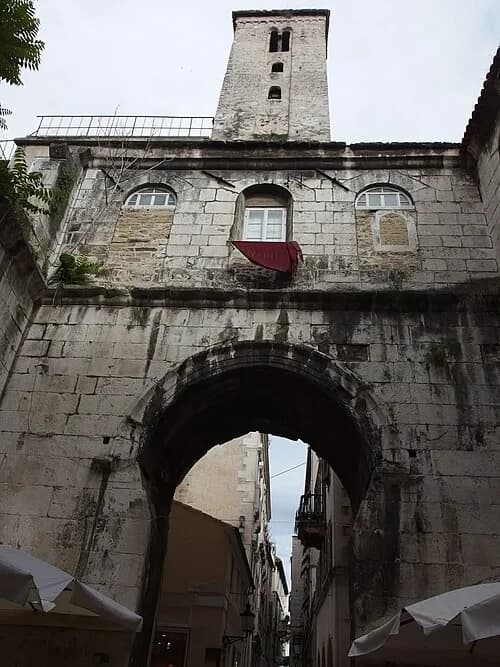
Iron Gate
Porta Ferrea, or the Iron Gate, holds a special place in the history of Split as the only one of the palace’s four gates that has never been closed. For 1,700 years, people have walked through this passage, making it the oldest continuous thoroughfare in the city. While the Golden Gate was reserved for the Emperor, the Iron Gate eventually became the 'front door' for the everyday citizens of medieval Split. As you look at the archway, you can see a fascinating patchwork of history. The arches are built from various types of stone and feature different carving styles, the result of centuries of repairs and modifications. This gate was the vital link between the original Roman palace and the medieval 'suburbs' that grew outside the walls to the west, eventually forming the new center of the city. In the Middle Ages, the guard’s passage above the gate was converted into a small chapel, a common practice to provide spiritual protection to those entering the city. Today, passing through the Iron Gate feels like moving through a time portal, transitioning from the dense, ancient core of Diocletian's retirement home into the lively squares of the medieval and modern city that expanded beyond it.
Chapel of Our Lady of the Belfry
Built into the guard's passage above the Iron Gate, this chapel features a distinctive early Romanesque bell tower.
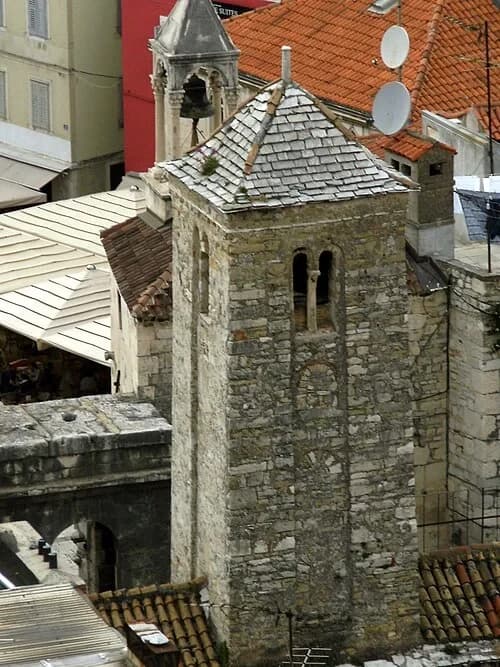
Chapel of Our Lady of the Belfry
Notice the narrow bell tower rising elegantly above the Iron Gate. This is the Chapel of Our Lady of the Belfry, a remarkable example of early medieval architecture tucked into a space never intended for prayer. Built in the 11th century, this structure is significant as the oldest bell tower in Dalmatia. It was ingeniously constructed inside the very passage where Roman guards once paced while defending the palace's western entrance. Originally, the chapel was dedicated to Saint Theodore. This choice was deeply symbolic, as Theodore was known as the protector of the Byzantine army. Given its location within a military gatehouse, the dedication offered spiritual reinforcement to the soldiers stationed here. The architecture reflects the transition from the heavy Roman military style to the more refined Romanesque period. Inside, the space remains incredibly narrow, mirroring the dimensions of the ancient guard’s corridor. It serves as a quiet reminder of how the citizens of Split repurposed every inch of Diocletian’s massive fortress, turning defensive gaps into sacred spaces. As the city evolved, the chapel changed its dedication to Our Lady, but the structure itself remains an untouched snapshot of the early Middle Ages perched atop Roman masonry.
Want to hear the rest?
Download the Stanza app to unlock all 34 stops and the complete guided audio tour.
Frequently Asked Questions
How long does the Diocletian's Palace audio tour take?
The Diocletian's Palace audio guide includes 34 narrated stops. Most visitors spend 45 minutes to 1.5 hours exploring the complete tour, though you can listen at your own pace and skip or revisit any stop.
Is the Diocletian's Palace audio guide available in my language?
Stanza supports 15 languages: English, Spanish, French, German, Italian, Portuguese, Russian, Japanese, Chinese, Korean, Arabic, Hindi, Polish, Dutch, Hebrew. Check the guide in the app to confirm the languages currently available for this tour.
Can I use the audio guide offline at Diocletian's Palace?
Yes! Download the complete Diocletian's Palace tour — including all audio, maps, and images — before your visit. The Stanza app works completely offline, so you don't need WiFi or mobile data at the venue.
How much does the Diocletian's Palace audio guide cost?
The Stanza app is free to download. The current listed price for the Diocletian's Palace audio guide is $4.99; app-store region and currency may affect the final price.
How do I use the Stanza audio guide at Diocletian's Palace?
Download the free Stanza app, search for "Diocletian's Palace", and download the tour. When you arrive at the venue, the app uses GPS to detect your location and automatically plays the relevant narration as you move between points of interest — completely hands-free.
What makes the Stanza audio guide different from other Diocletian's Palace tours?
Stanza offers GPS-triggered narration that plays automatically as you walk through Diocletian's Palace — no need to manually select stops. The tour is available in 15 languages, works fully offline, and includes 34 expertly narrated stops with images and historical context.
What other audio guides are available near Diocletian's Palace?
Stanza offers multiple audio guides in Split, Croatia and nearby areas. After downloading the app, browse the map to discover all available tours near Diocletian's Palace. Each guide can be downloaded for offline use.