Stanza · Audio guide
Sedlec Ossuary Audio Guide
A place to remember. A story to take with you.
The Sedlec Ossuary is a Roman Catholic chapel located beneath the Cemetery Church of All Saints in Sedlec. It contains the skeletons of between 40,000 and 70,000 people, whose bones have been artistically…
Download Stanza, then search for “Sedlec Ossuary”.
About the tour
One guide. Your kind of visit.
The Sedlec Ossuary is a Roman Catholic chapel located beneath the Cemetery Church of All Saints in Sedlec. It contains the skeletons of between 40,000 and 70,000 people, whose bones have been artistically arranged to form decorations and furnishings.
Ready when you are.
- 01Get the free Stanza app.
iOS & Android
- 02Find your guide.
“Sedlec Ossuary”
- 03Download before you go.
Works offline
Audio guide / 9 narrated stops
Inside the guide
Get to know a few of the stories before you go. Open a stop to read more.
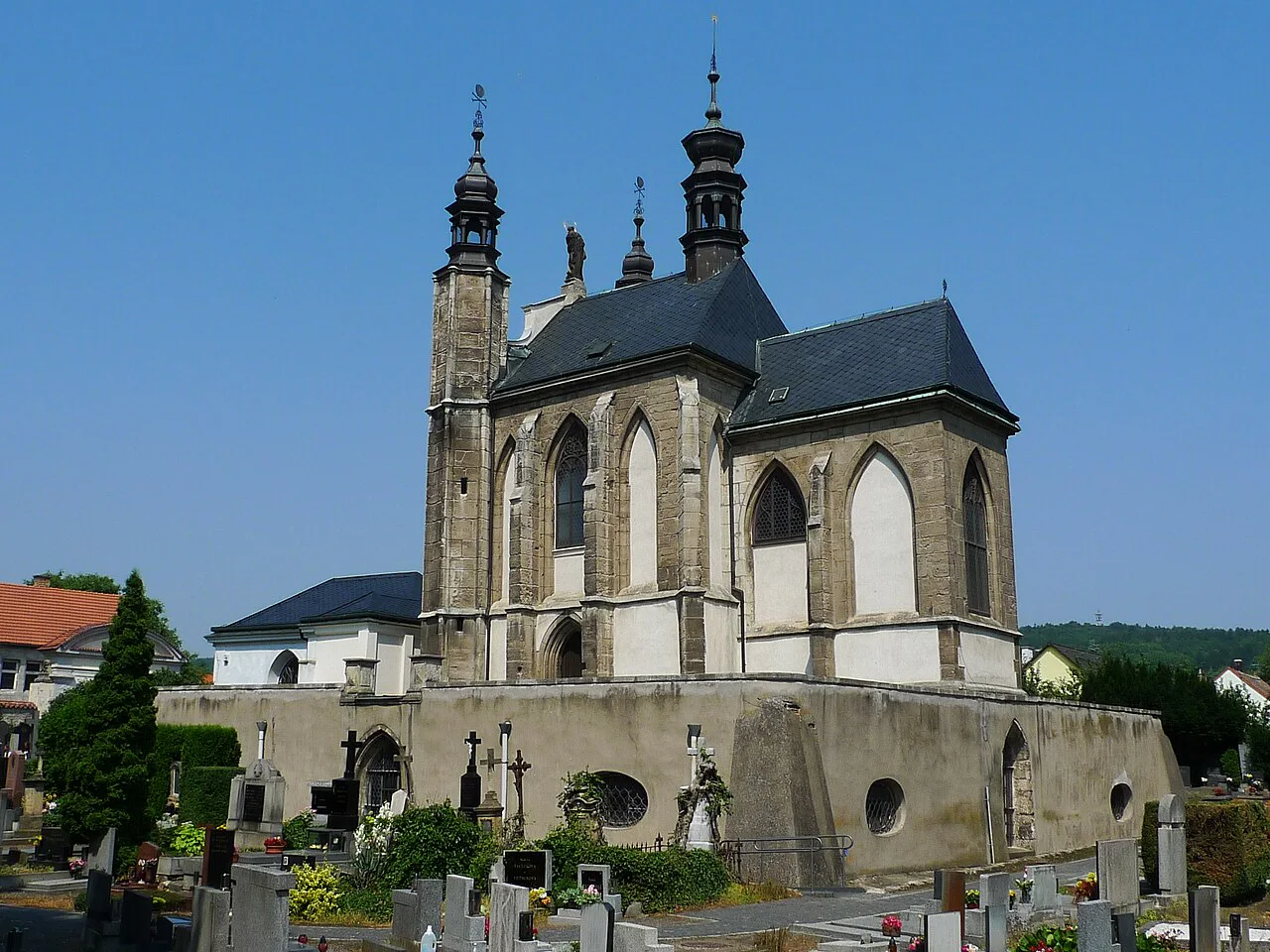
01 Historic Cemetery Grounds and Gothic Facade
Cemetery Church of All Saints from the Burial Ground
The Sedlec Ossuary is a Catholic chapel, set beneath the Cemetery Church of All Saints. The church stands in Sedlec, a suburb of Kutná Hora in the Czech Republic. It once belonged to a Cistercian abbey. Its two towers rise above a stone base, with headstones and paths all around. Estimates say between forty and seventy thousand people lie in the ossuary. The reason goes back to 1278. That year, Abbot Henry came home from the Holy Land with a little earth from Golgotha. King Ottokar the Second of Bohemia had sent him there. He scattered the soil over the abbey's cemetery. Word of the act soon spread, and people from across Central Europe wanted to be buried in it. Other tellings of the legend name an abbot called Heidenreich, and soil from the Holy Sepulchre in Jerusalem. During the Black Death in the mid fourteenth century, many thousands were buried here. More followed after the Hussite Wars in the early fifteenth century. Those were religious wars in Bohemia. Burials on that scale forced the cemetery to be greatly enlarged. At the centre of the cemetery, a Gothic church was built. The church is usually dated to around 1400, though some accounts start the building in the early fourteenth century. Its lower chapel was set aside as an ossuary. It took the bones of graves dug up during building work, or cleared to make room for new burials. The bones in that chapel came from this same ground.
Photo: MONUDET · CC BY-SA 4.0
02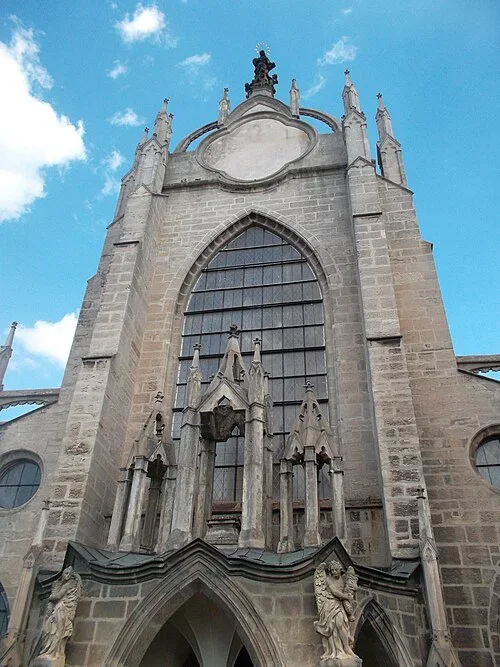 Historic Cemetery Grounds and Gothic Facade
Western Façade and Main Portal
The west front of the church was leaning outward, and it needed holding up. Work on it began in 1703. The architect Jan Blažej Santini-Aichel designed the rebuilding, and the work was done by 1710. He built a new entrance and a gable between the two towers, to brace the structure. The style is Czech Baroque, sometimes called Baroque Gothic. Below the gable, an arched porch holds carved figures at either side. The upper chapel was rebuilt too. Over the years the building drifted nearly half a metre from upright, because of a structural fault. Staged restoration began in 2014.
Photo: Fiver, der Hellseher · CC BY-SA 4.0
03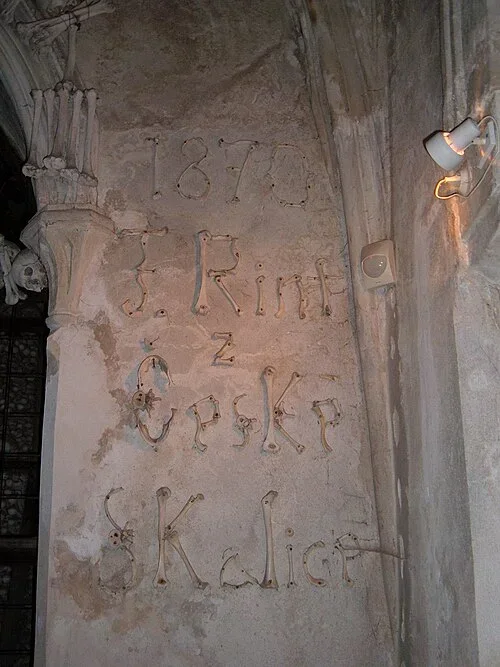 Crypt Entry and Master Woodcarver's Mark
Bone Signature of František Rint (1870)
The bones had been left in heaps, and in 1870 the Schwarzenberg family hired a woodcarver to put them in order. His name was František Rint, and he came from České Skalice. He signed his work on the wall near the entrance. The signature is built from bone, spelling out his name, his home town and the year. Local accounts credit him as the author of the ossuary's bone decoration.
Listen in the appPhoto: BrokenSphere · CC BY-SA 3.0
04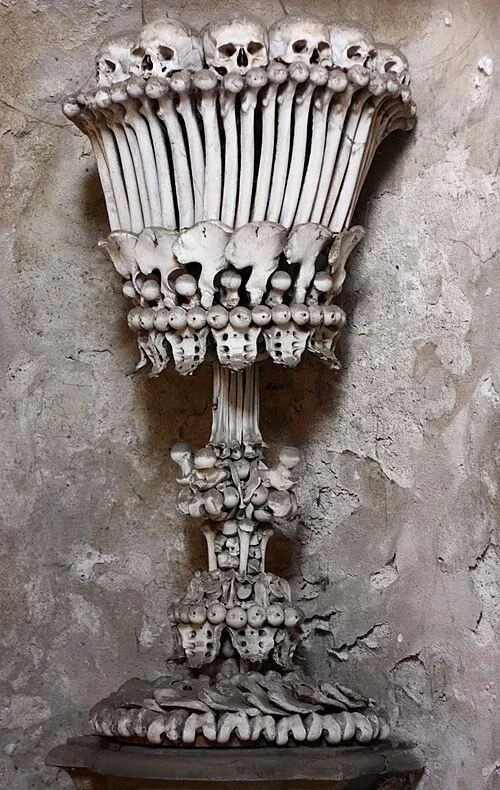 Crypt Entry and Master Woodcarver's Mark
Bone Chalice-Form Ornament
The message behind the bone decoration here is memento mori, a Latin phrase meaning remember death. For Christians it is a reminder to keep a person's last things in mind. Rising from a stepped base, a stem of bones widens into a cup. Long bones are laid in ranked rows around its sides, and a ring of skulls crowns the rim. The ossuary is also a place of hope, that the dead will be raised to eternal life.
Listen in the appPhoto: Mimaska · CC BY-SA 3.0
05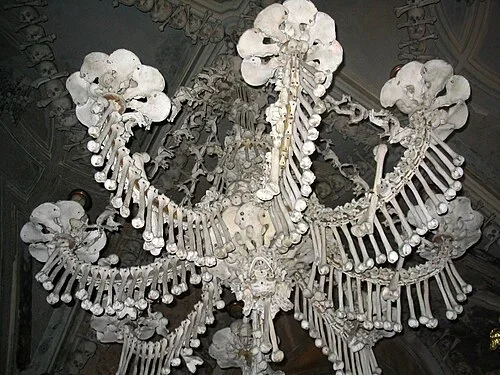 The Great Bone Chandelier and Vaults
Bone Chandelier Arms Close-Up
The arms of a bone chandelier curve outward like branches, and each one is made of bone. Rounded bone ends sit along the curves, like knots on a branch. Above them, the ceiling is patterned with more bone. Strands of smaller bones hang from the arms in tiers, like fringe.
Listen in the appDaniel Wabyick from San Francisco · CC BY 2.0
06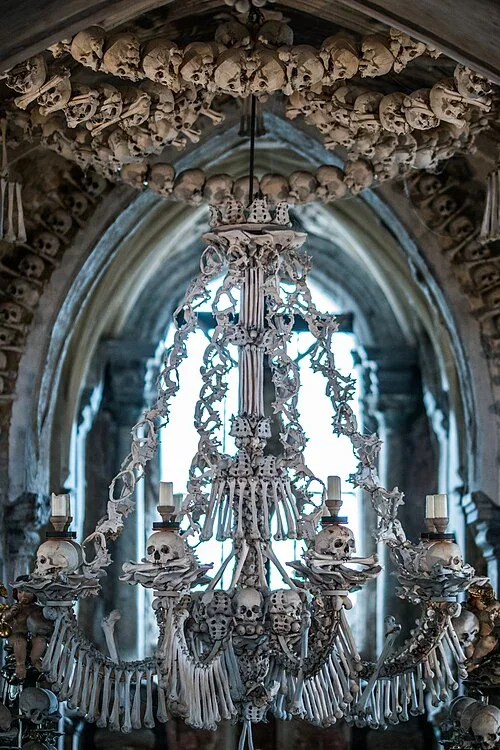 The Great Bone Chandelier and Vaults
The Great Bone Chandelier
A chandelier made of bone hangs from the middle of the nave. Its candles sit in cups set on small skulls. Garlands of skulls drape the vault above it. Through the arches behind, a bright window lets in light. One description of the chandelier says it holds at least one of every bone in the human body.
Listen in the appNan Palmero from San Antonio, TX, USA · CC BY 2.0
07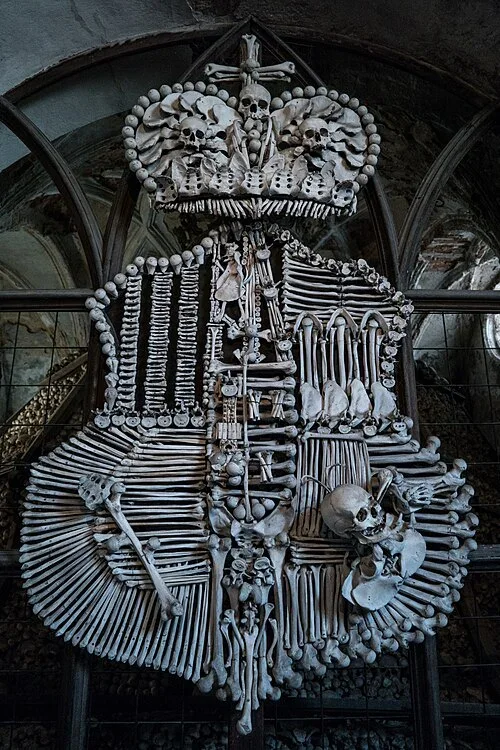 The Schwarzenberg Coat of Arms
The Schwarzenberg Family Crest in Bone
The Schwarzenberg family's coat of arms is made from bone. In 1784, Joseph the Second abolished the Sedlec monastery, among others. The Schwarzenbergs, from Orlík, bought its property. They had the ossuary adapted to the form it has today. The crown is made of skulls and round bone knobs, with a small cross on top. Below it, the shield is divided into fields of bones laid in rows. At the lower right, a skull stands for the Turk's head on the family's arms, with a raven pecking at its eyes. Arched windows rise behind the whole crest. The crest is the family's own emblem, made from the remains of people buried in the cemetery.
Listen in the appNan Palmero from San Antonio, TX, USA · CC BY 2.0
08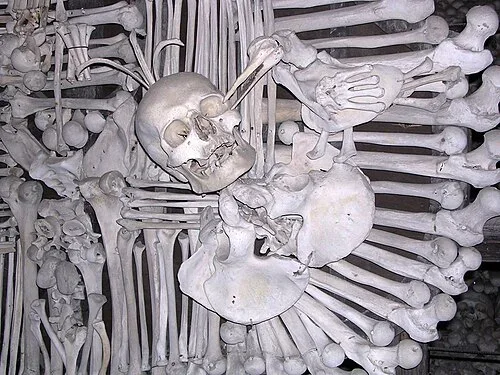 The Schwarzenberg Coat of Arms
Bone Detail: Skulls and Long Bones
A skull sits in profile among long bones here, and the bones fan out in rows around it. A hand rises at the upper right, its fingers spread among the shafts. Rounded ends line the lower edges, neatly set. The long bones lie side by side, so the surface reads as a pattern instead of a heap.
Listen in the appPhoto: Wilson44691 · Public domain
09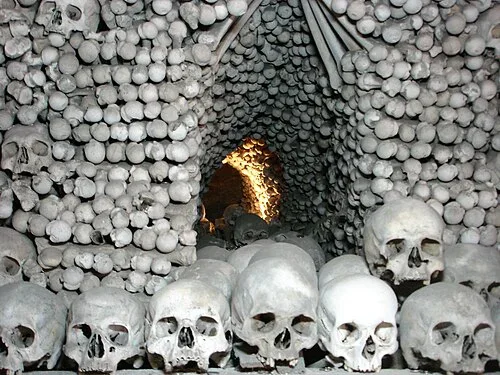 The Corner Bone Pyramids and Altar
Skull and Bone Wall with Lit Recess
According to a legend, a half-blind monk from Sedlec stacked exhumed bones into great pyramids. The legend ties the work to 1511. The cemetery was largely cleared at the end of the fifteenth century. Its bones were moved into the lower chapel. A row of skulls lines the front, and smaller rounded bones are packed above and behind them. A warm light glows from an opening at the centre. Today the ossuary draws over two hundred thousand visitors a year.
Listen in the appPhoto: Diether · CC BY-SA 3.0
Sedlec Ossuary
Frequently asked questions
How much does the guide cost?
Free app download. Listed guide price: $0.99. Guide price shown in the app. Audio guide only. Venue admission is separate.
Can I listen without internet?
Yes. Download the guide’s audio, images, and maps in the app before your visit. Your downloaded content is then available offline.
Can I listen in my language?
This audio guide is available in 15 languages, including English.
Do I need to follow a schedule?
No. This is a self-guided experience. Choose your stops, pause whenever you like, and return to a story at your own pace.
At your own pace
Explore Sedlec Ossuary.
Download Stanza, then search for “Sedlec Ossuary”.
Free app download · Guide price shown in the app
Keep exploring
Nearby audio guides
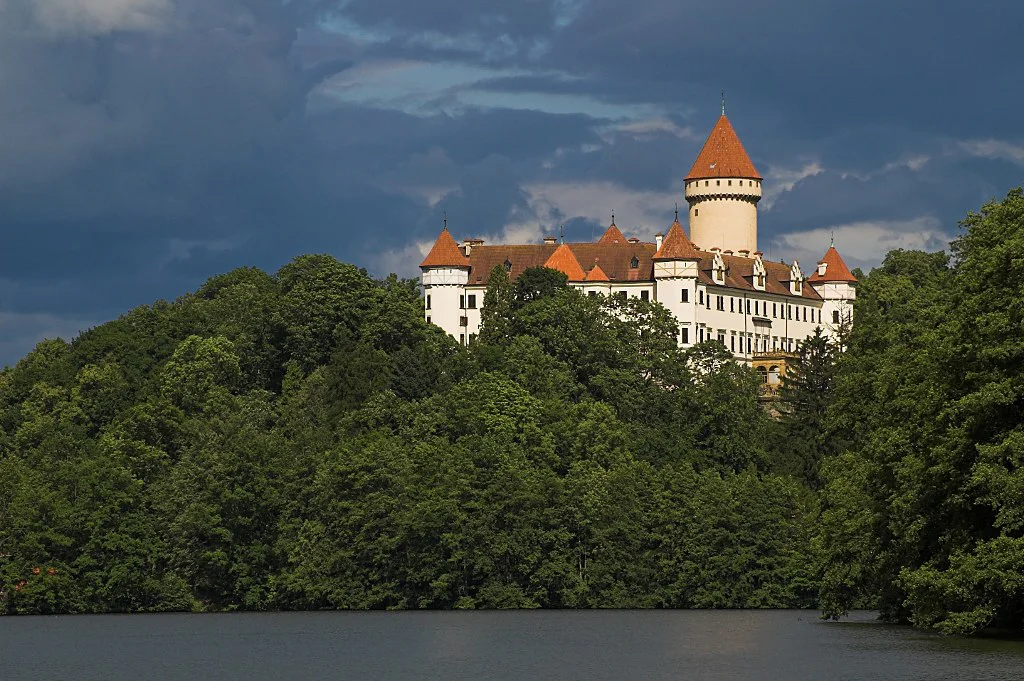
Benešov · 50 km
Konopiště Castle
Content & sources
Marek Prokop from Říčany, Czech Republic · CC BY 2.0
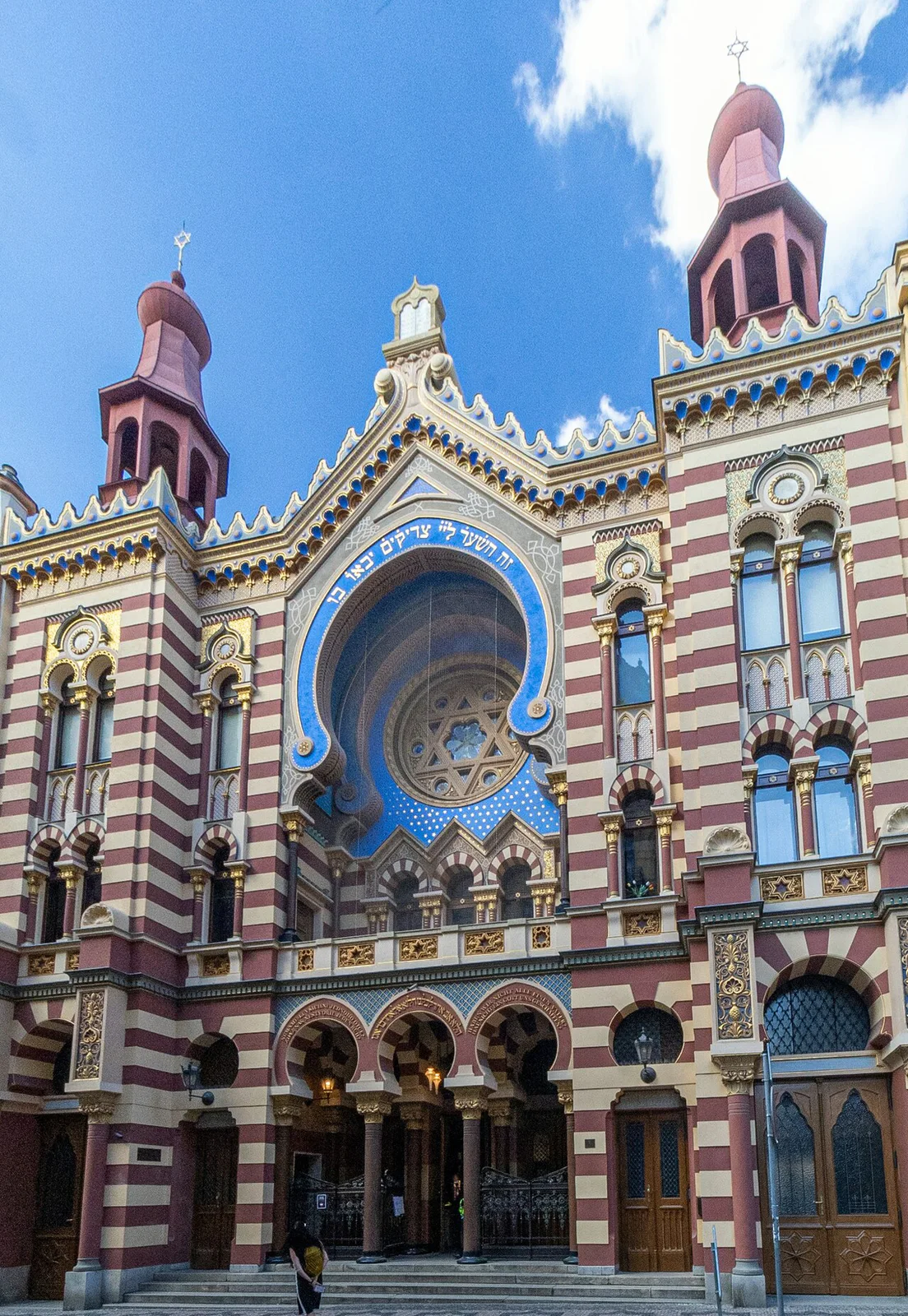
Prague · 63 km
Jubilee Synagogue
Content & sources
Vit · CC BY-SA 4.0
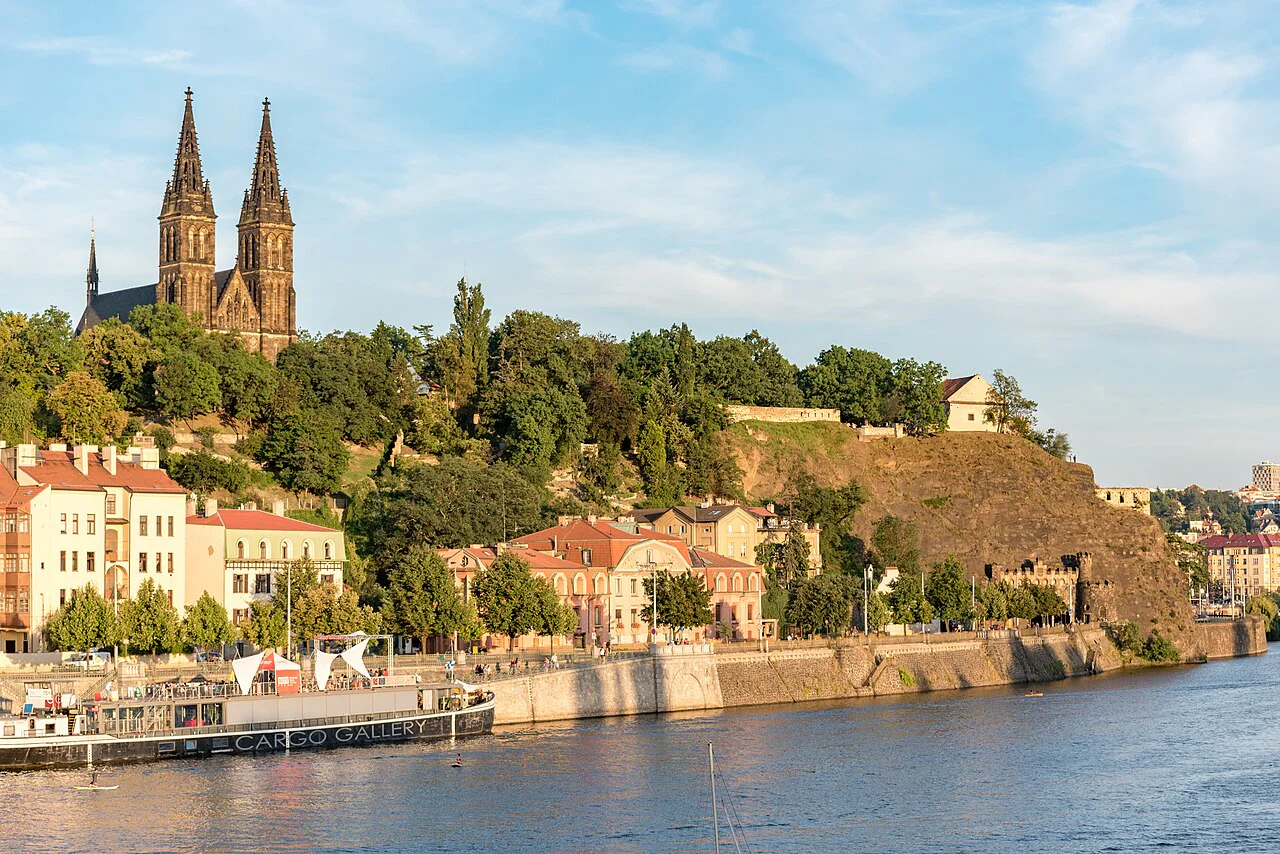
Prague · 63 km
Vyšehrad
Content & sources
Photo: Tilman2007 · CC BY-SA 4.0
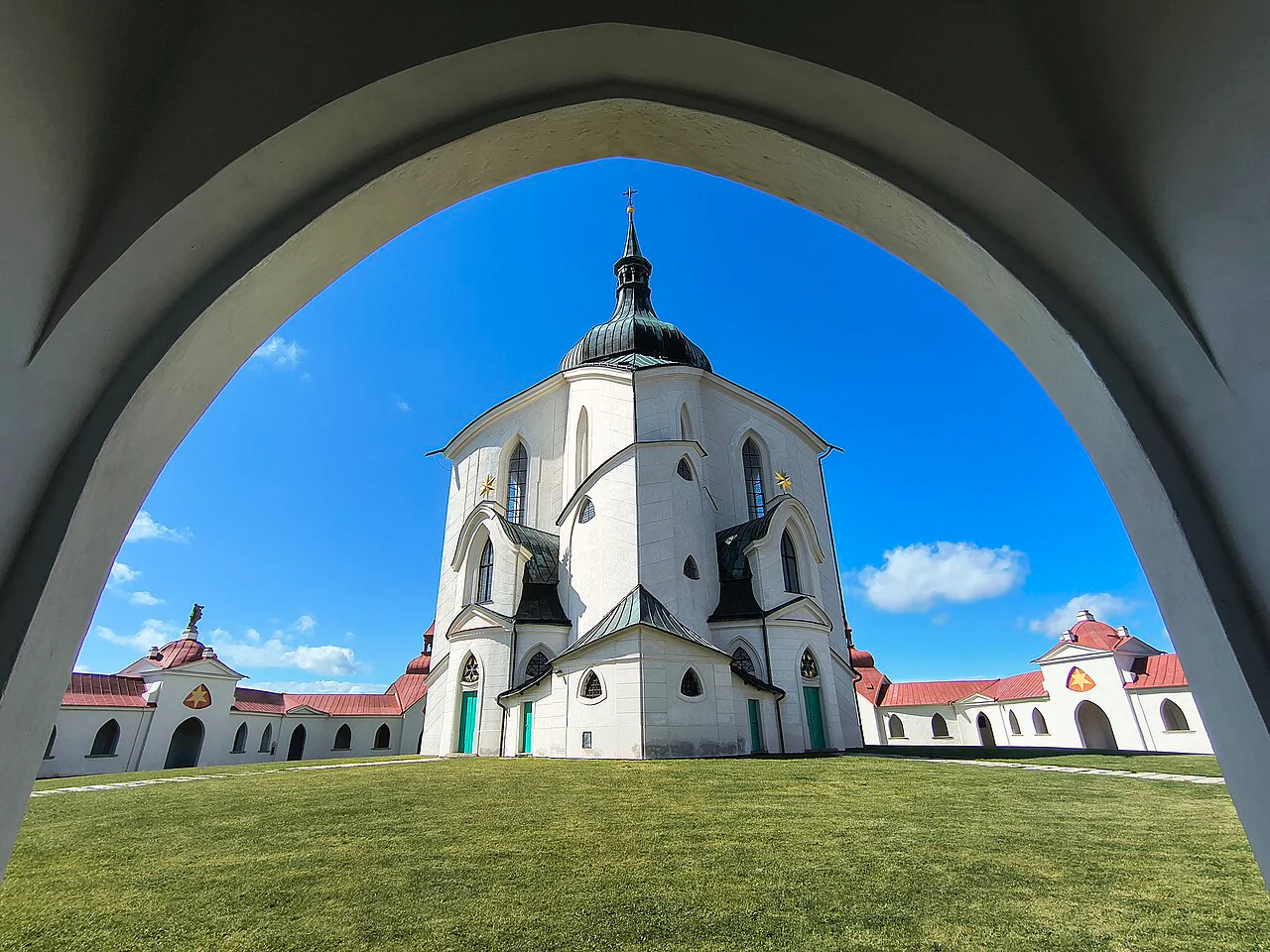
Žďár nad Sázavou · 63 km
Pilgrimage Church of Saint John of Nepomuk
Content & sources
Photo: Aqalexor · CC BY-SA 4.0