 Stanza / Audio guide
Content & sources
Stanza · Audio guide
Christiansborg Palace Audio Guide
A place to remember. A story to take with you.
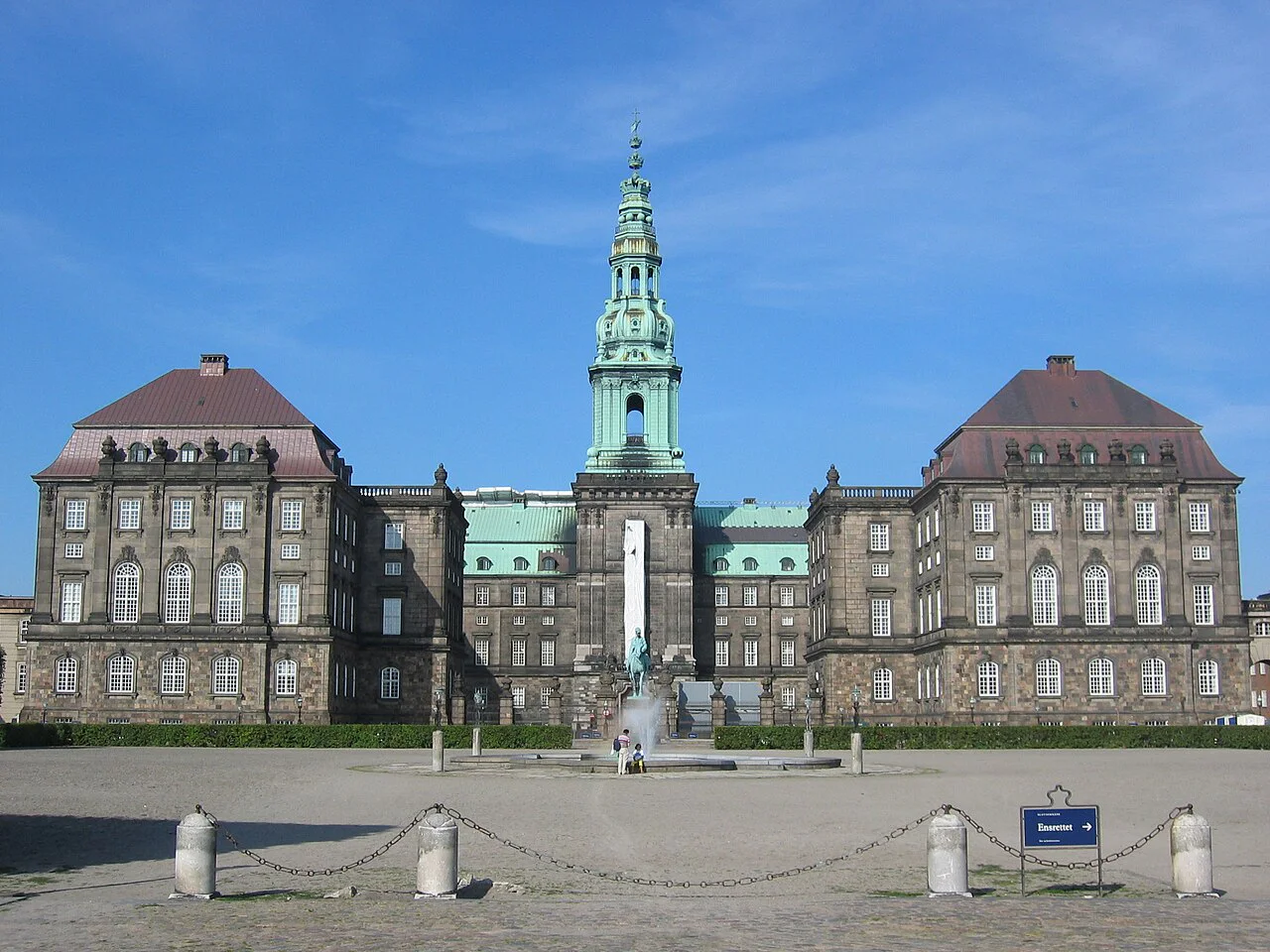
Christiansborg Palace is a palace and government building located on the islet of Slotsholmen in central Copenhagen. It serves as the seat of the Danish Parliament, the Prime Minister's Office, and the…
Download Stanza, then search for “Christiansborg Palace”.
About the tour
One guide. Your kind of visit.
Christiansborg Palace is a palace and government building located on the islet of Slotsholmen in central Copenhagen. It serves as the seat of the Danish Parliament, the Prime Minister's Office, and the Supreme Court of Denmark.
Ready when you are.
- 01Get the free Stanza app.
iOS & Android
- 02Find your guide.
“Christiansborg Palace”
- 03Download before you go.
Works offline
Audio guide / 18 narrated stops
Inside the guide
Get to know a few of the stories before you go. Open a stop to read more.
01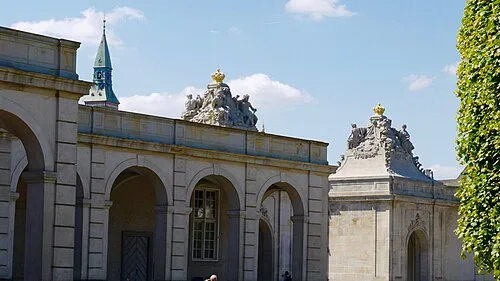 The Marble Bridge and Riding Grounds
The Rococo Pavilions at the Riding Ground Entrance
Welcome to Christiansborg, the palace on Slotsholmen, a small island in the middle of Copenhagen. It is one building with several jobs: the Danish Parliament meets here, so do the Prime Minister's Office and the Supreme Court, and the monarch keeps the Royal Reception Rooms and the Chapel. These two little pavilions with their crowned sculptures once marked the main entrance to the very first Christiansborg. They flank the Marble Bridge, built between 1739 and 1745 to carry visitors over the canal onto the island. Two young royal architects, Nicolai Eigtved and Lauritz de Thurah, designed bridge and pavilions in the fashionable Rococo style. The commission wanted arriving guests to be impressed, and the pavilions were meant to bind the whole entrance together. An iron gate once stood between them, but it rusted with age and was taken down in the 1830s. Ahead of this entrance, everything rests on eight hundred years of castles and palaces, one built on the ruins of the last.
Cha già José from Vienna, Austria · CC BY-SA 2.0
02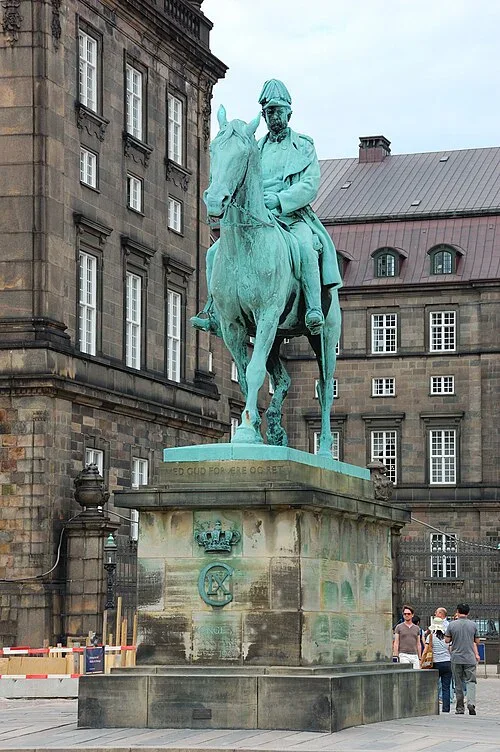 The Marble Bridge and Riding Grounds
Equestrian Statue of King Christian IX
The green figure on horseback is King Christian IX, and his monument took a very long time coming. After his death in 1906, a public collection was started to pay for a statue. The next year, four artists were invited to compete, and the sculptor Anne Marie Carl-Nielsen won. She was the wife of the composer Carl Nielsen, and her design showed the King on a high pedestal lined with reliefs of the leading men of the day. Those reliefs were later dropped, and the architect Andreas Clemmensen designed the plainer pedestal the horse stands on today. Carl-Nielsen travelled the country looking for a horse to model, and found the right one in Hanover, in Germany. Danish horse breeders were not pleased. The monument was finally unveiled in 1927, twenty-one years after the King's death, facing the statue of Frederick VII on the Palace Square.
Cha già José from Vienna, Austria · CC BY-SA 2.0
03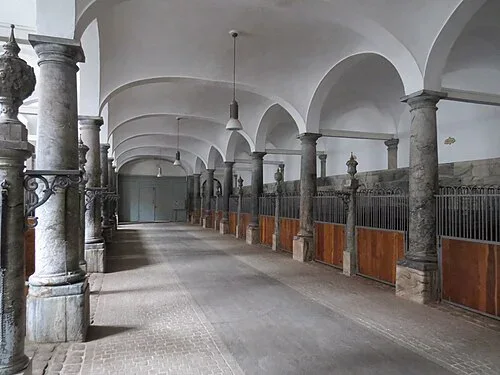 The Royal Stables and State Carriages
The Royal Stables
These stall aisles with their grey marble columns are the last working piece of the first Christiansborg. The show grounds and stables are all that survive of the great Baroque palace built here from 1738 to 1746. Work on the south wing stalled over supplies and restarted in 1744 under the young architect Nicolai Eigtved. In 1746 the stables received eighty-seven hunting horses and a hundred and sixty-five carriage horses. The peak came in 1789, when two hundred and seventy horses were stabled here. Today about twenty remain, the carriage horses used for royal ceremony, and other parts of the old stables have become offices and garages. The vaulted aisles and stone pillars still give a sense of how grand a working stable could be.
Listen in the appPhoto: Orf3us · CC BY 3.0
04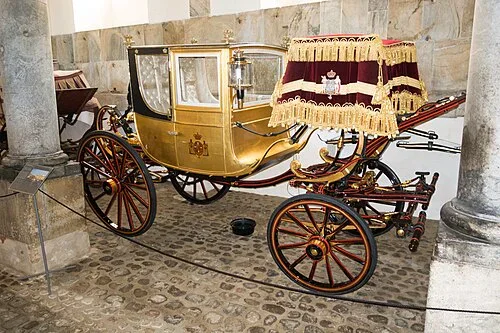 The Royal Stables and State Carriages
The Golden Coach
Among the stalls stands a carriage covered in gold. It dates from 1840, and it is no museum ghost. The Royal Stables still keep the horses and carriages that carry the Danish royal family at state events and festive occasions. This gilded coupé is one of them, polished and kept ready between its ceremonial duties. The same yard that once filled with two hundred and seventy horses now serves a handful, and the tradition they carry is still alive.
Listen in the appThomas Quine · CC BY 2.0
05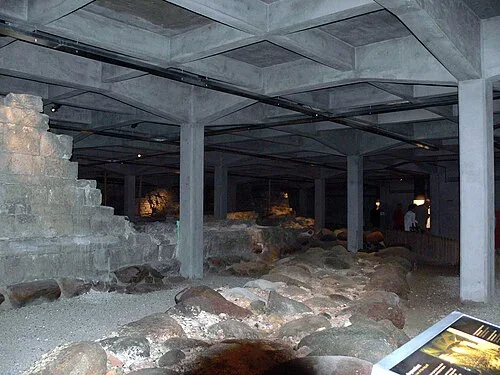 The Subterranean Medieval Ruins
Absalon's Castle: The Founding Wall
Under the palace floor lies the oldest thing on this island. The chronicler Saxo Grammaticus tells how Bishop Absalon of Roskilde built the first castle here in 1167, on a small island outside Copenhagen Harbour. His fortress was a curtain wall, in places up to five metres high, enclosing a courtyard with the bishop's palace, a chapel and smaller buildings. When workers cast the foundations of the present palace in the early twentieth century, they came upon these ruins and parts of that wall. Public interest was tremendous, and it was decided the ruins should never be covered over again. The reinforced concrete structure raised to shelter them was the biggest of its kind in Denmark when built in 1908. The exhibition opened to the public in 1924, and the rough stones have been down here ever since.
Listen in the appChristian Bickel · CC BY-SA 2.0 de
06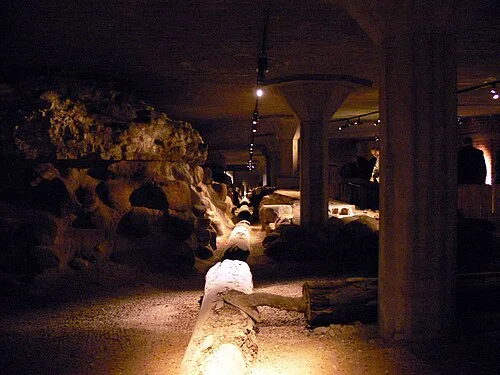 The Subterranean Medieval Ruins
From Absalon's Castle to Copenhagen Castle
Absalon's castle did not fall on its own. In 1370 King Valdemar IV was defeated in a conflict with the Hanseatic League, the merchant cities that dominated trade in the Sound. The castle had long been a thorn in their trade, and they ordered it removed. They sent forty stonemasons to demolish it, stone by stone. On the covered ruins, earthworks rose, and by the late fourteenth century a new stronghold stood here: Copenhagen Castle. It had its own curtain wall, a moat all around, and a large solid tower as its entrance gate. That castle served the kings of Denmark for centuries, until it was cleared away from 1731 to make room for the first Christiansborg. Three castles, one island, each built on the bones of the last.
Listen in the appChristian Bickel · CC BY-SA 2.0 de
07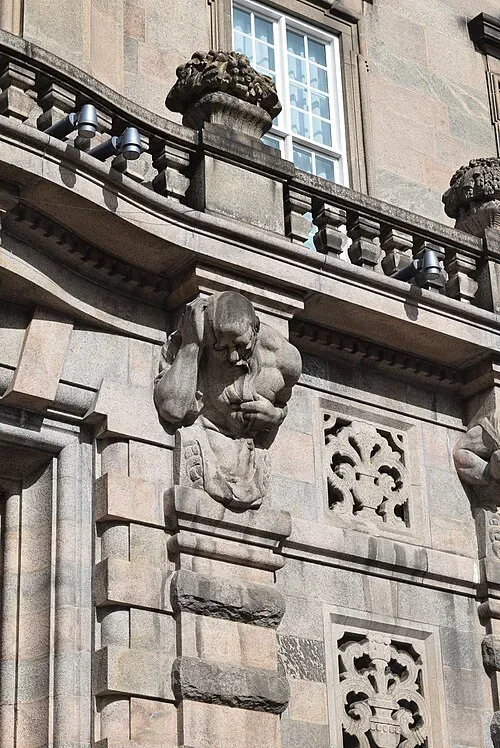 The Folketing and The Gate of Pain
The Gate of Pain: The Straining Atlantes
The granite figures straining under the balcony above the parliament entrance have a rough reputation. The sculptor Anders Bundgaard carved them, and the story goes that their pained look at the unveiling horrified the citizens of Copenhagen. A public fund was even raised, people say, to pay for chipping them off the wall. The statues stayed, and Copenhageners gave them mocking nicknames: Earache, Headache, Stomachache and Toothache. Bundgaard did most of the stone carving on the palace facade. Above the windows he set granite masks of famous Danes, among them Bishop Absalon and the astronomer Tycho Brahe. The fathers of the Danish constitution stand in that company too, gathered around the Folketing entrance.
Listen in the appHaydn Blackey from Cardiff, Wales · CC BY-SA 2.0
08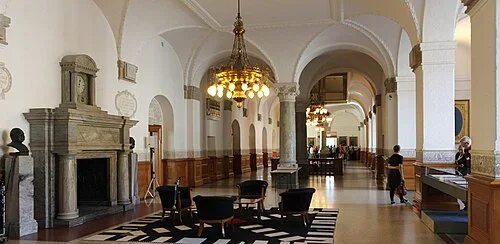 The Folketing and The Gate of Pain
The Lobby (Vandrehallen)
This vaulted hall with its chandeliers and marble fireplace is the Lobby, and the whole first floor of the Parliament Wing is arranged around it. At either end stood the chambers of the Rigsdagen, the old two-house parliament. The Folketing chamber sits at the far end, the Landsting at the other. Since 1953 the Folketing has been Denmark's only legislative assembly, and the far chamber is the only one still in use. After the Constitution of 1849, this south wing became the meeting place of Denmark's first parliament. The Rigsdagen began its work here in January 1850, in the same wing where the Folketing still sits.
Listen in the appPeter Leth · CC BY 2.0
09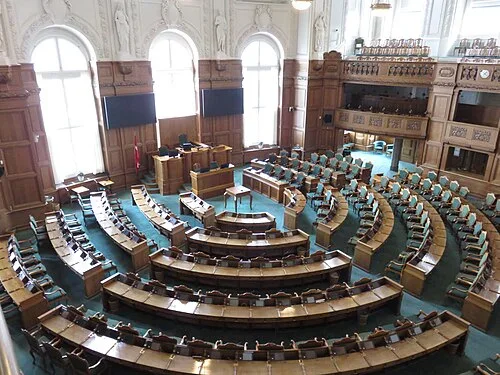 The Folketing and The Gate of Pain
The Folketing Chamber
In March 1848, thousands of citizens marched on Christiansborg. They demanded a constitution and an end to absolute rule. King Frederik VII gave in, and Denmark's first democratic constitution followed in 1849. This horseshoe of tiered green seats is where that promise went to work. The Folketing debates its laws here, in the room Danish politics still revolves around. No single party usually wins a majority, so governments are built by coalition, deal by deal, on this floor. The palace has grown so identified with politics that Danes simply call it Borgen, the castle. Eight centuries after Bishop Absalon raised his wall, the island still governs Denmark.
Listen in the appPhoto: Antony-22 · CC BY-SA 4.0
10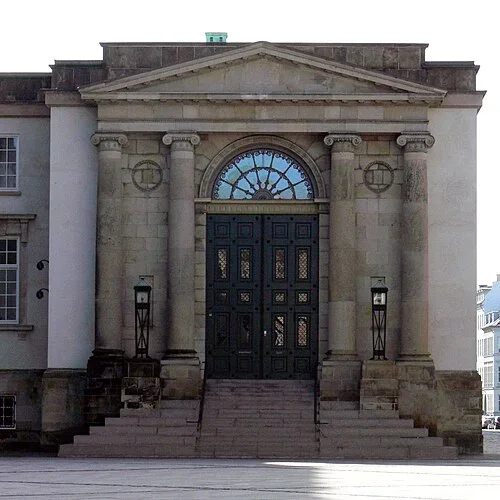 The Supreme Court and the Three Branches of Power
The Supreme Court Entrance
The Supreme Court of Denmark enters through a columned portico and a broad flight of steps. Christiansborg is the only building in the world that houses all three branches of a country's government. The stone walls carry a story of their own. The lower storeys are clad in stone collected and donated from more than seven hundred parishes across Denmark. Each stone was left rough on its outer face, so the facade shimmers with many different shades. Granite weathers well and needs almost no care, but it resists fine carving, so the decoration stays bold and coarse. In the north facade facing Prince George's Yard, fragments of C.F. Hansen's earlier palace were built into the new one.
Listen in the appChristian Bickel · CC BY-SA 2.0 de
- 11
The Great Hall and Its Tapestries
Forty metres of banquet hall, hung with seventeen tapestries telling Danish history.
- 12
The Royal Kitchen
Vaulted workrooms and rows of copper: the machinery behind every royal state dinner.
- 13
The Throne Room
The oval room where ambassadors present their credentials beneath the legend of the Danish flag.
- 14
The Proclamation Balcony
The balcony where a new Danish monarch is shown to the crowd in Palace Square.
- 15
The Palace Tower Spire
Copenhagen's tallest tower, in some of Denmark's oldest concrete, crowned with copper and crowns.
- 16
The View over Copenhagen
The panorama that shows how Copenhagen grew around one small island of power.
- 17
The Palace Chapel Facade
A temple-front royal church, begun on old foundations and opened on Denmark's thousandth Christian year.
- 18
The Palace Chapel Interior: Fire and Restoration
Fire, ashes and master craftsmanship: the chapel that rose again, and the palace that always has.
Christiansborg Palace
Frequently asked questions
How much does the guide cost?
Free app download. Listed guide price: $1.99. Guide price shown in the app. Audio guide only. Venue admission is separate.
Can I listen without internet?
Yes. Download the guide’s audio, images, and maps in the app before your visit. Your downloaded content is then available offline.
Can I listen in my language?
This audio guide is available in 15 languages, including English.
Do I need to follow a schedule?
No. This is a self-guided experience. Choose your stops, pause whenever you like, and return to a story at your own pace.
At your own pace
Explore Christiansborg Palace.
Download Stanza, then search for “Christiansborg Palace”.
Free app download · Guide price shown in the app
Keep exploring
Audio guides — Denmark
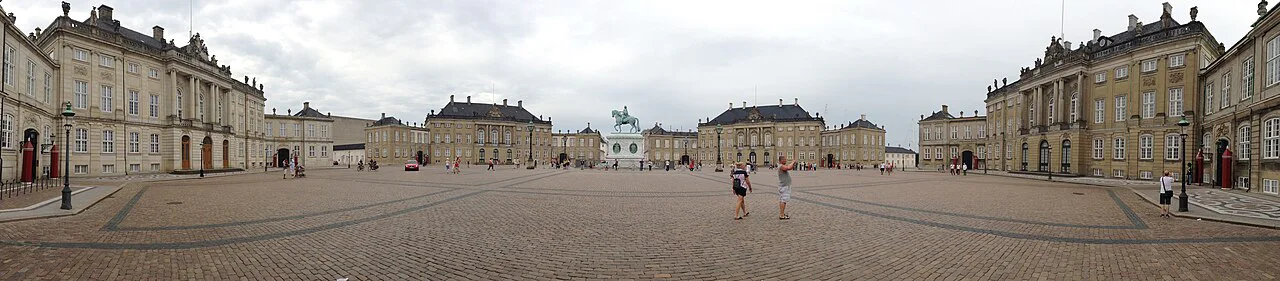
Copenhagen · 1 km
Amalienborg
Content & sources
Photo: Janeway666 · CC BY-SA 3.0
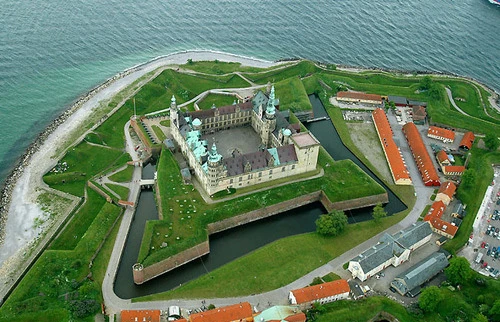
Elsinore · 40 km
Kronborg Castle
Content & sources
H.C. Steensen · CC BY-SA 3.0
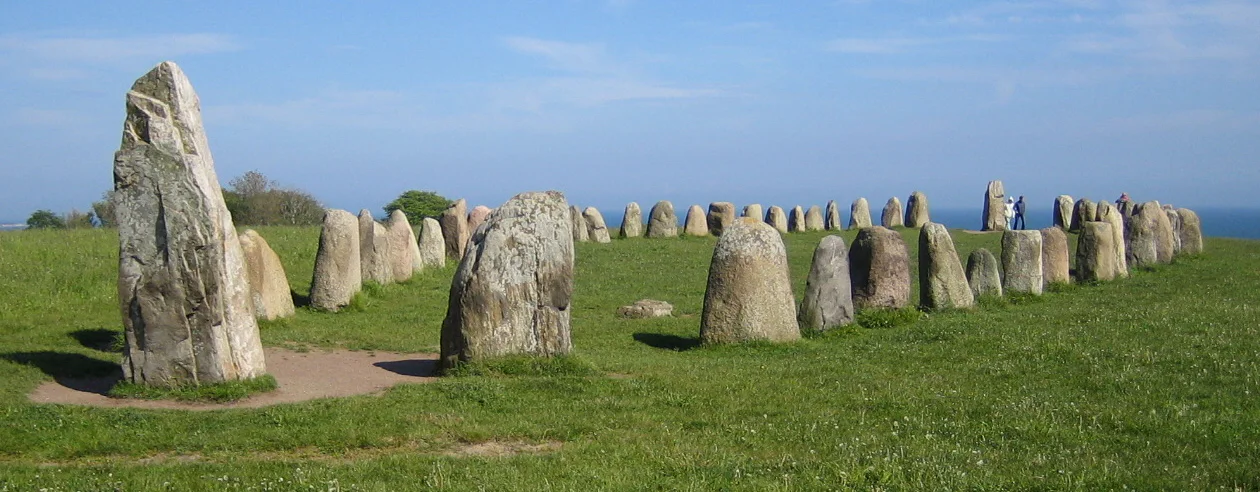
Ystad Municipality · 98 km
Ale's Stones
Content & sources
Photo: Fred J · CC BY-SA 3.0
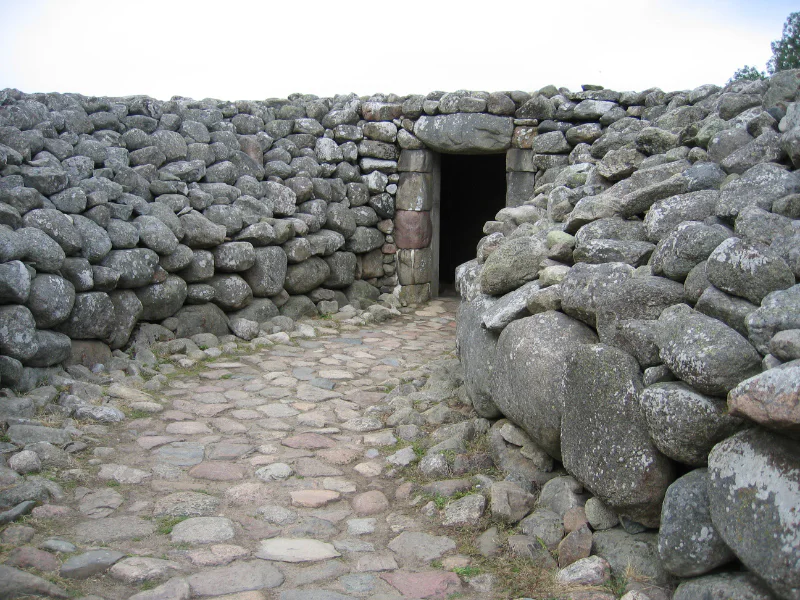
Kivik · 104 km
The King's Grave
Content & sources
Abelson at English Wikipedia · CC BY 2.5
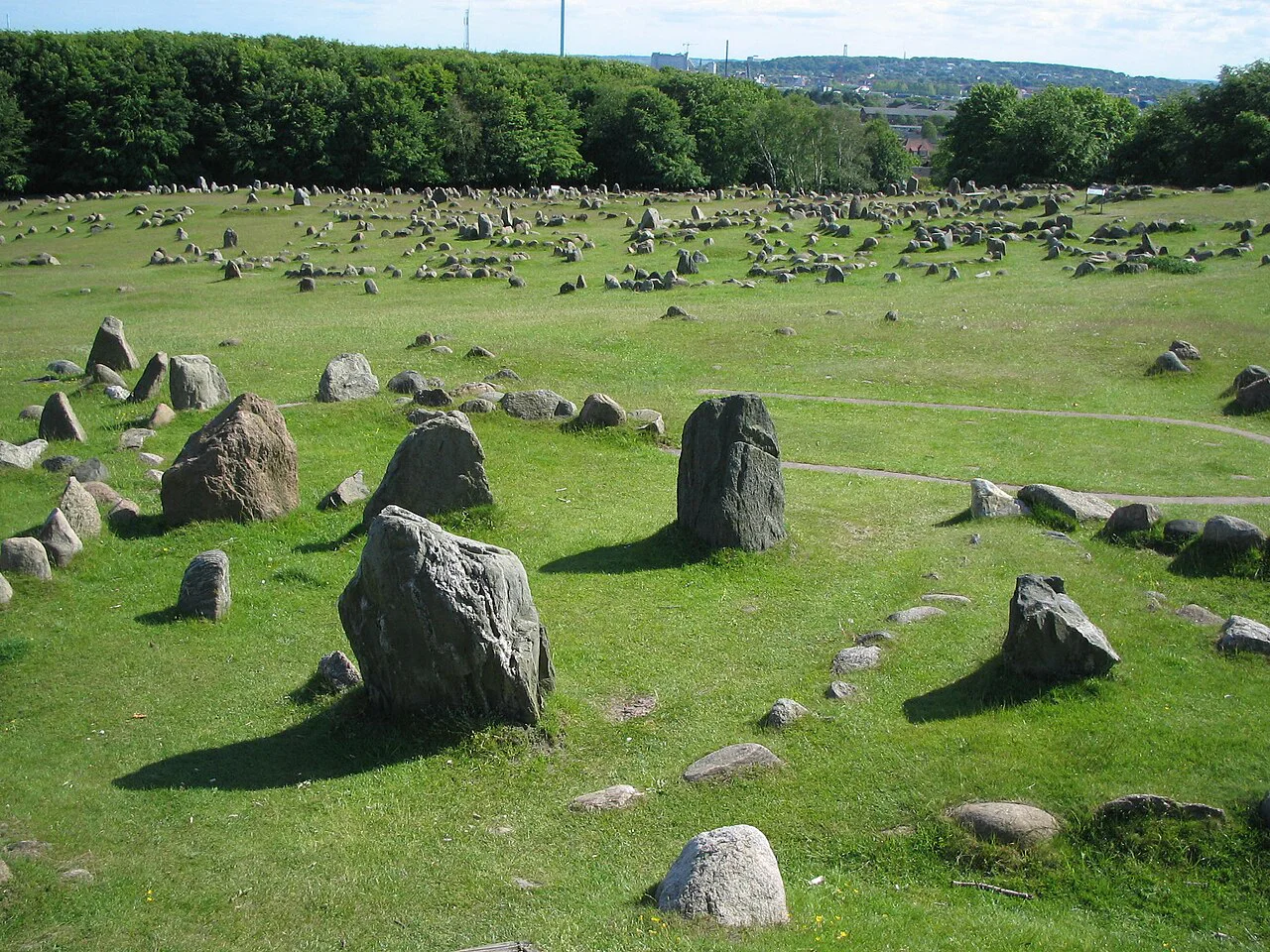
Aalborg
Lindholm Høje
Content & sources
Simon Wedege Petersen · CC BY 3.0