Stanza · Audio guide
Deir el-Medina Audio Guide
A place to remember. A story to take with you.
Deir el-Medina is an ancient Egyptian workmen's village that housed the artisans who built the tombs in the Valley of the Kings. It is historically significant as the home of the workers known as the Servants…
Download Stanza, then search for “Deir el-Medina”.
About the tour
One guide. Your kind of visit.
Deir el-Medina is an ancient Egyptian workmen's village that housed the artisans who built the tombs in the Valley of the Kings. It is historically significant as the home of the workers known as the Servants in the Place of Truth.
Ready when you are.
- 01Get the free Stanza app.
iOS & Android
- 02Find your guide.
“Deir el-Medina”
- 03Download before you go.
Works offline
Audio guide / 14 narrated stops
Inside the guide
Get to know a few of the stories before you go. Open a stop to read more.
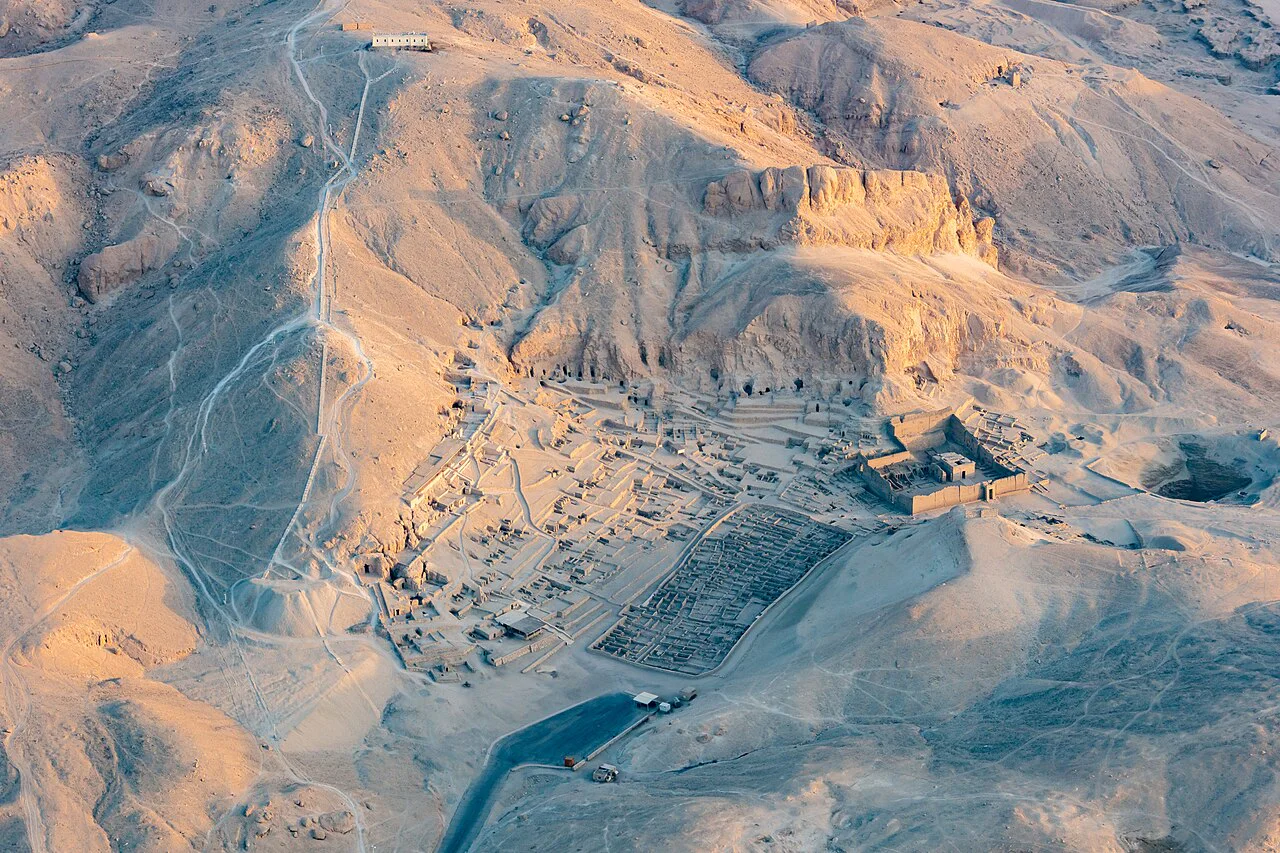
01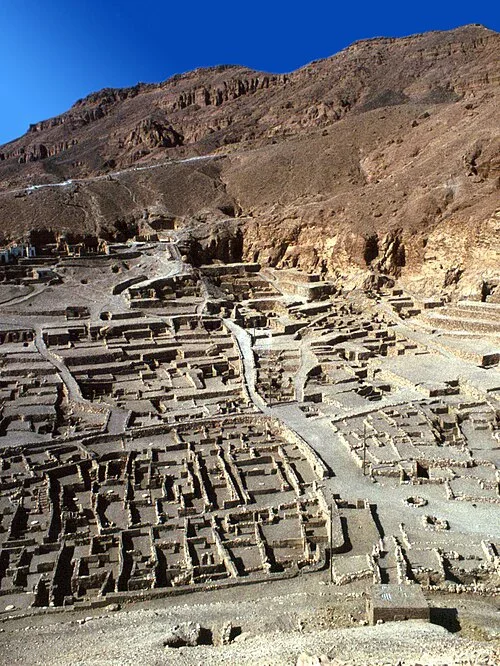 Village Overlook and Residential Quarters
The Village of the Tomb Builders from Above
Welcome to Deir el-Medina, the village of the men who built the tombs of the kings. Its ancient name was Set Maat, the Place of Truth, and the people who lived here were called Servants in the Place of Truth. The state built this walled settlement apart from everyone else, probably to keep the royal tombs secret. It sits in a small natural amphitheatre of desert, within easy walking distance of the Valley of the Kings, the funerary temples and the Valley of the Queens. From up here the setting explains itself. Barren hillsides throw the sun's glare onto the houses, and the hill of Gurnet Murai cuts off the north breeze and every view of the green river valley. The workforce was split into two gangs, left and right, working on opposite sides of a tomb's walls like the two sides of a ship's crew. Each gang had its own foreman, and the foremen supervised both the work and the village itself.
Photo: Gerd Eichmann · CC BY-SA 4.0
02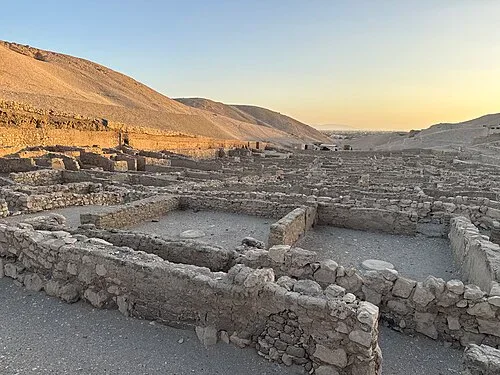 Village Overlook and Residential Quarters
Inside the Workmen's Houses
These low stone footings are all that is left of the workmen's houses. At its peak the village held about sixty-eight of them, packed inside the wall along one narrow main street. Each house had four or five rooms: an entrance, a main room, two smaller rooms, and a kitchen with a cellar. A wooden staircase climbed to the flat roof, where families slept on hot nights. The windows sat high on the walls to keep out the worst of the sun. Nearly every house had niches for statues and small altars. These families were not slaves but free citizens with access to the courts. The men were salaried state employees, paid in grain rations at up to three times a field hand's rate, which in modern terms would make them middle class. One famous resident was Kha, an overseer of works. In 1906 excavators found his tomb untouched, still holding his belongings and those of his wife Merit. That treasure is now one of the highlights of the Egyptian Museum in Turin.
Photo: Chabe01 · CC BY-SA 4.0
03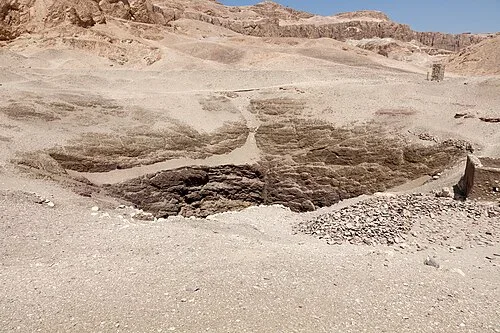 The Great Dry Well and Ancient Archives
The Great Dry Well
This great pit north of the village began as a well. Then the water gave out, and the villagers started throwing their written rubbish into the hole. The desert kept everything. Limestone chips and broken pots served the villagers as notepaper, and thousands of these shards, called ostraca, came out of this pit. They hold family letters, shopping accounts, drawings, and the records of lawsuits. The village ran its own court, made up of a foreman, deputies, craftsmen and a scribe, and it handled civil disputes and some criminal ones. Cases could drag on for years; one dispute involving the chief of police lasted eleven years. The most notorious case concerns Paneb, the son of an overseer, accused of looting royal tombs, adultery and stirring up trouble in the community. How his case ended, no one knows. What does survive is a record showing that a head of workmen was executed around that time.
Listen in the appRoland Unger · CC BY-SA 3.0
04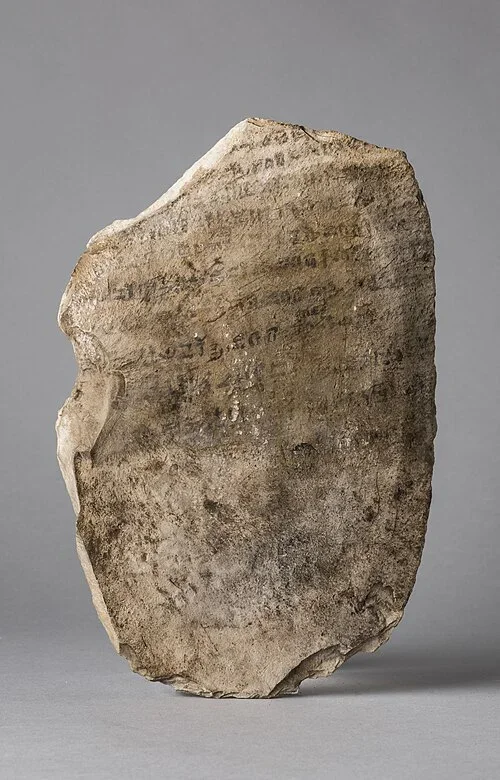 The Great Dry Well and Ancient Archives
The Journal of the Necropolis
This piece of limestone, now in the Museo Egizio in Turin, carries a work register written in hieratic script, the fast handwriting of Egyptian scribes. It is a Journal of the Necropolis, and this one notes the absence of workmen. Day by day, someone marked who had turned up for duty in the royal tombs and who had not. The same records help explain a famous moment. Around the twenty-fifth year of Ramesses III, grain rations stopped arriving on time. The crews threw down their tools and walked off the job, writing to the vizier to complain. We are hungry, they said; eighteen days have passed this month. They refused to return until their grievances were answered, and they told the village leaders to take their case to the pharaoh or the vizier. Once the authorities heard them out, the men went back to work the next day. It may be the first sit-down labour strike in recorded history. Complaints from the same village are recorded again forty and fifty years later, under Ramesses the Ninth and the Tenth.
Listen in the appPhoto: Marco Chemello (WMIT) · CC0
05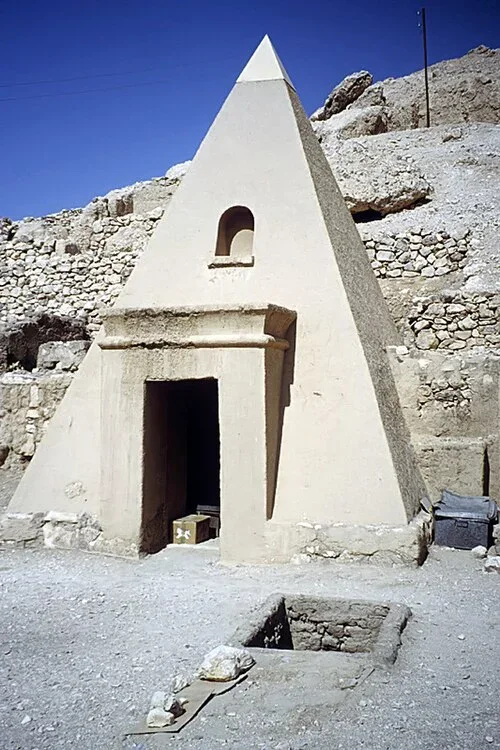 Tomb of Sennedjem (TT1)
: The Pyramid Chapel
On their days off, the men of this village worked on their own tombs. They were among the best craftsmen in Egypt, the people who cut and painted the royal burials, and their own tombs count among the most beautiful on the west bank. This small pyramid marks one of them. It stands over the tomb of Sennedjem, a Servant in the Place of Truth, and it is not a royal monument but a private chapel for his family. The community built its dead small rock-cut chapels like this one, topped with little pyramids. In 1886 the Egyptologist Gaston Maspero found Sennedjem's burial place here, on the second of February. The tomb carries the label TT1, the very first number in the catalogue of Theban tombs. Number one went to a workman, not to a king.
Listen in the appRoland Unger · CC BY-SA 3.0
06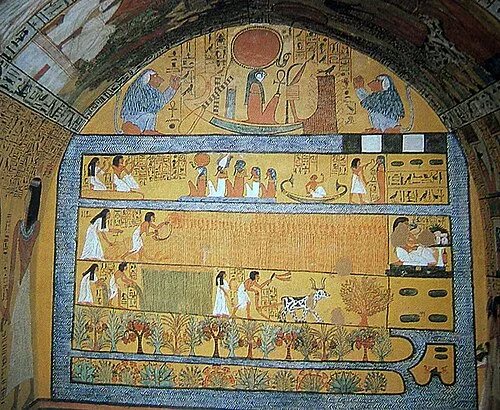 Tomb of Sennedjem (TT1)
Sennedjem's Fields of the Afterlife
Inside the vaulted burial chamber, Sennedjem and his wife appear in the fields of the afterlife, and the colours are still startlingly fresh. They plough and harvest in neat registers, watched over by the gods painted above. The scene makes a precise promise. Eternal life would look like the ideal Egyptian farm, where the work is done easily and forever, and the harvest never fails. Barley grows taller than the workers, and the couple move through it calmly, without sweat or hunger. That is why a modest workman's tomb can rival a royal one in freshness: its painters knew their craft. The paint here has waited three thousand years to look like this.
Listen in the appAnonymousUnknown author · Public domain
07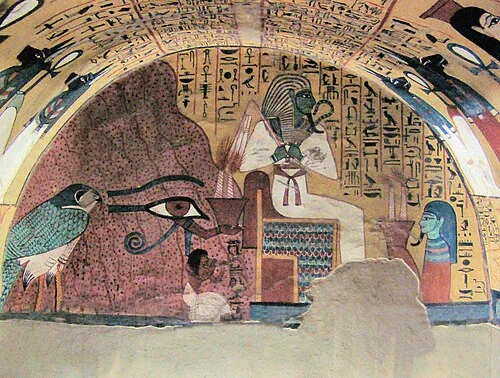 Tomb of Pashedu (TT3)
: Osiris and the Sacred Mountain
Pashedu was another Servant in the Place of Truth, and his tomb, TT3, holds some of the village's most loved painting. On this wall Osiris sits enthroned, the god of the dead, beside the wedjat eye and a falcon, all set against a reddish mound. Many see in that reddish shape the desert mountain itself, the sacred peak that rose over the royal valley. The villagers gave that mountain a name, Meretseger, She Who Loves Silence, and they turned to her for food and safety. Locally, she may have mattered as much as Osiris, the great god of the dead, himself. Here the state gods and the local ones were worshipped side by side, without any sense of conflict. Visitors to this tomb also look for a quieter image: Pashedu drinking from a pool beneath a palm tree, a small moment of rest painted for eternity.
Listen in the appkairoinfo4u · CC BY-SA 2.0
08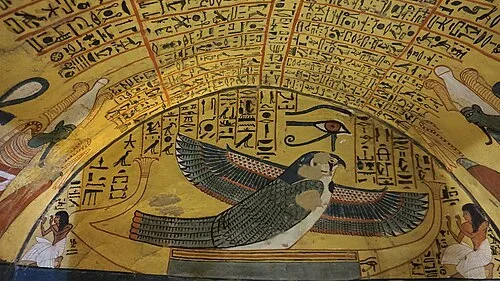 Tomb of Pashedu (TT3)
The Vaulted Sky of Pashedu's Tomb
The ceiling of Pashedu's burial chamber is a vault, carved out of the rock and then painted to become something else: a sky. Across its curved yellow surface run dense columns of hieroglyphs, protective texts wrapped around the room like a canopy. Spreading across the centre is a great winged figure, its feathers painted bird by bird, sheltering the burial place beneath. In tombs like this the vaulted roof stands for the heavens, so the dead person lies enclosed in a bounded cosmos: earth below, sky above, and sacred writing all around. The room is small, but the effect is deliberate. Every surface was given a job, and the job was protection. The painters who made it spent their working days doing the same thing for kings.
Listen in the appElias Rovielo · CC BY-SA 2.0
09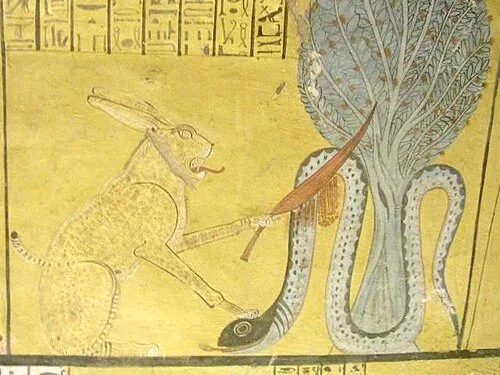 Tomb of Inherkhau (TT359)
The Cat of Heliopolis Slays Apep (TT359)
In the tomb of Inherkhau, a foreman in the Place of Truth, comes the most dramatic image the village painters left. A cat sits beneath a sacred tree, holding a knife, and severs the head of a huge serpent. The serpent is Apep, the great snake of chaos, enemy of the sun god Ra. Every night, as the sun travelled through the underworld, Ra had to defeat Apep to rise again in the morning. The cat is the sun god in his fiercest form, and this vignette shows his victory. The scene comes from the Ramesside period, when the village was at its artistic peak. It gives the afterlife journey its dark side: order against disorder, fought over again and again, night after night. The painters put that cosmic battle on the wall of a workman's tomb, a few hundred metres from the kings' own burial places.
Listen in the appHajor, Oct.2004. Released under cc.by.sa and/or GFDL. · CC BY-SA 3.0
10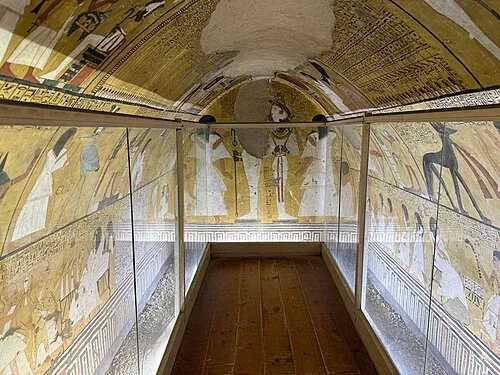 Tomb of Inherkhau (TT359)
Preserving the Painted Chambers Today
The painted chambers of Inherkhau's tomb are more than three thousand years old, and they are still open to visitors, but carefully. The paintings now sit behind protective glass screens, and the floor is a wooden walkway laid over the rock. The screens keep out breath, dust and touching hands while the tomb stays accessible. The setting itself does the rest of the shaping. These are steep, narrow chambers cut straight into the hillside, in a desert valley with little shade and real heat. The paintings were made on plaster laid over that living rock, which is part of why they need the protection. Everything about the visit, the dim light, the tight space, the screens, comes from keeping fragile Ramesside paint alive for the next visitors.
Listen in the appPhoto: Chabe01 · CC BY-SA 4.0
- 11
The Ptolemaic Temple of Hathor
A Ptolemaic temple on a shrine a thousand years older, and the village's own gods.
- 12
The Hathor Columns
Hathor's face on a column, and the women who served the village's shrines.
- 13
The Judgement Scene Relief
Judgement in stone: the dead weighed against truth before the enthroned god.
- 14
The Monastery of the Town: Closing the Story
Why the place is called a monastery, and how the story of the tomb builders ends.
Deir el-Medina
Frequently asked questions
How much does the guide cost?
Free app download. Listed guide price: $1.99. Guide price shown in the app. Audio guide only. Venue admission is separate.
Can I listen without internet?
Yes. Download the guide’s audio, images, and maps in the app before your visit. Your downloaded content is then available offline.
Can I listen in my language?
This audio guide is available in 15 languages, including English.
Do I need to follow a schedule?
No. This is a self-guided experience. Choose your stops, pause whenever you like, and return to a story at your own pace.
Deir el-Medina
The Stanza Journal
Travel tips
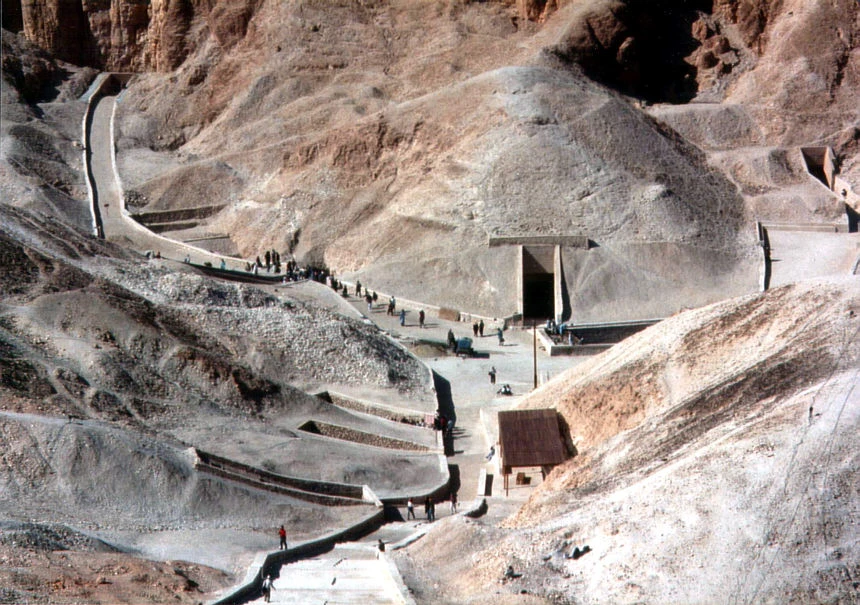
The Valley of the Kings and the Nile’s west bank at Luxor: how to plan the day
The royal tombs are the reason most people cross the Nile. Understand how the tickets work, pick one or two other sites, and leave room to look properly.Content & sources
Peter J. Bubenik (1995) · CC BY-SA 2.0 · Cropped
At your own pace
Explore Deir el-Medina.
Download Stanza, then search for “Deir el-Medina”.
Free app download · Guide price shown in the app
Keep exploring
Nearby audio guides
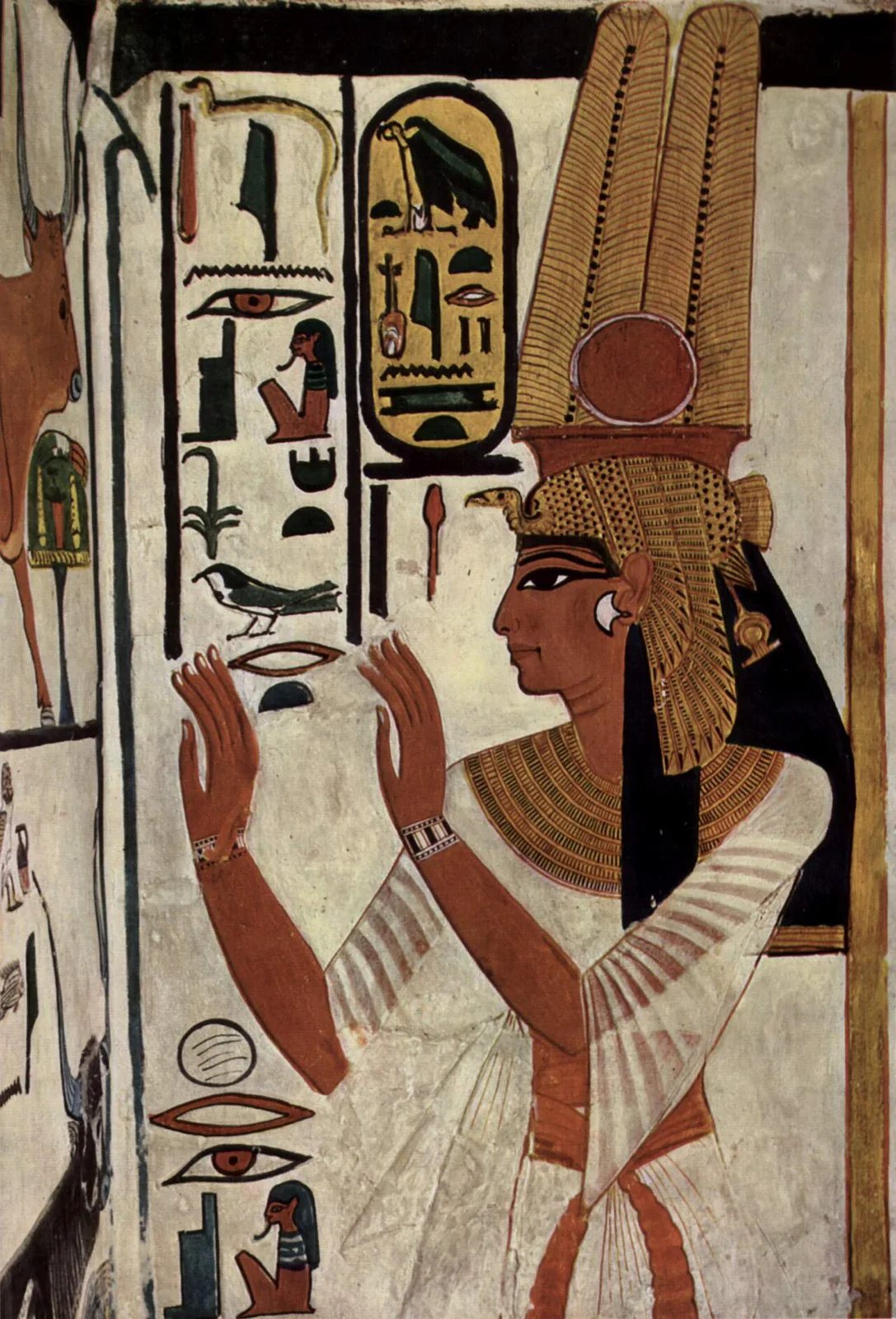
Al Baairat Village · 1 km
Tomb of Nefertari
Content & sources
Maler der Grabkammer der Nefertari · Public domain
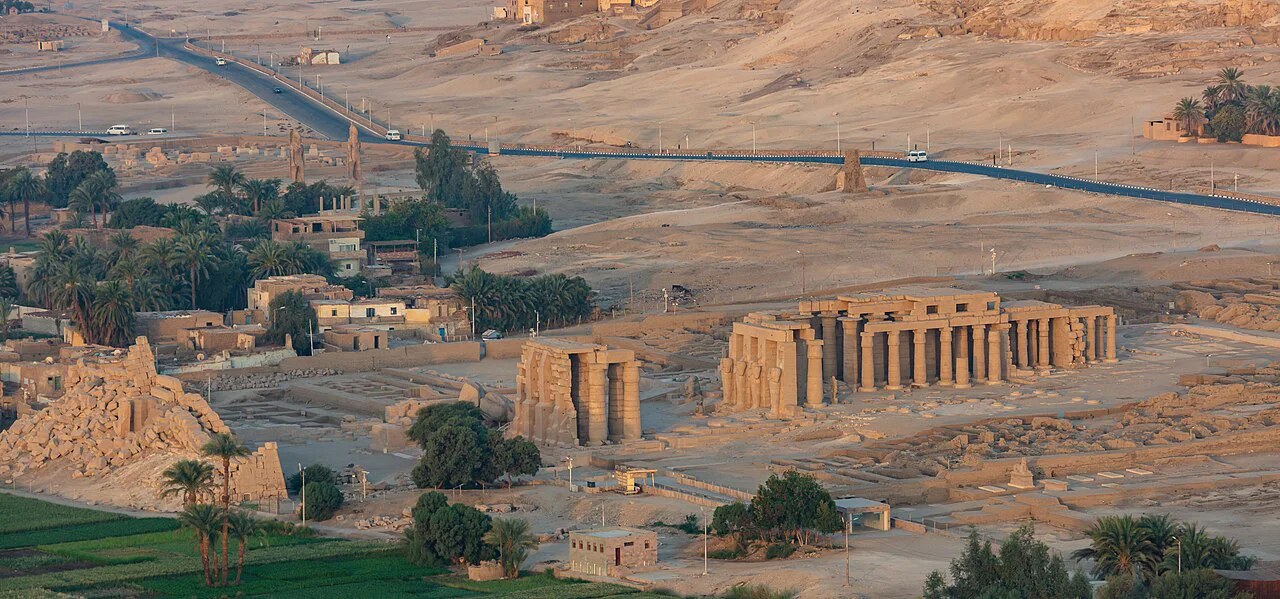
New Al Qarnh City · 1 km
Ramesseum
Content & sources
Diego Delso · CC BY-SA 4.0
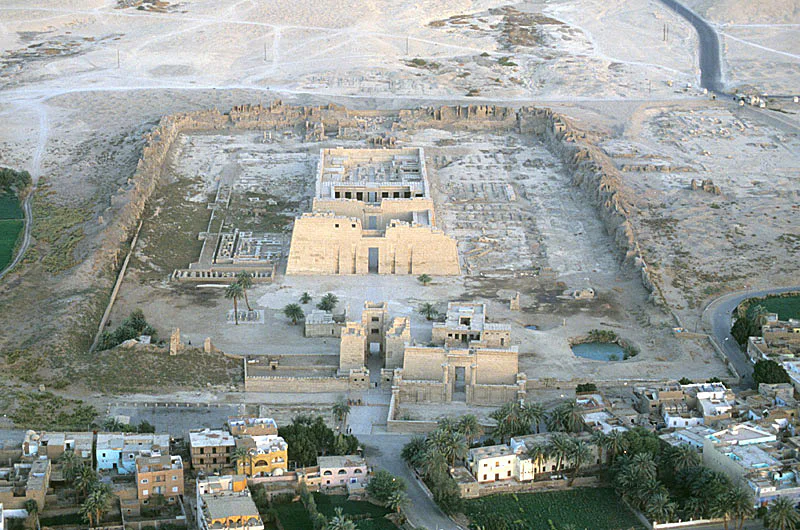
Al Baairat Village · 1 km
Mortuary Temple of Ramesses III
Content & sources
Roland Unger · CC BY-SA 3.0
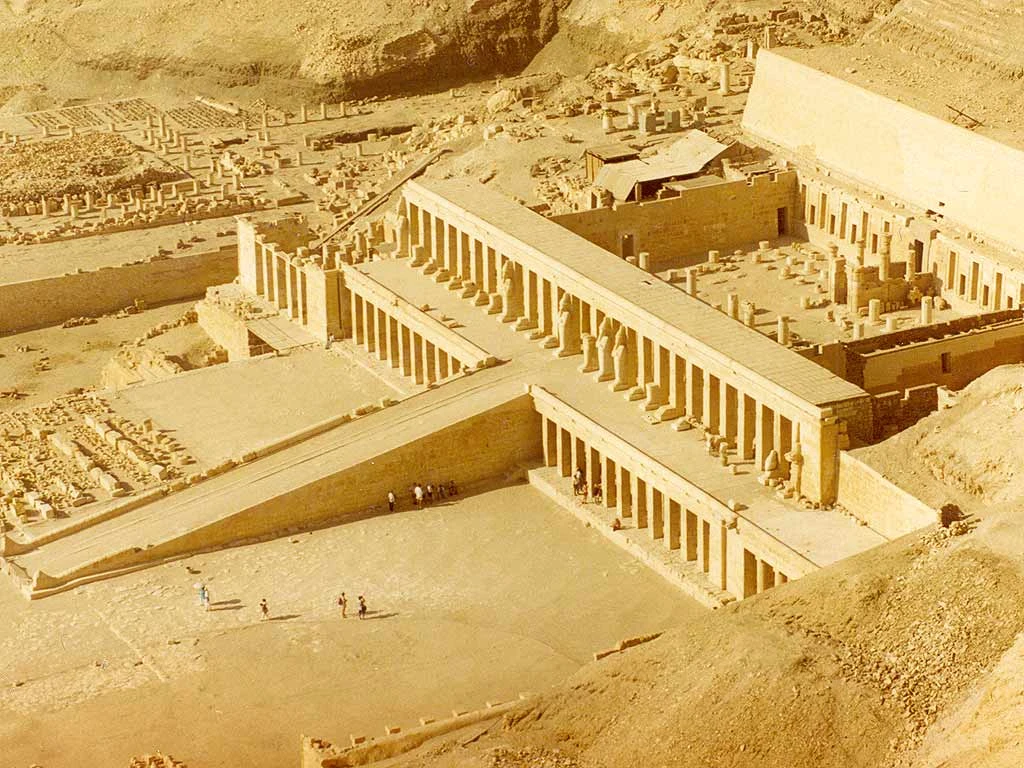
New Al Qarnh City · 1 km
Mortuary Temple of Hatshepsut
Content & sources
Ian Lloyd · CC BY-SA 3.0