Stanza · Audio guide
Ramesseum Audio Guide
A place to remember. A story to take with you.
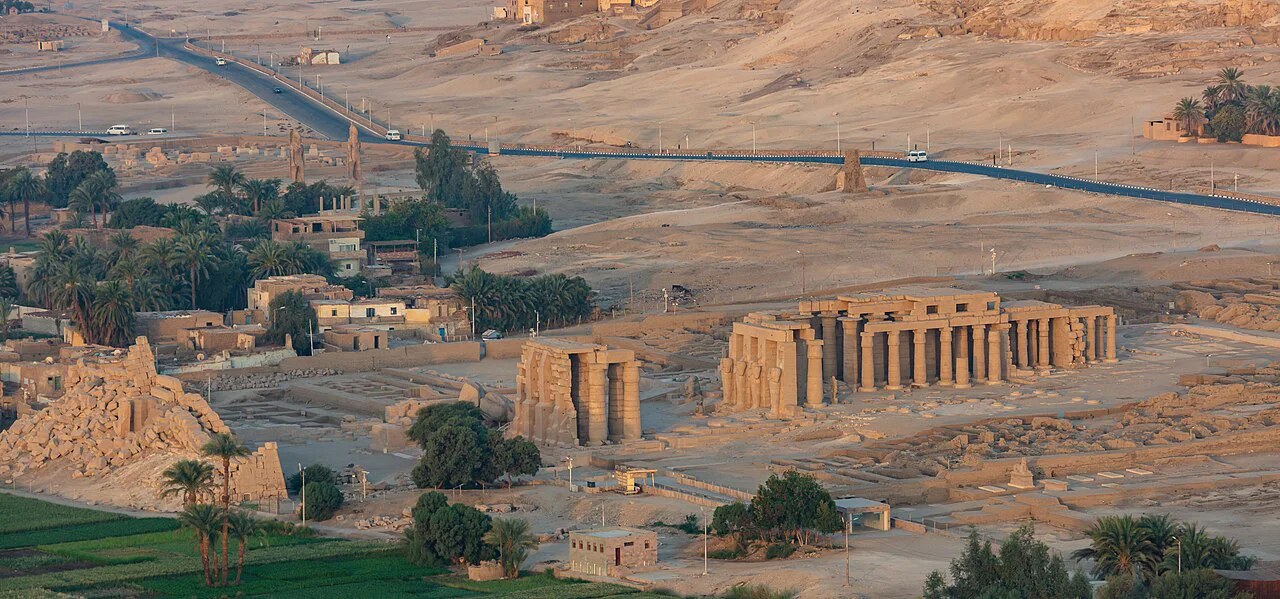
The Ramesseum is the memorial temple of Pharaoh Ramesses II. It is located in the Theban Necropolis in Upper Egypt, across from the modern city of Luxor.
Download Stanza, then search for “Ramesseum”.
About the tour
One guide. Your kind of visit.
The Ramesseum is the memorial temple of Pharaoh Ramesses II. It is located in the Theban Necropolis in Upper Egypt, across from the modern city of Luxor.
Ready when you are.
- 01Get the free Stanza app.
iOS & Android
- 02Find your guide.
“Ramesseum”
- 03Download before you go.
Works offline
Audio guide / 12 narrated stops
Inside the guide
Get to know a few of the stories before you go. Open a stop to read more.
01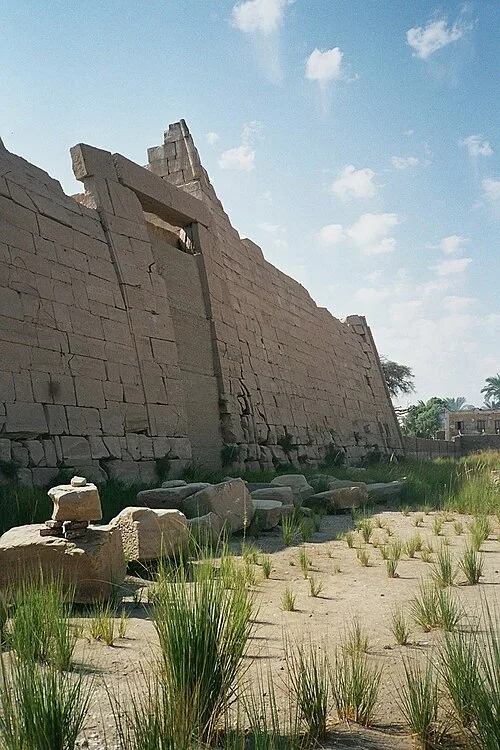 First Pylon & The Battle of Kadesh
The First Pylon: Entrance to a House of Millions of Years
Welcome to the Ramesseum, the memorial temple of Ramesses the Second on the west bank at Thebes. Its original name was grander still: the House of millions of years of Usermaatra-setepenra, that unites with Thebes-the-city in the domain of Amun. Usermaatra-setepenra was the throne name of Ramesses the Second. Work began shortly after he came to the throne and went on for twenty years. The temple was a place of worship dedicated to the pharaoh, a god on earth, where his memory would be kept alive after his death. The gateway ahead of you is one of two stone pylons, each about sixty metres wide. Beyond them lie courtyards, a great columned hall and the inner sanctuary, all in the standard pattern of a New Kingdom temple. What you see now is only a shadow of the original. The temple stands on the very edge of the Nile floodplain, and the annual inundation gradually undermined its foundations. Neglect and the arrival of new faiths took a further toll. In the early years of the Christian era, the temple even served as a Christian church.
Marion Golsteijn · CC BY-SA 3.0
02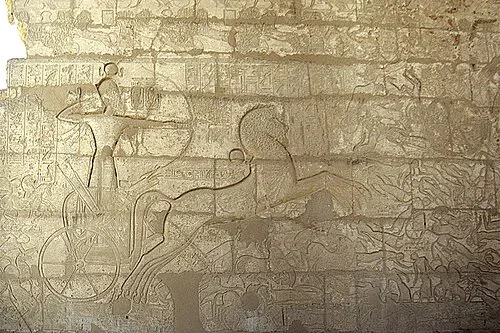 First Pylon & The Battle of Kadesh
Kadesh on the Pylon: The King's Battle in Stone
The carved walls of these pylons carried the pharaoh's military record for all to see. The great set piece here is the Battle of Kadesh, fought against the Hittites around 1274 BC. The relief shows Ramesses in his chariot, drawing his bow, while Hittite forces flee before the city. The scenes follow the canons of the epic poem of Pentaur, the official verse account of the battle. This was royal propaganda in the standard manner of New Kingdom temple walls, leaving due record of the king's victories and his kinship with the gods. One block atop the first pylon records something stranger. It shows the pillaging, in the eighth year of the reign, of a city called Shalem. Some have wondered whether that was Jerusalem, but the identification is uncertain.
Roland Unger · CC BY-SA 3.0
03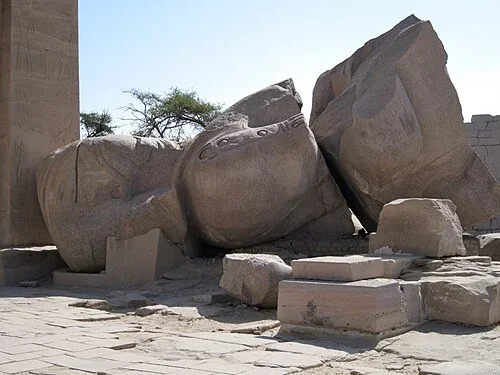 First Courtyard & The Fallen Colossus of Ozymandias
The Fallen Colossus
Only fragments remain of one of the largest colossal statues ever carved. The enthroned figure of the pharaoh was made of syenite, a stone close to granite, and is estimated to have weighed about a thousand tonnes. Standing, it would have risen somewhere between sixteen and nineteen metres. The block was hauled roughly two hundred and twenty kilometres from the quarry to this spot. The statue stood with a companion at the rear of the first courtyard, flanking the second pylon. The larger of the pair was called Sun of the princes and represented Ramesses himself. The smaller represented his mother, Tuya. What lies here now is the wreck of that giant, broken where it fell.
Listen in the appOlaf Tausch · CC BY 3.0
04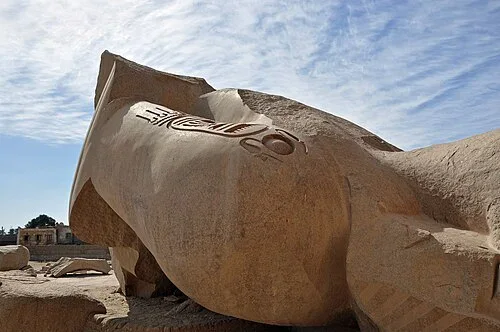 First Courtyard & The Fallen Colossus of Ozymandias
Ozymandias: The Cartouche and the Poem
On the shoulder of the fallen torso, a cartouche still carries the king's throne name: User-maat-re Setep-en-re. In the first century BC, the Greek writer Diodorus of Sicily visited Thebes and transliterated the first part of that name as Ozymandias. He took the whole temple for the Tomb of Ozymandias, and French engineers nearly two thousand years later made the same identification with much fanfare. In 1818, with London abuzz over the arrival of a colossal torso from this temple, Percy Bysshe Shelley wrote his sonnet. His vast and trunkless legs of stone owe more to poetic license than to archaeology. But the shattered visage, half sunk in the sand, describes this wrecked statue accurately. The hands and the feet lie nearby. And on the pedestal, the poem says, these words appear: My name is Ozymandias, King of Kings.
Listen in the appMarc Ryckaert · CC BY-SA 4.0
05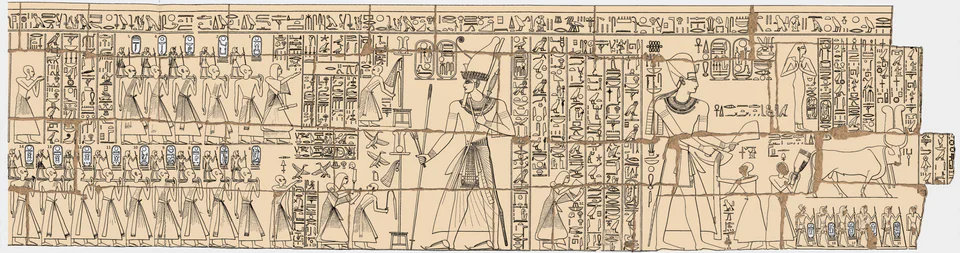 Second Pylon & The Ancestral King List
The King List: Ancestors Chosen and Erased
High on the second western pylon, a carved scene shows Ramesses honouring his ancestors at the festival of Min. Fourteen statues of ancestral kings are carried in procession, and a second procession is led by six kings, of whom five names survive. In all, nineteen cartouches hold the names of fourteen pharaohs. It is a curated history. Hatshepsut is missing, and so are the Amarna pharaohs. The list also records fewer kings than the one Ramesses had carved at Abydos. The scene was first published by Jean-François Champollion in 1845, and by Karl Richard Lepsius four years later. Ramesses the Third later copied the design at Medinet Habu, though his version listed only nine pharaohs.
Listen in the appPhoto: PLstrom · CC BY-SA 4.0
06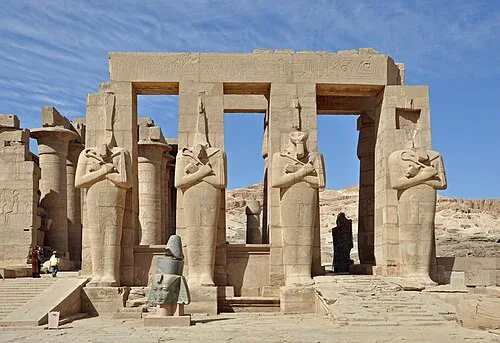 Second Courtyard & Osiride Portico
The Second Courtyard and the Osiride Portico
The second courtyard was once the ceremonial heart of the temple, and a few surviving pillars give an idea of its original grandeur. These are Osiride pillars: the king shown standing with arms crossed, holding the crook and flail, in the form of the god Osiris. For a memorial temple built to keep a dead king's cult alive, the image fit perfectly. The walls repeated the rout of the Hittites at Kadesh, the same story told on the outer pylons. In the upper registers runs a feast in honour of Min, the phallic god of fertility. It is the same festival at which the ancestral procession on the pylon took place, a ceremony binding the living king to the dead ones.
Listen in the appMarc Ryckaert · CC BY 3.0
07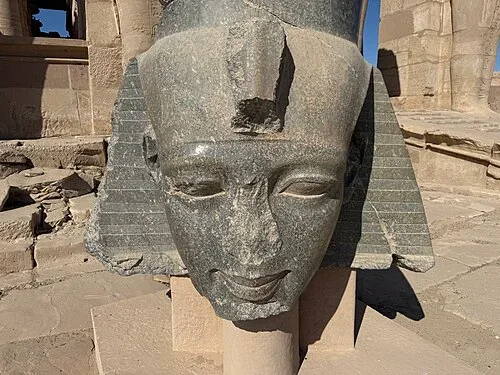 Second Courtyard & Osiride Portico
The Granite Head and the Younger Memnon
Scattered in the court lie the remains of two seated colossi that once flanked the temple entrance, one in pink granite and one in black. The head of one of them was removed to the British Museum. In 1815 the Italian showman and engineer Giovanni Belzoni reached Cairo, where he met the British Consul General Henry Salt. Salt hired him to collect the so-called Younger Memnon, the torso of one of these granite statues, and take it to England. Napoleon's men had failed at the same task a decade or so earlier. Belzoni's hydraulics and engineering skill succeeded. The seven-ton torso reached London in 1818, was dubbed the Younger Memnon, and some years later was given pride of place in the British Museum.
Listen in the appPhoto: Chabe01 · CC BY-SA 4.0
08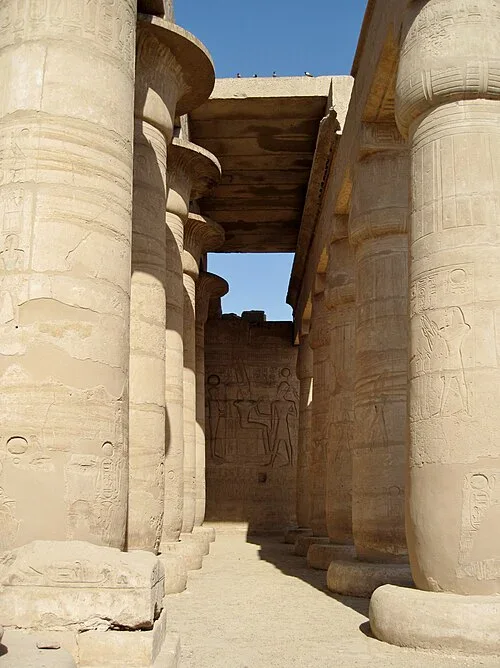 The Great Hypostyle Hall
At the centre of the complex, past the second courtyard, stood a covered hall of forty-eight monumental columns. It measured about forty-one by thirty-one metres and surrounded the inner sanctuary, the ritual core of the whole temple. Thirty-nine of those columns still stand in the central rows. The design follows the standard canons of New Kingdom temple architecture, cast in the same mould as the great temples of Ramesses's neighbours and successors. The ground here held a secret older than the temple itself. Beneath the hall, archaeologists found a shaft tomb from the Middle Kingdom, yielding a rich hoard of religious and funerary artefacts. The site was in use long before Ramesses had his first stone put in place.
Listen in the appOlaf Tausch · CC BY 3.0
09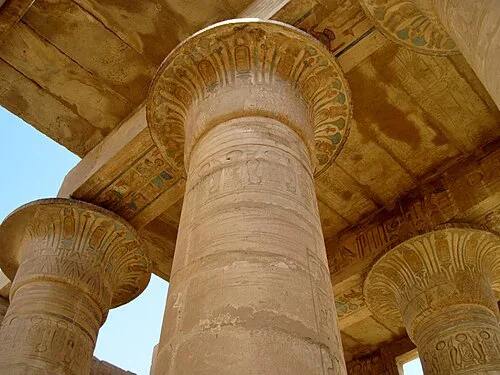 The Great Hypostyle Hall
Under the Painted Sky: Columns and Ceiling
The columns carry the usual scenes of the king standing before various gods, carved and once brightly painted. Part of the ceiling has survived, and it changes how the hall must have looked. It is decorated with gold stars on a blue ground, a ceiling made to evoke the night sky. Overhead, the king stood eternally among the gods, under a painted heaven. On the few walls that remain, the sons and daughters of Ramesses appear in procession, the royal family marching through the ritual world their father built. What has fallen away was once the same: colour, gold and gods on every surface.
Listen in the appOlaf Tausch · CC BY 3.0
10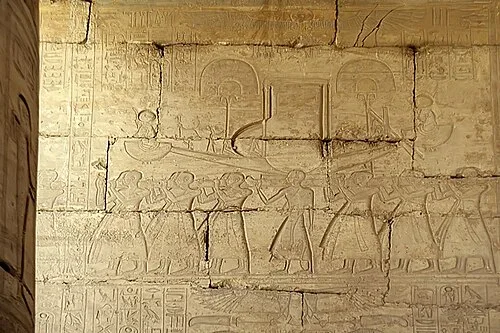 Inner Sanctuary & Sacred Barque Relinquary
The Inner Sanctuary
A carved relief shows figures carrying a sacred barque, the boat in which a god's cult image travelled during Theban festivals. This was the destination such processions aimed for: the inner sanctuary, composed of three consecutive rooms with eight columns and a four-columned chamber at its heart. The ceiling of the first room was decorated with astral scenes, matching the starry sky of the great hall. Of the second room only a few remains are left. In a memorial temple, rituals like these had a purpose beyond the god's visit. They sustained the cult of the dead king, feeding his memory and his spirit, year after year, for millions of years.
Listen in the appRoland Unger · CC BY-SA 3.0
- 11
The Mudbrick Granaries: The Oldest Arches in Egypt
Behind the temple: mudbrick vaults that are the oldest true arches still standing in Egypt.
- 12
A Working Temple: Stores, Kitchens and Scribes
Kitchens, bakeries and a school for scribes: the temple as a living institution.
Ramesseum
Frequently asked questions
How much does the guide cost?
Free app download. Listed guide price: $1.99. Guide price shown in the app. Audio guide only. Venue admission is separate.
Can I listen without internet?
Yes. Download the guide’s audio, images, and maps in the app before your visit. Your downloaded content is then available offline.
Can I listen in my language?
This audio guide is available in 15 languages, including English.
Do I need to follow a schedule?
No. This is a self-guided experience. Choose your stops, pause whenever you like, and return to a story at your own pace.
Ramesseum
The Stanza Journal
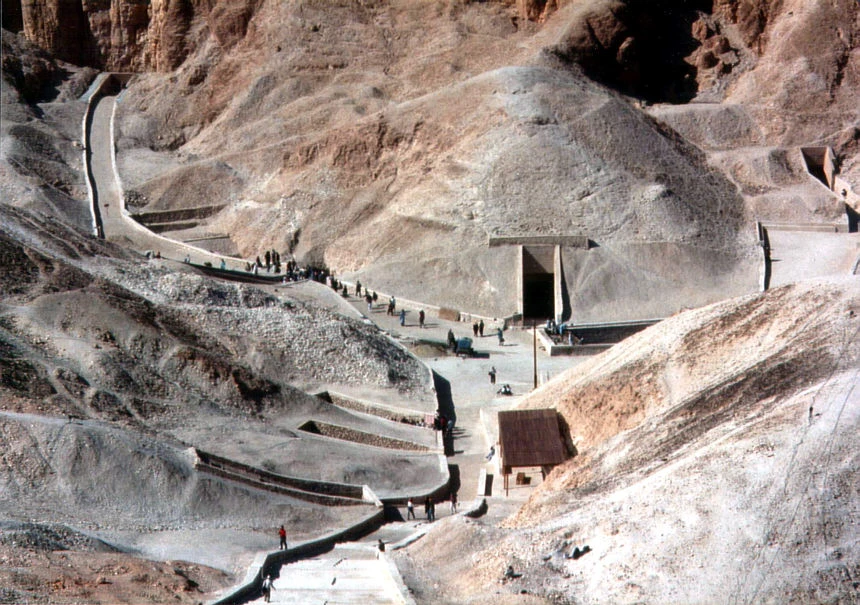
Travel tips
The Valley of the Kings and the Nile’s west bank at Luxor: how to plan the day
The royal tombs are the reason most people cross the Nile. Understand how the tickets work, pick one or two other sites, and leave room to look properly.Content & sources
Peter J. Bubenik (1995) · CC BY-SA 2.0 · Cropped
At your own pace
Explore Ramesseum.
Download Stanza, then search for “Ramesseum”.
Free app download · Guide price shown in the app
Keep exploring
Nearby audio guides
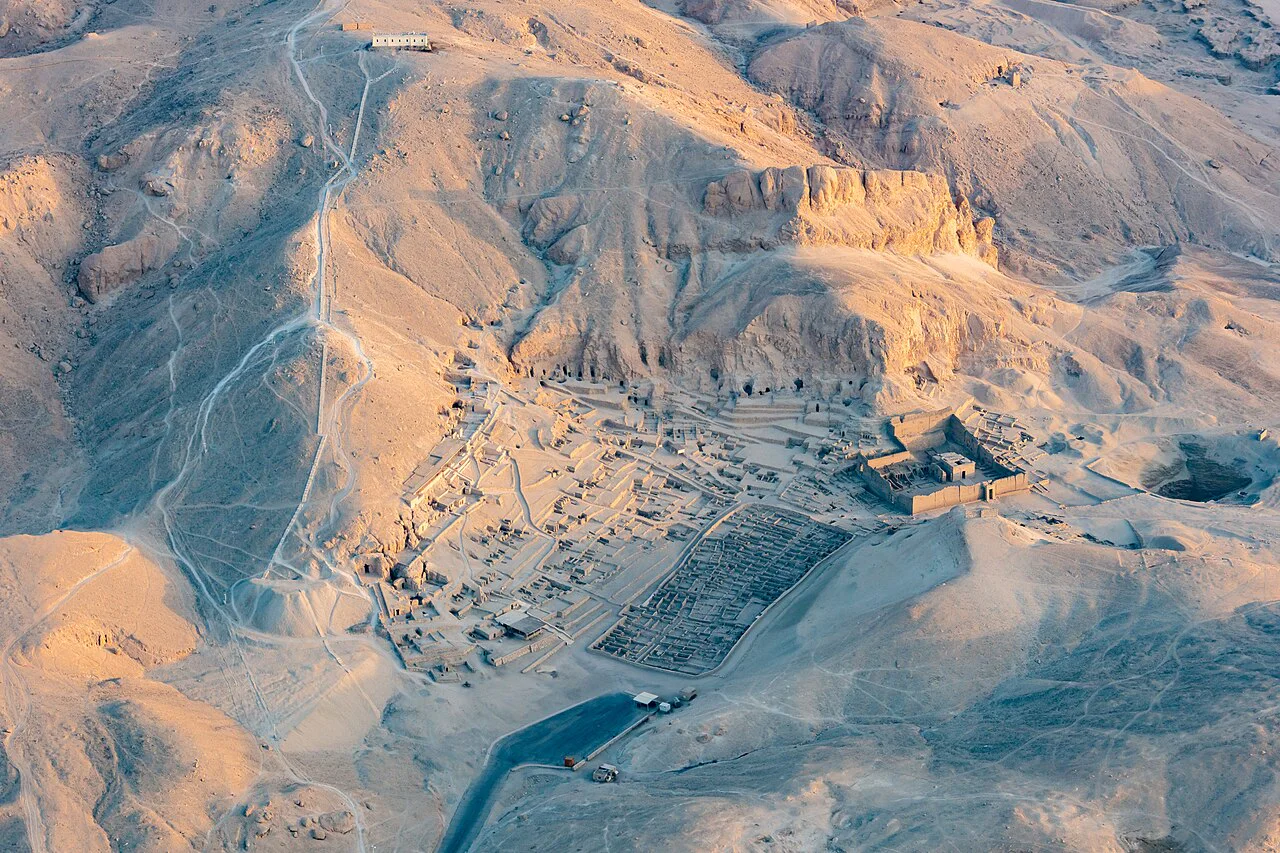
Al Baairat Village · 1 km
Deir el-Medina
Content & sources
Diego Delso · CC BY-SA 4.0
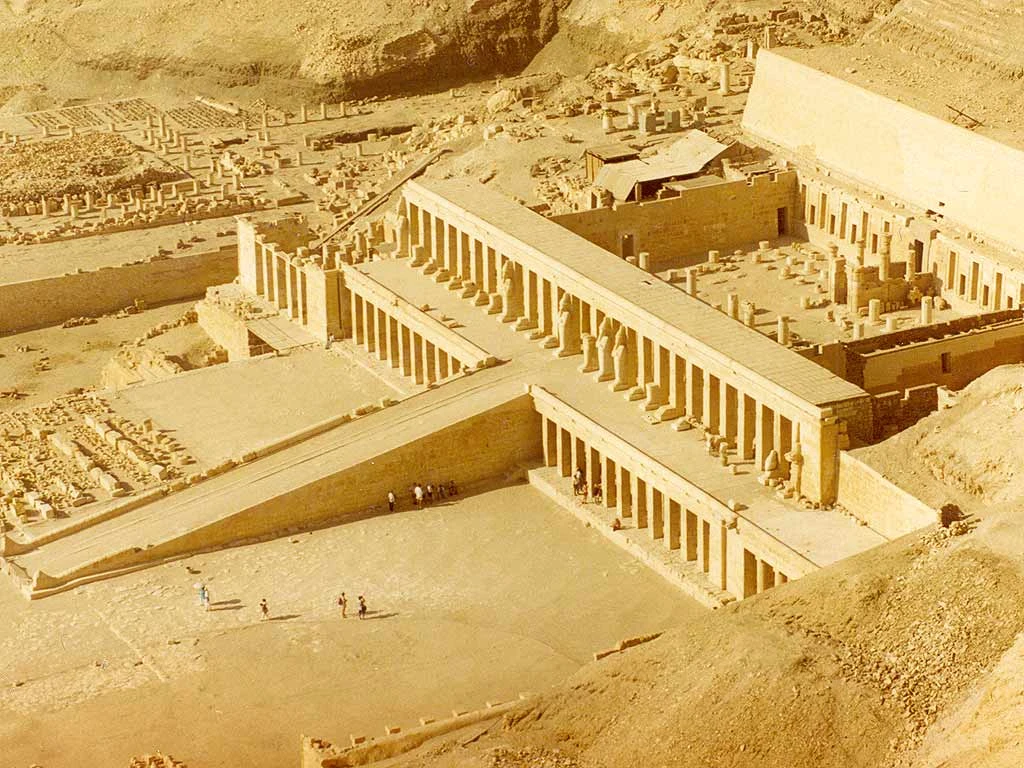
New Al Qarnh City · 1 km
Mortuary Temple of Hatshepsut
Content & sources
Ian Lloyd · CC BY-SA 3.0
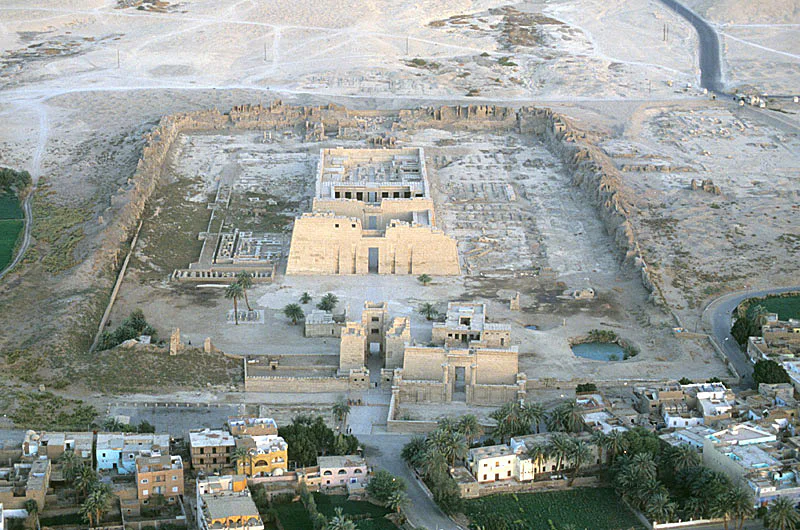
Al Baairat Village · 1 km
Mortuary Temple of Ramesses III
Content & sources
Roland Unger · CC BY-SA 3.0
Luxor · 2 km
Valley of the Kings
Content & sources
Fotograf/Photographer: Peter J. Bubenik (1995) · CC BY-SA 2.0