Stanza · Audio guide
Abydos, Egypt Audio Guide
A place to remember. A story to take with you.
Abydos was one of the oldest cities of ancient Egypt. It is located about 11 kilometres west of the Nile in Upper Egypt.
Download Stanza, then search for “Abydos, Egypt”.
About the tour
One guide. Your kind of visit.
Abydos was one of the oldest cities of ancient Egypt. It is located about 11 kilometres west of the Nile in Upper Egypt.
Ready when you are.
- 01Get the free Stanza app.
iOS & Android
- 02Find your guide.
“Abydos, Egypt”
- 03Download before you go.
Works offline
Audio guide / 20 narrated stops
Inside the guide
Get to know a few of the stories before you go. Open a stop to read more.
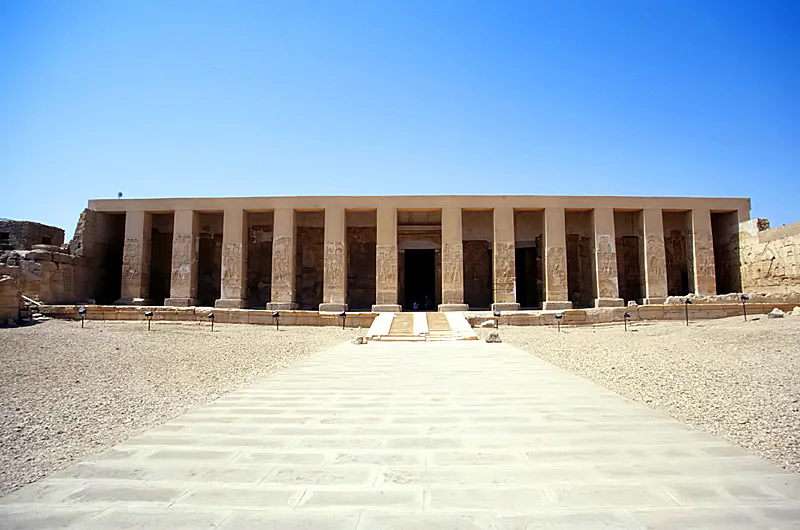
01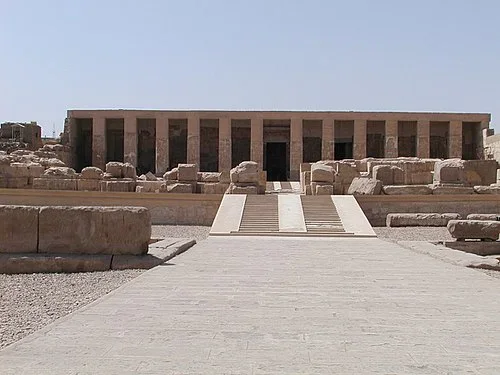 Temple of Seti I
: The Great Temple of Abydos
Abydos is one of the oldest cities of ancient Egypt, and among its holiest. The earliest pharaohs were buried in its desert, and in later centuries the city became Egypt's great centre for the worship of Osiris, lord of the dead. The temple before you is the memorial temple of Seti I, a king of the Nineteenth Dynasty. He raised it on entirely new ground, half a mile south of the long line of older temples. His son Ramesses II finished the work after him. Its principal purpose was to serve as a memorial to Seti himself, and to show reverence for the early pharaohs through what the Egyptians called the Rite of the Ancestors. The colonnaded facade and the wide forecourt still read clearly from this angle. When new, the temple ran about a hundred and seventy metres from end to end. The part preserved in good condition is far shorter, though it still held seven chapels for the worship of the pharaoh and the principal deities. Behind the temple lies an enigmatic subterranean structure known as the Osireion, built as a cenotaph for Seti.
Photo: Néfermaât · CC BY-SA 2.5
02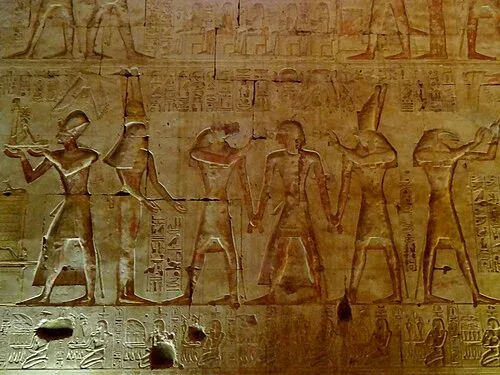 Temple of Seti I
Seti I Reliefs: The Art of the Ancestors
The reliefs of this temple are counted among the finest carvings of Egypt's New Kingdom. They are raised relief, cut with unusual delicacy into fine limestone, and large areas of the original paint survive. In the scene a row of painted figures moves along the wall, several wearing the tall white crown, with bands of hieroglyphs running above them. The style is deliberately double. It borrows the archaism of Egypt's earliest dynasties and joins it to the vibrancy of late Eighteenth Dynasty work. That combination of old and new is what gives these walls their particular refinement. Recording them took generations of scholars. Auguste Mariette published the sculptures mostly as hand copies, not facsimiles, in the first volume of his Abydos. Later, Amice Calverley and Myrtle Broome recorded the temple epigraphically in four volumes, The Temple of King Sethos I at Abydos, which appeared between 1933 and 1958. Their copies remain a standard record of these walls.
Olaf Tausch · CC BY 3.0
03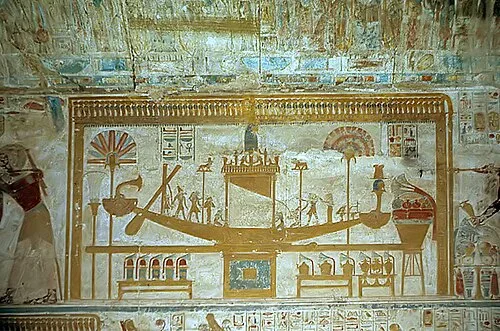 Temple of Seti I
The Osiris Bark and the Seven Chapels
The seven chapels stand at the heart of this temple. Three belonged to the state gods: Ptah, Re-Horakhty, and Amun, who was given the central position. The others served the deified Seti himself and the Abydos triad of Osiris, Isis and Horus. The rites recorded in these chapel walls are the first complete form known of the Daily Ritual, the sequence later performed each day in temples across Egypt throughout the pharaonic period. The painted scene here shows the sacred barque of Osiris, the ceremonial boat that carried the god, with its shrine, standards and fans rendered in colour. Almost everything carved in this temple is religious in nature, devoted to the transformation of the king after his death. Only the list of pharaohs and a panegyric on Ramesses II break from that pattern. The temple was, at its core, a machine for one man's passage into the afterlife.
Listen in the appRoland Unger · CC BY-SA 3.0
04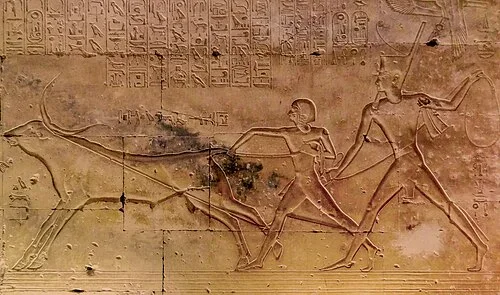 Temple of Seti I
The Wild Bull Hunt: Chaos Tamed in Stone
A wild bull surges along the wall, head lowered, while two men strain against the rope that holds it. Above them runs a crisp band of hieroglyphs, and the modelling of the figures in the limestone is sharp enough to show the tension in every limb. Scenes like this belong to a long tradition in New Kingdom art. The hunt for wild, untamable animals served as an image of royal and cosmic order, chaos brought to heel by the king's power. Whatever its exact meaning here, the craft is plain to see. The raised carving catches muscle, rope and movement with a precision that has kept this corridor scene vivid after three thousand years.
Listen in the appOlaf Tausch · CC BY 3.0
05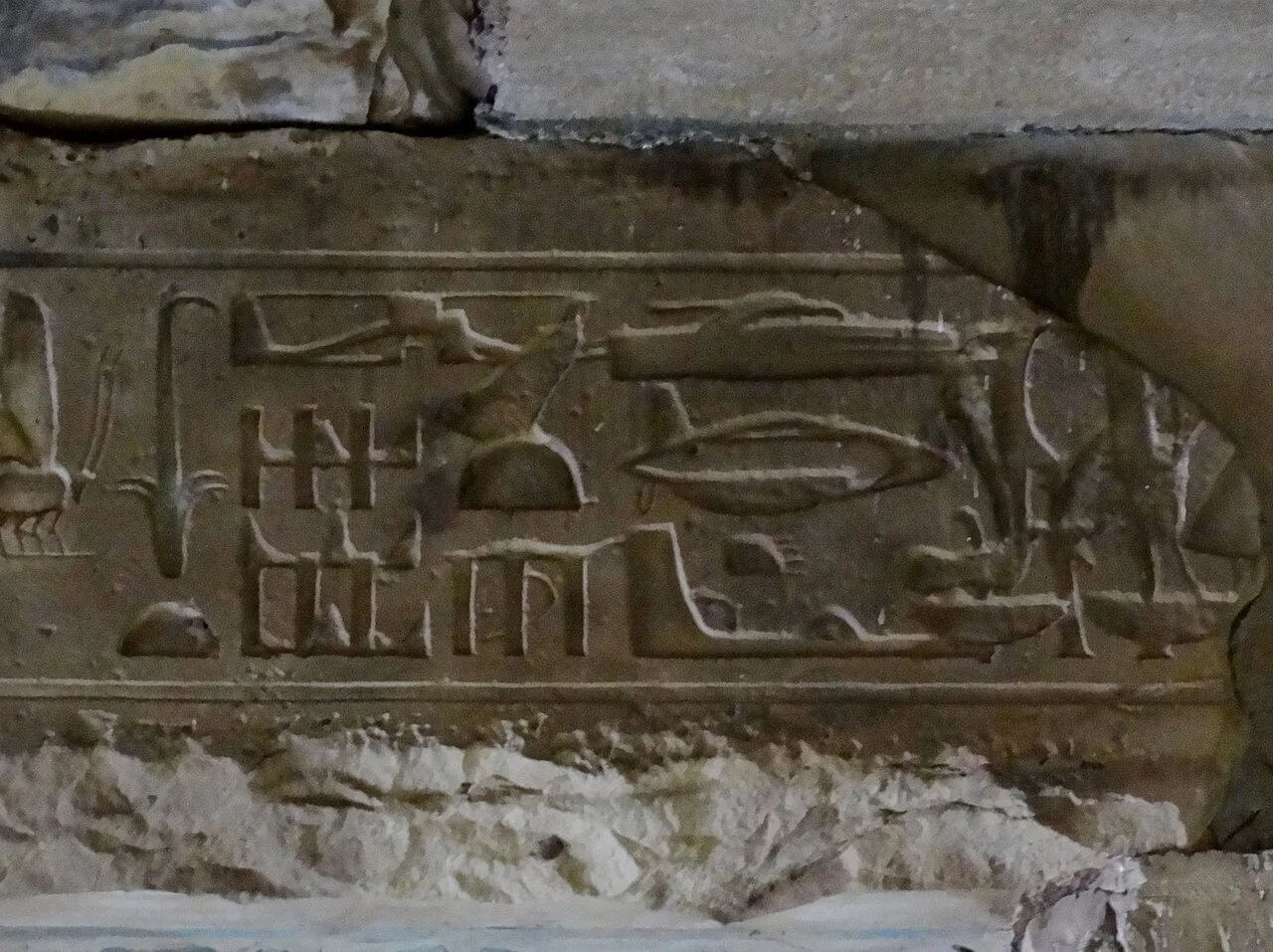 Helicopter Hieroglyphs
The Helicopter Hieroglyphs: A Palimpsest Explained
Overhead on this architrave, one panel of hieroglyphs has made this temple famous far beyond Egyptology. In some lighting, the overlapping signs seem to show a helicopter, a submarine, and a zeppelin or plane. Writers in esoteric and ufological circles have taken the shapes as depictions of modern technology, and the image has circulated widely. Egyptologists read it differently, and the carving itself tells the story. Seti I first had an inscription cut here that translates as 'He who repulses the nine enemies of Egypt'. Later, the signs were filled in with plaster and re-carved under his son Ramesses II with a new title, 'He who protects Egypt and overthrows the foreign countries'. Over the centuries the plaster has eroded away. Both inscriptions are now partially visible at once, overlapping into palimpsest-like shapes. The helicopter is two royal titles, superimposed.
Listen in the appOlaf Tausch · CC BY 3.0
06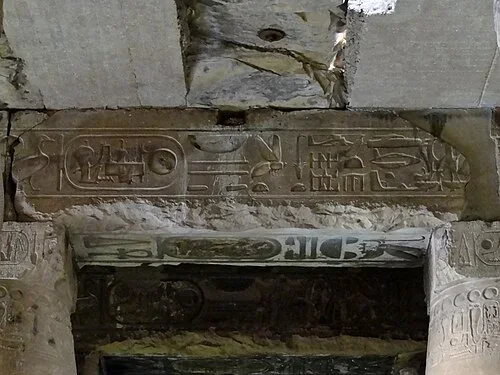 Helicopter Hieroglyphs
Reading the Architrave Again
The same architrave, seen from a second angle, rewards a slow look. The cartouches, the oval rings that hold royal names, are the place to begin. Within them the outlines of modified signs double and shift, the older carving and the later one sitting slightly out of register with each other. Once the eye finds that mismatch, the layered history of the stone becomes visible rather than abstract. This kind of reworking is one reason the temple's walls repay close attention. Ancient visitors left their marks here too. The building carries ancient Phoenician and Aramaic graffiti, known to scholars as the Abydos graffiti, scratched onto its walls long after the pharaohs were gone.
Listen in the appOlaf Tausch · CC BY 3.0
07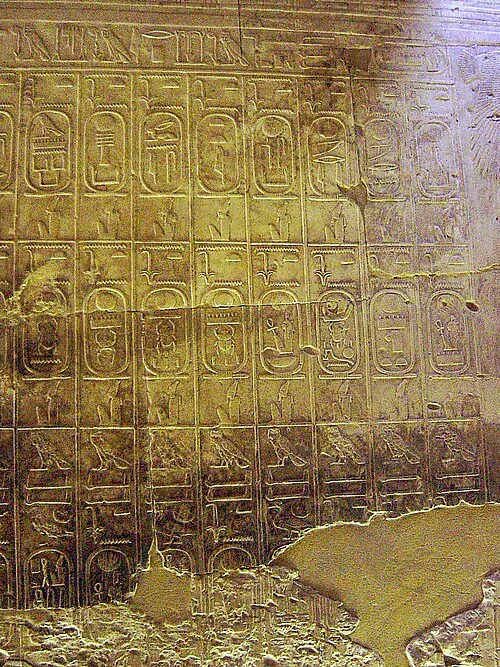 Abydos King List
The Abydos King List: Seti I and the Ancestor Canon
On this wall, Seti I and the crown prince Ramesses appear in low relief, making offerings to a long roll of their predecessors. This is the Gallery of Ancestors, and its inscription is known to the modern world as the Abydos King List. Seventy-six cartouches run in rows, naming the dynastic pharaohs of Egypt from Menes, the first king, down to Ramesses I, Seti's own father. The message was one of an unbroken royal line, asserted after the upheavals of the Amarna period. But the line was curated. The Hyksos rulers of the Fifteenth Dynasty were left out, and so was Akhenaten, the Eighteenth Dynasty heretic. Rulers may have been excluded from the official canon because they were associated with periods of internal weakness and division. For modern Egyptology the list became foundational. It remains one of the key documents for working out the order and chronology of Egypt's kings.
Listen in the appPhoto: JMCC1 · Public domain
08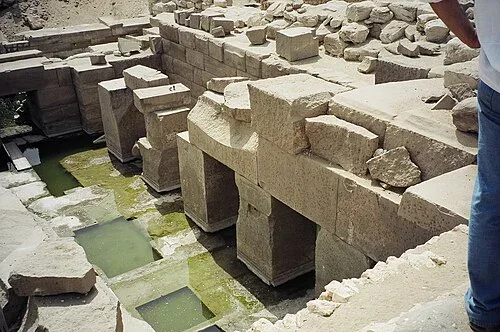 Osireion
The Osireion: An Island in the Primordial Waters
Behind the temple of Seti I, half buried in the ground, lies one of the strangest buildings in Egypt. The Osireion was an integral part of Seti's funerary complex, and it served as a cenotaph for Seti-Osiris, the king identified with the god. Its very name carries that dedication: 'Menmaatre beneficial to Osiris', after one of Seti's royal names. The builders shaped it to resemble an Eighteenth Dynasty tomb in the Valley of the Kings, then went further. Massive unadorned granite pillars and lintels ring a sunken central platform, with a deep channel cut around it. The design evokes the primeval mound rising from the waters that existed before creation. It is thought to have been connected with the worship of Osiris as an 'Osiris tomb'. The contrast with the temple in front is deliberate. There, fine limestone and delicate painted relief. Here, bare stone, darkness and water.
Listen in the appNo machine-readable author provided. RsAzevedo assumed (based on copyright claims). · CC BY-SA 3.0
09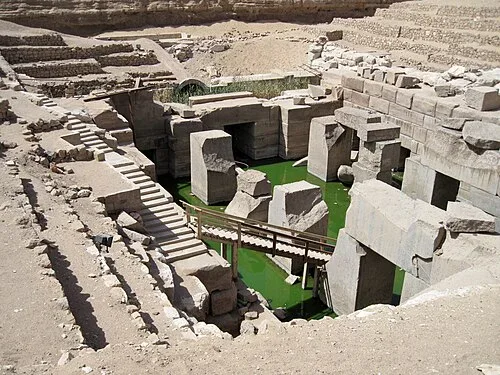 Osireion
The Osireion: Rituals of Resurrection and Rising Water
The Osireion may have seen ritual use of a very particular kind. There are signs it was connected with the growing of barley, which allowed a symbolic representation of the resurrection of Osiris, the god who died and rose again. It is also possible that a great hypogeum, an underground hall for the celebration of the Osiris mysteries, was built from these chambers under Seti's grandson Merenptah. Both remain possibilities rather than certainties. Osiris drew pilgrims to Abydos for centuries, and this sunken building sat at the heart of that devotion. Time has had the last word. Because of the Aswan Dam and rising floodwaters, parts of the Osireion now stand in water, the green channels visible between the granite piers, and the rear of the structure can only be viewed from an elevated ledge.
Listen in the appOlaf Tausch · CC BY 3.0
10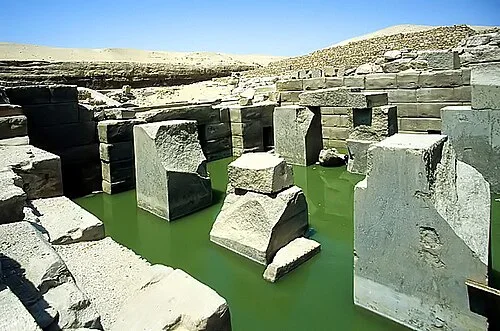 Osireion
The Osireion from the Northwest: Engineering in Granite
Seen from the northwest, the Osireion reveals itself above all as a feat of engineering. The granite piers rise in single massive blocks, some taller than a person, with lintels of matching scale laid across them. The walls around the hall are built just as heavily, and a stepped trench runs down toward the sunken centre.
Listen in the appRoland Unger · CC BY-SA 3.0
- 11
Temple of Ramesses II: The Son's Own Temple
Ramesses II built a smaller temple of his own north of his father's, and his version of the king list ended up in London.
- 12
Gateway into the Ramesses II Temple
A carved doorway with a winged sun disc, traces of paint, and a dark passage beyond.
- 13
Painted Processional Reliefs of Ramesses II
Processional figures in red, yellow and blue, among the best preserved colour at Abydos.
- 14
Shunet el-Zebib: Fortress of Eternity
A colossal mudbrick enclosure long mistaken for a fort, with heaps of ancient offering pots beside it.
- 15
Shunet el-Zebib: The Mudbrick Wall Up Close
Sun-dried mudbrick and niched panelling, standing in open desert for some 4,700 years.
- 16
The Great Osiris Temple: Pilgrims of the Resurrection
How the local jackal god merged with Osiris, and why every Egyptian hoped to reach Abydos.
- 17
Kom el-Sultan: Where the Town Lived
The settlement mound of ancient Abydos, and the town that now buries what is left of it.
- 18
Umm el-Qa'ab: Mother of Pots
The desert valley where pilgrims left millions of pots, and the tomb that became the grave of a god.
- 19
The First Dynasty Cemetery from Above
The First Dynasty royal cemetery on a labelled plan: first kings, growing tombs, and the retainers buried beside them.
- 20
The Pyramid of Ahmose: Abydos Reborn and Fading
The only pyramid in the area, the workers' town of Wah-Sut, and the long silence that followed.
Abydos, Egypt
Frequently asked questions
How much does the guide cost?
Free app download. Listed guide price: $3.99. Guide price shown in the app. Audio guide only. Venue admission is separate.
Can I listen without internet?
Yes. Download the guide’s audio, images, and maps in the app before your visit. Your downloaded content is then available offline.
Can I listen in my language?
This audio guide is available in 15 languages, including English.
Do I need to follow a schedule?
No. This is a self-guided experience. Choose your stops, pause whenever you like, and return to a story at your own pace.
At your own pace
Explore Abydos, Egypt.
Download Stanza, then search for “Abydos, Egypt”.
Free app download · Guide price shown in the app
Keep exploring
Nearby audio guides
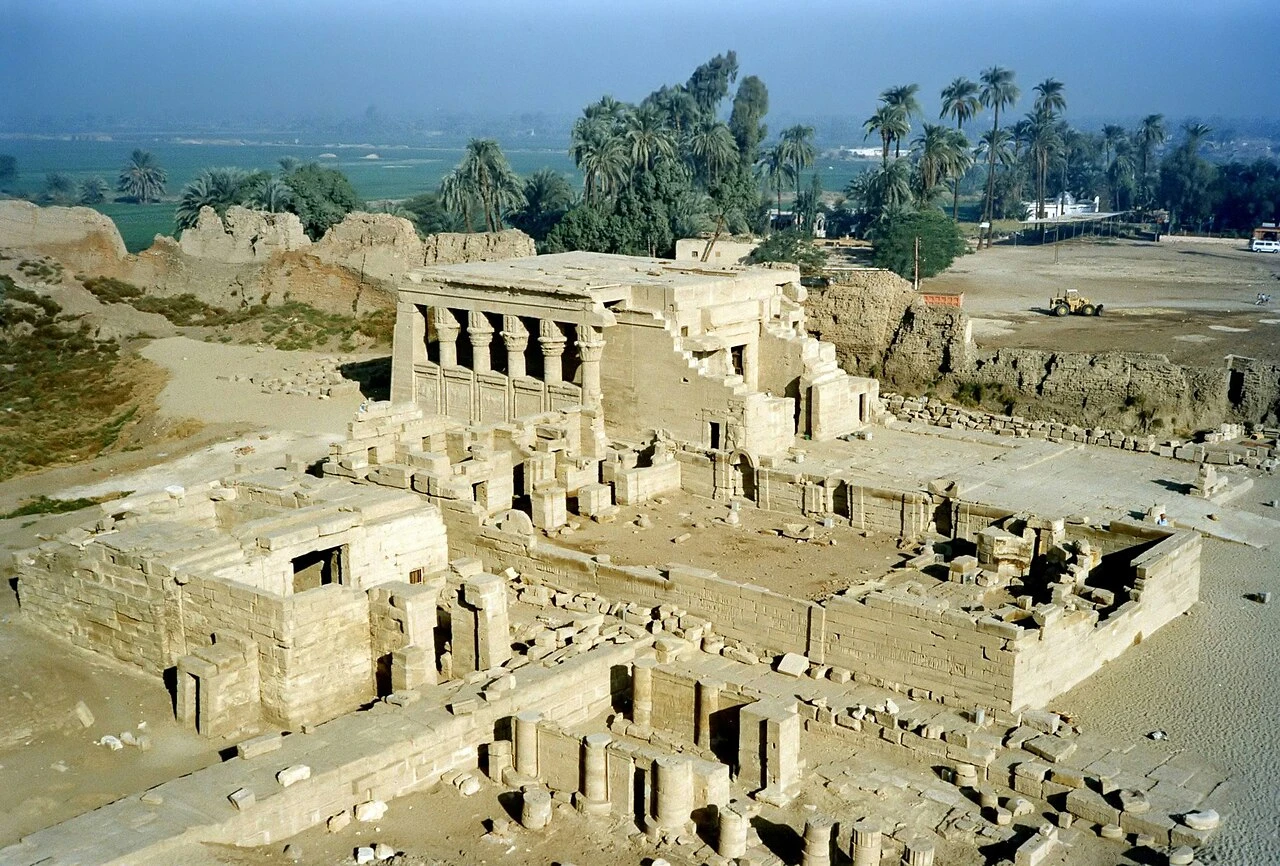
Dendera · 75 km
Dendera Temple complex
Content & sources
Bernard Gagnon · CC BY-SA 3.0
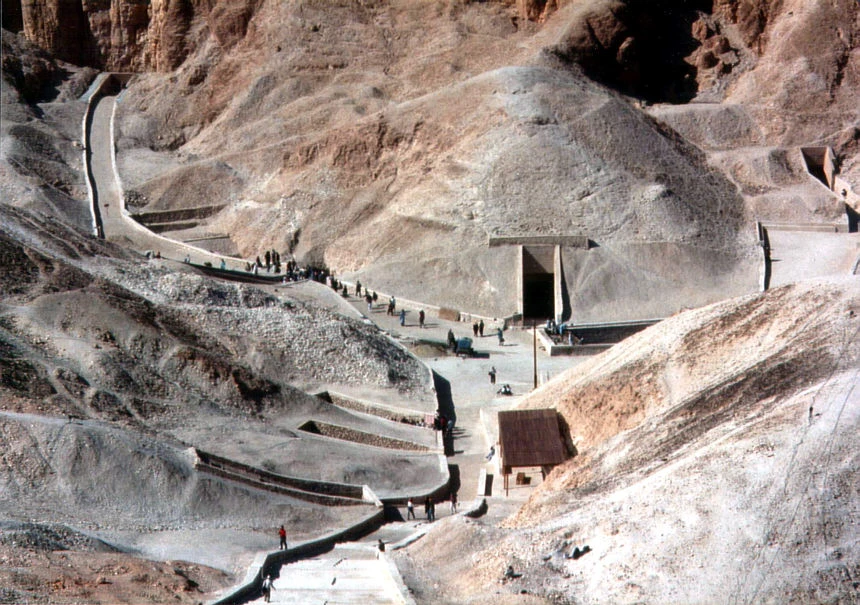
Luxor · 84 km
Valley of the Kings
Content & sources
Fotograf/Photographer: Peter J. Bubenik (1995) · CC BY-SA 2.0
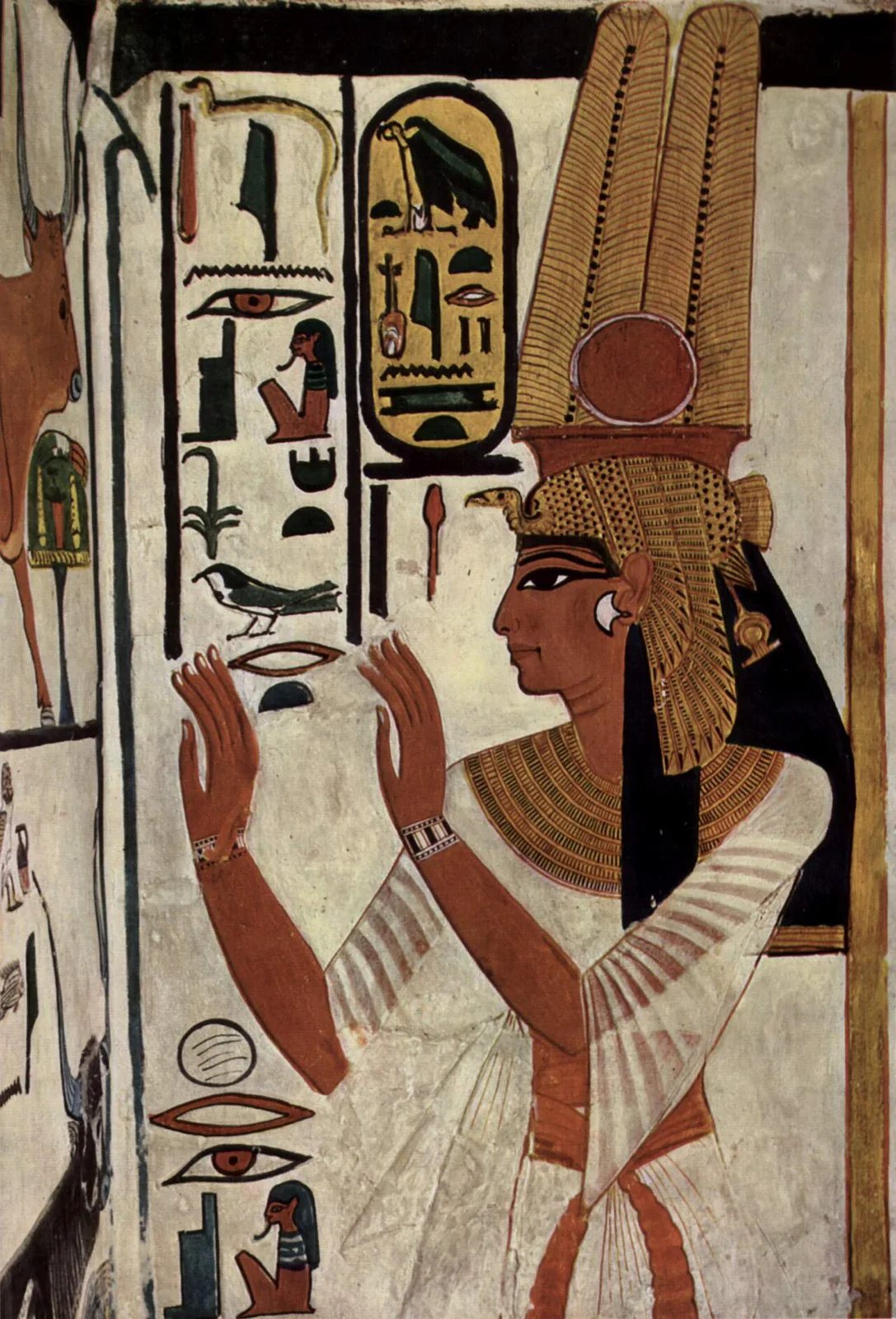
Al Baairat Village · 84 km
Tomb of Nefertari
Content & sources
Maler der Grabkammer der Nefertari · Public domain
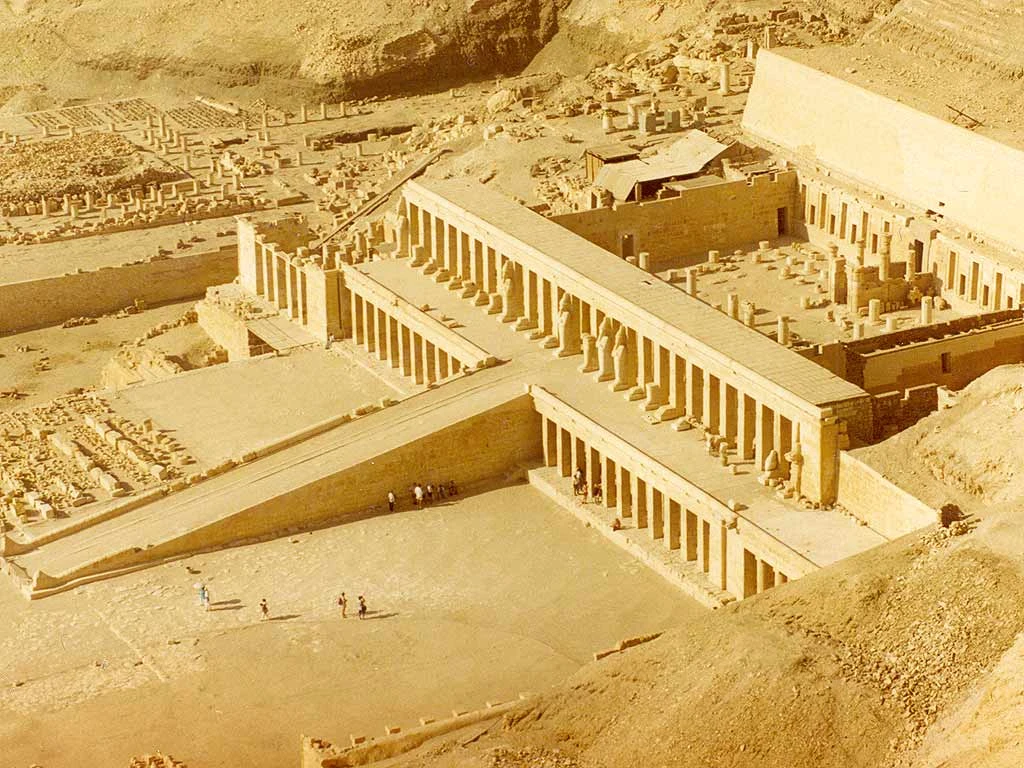
New Al Qarnh City · 85 km
Mortuary Temple of Hatshepsut
Content & sources
Ian Lloyd · CC BY-SA 3.0